A founder in Seattle is about to launch a software product. The app has a memorable name, a logo the team loves, and a feature that competitors don't have. The pressure usually lands on one question at the worst possible time: what exactly needs protection first?
That's where many startups lose ground. They treat trademark, copyright, and patent as interchangeable labels for “legal protection,” then file the wrong thing, file too late, or protect only one layer of a product that really needs three. The result isn't abstract. It can mean a brand conflict after launch, copied code with weak enforcement posture, or a core technical advantage left exposed.
The confusion is common for a reason. Trademark protects market identity. Copyright protects expression. Patent protects functional innovation. Those lines sound simple until a single product contains all three.
That's also why “trademark vs copyright vs patent” is the wrong question for many tech companies. A better question is how to use each right where it applies. That matters even more for startups moving fast, raising capital, signing contractors, and building with AI tools.
Your Startup Has an Idea a Brand and a Product Now What
A typical early-stage product has at least three separate assets hiding inside one launch plan. There's the name customers will remember. There's the software code, design copy, and visual content the team creates. There's also the underlying technical method that may be novel enough to justify patent analysis.
Many founders protect the easiest piece first. That's understandable. According to Wolters Kluwer's overview of patents, trademarks, and copyrights, 70% of small businesses in the U.S. prioritize trademark registration over patent filing. That makes business sense when a company needs immediate market differentiation and a lower-friction first step.
What founders usually get wrong
The mistake isn't choosing trademark first. The mistake is assuming that trademark solves the whole IP problem.
A federal trademark application can help secure the product name and logo. It won't stop a former developer from reusing code. It won't protect a novel recommendation engine, pricing model, or machine-learning workflow if that functional method is the competitive edge. It also won't fix ownership gaps if contractors created the assets and the paperwork never assigned rights properly.
A startup rarely owns “an idea” as a single legal asset. It owns a bundle of assets, and each one follows a different legal rule.
That's why product counsel has to start with an inventory, not a filing. Founders should identify the source-identifying parts of the business, the creative parts, and the functional parts. For consumer-facing companies, that review often overlaps with broader brand presentation questions such as packaging, interface appearance, and product look and feel. That's where trade dress can also become relevant, especially for businesses thinking beyond a word mark. A useful primer is this discussion of trade dress and brand identity.
The practical first move
Before spending money on any filing, a startup should answer four questions:
- What identifies the source? Product name, company name, logo, tagline, or distinctive packaging.
- What was created? Code, website copy, illustrations, product videos, UX text, documentation.
- What works in a new way? Process, system, architecture, hardware feature, or algorithmic method.
- Who created each piece? Founders, employees, freelancers, agencies, or AI tools.
That short exercise usually clarifies where trademark, copyright, and patent fit. It also surfaces the hidden risks founders don't see until diligence, a dispute, or a copycat launch.
The Three Pillars of IP Protection at a Glance
The fastest way to understand trademark vs copyright vs patent is to stop treating them as synonyms. They protect different business interests.
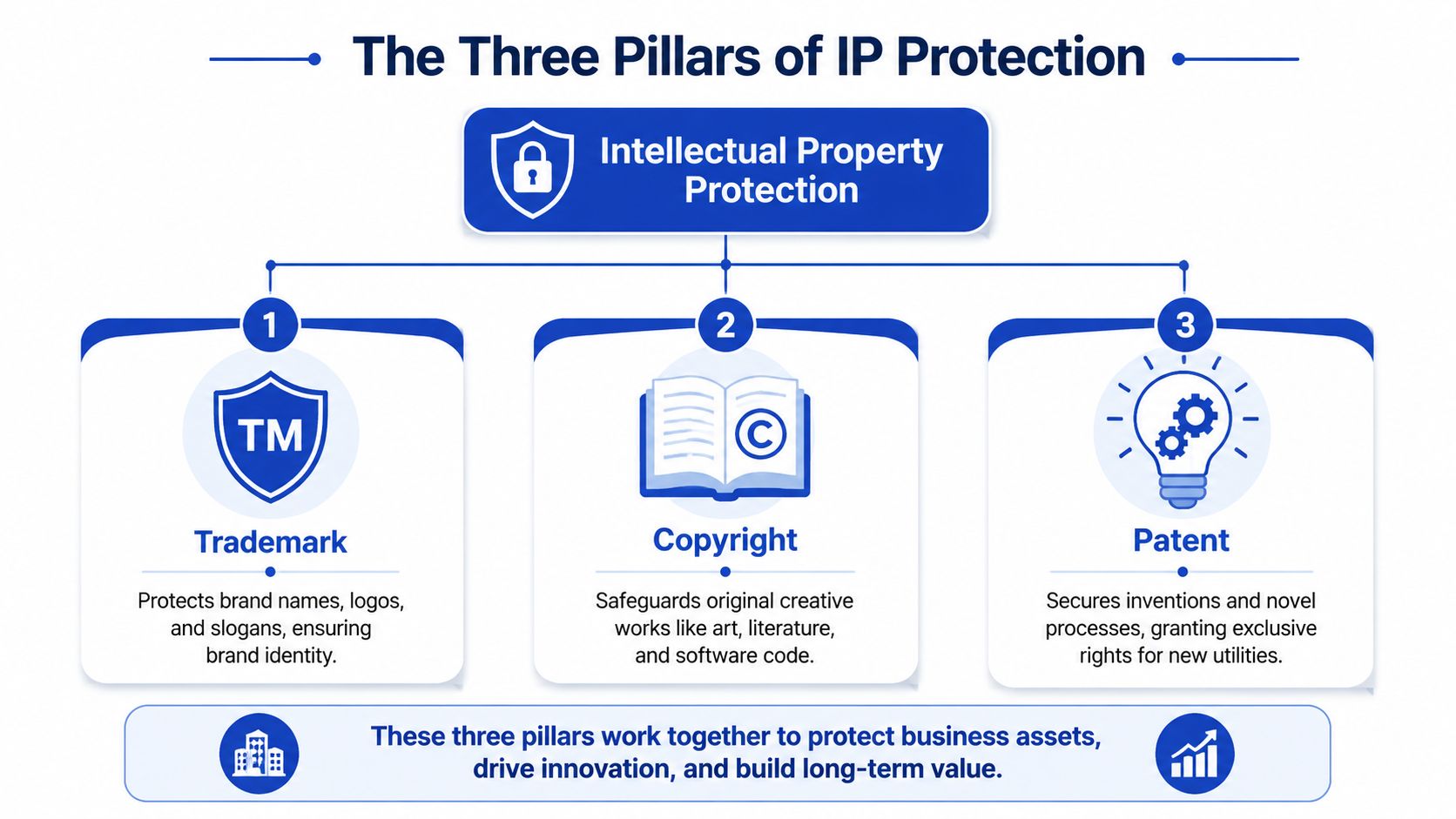
A useful mental shortcut is a book. Copyright protects the text itself. Trademark protects the title or brand that tells readers who published it. Patent would protect a new technical invention behind how the book is made or delivered, not the story on the page.
For founders who want a broader map of the categories, this overview of types of intellectual property rights is a helpful companion.
Trademark protects recognition
A trademark protects the identifiers customers rely on to know whose product they're buying. In a startup context, that usually means the company name, product name, logo, and sometimes a slogan or other branding elements that distinguish source.
Trademark law is about consumer confusion and distinctiveness. If a mark is weak, descriptive, or drifting toward generic use, it becomes harder to defend. If the mark is strong and used consistently, it can become one of the company's most durable assets.
Copyright protects expression
Copyright protects original expression once it's fixed in a tangible medium. For software companies, that often includes source code, website copy, interface text, graphics, tutorials, product videos, and internal documentation.
The key boundary is important. Copyright protects the expression itself, not the underlying idea or function. Two developers can independently build similar tools, and copyright won't stop that if one didn't copy the other's expressive work.
Patent protects function
Patent protection applies to inventions and processes that meet demanding legal standards. In practical terms, a startup evaluates whether a technical method, architecture, machine, or useful process is patentable.
Patent law doesn't care whether a competitor copied the invention directly. If a valid patent covers the claimed functionality, the patent owner may block unauthorized use even when the competing party developed it independently.
Quick rule: If the value lies in what customers call you, think trademark. If it lies in what your team created, think copyright. If it lies in how the technology works, think patent.
These categories overlap around a single product, but they don't replace one another. That's why a startup app can need all three at once.
A Detailed Comparison of IP Rights
A founder looking at one software product usually has three separate exposure points at once. The app name can be copied in the market. The code and design assets can be copied in the product. The underlying technical method can be copied by a competitor who writes its own implementation. Those are different legal problems, so they call for different rights.
The table below is useful for fast decisions, especially when a startup is deciding what to file now, what can wait, and what is not protectable at all.
| Attribute | Trademark | Copyright | Patent |
|---|---|---|---|
| What it protects | Brand names, logos, slogans, and other source identifiers | Original creative expression such as code, text, artwork, and media | Functional inventions, processes, and novel useful systems |
| Core legal focus | Distinctiveness and avoiding consumer confusion | Originality plus fixation in a tangible medium | Novelty, non-obviousness, and usefulness |
| How rights begin | Through use in commerce, with federal registration adding significant benefits | Automatically when the work is fixed in a tangible medium | Only after USPTO examination and issuance |
| Duration | Potentially indefinite if the mark stays in use and renewals are maintained | Life of the author plus 70 years for individual works, or 95 years from first publication or 120 years from creation for works made for hire, whichever expires first | 20 years from filing for utility patents if maintenance fees are paid; design patents last 15 years from grant |
| What it does not protect | Functional features or creative content by itself | Ideas, methods, systems, or brand identity by itself | Brand identity or expressive authorship by itself |
| Best startup use case | Product name, logo, flagship service branding | Source code, site content, visual assets, documentation | Core technical differentiator or protectable process |
Timing changes the business decision
These rights move at very different speeds. Copyright attaches as the work is created. Trademark rights can begin with actual use, although registration usually improves enforcement and expands practical advantage. Patent rights take the longest path because there is no issued patent until the application survives examination.
That timing affects product launch planning. A startup can ship copyrighted materials every week. A startup considering patents has to be more disciplined before demos, conference talks, public repos, sales decks, and feature releases create disclosure problems. Founders building technical products should review the filing sequence early, especially if the product includes novel software methods. Our guide to software patent planning for Seattle startups covers the timing issues that tend to create avoidable risk.
The legal threshold is not the same
Trademark asks whether customers use a word, logo, or other identifier to recognize source. Copyright asks whether the work contains original expression fixed in a tangible form. Patent asks whether the claimed invention satisfies a much harder standard and fits within patentable subject matter.
That difference matters because founders often overestimate what one filing can do. Registering a copyright in source code does not stop a competitor from using a confusingly similar product name. Filing a trademark application does not stop a competitor from copying your interface illustrations or help-center content. A patent application, even a well-drafted one, does not protect the goodwill tied to your product identity.
For a single software product, the better question is not which right is best. The better question is which part of the product creates which risk.
Enforcement depends on paperwork and proof
A legal right on paper is only part of the job. Disputes are won or lost on ownership records, filing dates, chain of title, specimen quality, registration status, and the ability to show what was created, when, and by whom.
Startups often get sloppy with intellectual property. Contractors write code without signed assignment language. Brand assets get used before clearance. Patent concepts are discussed publicly before counsel reviews them. Those mistakes are expensive because they weaken rights the company thought it already owned.
For lean teams, operations matter. Docketing deadlines, collecting signatures, organizing evidence of use, and tracking copyright deposits are not glamorous tasks, but they directly affect enforceability. Companies that need flexible support without hiring a full internal legal ops team sometimes use remote intellectual property paralegals to keep filings and records in order.
Cost should be measured against the asset at risk
Founders often ask which form of protection costs less. That is not the right starting point. The useful question is what failure would hurt more: brand confusion, copied content, or a competitor using the same technical solution.
Patent work usually requires the most budget, the most planning, and the most patience. Trademark filing is often easier to stage around launch and market entry. Copyright registration is commonly the fastest way to strengthen enforcement for core code, content, and creative assets.
For one startup, the product name is the commercial engine, so trademark gets priority. For another, the patent issue is central because the company is selling a technical advantage. For another, copyright matters first because the company’s value sits in software, design systems, training material, and documentation.
The strongest comparison is practical. Trademark protects market identity. Copyright protects expression. Patent protects functional innovation. A serious tech company usually needs to evaluate all three around the same product, not in separate silos.
Building a Hybrid IP Strategy for Your Tech Product
The strongest startup portfolios don’t choose between trademark, copyright, and patent. They layer them around one product.
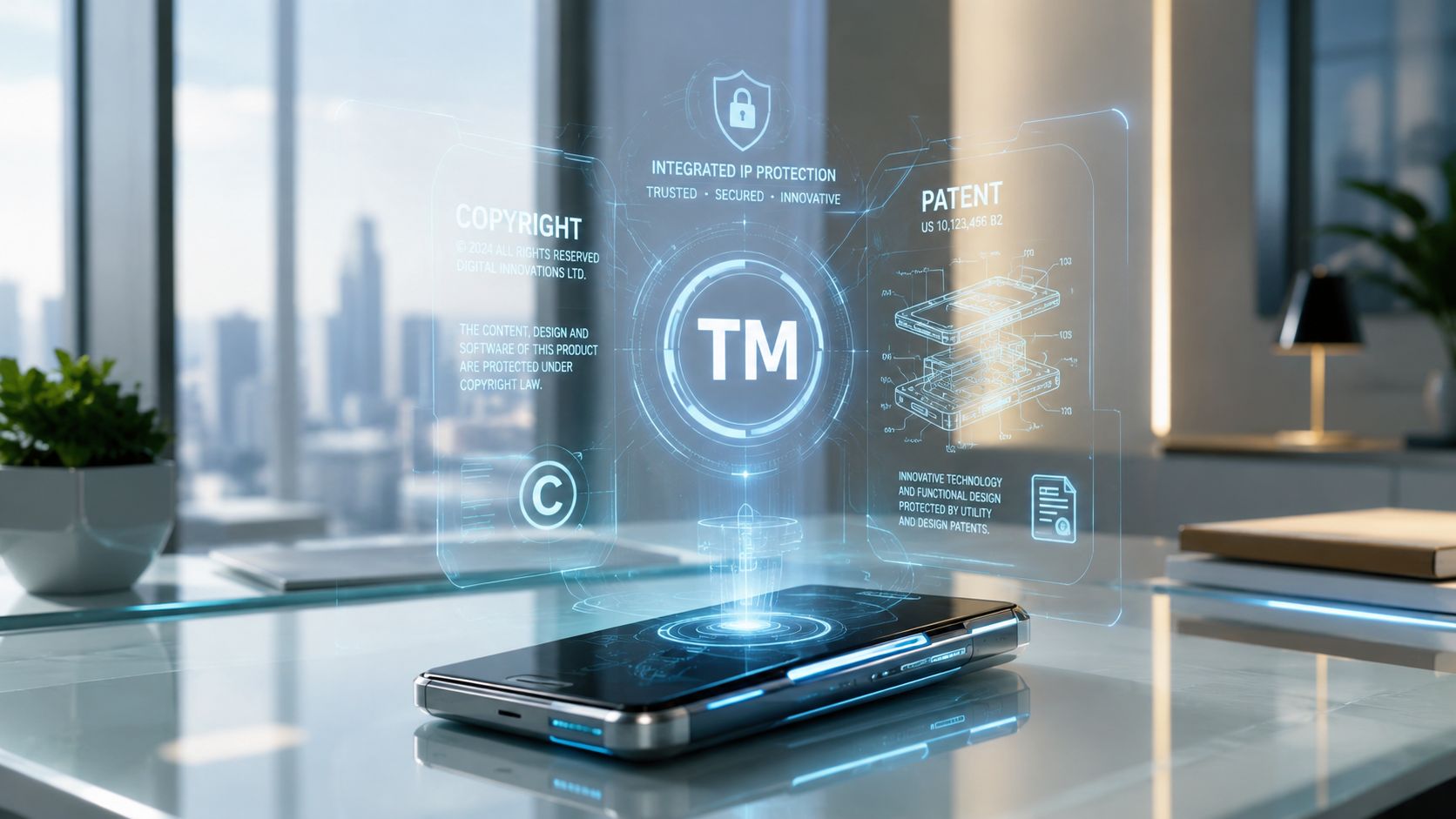
A software app is the clearest example. The name and logo need trademark analysis. The source code and creative assets fit within copyright. The novel algorithmic process or technical method may support patent review. The verified rule for technology companies is straightforward: a tri-layer IP strategy is often necessary, with copyright for source code, patent for the novel algorithmic process, and trademark for the brand name.
One product, three different risks
A startup that files only a trademark may still lose control of copied code.
A startup that registers only copyright may still watch a competitor adopt a confusingly similar brand.
A startup that pursues only patent work may still discover that its product identity was never secured and that customer recognition now benefits someone else.
That’s why hybrid strategy matters more than definitional accuracy. The founder’s job isn’t to memorize legal categories. It’s to identify where the company is vulnerable.
What a workable stack looks like
For a typical SaaS or AI-enabled platform, a practical stack often includes:
- Trademark layer: Company name, product name, logo, and key branded service names.
- Copyright layer: Source code, product copy, onboarding flows, design assets, videos, and help center content.
- Patent layer: A new technical process, system architecture, algorithmic workflow, or other functional feature worth exclusivity analysis.
- Trade secret layer: Internal know-how, non-public prompts, training methods, data handling procedures, customer lists, and backend processes that shouldn’t be disclosed publicly.
A product doesn’t need every filing immediately. It does need a deliberate order of operations.
Sequence matters
Public launch can affect patent options. Contractor work can create copyright ownership gaps. Brand adoption can outpace clearance. Those are sequencing failures, not just legal failures.
For software-heavy founders evaluating technical inventions, this guide on navigating software patents in Seattle addresses issues that often surface before a patent filing is even drafted.
A short explainer can also help teams align around the concept before legal review:
Where hybrid strategy usually fails
The most common breakdown is fragmentation. Marketing picks a brand name without clearance. Engineering publishes technical details too early. Contractors deliver code without an effective assignment clause. Product teams use generative AI assets without documenting human authorship or reviewing ownership assumptions.
A hybrid strategy works when someone owns the full picture. That usually means maintaining one internal asset map that lists:
- What the product is called
- What the team created
- What the product does in a novel way
- What must stay confidential
- Who owns each element today
That exercise prevents startups from spending money in the wrong order. It also produces better diligence files when investors, acquirers, or partners start asking for proof.
Your IP Decision Journey A Startup Founder’s Flowchart
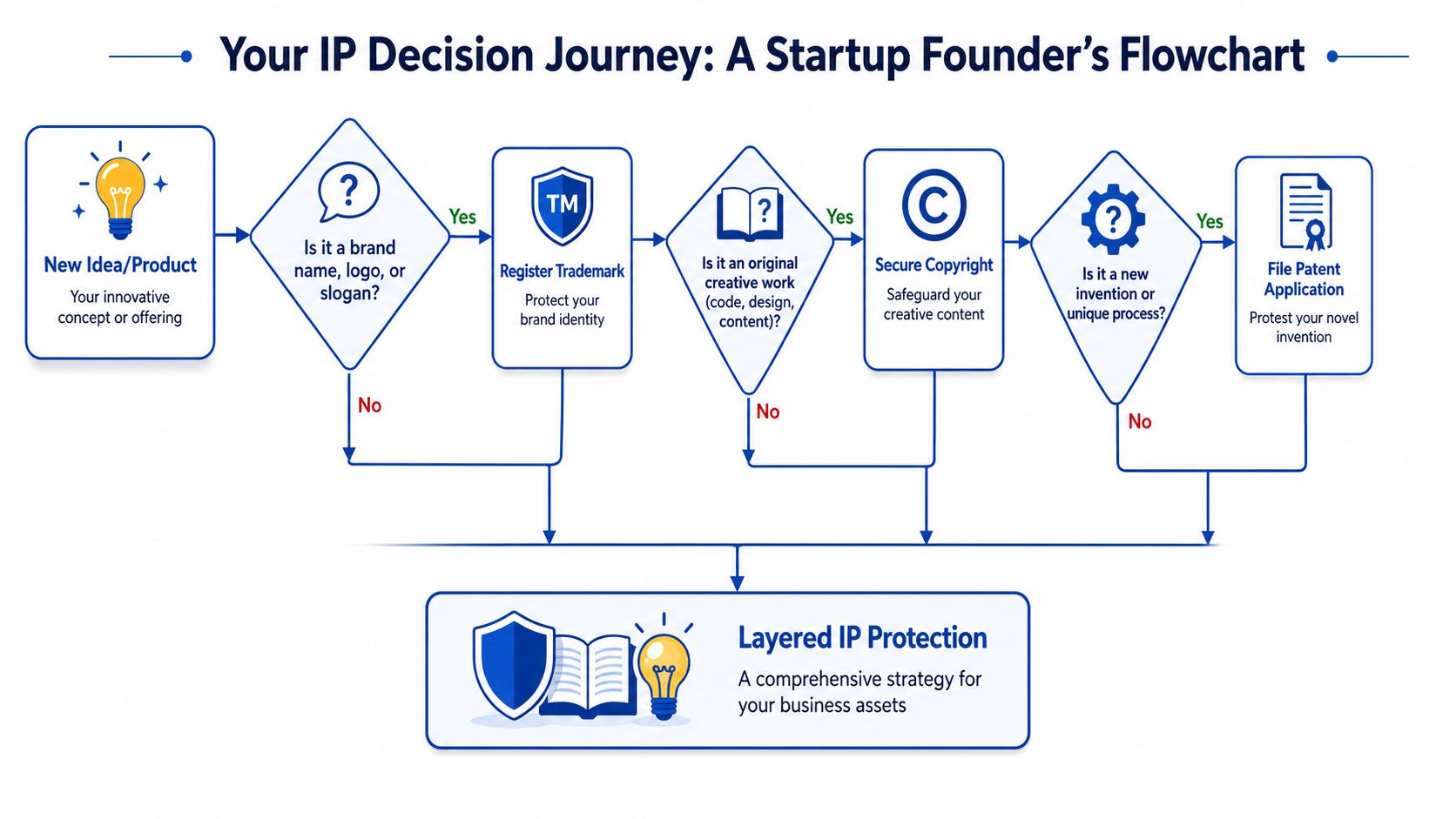
A founder is three weeks from launch. The app has a name, a logo, production code, a polished interface, and a feature the team believes competitors do not have. The first legal question is not which filing to submit. The first question is what part of the product you are trying to protect, and from whom.
Start with the asset, not the form
Use the flowchart as a triage tool. For a software company, one product usually contains several different IP assets at the same time.
- Brand name, logo, app icon, or slogan? Start with trademark analysis.
- Original code, interface design, website copy, documentation, videos, or graphics? Start with copyright.
- New technical method, system architecture, processing technique, or hardware-software interaction? Start with patent review.
- Value depends on keeping the information out of public view? Add trade secret controls, even if you also plan to file elsewhere.
That order matters because the wrong first move creates avoidable cost. I see founders spend money on a copyright application for a logo when the primary risk is trademark clearance. I also see teams talk publicly about a feature that should have gone through a patent review first. Good sequencing protects the product as a whole, not just one legal category.
Add the AI authorship check
AI changed this workflow in a way that affects day-to-day startup decisions. The U.S. Copyright Office’s 2024 guidance says material generated solely by AI is not protected by copyright without sufficient human authorship. For founders using AI for logos, illustrations, marketing copy, interface drafts, or code snippets, that means ownership and registrability need a separate review before the company treats the output as protected IP.
If the team cannot explain the human contribution to an AI-assisted asset, pause there.
That issue often crosses categories. An AI-assisted logo may still function as a brand identifier for trademark purposes if the company is using it in commerce. But that does not answer who owns the underlying artwork, whether it is clear of third-party issues, or whether the record supporting registration is clean. For one software product, those are different questions with different consequences.
A founder’s working checklist
Before launch, run one product-specific review:
- List the brand assets: product name, company name, logo, icon, tagline, domain.
- List the created assets: source code, UI files, onboarding copy, sales materials, demo videos, support content.
- List the technical assets: novel features, system processes, data handling methods, integrations, backend architecture.
- Mark AI-assisted materials: design drafts, generated text, images, code suggestions, voice assets.
- Match each asset to an owner: employee, contractor, vendor, parent company, or founder.
- Confirm the paper trail: invention assignments, contractor IP assignments, employment agreements, vendor terms, confidentiality controls.
This review does not replace counsel. It does give a startup founder a practical answer to the question that matters most before spending on filings: what exactly needs protection, and which rights need to work together around this single product.
That is how startups avoid the expensive version of IP cleanup, after launch, after investor diligence starts, or after a competitor adopts the part of the product the company failed to protect.
Next Steps and Legal Resources for Washington Businesses
A Seattle founder launches a software product under a polished name, hires a contractor to finish the interface, and demos the platform to investors before anyone checks ownership or filing timing. Six months later, the company has a trademark question, a copyright ownership gap, and a patent disclosure problem tied to the same product. That is a common startup mistake in Washington. IP issues rarely arrive one at a time.
For Washington tech companies, the practical next step is to treat legal review as product mapping, not form filing. The goal is to identify which parts of one product need trademark protection for the brand, copyright protection for code and creative assets, patent review for technical features, and trade secret controls for what should stay confidential. Founders who handle those rights together usually spend less fixing ownership, clearance, and filing mistakes later.
When DIY works and when it doesn’t
Some founders can file a basic trademark application on their own if the name is already cleared, the goods or services are narrow, and the company is using the mark in a straightforward way. The calculation changes fast when the product roadmap includes multiple offerings, the name sits close to existing brands, or the mark matters to fundraising and channel partnerships.
Patent work usually warrants counsel from the start. The same goes for products with contractor-built code, shared founder contributions, open-source dependencies, or AI-assisted assets that raise authorship and ownership questions. If AI-generated visuals, text, or design elements are part of the product or marketing, review the legal issues around copyrighting AI-generated art and related creative assets before treating them as clean company IP.
What to prepare before speaking with counsel
The best first meeting starts with records tied to the product, not a general request to “protect our IP.” Bring the materials that let counsel see the full chain of rights and the business risk around them.
- Brand materials: company name, product names, logos, taglines, app store listings, launch screenshots
- Ownership records: founder agreements, employment agreements, contractor agreements, invention assignments, vendor terms
- Product details: what the software does, which features may be novel, what is public, and what is still confidential
- Creation history: who wrote the code, designed the interface, created marketing content, and where AI tools were used
- Commercial timeline: first use dates, beta releases, investor decks, public demos, customer pilots, and any prior disclosures
Washington businesses should also use public resources selectively. Federal agency materials can help with process questions, but they do not replace a product-specific risk analysis. Local counsel becomes more useful when one software product has overlapping issues across branding, ownership, licensing, invention timing, and enforcement planning.
For founders who want practical startup-oriented reading between meetings, the ClaimKit blog can be a useful supplement to legal advice, especially on documentation and operational workflows around product launches.
Frequently Asked IP Questions
Can a startup protect an idea by itself
No. An idea alone usually isn’t enough. Patent law requires a protectable invention that can be claimed with specificity, and copyright doesn’t protect abstract ideas or concepts. Founders should document development carefully and move quickly when an idea has become actual code, a defined process, a design, or a concrete product feature.
Is copyright registration still worth it if protection is automatic
Usually, yes. Copyright protection begins automatically when a work is fixed in a tangible medium, but the Copyright Alliance explains that federal registration is required before filing an infringement lawsuit and may enable statutory damages up to $150,000 per work for willful infringement.
That changes the enforcement conversation. Automatic rights are real, but registered rights are often far more useful.
Does the poor man’s copyright work
No. Mailing a copy to yourself doesn’t replace registration and doesn’t create the procedural advantages a registered copyright provides. It’s a myth that survives because it sounds inexpensive and simple.
Where do trade secrets fit
Trade secrets are often the fourth leg of a startup’s IP strategy. They can protect information that derives value from remaining secret, such as customer lists, internal processes, data-handling methods, pricing logic, and confidential product plans. But trade secrets only work if the company treats the information as confidential through contracts, access controls, and internal discipline.
Can AI-generated work be copyrighted
Not if it was created solely by AI under current U.S. Copyright Office guidance. Startups using generative tools should review human authorship carefully, especially for logos, illustrations, marketing content, and code-heavy workflows. This discussion of copyright protection for AI art is a practical starting point for that issue.
Where can founders keep learning without getting lost in jargon
A good legal update source helps, especially for founders trying to track claim drafting, product language, and ownership issues without reading case law all day. The ClaimKit blog is one example of a practical resource for teams thinking about claims, product articulation, and legal clarity in adjacent workflows.
The core takeaway is simple. Trademark, copyright, and patent are not competing labels for the same thing. They are separate tools for separate risks. Most startups need more than one.
Founders in Washington who need help sorting out naming, ownership, software protection, AI-generated assets, or a coordinated filing strategy can work with By Design Law Firm & Legal Consultancy, PLLC. The firm advises startups and technology businesses across Seattle and the Greater Puget Sound on practical IP planning that supports launch, growth, and long-term asset protection. Contact our law office today at (206) 593-1519 for a complementary consultation.