A founder in Washington usually notices the problem too late. The chatbot is already answering customers, the vendor API is already moving data, and the board wants to know whether the company has a defensible AI risk assessment framework or just a stack of hopeful assumptions.
That gap matters because AI risk is not only technical. A model can touch consumer protection, privacy, security, intellectual property, and sector-specific compliance in the same workflow, even when the product team thinks it is “just a support assistant.” A useful framework forces the company to document scope, assign owners, score risk, and prove follow-through before the first serious incident.
NIST gave the market a practical reference point with AI RMF 1.0 in January 2023, after a May 2022 public draft, and built it around Govern, Map, Measure, and Manage across the AI lifecycle. That structure is the right backbone for a startup that needs to satisfy a board, a buyer, and a regulator without drowning in theory. The rest of this guide turns that backbone into a build-ready operating model, with governance roles, scoring logic, monitoring discipline, and a compliance map tied to Washington and federal obligations. For a related warning on unvetted tools, see Shadow AI and the legal minefield of unverified tech solutions.
Why Your AI Tool Is Already a Legal Risk
Your AI tool is a legal risk because it can touch customer data and affect how the company uses it, discloses it, and causes downstream harm. If it can see data or change decisions, you need a written risk record before launch.
A Seattle SaaS team can make this mistake in a single vendor integration. One support workflow pulls in health-adjacent free text, another one passes account details to an LLM, and suddenly the company is handling material that can implicate privacy rules, consumer protection expectations, and vendor risk obligations in one place. The issue is not whether the model is “smart enough.” The issue is whether the company can prove it understood the use case before deployment.

Practical rule: if the AI tool can see customer data, generate customer-facing output, or influence a business decision, it needs a written risk record before launch.
The right move is to build the framework early, not after an incident. NIST's published structure helps because it gives the company a common language for risk identification and response, and it does so across the full AI lifecycle, from design to monitoring. That matters in Washington, where privacy-sensitive data and consumer-facing claims can trigger scrutiny fast.
The CEO should want one thing from the framework, defensibility. That means the company can show who approved the use case, what data it touched, how it was scored, what controls were added, and who owns monitoring. A framework that can't produce that paper trail is not a framework, it's theater.
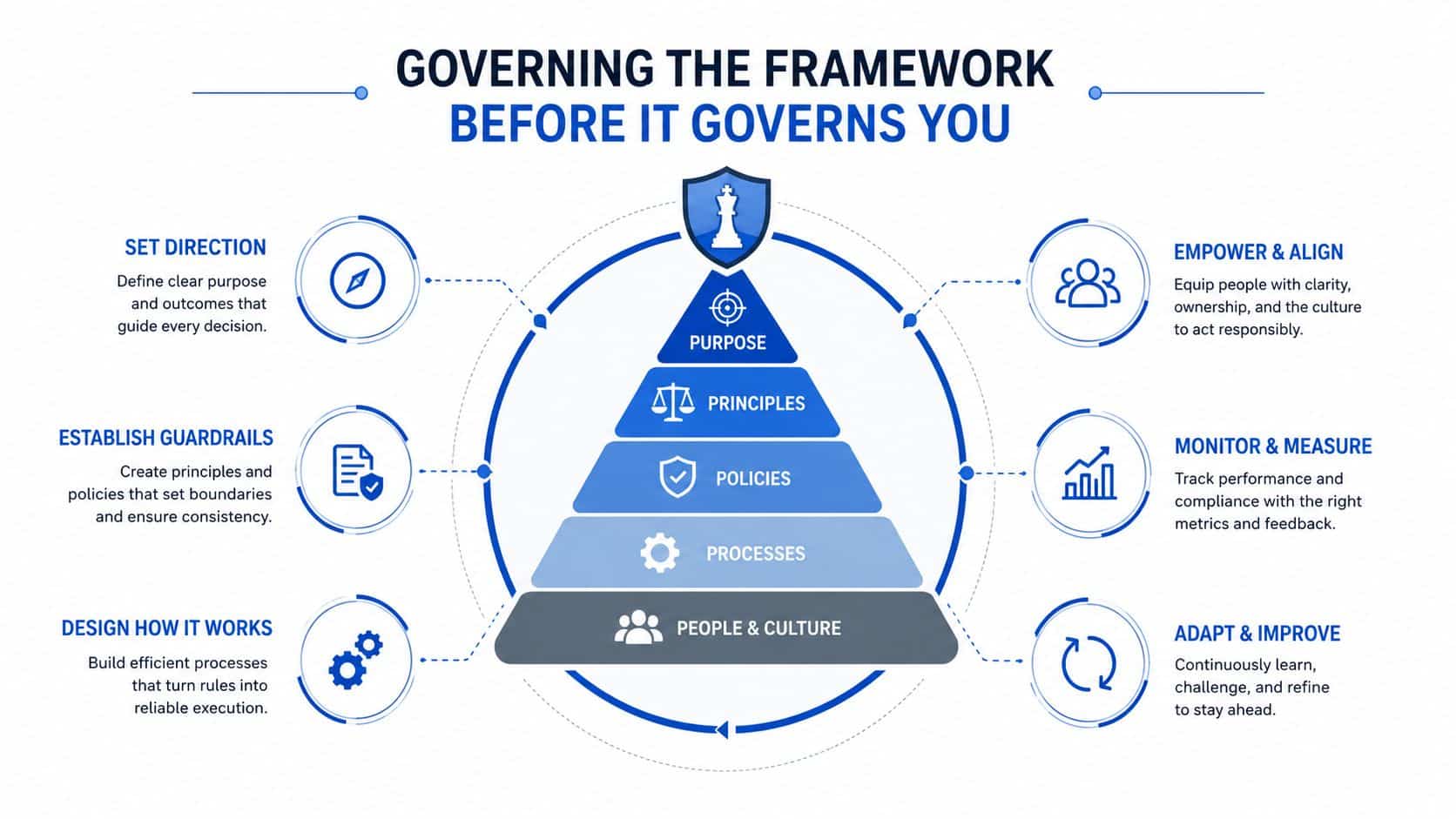
Governing the Framework Before It Governs You
The Govern function only works when someone with authority owns it. In a startup, that usually means an executive sponsor, a privacy lead, product and engineering representation, and outside counsel on call. If no one has the power to stop a launch, the framework will get routed around the first time a revenue deadline gets tight.
NIST's four functions, Govern, Map, Measure, Manage, are useful because they map cleanly onto a real org chart. Governance sets policy and accountability, mapping identifies the system and its data flows, measurement scores the risks, and management chooses the response. That division matters because a board does not want a technical memo, it wants to know who is accountable when the model misfires.
The cleanest operating model is a cross-functional AI Risk Committee with a short charter. It should meet on a fixed cadence, approve new use cases, review high-risk scores, and maintain the exception log. The committee should own three artifacts that matter: an AI Acceptable Use Policy, a model registry, and a short intake form for every new use case.
A useful intake form is simple enough to use and strict enough to matter:
- Use case name and owner: identify the business function and the person who can approve changes.
- Vendor or internal model: state who built it and who hosts it.
- Data categories: list customer, employee, health-adjacent, or other sensitive inputs.
- Decision impact: say whether the system informs, recommends, or automates a decision.
- Review status: mark whether legal, privacy, security, and product have signed off.
Washington-specific governance means naming a privacy lead who understands the My Health My Data Act and the consumer health data framework before procurement happens. That person should not be an afterthought in a purchase order chain. They should be in the room when the use case is scoped, because retrofitting privacy review after deployment is expensive and usually sloppy. For a useful policy baseline, see an AI governance policy template built for real-world oversight.
The committee should also require outside counsel review for any use case that touches regulated data or customer-facing outputs. That is not overlawyering. It is how a startup avoids discovering too late that a vendor contract, privacy notice, and launch plan do not line up.
If the company wants a fast test of whether governance is real, ask who can veto a launch. If the answer is unclear, the framework is still imaginary.
The governance file should prove who approved the use case, what risk threshold applied, and why the launch was still acceptable.
The mechanics can be documented in a short internal policy with two pages of substance and no fluff. For a starting point on information handling, data classification guidance for AI use cases helps the team decide which inputs stay out of the model entirely.
Mapping Every AI System and Its Data Flows
Mapping starts with the ugly truth that many teams cannot name every model they touched last quarter. Shadow AI, vendor add-ons, and one-off automations spread quickly, especially when product, support, and sales all buy tools separately. The fix is an inventory that captures every AI use case in one place.
A useful inventory entry should include the model's purpose, vendor, training data source if known, categories of data processed, output type, and downstream users. That is enough to expose the significant risk. A customer support assistant that only drafts marketing copy is not the same as a support assistant that ingests account numbers and health-adjacent complaints.
A Seattle fintech can see the value immediately. The company deploys a third-party LLM for customer support, then discovers in the inventory that the tool can receive account details, complaint narratives, and other sensitive free text. That one line item changes the legal posture, because the company now has to ask whether the use case should be limited, segmented, or pulled entirely.
A practical intake template can fit on one page:
- System name and business owner
- Vendor or internal build
- Input types and data sensitivity
- Output type and business impact
- Human reviewer name
- Known downstream recipients
- Retention and deletion setting
- Launch date and review cadence
Use the inventory to catch shadow AI, not just approved tools. Prompt-log reviews, SaaS spend audits, and department interviews often reveal models that procurement never saw. That discovery work is not glamorous, but it is cheaper than cleaning up an undisclosed data flow after a complaint.
The mapping exercise should also identify stakeholders, not just systems. Product, security, privacy, legal, compliance, and the business owner all need to be named against each use case. For a startup trying to make vendor review concrete, a vendor risk assessment template built for AI-era procurement is the right place to start.
A good inventory does one thing well. It gives the company a current list of what exists, who owns it, what data it touches, and where the risk lives. Without that list, everything that follows is guesswork.
Measuring Risk With a Scoring System That Holds Up
Measurement has to be numeric enough to compare risks, but not so false-precise that the board mistakes the number for truth. A 5×5 likelihood-impact matrix is the right floor because it forces the team to say how often something could happen and how bad it would be if it did. The IFAIS framework makes that floor explicit by requiring evaluation of severity of harm, likelihood, detectability, and affected population size in a 5×5 matrix as published here.
Use the score to force a decision
A score only matters if it leads to a treatment choice. The four choices are simple, accept, mitigate, transfer, or avoid. Microsoft's guidance is blunt on this point, residual scores can be accepted only if they fall below tolerance, and if they do not, the organization should mitigate, transfer, or avoid the risk, which is the kind of operational clarity boards like in AI risk assessment guidance.
| Risk | Likelihood | Impact | Raw Score | Treatment |
|---|---|---|---|---|
| Algorithmic bias in hiring | 3 | 4 | 12 | Mitigate |
| PII leakage through an LLM | 4 | 5 | 20 | Avoid or mitigate |
| Hallucinated legal advice in support chat | 3 | 5 | 15 | Mitigate |
The math is intentionally plain. If likelihood is 3 and impact is 4, the raw score is 12, which usually lands in a moderate band that requires controls, not celebration. That is why one startup may accept a low-risk internal drafting tool but refuse a customer-facing assistant that improvises legal language.
Bias deserves special treatment because it affects people, not just systems. A hiring model that ranks candidates unevenly can be scored, but the score alone does not solve the underlying issue. The company should document the test, the reviewer, the remediation, and whether the use case is still worth keeping.
PII leakage through an LLM usually scores high because both likelihood and impact can be serious. The smarter move is to narrow what the model can see, segment the data, and restrict output pathways before deployment. If those controls cannot shrink the residual score enough, the startup should avoid the use case.
Hallucinated advice is different because the harm often comes from user trust. A support assistant that sounds authoritative can create liability quickly if customers act on the answer. For practical ways to mitigate threats effectively, the team should compare model output controls with security-style threat modeling rather than treating the problem as a copywriting issue.
Escalation rule: when a model has low-frequency but high-severity failure modes, the matrix is not enough on its own. The company should add scenario analysis or probabilistic methods instead of pretending the 5×5 grid captures tail risk.
That matters for generative systems because classic scoring can understate rare but severe failures. If the company is building frontier features or public-facing assistants, leadership should expect a second layer of review for catastrophic scenarios, not just the standard risk score.
A residual-risk example makes the threshold concrete. Suppose the support chatbot starts at 15, the team adds retrieval grounding, output filtering, and human review, and the score drops to a level that sits under the company's tolerance. That is acceptable only if the mitigation log explains why the remaining risk is tolerable and who signed off.
Managing Risk Through Mitigation, Testing, and Monitoring
Management is where most frameworks go to die. Teams write policies, score risks, and then ship the model with one pre-launch test and a hope that drift won't matter. That approach fails because AI systems change after deployment, and the exposure often appears in production.
Controls that actually reduce exposure
The core controls are straightforward. Data minimization limits what enters the model, human-in-the-loop review adds approval gates, retrieval grounding ties answers to source material, output filtering blocks unsafe content, and red-teaming tests the model as an adversary would. None of those controls is decorative, and none should be optional for a customer-facing system.
MIT Sloan's framework is especially useful because it says organizations should ensure high-quality, accurate data with rights to use it, and commit to pre- and post-deployment continuous testing for algorithmic bias and accuracy as described here. It also says human oversight should intervene if models deviate from expectations, and the use case should be halted if deviations cannot be corrected. That is the right standard. If a team cannot stop the system, it does not control the system.
A working monthly checklist can fit into a project tracker:
- Review drift metrics: compare current output patterns against the last approved baseline.
- Check incident logs: look for customer complaints, unsafe outputs, or privacy issues.
- Confirm human review coverage: verify that the approval gate still exists where it should.
- Re-test bias and accuracy: rerun the approved test set against current model behavior.
- Validate vendor changes: confirm whether the provider changed the model, policy, or data handling.
Testing cadence should match the risk. High-impact tools need pre-deployment review and recurring post-deployment testing, not a one-time signoff. That rhythm matters because the model's behavior can shift with updates, prompt changes, or new data patterns.
The product owner should also have documented kill-switch authority. If the assistant starts drifting, the support manager or risk owner needs the power to pause it immediately, escalate the issue, and require re-approval before reactivation. A framework without halt authority is just paperwork.
For teams building on broader controls, resources to master NIST 800-53 controls in 2026 can help align AI monitoring with existing security discipline. That is especially useful when security, privacy, and AI teams need a common control vocabulary.
If a model can't be retested after update, can't be reviewed by a human where needed, and can't be paused when it drifts, it is already over the line.
The monthly report should end with one simple question, did the residual risk stay inside tolerance. If the answer is no, the decision is mitigation, reduction, or shutdown, not optimism.
Wiring the Framework Into Washington and US Compliance
The best AI framework doubles as compliance documentation. That is the key advantage for a Washington startup, because the same inventory, scorecard, mitigation log, and monitoring report can support privacy review, consumer protection analysis, and vendor diligence without rebuilding the file each time someone asks for proof.
Washington's My Health My Data Act matters the moment a model touches health-adjacent consumer data. The company needs the inventory to show where the data came from, the score to show the risk level, and the mitigation log to show what was done before deployment. If the output can affect consumers, the company should also treat its statements carefully, because the FTC has made clear that misleading AI claims are still subject to consumer protection scrutiny.
Sector rules still matter where the data is regulated. HIPAA, GLBA, and COPPA can all enter the analysis depending on the use case, and the framework should not be written as if AI sits outside those laws. The point is not to reinvent sector compliance, but to make sure AI does not slip through a gap between existing policies and a new tool.
A simple compliance mapping table is enough for outside counsel review:
| Framework artifact | Legal use |
|---|---|
| AI inventory | Shows data categories, systems, and owners |
| Risk score | Supports documented severity and tolerance decisions |
| Mitigation log | Proves controls, approvals, and compensating safeguards |
| Monitoring report | Shows continuous testing and drift review |
| Exception record | Documents residual risk acceptance or shutdown |
That table becomes especially valuable if the company faces a regulator, customer questionnaire, or investor diligence request. The evidence is stronger when the records are contemporaneous and consistent, not reconstructed after the fact.
Washington founders also need to stay aware of emerging state-level AI legislation. The safe approach is to design the framework so it can absorb new obligations without rebuilding the whole process. A strong baseline aligned with federal practice makes that much easier than starting from scratch later.
For teams that want a control-heavy view of implementation, NIST 800-53 control mapping in a current AI security context can help translate AI obligations into a familiar security structure. The legal lesson is simple, documentation is not overhead, it is the company’s defense file.
Your 90-Day Plan to Stand Up the Framework
The first 90 days should be practical, not theatrical. Weeks 1-2 inventory current AI use, including shadow tools, vendor add-ons, and any model that touches customer or employee data. Weeks 3-4 charter the governance committee, assign the executive sponsor, and publish the acceptable use policy.
Weeks 5-8 should cover the first scoring pass on the top five systems. The team should record likelihood, impact, treatment decision, and the owner for each mitigation item. Weeks 9-12 should deploy monitoring, document residual-risk acceptance decisions, and brief the board with a clear view of what was approved, what was paused, and what still needs work.
Three habits separate frameworks that survive from frameworks that collect dust. First, name one accountable owner. Second, set a fixed quarterly review cadence. Third, give someone documented authority to halt any system that crosses a defined threshold.
Board-ready rule: if the company cannot explain who owns the framework, when it gets reviewed, and who can stop a bad deployment, the framework is not live.
Do not wait for a regulator to define the standard for you. Build the record now, while the company still has room to choose the rules instead of reacting to them.
By Design Law Firm & Legal Consultancy, PLLC helps Washington startups build AI governance that stands up in boardrooms, vendor reviews, and regulator conversations. For companies that need a practical legal partner on AI risk assessment, privacy, and operational controls, visit By Design Law Firm & Legal Consultancy, PLLC and get the framework documented before the next launch goes live. Call our law office today at (206) 593-1519.