A founder usually reaches this point after the fun part is over. The logo is finished, the website is close to launch, packaging drafts are circulating in Figma or Adobe Illustrator, and someone asks the uncomfortable question: can anyone else stop this brand from using that design?
That's when trademark law stops being abstract. For a startup, a logo isn't just decoration. It sits on a landing page, pitch deck, app icon, booth banner, product label, and investor update. If the logo can't clear the USPTO, or if it collides with someone else's rights after launch, the cost isn't limited to a filing fee. It can force a rename, redesign, and cleanup across every customer touchpoint.
Startups in Washington feel that pressure early. Seattle and the broader Puget Sound market move fast, especially in software, consumer products, health tech, creative services, and e-commerce. Teams often want to file quickly and keep legal spend lean. That can work in straightforward cases. It fails when the logo is weak, the search results are crowded, or the application is built on sloppy descriptions and unusable specimens.
Laying the Groundwork Before You File
The first question isn't how to trademark a logo. The first question is whether the logo is worth filing at all.
A legally strong logo starts with distinctiveness. Trademark law protects source identifiers, not every attractive piece of design. Some logos are easier to protect because they are unusual by nature. Others are difficult because they describe the product, the industry, or a feature of the service too directly.
Distinctiveness decides how hard the road will be
A simple way to think about the spectrum:
- Fanciful marks are invented terms or highly original designs with no ordinary meaning. They tend to be the strongest.
- Arbitrary marks use familiar words or images in an unrelated way. They're also strong.
- Suggestive marks hint at a quality or idea but require some mental step from the customer.
- Descriptive marks tell buyers what the goods or services are, do, or contain. These are much harder to register without extra proof.
- Generic matter isn't protectable at all.
For logos, the same logic applies visually. A custom symbol paired with a unique commercial impression is stronger than a common geometric shape, a leaf for eco products, a lightning bolt for speed, or a skyline for local services. If a startup uses stock-style imagery plus descriptive wording, the filing may be technically possible but strategically weak.
A logo also has to be evaluated in context. The question isn't whether it looks different to the founder. The question is whether consumers could think it comes from the same source as another mark used for related goods or services.
Practical rule: If the logo's most important elements are common in the industry, the startup should assume the USPTO will look harder at conflicts.
That's why a clearance search matters before paying any filing fee.

Run a knockout search before investing further
A knockout search is not a full legal opinion. It's an initial screen for obvious problems using the USPTO database, including the legacy TESS search environment and the current federal trademark search tools available through the USPTO.
Founders should search for:
- The exact brand name in the logo.
- Close spelling variants.
- Sound-alikes.
- Shared dominant words.
- Design codes or visual equivalents if the logo includes a symbol.
According to the USPTO 2024 performance report, approximately 20-25% of all trademark applications are initially refused due to a likelihood of confusion with a prior registered mark, which is why the search step is never busywork.
A useful knockout search isn't just typing one phrase once. It means testing singular and plural forms, removing spacing, changing word order, and isolating the dominant part of the logo. If the logo contains a word mark and a graphic, the words usually carry more weight in the analysis because customers use words to search, ask for, and recommend brands.
What founders often miss in the search results
Search results need judgment, not just screenshots.
A founder may see a different font, different colors, or a different icon and assume it's safe. That's often the wrong lens. The USPTO compares overall commercial impression, and similarity in sound, meaning, or dominant wording can matter more than design differences.
Three practical filters help:
- Related goods and services matter more than exact matches. A conflict can exist even when the listed products aren't identical.
- Dead applications aren't automatic clearance. They may still point to market use by a business that never secured or maintained registration.
- Design-only searches are harder than word searches. Common visual motifs create false comfort.
For branding teams refining the logo before filing, these memorable logo design tips are useful because memorability and protectability often overlap, though they aren't the same legal test. A clean, distinctive logo usually performs better on both fronts.
Startups also benefit from understanding where trademark fits in the wider IP picture. A logo may raise trademark and copyright issues at the same time, which is why this overview of trademark, copyright, and patent differences is a practical companion before filing.
Preparing Your Trademark Application Package
Once the logo survives a serious pre-filing review, the application turns on three pieces: the drawing, the identification of goods or services, and the specimen. Most self-filed applications get into trouble here, not because the founders picked the wrong brand, but because they packaged it badly.
Choose the right drawing format
The USPTO asks applicants to define what exactly they want to protect.
A standard character drawing covers words alone, without claiming a specific font, layout, color, or stylization. If the startup's core asset is the brand name and the design may evolve, this usually gives broader flexibility.
A special form drawing covers the stylized version, design element, or composite logo. This is the filing most founders mean when they ask how to trademark a logo.
The choice has consequences:
| Filing approach | Best fit | Main trade-off |
|---|---|---|
| Standard character mark | The name matters most and design may change | Doesn't protect the graphic styling itself |
| Special form mark | The visual logo is central to brand recognition | Protection is tied to the filed appearance |
A startup can file for both in the right case, but that should be deliberate. Filing only the logo can leave the word brand less protected. Filing only the words can miss the value of a distinctive icon.
A startup that expects a rebrand refinement after launch should think carefully before locking itself into a narrow special form filing as its only application.
Draft the goods and services with precision
The identification of goods and services defines the legal scope of the application. It's where many DIY filings become either too narrow or improperly broad.
Founders should use the USPTO's Trademark ID Manual as a drafting tool, not as a box-checking exercise. The best identification is accurate, commercially realistic, and aligned with what the business sells or plans to sell.
Common mistakes include:
- Copying vague language that doesn't match the product.
- Overclaiming by listing everything the company hopes to offer someday.
- Misclassifying software, platforms, and services, which happens often with Washington startups.
- Ignoring how customers encounter the brand, especially when the same company sells both downloadable software and SaaS services.
A company offering downloadable mobile software may need different treatment than one offering temporary use of online non-downloadable software. Similar business models can land in different legal categories.
For early-stage companies sharing demos, product roadmaps, or contractor relationships while preparing a filing, a basic understanding of what an NDA agreement is also helps protect adjacent business information during launch discussions.
Build a specimen the examiner can actually accept
The specimen proves the logo is being used in commerce for the listed goods or services when the filing basis requires use.
For goods, acceptable specimens often include:
- Product packaging showing the logo
- Labels or tags attached to the product
- Point-of-sale displays associated with the goods
For services, acceptable specimens often include:
- A website page where the logo appears near a description of the services
- Digital ads or brochures that clearly offer the services
- Sales or marketing materials connecting the logo to the service activity
What doesn't work well? A logo floating alone on a mockup. A social media profile with no service context. A decorative image that doesn't show trademark use. An internal slide deck. A printer proof.
Founders should ask one blunt question before uploading a specimen: if an examiner saw this page with no explanation, would it be obvious what is being sold and under what mark? If the answer is no, the specimen needs work.
Navigating the USPTO Filing Process and Costs
This is the point where strategy matters more than speed. A startup can have a good logo and still make poor filing choices.
Two decisions shape the application early. The first is the filing basis. The second is the TEAS form used to submit the application.
Use in commerce or intent to use
A use-in-commerce application fits a startup that is already using the logo in U.S. commerce for the listed goods or services. That means real commercial use, not internal planning and not a placeholder launch page.
An intent-to-use application fits a startup that has not launched yet but wants to reserve priority while product, packaging, or go-to-market work is still underway. For founders trying to secure a brand before public rollout, this is often the better tool.
The trade-off is straightforward:
| Basis | Best for | Watch for |
|---|---|---|
| Use in commerce | Active brand already in market | Specimen must already be solid |
| Intent to use | Pre-launch or staged rollout | Extra steps arrive later before registration issues |
Intent-to-use filings can be powerful for startups that are still finalizing manufacturing, app release timing, or channel partnerships. They can also become expensive if the business files too early, then struggles to launch on schedule or keeps changing the logo.
TEAS Plus and TEAS Standard are not just pricing options
TEAS Plus is usually cheaper, but it asks more from the applicant on the front end. TEAS Standard gives more drafting flexibility.
For startups, the practical difference is this:
- TEAS Plus works best when the goods and services fit cleanly within the USPTO's accepted ID Manual language and the filer can satisfy the stricter requirements.
- TEAS Standard makes more sense when the business model is unusual, the offering is nuanced, or the ID needs specific wording.
Cheap doesn't always mean economical. If a startup chooses the lower-cost form and then triggers avoidable corrections, the savings can disappear quickly in attorney time, delay, or amendment problems.
Estimated USPTO trademark filing costs in 2026
The USPTO can change fees, and founders should always confirm the current schedule before filing. For planning purposes, this table is best treated as a framework rather than a promise of a fixed amount.
| Fee Type | Cost per Class | Notes |
|---|---|---|
| Initial TEAS Plus filing | Varies by current USPTO fee schedule | Lower-cost option if stricter requirements are met |
| Initial TEAS Standard filing | Varies by current USPTO fee schedule | Higher-cost option with more flexibility |
| Statement of Use for intent-to-use application | Varies by current USPTO fee schedule | Due later if the application began on an ITU basis |
| Extension request for intent-to-use application | Varies by current USPTO fee schedule | May be needed if launch timing slips |
| Post-registration maintenance filings | Varies by current USPTO fee schedule | Required later to keep registration alive |
Because fee structures and launch timing interact, the cheapest path on day one may not be the lowest total-cost path over the life of the application.
Decision lens: If the startup's description of its product takes three sentences to explain, TEAS Standard is often worth considering.
A broader brand strategy matters here too. Filing a logo in isolation, without thinking about naming, contracts, copyright, confidentiality, and product launch sequencing, usually creates gaps. This discussion of building a strong IP strategy is helpful for founders who want the filing to support the business rather than sit apart from it.
What happens after filing
After submission, the application doesn't move instantly. It enters the USPTO queue for examination. If the examining attorney sees no issue, the mark can move to publication for opposition. During that publication window, third parties can object if they believe the mark harms their rights.
If no opposition blocks the path and all requirements are met, registration follows for use-based applications. Intent-to-use applications take an extra step because the applicant must later prove use before the registration will issue.
For startup budgeting, the practical lesson is simple. The filing fee buys entry into the process. It doesn't buy certainty, speed, or automatic approval.
Responding to USPTO Office Actions
A founder opens a USPTO letter and sees refusal language. The instinct is usually one of two bad reactions: panic, or dismissal. Neither helps.
An Office Action is the examiner's written list of issues. Some are procedural. Some are substantive. A specimen may be unacceptable. The goods description may be indefinite. Or the examiner may argue that the logo is merely descriptive, ornamental, or too close to an existing mark.
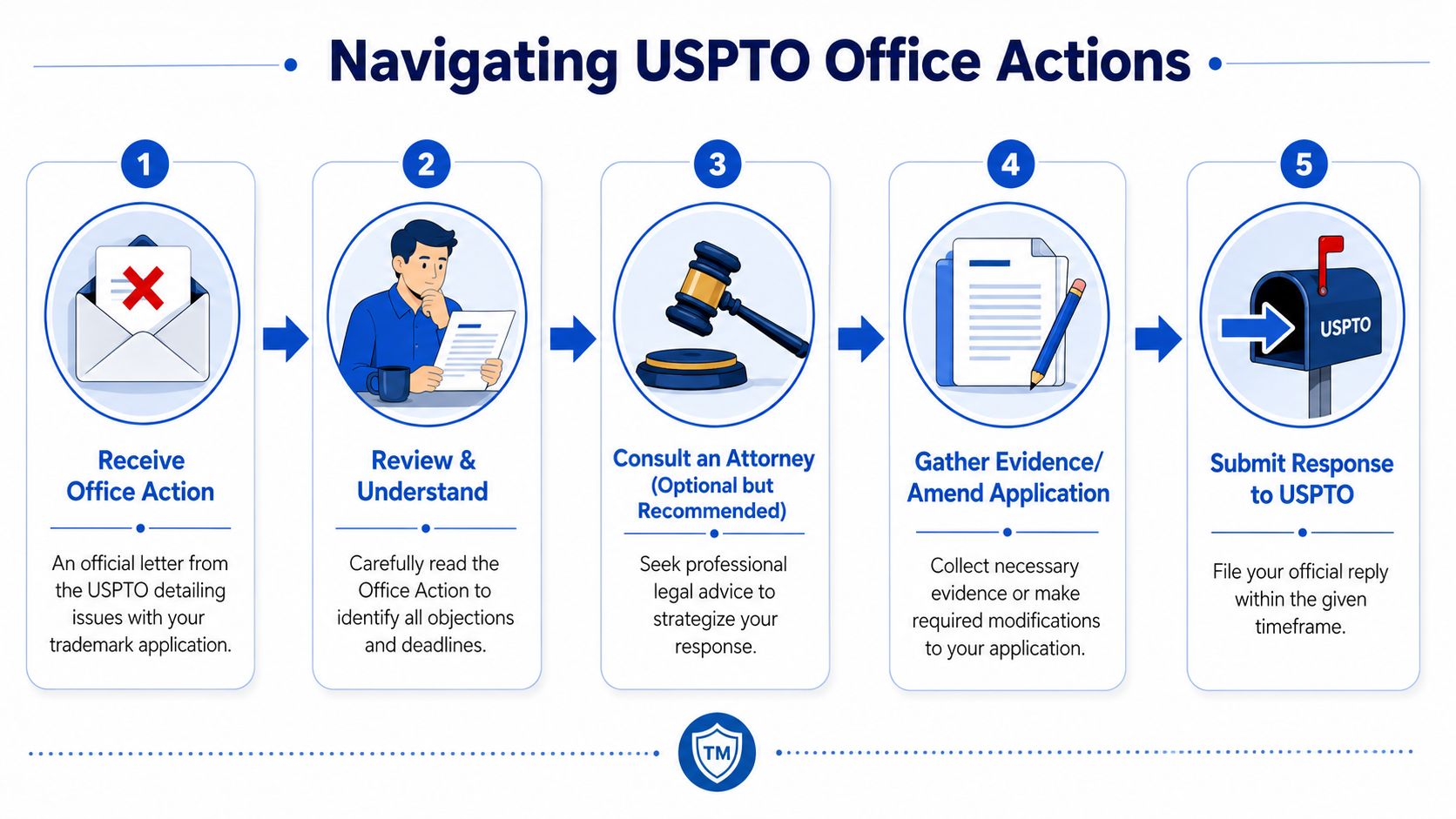
A recent analysis of USPTO data shows that over 50% of applications receive at least one Office Action, and applicants who file a complete response have a greater than 60% chance of ultimately achieving registration, according to WIPO IP statistics reporting.
A common scenario with a descriptiveness refusal
Consider a fictional startup that files a logo for a software platform with wording that directly names what the platform does. The examiner may issue an Office Action saying the wording is merely descriptive and that the design elements don't create a separate commercial impression strong enough to overcome that problem.
The letter usually identifies:
- The application serial number and mark
- Each refusal or requirement
- Supporting reasoning
- Evidence cited by the examiner
- A response deadline
The response deadline is strict. Missing it usually means abandonment.
What a useful response looks like
A weak response argues from preference. A strong response argues from law, facts, and evidence.
That may include:
- Amending the identification if the issue is procedural.
- Replacing the specimen if the original one was defective and the rules allow correction.
- Arguing suggestiveness instead of descriptiveness if the wording requires imagination or thought from consumers.
- Submitting evidence of acquired distinctiveness where available.
- Disclaiming unregistrable matter when that solves part, but not all, of the examiner's concern.
The examiner doesn't need to be convinced that the founder loves the brand. The examiner needs a legally sufficient reason to withdraw the refusal.
A startup should also distinguish between fixable technical issues and core brand defects. If the refusal is based on an easily corrected ID problem, a measured amendment may be enough. If the refusal attacks the logo's fundamental distinctiveness, the founders need to decide whether to fight, narrow the claim, or redesign.
When founders should stop improvising
Substantive Office Actions are where DIY filings often become expensive. The risk isn't only losing the application. It's creating admissions or amendments that weaken the registration later.
A thoughtful response should read like a legal position, not an emotional email. It should address every point the examiner raised, use the record carefully, and avoid overstatements. In many cases, professional counsel alters the result.
Protecting and Maintaining Your Registered Trademark
Registration is not the finish line. It's the point where the startup stops asking for rights and starts managing them.
A registered logo has value only if the owner uses it consistently, watches for conflicts, and keeps the registration alive with required maintenance filings. Businesses that ignore post-registration work often discover the problem too late, after copycats appear or the USPTO cancels the registration for missed maintenance.
Enforcement starts with attention
Most infringement problems don't begin with a dramatic counterfeit operation. They start small. A similar seller appears on Etsy, Amazon, Shopify, LinkedIn, or a local service website. A competitor adopts a close icon. A reseller uses the logo in a misleading way.
The first step is usually not a lawsuit. It's a careful investigation followed, in many cases, by a targeted cease and desist letter. The letter should match the facts. Sometimes a firm notice works. Sometimes coexistence or narrowing the ask makes more sense. Overreaching can backfire.
For online monitoring, many companies use watch services, platform reporting systems, and broader online brand protection services to identify misuse across marketplaces, domains, social accounts, and copied content channels.
Maintenance deadlines are easy to miss and expensive to ignore
The USPTO requires ongoing filings to keep the registration active.
- Between the fifth and sixth years after registration, the owner must file a Section 8 Declaration of Use.
- Between the ninth and tenth years after registration, the owner must file a combined Section 8 and Section 9 renewal.
- Every ten years after that, renewal continues on the same cycle if the mark remains in use and the filings are made properly.
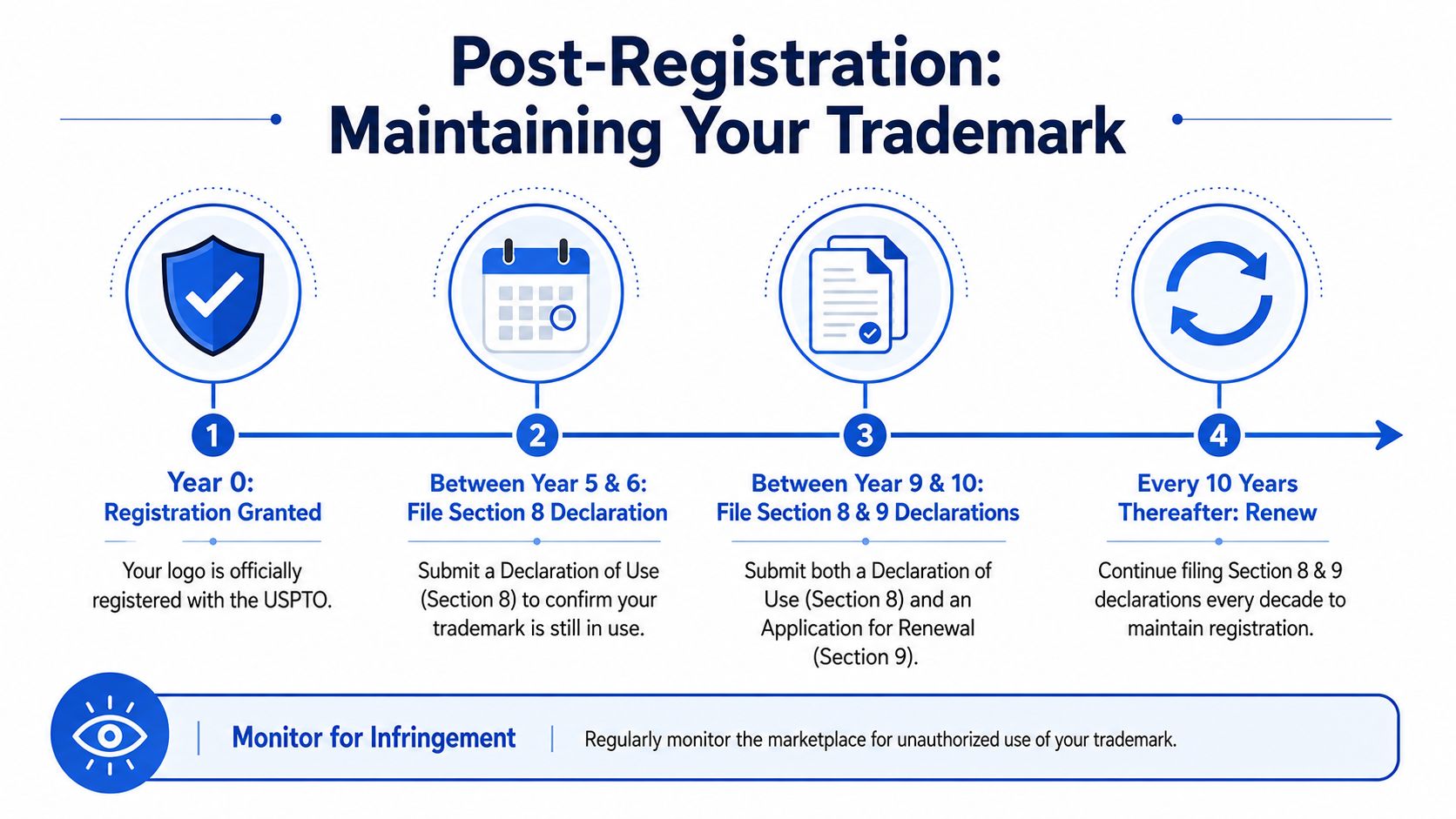
A strong post-registration practice usually includes a simple internal system:
| Ongoing task | Why it matters |
|---|---|
| Save current examples of logo use | Helps support future maintenance filings |
| Monitor similar uses in the market | Reduces the risk of brand erosion |
| Review logo changes before rollout | Avoids drifting away from the registered version |
| Calendar maintenance deadlines early | Prevents accidental cancellation |
Registration creates leverage, but only for businesses that keep their paperwork and real-world use aligned.
When to Partner with a Washington Trademark Attorney
Some founders can file on their own. That’s true when the mark is distinctive, the goods and services are straightforward, the search is clean, and the specimen is obvious.
The risk rises fast when any of those conditions disappear.
Situations where DIY usually stops making economic sense
A startup should think seriously about hiring counsel when:
- The search results are crowded. Similar names, related goods, or overlapping design themes need legal judgment.
- The company is filing a logo with layered elements. Composite marks create more strategic choices than word-only marks.
- The USPTO issues a substantive refusal. Descriptiveness, ornamentality, and confusion refusals are rarely solved by guessing.
- The business plans to expand abroad. U.S. filing choices can affect later international strategy.
- The branding process used outside creatives or downloaded assets. Ownership and licensing questions can undermine the filing itself.
That last point gets overlooked. A logo can clear trademark review and still create legal trouble if the font or design components weren’t licensed properly. This guide on how to protect businesses from font risks is worth reviewing when a startup’s identity package came from freelancers, template systems, or rushed launch work.
For Washington businesses, local counsel can add practical value beyond form completion. Seattle-area startups often move through financing, product pivots, channel partnerships, and multi-state expansion quickly. A lawyer who understands those patterns can help align trademark decisions with launch timing, investor diligence, employment and contractor issues, and broader IP priorities. Founders looking for that type of support can review this overview of intellectual property law services.
The core cost-benefit analysis is simple. A basic filing may look cheaper as a DIY task. A failed filing, rebrand, or weak registration usually isn’t.
By Design Law Firm & Legal Consultancy, PLLC helps Washington startups and growing businesses protect the brands they’re building, with practical guidance on trademark clearance, filing strategy, Office Action responses, and broader intellectual property planning. Founders who want experienced, business-focused counsel can learn more at By Design Law Firm & Legal Consultancy, PLLC.
Contact our law office today at (206) 593-1519.