IBM's annual Cost of a Data Breach reporting has repeatedly shown that breach response is expensive, slow, and far more disruptive than founders expect. For a Washington startup or small business, the actual risk is not only the intrusion itself. It is the point where a security incident turns into a legal, operational, and customer trust problem at the same time.
A data breach is broader than the headline version of a “hack.” In practice, it can mean unauthorized access to customer records, employee data, financial information, login credentials, or other sensitive business information, whether the cause is a phishing email, a misconfigured cloud system, a lost device, or an insider mistake. The business question is simple. Did someone get access to data they should not have had, and does that access trigger response duties?
That distinction matters in Washington. Founders do not just need a plain-English definition. They need to know when Washington breach notification law applies, how quickly the company needs to investigate, who should be involved on day one, and how to avoid creating bigger legal exposure through delayed or improvised decisions.
Small and midsize businesses get hit because they are reachable, busy, and often under-defended. A rushed SaaS deployment, stale admin account, or vendor with weak controls can create the same reporting and customer fallout that people associate with much larger companies.
The High Cost of Unpreparedness
Breach costs rarely stay inside the IT budget. For a Washington startup or small business, an incident can turn into legal fees, forensic bills, customer notices, contract disputes, insurance reporting, and a week or two where leadership is doing little else. That is what catches founders off guard. The direct technical problem is often only one part of the loss.
The harder issue is timing. Companies that have not decided in advance who leads the response, how evidence gets preserved, and when counsel should be involved usually spend the first 24 to 72 hours making avoidable mistakes. They overwrite logs, delay internal escalation, say too much to customers too early, or say too little for too long. Each of those choices can increase cost.
Healthcare often gets used as the headline example because regulated data creates expensive cleanup obligations. But the same pattern shows up in ordinary startup operations. A SaaS company with payroll data, customer login credentials, or stored identity documents can face the same business questions quickly: what was accessed, whose information was involved, what contracts require notice, and whether Washington law imposes a deadline.
Why founders underestimate the risk
Founders underestimate breach risk because they picture a complex public attack, but breaches often start with normal business mistakes. Reused passwords, exposed databases, or active ex employee accounts can still expose sensitive data.
- A reused password gives someone access to an admin account.
- A cloud database is exposed longer than the team realized.
- A former employee account stays active after departure.
- A phishing email captures finance, HR, or founder credentials.
None of those scenarios looks dramatic at first. All of them can create legal exposure if sensitive data was available to the wrong person.
Practical rule: If your company holds information that could harm a customer, employee, vendor, or the business itself if exposed, you already have breach risk that needs a response plan.
Money is usually the driver. Attackers are looking for data they can sell, credentials they can reuse, or pressure points they can use for extortion. That matters for smaller companies because it means you do not need to be famous to be a target. You need to be accessible and easier to compromise than the next business.
Delay is expensive
A slow response creates two separate problems. The attacker gets more time inside the environment. The company gets less time to investigate carefully before legal, contractual, and communication deadlines start to matter.
For Washington businesses, that trade-off is practical, not theoretical. If the team discovers a possible breach on a Friday afternoon with no incident plan, no forensic contact, and no assigned decision-maker, the weekend gets expensive fast. By Monday, leadership may be trying to preserve evidence, answer customer questions, notify the cyber insurer, and figure out whether the event triggers notice obligations. Preparation does not prevent every breach. It does reduce confusion, shorten decision time, and lower the odds that an already serious incident turns into a larger legal and business problem.
Defining a Data Breach Beyond the Headlines
A data breach is more specific than a general cybersecurity problem. As Proofpoint explains in its definition of a data breach, the issue is unauthorized access to, theft of, alteration of, or disclosure of sensitive information, or interference with systems in a way that compromises confidentiality, integrity, or availability.
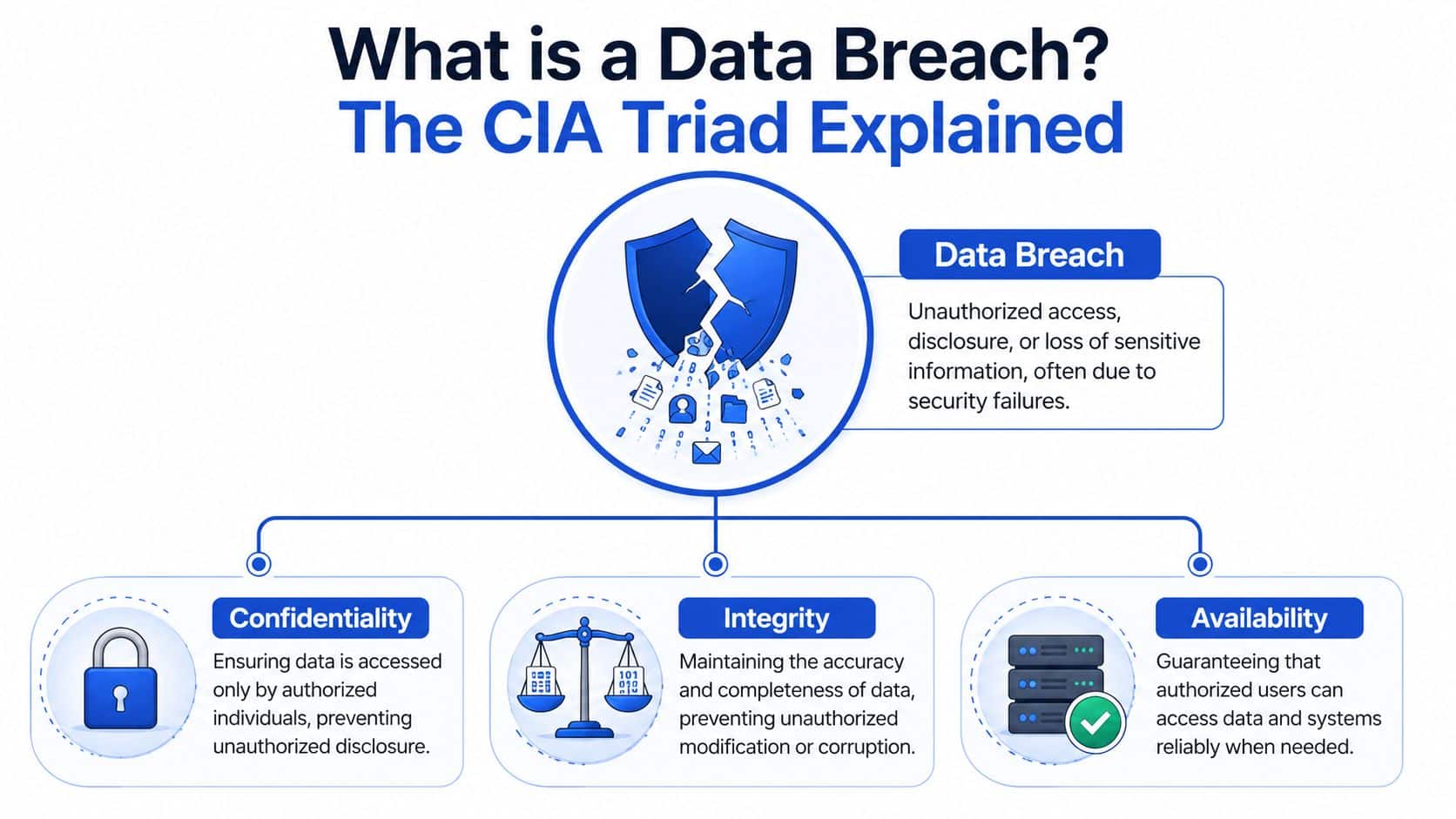
For a founder, the practical question is usually simpler. Did someone without proper authorization get access to protected data, change it, disclose it, or make it unavailable in a way that creates business, legal, or operational risk?
That line matters because every security event is not a reportable breach. A blocked phishing email, a failed login attempt, or a software misconfiguration caught before anyone accessed data may still require investigation and remediation. The legal analysis changes once protected information was exposed, acquired, altered, or locked up.
Washington companies need to be especially careful here. The label you apply in the first day of an incident affects how you preserve evidence, whether you call outside forensic support, when you notify your insurer, and whether state breach-notice duties may be triggered. Founders often lose time arguing about terminology when they should be confirming scope, preserving logs, and identifying what data was involved.
The CIA triad in plain English
Security teams use the CIA triad as a shorthand. Business owners can use it as a decision tool.
| Element | What it means in business terms | Example |
|---|---|---|
| Confidentiality | Data is only visible to authorized people | A threat actor downloads customer records or employee tax forms |
| Integrity | Data remains accurate and trustworthy | Payroll details, wiring instructions, or contract records are changed |
| Availability | Authorized users can access systems and data when needed | A ransomware event locks the team out of email, files, or billing systems |
Confidentiality gets the most attention because it often drives customer notification, regulator scrutiny, and fraud risk. Integrity and availability can be just as serious. If someone changes bank details in your accounting system or encrypts the only working copy of company records, the business impact is immediate even before you finish the legal analysis.
There is also an insider issue that startup teams miss. A breach does not always start with an outside hacker. The U.S. Department of Veterans Affairs defines the term broadly enough to include misuse of sensitive personal information by someone who already had authorized access, as reflected in the Cornell Law presentation of 38 CFR 75.113. In practice, that means a departing employee, contractor, or vendor account can create the same notification, liability, and trust problems as an external attack.
For Seattle and Washington SMBs, phishing remains one of the most common entry points into that broader breach story. Founders dealing with suspicious email compromise or credential theft should review this guide to phishing scams and legal recourse for Seattle businesses.
The business takeaway is direct. A data breach is not just stolen files in a dramatic headline. It is any unauthorized exposure, alteration, or loss of access to information that can trigger legal duties, disrupt operations, or harm customers, employees, and the company itself.
Anatomy of a Breach From Phishing to Exfiltration
Attackers rarely need complex code to hurt a small business. A convincing email, a reused password, or an exposed cloud setting is often enough to start the chain.
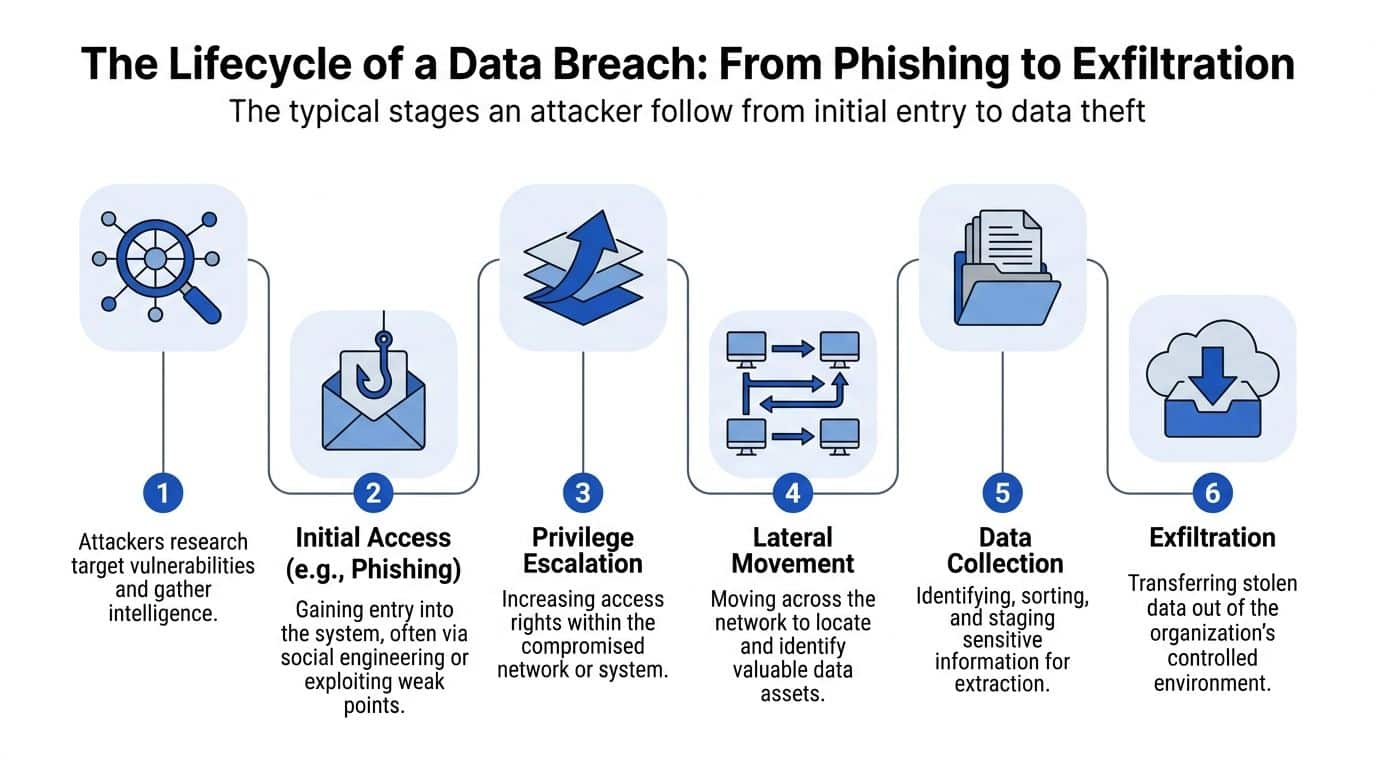
The common breach storyline
For a Washington startup or SMB, the pattern is usually familiar once you know what to look for. The attacker gathers public details about your team, vendors, software stack, and login portals. LinkedIn profiles, job postings, website metadata, and vendor invoices can all help them choose the easiest target.
Then comes initial access. In practice, that often means a phishing email, a stolen password, or a login approved through a compromised inbox. For many Seattle-area companies, the first foothold is Microsoft 365, Google Workspace, payroll software, or an admin account tied to a cloud platform. If your team is dealing with suspicious email compromise, this guide to phishing scams and legal recourse for Seattle businesses walks through the local legal issues.
Once inside, the attacker tests what that account can reach. A single mailbox may expose password reset links, shared files, customer records, internal chat, or finance approvals. If permissions are broad, the incident stops being an email problem and becomes a business systems problem.
The next stage is privilege escalation and lateral movement. Attackers look for saved credentials, weak multi-factor authentication setups, connected SaaS tools, and admin roles that were never cleaned up after an employee changed jobs. Startups are especially exposed here because convenience often wins during early growth. Fast onboarding, shared admin access, and informal vendor access make operations easier until an attacker uses the same shortcuts.
Exfiltration is the point founders tend to picture first, but it usually comes later. By then, the attacker has already identified what matters, copied it to a staging location, and prepared to move it out without attracting attention. Customer data gets the headlines, but payroll data, source code, contracts, investor materials, and internal financials can be just as damaging in a Washington breach response.
A large 2025 exposure reviewed by Huntress in its roundup of major breaches reportedly involved a massive database left accessible without a password. The lesson is plain. Serious incidents do not always begin with advanced intrusion. Basic access control failures can create the same legal and operational mess.
What works and what fails
The weak assumption is that one security tool will catch the whole sequence. It will not. Endpoint protection does not fix overbroad permissions. Strong passwords do not stop an attacker who controls an employee mailbox and can approve resets or payment changes.
What holds up better is a layered setup that reflects how breaches unfold:
- Tight access management so one compromised account does not expose every system
- Cloud configuration review before tools go live and again after major changes
- Role-based permissions for finance, HR, engineering, founders, and contractors
- Meaningful logging and alerts that someone on the team checks
- A written response playbook with legal, technical, and communication steps assigned in advance
From a legal and operational standpoint, timing matters. The earlier you catch the access problem, the more options you preserve. If you detect the phishing email before credentials are used, you may have a routine security event. If you detect the issue after data leaves the company, you may be dealing with notice duties, customer communications, insurer reporting requirements, and evidence preservation.
A short explainer on the attacker workflow helps make that lifecycle concrete.
The Ripple Effect of a Data Breach
For a Washington startup or small business, the financial hit from a breach rarely starts with a regulator. It starts with disruption. Payroll gets delayed, sales conversations stall, engineers stop roadmap work to answer forensic questions, and leadership spends days on decisions that should have been made in an incident plan months earlier.
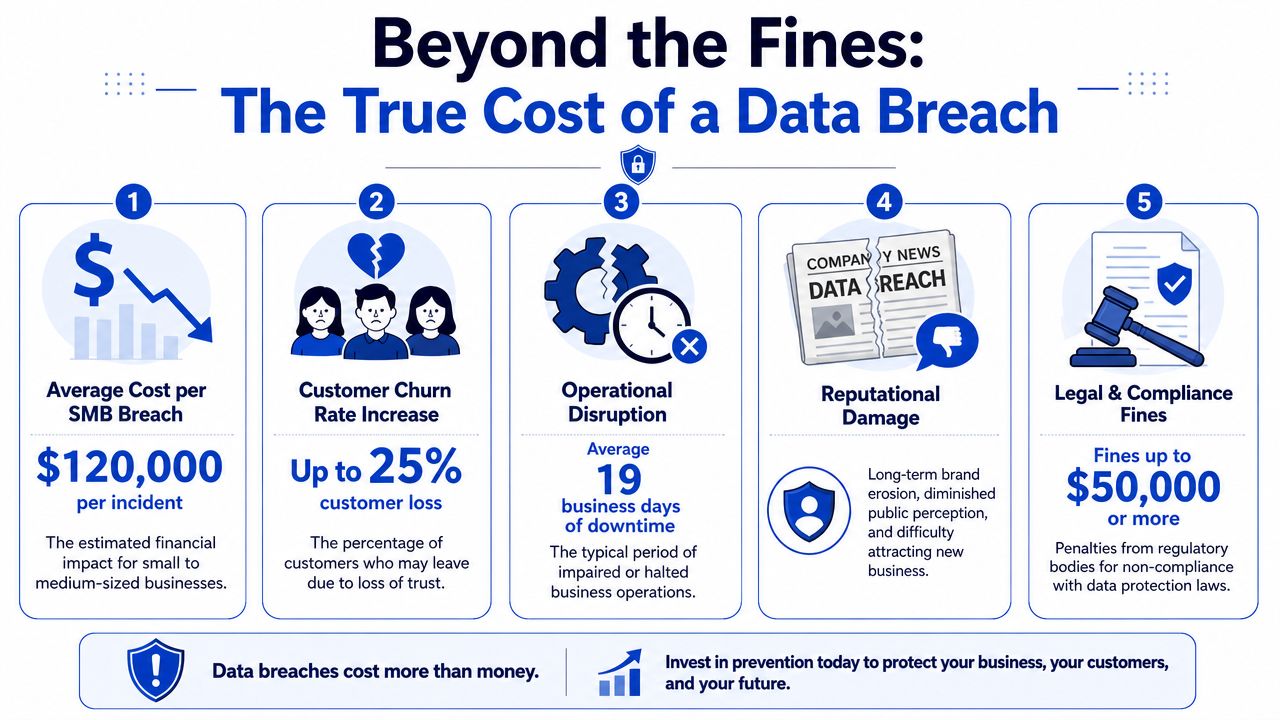
That is why breach cost discussions often miss the point for SMB owners. The headline number matters less than the chain reaction underneath it. Even a contained incident can trigger outside forensic work, legal review, customer notice analysis, contract disputes, insurer reporting, and weeks of internal distraction.
Where the money actually goes
A founder usually feels the damage in overlapping layers, not as a single invoice.
| Cost category | What it includes |
|---|---|
| Emergency response | Forensics, containment, outside counsel, crisis coordination |
| Notice and remediation | Customer communications, call handling, identity restoration support |
| Operational disruption | Paused sales cycles, delayed product work, vendor friction |
| Legal exposure | Regulatory inquiries, contract disputes, class claims, insurer disputes |
| Reputational fallout | Lost trust, lost renewals, slower enterprise procurement |
Some costs are immediate. Others show up later during diligence, renewal, or procurement.
I have seen companies spend more time answering customer security questionnaires after an incident than they spent on the original technical cleanup. That is a business problem, not just a security problem.
Why the impact spreads past IT
A breach changes how other people assess your company. Customers ask whether you can safely handle HR records, payment information, or account data. Investors and acquirers ask harder questions about governance, logging, vendor management, and whether the company followed its own policies. Banks, insurers, and enterprise buyers often do the same.
The answer is not always in your favor, even if the attacker took relatively little data.
For Washington companies, the spread of consequences also depends on what was exposed and whose information was involved. State notice rules may apply, but contracts often create separate duties with shorter practical timelines. A payment processor may require immediate escalation. A healthcare partner may demand a written incident summary. A public sector customer may insist on preserved logs and formal updates. If you need the state-law framework, this Washington data breach notification guide is a useful starting point.
The overlooked costs founders underestimate
Small teams often budget for outside counsel and a forensic vendor. They forget the secondary work:
- Reissuing credentials and rebuilding trust in affected systems
- Reviewing contracts to identify notice, indemnity, and security commitments
- Handling inbound questions from customers, employees, and vendors
- Documenting decisions for insurers, regulators, and possible litigation
- Delaying launches, fundraising work, or finance operations while leadership focuses on the incident
If the breach touches payment card data, the response can widen again through PCI requirements, assessor involvement, and merchant agreement issues. Founders dealing with that layer should review ThreatExploit AI’s PCI DSS insights to understand how testing and compliance expectations can affect post-incident decision-making.
Key takeaway: The technical event is only the starting point. The quality, speed, and discipline of your response usually determine whether the incident stays expensive or becomes existential.
That distinction matters more for startups than for large enterprises. A public company may absorb several weeks of disruption with dedicated legal, security, and communications teams. A Washington SMB with one finance lead, a fractional IT provider, and a founder handling customer calls can lose momentum fast, and that loss often outlasts the breach itself.
Your Legal and Regulatory Obligations
A breach becomes a legal problem before you know every technical detail. For a Washington startup or SMB, the first job is to identify which law sets the notice trigger, which regulator may care, and which contracts add duties that are stricter than the statute.
That analysis usually starts with Washington law. It does not end there.
The deadlines are different, and they stack
Founders often ask for a single notification deadline. There usually is not one. The timeline depends on who was affected, what data was involved, whether the data was acquired or only exposed, and whether another rule set applies because of your industry or customer base.
If the incident involves EU personal data and poses a risk to individuals’ rights and freedoms, the GDPR can require notice to the supervisory authority within 72 hours of awareness, as explained in the European Commission’s GDPR breach guidance.
In the United States, state breach laws vary. As noted earlier, some states move faster than others, and many require notice without unreasonable delay. If your company serves customers in multiple states, a Washington-based response still needs a multi-state review.
Washington businesses should start with the state rule set that applies to affected residents and then test whether federal or sector-specific obligations sit on top of it. A practical starting point is this guide to data breach notification laws in Washington.
Washington founders should focus on scope before messaging
The most common mistake I see is drafting the customer email too early.
First determine whether the event meets the legal definition of a breach under the laws that apply to your business. Then confirm whose data was involved, whether key safeguards such as encryption were in place, and whether law enforcement or a forensic investigation justifies a short delay. Those facts affect both whether notice is required and what the notice must say.
For Washington companies, this matters because the wrong initial characterization can create a second problem. If you tell customers their information was compromised and later learn the exposed data was encrypted, or that the affected records fall outside the statutory definition, you have created avoidable confusion, support burden, and credibility damage.
Contracts can create stricter duties than the statute
Your legal exposure is not limited to breach notification law. Customer agreements, vendor contracts, cyber insurance policies, payment processor terms, and investor diligence materials can all shape your obligations after an incident.
Payment card environments are a good example. A card brand issue may trigger forensic expectations, reporting duties, or remediation steps through merchant agreements even before a state regulator contacts you. Teams reviewing those obligations should read ThreatExploit AI’s PCI DSS insights to understand how testing and control maturity affect breach readiness and post-incident scrutiny.
Health data, consumer financial data, and student data can create the same kind of layered exposure. The practical point is simple. Do not let the IT team assess the event in isolation from legal and contract review.
The mistakes that increase liability
Four errors make breach response harder and more expensive:
- Waiting to classify the data. You cannot judge notice duties until you know whether the records include regulated personal information, health data, payment data, or credentials.
- Assuming Washington law is the only law that matters. Startups routinely store data on residents of several states and sometimes of other countries.
- Sending notices before the facts are stable. Corrections invite customer distrust and give plaintiffs’ lawyers language to work with.
- Ignoring written commitments. Security addenda, MSAs, and vendor terms often require notice to business partners on timelines that are shorter than public notice rules.
Good breach response is a sequencing exercise. Preserve facts, identify the governing rules, and communicate only what you can support. That approach protects customers and puts the business in a much stronger position if regulators, insurers, or investors start asking questions.
An Actionable Incident Response Plan for SMBs
The first hours matter more than founders expect. The wrong email, the wrong reboot, or the wrong statement to a customer can make forensic reconstruction harder and legal exposure broader.
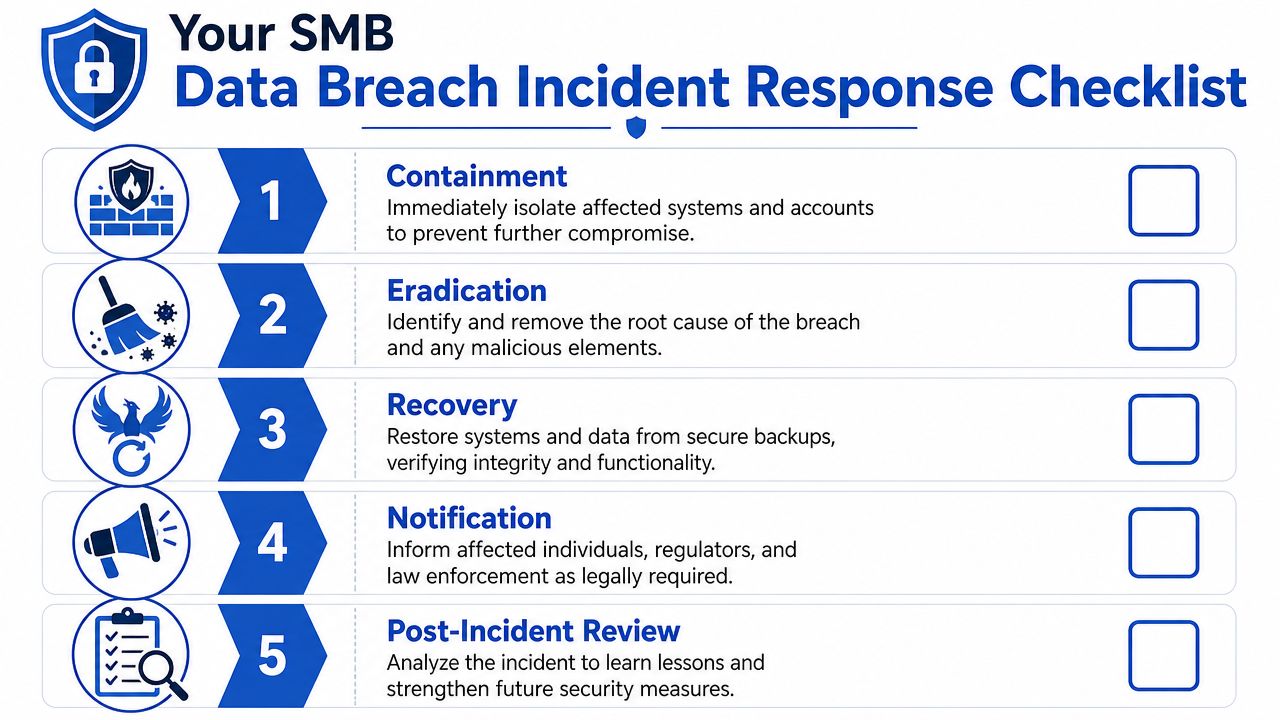
The first moves after suspicion
A practical SMB checklist looks like this:
-
Contain affected systems
Isolate compromised accounts, endpoints, storage locations, or SaaS sessions. Don’t give the attacker extra time. -
Preserve evidence
Don’t wipe everything immediately. Logs, access histories, screenshots, and system state often matter for legal analysis and insurance. -
Bring in counsel early
Privileged coordination can help structure the investigation, engage forensics appropriately, and reduce avoidable communication mistakes. -
Scope the event
Determine what data was involved, who may be affected, and whether the access was confirmed or only suspected. -
Prepare notices and remedies
Notifications should match the facts, not assumptions.
A more detailed legal-operational checklist appears in this cyber incident response plan resource.
What affected individuals may need
When Social Security numbers or financial information are exposed, the FTC’s guidance states that businesses should offer at least one year of free credit monitoring or identity restoration services, as set out in the FTC’s data breach response guide for business. That’s not just a goodwill gesture. In many cases, it’s part of a credible remediation package.
For the technical side of detection and visibility, companies modernizing cloud operations often benefit from better log correlation and alerting. Teams evaluating monitoring architecture may want insights into SIEM for cloud-native security from CloudCops GmbH as a practical companion to response planning.
What doesn’t work in a real incident
Some responses sound decisive but create new problems:
- Mass password resets with no scoping can lock out staff and obscure the timeline.
- Broad internal blame discourages truthful reporting.
- Press statements before forensic review can become discoverable contradictions.
- Restoring from backups too quickly can reintroduce the same weakness if the root cause isn’t fixed.
A disciplined response isn’t the fastest-looking response. It’s the response that preserves evidence, contains harm, and gets the facts right.
Proactive Defense and Building a Security Culture
The best breach response starts long before the breach. For startups and SMBs, the most effective controls are often cultural and procedural, not flashy.
A founder can buy software in a day. Building habits takes longer, but that’s what reduces preventable mistakes. Employees decide whether a phishing email gets reported. Managers decide whether access rights shrink when someone changes roles. Procurement decides whether a vendor gets sensitive data before proper review.
The controls that carry real weight
A practical prevention stack usually includes a few basics done consistently:
-
Multi-factor authentication everywhere it matters
Email, admin consoles, payroll, HR platforms, and cloud dashboards should never rely on passwords alone. -
Clear data classification
Teams protect data better when they know which information is confidential, regulated, or operationally critical. A legal-business primer on that topic appears in this explanation of data classification. -
Vendor due diligence
Many breaches start with third parties, shared systems, or inherited risk from outside tools. -
Routine employee training
Not generic slide decks. Short, recurring, role-specific training tied to real workflows.
For a concise incident-readiness perspective outside the Pacific Northwest, cybersecurity incident response for North Texas offers a practical reminder that response strength depends heavily on what the organization prepared in advance.
Security culture beats security theater
Security theater is policy nobody follows, tools nobody monitors, and access nobody audits. Security culture is simpler. It means staff know how to escalate suspicious activity, leadership accepts friction around sensitive systems, and the company treats customer data as something held in trust.
That approach is usually more durable than buying another dashboard. A smaller company with disciplined access controls and strong reporting habits often fares better than a larger company with expensive tools and loose internal practices.
Data Breach FAQs for Washington Businesses
When does the notification clock start in Washington
For Washington businesses, the working assumption is simple. The clock usually starts when the company discovers, or reasonably should have discovered, a breach. The exact trigger can get complicated if the facts are still developing, systems are spread across vendors, or residents in multiple states are affected. That is why founders should document the discovery timeline from the first alert, not from the day the team feels certain.
Are the rules different for healthcare companies
Yes. A healthcare startup may have to address Washington law, federal health privacy rules, contractual notice duties, and regulator expectations at the same time.
That changes the response. A security incident involving protected health information can require notice to agencies and, in some cases, public reporting obligations that do not apply to an ordinary SaaS company. Waiting too long to sort out which rule applies can create a second problem on top of the breach itself.
Does a lost company laptop count as a data breach
Sometimes.
An encrypted laptop with strong access controls presents a very different legal and practical risk than a device holding readable customer files, saved credentials, or an unprotected browser session. The answer turns on what data was stored locally, whether encryption was active, whether remote wipe was available, and whether anyone outside the company likely accessed the device.
What if the issue was caused by an employee, not a hacker
It can still be a breach. Washington founders sometimes picture breaches as an outside attack, but legal exposure often starts with an insider who accessed records without a business reason, sent data to the wrong recipient, or mishandled a shared drive. From a response standpoint, the source matters less than the facts. What was exposed, who was affected, and whether the company can show reasonable controls.
If data was exposed but there’s no proof anyone downloaded it, is it still a breach
Possibly. Companies rarely get perfect evidence.
Misconfigured cloud storage, public links, and exposed databases often leave an incomplete record. The key question is usually whether unauthorized access occurred, or can reasonably be believed to have occurred, not whether the company can prove exfiltration file by file. In practice, that is one of the hardest judgment calls in breach response, and one of the reasons early forensic review matters.
What should a Washington founder do first after discovering a possible breach
Contain the issue, preserve logs and devices, stop automatic deletion, and bring in legal counsel before the company makes broad statements to customers, employees, or investors. In Washington, that early sequence matters because the first few hours shape privilege, evidence quality, notification timing, and the credibility of every later update.
Washington businesses do not need panic. They need a fast, disciplined response tied to the facts, the data involved, and the laws that apply. For founders and companies that want practical guidance on breach readiness, notification duties, incident response, and broader cyber and data privacy strategy, By Design Law Firm & Legal Consultancy, PLLC provides Seattle-based counsel built for startups, SMBs, and growing technology-driven businesses.
Contact our law offices at (206) 593-1519 for a complementary consultation.