A board resolution is the formal written record of a board's decision, voted on and signed, that proves the company authorized an action. When a bank, investor, or regulator wants proof, this is the paper trail they expect to see.
That is usually the moment a founder realizes the email thread was never enough. The money is ready, the lease is on the table, or the financing is closing, and somebody on the other side asks for a board resolution before anything moves.
The Moment a Founder First Needs a Board Resolution
A founder often meets a board resolution at the worst possible time, right when a deadline is live and another party needs proof of authority. The bank wants to know the company approved the new account. The investor wants to see that the financing was properly authorized. The landlord wants more than a founder's signature and a promise that “the board is fine with it.”
That is where the document earns its keep. A board resolution is the company's formal record that the board of directors or trustees approved a specific action, usually by vote or, where permitted, by written consent. Cornell Law describes corporate resolutions as board actions adopted at a meeting and recorded in the minutes, often covering major decisions like changing ownership structure, voting in new board members, or authorizing access to corporate funds and loans, and it notes that modern templates usually include a date, resolution number, title, recitals, a final RESOLVED clause, vote record, and signature lines (Cornell Law on corporate resolution).
What It Is, and What It Is Not
A board resolution is not a memo. It is not a casual email chain. It is not a management instruction dressed up to look formal. It is the company's evidence that the right people approved the right act through the right process.
Practical rule: if a third party will later ask, “Who approved this, and where is the proof?”, a board resolution is usually the document that answers it.
For startups, that distinction matters because informal direction breaks down the minute outside verification enters the picture. A CEO can tell the team to move fast, but a bank, auditor, or investor is asking about authority, not enthusiasm. If the action is material, documented board approval is what turns a founder's intent into corporate action.
Founders working through a fundraise should keep the approval trail tight and organized, not scattered across inboxes and chat threads. A clean workflow is part legal hygiene and part survival, and it helps to manage your fundraising workflow before the closing table gets messy. For a more detailed look at the fundraising side of the equation, the related guide at By Design Law's funding and seeding resource is worth reading alongside the company records.
Anatomy of a Proper Board Resolution
A proper resolution reads like an auditable record, because that is what it is. Diligent's template guidance lays out the core compliance structure as a dated header, recitals that state the factual basis, operative RESOLVED clauses, secretary certification, and signatures or board approval records, with the voting outcome and responsible officers captured in the control trail (Diligent sample board resolution).
The Pieces That Actually Matter
Start with the header. It should show the date, a unique resolution number, and a descriptive title. That feels fussy until a banker or auditor is scanning a record book and needs to match one approval against another without guessing.
The recitals matter because they explain why the board is acting. They are the context block, and in a dispute they help show what facts the board relied on. The operative language then moves from setup to action, usually in a formulaic RESOLVED clause that states the approval in direct terms. A voting record should identify the directors and how each one voted, and the secretary's certification or authentication line helps prove the document is complete.
The cleaner the structure, the easier it is to defend later. Banks and opposing counsel both favor documents that do not force them to reconstruct the record.
A well-built resolution is a chain of proof. The board said what it needed to say, the vote was captured, and the record can survive a later financing, audit, or lawsuit. That is also why founders should keep capitalization records organized alongside board approvals, especially when the approval touches equity or financing work. A clean capitalization table management process keeps the board record aligned with who owns what and who had authority to act.
Types of Resolutions Every Startup Encounters
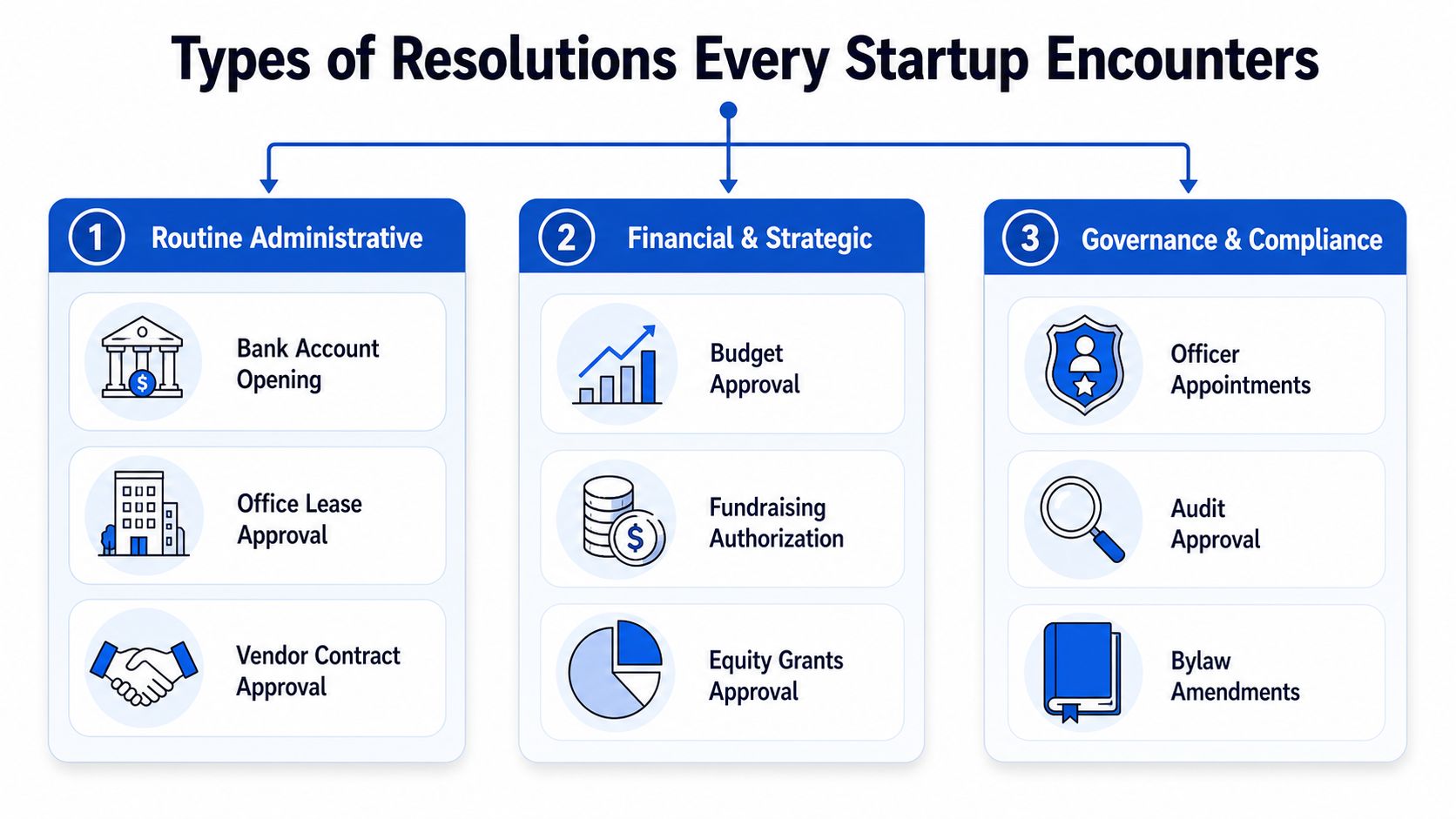
A founder walks into the bank with a signed stock purchase agreement, and the banker asks for the board resolution that proves the company had authority to act. That is the moment the category matters. Startup boards usually see the same three kinds of resolutions, routine administrative approvals, major corporate actions, and resolutions by written consent when no meeting is held. The written-consent path matters when the board can act without pulling everyone into a room.
Routine, Major, and Written Consent
Routine administrative resolutions cover the boring but necessary work, opening bank accounts, ratifying earlier acts, approving minutes, or authorizing a lease or vendor contract. Those documents usually move fast because the counterparty wants proof that the company had internal approval before the transaction closed.
Major corporate actions deserve more care. Issuing equity, approving a financing, hiring officers, adopting a stock option plan, or authorizing a loan should never be handled like a lunch-order decision. Cornell Law's description of typical corporate resolutions tracks that reality by pointing to ownership changes, new board members, and access to corporate funds and loans as the kinds of matters boards document in formal records (Cornell Law on corporate resolution).
Written-consent resolutions work differently because they avoid a meeting altogether when the governing documents and applicable law allow them. The point is simple, the board can approve action in writing, and the record should show each director's vote and the chair's or president's signature to complete the file.
Founders should classify the action before drafting anything. If the request is routine, keep the language crisp and document it. If it changes capital structure, financing terms, or authority levels, treat it like a real governance event, because that is how a bank, investor, or regulator will read it.
The cap table should match the resolution trail. When the company is authorizing equity or a financing, the board record and the ownership record need to tell the same story, which is why a good capitalization table management process belongs inside resolution discipline, not beside it.
Quorum, Notice, and the Vote Threshold That Makes It Binding
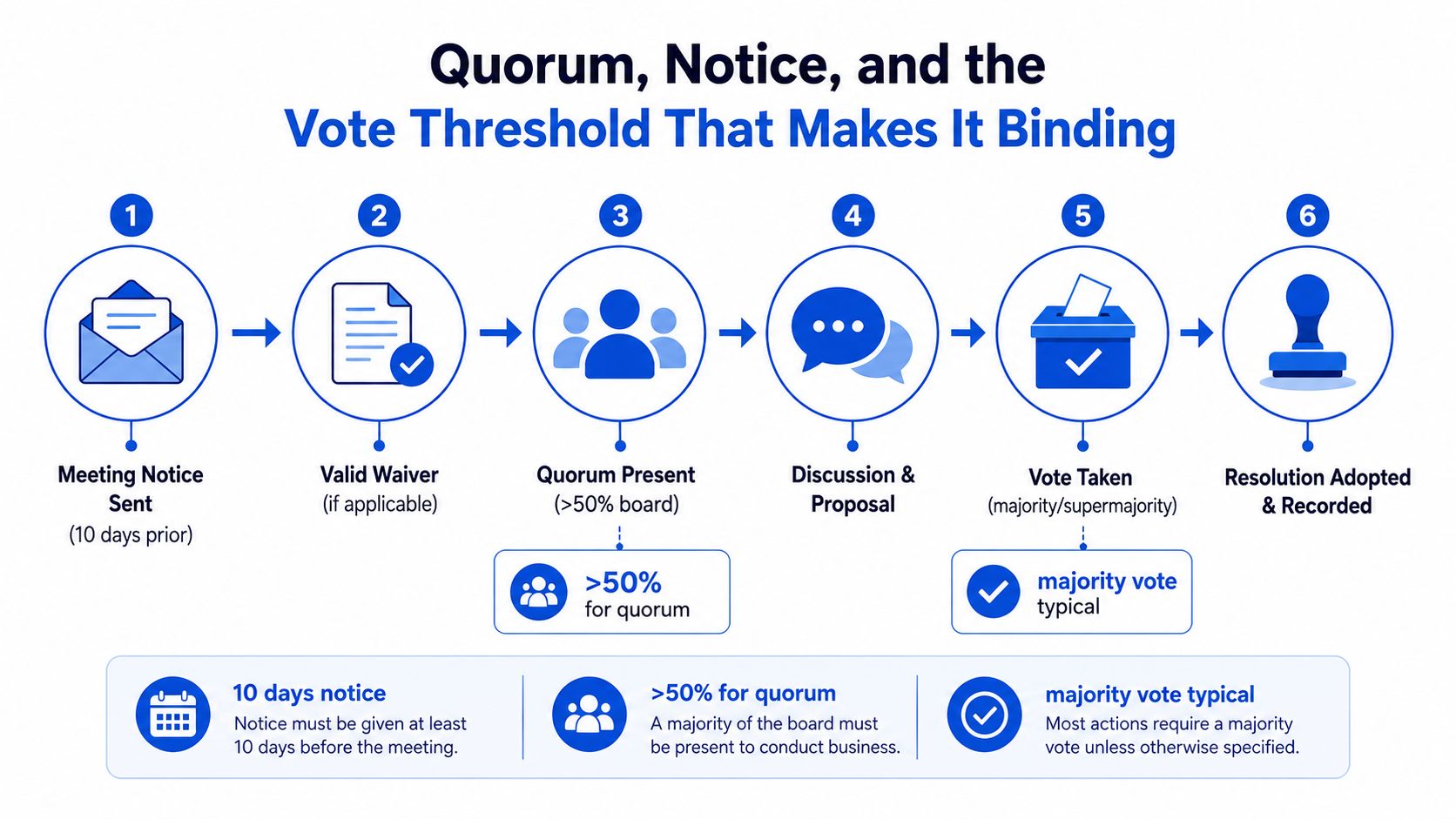
Founders usually get burned here in the same way, they assume agreement in the room equals authority. It does not. A resolution only carries weight when the board followed the company's own rules for notice, quorum, voting, and recordkeeping, and that is exactly what a bank, investor, or regulator will ask about when they want proof the company had the power to act.
The Mechanics That Make It Stick
A valid board resolution depends on proper authority, a properly convened meeting or permitted written action, adequate notice or waiver, quorum, the required vote threshold, and accurate recording or certification for third parties (Respicio on board resolution requirements). If any of those steps are missing, the paper may still exist, but it loses force as proof of corporate approval.
The failure points are predictable. A meeting held without quorum can collapse even if every director in the room is supportive. A consent signed by fewer than all directors fails when unanimous written consent is required by the law or bylaws. A resolution adopted without the required notice can trigger a fight over whether the board had authority to act at all.
Hard rule: if the process was broken, the document may look complete and still fail when authority is challenged later.
The clean way to think about it is straightforward. Get the right people, give the right notice, and secure the right vote at the right time. For a practical drafting standard, Board of directors structure matters because the resolution has to match how the company allocates authority, not how founders wish it worked. The signed record should still show who approved, who signed, and who certified the action, which is the kind of basic discipline BoardEffect describes in its board resolution guidance.
Written consent is the simpler route when a meeting is unnecessary and the governing documents allow it. Every director signs the same document, the company keeps it with the minutes, and the resolution becomes effective on the last signature date or on a later date the document states. That saves time, but it still has to track the company's authority structure, because a fast signature set is useless if the document does not match the board's actual power to approve the action.
Corporations Versus LLCs and the Washington State Overlay
A lot of generic articles talk as if “board resolution” is universal. It isn't. In Washington, the answer depends on the entity type, and that difference matters more than most founders expect.
Washington Corporations and Washington LLCs Are Not the Same
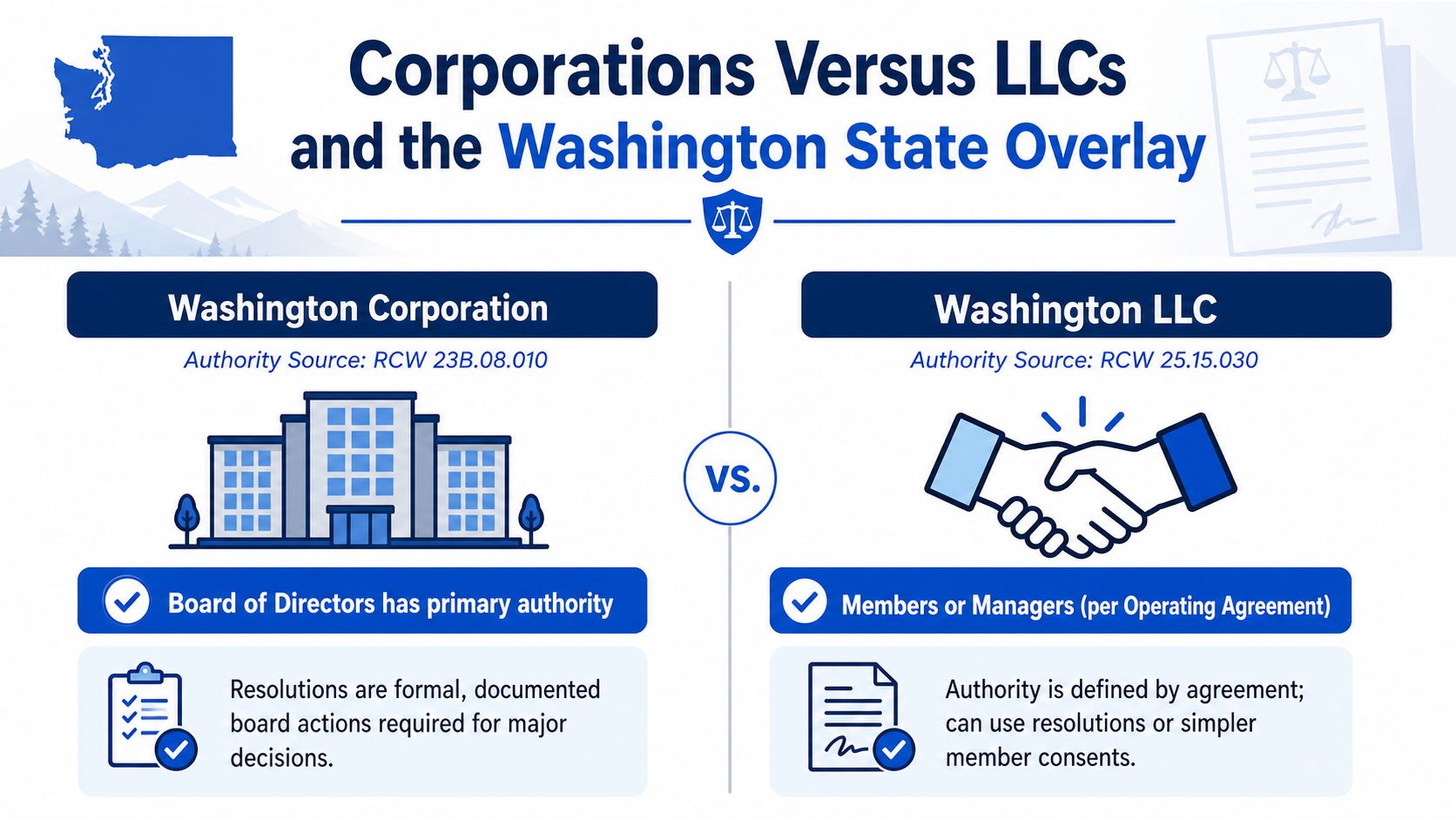
For a Washington corporation, the board is the central authority body, and formal resolutions are the standard way to document major actions. The state overlay is practical, not decorative. Washington corporate practice puts the burden of recordkeeping on the company, and that means the board record has to be available when somebody asks for proof.
For a Washington LLC, the operating agreement usually controls whether members, managers, or both can approve actions. In that setting, the analogous document is often a written consent of members or managers, not a board resolution at all. The term still gets used loosely in practice, but loose language creates risk if the company's internal documents call for something different.
The statutory distinction is worth keeping straight. Indian company law is one example of how specific the framework can be, with board resolutions governed by Section 179 of the Companies Act, 2013 and related administration running through the Ministry of Corporate Affairs and the Registrar of Companies, while member resolutions cover different corporate acts (Indian board resolution framework). That kind of specificity is the point, entity form changes the authority source.
Washington founders also need to watch state filings alongside the internal record. A resolution may authorize an action, but the company still has to make sure the related Secretary of State filings, if any, line up with the action taken. There is no state-level corporate resolutions registry, so the company owns the proof problem from start to finish.
For LLCs, the operating agreement is the first document to inspect, not the resolution template. A clean operating agreement often prevents future fights about whether the company needed a board-style approval at all, which is why the drafting rules at By Design Law's operating agreement guide matter long before a bank asks for proof.
A Sample Resolution You Can Adapt Today
A bank-account authorization is one of the most common startup resolutions, and it's also one of the easiest to get wrong if the template is sloppy. A good sample is short, direct, and built so a banker can tell who was authorized to act and what they were allowed to do.
Sample Bank Account Authorization Resolution
| Block | Sample Language | Why It Matters |
|---|---|---|
| Date and resolution number | “Resolution No. 2026-01, adopted on July 27, 2026” | Gives the document a unique identity for the record book. |
| Title | “Authorization to Open Business Bank Account” | Tells the reader the action without hunting through the text. |
| Recitals | “WHEREAS, the corporation needs a business banking relationship to conduct ordinary operations” | Shows the factual basis for the decision. |
| Operative clause | “RESOLVED, that the corporation is authorized to open and maintain a business account with the selected bank” | Makes the board's approval explicit. |
| Named authority | “RESOLVED, that [Officer Name] is authorized to execute bank forms and related documents” | Identifies the human being who can act. |
| Vote record | “Approved by majority vote of the board” | Captures the approval method. |
| Certification | “Certified by the secretary as a true and correct record” | Helps banks and counsel rely on the document. |
| Signature lines | Chair, secretary, or board approval lines | Shows the record was finalized, not just drafted. |
The sample is simple on purpose. If the action is equity issuance instead of a bank account, the recitals and operative clause should change to reflect the financing authority and the specific corporate act being approved. The structure stays the same, but the substance has to match the transaction.
That is the point founders miss. The form is reusable, the authority is not.
Drafting, Approving, Recording, and Preserving Resolutions
A resolution is only useful if the company can find it later. The drafting process, approval path, and storage discipline matter as much as the language on the page, because a document that cannot be produced is a weak document.
The Workflow Founders Should Actually Use
Usually the CEO or corporate secretary drafts the resolution, and counsel should review anything material. The document then circulates as part of a consent packet or appears as an agenda item for the board meeting. Once the board approves it, the company stores it with the meeting minutes, indexes it by resolution number, and keeps it in the corporate record book.
The worst failure mode is silent. The board agrees verbally, everyone moves on, and nobody reduces the decision to writing or preserves a signed copy. Then a bank, investor, or auditor asks for the record and the company is stuck reconstructing authority from memory.
Keep the minute book like a company asset. If it’s treated like a storage box, it will eventually act like one.
That recordkeeping point matters even more in startup environments where approvals happen quickly and people assume “we all agreed” is enough. It isn’t. A clean process protects the transaction and protects the company when somebody later questions whether the action was authorized.
For teams trying to keep approvals from getting lost in the weeds, improve document workflow efficiency before the next closing or board cycle starts. The legal rule is simple, but the operational habit is what keeps the proof intact.
Frequently Asked Questions About Board Resolutions
A written-consent resolution can be as valid as a meeting-held resolution when the governing law and company documents allow it, and that’s true in Washington and Delaware when all directors sign. The difference is procedural, not cosmetic, because the company still has to prove the action was authorized through the proper channel.
A founder can usually sign a resolution alone on a single-director board if the document clearly reflects that structure. The key is accuracy, not drama. The record should state that there is only one director and that the sole director is acting in that capacity, not pretending there was a multi-person vote.
Yes, a resolution can be electronic and signed digitally. Washington’s Uniform Electronic Transactions Act supports electronic records and signatures, and modern board portals are built around that reality. The caution is the same as with paper, the company still has to preserve the record, make the approval trail clear, and keep the final signed version with the corporate minutes.
A founder should also know that a board resolution is not a substitute for careful internal governance. It is a formal decision instrument, and that means the board, the secretary, and the company’s counsel or operators need to treat it as part of the legal record, not as administrative fluff. That mindset avoids the most expensive mistake, discovering too late that the company had action, but not proof.
By Design Law Firm & Legal Consultancy, PLLC helps founders and growing companies build clean corporate records, fix governance gaps, and document decisions the right way before a bank, investor, or regulator forces the issue. Visit By Design Law Firm & Legal Consultancy, PLLC to get practical help with board resolutions, corporate governance, and the rest of the legal stack that keeps your company moving. Contact our law office today at (206) 593-1519.