A startup dispute rarely arrives with a neat label. It shows up as a co-founder refusing to sign a financing update, a vendor missing deliverables before launch, a customer data issue that can't wait, or a trade secret concern that turns a calm Slack thread into a crisis. At that moment, the central question is no longer who is “right.” It's which process protects the company's cash, timeline, confidentiality, and strategic advantage.
For a Seattle founder, mediation vs litigation is usually a decision about control. Mediation can keep the matter private and move quickly toward a business solution. Litigation can force evidence into the open, preserve rights through court power, and create outcomes a private deal can't always deliver. The right path depends on the dispute, not on a reflex.
| Decision Filter | Mediation | Litigation |
|---|---|---|
| Cost | Usually far lower, with reported averages around $2,000 to $5,000 per party, and some U.S. estimates around $3,500 (Wolters Kluwer summary, GCAAM summary) | Usually much higher, with reported averages around $15,000 to $20,000 per party, and some U.S. estimates at $25,000+ (Wolters Kluwer summary, GCAAM summary) |
| Time | Often resolves in 2 to 6 months, and some summaries describe completion in a few days to a few weeks (GCAAM summary, Indian dispute-resolution paper) | Often takes 12 to 27.7 months, and can run much longer depending on motion practice and trial (GCAAM summary, Indian dispute-resolution paper) |
| Confidentiality | Usually private and business-friendly | Public filings and hearings are part of the process |
| Enforceability | Strong when reduced to a signed settlement or stipulated order | Strong through court judgment and enforcement powers |
| Control over outcome | Parties craft the deal | A judge, jury, or court process can impose the result |
A practical guide to structuring business disputes starts with the contract language itself, and this business dispute resolution resource is a useful starting point for that mindset. The table above is the short version. The details matter more once money, timing, or brand risk is on the line.
The Moment a Business Dispute Becomes a Decision
A founder usually doesn't wake up and decide to “litigate.” The trigger is more immediate. One side has stopped performing, one partner is threatening to walk, or an email thread has made it clear that the next move will shape the company's future.
That's when the dispute stops being emotional and starts being strategic. A SaaS company with a delayed implementation, for example, may need the vendor to keep supporting the product while the legal issue gets sorted out. A clean break through court might sound decisive, but it can also freeze operations, scare customers, and burn cash the company needs for payroll.
The first business question is not blame
The first question is which process protects the enterprise value that still exists. In many commercial matters, mediated resolution can preserve a working relationship long enough to finish a project, transfer data, or separate roles without turning every document into public evidence. Litigation can do the opposite, but it can also be the only path when the other side won't cooperate.
Practical rule: if the company still needs the other side to do something useful, start by asking whether a negotiated outcome can keep the business moving.
The business owner's instinct often leans toward speed, but speed alone is not the whole test. A rushed settlement that fails to protect IP, customer data, or governance rights can cost more later than a slower court process. A lawsuit can also become a distraction that lands the entire dispute in front of employees, customers, and competitors.
A more useful frame is simple. What outcome is needed, what level of certainty is required, and what level of public exposure can the company tolerate? That set of questions usually points toward either a private settlement process or a court-backed one, and the answer often changes once evidence, injunctions, or precedent come into view.
What Mediation and Litigation Are
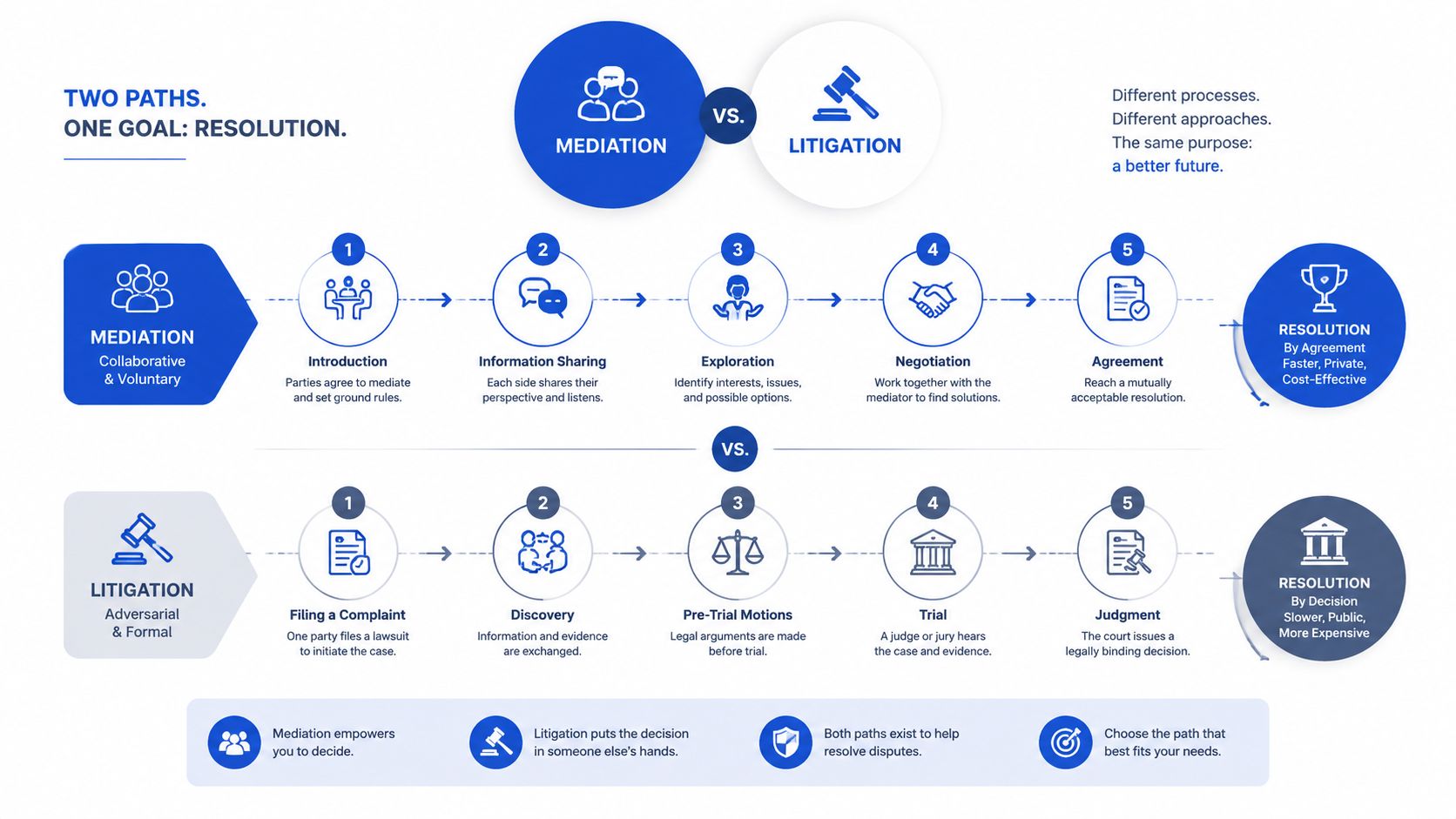
Mediation is facilitated negotiation. A neutral mediator guides the discussion, helps each side test options, and presses the parties toward a deal they can both sign. In a Washington commercial dispute, that agreement often becomes enforceable when it is written into a settlement contract or folded into a stipulated court order.
Litigation is a court process. It usually starts with a demand letter or pre-suit negotiations, then moves into pleadings, discovery, motion practice, trial preparation, trial, and sometimes appeal. In Washington, a business may end up in King County Superior Court, federal court in the Western District of Washington, or another forum depending on the claims and the contract.
Where each process ends
Mediation ends when the parties sign an agreement, or when they walk away without one. That flexibility is the point, because the process is built for voluntary resolution rather than imposed judgment. Litigation ends with a court ruling, a settlement on the courthouse steps, or a later enforcement phase if the judgment is ignored.
Mediation is not “less legal.” It is a different way to reach a legal result.
The strategic difference is who controls the substance. In mediation, the parties shape the business terms, payment structure, confidentiality provisions, and transition steps. In litigation, the court controls the procedural rules, and a judge or jury controls the outcome if the case does not settle first.
For a founder, that distinction matters because the wrong process can create needless friction. A straightforward payment dispute may not need the weight of discovery and motion practice. A trade secret claim or urgent contract breach can need that weight, because private negotiation alone may not stop the harm.
A clear understanding of the process also lowers false expectations. Mediation is usually not a mini-trial. Litigation is not just a louder version of negotiation. Each path serves a different business need, and the forum should match the problem.
Comparing the Two Paths Across Five Decision Filters
A Seattle company should sort mediation vs litigation through five filters, not slogans. The useful filters are cost, time, confidentiality, enforceability, and control over outcome. Once those are matched to the dispute, the better path usually becomes clear.
A startup founder rarely faces this decision in the abstract. The question is whether the company needs a fast business fix, a public ruling, a private deal, or a process that can hold up if the other side refuses to cooperate. In Washington, I also look at whether the dispute is really about a contract term, a payment problem, a relationship break, or conduct that needs court intervention, which is why a good contract dispute resolution guide belongs in the early review.
Here is the core comparison.
| Decision Filter | Mediation | Litigation |
|---|---|---|
| Cost | Often far lower, with reported averages around $2,000 to $5,000 per party and some U.S. estimates around $3,500 (Wolters Kluwer summary, GCAAM summary) | Often far higher, with reported averages around $15,000 to $20,000 per party and some U.S. estimates at $25,000+ |
| Time | Often resolves in 2 to 6 months, and some summaries describe much faster completion in a few days to a few weeks (GCAAM summary, Indian dispute-resolution paper) | Often takes 12 to 27.7 months, and can stretch beyond that |
| Confidentiality | Usually private, which helps protect deal terms, IP, and reputation | Court filings and hearings are public unless sealed or otherwise limited |
| Enforceability | Strong if turned into a signed settlement or court-approved order | Strong through judgment, contempt power, and formal enforcement tools |
| Control | High, because the parties design the solution | Lower, because procedure and final decision sit with the court |
The cost gap is often the first thing founders notice, but it is not the only one that matters. Mediation usually reduces spend because it limits discovery, motion practice, and the number of attorney hours needed to get to a result. Litigation can be justified, but if the dispute is mostly about money allocation, transition terms, or a one-time contract problem, the added process can consume value that the business needs to preserve.
The timing gap matters just as much. A company that needs to close a vendor dispute before a launch, or resolve a founder issue before a financing, usually cannot wait through a full court track if there is a workable settlement path. That is also where mediation fits with the practical reality of startup operations, including issues tied to meeting records and document retention, especially if you have to navigate meeting recording compliance.
Confidentiality is another real dividing line. Mediation keeps the discussion private, which helps when the dispute touches IP, customer relationships, pricing, or a founder breakup that could spook employees or investors. Litigation can be narrowed with sealing orders, but the default in court is public process, and that changes bargaining behavior.
Enforceability is where founders often want a straight answer. A mediated deal becomes meaningful when it is written well, signed correctly, and, where needed, turned into a court-enforceable order or settlement agreement. Litigation gives you a judgment and formal enforcement tools, but those tools do not help if the company needed a faster business result than a court can deliver.
Control over outcome is the last filter, and for many companies it is the one that decides the case. Mediation lets the parties build the business solution, payment schedule, release language, confidentiality terms, and transition plan. Litigation gives control to the judge or jury, which can be the right answer when the dispute must be decided, but it is a poor fit when the business wants to shape the exit.
The counterintuitive part is settlement probability. Commercial mediation sources report roughly 70% to 80% of mediated cases settle, and one JAMS-related paper found about 85% of commercial matters submitted to mediation end in a written settlement agreement (Wolters Kluwer summary, JAMS-related paper, GCAAM summary, Indian dispute-resolution paper). That makes mediation more than a polite first step. It is often the most efficient way to reach a binding result when the parties still have room to compromise.
Bottom line: the cheaper path is often also the faster and more settlement-rich one, but only if the dispute can be solved by agreement.
A practical way to start is to ask whether the dispute is really about a business fix, or whether it needs court power to protect the company. If the answer is the former, mediation should usually be the first move. If the answer is the latter, litigation may be justified from the start.
Where Mediation Wins and Where It Struggles
Mediation is strongest when the company still has something to preserve. That might be a vendor relationship, a co-founder tie, a customer account, or a brand that would take damage if the dispute became public. It also works well when the core issue is money allocation, workflow, or transition terms rather than a need for a ruling.
The best business mediations are usually the ones where both sides have enough information to bargain intelligently and enough flexibility to make a deal. In that setting, mediation’s settlement rates matter because they show the process is not just symbolic. Commercial matters often end in agreement, and that is the point of using a neutral instead of a judge (Wolters Kluwer summary, BC justice review).
When mediation starts to fray
Mediation struggles when one side needs discovery, emergency injunctive relief, or a ruling that will matter beyond the immediate dispute. Harvard’s Program on Negotiation notes that litigation is often the better tool when formal evidence-gathering or enforcement is necessary, while mediation is better when the parties want to craft their own result and preserve relationships (Harvard PON). That distinction is critical in trade secret, data, and founder-control disputes.
It also struggles when there’s a serious power imbalance. If one side can’t speak freely, lacks basic information, or feels pressured into accepting a lopsided deal, mediation can become an expensive detour rather than a solution. In those cases, the court process may be the safer lever.
For a founder-co-founder split, mediation works well when the dispute is really about valuation, role separation, and the timing of a buyout. It does not work well if one founder is actively hiding records, moving assets, or stripping the company of access rights. A private conversation cannot replace a legal hold, a subpoena, or a court order.
Where Litigation Wins and Where It Hurts
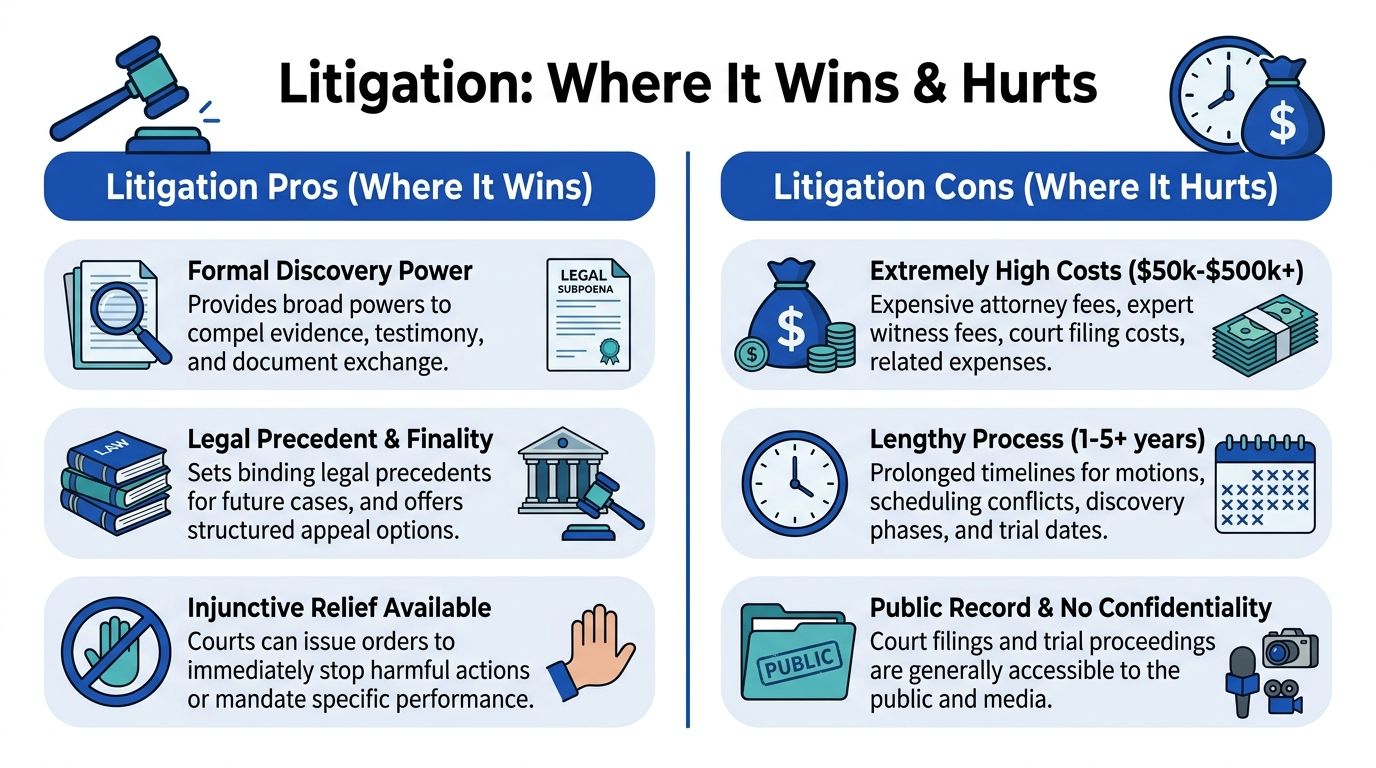
A startup does not choose litigation in the abstract. It chooses it when the company needs the court’s coercive tools to change the other side’s behavior, preserve evidence, or get a ruling that carries weight beyond a private settlement. Discovery can force documents and testimony into the open. Emergency motions can seek injunctive relief. A judgment can bind the parties, and in some disputes the ruling itself matters as much as the money.
That is why litigation belongs in some technology-sector disputes. A trade-secret misappropriation claim, for example, may require fast preservation of evidence, targeted restraining relief, and formal process that reaches beyond a private conversation. If the harm is ongoing, mediation alone may be too slow and too voluntary. In Washington practice, that can mean filing early to protect the company before the evidence disappears or the injury spreads.
Practical insight: when the dispute turns on what the other side knows, has hidden, or might destroy, the court process becomes much more valuable.
Litigation also comes with a steep trade-off. It takes time, and it opens the dispute to public view. For a startup, that can pull internal disagreements into the open, create distraction for the founding team, and unsettle investors or key customers. A claim that starts as a narrow contract fight can become a public record of emails, drafts, and internal decisions.
Meeting records can widen that exposure faster than many founders expect. AONMeetings has a useful discussion on how recordings can create full-scale legal discovery, and that issue matters because once documentation exists, litigation can broaden the paper trail in ways many companies do not anticipate (AONMeetings discussion on meeting recording compliance risks).
The litigation trade-off in business terms
Litigation is often commercially self-defeating for routine payment disputes. Even when the underlying claim is strong, the process can consume attention and legal spend that the business would rather put into customers and product delivery. That is why many companies reserve litigation for disputes where the court’s power is needed, not as a default response to every conflict.
The better mindset is surgical use. If the company needs an injunction, discovery, or a precedent-setting answer, litigation belongs on the table. If the company mainly needs a business solution, litigation can be the wrong first move. A well-drafted dispute-resolution clause can also help the company line up the right forum before the conflict turns urgent, and dispute resolution clause drafting for startup contracts is where that planning starts.
Matching the Process to Startup and Tech Disputes
Different disputes call for different tools. A founder equity fight, a vendor breach, a privacy incident, and a trade secret claim may all look like “conflict,” but they are not the same problem. The right forum depends on what the company is trying to protect.
Founder and equity disputes
When the issue is valuation, vesting, role changes, or a possible breakup, mediation is usually the first stop. It gives the parties room to separate ownership from day-to-day control, and it keeps the conversation narrow enough to reach a practical exit. If one founder is stripping access, hiding records, or threatening the cap table, litigation may need to start earlier.
Vendor and SaaS contract breaches
If the vendor still has to deliver something important, mediation often preserves the project while terms get reset. If the breach affects uptime, data access, or customer obligations, the company may need litigation to force performance or preserve evidence. A court filing can also reset a stalling counterparty who believes delay helps them.
Customer data and privacy incidents
These disputes often need a dual track. Mediation can address indemnity, remediation, and commercial allocation, while litigation may be needed if records must be preserved or if the incident creates a live legal fight over responsibility. A fast private deal is useful, but only if it doesn’t weaken the company’s ability to respond to regulators or affected customers.
Trademark, trade secret, and AI governance disputes
Trade secret and trademark fights often turn on enforceability and speed. If the misuse is ongoing, litigation is usually the tool that can stop the harm. AI governance disputes are more varied, but they often start as internal policy and contract problems, which means mediation can solve them before they become public.
For a routine commercial disagreement, mediation is usually the cleaner first move. For urgent IP harm, it’s often better to seek court relief and still keep settlement talks open in the background. The most efficient posture is often not either-or, but sequence and pressure management.
A Practical Framework for Choosing Between Mediation, Litigation, and Arbitration
A founder usually has to choose the path after the first serious demand letter, missed payment, or breakdown in a key vendor or customer relationship. The right move depends on the contract, the pressure on the business, and how much risk the company can tolerate while the dispute is still unresolved.
Start with the clause. If the agreement already requires mediation or arbitration, that language should drive the process unless both sides agree to change it. If you want a closer look at how these provisions are built, the dispute resolution clauses guide is a useful reference when the contract itself needs to be reviewed. If the clause is silent, or if the problem has already turned urgent, then the practical question becomes whether the company needs court relief, private settlement talks, or a formal process that can compel evidence.
The five filters are the ones I use most often in Washington practice: cost, time, confidentiality, enforceability, and the relationship between the parties. Cost matters because early mediation can keep legal spend contained, while litigation usually forces the business to pay for pleadings, discovery, motion practice, and more attorney time. Time matters because some disputes can wait for a negotiated resolution, while others keep hurting the company every day they remain open. Confidentiality matters when trade secrets, customer data, pricing, or reputation are at stake. Enforceability matters when the other side may ignore a handshake deal. Relationship matters when the parties may still need to work together after the dispute ends.
A short decision rule
- An arbitration clause already governs the dispute: follow it unless both sides agree to a different path.
- The company needs immediate court relief: go to court first, then keep settlement talks open.
- Records, witnesses, or third-party documents matter: litigation usually gives you the stronger tool set.
- The business relationship still has value: mediation is often the better first step.
- Confidentiality is a priority: mediation or arbitration usually fits better than open court.
For Washington startups, the best answer is often a hybrid plan. That usually means mediation first, court only if the other side refuses to engage or the company needs immediate relief, and arbitration only when the contract already points there or the business wants a private forum with a binding result. Arbitration can work well, but hearing logistics still matter, especially if testimony depends on language access or technical witnesses, which is why the guide to arbitration interpreting belongs on the checklist.
A layered approach also gives the company room to protect its bargaining position. It keeps settlement in play without giving up the ability to enforce rights, preserve evidence, or seek an injunction if the facts demand it. In Washington practice, that balance is usually better than choosing a single path too early.
Preparing for Mediation or Litigation in Washington
Preparation drives outcome more than posture does. Before mediation, the company should identify the documents that move the deal, including the contract, key emails, payment records, access logs, and any board or member approvals. The mediator should have subject-matter familiarity, because a SaaS pricing dispute and an IP assignment dispute do not need the same kind of facilitation.
BATNA analysis matters too. A founder who knows the best alternative to agreement can evaluate whether the settlement offer is better than the court path, not just quieter. The most productive mediations are usually the ones where the company has already decided what it can live with.
A practical Washington checklist
- Preserve evidence early: send a litigation hold before files disappear.
- Map the venue: confirm whether state court, federal court, or arbitration best fits the claim.
- Control communications: stop casual Slack debate that can later become discovery.
- Quantify spend: set a realistic legal budget and identify the decision points that could change it.
- Draft for the next dispute: tighten contract language before the current one ends.
For litigation, preservation becomes nonnegotiable. Documents, chat logs, meeting notes, and access credentials can matter as much as the underlying contract, and once a case starts, discovery can spread quickly. A founder who waits too long to preserve evidence often loses an advantage before the first hearing.
A solid drafting discipline helps too. The same attention that turns messy facts into a polished brief also helps organize the early record, and this from research to polished brief resource gives a useful sense of how counsel turns facts into a legal narrative. That narrative can shape settlement advantage long before trial.
Two clause patterns often help in Washington commercial deals. A tiered clause might require negotiation, then mediation, then arbitration if settlement fails. An exclusive-jurisdiction clause might direct any court action to Washington courts, which can reduce forum fights and keep the dispute anchored where the business operates.
A founder facing a live conflict should not wait for the other side to set the pace. The right move is to preserve evidence, review the contract, identify the core business objective, and choose the forum that protects it. Once that happens, the process stops being reactive and starts being strategic.
By Design Law Firm & Legal Consultancy, PLLC helps Washington startups and businesses sort out contract conflicts, IP disputes, privacy incidents, and governance breakdowns with practical legal strategy. If a dispute is starting to threaten cash flow, confidentiality, or control, visit By Design Law Firm & Legal Consultancy, PLLC to discuss the right path before the problem gets more expensive. Contact our law office today at (206) 593-1519.