The envelope arrives on a bad day. Payroll has already been processed, a contractor invoice is waiting approval, and someone in operations just noticed a mismatch between the books and a federal filing. That is the moment most founders learn the hard truth, federal tax administrators are not a background function. They are an active part of how a business gets paid, corrected, questioned, and sometimes punished.
For a startup or SMB, the first IRS notice rarely means disaster. It usually means a record did not line up, a return was filed late, or a third-party report created a mismatch. What matters is not panic, it's discipline. Businesses that treat notices like ordinary operations, with clean records, fast triage, and the right escalation rules, do better than businesses that improvise after the deadline has already passed. Practical primers like tax compliance for small businesses are useful because they reinforce a simple reality, compliance is a workflow, not a once-a-year event, and the same is true for ownership filings and transparency obligations under corporate disclosure rules.
The right mental model is straightforward. Federal tax administrators collect, match, question, and enforce. If a business owner understands where the friction points are, notices stop feeling mysterious and start looking like operational problems that can be managed.
Why Federal Tax Administrators Matter to Your Business
A founder gets the letter, opens it in the office kitchen, and immediately wants to know whether the company is in trouble. That reaction is normal. The core issue is not the envelope, it's what it signals: the IRS has entered the business's operating rhythm, and that changes how payroll, bookkeeping, and risk management need to run.
The IRS is the federal revenue service responsible for collecting U.S. federal taxes and administering the Internal Revenue Code, which makes it the central federal tax administrator in the United States. In FY 2025, it collected $5.3 trillion in gross taxes, processed 271.4 million tax returns and other forms, and issued $638.8 billion in tax refunds (IRS data). That scale matters to business owners because even small filing errors can be absorbed into a very large system that still notices patterns, mismatches, and missing documents.
What founders actually feel first
Most businesses meet federal tax administrators through friction, not formality. A payroll deposit is off by a day. A contractor gets a 1099 that doesn't match the books. A refund is delayed because a return was flagged for review. Those are not abstract compliance issues, they are cash flow issues, vendor issues, and management issues.
The IRS also provides direct taxpayer support at scale. In FY 2025, 50.4 million taxpayers were assisted by calling or visiting an IRS office (IRS data). That tells founders something important, the agency is not only a collector. It is also a support and resolution channel, which means businesses should treat it like any other high-stakes service process, with documentation, tracking, and escalation rules.
Practical rule: if a tax issue affects cash, payroll, ownership records, or refund timing, it belongs in the operating calendar, not in someone's memory.
For owners who rely on contractors, outsourced bookkeeping, or a part-time controller, the risk is the same. The IRS does not care that the person who prepared the return left the company. It cares whether the filing is correct and whether the business can prove it. That is why even small firms need a simple response plan before the first notice shows up.
How Federal Tax Administrators Operate
Federal tax administration works like a funnel. At the top are registrations, forms, and reporting. Downstream are matching, assessment, collection, and audit. The point is not to process paper. The point is to identify what was reported, compare it to what should have been reported, and move noncompliant cases into enforcement channels.
The IRS is the agency charged with implementing, administering, and enforcing tax laws enacted by Congress. Its mission includes collecting taxes, assisting taxpayers, resolving incorrect or fraudulent filings, and administering benefit programs tied to the tax code (IRS mission and authority). Business owners should treat the IRS as an operating system for federal revenue, not as a single office that merely receives returns.
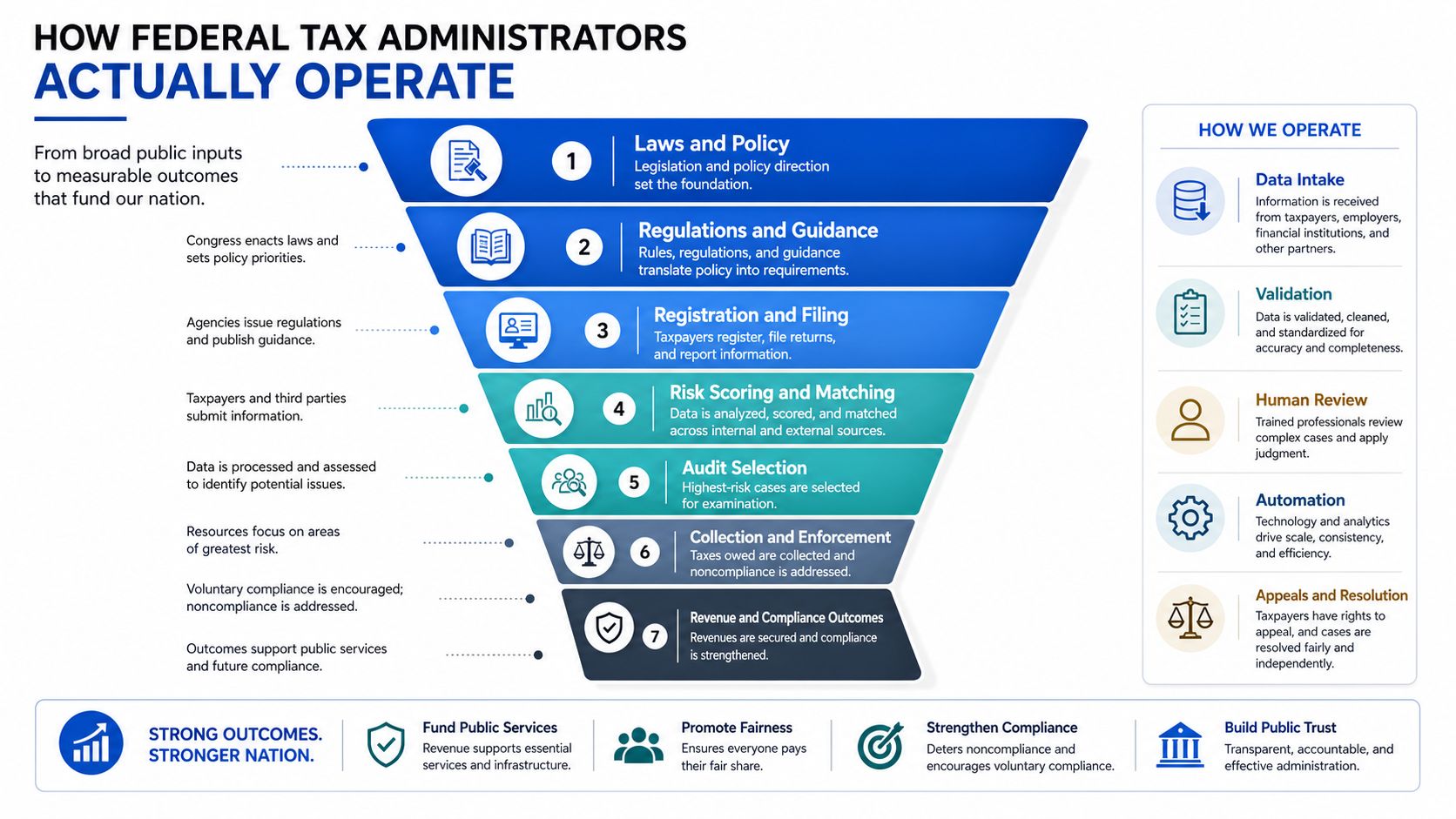
The compliance cycle drives the system
The IBFD handbook describes the core functions of tax administrations as taxpayer identification and registration, return and third-party information processing, assessment, enforced collection, and audit-based verification. It also notes that tax administrations prevent and combat fraud, which means the work is driven by data matching, risk scoring, and enforcement sequencing rather than simple form handling alone (IBFD handbook_final_web_0.pdf)).
That structure explains why businesses get notices months after a filing. The system receives the return, compares it to third-party information, then decides whether the mismatch is serious enough to pursue. If it is, a notice goes out, and that notice is usually the first visible step in a much longer internal process.
A founder should read that sequence as a workflow problem, not a mystery. If records are clean, responses are timely, and the paper trail is consistent, the business stays on the low-friction side of the funnel. If payroll records, contractor files, or receipts drift out of sync, the system notices.
Use disciplined vendor management, especially when contractors, bookkeepers, and payroll processors touch the same data. A simple process review with vendor management best practices reduces the chance that a third party creates the mismatch your company has to defend.
Authority sits inside Treasury, not outside it
The IRS is led by a commissioner of internal revenue appointed to a five-year term by the president (IRS Data Book). The agency sits inside the Department of the Treasury, which matters because founders sometimes imagine the IRS as a disconnected enforcement body. It is part of a formal federal administrative structure with hierarchy, oversight, and institutional memory.
The practical takeaway is direct. Once you understand the funnel, a notice stops looking random. It becomes a clue about where the system found a mismatch, which tells the owner whether the fix is bookkeeping, payroll, documentation, or legal response.
Common Business Interactions with Federal Tax Administrators
Most business owners only think about the IRS when something goes wrong, but the contact points are more ordinary. Filing returns, paying payroll taxes, issuing information returns, and responding to correspondence are all routine interactions. The risk level changes depending on whether the business is merely reporting facts or whether it is creating data that can trigger a mismatch.
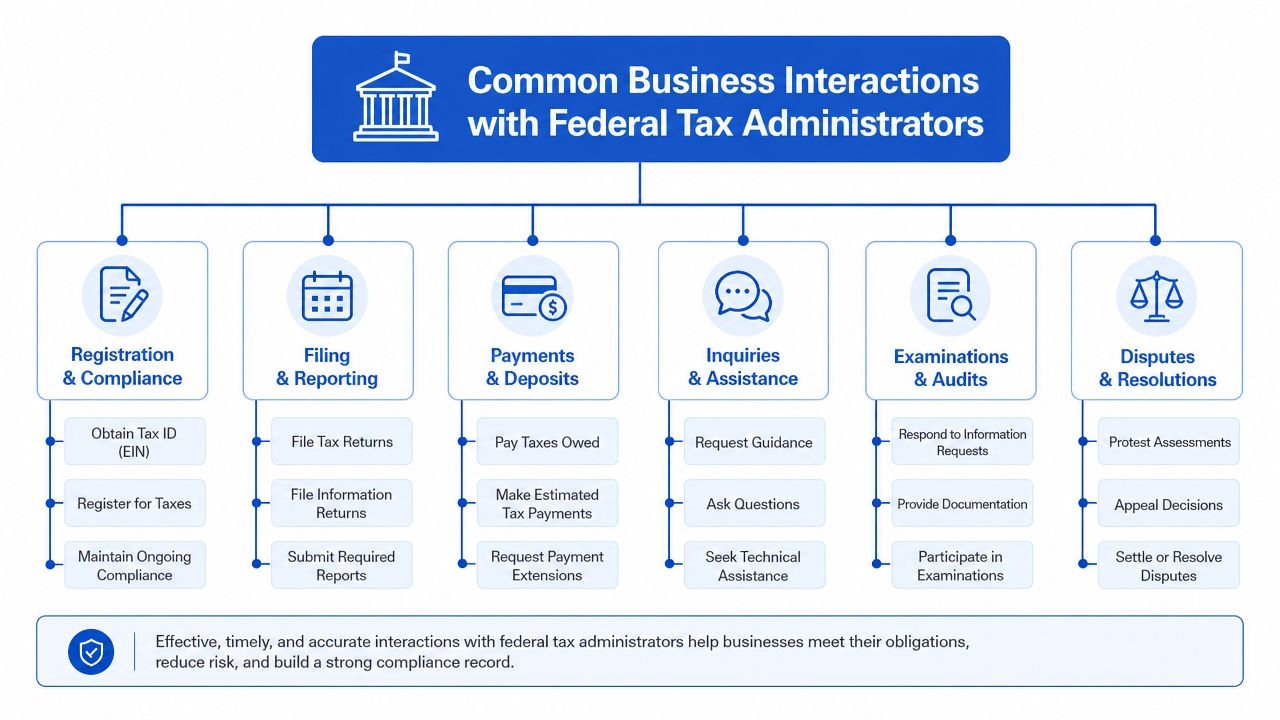
Routine reporting turns into risk when records drift
A startup that pays employees, contractors, and vendors is already in the tax system whether it feels ready or not. Payroll withholding, quarterly filings, annual returns, and information returns all create records that federal tax administrators can cross-check. A mismatch between what the business reported and what a bank, contractor, or marketplace reported is often enough to generate a notice.
Contractor classification becomes expensive when a tech company treats someone like a contractor in the ledger but like an employee in day-to-day operations, inviting payroll tax problems. An e-commerce business can also trip over marketplace reporting when gross receipts, refunds, and fees are not reconciled carefully. The issue is not just accuracy, it's whether the business can explain every number without improvising.
If the numbers cannot be reconciled from source documents, they are not ready for filing.
The private-sector tax administrator role is built around this same reality. Tax administrators may work internally for one company or externally as consultants, and they focus on compliance, reporting, and tax-related objectives rather than general bookkeeping (Indeed overview). That matters because a bookkeeper who does not understand tax consequences can still enter clean-looking numbers that create ugly compliance exposure later.
For vendor-heavy businesses, the problem often starts upstream. A messy onboarding process means missing W-9s, unclear entity types, and inconsistent payment records. A useful vendor-management framework helps keep tax files defensible, especially when contractors change often, as discussed in vendor management best practices.
Enforcement touchpoints are not all equal
Notices are common. Audits are more serious. Liens, levies, and collection actions are the point where a business's banking and credit relationships can be affected. The IRS also closed 497,621 tax return audits in FY 2025 and recommended $26.8 billion in additional tax (IRS Data Book). Those numbers show that examination is not rare, and it is not ornamental.
The business owner's job is to distinguish between a math correction and an escalated dispute. A notice about a missing form is one thing. A notice that questions the existence of income, payroll classification, or deductions is another. The second category is where legal review becomes valuable fast.
California's Tax Administrator I classification shows how this looks inside government. The role works under a Tax Administrator II and serves as a technical specialist for audit and compliance work (California job classification). That hierarchy reflects the same reality businesses face, tax administration is specialized, layered, and driven by compliance enforcement.
Your Workflow for Responding to IRS Notices and Audits
When a notice arrives, the clock starts immediately. The mistake most businesses make is treating every IRS letter like the same problem. They are not the same, and the wrong response can turn a manageable file into a mess that takes months to unwind.
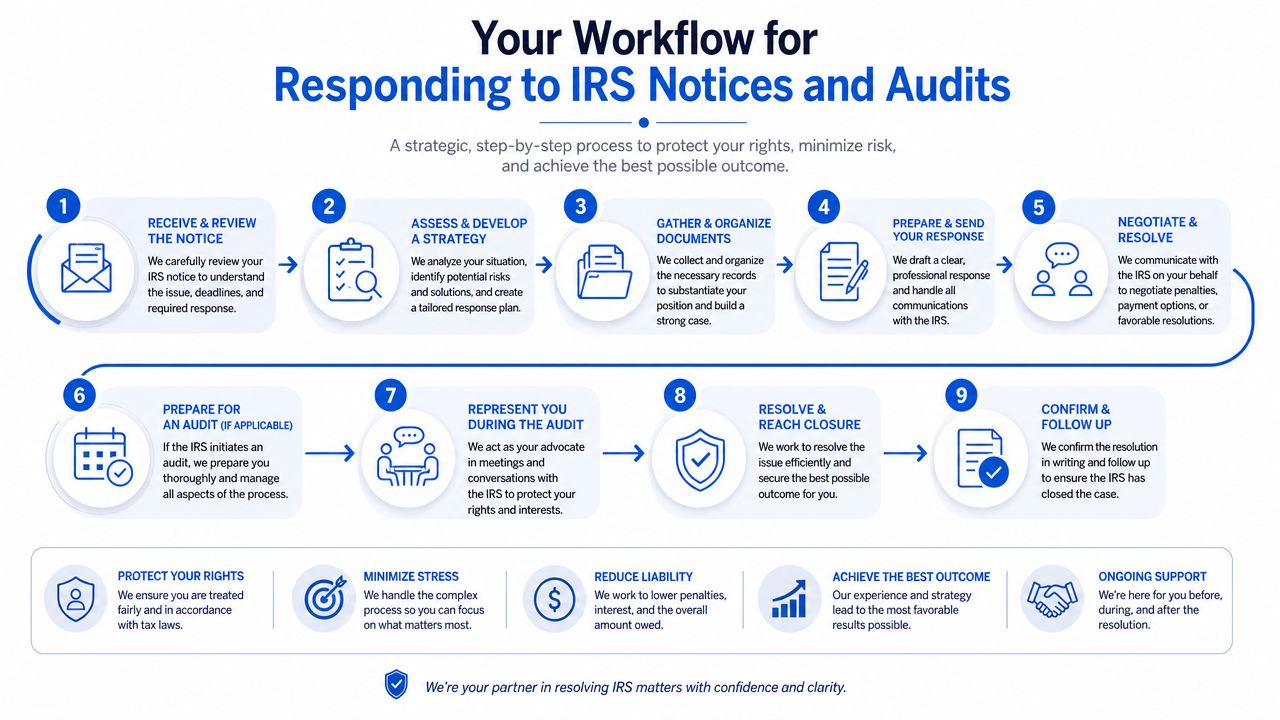
The first move is triage. Identify the notice type, the tax year, the issue raised, and the response deadline. Then pull the filed return, source documents, payroll records, and any prior IRS correspondence into one folder. If the deadline is short or the letter alleges a serious issue, the owner should stop debating the facts in email and start organizing the record.
A response workflow that actually works
- Date the notice the day it arrives. The postmark matters, but the business should treat the receipt date as the internal trigger.
- Identify the tax issue. Missing form, underpayment, information mismatch, audit request, or collection action.
- Freeze the record set. Lock the books for the relevant period so nothing gets overwritten while the response is being prepared.
- Assign one owner. A bookkeeper, controller, or office manager can coordinate, but one person needs final responsibility.
- Decide whether the issue is factual or legal. Simple math correction, or something that affects classification, deductions, ownership, or fraud exposure.
- Gather source documents. Bank statements, invoices, payroll registers, contractor agreements, and prior filings.
- Draft a clean response. Short, factual, and supported by attachments.
- Escalate when the issue is strategic. That includes proposed assessments, field audits, or anything suggesting intentional misreporting.
- Track the case to closure. Save every letter, confirmation, and call log in one place.
A clean audit trail changes outcomes. Tools and workflows that strengthen document tracing, like how WP TieOut strengthens audit trails, matter because IRS disputes are won and lost on whether the business can reconstruct the story behind the numbers.
When the response should stop being internal
Internal handling works when the issue is mechanical and the documents are clean. It breaks down when the notice alleges a pattern, asks for broad records, or touches payroll, ownership, or fraud risk. A business should also stop DIY handling if multiple people have already explained the issue differently.
Bottom line: the faster the government's letter starts asking for narrative explanations instead of one missing number, the more likely legal counsel will change the result.
There is a difference between sending a correction and making a legal response. A lawyer can control privilege, frame the facts without over-disclosing, and negotiate from a position that protects the business if the file gets bigger. The business can often handle a first-pass math issue internally, but it should not bluff through an audit.
A useful reminder for founders comes from business litigation practice. Disputes become harder to contain once the paper trail starts telling a mixed story, which is why what is business litigation is worth understanding before a tax issue turns into a broader conflict.
The Hidden Compliance Gaps Most Businesses Overlook
The usual tax story says enforcement drives compliance. That's incomplete. A business can be honest and still file badly if the people touching the return do not understand the rules, or if the preparer is cheap, fast, and unregulated. Federal tax administrators know this, and business owners should stop pretending otherwise.
The National Taxpayer Advocate's 2024 report says the IRS should build a strategic tax-literacy plan with standardized metrics, stakeholder input, and outreach designed for vulnerable groups such as immigrants, older adults, people with disabilities, and low-income taxpayers (Taxpayer Advocate report). That is not just a public-policy note. It is a warning that tax confusion creates compliance failures before enforcement ever begins.
Why literacy is a business risk
Low tax literacy shows up in ordinary business mistakes. A founder misunderstands contractor rules. A manager misses a payroll deadline. A controller files a return correctly but cannot explain why the reported numbers changed from one quarter to the next. Those are not malicious acts, but they are still compliance problems.
The report's emphasis on public education matters because it treats administration partly as a communications problem. Businesses should do the same. If owners, managers, and bookkeepers cannot explain the basic tax posture of the company in plain English, the company is already exposed.
Why preparer quality matters just as much
A Senate hearing record on improving tax administration states that Congress should give the IRS authority to set minimum standards for unenrolled tax preparers and override the Loving line of cases that limits that authority (Senate hearing record). That's the hidden flaw in many tax-administration discussions. They assume the taxpayer owns every mistake. In reality, a bad intermediary can create the mistake and move on.
For small businesses, that means the vetting process matters as much as the filing process. The owner should ask who prepares the return, whether the preparer understands the business model, and how backup documentation is stored. If a preparer cannot explain a position clearly, the business is renting risk.
A practical way to close the gap is simple. Train someone inside the company to understand due dates, contractor files, and response protocols. Keep a written record of why tax positions were taken. And never let a preparer become the only person who knows how the return was built.
When and How to Engage Legal Counsel for Tax Matters
A bookkeeper can fix a typo. A CPA can prepare a return. A lawyer becomes useful when the issue changes from arithmetic to exposure. That threshold is not subtle, and businesses that wait for a second letter usually pay more for the cleanup.
The clearest trigger is a notice of proposed assessment. That means the IRS is not just asking for clarification, it is moving toward a formal position. A field audit is another trigger, especially if the agent wants broad records, interviews, or explanations of business purpose. Potential fraud, willful misclassification, multi-state nexus, and tax issues tied to a funding round or acquisition also belong with counsel.
What counsel does that accounting support does not
A lawyer can protect privilege, which matters when management needs to analyze what happened without creating discoverable admissions. Counsel can also negotiate the frame of the dispute, not just the numbers. That changes the tone of the case and can keep a business from volunteering unnecessary facts.
There's also a cost-control argument. A short engagement to review the notice, map the risks, and draft the response usually costs far less than letting an audit broaden because the owner guessed wrong. In close cases, a lawyer also helps decide whether the business should answer, amend, disclose, or contest.
If the business is asking whether the issue could look intentional to an examiner, it is already past the point where legal review is optional.
Businesses should look for counsel who understands both operations and tax risk, not just one or the other. A startup founder needs someone who can read a cap table, a contractor model, and a notice in the same sitting. That is where a business and technology law practice makes sense, because the tax issue rarely lives alone.
Building a Sustainable Federal Tax Compliance Foundation
A tax problem rarely starts with a dramatic confrontation. It starts with a missing payroll deposit, a late notice that got buried in email, or a contractor file that never got reviewed. By the time a federal tax administrator is asking questions, the business already has an operational gap, and the task is to show the gap was controlled, documented, and corrected.
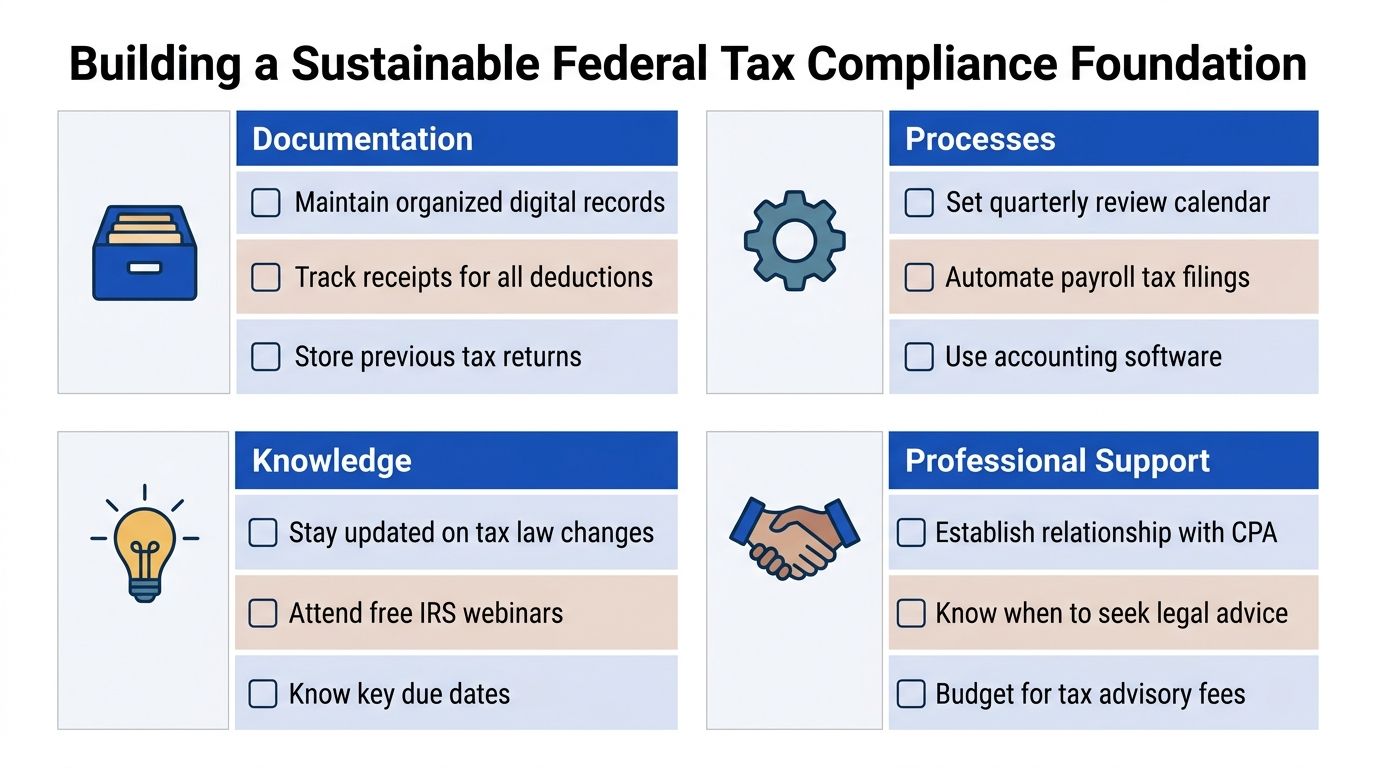
A sustainable compliance foundation is built in stages. Formation calls for an EIN, the right entity structure, and a filing calendar that someone owns. Growth calls for payroll controls, contractor classification reviews, and records that can survive scrutiny. Scaling calls for tighter review loops, better internal tax literacy, and outside professionals who already understand the business before the first serious notice arrives.
The checklist that keeps businesses out of trouble
- Documentation: keep digital records organized, retain receipts that support deductions, and store prior returns where they can be pulled quickly when a notice arrives.
- Processes: set a quarterly review calendar, automate payroll tax filings, and use accounting software that preserves an audit trail instead of allowing edits to disappear.
- Knowledge: stay current on tax law changes, use free IRS webinars when they are available, and know the key due dates before they hit the calendar.
- Professional support: maintain a relationship with a CPA, know when tax questions have turned into legal risk, and budget for advisory fees instead of treating them as an emergency expense. For businesses that want structure around recurring risk, a legal guide to building effective compliance programs for Seattle corporations gives a clearer picture of how to set that up.
That framework gets stronger when the business also borrows from broader tax-prep discipline. Practical tax prep strategies for small businesses push owners to think in terms of workflow, not panic, and that mindset matters when federal tax administration turns into a records request.
Federal tax administration is moving toward deeper data matching and more scrutiny of preparer quality. The businesses that hold up are the ones that build systems now, keep their records clean, and know exactly when a tax issue has crossed into legal territory. For companies that want a compliance structure built around real operational risk, By Design Law Firm & Legal Consultancy, PLLC helps startups and SMBs turn tax problems into managed processes before they become expensive disputes.