A Seattle founder can get all the way through interviews, references, and a polished offer, then the background report lands with one old misdemeanor or a record entry that looks wrong. That is the moment a pre adverse letter matters. It is not the denial itself, it is the legally required pause that keeps the hiring process inside the Fair Credit Reporting Act, gives the candidate a chance to respond, and keeps the company from turning a fixable screening issue into a compliance problem.
For Washington employers, that pause matters even more because federal FCRA rules rarely stand alone. A sloppy template, a rushed final rejection, or a failure to document the candidate's response can invite disputes, agency complaints, or private litigation. In the Pacific Northwest market, the primary risk is not just the decision, it is how the decision gets made, recorded, and defended. For a practical legal guide on what background-report mistakes can do to an employer, see this discussion of how an inaccurate background report can hurt a business.
When internal teams are stretched thin, many founders lean on HR vendors, but the workflow still needs an owner. A well-run screening process often includes a legal checklist, a review queue, and a written decision record. For teams that want support without building a full in-house compliance function, cost-effective employment paralegal solutions can help with document handling, notice tracking, and file organization, which are the boring details that often determine whether a file holds up later.
The key is simple. A pre-adverse step is not a courtesy email, it is a legal pause that must happen before the final adverse action notice goes out.
Why a Pre Adverse Letter Matters for Washington Employers
A Seattle startup can do everything right through the interviews, then the background check turns up a five-year-old misdemeanor no one expected to see. The instinct is to send a denial and move on. That is exactly where the pre adverse letter protects the process, because under the FCRA the employer has to stop, share the report, and give the candidate a reasonable period to respond before the final decision is locked in, with federal guidance commonly treating that pause as at least five business days.
That pause matters because the candidate may have context the report does not show. The record could be incomplete, the date could be stale, or the report could reflect a mismatch that looks disqualifying on paper but is not the applicant's record. Under the FCRA workflow, the notice starts review, not the final verdict, and the employer still needs to consider any response before sending the final adverse action notice. For a practical look at how an inaccurate background report can create real employer risk, see this discussion of background-report errors and business harm.
Why founders should care now
Washington is not a place to treat screening as a copy-paste task from a national handbook. The state layers its own rules on criminal-record timing and record-use limits, so a form that looks compliant in one state can miss the mark in Bellevue or Tacoma. Small employers feel that gap first, especially when they assume a background report is the same thing as a hiring decision.
Practical rule: if the report creates hesitation, the company should pause, document, and review. If the company is already acting like the candidate is rejected, the pre-adverse step is probably being used too late.
The litigation risk is real because background-screening cases often turn on process, not just outcome. Smaller companies, especially those without in-house employment counsel, benefit from a repeatable workflow and outside help when the facts are messy. Founder teams that want a repeatable screening process often start by pairing legal review with an operational checklist, then keep the decision trail tight enough to defend months later. For teams that want support without building a full in-house compliance function, cost-effective employment paralegal solutions can help with document handling, notice tracking, and file organization, which are the boring details that often determine whether a file holds up later.
What a Pre Adverse Action Notice Actually Is
A pre adverse action notice is the employer's formal warning that a consumer report may lead to a negative employment decision, but the decision is not final yet. It sits between the background check result and the final adverse action notice, so the candidate still has a real chance to point out errors, clarify context, or explain what the report leaves out.
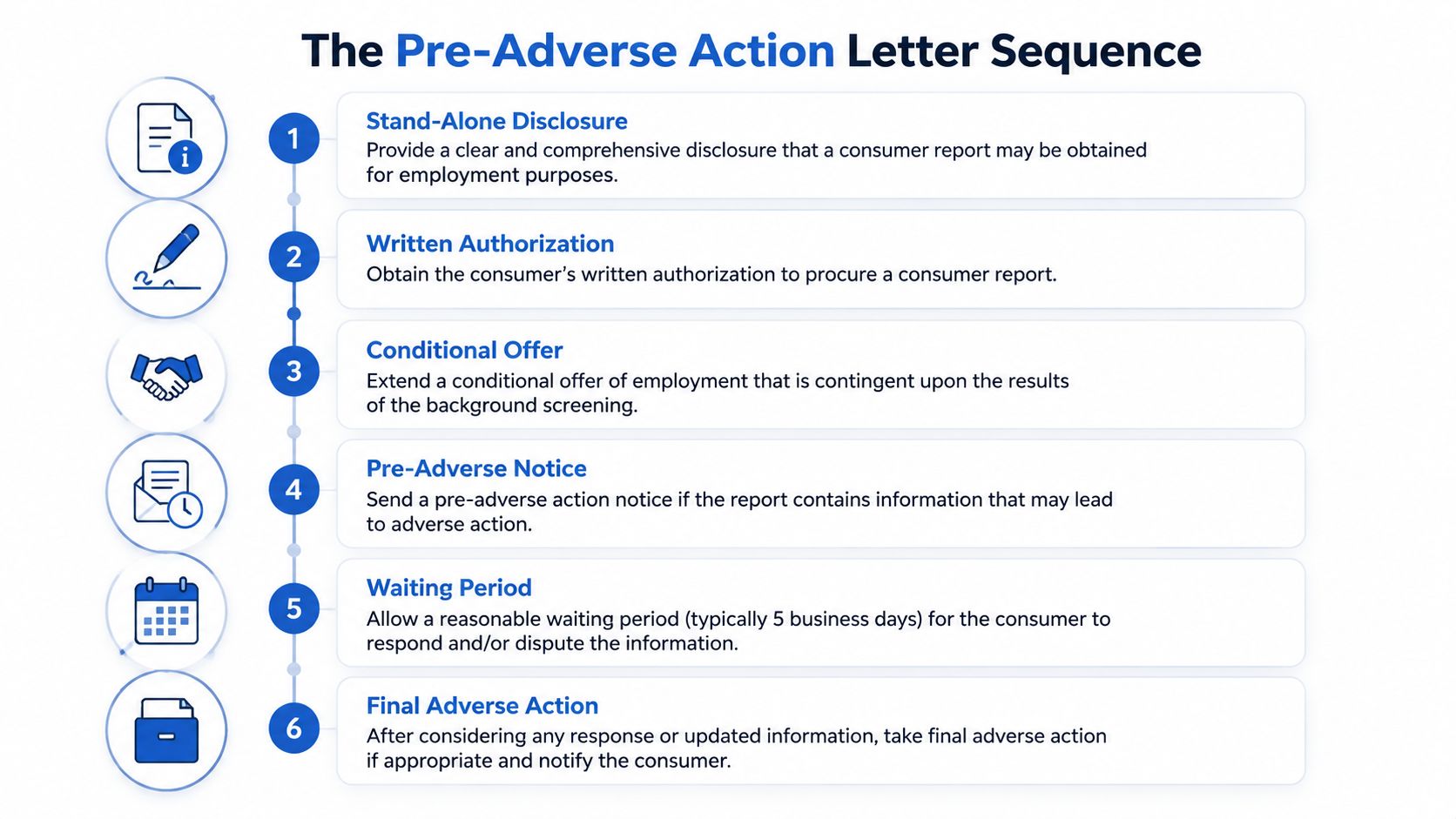
For founders, the practical point is simple. The notice is the pause point in the FCRA sequence, and it only works if the company treats it as a real pause. In a clean workflow, the employer has already given the required disclosure and authorization, reviewed the report, and then sent the pre-adverse packet before making a final decision, as shown in this six-step pre-adverse action sequence. The conditional offer matters because it keeps the screening decision tied to a legitimate hiring stage, instead of a loose impression that the candidate is probably out.
What the notice is doing
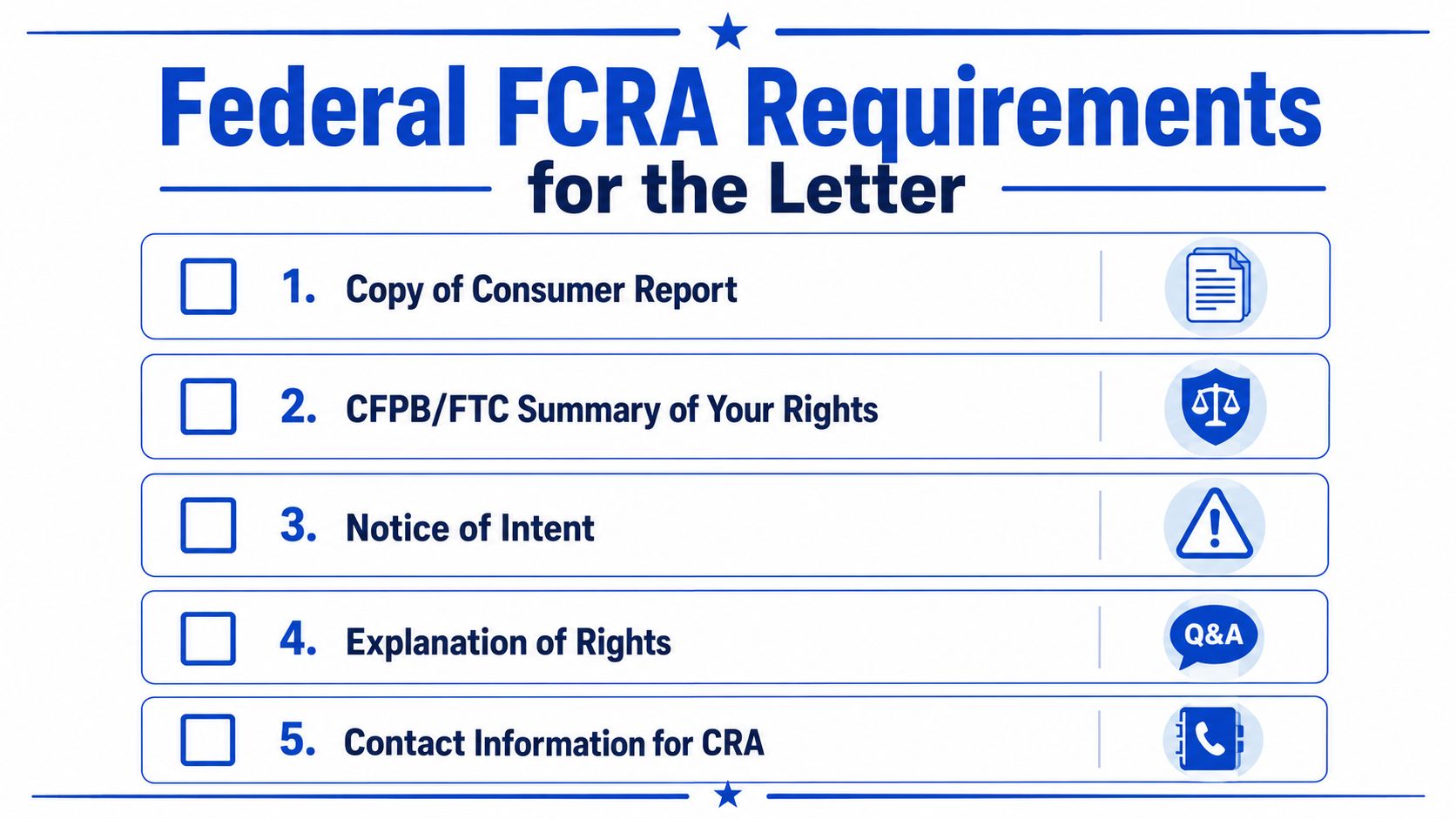
The notice is not about polished wording. It is about giving the applicant enough information to see what issue triggered concern, review the report, and decide whether to dispute it. A compliant packet should include the consumer report itself, the CFPB or FTC Summary of Your Rights, and enough context to make clear that the company has not reached a final decision yet.
The difference between the pre-adverse notice and the final adverse notice matters in practice. If the company sends one letter that reads like a done deal, it can blur the two-step process and take away the chance to correct errors before the hire is lost. A founder who uses a screening vendor should still confirm who sends what, when the waiting period starts, and whether the file shows proof that the candidate received the notice. For a plain-language primer on how that warning step fits within a broader decision, see the adverse employment action legal guide.
A good packet also needs clean sourcing. If the report includes identity data or a trace that needs review, the employer should make sure the candidate can understand which record belongs to them, which is where a clear reference to the underlying search, such as a SSN trace explanation, can help organize the file without turning the notice into an argument.
Federal FCRA Requirements for the Letter
A pre-adverse letter has to do more than warn the candidate that a background check raised concerns. Federal FCRA practice starts earlier, with a stand-alone disclosure and written authorization before the report is pulled, then moves into a separate notice step once the employer is considering a negative decision. If the employer skips the disclosure, that is its own compliance problem, even if the later letter is otherwise clean.
The timing matters just as much as the paper trail. The candidate should understand that the company has not made a final call yet, and the file needs a real waiting period before any denial goes out. In day-to-day practice, the five-business-day floor is the safer baseline for employers that want a defensible process, especially when a startup is trying to move fast but still needs room for a response.
What belongs in the packet
A proper pre-adverse packet should give the candidate enough information to identify the report, understand the issue, and respond before the employer acts. That usually means the consumer report itself, the written Summary of Your Rights Under the Fair Credit Reporting Act, and contact details for the consumer reporting agency. The notice should also make clear that the decision is still pending and that the candidate can dispute errors or submit context before the final step.
A short notice works better than a long explanation. If the employer writes too much, the required disclosures get buried. If it writes too little, the candidate may not know why the report matters or what response the company is expecting.
The packet should also be separate from the final adverse action notice in the company's records, even when a screening vendor generates both letters. That separation helps show the employer gave the waiting period a real chance to run. For teams that want cleaner upstream screening files, a SSN trace overview can help explain why identity accuracy should be checked before a report turns into a hiring decision.
Washington State Rules That Tighten the Process
Washington does not merely echo the federal rules. It layers its own limits on how employers use criminal records, which means a company can comply with the FCRA and still mishandle the screening decision under state law. The broadest trap is assuming that any negative record can be treated as a clean disqualifier, when Washington's record-use rules often demand a narrower, more individualized approach.
Federal baseline and Washington overlay
| Requirement | Federal FCRA baseline | Washington State overlay |
|---|---|---|
| Timing of notice | Pre-adverse notice before the final denial, with a reasonable waiting period | Washington employers still need to respect the federal timing, but state law may tighten when criminal history can be considered |
| Arrest records | Federal screening rules do not give employers a free pass to rely on raw arrests | WAC 162-22 limits the use of arrest records that did not lead to conviction |
| Juvenile records | Federal law does not create a blanket workplace rule for juvenile records | RCW 9.96A.120 governs sealing of juvenile records |
| Criminal inquiry timing | Federal law focuses on the notice sequence after a report is obtained | Washington's Fair Chance Act restricts when criminal history can be asked about, which shapes the whole hiring flow |
| Record-sharing practice | FCRA governs the background-report process | Washington's Equal Pay and Opportunities Act adds pressure to keep hiring criteria job-related and consistent |
That is why remote-first companies with a Washington employee still need Washington-aware screening logic, even if headquarters sits elsewhere. A manager in another state may think the file is simple, but if the applicant lives in Washington, state restrictions can still control the hiring step. For a deeper look at those state-specific obligations, this Washington FCRA overview is a good companion reference.
Two state concepts matter especially in practice. First, the Fair Chance Act affects the timing of criminal-history questions and pushes the conversation later in the process, so the background check and the interview script cannot be designed in isolation. Second, Washington's record rules give extra significance to documents that show a record was sealed, vacated, or legally limited, which makes candidate response materials more than just a courtesy email.
Working rule for Washington hiring: if the record looks old, incomplete, sealed, or jurisdictionally odd, the hiring team should slow down and review the document trail before treating it as disqualifying.
A national policy that says, “any criminal history is a no-hire,” is usually too blunt for Washington. So is a workflow that asks about criminal history too early or forgets the state-specific order of operations. For employers in Seattle, Redmond, Tacoma, and Bellevue, the safer path is to align the screening schedule with both federal notice law and Washington's restrictions on criminal-record use.
Sample Pre Adverse Letter Wording You Can Adapt
A workable letter does not need to sound formal to the point of stiffness. It needs to be clear about three things, the report has been reviewed, the decision is not final, and the candidate has a defined path to respond. A founder can adapt the following structure without turning it into a generic form letter.
Sample pre adverse letter
[Company Name]
[Date]
[Candidate Name]
[Candidate Address]
Dear [Candidate Name],
After reviewing the background report obtained in connection with your application for [Position Title], [Company Name] is considering information that may affect the hiring decision. No final decision has been made.
Enclosed please find a copy of the background report, along with the Summary of Your Rights Under the Fair Credit Reporting Act. The report was provided by [Consumer Reporting Agency Name], and the agency may be reached at [CRA Phone Number], [CRA Mailing Address], and [CRA Email or Web Contact, if applicable].
If you believe the report contains incomplete or inaccurate information, you may contact the consumer reporting agency to dispute the report and you may also provide any supporting documents to [Company Contact Name or Team] by [Date at least five business days after delivery]. We will review any information you submit before making a final decision.
Sincerely,
[Authorized Representative Name]
[Title]
That wording works because it separates notice from conclusion. It also gives the candidate a real response path instead of a vague invitation to “reach out if there are questions.” In practice, the deadline should be tied to the company's documented waiting period, not just to the date the letter was drafted.
The final adverse action notice can be shorter, but it should be clearly separate.
Sample final adverse action snippet
“After considering the information available to us, [Company Name] has decided not to move forward with your application for [Position Title]. This decision was based in whole or in part on information contained in the background report provided by [Consumer Reporting Agency Name].”
That final notice should be reserved for the true end of the process. If the file still has an open dispute, unresolved identity issue, or a piece of mitigation that needs review, the employer should not jump to the final step. Where union rules, government contracts, or industry-specific statutes apply, the language should be reviewed before use so the template does not create a hidden conflict.
How to Evaluate Disputes and Rehabilitation Evidence
A good dispute review starts by separating report items into three buckets: clear errors, legally sensitive records, and potentially disqualifying but context-dependent findings. That simple split keeps the company from auto-rejecting a candidate because a screening report is incomplete or because a criminal record looks worse than it appears. It also creates a defensible record if the candidate later claims the employer ignored the response.
A practical decision framework
The first question is whether the item is probably wrong. Name mismatches, date of birth mismatches, and records that appear to belong to someone else should go straight to verification. If the candidate shows a sealed case, an expungement order, or a vacatur, the company should not treat the old record as if it were still active, because the legal status of the document matters more than the database summary.
The second question is whether the item is even usable under the applicable law. Washington employers have to be careful with arrest records that did not lead to conviction, and they should be cautious around juvenile records and other documents Washington law treats specially. A report item that is technically visible in a database is not automatically a lawful hiring basis.
The third question is whether the candidate's materials change the employment analysis. A rehabilitation letter, proof of completion of a sentence, or documentation that a record was sealed can all matter, depending on the role and the nature of the issue. The employer should weigh the material against the job duties, the timing of the conduct, and whether the issue predicts risk in the role.
Document the reason, not just the result. A file that says “denied after review” is weaker than a file that shows what was disputed, what evidence was checked, and why the final decision still went the same way.
The EEOC's ban-the-box guidance and Washington's own reform posture both point toward individualized review instead of reflexive rejection. That does not mean every dispute wins. It does mean the employer should be able to explain why a candidate's evidence did or did not overcome the concern, rather than letting a software rule or a hurried recruiter make the call alone.
For Washington teams that want an operations reference on later-stage employee separations and documentation habits, this employee offboarding checklist can help keep records clean even after the hiring file closes. The same discipline that protects offboarding decisions usually helps when a candidate dispute needs to be documented carefully.

Compliance Checklist and SMB Risk Reduction Playbook
A small company does not need a giant legal department to run this process well. It does need a checklist, a written owner, and a vendor that understands the difference between a screening workflow and a final hiring decision. The most common mistakes are predictable, and they are preventable.
A working checklist
- Use a stand-alone disclosure first. The background check disclosure and written authorization should happen before the report runs, not after the decision becomes messy.
- Separate the pre-adverse letter from the final notice. If the first letter reads like a rejection, the company has probably compressed the process too much.
- Track the waiting period. The company should be able to show that the candidate had a real response window, not just a same-day email.
- Keep the candidate's response in the file. If the applicant sends records, explanations, or dispute materials, save them with the decision record.
- Review Washington overlays before closing the file. Arrest records, sealed records, and the timing of criminal-history inquiries need a state-law check.
A lot of SMB risk comes from process drift. One recruiter uses an old template. Another sends a “final decision” note before the response window closes. Someone else forgets to attach the rights summary. Those are the kinds of errors that turn a routine background issue into a compliance headache.
The best way to reduce that risk is to create a vendor and internal ownership map. The screening provider should know exactly when to release the report packet, who approves the pre-adverse notice, and who signs the final action letter. Internal HR or people-ops staff should know that the report is not the decision, it is the input.
For teams wanting a broader systems view, optimize your talent pipeline is a useful lens because screening, disposition rules, and rehire judgments all depend on consistent records. Once the hiring file is messy, every later decision gets harder to defend.
If a candidate raises a difficult issue, pause and escalate it. A fast but sloppy decision is far more expensive than a measured one that gets documented correctly.
This is general legal information, not a substitute for jurisdiction-specific advice. Washington hiring rules can shift with job category, geography, and the type of record involved, so a one-size-fits-all template is not enough for every employer.
By Design Law Firm & Legal Consultancy, PLLC helps Washington startups and SMBs turn screening chaos into a defensible process, especially when a pre adverse letter, a disputed report item, or a state-law overlay makes the file harder than usual. If your hiring team needs practical guidance on FCRA notices, Washington criminal-record rules, or a review of your background-check workflow, visit By Design Law Firm & Legal Consultancy, PLLC to get help that fits the way your business hires.