A founder usually calls a business lawyer too late. The trigger might be a threatened lawsuit, an investor's diligence request, a customer contract that suddenly carries unacceptable liability, or a data incident that demands an answer before the team has identified what happened. By then, counsel is often repairing a structure that should have been designed before the company started operating.
So, what does a business lawyer do for a company that isn't in crisis? The practical answer is broader than incorporation or dispute work. Business counsel helps founders turn legal duties into operating systems, protect revenue from preventable losses, and make decisions about contracts, hiring, intellectual property, privacy, cybersecurity, artificial intelligence, and growth with a clearer view of risk.
The Real Cost of Waiting Too Long for Legal Counsel
A founder signs a customer agreement using a template found online. The company starts delivering, hires a contractor, and stores customer information in a growing collection of software tools. Months later, a large prospect asks for proof of ownership of the company's intellectual property, a vendor refuses to accept a liability cap, and a former contractor claims the product code belongs to them. The founder now needs answers quickly, but the missing terms, inconsistent records, and unclear ownership cannot be fixed with one urgent document.
That reactive approach often costs more than a planned legal review. A 2025 small-business study found that 47% lost at least $500 to preventable legal issues, nearly 1 in 5 lost more than $5,000, and 40% missed revenue opportunities because of legal fears or lack of advice. Those findings are reported in the small-business legal pitfalls study.
The missed opportunity can be just as damaging as the direct bill. A founder may avoid a partnership because the agreement feels too complicated, delay a product launch because privacy obligations remain unclear, or accept unfavorable customer terms because nobody has explained which provisions are negotiable.
Prevention protects more than the balance sheet
A business lawyer can identify problems while the company still has options. That may mean choosing an entity structure, documenting ownership, setting an approval process for contracts, or creating a diligence file that makes a future transaction easier to evaluate. The lawyer isn't merely waiting for a dispute. The lawyer is helping the company avoid decisions that create unnecessary exposure.
Practical rule: Legal counsel should be engaged when a business decision could affect ownership, revenue, confidential information, employment relationships, or the company's ability to exit an agreement.
A focused legal review doesn't require founders to outsource every decision. It gives them a framework for knowing which decisions require professional judgment and which can follow a documented internal process. A business due diligence checklist can help expose missing records and unresolved obligations before an investor, buyer, lender, or major customer does.
Core Functions That Define Business Law Practice
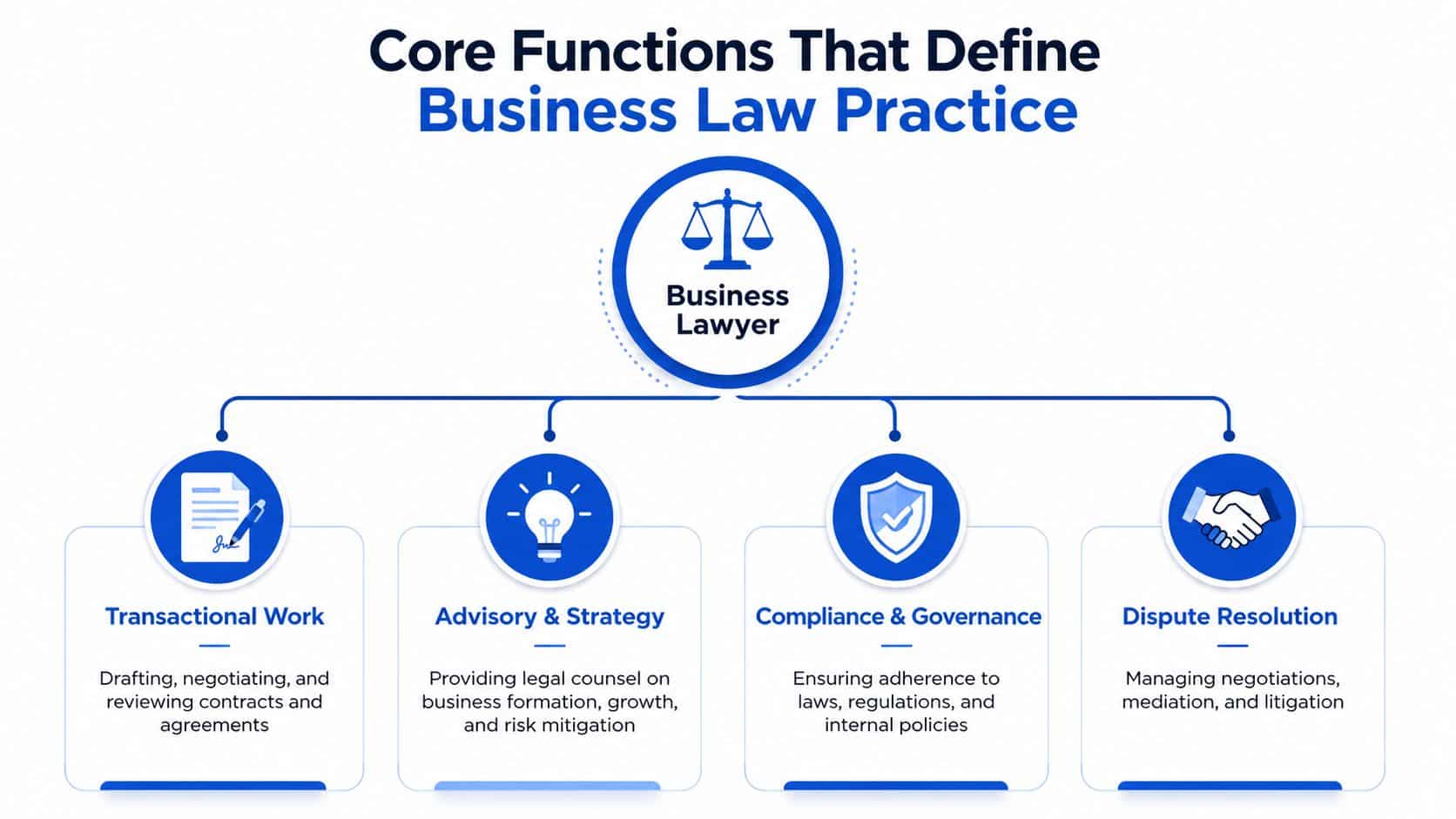
A business lawyer's work usually falls into four connected functions. Transactional work handles agreements and deals. Advisory work supports decisions about structure, growth, and risk. Compliance and governance convert legal duties into company procedures. Dispute work protects the company when negotiation fails or another party alleges a breach.
Legal judgment becomes an operating system
For a corporation or LLC, counsel may prepare formation documents, ownership records, governance documents, board resolutions, and procedures for approving significant actions. The value isn't the document alone. The value lies in creating a repeatable process that shows who can decide, how decisions are recorded, and which duties apply to directors, officers, managers, or members.
A lawyer also allocates risk across the company's contracts, intellectual property, employment relationships, regulatory obligations, and internal policies. A vague agreement might fail to define performance standards, remedies, termination rights, or dispute procedures. A carefully structured agreement gives the business a clearer response when performance falls short.
Digital risk now belongs in the conversation
Modern counsel must understand how information moves through the business. Survey-based legal-industry reporting identified data privacy compliance and protection of sensitive information from cyber threats as a top concern for 46% of legal professionals, while 43% highlighted client confidentiality. Those figures appear in legal-industry reporting on compliance and business professionals.
That concern changes the practical assignment. A lawyer may help map data responsibilities, review vendor terms, define access rules, prepare privacy policies, and establish escalation procedures for an incident. The company then has controls that employees can follow instead of a general instruction to “stay compliant.”
Founders also benefit from understanding how legal support connects with business development. Firms evaluating their own visibility and client communication can review resources on CPA and legal marketing solutions, while startups seeking company-specific counsel can examine corporate law for startups. The common principle is straightforward: legal work should support a business process, not sit in a folder that nobody uses.
Essential Services Every Growing Business Needs
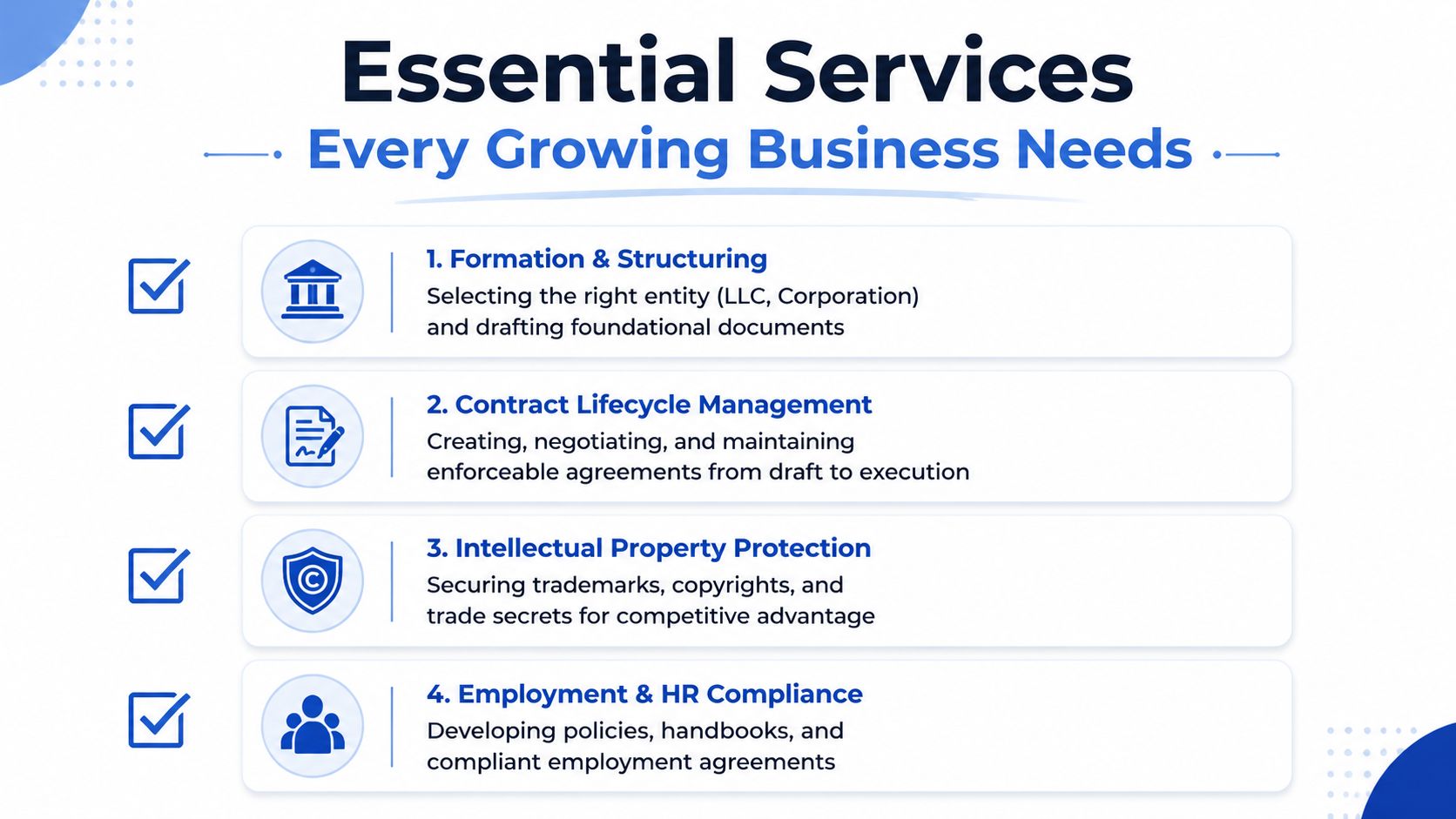
A growing company rarely needs a single “business law document.” It needs a set of legal deliverables that match how the company earns money, hires people, handles information, and protects valuable assets.
Formation and governance
Entity selection affects ownership, management, liability, tax coordination, and future transactions. Counsel prepares foundational documents and helps establish governance practices that reflect the actual relationship among founders, members, directors, and investors. The company should know who owns what, who can sign, and how major actions receive approval.
A lawyer can also help maintain those records as the business changes. New ownership, financing, leadership changes, and material transactions should not leave the original documents obsolete.
Contracts that allocate economics and risk
Customer, vendor, employment, contractor, licensing, and service agreements do more than authorize a signature. Their clauses determine payment timing, indemnity obligations, liability limits, performance standards, termination rights, and dispute procedures. A business lawyer negotiates those terms according to the company's bargaining power and the commercial value of the deal.
A founder should be wary of a review process that treats every contract as equally important. A modest vendor agreement may need a quick risk screen, while a strategic customer agreement may justify detailed negotiation of intellectual property, data use, exclusivity, renewal, and exit terms. A practical contracts resource for business owners can help identify which agreements belong in the company's core legal system.
Intellectual property and confidential information
Trade secret protection requires more than labeling a file confidential. It involves identifying trade secrets, creating and maintaining protection programs, developing confidentiality agreements with employees, partners, suppliers, and customers, and creating physical security measures. Those elements are described in Fenwick's trade secret litigation practice materials.
Counsel may define what the company treats as confidential, align agreements with actual workflows, and prepare an enforcement strategy if information is misused. Trademark, copyright, patent, licensing, and assignment work can protect other forms of value.
Employment and compliance support
As hiring expands, counsel may develop employment agreements, handbook provisions, contractor terms, confidentiality obligations, and workplace policies. Regulatory work can include identifying obligations, assigning responsibility, and building documentation that demonstrates the company followed its own procedures.
The useful deliverable isn't a thick policy manual that employees never read. It's a set of clear rules, owners, approval paths, and review dates that fit the company's real operations.
Matching Legal Services to Your Company Stage
Legal priorities change as the company moves from an idea to an operating business, then to a larger organization with investors, employees, valuable intellectual property, and more complicated contracts. The right approach isn't to buy every service immediately. It's to address the risk that could block the next important business milestone.
| Company Stage | Priority Services | Secondary Services |
|---|---|---|
| Pre-launch or founder formation | Entity selection, formation documents, ownership records, founder arrangements, basic governance | Initial intellectual property assignments, privacy review, standard contracts |
| Early revenue | Customer and vendor agreements, payment terms, contractor classification review, intellectual property ownership | Employment policies, trademark strategy, regulatory mapping |
| Hiring and scaling | Employment documentation, handbook policies, contract approval workflows, compliance tracking | Expanded privacy program, trade secret controls, financing preparation |
| Funding or strategic transaction | Diligence preparation, capitalization records, transaction documents, representations and warranties | Commercial contract cleanup, intellectual property review, dispute assessment |
| Established enterprise | Ongoing governance, risk allocation, regulatory compliance, incident response, complex transactions | Litigation management, acquisitions, licensing, franchise or expansion work |
What deserves attention first
Unclear founder ownership is the first thing to fix because it can derail later investment, acquisition, or hiring. Next, set clear agreements for intellectual property and cash flow before you scale.
Early revenue changes the emphasis. The company now needs agreements that protect cash flow and define what it is promising. As hiring begins, employment and contractor documentation becomes more urgent because the company’s obligations multiply with each new working relationship.
Growth-stage companies should invest in systems rather than isolated documents. A contract intake process, signing authority matrix, renewal calendar, and centralized recordkeeping often deliver more value than repeatedly asking counsel to review the same issue from scratch. Teams that need drafting and workflow support can also evaluate legal document tools, while reserving attorney judgment for interpretation, negotiation, and material risk.
The right question isn’t “Do we need a lawyer for everything?” It’s “Which legal gap could stop the next stage of growth?”
Navigating Modern Tech and Data Privacy Challenges
Technology has changed the questions business lawyers must ask. A company using artificial intelligence may need to evaluate training data, confidential information, vendor commitments, human review, disclosure practices, and claims made about the tool’s performance. A company collecting customer data must understand where that information goes, who can access it, and what happens when a vendor or employee reports an incident.
Counsel connects policy to actual workflow
A useful technology review starts with the company’s real systems, not an abstract policy. Counsel may identify data categories, review vendor agreements, establish acceptable AI use rules, restrict confidential inputs, and create records showing who approved a tool or process. The lawyer can also challenge unsupported marketing claims, including claims that imply an AI system is safer, more accurate, or more compliant than the company can substantiate.
Cybersecurity planning follows the same logic. An incident response plan should assign responsibilities, preserve evidence, coordinate technical investigation, guide communications, and identify legal reporting duties. Without an agreed process, employees may delete relevant records, notify customers too early, or delay escalation while trying to determine who owns the decision.
The following video provides additional context for business owners considering privacy and technology risk:
Washington breach response requires precision
Washington businesses must notify affected residents in the most expedient time possible and no later than 30 days after discovery of a security breach involving personal information, as explained by the Washington Attorney General’s business privacy guidance. If the incident crosses applicable reporting thresholds, counsel may also coordinate required communications with regulators and affected people.
The lawyer’s role is operational. Counsel helps establish the clock, determine what information was involved, assess whether a legal exception applies, prepare notices, and coordinate the company’s response with technical and communications teams. Businesses developing a broader program can review Washington data privacy and compliance guidance as part of that preparation.
Understanding Fee Structures and When to Engage Counsel
Business lawyers commonly use several pricing models. Hourly billing fits unpredictable negotiations, disputes, and advisory work. Flat fees can work for defined deliverables such as formation documents, a standard agreement, or a focused policy review. Retainers support recurring counsel, while project pricing can make sense for financing, acquisition, contract remediation, or a privacy program with a defined scope.
The cheapest option isn’t always the lowest-cost option. A founder who drafts a critical agreement without understanding indemnity, intellectual property, payment, or termination language may save a review fee and create a problem that affects revenue, negotiating power, or ownership. A founder who brings counsel into every low-risk administrative decision may overspend and slow the business.
Signs that counsel should be involved
Immediate legal advice makes sense when the company receives a demand letter, faces a threatened claim, experiences a security incident, considers financing, signs a major customer agreement, hires key personnel, licenses valuable technology, or changes ownership. It also makes sense when a founder cannot explain who owns the company’s code, brand, customer data, or confidential processes.
DIY work can be reasonable for routine internal organization when the company understands the issue, the stakes are limited, and a reliable process already exists. It becomes dangerous when a template hides a business-specific obligation or when the company treats a legal question as a formatting exercise.
For planning purposes, an attorney hourly rate guide can help a founder compare engagement models, but price should be evaluated against scope, responsiveness, commercial understanding, and the cost of correcting an avoidable mistake.
Your Washington State Business Law Action Checklist
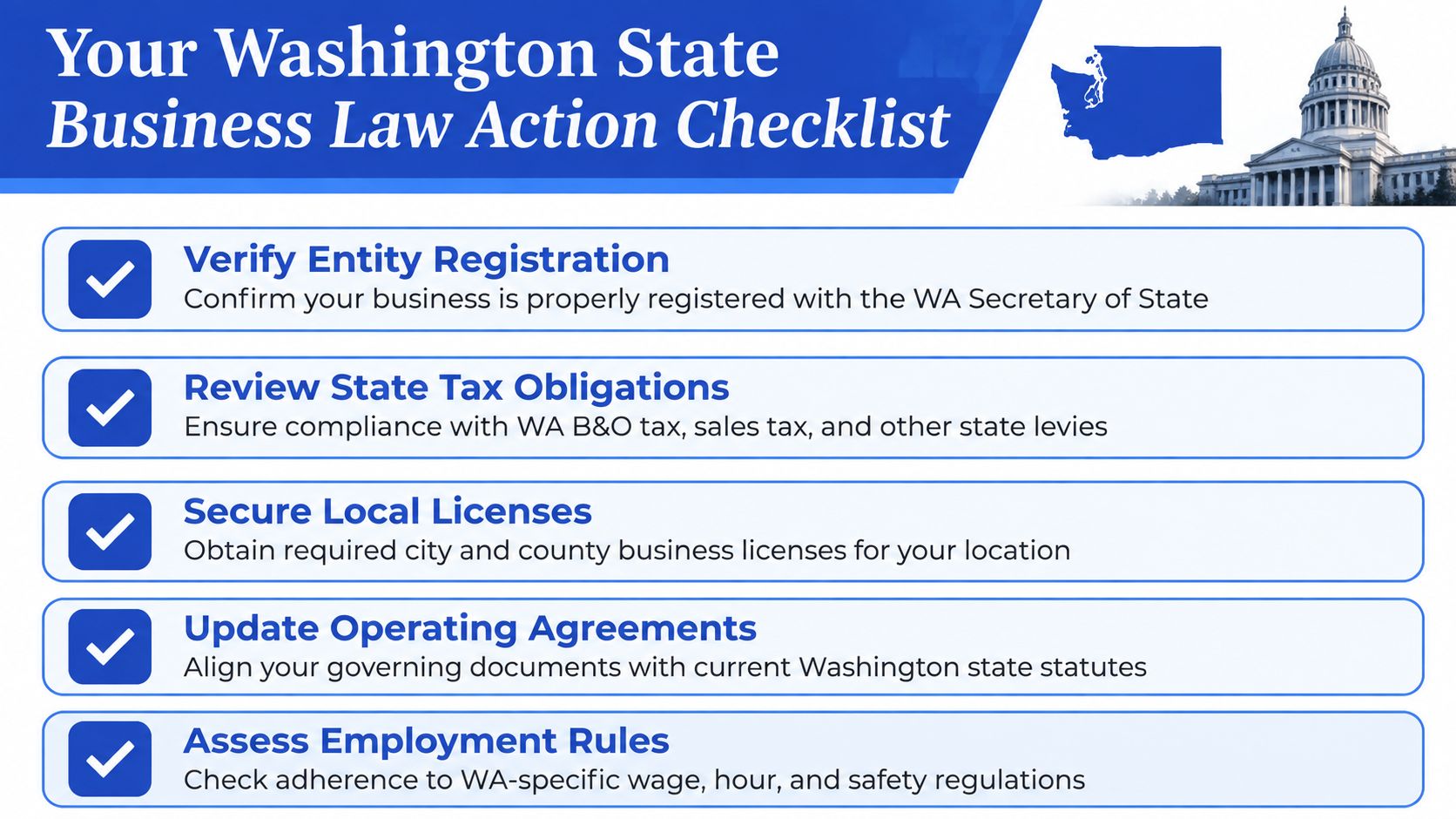
A Washington founder can start with a practical legal inventory rather than waiting for a crisis. The purpose is to identify gaps, rank them by business impact, and assign a clear next step.
Review the company’s foundation
- Confirm entity records: Verify formation documents, ownership records, operating agreements, bylaws, resolutions, and signing authority.
- Audit core contracts: List customer, vendor, contractor, employment, licensing, and service agreements. Flag missing terms, automatic renewals, unusual liability exposure, and unclear ownership provisions.
- Trace intellectual property: Confirm that founders, employees, and contractors have assigned relevant work to the company and that confidential information has practical protection.
- Check workplace documentation: Review employment agreements, contractor arrangements, handbook policies, wage and hour practices, and safety obligations that apply to Washington operations.
- Map data and technology: Identify personal information, vendors, AI tools, access permissions, retention practices, and the people responsible for responding to an incident.
Washington breach notices must include the date of the breach, the date of discovery, the types of personal information involved, a toll-free number for more information, and credit-reporting agency contact details, according to Washington breach-notification guidance. A company should confirm that its incident plan can produce those details quickly and accurately.
When interviewing counsel, founders should ask who will handle routine questions, how the lawyer approaches contract risk, which issues require immediate escalation, how work will be priced, and whether the lawyer understands the company’s industry and growth plan. A strong legal foundation isn’t measured by the number of documents in a folder. It’s measured by whether the business can make important decisions with clear ownership, usable controls, and a credible response when something goes wrong.
By Design Law Firm & Legal Consultancy, PLLC advises Washington startups, founders, and established businesses on formation, governance, contracts, intellectual property, AI, data privacy, cybersecurity, and disputes. Visit By Design Law Firm & Legal Consultancy, PLLC to discuss the legal systems your company needs before the next growth decision becomes an emergency. Contact our law office at (206) 593-1519 for a complementary consultation to help address your business’ legal needs.