A Seattle founder signs a new SaaS contract on a busy Friday, the product team moves customer records into the platform, and nobody notices that personal data just left the building under someone else's terms. Then the vendor has a security incident, the inbox fills with questions, and the contract is the first place everyone looks for answers. That's where a data processing agreement stops being paperwork and starts functioning like an operational control.
The problem is that many template contracts look complete while still leaving the key risks untouched. A DPA is supposed to tell the vendor what it may do, how it must do it, who else can touch the data, and what happens when something goes wrong. When that document is weak or missing, the controller and the processor both end up exposed at the moment clarity matters most.
A practical checklist for SMB teams can also help separate contract clutter from real privacy work, especially when the vendor review queue is moving faster than legal can keep up. For a useful comparison point, see practical SMB compliance advice from CloudOrbis Inc., then compare it against your own intake process and vendor controls. For teams that want to pair contracting with a fuller risk review, the workflow in vendor risk assessment is the right companion step.
Why Your Vendor Contracts Need a Data Processing Agreement
A founder usually learns this the hard way. A team buys a platform to save time, uploads customer data, and assumes the main services agreement covers privacy. It often doesn't, and when the vendor later suffers an incident, the company discovers that a standard SaaS contract never spelled out who had authority to process the data, what security controls applied, or how quickly the vendor had to help.
A data processing agreement exists because modern vendor relationships are not generic business relationships. Under GDPR, which became enforceable on May 25, 2018, a written or electronic DPA is required whenever a controller uses a processor to handle personal data on its behalf, and Article 28(3) requires eight mandatory provisions. Those provisions include documented instructions, confidentiality, security measures, subprocessor controls, assistance with rights and breach issues, deletion or return at the end of service, and audit or access rights, which is why the DPA has become a compliance baseline for many global vendors and enterprise customers. See the GDPR milestone summary in the verified source on DPAs under GDPR.
The real risk is operational, not theoretical
A weak DPA doesn't just create a contract gap, it creates a control gap. If the agreement doesn't require documented instructions, the processor can drift from the controller's purpose. If it doesn't control subprocessors, another vendor can enter the chain without meaningful review.
Practical rule: if the DPA does not tell the vendor how to handle the data in day-to-day operations, it is not doing its job.
The strongest agreements work like guardrails for procurement, security, and incident response. That's why a serious privacy review treats the DPA as the first place to test whether the vendor can hold personal data safely, not just a legal appendix to sign and forget. It also explains why a missing DPA often turns a vendor breach into a self-reported compliance failure rather than just an unfortunate operational event.
What a Data Processing Agreement Actually Is
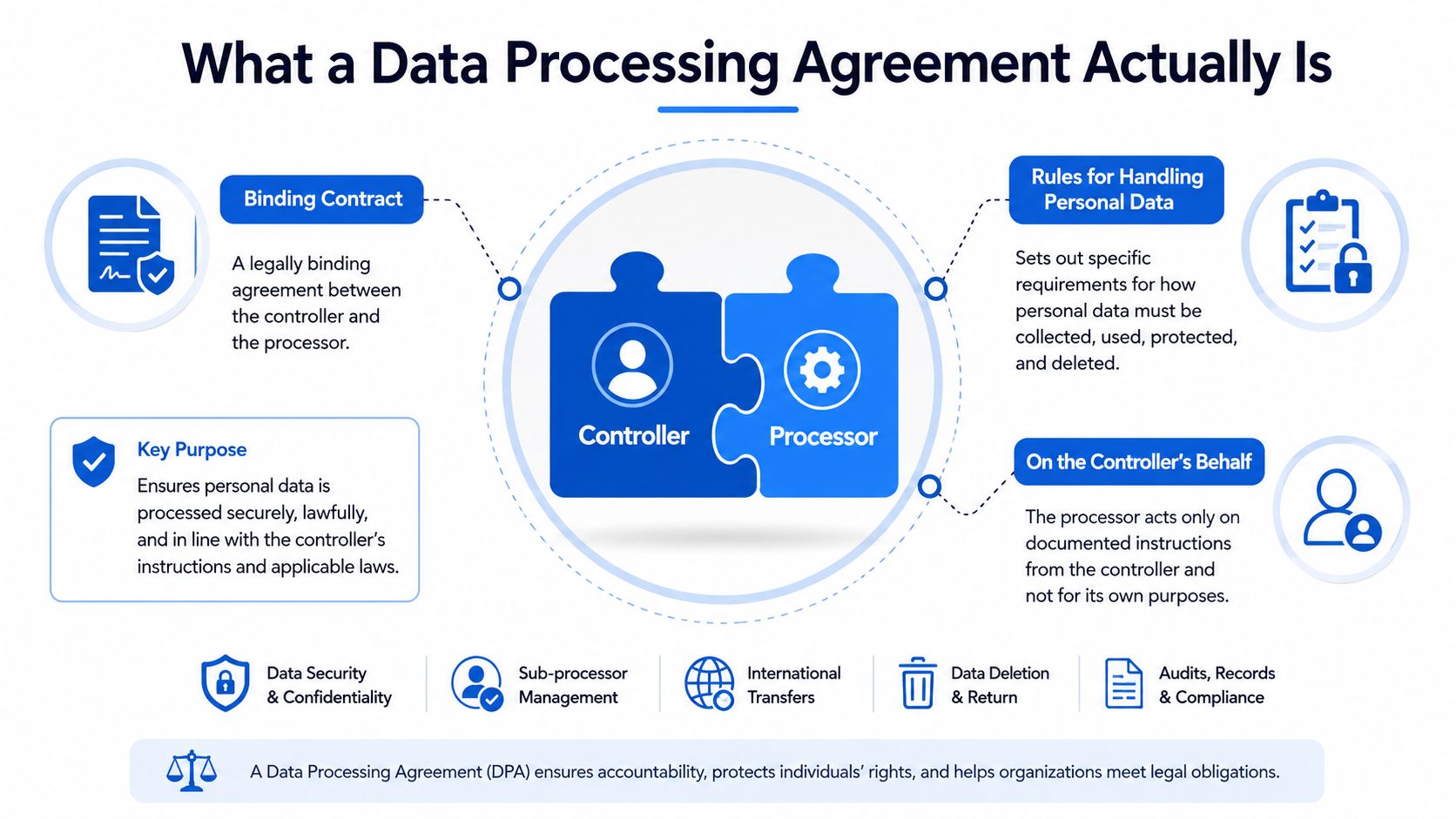
A data processing agreement is a binding contract between a controller and a processor. The controller decides why personal data is collected and how it will be used, and the processor handles that data on the controller's behalf. In plain English, it is the document that says who may enter the room, what they can do there, and what condition they must leave it in.
That's why a DPA is different from a generic privacy clause in a master services agreement. A privacy clause might promise “reasonable safeguards,” but a real DPA has to define the processing relationship itself, including the subject matter, duration, nature and purpose of processing, the type of personal data, the categories of data subjects, and the parties' rights and obligations. The UK ICO confirms that structure, and it separately requires clauses on documented instructions, confidentiality, security, subprocessors, data subject rights, end-of-contract handling, and audits or inspections. See the ICO guidance on contract terms between controllers and processors.
Where the trigger shows up for WA and California businesses
Washington companies usually meet the DPA requirement when they buy cloud, analytics, CRM, support, or payroll services that touch personal data. Under GDPR Article 28, the trigger is clear whenever EU personal data is processed by a processor on a controller's behalf. For Washington businesses handling consumer health data, the My Health My Data Act can bring the same discipline to vendor contracts, and California's CCPA and CPRA regime does the same for resident data through service provider and contractor concepts.
The important practical point is that the title of the agreement doesn't matter as much as the role relationship. Some vendors call the document a data processing addendum, others call it a vendor addendum, and some bury it inside a broader MSA. The legal question is still the same, whether the contract governs the handling of personal data in the way privacy law expects.
The DPA is closer to a lease than a marketing brochure
A lease doesn't just say a tenant may occupy space. It defines access, usage, upkeep, and what happens when the term ends. A DPA does the same thing for personal data, and that's why the annexes matter so much. If the details are missing, the document may look polished while failing the actual compliance test.
Controller, Processor, or Joint Controller
Starting with the contract before confirming the relationship is the most common drafting mistake. A startup cannot choose the right DPA until it has answered whether it is acting as a controller, a processor, or sometimes a joint controller. That classification changes the whole obligation set, and a standard Article 28 DPA is the wrong tool if both parties are shaping the purposes and means of processing.
The practical distinction is simple, but not always comfortable. A controller decides why data is processed and what the processing is for. A processor follows documented instructions. A joint controller shares decisions about purposes and means, which means the parties need a different legal structure and a different risk allocation.
The biggest failure point is the classification that came before the clause language.
SaaS, embedded tools, and analytics relationships can create trouble. Shared product analytics can look like processor activity on one side and controller activity on the other. An embedded SDK can collect data in a way that makes the vendor more than a passive processor. Co-marketing platforms and marketplace relationships are especially tricky because both sides may influence why the data is being collected in the first place. The verified source on contracts that count flags this as one of the core issues in DPA work, and it is one of the most overlooked too.
The onboarding question that should come first
Vendor intake should ask one threshold question before anyone starts redlining, who decides the purposes and means of processing. If the answer is unclear, the template is already in the wrong lane. That is the point where a controller-to-processor DPA may not fit, or may need to be split from another set of terms.
For Seattle and Puget Sound companies, this matters because the same vendor can play different roles in different contexts. A cloud provider may be a processor for hosted customer data, a controller for its own account data, and a joint controller in a collaborative product program. Treating all three relationships as if they are the same is how contracts become neat on paper and useless in a dispute.
Role mapping keeps the legal test honest
A clean internal map should list the vendor, the role, the data flow, and the legal basis for the contract form selected. That is not bureaucracy, it is how teams avoid signing the wrong paper with confidence. Once the role is wrong, the clause set can be perfect and still miss the legal target.
The Eight Mandatory Clauses Most DPAs Miss
The core of a DPA is not the header, the signatures, or the recital. It's the operational clauses that Article 28(3) requires and that many templates handle too loosely. The EDPB guidance, the GDPR checklist materials, and the ICO all point to the same baseline, the controller-processor contract has to hard-code how processing works in practice. See the official-style summary in the GDPR reference on what must be in a DPA.
| Clause | What It Requires | Question It Answers for the Controller |
|---|---|---|
| Documented instructions | The processor only acts on the controller's written instructions | Can the vendor use the data for anything else? |
| Confidentiality | Authorized personnel must be bound to confidentiality | Who inside the vendor can see the data? |
| Security measures | Appropriate technical and organizational measures must be in place | What protections actually exist? |
| Subprocessor limits | Subprocessors need approval or controlled authorization | Who else can touch the data? |
| Data subject rights support | The processor must help with access, deletion, and other rights requests | Will the vendor help when an individual makes a request? |
| Breach and DPIA support | The processor must assist with incident and impact-assessment obligations | Can the controller respond quickly and accurately? |
| Deletion or return | Data must be returned or deleted at the end of the contract | What happens when the relationship ends? |
| Audit and access rights | The controller can verify compliance | How does the controller prove the vendor is following the contract? |
Article 28(3) is stricter than a normal business clause because it forces the vendor to behave like part of the controller’s compliance program. The contract has to say what data is processed, why it is processed, how long it is processed, and what rights the controller keeps over the arrangement. The European Data Protection Supervisor also adds a drafting point that many summaries skip, the agreement should specify the retention period. That detail matters because retention defines how long the processor may keep personal data before deletion or return. See the EDPS checklist on processing agreement requirements.
What actually gets missed in template language
Template language often says the vendor will use “appropriate” security or “reasonable” cooperation. Those words are too soft when the regulator, customer, or plaintiff’s lawyer starts asking for proof. The contract should identify the mechanics, not just the aspiration.
U.S. businesses often need a little more than GDPR’s baseline too. State breach notification rules, vendor indemnity, and liability allocation should sit next to the Article 28 clauses rather than floating in a separate MSA section. A controller that separates privacy duties from commercial remedies usually discovers too late that the contract was never built to be enforced.
A practical reading test
If the DPA can’t answer these three questions, it’s not ready. What data is processed, who can access it, and what happens when the contract ends. If those answers are vague, the rest of the document is mostly decoration.
Security Measures, Subprocessors, and Breach Notification in Practice
Security schedules are where vague legal language turns into procurement-grade controls. A good DPA doesn’t just say the processor will protect data, it lists the protections with enough detail for a security reviewer to compare them against the vendor’s actual environment. The verified guidance from Morae on data processing agreement templates is useful here because it points toward concrete items like encryption, access control, backups, approved subprocessors, breach steps, and deletion timing.
What belongs in the security schedule
A serious schedule usually covers encryption standards, access-control protocols, backup and recovery procedures, approved subprocessors, breach-response steps, and deletion timelines. Some controllers also require service-level metrics or a data-transfer impact assessment if processing crosses borders. Those details do real work because they reduce the back-and-forth during security review and create evidence that the processor can meet confidentiality, integrity, and availability expectations under a shared responsibility model.
A practical redline should ask for specific rather than aspirational language:
- Encryption: Specify encryption at rest and in transit, not a promise to “use industry standard methods.”
- Access control: Require role-based access, least privilege, and multi-factor authentication where appropriate.
- Backups and recovery: State how backups are protected and how recovery is tested.
- Data location: Identify any residency commitments or transfer limits.
- Change control: Make security changes traceable through vendor notice or policy updates.
Subprocessors need more than a blanket yes
The vendor should not be able to add new subprocessors without notice. A general authorization model can work, but only if the controller gets advance notice and a meaningful objection path. If the contract permits unlimited flow-downs, the processor can push sensitive data into a chain the controller never reviewed.
A subprocessor list is only useful if it stays current and if the vendor has a real obligation to tell the controller when it changes.
Breach notice timing has to be realistic
Many templates say the processor will notify the controller within 72 hours after a breach. That can be too late if the controller has to assess its own notification duties quickly. In practice, the contract should require notice without undue delay, followed by prompt updates as facts develop, not a single message after the vendor finishes its internal analysis.
For a useful operational counterpart, the incident workflow in Incident response plan for MSPs helps show what the processor should already have ready before an incident starts. Washington businesses should also compare that with the state-facing checklist in data breach notification laws in Washington, because the contract clock and the legal clock are not always the same thing.
International Data Transfers and Liability Allocation
Cross-border processing is where a DPA turns from a vendor form into a transfer-control document. If personal data leaves the EU or UK and lands in a U.S. vendor’s environment, the contract has to line up with the chosen transfer mechanism. That usually means Standard Contractual Clauses, the EU-U.S. Data Privacy Framework when the vendor is certified, or the UK addendum when UK data is involved. For Seattle companies moving data internationally, the practical guidance in cross-border data transfers after Schrems II is the right lens for the rest of the transfer file.
Pick the mechanism that matches the data flow
SCCs still matter when the recipient country doesn’t have an adequacy decision. The Data Privacy Framework can simplify the path for certified U.S. companies, but only if the certification covers the transfer relationship. The UK addendum or UK IDTA may be needed when the data originates in the UK, even if the EU side is handled elsewhere.
The point is not to collect legal mechanisms like badges. The point is to document the route the data takes and the safeguards that apply to that route. An auditor wants to see that the business knows why the transfer is lawful, not just that the contract has a cross-border appendix.
Liability should follow the value of the data risk
Indemnification is often too small because it is drafted against the contract value instead of the data risk. That’s backwards. If a vendor holds sensitive customer records, the indemnity and liability framework should reflect the exposure created by that data set, not just the monthly subscription fee.
Audit rights, insurance, and termination assistance belong in the same discussion. A controller needs enough access to verify compliance, enough insurance to make the risk allocation meaningful, and enough exit support to move the data cleanly if the vendor is acquired or replaced. A DPA that ignores exit handling leaves the controller trapped in a bad operational relationship long after the contract should have ended.
Common Mistakes That Quietly Void Compliance
The most common mistake is signing a vendor’s standard DPA without changing anything. That feels efficient, but it usually means accepting the vendor’s preferred subprocessor regime, its breach timing, its deletion language, and its audit limits. Once the document is signed, the company often discovers that the fine print did not preserve the controls it thought it bought.
Another quiet failure is treating breach notice timing as flexible. It isn’t. If the processor waits until it has completed its internal review, the controller may already be behind on its own disclosure duties. The same problem appears when a template omits retention or deletion timelines, because the vendor then keeps data longer than the controller ever intended.
Practical warning: a DPA that sounds protective but doesn’t force operational action can still fail the compliance test.
The mistakes that show up most often in review
- Unredlined vendor forms: The controller accepts the processor’s paper and loses bargaining power on core privacy terms.
- Weak flow-down clauses: Subprocessor obligations get watered down until approval is meaningless.
- No retention schedule: Data sits in backups, exports, or archives with no clear end point.
- Skipped role analysis: The parties act as if all vendor relationships are processor relationships, even when the legal test says otherwise.
- No transparency for affected parties: If the vendor’s own customers or downstream users are impacted, the contract should not hide that reality.
For teams that want to benchmark privacy language against a broader control framework, the SOC 2 compliance checklist is a useful comparator because it shows how security controls and contractual controls should line up. Washington businesses should also compare their vendor language against data minimization and purpose limitation laws in Washington State, since the legal pressure points overlap even when the statutes differ.
Your Next Steps for Seattle and Washington Businesses
The next 30 days should focus on three moves. First, inventory every third-party processor that touches personal data. Second, classify each relationship as controller-processor, joint controller, or something else. Third, prioritize redlines for the top five vendors by data sensitivity, not by contract size. That ordering usually saves more risk than polishing low-exposure agreements.
Outside counsel adds the most value in borderline classification calls, cross-border transfer documents, and incident-driven renegotiations. Those are the spots where a template can look clean and still fail the legal test. They’re also the moments when a vendor’s sales team wants a signature fast, which is exactly when privacy counsel needs to slow the process down long enough to make the paper enforceable.
A good DPA review request should ask for the current template, the subprocessor list, the security schedule, the breach notice language, the transfer mechanism, and the deletion timeline. If any one of those is missing, the review is not finished. If the vendor can’t explain the role relationship cleanly, the classification work has to happen before anyone signs.
By Design Law Firm & Legal Consultancy, PLLC helps Seattle and Washington businesses review vendor contracts, classify controller and processor relationships, and tighten the privacy terms that make a data processing agreement enforceable in practice. For companies that need privacy and cyber contract support tied to real operations, visit By Design Law Firm & Legal Consultancy, PLLC and start with a contract review before the next vendor goes live. Call our law office today at (206) 593-1519.