A founder can run a business for months on email threads, a PDF draft, and a friendly “we're aligned.” Then the first missed deadline lands, the vendor says the extra work wasn't included, and the founder realizes the relationship was never pinned down in writing. That's usually when the question of what is a service agreement stops being theoretical and starts looking like a costly gap in operations.
A service agreement is the document that turns a vague promise into a defined business relationship. It tells each side what gets done, when it gets done, how payment works, and what happens if the work slips. In practice, it's less about paperwork and more about risk management, because the contract gives both sides a standard to measure performance against instead of arguing over impressions and assumptions.
The Real Cost of Skipping a Service Agreement
A Seattle startup founder once hired a developer after a few confident email exchanges and a handshake at a coffee shop. The vendor started quickly, then the project drifted as new features got added, deadlines moved, and each side had a different memory of who owned the code. By the time the dispute hardened, the problem wasn't just missed delivery, it was that the parties had never clearly locked down scope, payment triggers, or intellectual property ownership.
That's the point most founders miss. A missing service agreement doesn't mean there's no contract, it usually means the deal is floating on ambiguity. Default law may fill some gaps, but those defaults don't know the business context, and they rarely match what either side thought they were getting.
Practical rule: If a service is important enough to affect revenue, customer delivery, or product ownership, it's important enough to document before work starts.
The operational value of a service agreement is simple. It translates expectations into measurable obligations, so the parties can tell whether performance was acceptable without relying on memory or goodwill. Canada's Treasury Board guidance treats the service relationship as a formal agreement with conditions, not a casual understanding, and that mindset is exactly what founders need when they're working with vendors, contractors, or recurring service providers. See the broader contract-management lens in contract management best practices, because the quality of the paper often determines how well the business can enforce the deal later.
A service agreement also creates a stronger position when things go wrong. If the contract defines timing, quality, and remedies, the client can ask for cure, credits, or termination based on the document instead of arguing over what “reasonable” meant. That shift is the difference between a manageable dispute and an open-ended fight over expectations.
Defining a Service Agreement and Its Legal Boundaries
A service agreement is a contract for the provision of services, not goods. Canada's government guidance draws that boundary clearly, and it matters because service contracts focus on output, timing, responsibility, and delivery conditions rather than a sale of inventory or physical products. In real business terms, the agreement should say what service is being delivered, who is responsible for it, and what standard decides whether the work is complete.
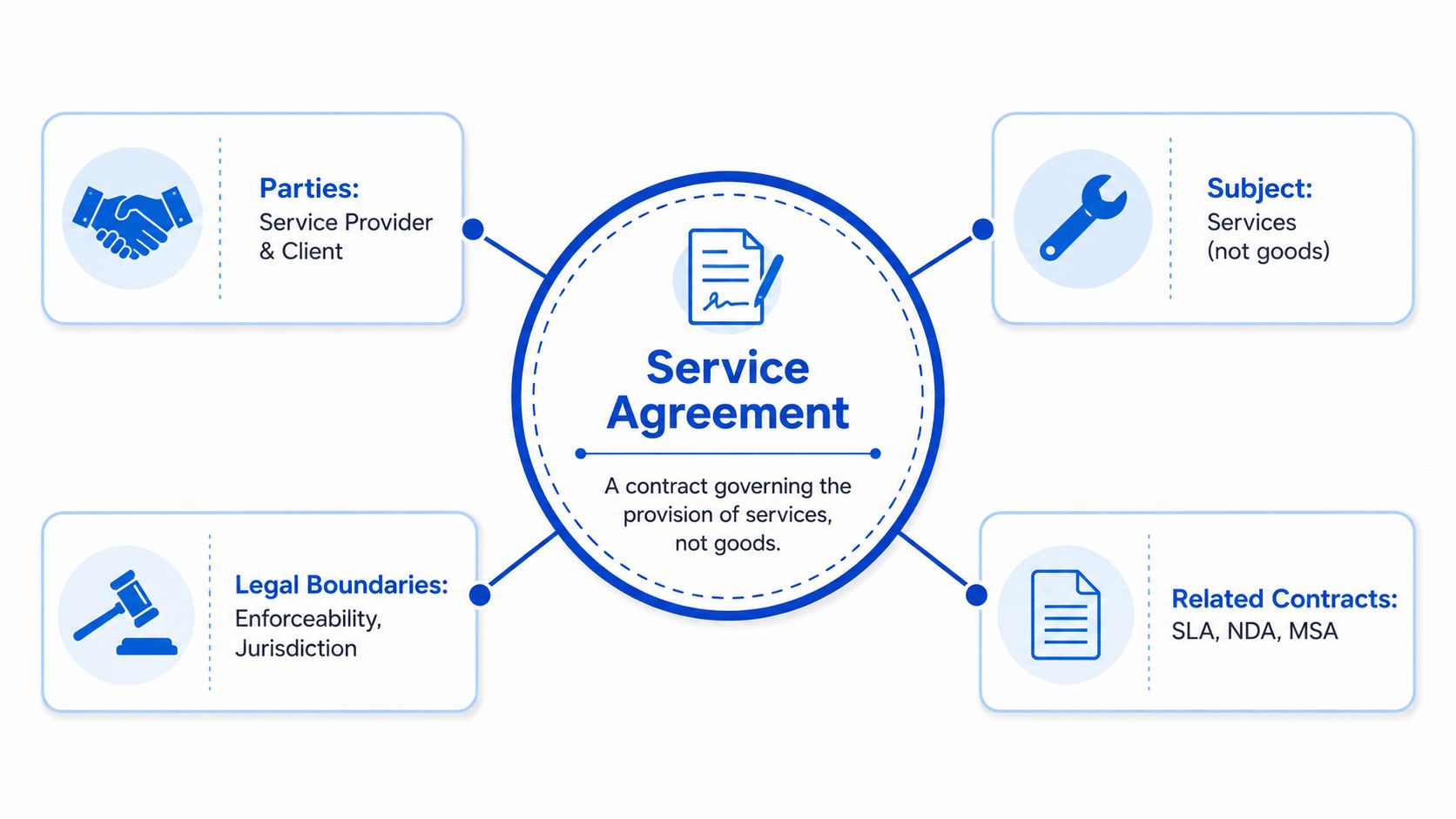
How it differs from related contract types
Founders often blur service agreements with consulting agreements, independent contractor agreements, MSAs, and SOWs. The names overlap, but the legal function is different. A consulting agreement usually centers on advice or specialized expertise, while an independent contractor agreement focuses more broadly on a non-employee working relationship.
An MSA, or master service agreement, sits above the transaction level. It sets the general rules for future work, then the parties use a separate SOW, or statement of work, for the specific project details. That structure makes sense when the same vendor will deliver repeated or evolving work over time, because the legal framework stays stable while the work orders change.
A plain service agreement is often the better fit for a one-off project or a clearly bounded recurring service. An MSA/SOW setup makes more sense when the relationship is expected to scale, branch into multiple projects, or span different deliverables under one legal umbrella. For a practical example of service terms in the wild, review conditions of using our services, because those terms show how service relationships are often framed around deliverables and conditions rather than product sales.
A service agreement should answer one question first, then everything else, what exactly is being sold, and what is outside the deal.
The contract map founders should use
A useful way to think about the structure is this, service agreement, consulting agreement, independent contractor agreement, MSA, and SOW often sit on a spectrum of specificity. The more repeatable and recurring the relationship, the more likely a master structure makes sense. The more discrete the work, the more a standalone agreement can keep the deal clean.
That distinction helps avoid template abuse. A founder who uses a contractor form for an ongoing vendor relationship may leave gaps in service levels, confidentiality, billing cadence, or termination rights. A founder who uses an MSA for a small one-time project may overcomplicate a simple deal and spend more time negotiating boilerplate than defining the actual work.
Essential Clauses Every Service Agreement Must Include
A service agreement works best when it removes guesswork before work starts. The drafting should show exactly what gets done, how money moves, who owns the output, and how each side can exit if the deal stops working. If any of those points stays fuzzy, the result is usually not flexibility, it is a dispute.
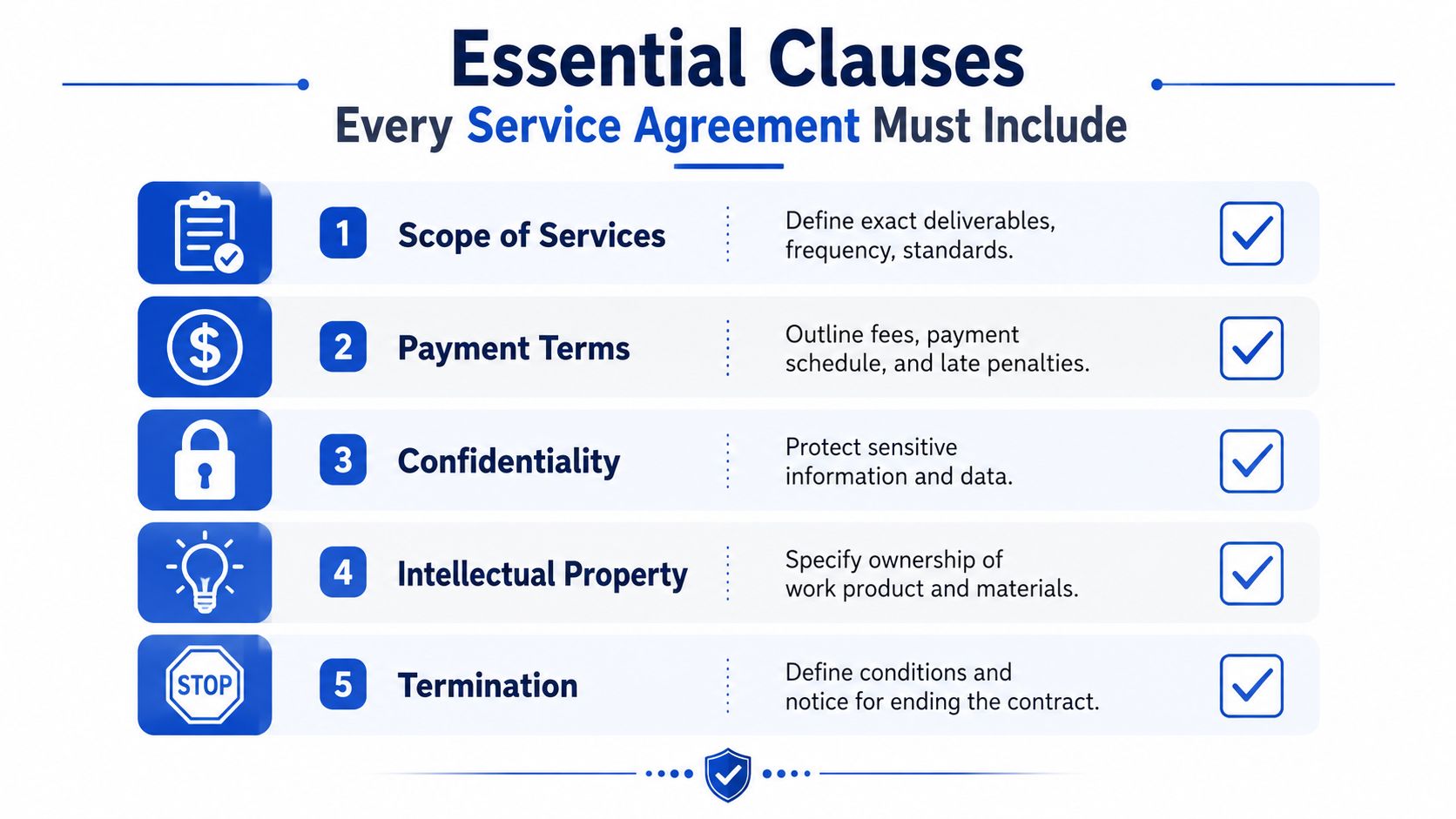
Scope and payment mechanics
The scope clause should be granular. Good drafting covers the exact services, frequency, schedule, standards, staffing, reporting requirements, and explicit exclusions, because the point is to separate included work from anything that should trigger a change order or separate engagement. Weak scope language sounds friendly, then fails as soon as the relationship gets busy or a deliverable changes.
A strong version says, “Provider will deliver weekly compliance reports, monthly review calls, and incident-response support during the stated service window. Any work outside those deliverables requires written approval.” A weak version says, “Provider will provide consulting services as needed.” The second version invites scope creep immediately, and it gives both sides room to argue about what was supposed to happen.
Payment language deserves the same discipline. The contract should cover compensation structure, method of payment, payment frequency, and acceptable payment methods. Financial terms should also address invoices, variances, adjustments, and settlement arrangements, because those details are what keep billing disputes from turning into relationship disputes. Canadian Treasury Board guidance shows how structured those terms often become in real agreements, with 30 days from customer's receipt of invoice used in 62% of signed agreements, 48% using monthly invoicing, 46% using annual invoicing, 70% of cloud service agreements being annual, 19% monthly, and 90% including automatic renewal, with 84% of auto-renewed contracts requiring 30-day non-renewal notice (Canadian Treasury Board guidance).
Risk allocation and exit rights
Intellectual property, confidentiality, warranties, indemnification, limitation of liability, termination, and dispute resolution belong in the same review bucket because they define the deal's downside. A service provider usually wants to keep pre-existing IP and limit liability to a reasonable amount tied to fees. A client usually wants ownership of work product, mutual confidentiality, and a clean right to terminate for cause if the work falls apart.
Termination language should include both convenience and cause. If the contract only allows termination for breach, a client may get trapped in a bad relationship for longer than it should. If it only allows termination at will, the vendor may be exposed to sudden revenue loss without any planning window.
For founders working from a template, a useful drafting aid is a statement of work template, because the SOW usually carries the project-specific details that keep scope and delivery from drifting.
Drafting insight: Ambiguity at the drafting stage usually shows up later as change orders, unpaid invoices, or a fight over who owns the finished work.
Common Types of Service Agreements and When to Use Each
Different business relationships need different paper. A consulting arrangement, a software subscription, a maintenance contract, and a subcontractor relationship all involve services, but the legal risks don't line up the same way. Founders get into trouble when they force every deal into one generic template and assume the labels won't matter.
| Agreement Type | Best For | Key Unique Clauses | Typical Duration |
|---|---|---|---|
| Consulting Agreement | Strategic advice, expert guidance, project-based advisory work | Advisory scope, deliverables, conflict disclosures, work product ownership | Short-term or project-specific |
| SaaS or Technology Service Agreement | Software access, hosted tools, digital service delivery | Service levels, uptime, data handling, security, support, credits | Ongoing subscription-based |
| Professional Services Agreement | Specialized services like design, marketing, accounting, or implementation | Detailed scope, milestones, review cycles, acceptance criteria | Project-based or recurring |
| Subcontractor Agreement | A downstream provider performing work for a prime contractor | Flow-down obligations, confidentiality, insurance, indemnity | Tied to a parent contract |
| Maintenance and Support Agreement | Ongoing upkeep, repairs, monitoring, or technical support | Response windows, support tiers, escalation paths, renewal rules | Ongoing or term-based |
Choosing the right structure
SaaS agreements differ from traditional service contracts because they’re built around access, support, and measurable service performance rather than a one-time output. That’s why they often include uptime commitments, response expectations, and service credits. A maintenance agreement, by contrast, usually centers on keeping something working, which makes response time, repair obligations, and service windows more important than creative deliverables.
Consulting agreements should be used when the buyer wants advice or analysis, not a guaranteed operational outcome. Professional services agreements fit when the provider is doing the work, whether that’s implementation, design, accounting, or other specialized execution. Subcontractor agreements need extra care because the downstream provider may be tied to obligations in the prime contract, so risk has to flow through cleanly.
For businesses comparing master structures, what is an MSA agreement is a useful reference point, because the key question is whether the relationship should be governed by one master framework or by a single agreement for the whole engagement.
The practical selection test
If the relationship will repeat, expand, or generate multiple work orders, an MSA with SOWs often keeps operations cleaner. If the relationship is narrow and finite, a standalone service agreement is easier to negotiate and enforce. If the deal includes software access or continuous support, the contract should look more like a technology service agreement than a generic services form.
Service Level Agreements and Measurable Performance Commitments
An SLA turns a service promise into an enforceable performance obligation. That matters in a real deal because phrases like “prompt support” or “reasonable response” sound useful, yet they leave too much room for disagreement when something goes wrong. A better SLA ties the promise to uptime, response time, resolution time, delivery windows, and a specific remedy if the provider misses the mark.
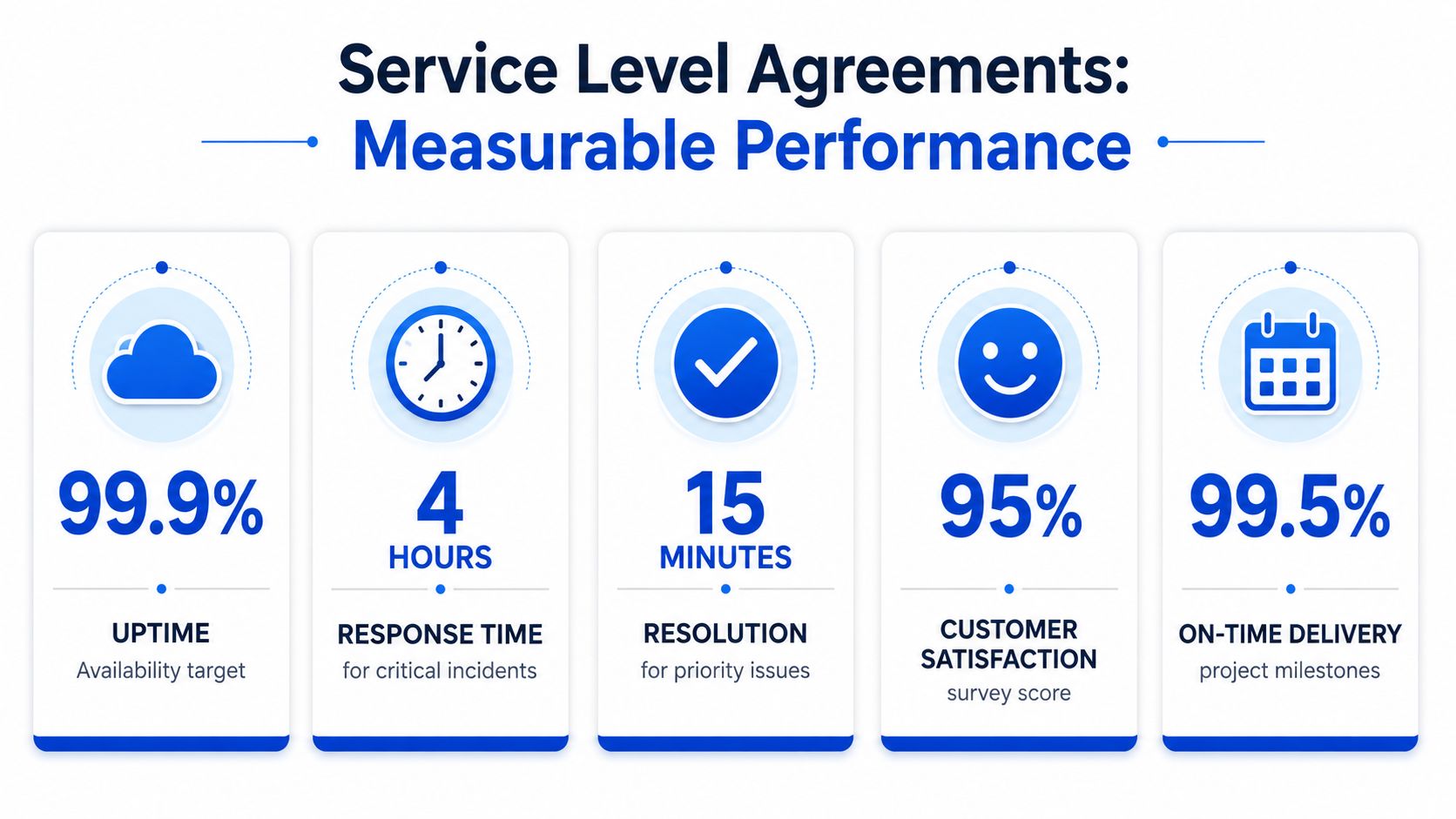
Making performance auditable
A useful SLA starts with metrics the business can verify. It should spell out what gets measured, who records it, and what event starts the clock, because a dispute over timing can make an otherwise solid clause hard to use. If the contract does not say whether response time begins at ticket submission, acknowledgment, or human engagement, the parties will end up arguing over the contract instead of the service.
The operational reason for that precision is simple. A service agreement is supposed to translate a business promise into something measurable, so the customer can tell whether the provider met its obligations and the provider can price the risk with open eyes. Benchmarks such as uptime and incident response are often discussed in the incident.io guide, which also explains why these definitions matter before a vendor starts missing service levels. That kind of drafting is less about theory and more about deciding, in advance, what failure looks like.
Remedies that actually change behavior
A remedy only works if it gives the customer something meaningful without making the deal impossible to sign. Service credits are common because they give the client a practical response to underperformance while preserving the relationship for ongoing work. In practice, the remedy should match the economics of the engagement, since a small recurring fee and a high-risk operating dependency do not call for the same relief.
The contract should also connect the SLA to the broader agreement structure. A master service agreement can set the legal framework, while the SLA and any work orders define the operating details for each engagement. Teams that want to track these commitments as work unfolds often rely on dashboards and alerting tools, and the best SLA monitoring tools are most useful when the contract has already defined the exact metrics those tools need to watch.
A solid template helps keep that drafting disciplined. A service level agreement template is useful when the goal is to turn measurable performance into contract language with real remedies, instead of leaving the client with only a vague promise and a disappointed expectation.
Common Pitfalls and Negotiation Mistakes to Avoid
The costliest mistake is signing vague language and assuming the relationship will stay friendly. A vague scope invites scope creep, vague timing invites missed deadlines, and vague remedies leave the customer with little recourse when performance slips. The whole point of the agreement is to turn expectations into obligations that can be measured and enforced.
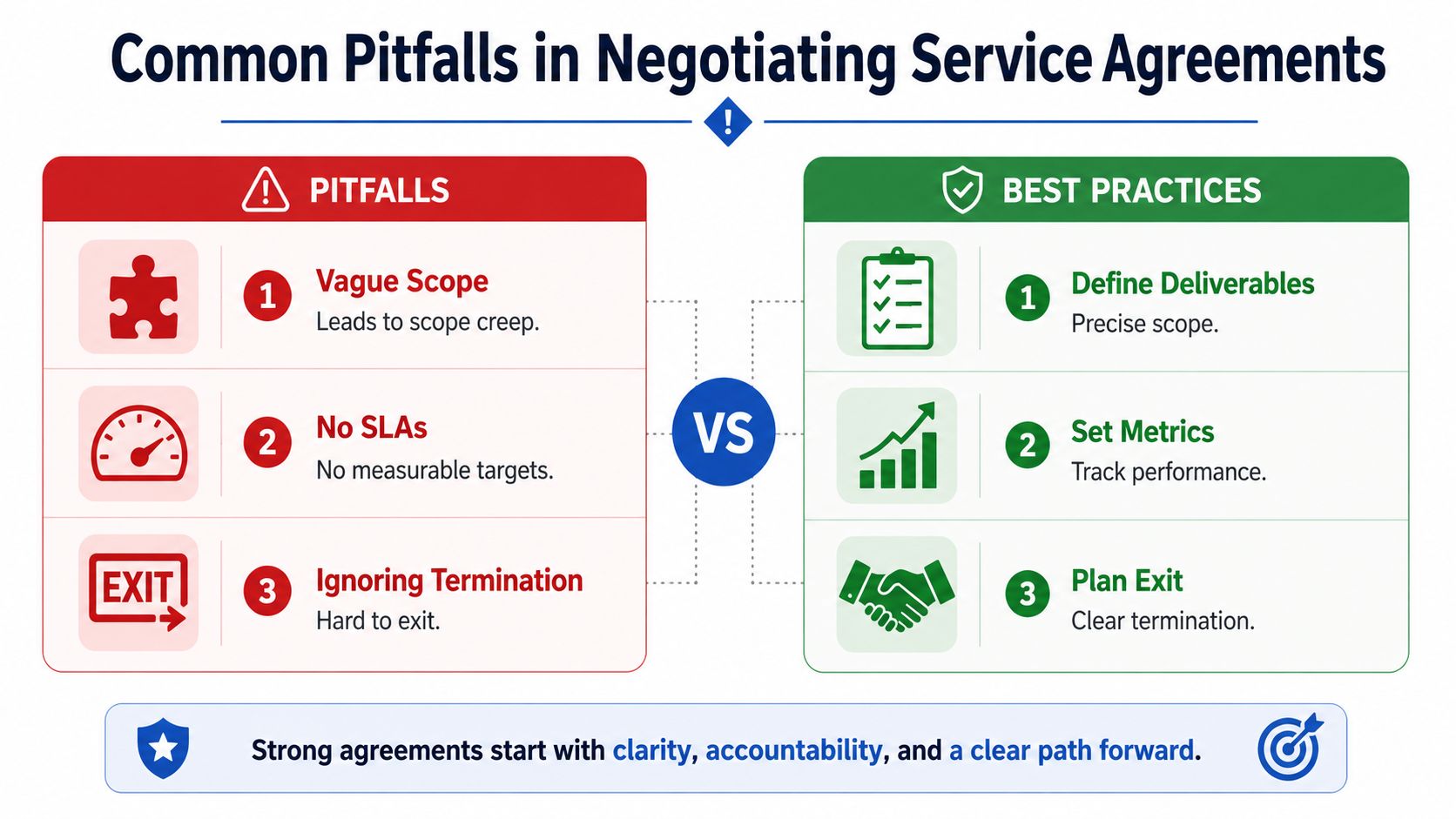
Clauses that deserve pushback
Unlimited liability is one of the fastest ways to break a deal. A provider who accepts open-ended exposure on a modest fee may walk away, or price the work so high that the deal no longer makes sense. Clients still need a meaningful cap, but the cap should fit the economics of the transaction instead of creating a theoretical risk no one can realistically absorb.
Automatic renewal clauses create another common trap. If the notice window is short or buried in boilerplate, the business can end up locked into another term without making an informed choice. That risk is especially sharp when renewal happens unless someone spots a narrow deadline in time.
Another common mistake is treating the other side’s template as fixed. That assumption usually costs money later. Scope, liability caps, confidentiality, IP ownership, renewal, and termination are regular negotiation points, while the true deal-breakers are often the commercial economics and the service definition. The service agreement should reflect what the parties genuinely want to happen if performance goes off track, not just what looked acceptable during the first draft exchange.
What to flag before signing
- Undefined exclusions: If the scope says what the provider will do but not what it will not do, the client may end up paying for work that should have been separate.
- One-sided confidentiality: Mutual protection is usually cleaner than a clause that only binds one side.
- Missing IP assignment: If the contract does not clearly say who owns the work product, ownership can become the first real dispute.
- No convenience termination: A deal can become operationally toxic if there is no exit path except breach.
- No service-level remedy: If the agreement promises performance but gives no consequence for failure, the promise may have little practical value.
Washington businesses should also pay attention to venue and governing law when the counterparty is out of state, because a dispute in the wrong forum can make even a solid claim expensive to pursue. For teams trying to draft faster without losing control, AI tools for lawyers can help with review workflows, but they do not replace careful human negotiation on the clauses that shift real risk.
Washington State Considerations and When to Hire Legal Counsel
A service agreement in Washington does more than set expectations between the parties. It also helps control risk, define remedies, and reduce the chance that a vague business promise turns into a dispute over scope, payment, or performance.
Washington founders should pay close attention to restrictive covenants, especially non-compete and non-solicitation language, because overly broad drafting can create enforceability problems. Agreements that involve personal data also need to account for state privacy rules, including the Washington Privacy Act where it applies. Venue and jurisdiction matter as well, because a dispute is easier to manage when the contract says where it belongs and which law will control.
The do-it-yourself route can work for low-risk, short-term services with limited financial exposure. It becomes harder to justify when the deal involves intellectual property, recurring payments, sensitive data, regulated activity, or multi-year commitments. Those are the arrangements where one vague sentence can shift cost, control, and liability in ways founders do not notice until the relationship starts to break down.
A practical review process works better than random cleanup. Start by auditing existing vendors, flag the highest-risk agreements first, and focus on terms that govern ownership, data handling, renewal, liability, and exit rights. That approach usually surfaces a small number of contracts that deserve a lawyer’s review before they create operational drag or expose the business to avoidable claims.
By Design Law Firm & Legal Consultancy, PLLC handles business contract drafting and review, general counsel support, and technology and data privacy work for Washington businesses. For founders who need help tightening service agreements before the next renewal or vendor launch, By Design Law Firm & Legal Consultancy, PLLC can help align the paper with the actual risk profile of the relationship.
By Design Law Firm & Legal Consultancy, PLLC helps businesses draft, review, and negotiate service agreements that fit the work, the risk, and the operating reality behind the deal. If a vendor relationship needs clearer scope, stronger remedies, or better exit language, visit By Design Law Firm & Legal Consultancy, PLLC to discuss practical contract support for your business. Call our law office today at (206) 593-1519.