A force majeure clause is a contractual emergency brake that can excuse a party from obligations when an unforeseeable, uncontrollable event makes performance impossible. For modern businesses, that matters because a disrupted shipment, factory shutdown, government restriction, or civil unrest can turn an otherwise workable deal into an immediate legal and operational problem.
A Washington business owner doesn't need a lecture on uncertainty. The issue is already familiar. A supplier misses a delivery window. A port slowdown ripples into inventory shortages. A customer still expects performance on the original timeline, while the company can't control the event causing the delay. At that point, the question isn't academic. It's practical. What does the contract allow, and what happens next?
That is where understanding what is Force Majeure Clause becomes useful. Done well, the clause allocates risk before the crisis arrives. Done badly, it gives everyone a false sense of security and then fails when it is needed most. The post-COVID contracting environment has made that difference much more visible, especially for businesses in the Pacific Northwest that depend on logistics, technology vendors, manufacturers, landlords, and multi-state counterparties.
Your Business and the Unforeseeable Event
A Seattle company is preparing a product launch. Components are supposed to arrive through a West Coast shipping channel. Marketing is scheduled. Customer commitments are lined up. Then an external disruption hits and the delivery chain stalls. The company isn't dealing with poor planning or ordinary delay. It is dealing with an event outside its control that may make timely performance impossible.
That is the kind of moment where a force majeure clause stops being boilerplate and starts acting like a decision tool. It tells the parties whether obligations pause, whether deadlines move, whether notice must go out immediately, and whether the contract can eventually be terminated if the disruption continues.

Why this matters in Washington
Pacific Northwest businesses often sit at the intersection of technology, trade, and regional infrastructure. That means a local company can be affected by a distant war, a factory closure abroad, a flood, or a sudden government order. The contract needs to answer a simple question before the parties are under pressure: who bears the risk when nobody caused the disruption?
Entrepreneurs often focus first on pricing, scope, and payment terms. That makes sense. But the hidden risk usually lives in the exception language. A useful companion to that exercise is learning about identifying hidden supply chain risks, because operational weak points and contract weak points usually show up together.
A related problem appears in early-stage companies that rely on template agreements or handshake assumptions. If the contract package is thin, the business may not have a workable force majeure clause at all. Founders who are building a stronger legal foundation should also review the essential contracts for business owners, because force majeure only works when it is part of a broader contract system.
A contract can't prevent disruption. It can decide in advance how the disruption will be handled.
The practical promise of the clause
The clause is not magic. It doesn't erase losses. It doesn't automatically excuse nonperformance. What it can do is reduce avoidable fights by setting the rules while the parties are still calm.
That is the true value for business owners. Not abstract doctrine. Predictable options under stress.
Unpacking the Core Legal Concept
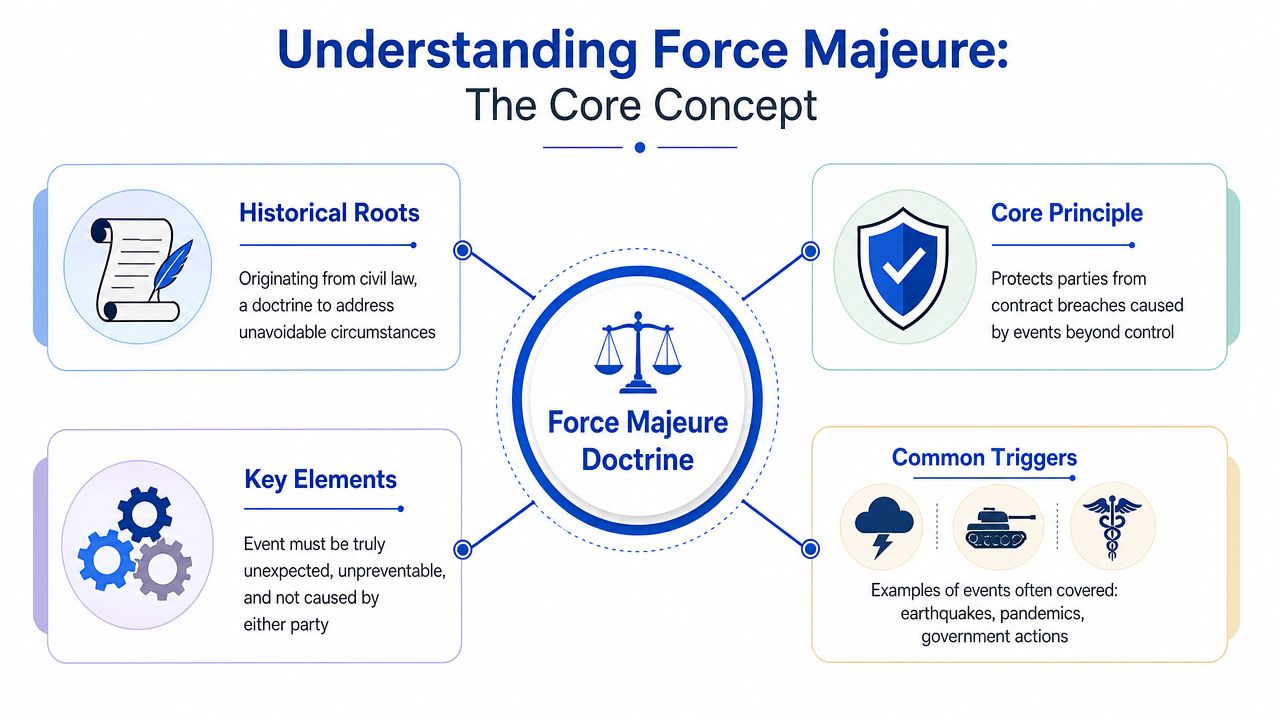
Force majeure is a long-standing contract doctrine with roots in French civil law and the Napoleonic Code. In modern legal usage, it refers to an extraordinary, unforeseeable event that can excuse a party from contractual obligations when performance becomes impossible because of circumstances beyond its control, as explained in Britannica's discussion of force majeure.
In plain English, the clause works like an emergency brake in a contract. Most of the time, the parties keep moving under the original terms. When a qualifying outside event makes performance impossible, the brake can slow or stop contractual duties in the specific way the contract allows.
It is not automatic
This is the first point many businesses miss. In common-law contracting, force majeure is not a default rule that appears by itself. If the contract doesn't include it, the parties usually can't assume they have it.
That matters because founders often understand the basics of contract formation, such as offer, acceptance, and consideration, but spend less time on the clauses that govern what happens when performance breaks down. The force majeure provision sits in that second category. It tends to be ignored until it becomes central.
For the same reason, it should be reviewed alongside other risk-shifting terms, including the importance of indemnity clauses in Washington State contracts. These provisions do different jobs, but they often work together in allocating business risk.
Force majeure compared with related doctrines
Business owners also hear nearby legal terms such as impossibility, impracticability, and frustration of purpose. They are not the same thing.
- Force majeure depends on contract language. The parties define the covered events and the remedy.
- Impossibility usually refers to a situation where performance can't be done at all.
- Impracticability typically addresses performance that has become unworkable in a legally recognized sense, even if not entirely impossible.
- Frustration of purpose focuses on a contract whose main reason has been destroyed by an outside event.
Those fallback doctrines can matter in a dispute, but relying on them is usually a weaker business position than relying on a well-drafted clause. A negotiated force majeure provision lets the parties write their own rules instead of arguing later about default doctrines.
Practical rule: If a business wants predictability, it shouldn't leave disruption management to implied doctrines and courtroom interpretation.
Typical Triggers and Common Exclusions
The modern importance of force majeure became especially visible during COVID-era disruptions. The World Bank's checklist for project contracts lists epidemics, pandemics, floods, earthquakes, wars, embargoes, and civil unrest as standard triggers in force majeure drafting, as described in the World Bank force majeure checklist.
That list is useful because it shows how commercial drafting treats force majeure as a category of serious external events, not as a catch-all excuse for any difficult business condition.
Events usually treated as triggers
Most clauses include a customized list of specific events. Common examples include:
- Natural events: earthquakes, floods, severe storms, and similar events that disrupt operations or destroy necessary infrastructure.
- Political or security events: war, terrorism, embargoes, and civil unrest.
- Public health events: epidemics and pandemics.
- Government actions: shutdown orders, legal restrictions, or other official actions that directly stop performance.
- Labor and logistics disruptions: sometimes strikes, transportation shutdowns, or port closures, if the parties choose to include them expressly.
The key word is include. Coverage depends on drafting. If a business depends on cloud infrastructure, a key manufacturer, or cross-border transport, the clause should reflect that operating reality instead of relying on generic language.
Events often excluded
A well-drafted clause also says what isn't covered. That is just as important. The most common exclusions involve ordinary business risk, including financial stress and market changes.
| Typically Included Events (Triggers) | Typically Excluded Events |
|---|---|
| Earthquakes, floods, wars, embargoes, civil unrest, epidemics, pandemics, and some government restrictions if listed in the clause | Price increases, market downturns, reduced profitability, cash flow problems, supplier financial trouble, and events the contract specifically excludes |
Economic pain alone usually isn’t enough. If performance is still possible but more expensive, many clauses won’t help. That distinction matters in industries where margins are tight and external shocks move costs quickly.
What businesses often get wrong
A common drafting mistake is broad wording with no boundaries. Another is a narrow list that ignores the company’s actual exposure. A software company may need language around government actions and critical vendor outages. A manufacturer may care more about transport interruptions and raw material constraints. A commercial customer using a service level agreement template should make sure the SLA and the force majeure clause don’t contradict each other on uptime, delay, credits, or termination rights.
The strongest clauses don’t just list dramatic events. They separate extraordinary outside events from normal commercial turbulence. That line is where many disputes start.
How a Force Majeure Clause Actually Works
A force majeure clause must be written into the contract in common-law systems, and effective clauses usually do two jobs. They define the triggering event and specify the remedy, which is often suspension of obligations, as summarized in Summit Law’s guide to force majeure under common-law contracting.
That sounds straightforward. In practice, most of the operational work then begins.
The invocation process
When a party wants to rely on force majeure, it generally needs to do more than announce that a disruption occurred. The party invoking the clause usually bears the burden of showing that the event fits the clause, caused the nonperformance, and could not be avoided through reasonable mitigation.
A disciplined response usually includes:
- Check the contract language immediately. The exact event list, notice method, and timing control the analysis.
- Send notice the way the contract requires. If the contract says written notice to a named address or email, that detail matters.
- Document causation. The affected party should be able to show how the event directly prevented performance.
- Mitigate where possible. Alternative suppliers, substitute transport, temporary workarounds, or partial performance can all matter.
- Track the duration and effect. Some clauses allow suspension first and termination later if the disruption continues.
Suspension is not the same as termination
Many owners assume force majeure ends the contract. Often it doesn’t. It pauses duties for the period stated in the agreement, or for as long as the direct effects continue. Only some clauses allow termination after a defined duration or after continued impossibility.
That distinction affects cash flow, staffing, customer communications, and procurement decisions. A business that treats a temporary suspension like a permanent exit can create a second breach while trying to avoid the first.
The real legal fight is often not whether something bad happened. It is whether the contract gave that event the specific consequence the claiming party wants.
What works and what doesn’t
What works is procedural discipline. Fast notice. Good records. Specific evidence. Credible mitigation.
What doesn’t work is vague language such as “business conditions made performance difficult,” or a bare claim that a supplier problem automatically qualifies. If a party can’t show direct impact and reasonable efforts to reduce it, the clause may offer little protection even when the triggering event looks serious on paper.
Drafting and Negotiating Your Clause
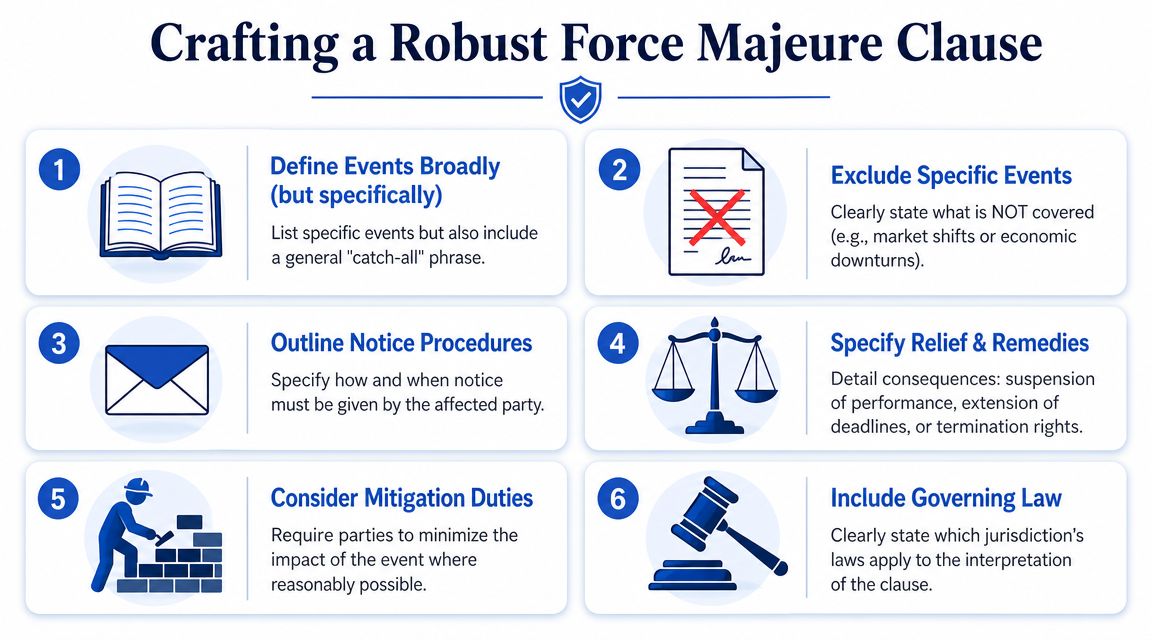
Many disputes arise because the clause answers the wrong question. It defines force majeure in general terms, but says too little about what happens after invocation. Ashurst notes that effective drafting usually has two parts: the definition of the force majeure event and the operative provisions that determine the consequences, and the claiming party typically must show the event was beyond its control and that no reasonable steps could have avoided the impact, as outlined in Ashurst’s quick guide under common law.
A practical sample structure
A workable clause often follows this pattern:
If a listed event beyond a party’s reasonable control makes performance impossible, the affected party must give prompt written notice, use reasonable efforts to mitigate the effects, and is excused from the affected obligations for the period of the event and its direct consequences. If the event continues beyond the contract’s stated threshold, either party may terminate on written notice.
That isn’t plug-and-play language. It is a checklist in sentence form. Each phrase carries weight.
- Listed event beyond control narrows the trigger.
- Prompt written notice creates a procedural gate.
- Reasonable efforts to mitigate prevents passive reliance.
- Excused from affected obligations avoids overbroad relief.
- Termination after a stated threshold creates an exit rule.
A business negotiating a Seattle office, warehouse, or retail agreement should also make sure the force majeure language aligns with the rest of the deal, especially lease-specific obligations discussed in these tips for navigating commercial lease agreements in Seattle.
A visual overview can help clarify the moving parts before language is finalized.
Buyer and seller priorities are different
A customer or buyer often wants a narrower clause. The customer usually pushes for:
- Specific triggers only: no vague catch-all language.
- Tight notice requirements: missed notice should have consequences.
- Mitigation duties with teeth: substitute performance should be required where feasible.
- Termination rights: if the disruption lasts too long, the customer needs a clean exit.
A vendor or seller often wants flexibility. The vendor usually asks for:
- Broader event categories: enough room to capture real operational disruptions.
- Clear suspension rights: so delay doesn’t become immediate breach.
- Protection for upstream disruption: especially where supply chains are layered.
- Cure runway: time to recover before termination becomes available.
What strong drafting looks like
Strong drafting is balanced and specific. It matches the company’s business model. It doesn’t confuse inconvenience with impossibility. It also doesn’t assume that a generic internet form will fit a Washington startup, a manufacturing agreement, and a multi-vendor SaaS contract equally well.
The best clause is the one the parties can use under pressure without guessing what it means.
Washington State Legal Considerations
For Washington businesses, the broad common-law principles discussed above remain the starting point. Courts generally focus on the contract’s language. That means the words chosen in the clause will usually matter more than labels or assumptions about what force majeure is supposed to mean.
Plain language matters most
In practical terms, a Washington company should assume that a court will read the agreement closely and ask ordinary contract questions. Was the event covered? Was it beyond the party’s control? Did it prevent performance? Did the party follow the notice and mitigation requirements?
That makes specificity more valuable than rhetorical flourish. A clause that refers loosely to “events outside the parties’ control” may sound protective, but it often leaves too much room for argument.
Regional business realities should shape drafting
Washington companies face a mix of risks that can be unusually concentrated. International sourcing, port-related logistics, technology dependencies, weather events, and layered vendor relationships all affect how the clause should be customized. A company in Spokane may need different language than a software business in Seattle or a distributor serving the Puget Sound region.
If a clause doesn’t reflect how the business actually operates, it may fail at the exact moment the business expects it to help.
The takeaway for local companies is simple. National contract principles apply, but local drafting should reflect local exposure. Clear language is still the safest route.
A Practical Checklist for Contract Risk Mitigation
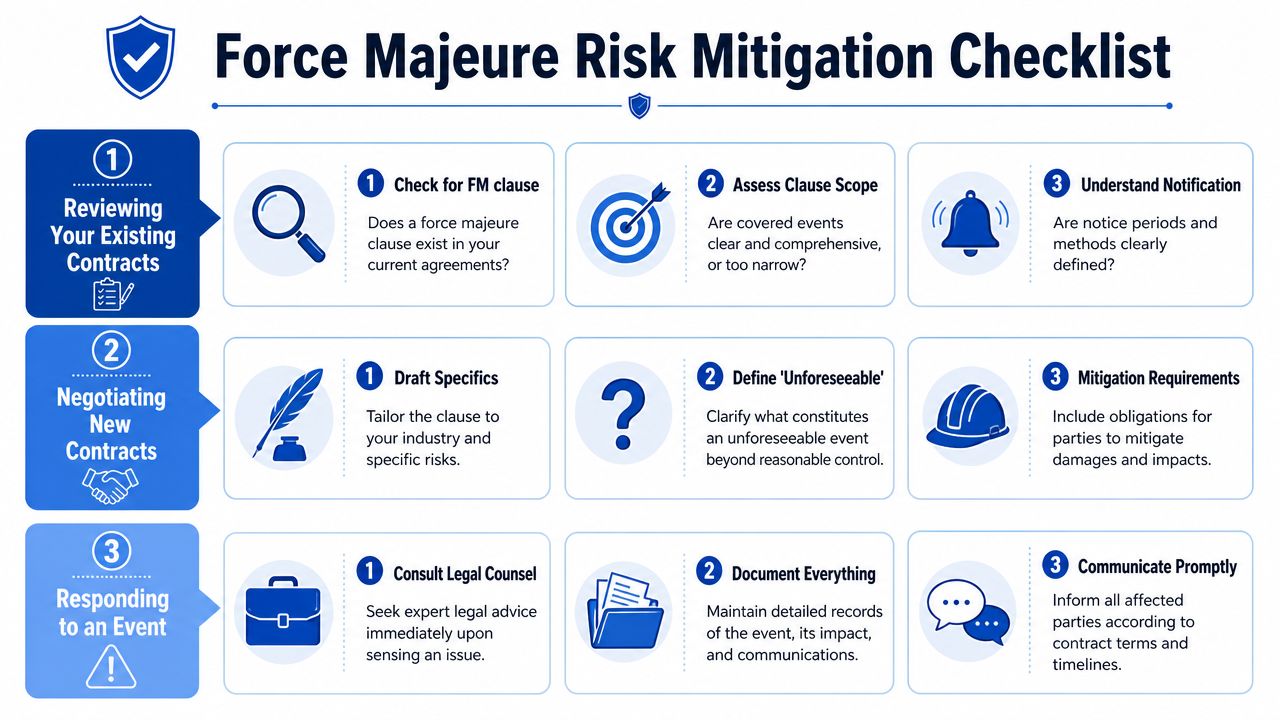
Understanding what is Force Majeure Clause is only useful if it changes how contracts are reviewed, negotiated, and managed. The checklist below is a practical way to pressure-test agreements before a disruption arrives and to respond intelligently when one does.
Reviewing existing contracts
Start with signed agreements already in circulation.
- Look for the clause itself: some contracts don’t contain one at all.
- Match the trigger list to actual operations: if the business relies on international freight, key subcontractors, or cloud services, the clause should reflect those dependencies.
- Check the remedy language: does the clause suspend obligations, extend time, permit termination, or stay silent on consequences?
- Read the notice provision carefully: the method, recipient, and timing can determine whether rights are preserved.
- Compare connected provisions: payment terms, service levels, indemnity language, and termination sections should not conflict with the force majeure mechanism.
Negotiating new agreements
When the business is still at the drafting table, it is in a position to make the clause useful.
- Define covered events with precision: use an industry-specific list, then decide whether a narrow catch-all belongs.
- State the exclusions: economic downturns, cost increases, and financing trouble are common candidates.
- Require mitigation: the clause should push both sides to reduce the disruption rather than merely declare one.
- Set the notice rules: prompt notice should be realistic but clear.
- Decide the endgame: if the event continues, does the contract remain paused or can one or both parties walk away?
Responding when an event hits
The first response should be operational and legal at the same time.
- Pull the contract immediately. Don’t rely on memory or a summary.
- Preserve evidence. Save government notices, supplier communications, logistics updates, and internal records showing impact.
- Map the causation chain. The company should be able to explain exactly why performance became impossible.
- Take reasonable mitigation steps. Explore substitute supply, alternate routing, revised performance sequencing, or partial delivery.
- Send formal notice. It should match the contract’s notice provision, not just a casual business email.
- Review termination exposure. Counterparties may gain exit rights if the disruption continues.
A useful internal exercise is to keep a simple force majeure response file for major contracts. That file should contain the agreement, notice contacts, business dependencies, and a short internal playbook. When pressure builds, speed and documentation often matter as much as the clause text itself.
A force majeure clause is not a substitute for resilient operations. It is the contract tool that supports resilience when operations are hit by something outside the company’s control.
Businesses across Seattle and Washington State benefit from contracts that don’t just look polished, but hold up when real disruption arrives. By Design Law Firm & Legal Consultancy, PLLC advises startups and established companies on drafting, negotiating, and stress-testing business agreements so force majeure, indemnity, termination, and related provisions work together as a practical risk-management system. Call us today at (206) 593-1519.