A founder has a sales contract in one tab, a vendor MSA in another, and an investor document sitting in email marked urgent. The temptation is obvious. Drop each file into an AI tool, get a clean risk summary, move faster, and keep legal spend under control.
That instinct is understandable. It's also where trouble starts.
AI contract review is now mainstream enough that founders can't ignore it, but it's still immature enough that they can't trust it blindly. For startups and SMBs, that creates a narrow path. Used well, these tools can take repetitive review work off a legal or operations team's plate. Used carelessly, they can miss exactly the clause that matters most, expose sensitive data, and create a false sense of legal safety.
The right question isn't whether a business should use AI contract review. The right question is where it belongs in the workflow, who checks it, and what safeguards exist before a confidential agreement ever touches the system.
The Rise of AI in Contract Management
Founders aren't dealing with a theoretical trend. They're dealing with contract volume, limited bandwidth, and pressure to close. That's why AI contract review has moved from novelty to operational tool so quickly.
The market tells the story. The AI Contract Review Software Market was valued at $2.13 billion in 2025 and is projected to reach $7.5 billion by 2035, with a 13.4% CAGR, according to Wise Guy Reports' AI contract review software market analysis. That kind of growth doesn't happen because lawyers enjoy shiny software. It happens because contract bottlenecks cost businesses time, advantage, and attention.
Why founders are paying attention
Founders pay attention because contract work lands on them when startups lack dedicated contracts teams. Legal review often starts late, after terms are already conceded, so deals can get rushed.
- Routine agreements pile up: NDAs, customer forms, SaaS terms, and vendor agreements all compete for attention.
- Important deals get rushed: Teams skim, sign, and hope the paper matches the business conversation.
- Legal review becomes reactive: Counsel gets looped in late, after terms are already conceded.
AI tools promise to fix that by making first-pass review faster and more consistent. That promise is real for some contract types. It is not universal.
Practical rule: AI is strongest where the contract is repetitive, the fallback positions are known, and the review criteria can be written into a playbook.
That's why the most useful founder mindset is neither fear nor hype. It's controlled adoption. Contract automation now sits in the same broader risk category as privacy, security, and data handling. A company that wants AI speed also needs AI governance, especially where sensitive contract data intersects with regulatory obligations discussed in By Design Law's analysis of generative AI and U.S. data privacy laws.
How AI Contract Review Actually Works
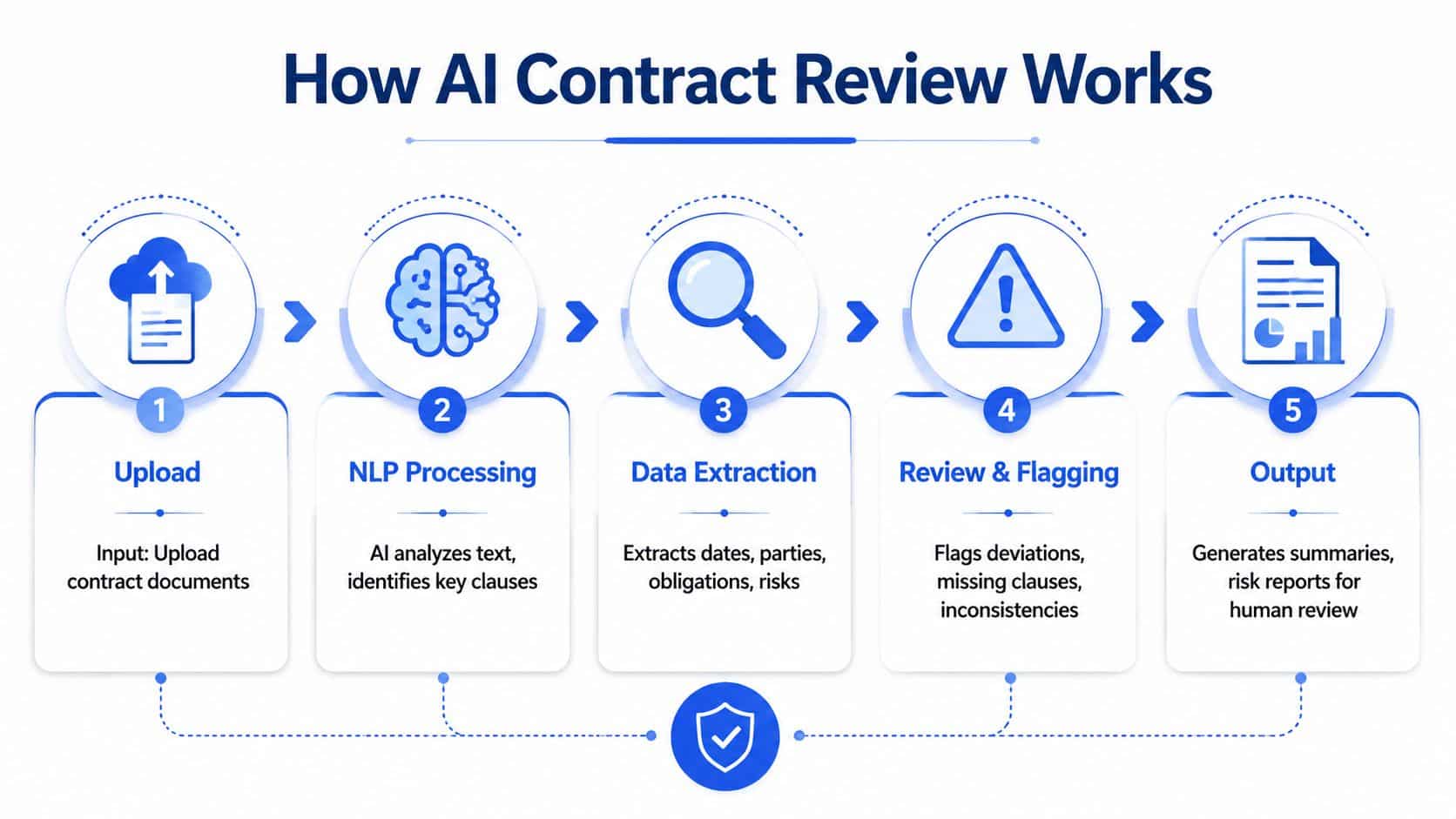
AI contract review works like a fast first pass assistant. It compares a contract against patterns, clauses, and set legal positions.
The core mechanics
At a practical level, these systems use natural language processing to parse contract language and machine learning to recognize clause types, obligations, and deviations from expected wording. For legal teams, the useful output usually falls into a few buckets:
- Clause identification: The tool labels provisions such as indemnity, limitation of liability, assignment, termination, and confidentiality.
- Issue spotting: It flags language that differs from the company's preferred position.
- Data extraction: It pulls out dates, parties, payment terms, notice requirements, and renewal mechanics.
- Suggested redlines: Some systems propose alternate language based on a legal playbook.
In 2026, purpose-built legal AI tools achieve over 90% accuracy in clause identification, while general-purpose AI chatbots were observed at 69% accuracy, according to Justee's guide to AI contract review. That difference matters. Founders shouldn't use a general chatbot for legal review when a specialized tool exists.
The workflow that actually works
A sensible AI contract review workflow looks like this:
- Upload the contract in Word or PDF format.
- Run the first-pass analysis against a playbook of approved terms and fallback positions.
- Review flagged issues such as broad indemnity, auto-renewals, data use rights, or unusual termination limits.
- Escalate legal judgment calls to a lawyer or trained reviewer.
- Finalize edits in the native document and preserve an audit trail.
The best tools fit existing legal habits instead of forcing a new one. Products that work directly in Microsoft Word tend to be easier to pilot and easier for lawyers to trust because they preserve the drafting environment while showing playbook-based deviations and suggested language, as described in Simular's overview of AI contract review tools.
For teams that still receive contracts as image files or scans, converting them into a cleaner review format before analysis can help. A simple utility like JPG to PDF is useful when a counterparty sends page images instead of a workable document set.
Human review is the real control point
The most important stage is the one vendors like to downplay. Human verification.
A trained reviewer has to confirm whether the flagged issue is real, whether the suggested fallback fits the deal, and whether the document reflects the actual commercial understanding. That matters even more for work orders, implementation documents, and custom scopes. A startup using a statement of work template may standardize project terms, but once customer-specific commitments get layered in, software alone won't protect the business from mismatched deliverables or hidden service obligations.
AI can spot text patterns quickly. It can't own the business risk created by a bad compromise.
The Business Case for Automated Review
The strongest case for AI contract review isn't abstract innovation. It's throughput. If a company handles high-volume routine agreements, speed and consistency are worth real money, even when no one puts a precise dollar figure on it internally.

A December 2025 survey of 452 in-house legal professionals found that 52% of in-house legal teams are using or evaluating AI for contract review. The same report states that these tools can analyze an NDA in 26 seconds compared with 92 minutes for human review, with 94% accuracy, and can accelerate the process by 45% to 90%, according to LegalOn and In-House Connect's adoption announcement.
Where the return shows up
For startups, those gains usually show up in operational friction rather than accounting line items.
- Sales closes faster: Routine customer paper gets triaged quickly instead of sitting in a founder inbox.
- Procurement stops clogging: Vendor terms can be screened before leadership spends time negotiating.
- Legal time gets reserved for real risk: Counsel can focus on key negotiation points, not repetitive markup.
- Internal consistency improves: The tool applies the same baseline playbook every time.
That's why the strongest use cases are still boring. NDAs. Standard customer terms. Common vendor agreements. Employment-related documents with stable fallback language. AI contract review is most valuable when the company already knows what “acceptable” looks like.
Routine work is where automation earns trust
Vendor marketing often overcomplicates this point. The business win is simple. If software reliably handles the front-end reading, flagging, and comparison work, the human reviewer can spend time on negotiation strategy and exception handling.
Axiom reports that AI contract review software delivers 40% to 60% time savings on routine tasks such as reading, flagging clause deviations, and applying playbook standards, particularly for high-volume agreements like NDAs, vendor contracts, and employment agreements, in Axiom's discussion of AI contract review and analysis.
A short overview helps illustrate the operational fit:
The best business case for AI contract review is narrow, not broad. Start with repeatable contracts, stable playbooks, and obvious bottlenecks.
A founder who buys an enterprise platform expecting it to solve every contract problem will be disappointed. A founder who uses it to tame repetitive review work will probably keep it.
Accuracy Limits and Common Failure Modes
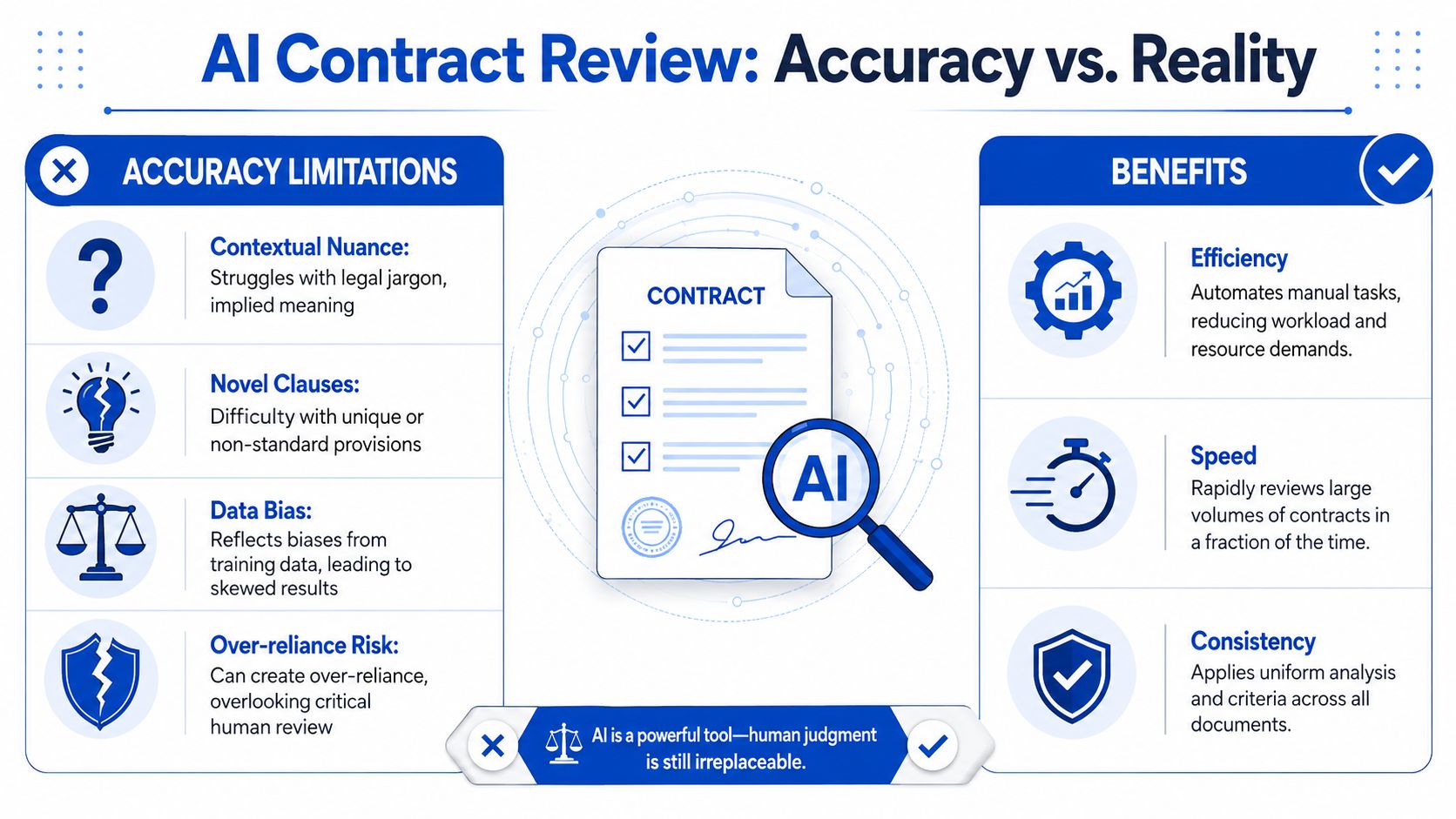
The biggest mistake in this category is assuming fast review equals competent review. It doesn't.
AI contract review performs best when the contract structure is familiar and the clause language fits patterns the model has seen before. It gets shakier when the draft is bespoke, heavily negotiated, or tied to unusual deal terms. That's exactly where startups often face their most important paper.
Where tools break down
Independent testing highlighted a problem vendors often sidestep. While vendors promote 40% to 60% time savings, many AI tools fail to detect critical clauses like unlimited liability or indemnification caps in non-standard, bespoke startup agreements, creating a dangerous gap between perceived efficiency and actual legal competence, as discussed in ContractSafe's review of AI contract review software.
That gap is not academic. It affects the exact documents that can alter a startup's future:
- Investor term sheets and financing documents
- Acquisition or strategic transaction paper
- Custom enterprise customer agreements
- Partnership contracts with unusual revenue or IP terms
Common failure modes founders should expect
Not every AI miss looks dramatic. Many are subtle, which makes them more dangerous.
| Failure mode | What it looks like in practice | Why it matters |
|---|---|---|
| Clause omission | The system doesn't flag a non-standard liability provision | The business accepts risk it never priced |
| False comfort | The summary looks polished, so no one checks the raw text | Review quality drops because trust rises too fast |
| Context failure | The tool sees standard words but misses a negotiated carveout | The legal effect is opposite of what the team assumes |
| Deal mismatch | The document is internally coherent but doesn't match the commercial agreement | The paper records the wrong deal |
The wrong contracts for blind automation
Founders should be skeptical whenever a contract has fluid terms, unusual power imbalances, or a low tolerance for interpretive mistakes. In those deals, the role of AI should shift.
Instead of asking the system to “review the contract and tell us if it’s okay,” the smarter use is to ask whether the final paper matches the known deal structure, approved fallback positions, and required protections. That’s a validation task, not delegated legal judgment.
Red flag: If a tool performs well on NDAs and then gets used on M&A documents without a different review protocol, the company has confused efficiency with competence.
For high-stakes agreements, a clean AI summary should increase scrutiny, not reduce it.
Navigating Critical Legal and Privacy Risks
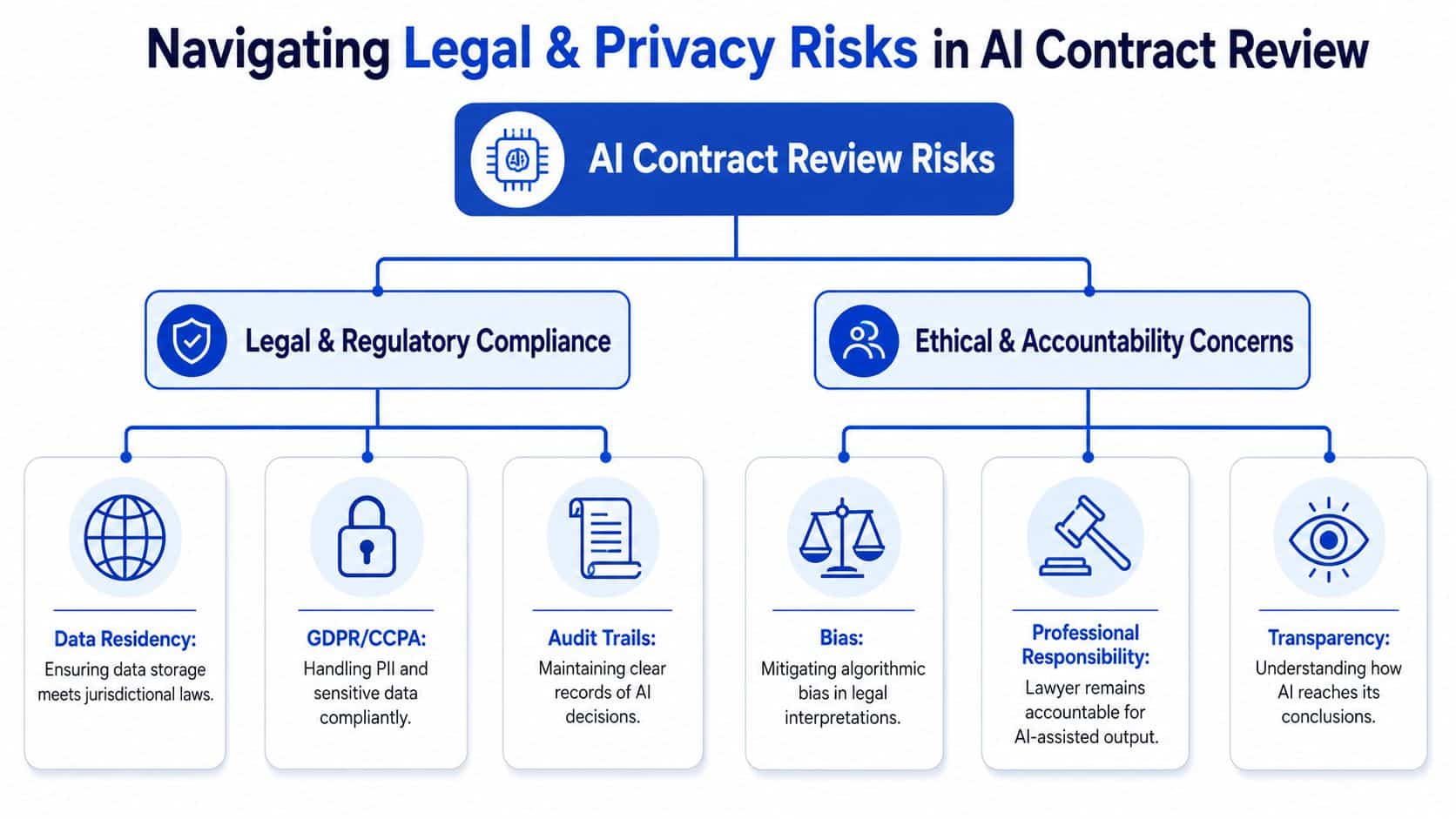
A company that gets comfortable with AI contract review too quickly tends to create three problems at once. It exports sensitive data, lowers human vigilance, and muddies accountability when something goes wrong.
That’s why legal risk in this area isn’t limited to missed clauses. It also includes privacy exposure, ethics duties, and recordkeeping failures.
Professional responsibility still applies
Legal professionals have an ethical duty to “reasonably understand the AI’s capabilities and limitations” and can’t rely on output without independent verification, according to UE’s guidance on using artificial intelligence in contract creation.
That obligation matters beyond law firms. Startups often route legal operations through a founder, COO, GC, or outside counsel. Whoever owns the review process needs to understand what the tool does well, where it fails, and when escalation is mandatory. “The software said it was fine” is not a defense. It’s evidence of poor governance.
Privacy and confidentiality are contract issues too
Every upload raises a data-handling question. The contract may contain pricing, customer names, product roadmaps, personal data, security commitments, or acquisition details. If the vendor’s terms allow model training on submitted data, broad subcontractor access, or cross-border processing without clarity, the tool itself becomes a counterparty risk.
A practical privacy screen should cover:
- Data use restrictions: The vendor shouldn’t train models on client contracts.
- Access controls: Teams need role-based permissions and identity management.
- Storage and transfer rules: The company needs to know where data sits and who can access it.
- Document hygiene: Files often contain hidden metadata that reveals authorship, revision history, and internal comments. Before external sharing, teams should understand practices for ensuring complete PDF privacy for professionals.
Auditability and dispute posture
A second problem appears later, when a dispute arises. If a company can’t show who reviewed the AI output, what version was used, what changes were accepted, and what reasoning supported key decisions, the workflow becomes hard to defend internally or externally.
That doesn’t mean every AI-assisted review must be litigation-ready from day one. It does mean the company needs basic records:
- What document was uploaded
- Which playbook or review standard applied
- Who validated the output
- What issues were escalated
- What final changes were approved
A startup building that discipline early will handle growth much better than one that treats AI review as a disposable convenience tool.
The compliance mindset founders need
The safest position is simple. AI contract review should sit inside the company’s broader AI risk and compliance program, not outside it. A lightweight internal framework is enough at the start, but it has to exist. Teams that need a starting point for policy alignment often benefit from an internal AI risk assessment template and U.S. business guide before they sign a vendor contract.
A fast contract workflow that leaks confidential data or bypasses competent review isn’t efficient. It just hides the cost until later.
A Governance Framework for Startups and SMBs
Most startup AI adoption fails at procurement, not at prompting. The team buys a tool before deciding which contracts it may review, which data may enter it, who approves exceptions, and what happens when the output is wrong.
The fix is not complicated. It requires discipline.
LegalOn notes that compliant vendors should hold SOC 2 Type II certification, adhere to GDPR/CCPA, explicitly prohibit training AI models on client contracts, and provide access controls such as SSO and encryption, as outlined in LegalOn’s AI contract review software requirements. Those are baseline controls, not premium features.
Start with a procurement checklist
Before any pilot begins, the company should force the vendor through a structured review.
| Verification Area | What to Ask / Confirm | Red Flag |
|---|---|---|
| Security controls | Confirm SOC 2 Type II status, encryption at rest and in transit, and SSO availability | The vendor gives marketing language but no clear control commitments |
| Data use | Confirm the vendor does not train models on customer contracts or uploaded matter data | The contract permits training, “service improvement,” or broad derivative use |
| Privacy compliance | Confirm GDPR/CCPA handling, subprocessors, and data location transparency | The vendor is vague about storage regions or subprocessors |
| Access management | Confirm role-based permissions, admin controls, and user logging | Anyone with a seat can access every file |
| Workflow fit | Confirm the product works in the team's actual drafting environment and supports playbooks | The tool requires major process change before value appears |
| Auditability | Confirm review logs, version records, and exportable reports exist | No meaningful audit trail |
| Escalation model | Confirm the vendor's materials support human review and exception handling | The sales pitch treats the tool like autopilot |
Put contract limits in writing
Founders should scrutinize the vendor paper as hard as the product demo. A few clauses matter more than anything else.
- Data ownership and use: The agreement should state that customer data remains the customer’s data and isn’t used to train models.
- Confidentiality scope: Confidentiality terms should cover uploaded documents, extracted data, and generated outputs where appropriate.
- Security commitments: The contract should reference specific controls, not vague promises of “industry standard” protection.
- Incident notice: The vendor should have a clear obligation to notify the customer of security incidents involving contract data.
- Subprocessor transparency: The company should know who else may touch the data.
A broad “license to use submitted content” clause is a serious problem. So is any term that lets the vendor retain files indefinitely for unspecified product development.
Build a human-in-the-loop policy
A startup doesn’t need a thick governance manual. It does need a short operational rule set. Good internal policy usually separates contracts into categories.
For example:
- Category A, routine contracts: Standard NDAs, lightweight vendor forms, repeatable low-risk paper. AI first pass allowed, human validation required.
- Category B, moderate-risk contracts: Customer MSAs, data processing terms, employment-related agreements. AI assistance allowed, legal review required before signature.
- Category C, high-stakes contracts: Financing, M&A, IP transfers, exclusivity, major strategic partnerships, heavily negotiated enterprise deals. AI may assist with issue spotting, but not final decision-making.
Assign responsibility before rollout
Governance fails when everyone assumes someone else checked the output. The company should name actual owners.
- Business owner decides whether the contract is routine or sensitive.
- Legal owner approves the playbook and escalation thresholds.
- Operations or IT owner confirms security, access, and vendor controls.
- Executive owner approves exceptions for high-risk deployments.
That structure doesn’t need to be bureaucratic. It needs to be unmistakable.
Keep the program light, but real
Small businesses often overcorrect and assume AI governance requires enterprise overhead. It doesn’t. It requires a short policy, a vendor checklist, a contract fallback matrix, and a simple incident-response plan for bad outputs or data mishandling. Teams looking for a broader framework on operating controls may find Averta’s AI agent governance insights useful as a practical complement to legal review.
For internal implementation, a concise set of AI governance best practices can anchor who may use the tool, for what documents, under what controls.
If a startup has enough process to approve software spend, it has enough process to govern AI contract review.
Conclusion The Smart Path Forward
AI contract review is worth using. It is not worth trusting blindly.
The technology already has a clear role in startup operations. It can speed up routine review, improve consistency, and reduce contract backlog where documents are standardized and fallback terms are known. That part is real. So are the limits. Bespoke agreements, sensitive deal documents, privacy-heavy contracts, and high-stakes negotiations still require close human judgment.
The smart path is controlled adoption. Use specialized tools, not general chatbots. Restrict use cases at the start. Verify the vendor’s security and data-use terms. Require human review. Keep records. Escalate unusual paper early.
Most important, legal review should happen before procurement, not after implementation. A company that buys first and governs later usually ends up paying twice. Once for the tool, and again for the cleanup.
By Design Law Firm & Legal Consultancy, PLLC helps startups and growing companies adopt AI with the right legal, privacy, and governance structure from the start. Businesses that need practical counsel on contract workflows, vendor terms, data handling, or AI risk management can learn more at By Design Law Firm & Legal Consultancy, PLLC. Contact our law office today at (206) 593-1519.