A SaaS founder is watching the internal team drown in access requests, security alerts, cloud maintenance, and vendor escalations. A healthcare founder faces a different version of the same problem, with billing, scheduling, records administration, and compliance work competing for attention while clinical decisions must remain with licensed professionals. In both situations, a managed services organization can look like the clean answer.
The contract often creates the core problem. The provider may control systems, subcontractors, data flows, artificial intelligence tools, and operational decisions without accepting responsibility for the consequences. A low monthly fee won't protect a company from an unclear service-level agreement, weak exit rights, or a regulatory violation.
Managed services has moved from a niche outsourcing practice into a core operating model for cloud, cybersecurity, and IT operations. One market estimate valued the global market at USD 401.2 billion in 2025 and projected it to reach USD 847.4 billion by 2033, with a projected 9.9% compound annual growth rate from 2026 through 2033 (Mordor Intelligence market analysis). That scale makes contract discipline more important, not less.
Why This Guide Matters for Startups and SMBs
This guide matters because it shows how an MSO deal splits control, data ownership, and responsibility when systems fail. It also warns that outsourcing activity does not outsource accountability.
The right starting point is the operating model. An IT-focused arrangement may cover infrastructure monitoring, identity management, cloud administration, security operations, and help desk support. A healthcare MSO may handle non-clinical administration while leaving diagnosis, treatment, and professional judgment with the medical practice. Those structures carry different legal constraints, even when both providers call themselves managed services organizations.
Practical rule: A company can't outsource accountability merely by outsourcing activity.
A proper review should proceed in a deliberate order:
- Define the delegated function: Identify the exact processes the provider will perform, supervise, automate, or approve.
- Identify retained authority: Record which decisions remain with the client, clinical entity, board, security officer, or other accountable person.
- Map the information: List personal data, health information, confidential business information, credentials, source code, and regulated records the provider can access.
- Test the contract: Check service levels, liability, audit rights, subcontractors, artificial intelligence use, data return, and transition assistance.
- Plan the exit: Require a workable way to retrieve data, replace tooling, transfer documentation, and maintain continuity after termination.
The managed services market is also concentrated in high-spend regions. North America represented more than 33.0% of global managed services revenue in 2025, estimated at about USD 132.5 billion, according to Market.us market research. That commercial maturity gives buyers a stronger negotiating position, but only if the buyer understands what the provider is promising.
This guide treats an MSO as an ongoing operational relationship, not a generic outsourcing purchase. The useful question isn't whether the provider can perform the work. It's whether the agreement allocates control, evidence, risk, and transition obligations in a way the company can live with.
What a Managed Services Organization Really Is
A managed services organization assumes continuing responsibility for defined operational functions under a managed services agreement. The provider doesn't merely sell software, place personnel, or deliver advice. It operates a function against agreed standards, reports performance, handles exceptions, and maintains the systems or processes needed to deliver the service.
A SaaS vendor sells access to a platform. A staffing agency supplies personnel, while the client generally directs those individuals day to day. A consultant evaluates, recommends, designs, or advises. An MSO sits closer to the operating core. The client pays for an ongoing service with defined responsibilities, recurring performance expectations, and an escalation structure.
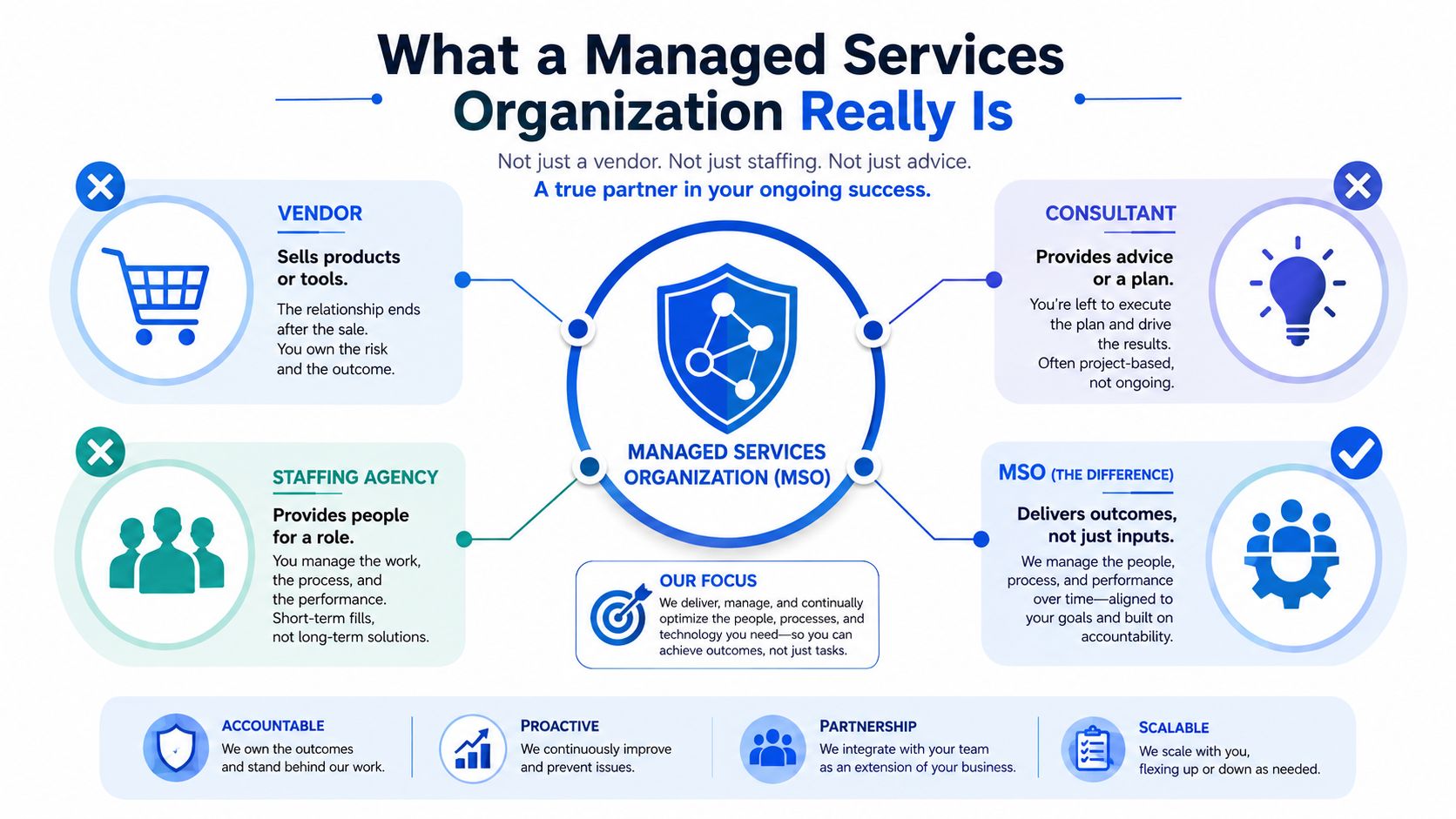
The operational distinction
The difference appears in the agreement's verbs. A vendor may grant access. A consultant may recommend controls. A staffing firm may assign an administrator. An MSO may monitor, maintain, respond, remediate, document, and report. Those obligations create a continuing performance relationship rather than a one-time deliverable.
That distinction affects the legal analysis. If the provider controls a production environment, the contract should identify access rules, change authority, security duties, incident response, and evidence requirements. If the provider creates scripts, configurations, reports, documentation, or automated workflows, the agreement should separate client-owned work product from the provider's pre-existing tools.
The healthcare meaning
Healthcare uses the term differently. In states with corporate practice of medicine restrictions, an MSO can separate administrative and business operations from clinical decision-making. The management services agreement must avoid fee-splitting and arrangements that give the MSO de facto control over physician practice, as explained by the Medical Group Management Association's MSO compliance guidance.
The structure therefore determines who answers to regulators, who controls patient information, who employs administrative personnel, and who retains professional judgment. Calling an entity an MSO doesn't solve those questions. The actual rights and conduct of the parties control.
A buyer should read the arrangement as a control map. The contract, access permissions, payment formula, staffing structure, and operating practices must point in the same direction. If the paperwork says the client controls a function but the provider makes every meaningful decision, the label won't eliminate the exposure.
Common MSO Models and How They Are Priced
MSO proposals usually fall into three operating models. The first is a dedicated operations model, where the provider builds and runs a function primarily for one client. This can create close alignment and stronger institutional knowledge, but the buyer must examine staffing dependency, replacement obligations, and the cost of bespoke work.
The second is a shared services model. The provider supports multiple clients with common tools, playbooks, monitoring systems, and escalation processes. Shared delivery can improve consistency and make specialized capabilities accessible to smaller businesses, but the contract must define prioritization, maintenance windows, resource allocation, and conflicts between customers.
The third is a hybrid model. The client retains strategy, approval authority, architecture, or compliance ownership while the MSO executes routine work. This often suits a growing company that has a capable internal leader but lacks enough operational capacity. It also creates boundary disputes unless the agreement clearly identifies who approves changes and who bears responsibility for missed obligations.
Pricing shifts risk differently:
- Per-user or per-device pricing: Easy to budget, but the client can pay more as adoption grows. The model may also discourage the provider from improving automation if fewer users or devices reduce fees.
- Fixed monthly pricing: Predictable for the buyer, but vulnerable to scope creep. The agreement needs a precise service catalog and a change-order process.
- Tiered usage pricing: Better for variable demand, provided the measurement method, thresholds, and billing records are auditable.
- Outcome-based pricing: Potentially aligned with business value, but only when success, baselines, exclusions, and causation are defined. KPMG reports that 99% of organizations view managed services as strategic, while TSIA has identified difficulty proving return on investment for artificial intelligence and pressure on traditional labor-based, fixed, and per-user pricing (KPMG managed services outlook).
| Stage | Best Fit Model | Typical Pricing | Main Trade-Off |
|---|---|---|---|
| Early startup | Shared services | Fixed monthly or tiered usage | Lower customization, less direct control |
| Growing SMB | Hybrid | Per-user, fixed monthly, or tiered usage | Requires clear division of authority |
| Regulated or operationally complex business | Dedicated or hybrid | Fixed base with defined variable charges | Higher cost, stronger continuity requirements |
Before accepting an outcome-based proposal, the buyer should define the business result in a schedule, establish the measurement source, and exclude factors outside the provider’s control. A carefully drafted service-level agreement template can help translate broad promises into measurable obligations.
Benefits and Honest Risks of Engaging an MSO
The strongest commercial case for an MSO is operational efficiency. A startup can obtain access to specialized security, cloud, compliance, or infrastructure capabilities without building every function internally. A growing business can also replace unpredictable emergency work with a recurring operating relationship, provided the service scope and response commitments are real.
The benefits generally fall into four categories:
- Predictable cost: A defined recurring fee can simplify planning and reduce surprise invoices for routine work.
- Access to senior specialists: The provider may bring expertise that would be difficult to recruit or retain internally.
- Faster compliance maturity: A mature provider can supply processes, evidence collection, reporting, and control frameworks.
- Stronger security posture: Continuous monitoring, patching, access administration, and incident procedures can strengthen day-to-day resilience.
The risks are equally concrete. A long term creates contract lock-in if termination fees, data extraction limits, or transition duties make replacement impractical. A provider may rely on subcontractors that the client never vetted. A security certification held by the provider won’t automatically make the client’s own compliance program sufficient.
The buyer isn’t purchasing a logo. The buyer is accepting a chain of operational dependencies.
Artificial intelligence adds another layer. A provider may use automation to triage tickets, generate code, summarize incidents, classify records, or recommend changes. If the pricing model assumes human throughput, automation can make the provider’s economics more efficient while leaving the client uncertain about service quality, data use, and accountability.
The contract should therefore address both performance and process. It should require reporting that shows what the provider performed, what automated systems performed, which exceptions were escalated, and how the client can verify the result. The buyer should also test whether the provider’s insurance, incident response plan, access controls, and subcontractor oversight match the sensitivity of the environment.
A sound decision can be expressed in two sentences. The company is better off with an MSO because the provider supplies defined operational capacity and expertise without requiring the company to build every function internally. The arrangement can fail if the contract leaves control, data, AI use, subcontractors, and exit obligations unclear.
A practical vendor management framework helps convert those concerns into diligence questions and repeatable approval steps.
Legal Issues That Drive the MSA Negotiation
The master services agreement should be negotiated as a risk allocation document, not as administrative paperwork. The provider’s first draft usually protects its operating model. The buyer must make the contract reflect the buyer’s regulatory exposure, business continuity needs, and ownership expectations.
Contract structure and liability
The agreement should identify the master terms, service descriptions, order forms, security addendum, data processing terms, and service-level schedules. It should state which document controls if terms conflict. Liability caps need careful treatment. A general cap may be acceptable for ordinary service failures, but it shouldn’t erase meaningful remedies for confidentiality breaches, data incidents, intellectual property infringement, fraud, gross negligence, or intentional misconduct.
Indemnity language must match the risks the provider controls. The buyer should seek protection for third-party claims arising from provider negligence, security failures, IP infringement, and violations of law. Insurance requirements should specify coverage types, evidence of coverage, notice of cancellation, and limits appropriate to the services.
Privacy and cybersecurity
Data terms need more than a generic confidentiality clause. The contract should define ownership, permitted processing, retention, deletion, access logging, encryption expectations, incident notification, forensic cooperation, and regulatory assistance.
Demand evidence, not marketing language. Depending on the service, the buyer may require current SOC 2 and ISO 27001 evidence, penetration-testing summaries, risk assessments, business continuity materials, and documented incident-response procedures. Data residency, cross-border transfers, and subprocessors must appear in the contract or an incorporated schedule.
The provider should disclose its subprocessors, require approval or advance notice for changes, flow down equivalent obligations, and remain liable for their performance. A client shouldn’t discover a material data processor only after an incident.
Intellectual property and employment structure
The agreement must distinguish client-owned work product from provider background technology. The client should own custom configurations, documentation, reports, scripts, and other deliverables created specifically for the client, while the provider can retain pre-existing tools subject to a broad, durable license where necessary.
Source code escrow may be appropriate when the service depends on custom software or critical automation. The escrow terms must address release triggers, updates, verification, and the buyer’s right to use the code for continuity.
Employment classification also matters. If provider personnel work like the client’s employees, receive direct supervision, or occupy roles that the client controls day to day, the parties should assess worker classification, wage, benefits, and co-employment exposure. The MSA should define supervision, reporting, replacement, access, and disciplinary authority.
Tax, licensing, and professional regulation
The parties should allocate responsibility for sales tax, software licensing, export restrictions, local registrations, and professional licenses. Healthcare arrangements require extra care because administrative services can cross into prohibited control of clinical practice.
A useful MSA agreement overview can orient a business before counsel reviews the actual documents. It cannot replace a service-specific risk analysis. The contract must reflect the provider’s real access and authority, not only its sales description.
Healthcare MSOs and the Corporate Practice of Medicine
Healthcare MSOs operate inside a regulatory structure that differs sharply from ordinary IT managed services. In states with corporate practice of medicine restrictions, the MSO may provide administration, technology, finance, staffing support, and other business services, while a physician-owned professional entity retains clinical authority.
The management services agreement must avoid fee-splitting and de facto control over medical practice. That means the MSO shouldn’t control diagnosis, treatment, professional judgment, clinical hiring decisions, medical records decisions, or other matters reserved to licensed professionals. The parties also need to examine financial formulas, restrictive covenants, ownership rights, governance documents, and the practical role of any friendly physician-owner.
Oregon illustrates how quickly the rules can change. Oregon enacted SB 951, with restrictions for MSOs and professional medical entities formed on or after June 9, 2025 beginning January 1, 2026. For older entities, the restrictions phase in on January 1, 2029, according to Sheppard Mullin’s analysis of Oregon SB 951.
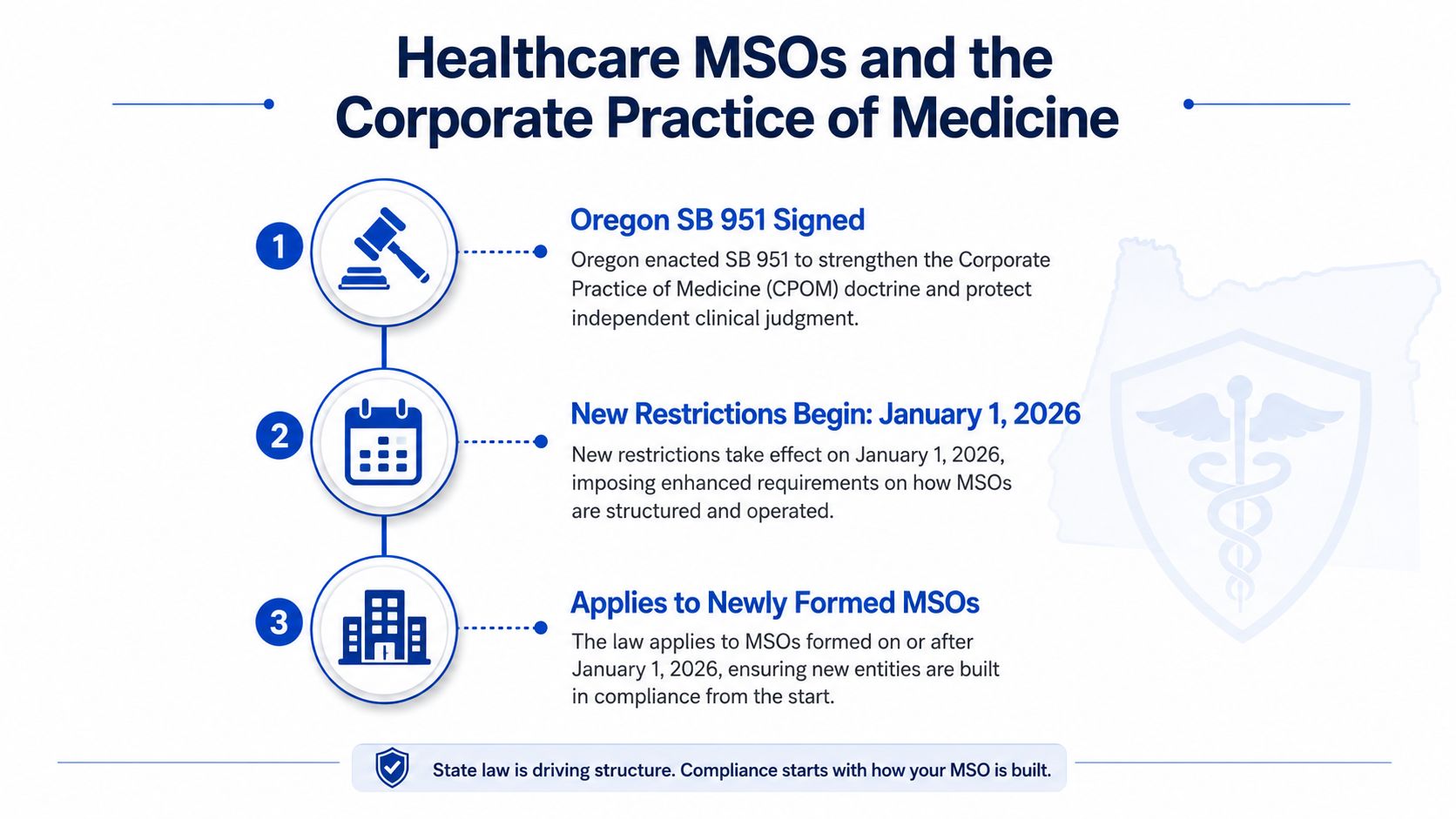
Independent policy analysis reports that all states permit some form of workaround structure, such as an MSO or friendly physician-owner model, but enforcement and interpretation vary widely by state (Milbank policy analysis). A healthcare founder should therefore complete a state-by-state review before forming the entity or signing the MSA.
The diligence should cover professional entity ownership, permitted management fees, clinical control boundaries, record custody, physician independence, state filing requirements, and enforcement history. Documents should be reviewed together, including the operating agreement, stock transfer restrictions, succession provisions, employment agreements, and management services agreement.
The transferable lesson is simple. Whenever a regulated profession meets an MSO, the regulator’s view of control matters more than the operator’s preferred organization chart.
Contract Clauses to Negotiate Before Signing
Only a handful of provisions determine whether an MSO relationship remains workable. Polishing boilerplate while leaving these clauses vague wastes time.
Service levels and remedies
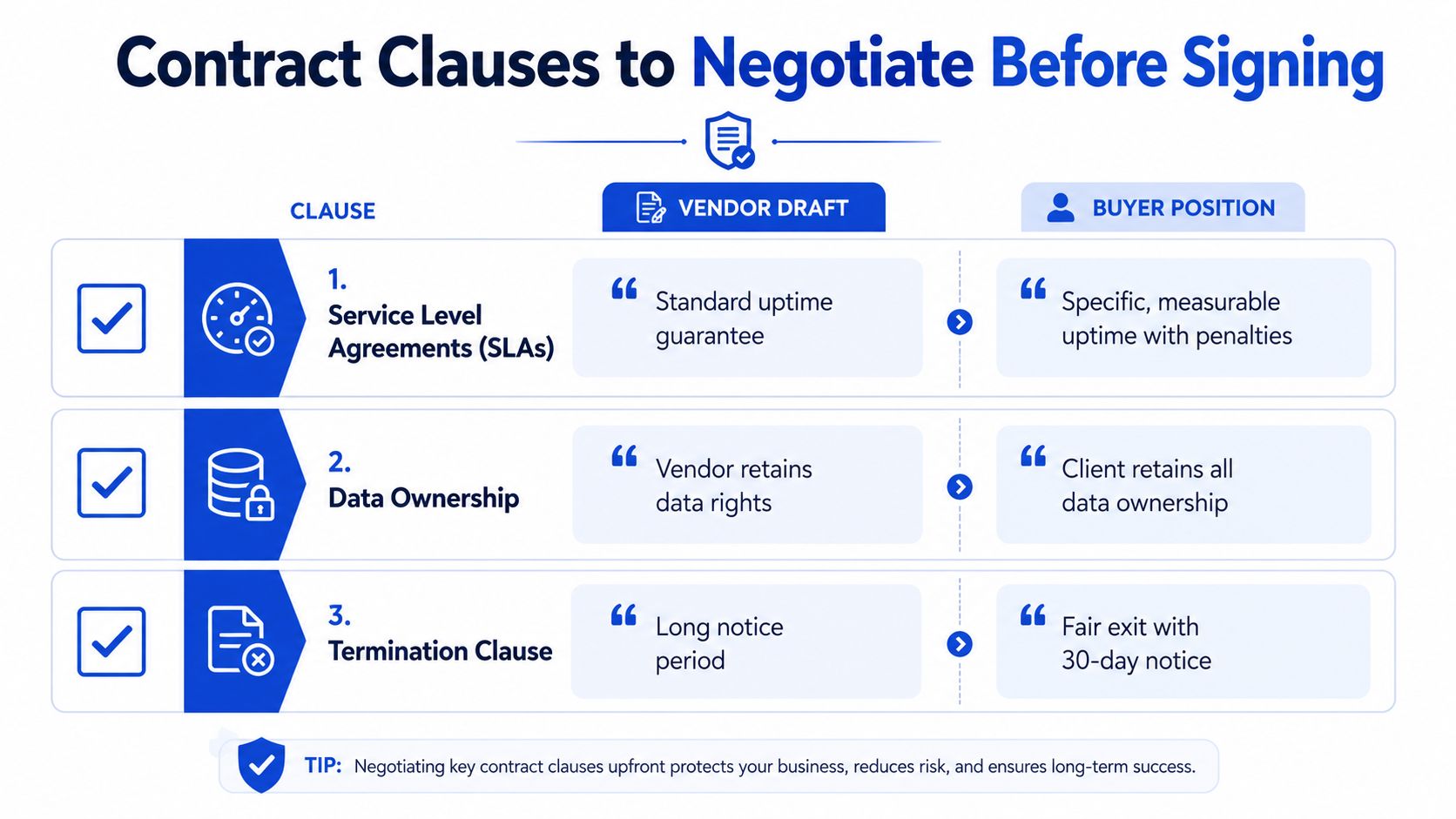
A vendor draft may promise a general uptime target, reasonable response times, or commercially reasonable efforts. The buyer should require measurable service levels tied to defined systems, business hours, severity classifications, exclusions, reporting, and service credits or other remedies.
Service credits shouldn’t be the sole remedy for a serious recurring failure. The agreement should permit escalation, remediation plans, termination rights, and damages where the failure causes a covered loss.
Data, subprocessors, and artificial intelligence
The buyer should retain all rights in client data and receive data in a usable format at termination. The provider’s rights should be limited to delivering, securing, and improving the contracted service, with no permission to sell, reuse, disclose, or train models on client information unless the buyer expressly approves it.
Subprocessors need advance notice, objection rights for material changes, equivalent contractual duties, and provider responsibility. AI terms should identify approved tools, human review requirements, prohibited inputs, model-training restrictions, output ownership, audit logs, and incident escalation.
Exit and liability
A vendor may request a long notice period, automatic renewal, termination fees, and limited transition support. An acceptable buyer position includes reasonable termination for convenience, termination for repeated service failures or security events, data export, documentation delivery, knowledge transfer, and transition assistance at defined rates.
The liability provision should include carve-outs or separate treatment for data breaches, confidentiality violations, IP infringement, fraud, gross negligence, and intentional misconduct. The buyer should also require audit rights, security evidence, cooperation with investigations, and preservation of relevant records.
A focused vendor risk assessment should support the redline. It should evaluate the provider, critical subprocessors, systems, access paths, certifications, insurance, incident history, and financial ability to maintain service.
The final rule is blunt: verbal promises, slide decks, proposals, and marketing collateral usually don’t create enforceable obligations unless the contract incorporates them. If a promise matters, place it in the MSA, order form, SLA, security addendum, or another signed document.
Practical Checklist and When to Retain Counsel
Before signing, the founder or operator should document answers to these questions:
- Operating model: Is the relationship dedicated, shared, or hybrid, and who controls daily decisions?
- Pricing: Is the fee per user, per device, fixed, tiered, or outcome-based? What activity creates additional charges?
- Security evidence: Has the provider supplied relevant SOC 2 and ISO 27001 evidence, insurance information, incident procedures, and continuity documentation?
- Data inventory: Does diligence identify personal data, health information, credentials, source code, confidential records, and cross-border transfers?
- Subprocessors: Does the agreement disclose them, control changes, impose flow-down duties, and preserve provider liability?
- Artificial intelligence: Does the contract restrict model training, identify approved tools, require human review, and assign responsibility for outputs and incidents?
- Exit: Can the client retrieve data, documentation, configurations, and other work product in a usable format?
- Legal budget: Has the company budgeted for outside review before execution, rather than after a dispute?
Retain counsel for any MSO deal above an annual five-figure threshold, any arrangement involving regulated data, any healthcare MSO structure, and any engagement involving custom AI usage. These factors create enough exposure that contract review belongs in the transaction budget, not the dispute budget.
Counsel should also review formation and governance documents when the MSO supports a regulated professional practice. The review should test whether the documents, payment model, access controls, and actual operations assign authority consistently.
By Design Law Firm & Legal Consultancy, PLLC advises on MSO contracts, vendor management, data privacy, artificial intelligence governance, and corporate governance. Founders can visit By Design Law Firm & Legal Consultancy, PLLC to discuss the proposed operating model, contract redlines, and regulatory structure before signing.
A focused legal review can also address MSA terms, SLA obligations, data ownership, AI controls, and corporate control risks. Schedule that review before the MSO contract or healthcare structure becomes difficult to unwind. Contact our law office today at (206) 593-1519.