An operations lead approves a customer support bot. A product manager turns on an AI writing feature inside a SaaS platform. A founder pastes internal data into a model to speed up sales outreach. None of those decisions feels dramatic in the moment. Then someone asks the uncomfortable questions. Who approved this use case. What data touched the model. Can the team explain a bad output. Can the company shut it down fast if something goes wrong.
That's where AI governance best practices stop being abstract. They become the everyday controls that keep AI useful, legal, and reviewable.
The shift is no longer theoretical. Enterprise spending on AI ethics rose from 2.9% of all AI spending in 2022 to 4.6% in 2024, and IBM projects 5.4% in the near term, according to IBM's AI governance research. That budget signal matters because it shows governance is moving into standard operating practice, not sitting off to the side as a values statement.
Strong governance also has a practical backbone now. Organizations commonly structure programs around the NIST AI Risk Management Framework, released in 2023, along with the OECD AI Principles and the EU AI Act. The best programs don't start with lofty language. They start with ownership, documentation, review paths, and monitoring.
1. AI Risk Assessment and Due Diligence Frameworks
A team shouldn't discover an AI system's risks after launch. Risk assessment belongs at intake, before a model reaches customers, employees, or regulated workflows.
The simplest version is a gate. Before deployment, the team answers a fixed set of questions. What decision does the system influence. Who could be harmed if it fails. What data does it use. Can a human override it. A hiring screen, claims triage tool, and meeting-summary bot won't carry the same level of risk, so they shouldn't get the same level of review.
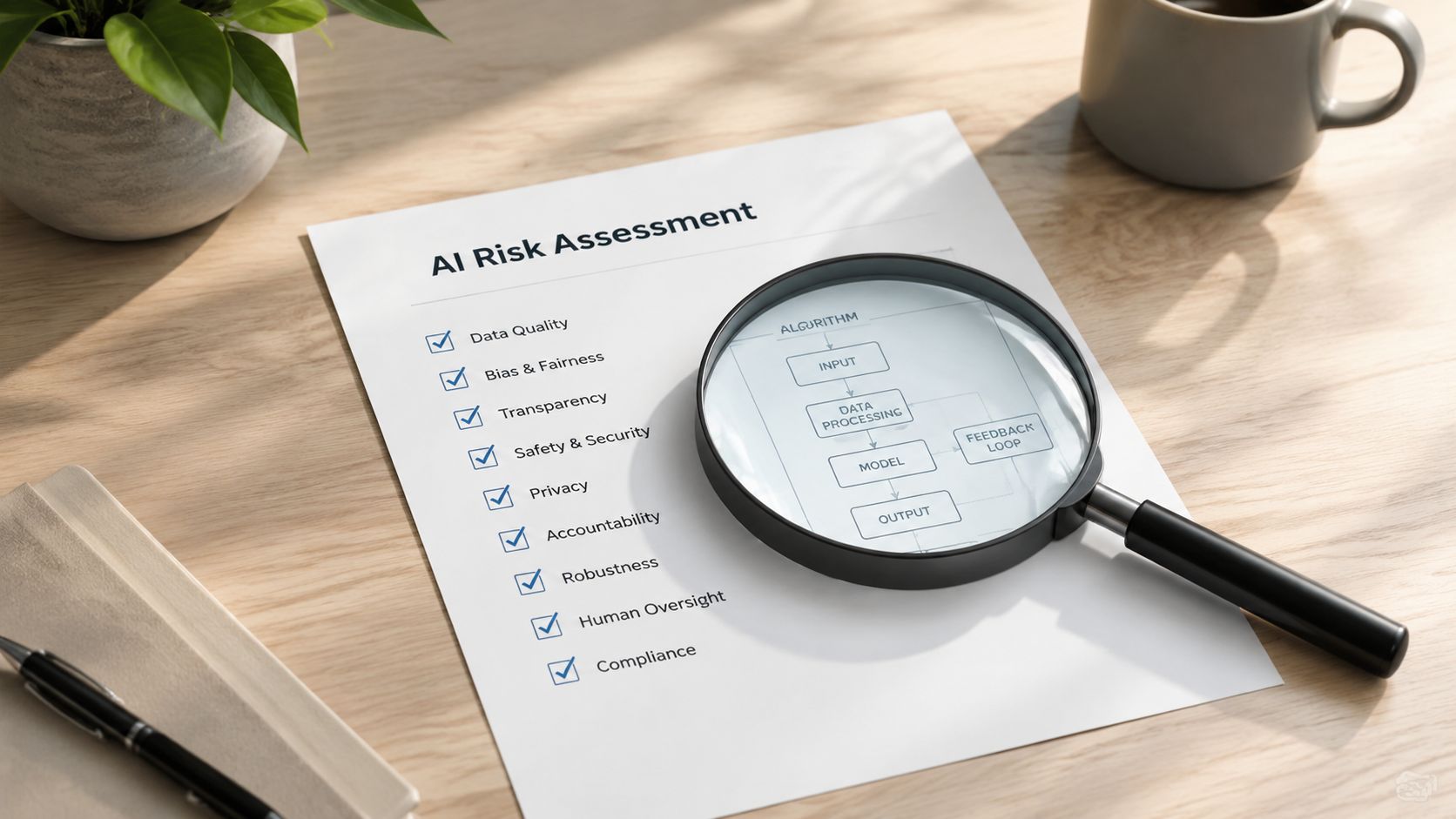
What good due diligence looks like
Good due diligence is predeployment review of the full AI system, including prompts, data sources, failure risks, and a named approval path. If a company cannot explain the system purpose, inputs, and human fallback in one page, it is not ready to ship.
A practical workflow often includes these artifacts:
- Use case statement: A short document that defines intended use, prohibited use, and affected users.
- Data review: A record of where the data came from, whether the company had the right to use it, and any known limits.
- Failure analysis: A list of likely bad outcomes, such as false flags, fabricated outputs, or misuse by staff.
- Approval path: Named reviewers from legal, technical, security, and business teams.
Practical rule: If a company can't explain the system's purpose, data inputs, and human fallback in one page, it isn't ready to ship.
A startup can begin with a template instead of a committee. A useful starting point is this AI risk assessment template from By Design Law. The point isn't paperwork for its own sake. The point is forcing clear thinking before an AI feature reaches a real person.
2. Transparency and Explainability Requirements
Users usually don't ask for model architecture diagrams. They ask simpler questions. Why did the system suggest this. How much should staff trust it. What are its limits.
That's why transparency in AI governance best practices starts with plain language, not technical theater. A sales assistant might say it drafts first-pass emails based on CRM data and should be reviewed before sending. A loan-screening tool might explain which factors inform the recommendation and which decisions always require human review.
Documentation people can actually use
Useful transparency has two audiences. Internal teams need a record they can maintain. External users need a clear explanation of how the system affects them.
Good documentation often includes:
- System summary: What the tool does, where it's used, and who owns it.
- Input and output description: What data goes in, what comes out, and what the output should not be used for.
- Known limitations: Situations where the model is weaker, less reliable, or prone to overconfidence.
- User disclosure: A short notice that tells customers or employees when they're interacting with AI or receiving AI-supported output.
Washington State agencies and European organizations have helped normalize this style of disclosure through algorithmic impact assessments and transparency expectations under privacy and AI rules. The practical lesson for businesses is simple. If a compliance officer, customer, or regulator asks how the system works, the answer shouldn't live only inside a data scientist's head.
Clear explanations reduce confusion inside the company as much as outside it. Support, sales, legal, and product teams all need the same baseline understanding.
A useful test is whether a nontechnical manager can explain the system accurately after reading the documentation. If not, the material is too vague or too technical.
3. Data Governance and Privacy by Design
Most AI governance failures aren't really model failures at first. They're data failures. A team uses the wrong dataset, keeps information too long, mixes personal and business data, or sends confidential material into a tool with unclear handling terms.
Privacy by design fixes that upstream. It asks the team to decide early what data the system needs, what it doesn't, who can access it, and how the company will prove those decisions later.

The controls that matter most
Practitioner guidance consistently points back to data lineage, access controls, and observability. Alation's guidance also recommends tracking the percentage of AI systems registered, reviewed, and monitored as a core KPI in governance programs, alongside lineage and monitoring controls, in its article on AI governance best practices for data leaders.
For everyday operations, that means asking concrete questions:
- Data lineage: Can the company trace where training, reference, and prompt data came from.
- Access control: Which employees, vendors, or systems can see raw inputs and generated outputs.
- Retention: How long does the company keep prompts, logs, uploaded files, and responses.
- Segregation: Is regulated or sensitive data isolated from low-risk experimentation.
A retailer using an AI chatbot for product support may only need product catalog data and return-policy content. If employees start pasting customer complaint histories or payment details into the same tool, the risk profile changes immediately.
Businesses that are sorting out these issues should review both the legal side and the product side together. This discussion is especially relevant in By Design Law's article on the impact of generative AI on U.S. data privacy laws. Public-facing disclosures matter too, which is why a company's privacy statement should line up with how its AI tools handle personal information.
4. AI Accountability and Responsibility Assignment
A customer receives a harmful AI-generated response on Friday afternoon. Support sees the complaint first. Engineering says the model came from a vendor. Product says the feature shipped under a tight deadline. Legal asks who approved the use case. If no one can answer in the first hour, the company has an accountability problem, not just a technical one.
AI governance works like fire safety in a building. Many people help prevent problems, but specific people still hold specific duties. Someone checks the alarms. Someone maintains the exits. Someone decides when to evacuate. AI systems need the same kind of clarity.
Ownership has to be assigned by name
Department labels create confusion because they spread responsibility across a group. A named person creates a clear decision path. “Data team” leaves room for finger-pointing. “Head of Data Platform” tells everyone who must respond if the system starts producing unsafe, misleading, or noncompliant outputs.
That does not mean one person does all the work.
It means one person is accountable for making sure the work gets done, documented, and escalated when needed.
A practical assignment model usually includes:
- Business owner: Defines the use case, approves the goal, and decides whether the system still serves a legitimate business purpose.
- Technical owner: Manages the model, prompt logic, integrations, version changes, testing, and rollback plans.
- Risk or compliance owner: Reviews policy fit, regulatory obligations, approval conditions, and exception handling.
- Escalation authority: Resolves conflicts when speed, revenue, user impact, and risk point in different directions.
The details matter more than many articles admit. For example, if a marketing team uses a generative AI tool to draft campaign copy, the technical owner may not sit in central engineering at all. It may be a marketing operations lead who controls the workflow, vendor settings, and approval gates. If a hospital uses AI for clinical documentation support, the escalation authority should be clear before an incident occurs. Is it the CMIO, the privacy officer, or the product executive who can suspend use?
Those choices should be written down at the system level, not left in a general policy. A useful record includes the system name, purpose, owner names, approval date, update history, and the trigger for escalation. If the tool is changed, retrained, connected to a new data source, or expanded to a higher-risk use case, the owner list should be reviewed again. Accountability that only exists at launch tends to fail in production.
Clear ownership also changes how incidents are handled. If an employee asks, “Who can shut this off right now?” there should be one answer. If a regulator, customer, or auditor asks, “Who approved this use?” there should be one answer to that too.
For a small company, a simple RACI table may be enough. For a larger organization, especially one using AI in hiring, lending, healthcare, or customer-facing decisions, a governance council often helps. The council should support the named owners, not replace them. Committees are useful for review. They are weak substitutes for direct accountability.
A named owner does not need to complete every task personally. That person does need to answer for the system when questions, failures, or tradeoffs arise.
5. Bias Detection, Testing, and Mitigation Protocols
Bias testing can't be reduced to a single fairness score. Real systems fail in uneven ways. A model may perform well overall and still underperform for a subgroup, a language variant, or a particular workflow.
That's why bias review needs to happen in layers. Teams should examine the training data, evaluate outputs across relevant groups, and test real-world use conditions. A resume screening tool, for example, should be reviewed for how it handles employment gaps, school names, disability-related language, and nonstandard career paths. A healthcare triage tool should be tested across patient populations, symptoms, and care settings.

Testing has to reflect actual use
Bias protocols work best when they mirror how the system is really used. If customer service agents rely on a model summary to decide whether a complaint gets escalated, the team should test summary quality and omission risk, not just language fluency.
A practical bias program usually includes:
- Representative test cases: Inputs that reflect the users, regions, and edge cases the product will face.
- Multiple fairness checks: More than one lens for evaluating uneven treatment or error distribution.
- Documented trade-offs: A record of what the team optimized for and what risks remain.
- Remediation path: A specific process for pausing, retraining, narrowing scope, or adding human review when bias appears.
IBM's AI Fairness 360 and Microsoft's fairness tooling are often cited in practitioner discussions because they make this work more concrete. The bigger lesson is broader than any one toolkit. Teams need a repeatable method for spotting harm before affected people do.
Some systems should never rely on fairness testing alone. Hiring, lending, insurance, education, and healthcare decisions usually need additional human review, legal analysis, and scope limits.
6. Human in the Loop and Explainable Decision Review Processes
High-stakes decisions shouldn't become “the model said so.”
Human-in-the-loop governance means a person keeps meaningful authority over important outcomes. That person isn't there to rubber-stamp the AI. The reviewer needs enough context, time, and training to challenge it.
Where human review matters most
A smart company maps review requirements to impact. A support chatbot answering store hours may not need human review for every response. A credit recommendation, fraud alert, employment screen, or clinical suggestion is different.
Review design usually works better when teams define these rules in advance:
- Mandatory review points: Which decisions always require a human signoff.
- Override authority: Who can reject or change the AI recommendation.
- Appeal path: How an affected person can challenge the outcome.
- Audit trail: What the reviewer saw, what decision they made, and why.
Consider a hiring workflow. AI may summarize resumes and flag possible matches. A recruiter still decides which candidates move forward, and the company records when the recruiter disagreed with the tool. That matters for fairness review and for later disputes.
Human oversight only counts if the reviewer can understand the tool's limits and has permission to override it.
Explainability supports this process. A reviewer needs some basis for evaluating the recommendation, even if the underlying model is complex. In practice, that often means reason codes, confidence cues, known-limit prompts, or workflow notes that show what information shaped the output.
7. AI Policy Development and Governance Documentation
Every AI program eventually runs into the same problem. Teams improvise until one difficult use case exposes the gaps. Then they scramble to write rules under pressure.
Written policy prevents that. It turns scattered judgment calls into a shared operating standard. It also gives legal, compliance, HR, engineering, and procurement teams a common language.
Policies should answer operational questions
A useful AI policy doesn't stop at values like fairness or accountability. It tells people what they must do before using, buying, deploying, or changing an AI system.
Strong policy sets usually cover:
- Permitted and prohibited uses: For example, whether staff may use public AI tools with internal documents.
- Risk classification: Which use cases are low, moderate, or high risk.
- Approval requirements: What reviews are needed for each risk tier.
- Documentation standards: Which records must be created and maintained.
- Monitoring and incident duties: Who tracks performance and who responds when something breaks.
Organizations often anchor these rules in external frameworks so the program doesn't drift. One practical route is to build around By Design Law's guidance on mastering AI policies for business strategy, then map internal requirements to standards such as NIST and to evolving international policy discussions like this piece on shaping AI regulation by G7 countries.
Policies also need maintenance. A rule written for internal copilots may not be enough once the same model appears in customer support, recruiting, or procurement. Governance documentation should evolve with scope, data use, and legal exposure.
8. Third Party AI Vendor and Model Risk Management
Many companies don't build the model that creates the risk. They buy software with AI already inside it, connect to an API, or adopt a vendor tool that includes generative features.
That changes the governance job. The company may not control training methods or model weights, but it still owns the business risk. Customers, employees, and regulators usually won't care that the model came from someone else.
Vendor governance is now a core control
This is one of the most overlooked areas in AI governance best practices. Mirantis highlights the growing importance of third-party AI policy, incident response, model risk, data lineage, and traceability across datasets, prompts, features, and outputs in its guide to AI governance best practices and third-party controls.
A serious vendor review should cover more than security questionnaires:
- Model transparency: What will the vendor disclose about system behavior, limitations, and updates.
- Data handling: Whether prompts, uploads, and outputs are retained, reused, or shared.
- Contract rights: Audit rights, notice obligations, indemnity language, and restrictions on secondary data use.
- Operational resilience: How the vendor handles incidents, outages, and major model changes.
- Exit planning: How the company retrieves data and migrates workflows if the relationship ends.
A procurement team buying an AI note-taking tool for meetings should ask whether customer names, strategy discussions, or regulated data can enter the system at all. The answer shouldn't arrive after purchase.
Businesses building a vendor review process can use these vendor management best practices from By Design Law as a practical legal and operational starting point. Product teams that are also surveying the fast-moving agent ecosystem may find market context in this piece on AI agent solutions for 2026, but vendor selection still needs company-specific diligence.
9. AI System Monitoring, Auditing, Performance Tracking, and Incident Response
Launch isn't the finish line. It's the beginning of the part that matters most.
An AI system can drift, degrade, get misused, or start producing harmful outputs as real-world behavior changes. Monitoring catches that movement before it becomes a legal issue or a customer trust problem.
What teams should watch after deployment
The strongest programs treat monitoring as an operating discipline, not a dashboard decoration. That includes output quality, failure patterns, user complaints, fairness indicators, and signs that the system is being used outside its approved purpose.
A practical monitoring stack often tracks:
- Performance over time: Whether the system still meets the quality level defined before release.
- Data drift: Whether the inputs now look different from what the model was designed for.
- Scope creep: Whether users have started relying on the tool for decisions it was never approved to support.
- Version traceability: Which model, prompt, rule set, or vendor release was active when an issue happened.
A useful benchmark from governance practice is to track the share of AI systems that are registered, reviewed, and monitored. If a company can't answer which AI systems are live and under watch, it doesn't really have governance.
This video gives a practical overview of governance and monitoring concepts in plain terms.
The market signal behind this trend is clear too. The global AI governance market is projected to grow from USD 0.89 billion in 2024 to USD 5.78 billion by 2029, a 45.3% CAGR, according to MarketsandMarkets research on AI governance. That projection suggests governance tooling is becoming standard enterprise infrastructure, especially where monitoring, traceability, and risk controls need to scale.
10. AI Incident Response and Crisis Management Planning
Every governance program needs a bad-day plan.
An AI incident might be a harmful recommendation, an exposed dataset, a discriminatory output, a vendor failure, or a public-facing hallucination that spreads quickly. Waiting to design a response until that moment is a costly mistake. Teams need a playbook in advance.
The first hours matter
Good incident response starts with classification. The company needs to know whether the issue is a privacy event, model failure, security breach, consumer protection issue, or some combination of the above. That classification shapes who gets involved and how fast decisions happen.
A useful crisis plan usually defines:
- Response team: Legal, security, product, engineering, communications, and business leadership.
- Containment actions: Pause the system, restrict a feature, switch to manual review, or cut a vendor integration.
- Communication rules: Who informs users, regulators, partners, employees, and the board.
- Evidence handling: What logs, prompts, model versions, and decision records need preservation.
- Post-incident review: Root cause analysis, control changes, and documented lessons learned.
Recent public attention around generative AI errors, deepfake misuse, and AI-enabled fraud has made this planning more urgent, even when a company's own systems are relatively narrow. A local business may not think of itself as an AI company, but if it uses AI in support, hiring, pricing, or marketing, it needs escalation paths.
The best incident plan is specific enough that a general counsel, engineer, and communications lead can all act from the same document within minutes.
AI Governance: 10-Point Best Practices Comparison
| Item | Implementation complexity | Resource requirements | Expected outcomes | Ideal use cases | Key advantages |
|---|---|---|---|---|---|
| AI Risk Assessment and Due Diligence Frameworks | High, cross‑functional audits, bespoke risk scoring | High, legal, data science, audit firms, time | Identifies compliance gaps, prioritized risks, documented trail | Pre‑deployment of high‑risk systems, fundraising, M&A diligence | Reduces liability, informs go/no‑go, supports litigation defense |
| Transparency and Explainability Requirements | Medium‑High, documentation plus XAI techniques | Medium, documentation, XAI tools, legal review | Clear disclosures, improved contestability, regulatory alignment | User‑facing decisions, regulated products, consumer platforms | Builds trust, reduces undisclosed‑decision risk, aids regulators |
| Data Governance and Privacy‑by‑Design | High, lifecycle controls, technical privacy measures | High, privacy engineers, data governance, compliance teams | Strong privacy compliance, reduced breach risk, customer trust | Healthcare, finance, consumer data‑intensive services | Prevents breaches, ensures regulatory compliance, market differentiation |
| AI Accountability and Responsibility Assignment | Medium, org design, RACI matrices, governance processes | Medium, leadership commitment, governance committee, training | Clear ownership, faster issue escalation, auditability | Large enterprises, cross‑functional AI programs, regulated firms | Prevents governance gaps, demonstrates maturity to stakeholders |
| Bias Detection, Testing, and Mitigation Protocols | High, technical testing, metric selection, continuous monitoring | High, data scientists, testing frameworks, external audits | Measured fairness, reduced discriminatory outcomes, remediation plans | Hiring, lending, healthcare, criminal justice, high‑stakes models | Minimizes legal/reputational risk, improves equitable outcomes |
| Human‑in‑the‑Loop and Explainable Decision Review Processes | Medium, workflow design, reviewer training, audit trails | Medium‑High, trained reviewers, process overhead, tooling | Human oversight of critical decisions, reduced irreversible harm | Loans, clinical decisions, hiring, content moderation | Preserves human agency, supports appeals, increases trust |
| AI Policy Development and Governance Documentation | Medium, policy drafting, alignment with standards, updates | Medium, legal, compliance, stakeholder engagement | Consistent standards, onboarding clarity, regulatory evidence | Enterprise‑wide AI adoption, regulated sectors, policy enforcement | Reduces inconsistency, supports compliance, enables institutional learning |
| Third‑Party AI Vendor and Model Risk Management | Medium‑High, contracts, SLAs, vendor audits | Medium, legal review, vendor monitoring, due diligence | Managed vendor risk, clearer liability, contractual protections | Use of external models/APIs, cloud AI services, outsourced ML | Faster access to capability, contractual safeguards, risk visibility |
| AI System Monitoring, Auditing, Performance Tracking, and Incident Response | Very High, real‑time monitoring, drift detection, audit pipelines | Very High, MLOps engineers, monitoring tools, incident teams | Early detection of drift/bias, rapid remediation, continuous improvement | Live production systems, high‑volume/user‑safety critical apps | Detects degradation/bias early, minimizes harm and exposure |
| AI Incident Response and Crisis Management Planning | Medium, playbooks, escalation trees, communication plans | Medium, legal, communications, technical responders | Coordinated incident handling, compliant notifications, root‑cause learning | Organizations with deployed AI, regulated industries, public‑facing services | Minimizes damage, meets notification requirements, preserves reputation |
Final Thoughts
AI governance best practices work best when they feel operational, not ceremonial. A company doesn’t need a sprawling bureaucracy to get started. It needs a clear inventory of AI systems, named owners, risk-based review, documented rules, vendor diligence, monitoring, and an incident plan that people can use.
That practical approach fits how governance has matured. Organizations now rely on frameworks such as NIST AI RMF, the OECD AI Principles, and the EU AI Act as working references for ownership, assessment, oversight, and lifecycle controls. That matters because AI governance is no longer just about drafting an ethics statement and hoping teams act carefully. It’s about proving who approved a system, what data it used, how it’s monitored, and what happens when it fails.
For founders and operating teams, the biggest mistake is treating AI governance as something only very large enterprises need. Small and mid-sized companies often face the same categories of risk with fewer buffers. One employee can expose sensitive data through a public tool. One vendor update can change model behavior overnight. One unsupported workflow can turn an internal assistant into an unreviewed decision engine.
A sensible first move is to identify every live AI use case, sort them by impact, and assign a human owner to each one. After that, most of the rest becomes easier. Policies can be written around real systems. Vendors can be reviewed with concrete questions. Monitoring can focus on actual business risk instead of generic fear.
For businesses that want legal support while building those controls, By Design Law Firm & Legal Consultancy, PLLC is one relevant option because its practice includes AI risk, cyber, and data privacy matters alongside broader business counseling. That kind of cross-functional legal support can be useful when governance touches contracts, privacy, compliance, and product operations at the same time.
The strongest governance programs don’t slow AI down. They make it safer to use at scale. They reduce guesswork, improve accountability, and give leadership a clearer view of where AI belongs and where it doesn’t.
Businesses that need help turning AI use into documented policy, risk assessment, vendor controls, and privacy-aware workflows can contact By Design Law Firm & Legal Consultancy, PLLC for practical legal guidance aligned with real operational needs. Call us today at (206) 593-1519 for a complementary consultation.