A founder in Seattle usually meets the SAFE at an awkward moment. The investor likes the company, wants to move fast, and sends over a short document that seems simpler than a full stock purchase agreement. That simplicity is the trap. A SAFE agreement, short for Simple Agreement for Future Equity, can be a clean way to raise early money, but only if the founder understands what is being signed, what does not happen at signing, and what can still go wrong months or years later.
Introduction to SAFE Agreements for Washington Founders
A first-time founder often sees the SAFE after a friendly call that ends with, “We can just paper this quickly.” The document looks short enough to skim on a phone, and that's where trouble starts. A SAFE is not a routine receipt for cash, and it's not a casual promise that can be sorted out later. It is a financing contract that can shape ownership, reporting, and future fundraising.
In Washington, that matters because early mistakes tend to surface at the worst time, during diligence for the next round or when an investor asks why the cap table looks messy. The problem is rarely the idea of a SAFE itself. The problem is signing one without understanding how its terms control conversion, dilution, and transfer restrictions. Legal and accounting questions also tend to show up after the money is already in the bank.
A practical reading of a SAFE starts with one question, what does the founder give up today? The answer is, not stock, not debt, but a future right that can become equity later. That sounds harmless until a priced round arrives and the math starts to matter. For Washington founders, the right time to slow down is before signature, not after.
Practical rule: if the investor says the SAFE is “standard,” still read the valuation cap, any discount, the transfer limits, and the conversion trigger. Standard doesn't mean harmless.
The rest of the document determines whether the instrument stays a useful bridge or becomes a source of confusion. Washington founders who treat the SAFE as a legal shortcut usually spend more time untangling it later than they would have spent reviewing it carefully in the first place.
What a SAFE Agreement Actually Is
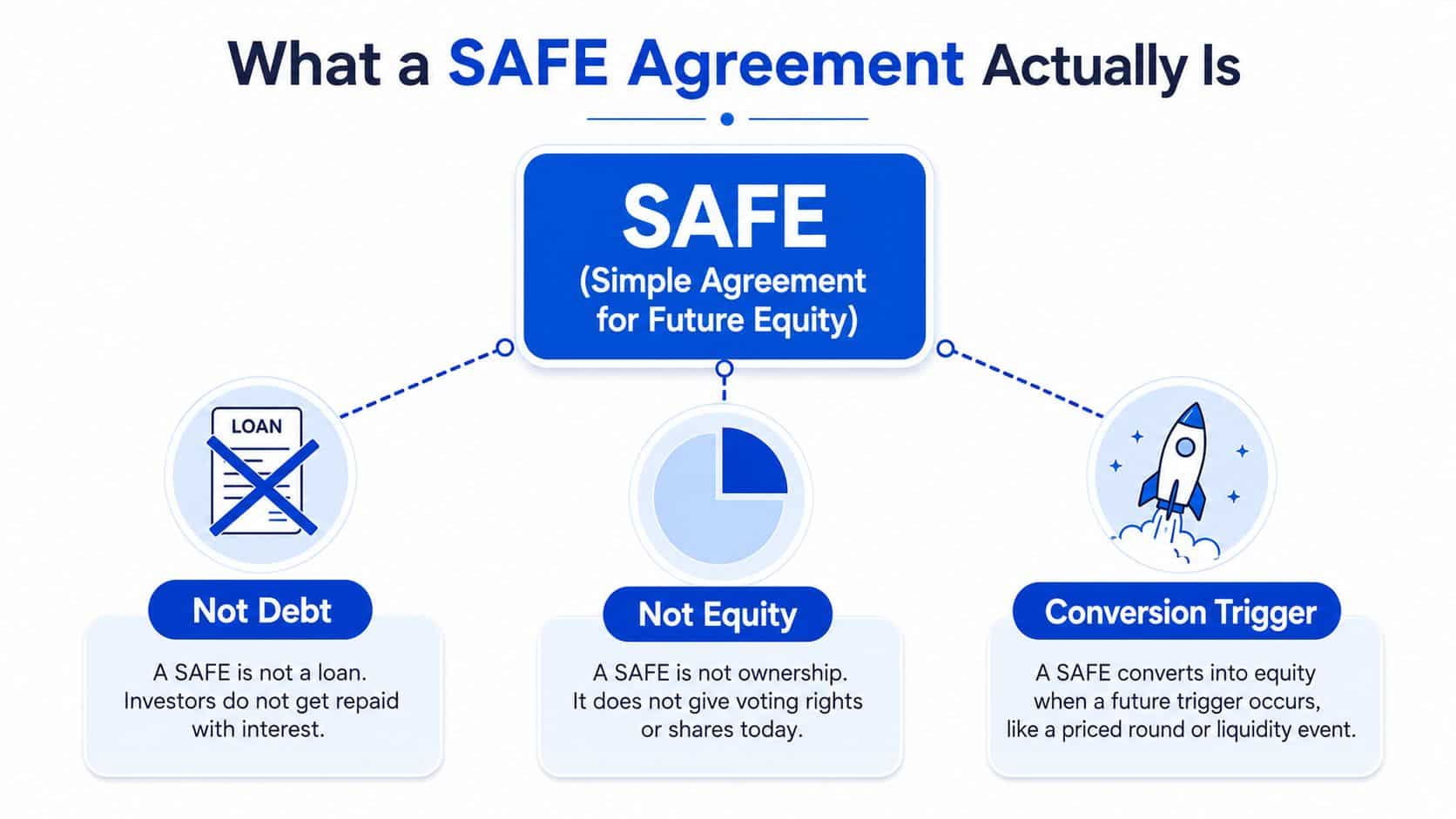
A SAFE is a contract for future equity, not current equity. It gives the investor the right to receive shares later, usually when the company closes a priced financing round or hits another triggering event. Until that happens, no shares are issued, and the investor is not yet a stockholder.
That distinction matters because a SAFE was designed to strip out the mechanics that make early debt financing slower and heavier. Y Combinator introduced SAFEs in 2013 as an alternative to convertible notes, then updated the form in 2018 with the widely used post-money SAFE structure (Carta's overview of SAFEs). The market adopted the instrument because it keeps early fundraising compact and avoids debt features like interest and a maturity date (Practical Law's SAFE explanation)).
The two numbers that drive the deal
Most SAFE negotiations circle back to two economic terms, the investment amount and the valuation cap. A valuation cap is the ceiling used to determine the conversion price if the company later raises at a higher valuation. That is why investors care about the cap and founders need to understand how low is too low.
The practical question is not whether the SAFE is “good” or “bad.” It's whether the price of speed is acceptable for this company at this stage. A SAFE can be smart for a pre-revenue startup that needs to close quickly. It can also be a bad fit if the founder wants certainty about ownership now or if the investor expects protections that only a priced round provides.
A separate issue rarely explained in basic guides is what happens if the SAFE never converts. Some SAFEs can sit outstanding indefinitely if no triggering event occurs, and an investor may never receive anything if the company never raises a priced round or exits (discussion of the non-conversion problem). That isn't just a theoretical edge case. It affects how a founder stores records, how counsel reviews the cap table, and how future investors assess cleanup risk.
How SAFE Agreements Work Under the Hood
The mechanics are simple on paper and easy to misunderstand in practice. A founder signs the SAFE, the investor wires money, and the company records a contractual right rather than issuing shares. Later, when the triggering event happens, the SAFE converts into stock under the agreed formula.
The conversion trigger is usually a priced equity round, though some SAFEs also address a liquidity event. Until then, the investor typically has no voting rights and no stock certificate. That is why the instrument feels lighter than a priced round, but it still changes the future ownership picture.
The distinction between pre-money and post-money SAFEs matters because it changes how dilution is measured. A post-money SAFE gives founders a clearer view of the ownership impact at the time of signing, which is part of why the post-money form became the dominant standard after the 2018 update. In plain terms, the later structure makes the math easier to model, but it can also make founder dilution feel more certain up front.
The company should know, before closing the SAFE, how much room remains for the next institutional round. Otherwise the cap table gets crowded before anyone notices.
A founder who wants to visualize the document lifecycle should think in four stages, signature, funding, trigger, conversion. That's the useful mental model. The legal reality is still more nuanced because every SAFE sits inside a larger financing stack, and one agreement can affect the others.
For cap table hygiene, a clean process matters as much as the form itself. This capitalization table management resource is relevant because SAFE tracking gets messy fast when multiple investors close at different times.
SAFE Agreements Compared to Other Financing Options
Founders usually compare a SAFE with two other tools, a convertible note and a priced equity round. Those are not interchangeable. Each one solves a different problem, and each one creates a different set of follow-on obligations.
A SAFE is usually the fastest to close because it avoids debt terms and often uses a short standardized form. A convertible note adds debt mechanics, including interest and maturity features, which can pressure the company if the next round takes longer than expected. A priced round takes more time and legal work, but it gives the company a formal valuation and immediate issuance of stock.
| Feature | SAFE | Convertible Note | Priced Equity |
|---|---|---|---|
| Speed | Usually fast | Moderate | Slower |
| Debt features | No | Yes | No |
| Immediate stock issuance | No | No | Yes |
| Interest and maturity | No | Yes | No |
| Founder visibility on dilution | Moderate, better with post-money | Lower until conversion | Higher at closing |
| Balance-sheet complexity | Can be significant | Debt-related complexity | Equity treatment at closing |
A founder weighing a bootstrapped path can also look at capital ideas for bootstrapped businesses for context on non-dilutive or lower-dilution alternatives. That kind of comparison is useful when the company wants capital without giving away future upside too early.
When a priced round is worth the extra work
A priced equity round makes more sense when governance matters more than speed. That can happen once the company is ready for institutional investors, board structure, or more precise ownership allocation. A convertible note can still be useful when the team expects to close into a near-term equity round but wants a debt-based bridge.
For founders who want a deeper comparison with notes, this convertible note guide is a logical companion. It helps highlight the practical difference between a contractual promise to convert and a debt instrument that can mature.
The right answer is stage-specific, not ideological. A SAFE is often the cleanest tool for a first small raise, but it is not automatically the best instrument for every round or every investor.
Key Clauses Founders and Investors Should Negotiate
A standard SAFE is short, but the shortest documents often hide the largest trade-offs. Start with the company’s authority to issue it. The company should represent that the SAFE is authorized under its governing documents and not inconsistent with pre-existing obligations. That point matters because a founder cannot assume the board approvals, charter language, and earlier commitments all line up on their own.
The clauses that move risk
Transfer restrictions deserve attention early. SAFE investors generally cannot assign their rights except to an affiliate or to a person or entity with common ownership or control. That restriction helps keep the cap table from turning into a secondary-market problem before the company is ready for it.
The economics are where the negotiation happens. A valuation cap rewards early risk by setting the ceiling used at conversion. A discount gives the investor a lower price on the future round. An MFN clause, short for most-favored-nations, protects early investors if later SAFEs are issued on better terms. Each term may be market-standard in the right setting, but each one shifts value if the company grows quickly.
Negotiation reality: founders can usually push on cap level, discount size, and whether MFN language should be included. The weaker the company’s position, the fewer of those terms will move.
Accounting treatment also belongs in the discussion before signatures go out. Some SAFEs are treated as derivative liabilities rather than equity because they can require the company to issue a variable number of shares depending on future events. That can affect the balance sheet and complicate later valuation conversations, even though the instrument does not function like a loan.
The drafting package matters too. A careful investment agreement template helps founders see how consent language, exhibits, and closing mechanics fit together before the document goes out for signature. A sloppy set of papers can create diligence friction later, when the company is trying to close a priced round or explain what was agreed.
Real Startup Examples and Common Mistakes to Avoid
A practical example helps more than abstract definitions. A startup raises money on a SAFE with a valuation cap, then closes a future priced round at a higher valuation. The SAFE converts using the cap-based formula, which gives the SAFE investor a better entry price than later investors get in the priced round. That is the point of the cap, it rewards the early check by reducing conversion price.
Founders often miss that the math lives on the cap table, not in the pitch deck. Every outstanding SAFE needs its own record, because one investor may have a discount while another has a cap, and the terms may not line up. If the records are sloppy, the next round can stall while the company reconstructs who owns what and under which terms.
A clean file also matters after the cash has cleared. If the company later raises priced equity, investors will ask for the SAFE package, board approval, and the updated ownership records. That diligence step is normal, and it is easier to handle when the company has a single place for signatures, dates, and term details. For founders who want help setting that up, By Design Law’s startup funding and seeding guidance is a practical place to start.
The common mistakes that create real cleanup work
- Failing to log every issuance: a SAFE that is not reflected in the cap table can surprise everyone during diligence.
- Mixing up conversion timing: founders sometimes assume shares exist immediately, but they do not until the trigger occurs.
- Ignoring the indefinite-outstanding problem: if no conversion event ever happens, the SAFE can remain open-ended and an investor may receive nothing.
- Treating accounting as an afterthought: some SAFEs can affect financial reporting in ways that are easy to miss if the financing feels lightweight.
A founder also needs to keep the paper trail clean. If the company later raises on priced equity, future investors will ask for the SAFE package, board approval, and the updated ownership records. That diligence step is normal. The problem is when the answer to “where are the signed SAFEs?” becomes a chain of forwarded emails and half-filled spreadsheets.
A SAFE that never converts is not just a theoretical outcome. It is an operating issue for the company, because the document can sit on the books for a long time and create confusion in later financing if no one tracks it cleanly.
The best habit is boring but effective. Keep a single source of truth for every SAFE, every cap, every discount, and every signature date. That discipline keeps a simple document from turning into an expensive reconstruction project.
Next Steps for Washington State Founders
A Washington founder should treat a SAFE as a financing decision, not a formatting choice. The next step is simple. Read the cap, the discount, the transfer limits, the conversion trigger, and the company authority language before anyone signs. If the deal is standard and the company has clean governance, the form may be workable. If the company has multiple prior financings, unusual entity structure, or shaky records, it’s time to slow down.
For Washington-specific planning, counsel should understand both corporate governance basics and the practical mechanics of startup financing. That matters because the document can affect the cap table, financial reporting, and future diligence long after the cash arrives. The cleaner the legal setup now, the less cleanup a later investor will demand.
A useful checklist is straightforward:
- Confirm authority: make sure the board and governing documents permit the issuance.
- Review the economics: check valuation cap, discount, and MFN language.
- Map the trigger: understand what event causes conversion.
- Track the paper trail: store every signed SAFE and keep the cap table current.
- Escalate when needed: use counsel if the round is not a simple early-stage raise or if there are existing obligations that could conflict.
For founders who want startup financing support in Washington, By Design Law’s funding and seeding guidance is relevant to the broader process of getting capital in place without creating avoidable cleanup later.
If a SAFE offer is on the table and the terms aren’t fully clear, By Design Law Firm & Legal Consultancy, PLLC can review the document, explain the trade-offs, and help align the financing with the company’s cap table and governance needs. Visit By Design Law Firm & Legal Consultancy, PLLC to get practical counsel before signing away more ownership than intended. Call our law office today at (206) 593-1519.