A founder in Seattle usually opens a 40-page software licensing agreement right after a vendor demo that felt quick and friendly. Then procurement sends the redline, finance wants budget certainty, and legal wants to know whether the company is buying software or just renting permission to use it. That's the part many miss, and it's where budgets leak.
A software licensing agreement is not a purchase order dressed up in legal language. It is a permission system. The vendor keeps title to the software, and the customer gets only the rights the contract grants. In real deals, those rights are measured by things like named users, concurrent users, devices, CPU cores, transactions, or API calls. That metric language is where founders get burned.
The licensing market has become a serious operational category, not a back-office footnote. One industry report estimated the global software licensing management market at USD 3,296.4 million in 2024, with a projection to reach USD 7,913.5 million by 2030, reflecting a 16.2% CAGR from 2025 to 2030, and said subscription-based licensing accounted for over 48.2% of global revenue in 2024 (software licensing management market overview). That tells you everything about the way vendors now think about access, renewals, and recurring control.
Practical rule: If the contract says “use,” the next question is always “how much, by whom, where, and on what hardware.”
For founders who still think of software as something they “buy,” a good plain-English lens is to treat the agreement like a series of locked gates. One guide to intellectual property rights breaks down why ownership and usage rights are different in commercial contracts, which is the right mental model here (types of intellectual property rights). If perpetual licensing is part of the conversation, Creem's discussion of perpetual licenses is a useful companion read because it shows how buyers and sellers think about long-term use versus ongoing access (Creem's take on perpetual licenses).
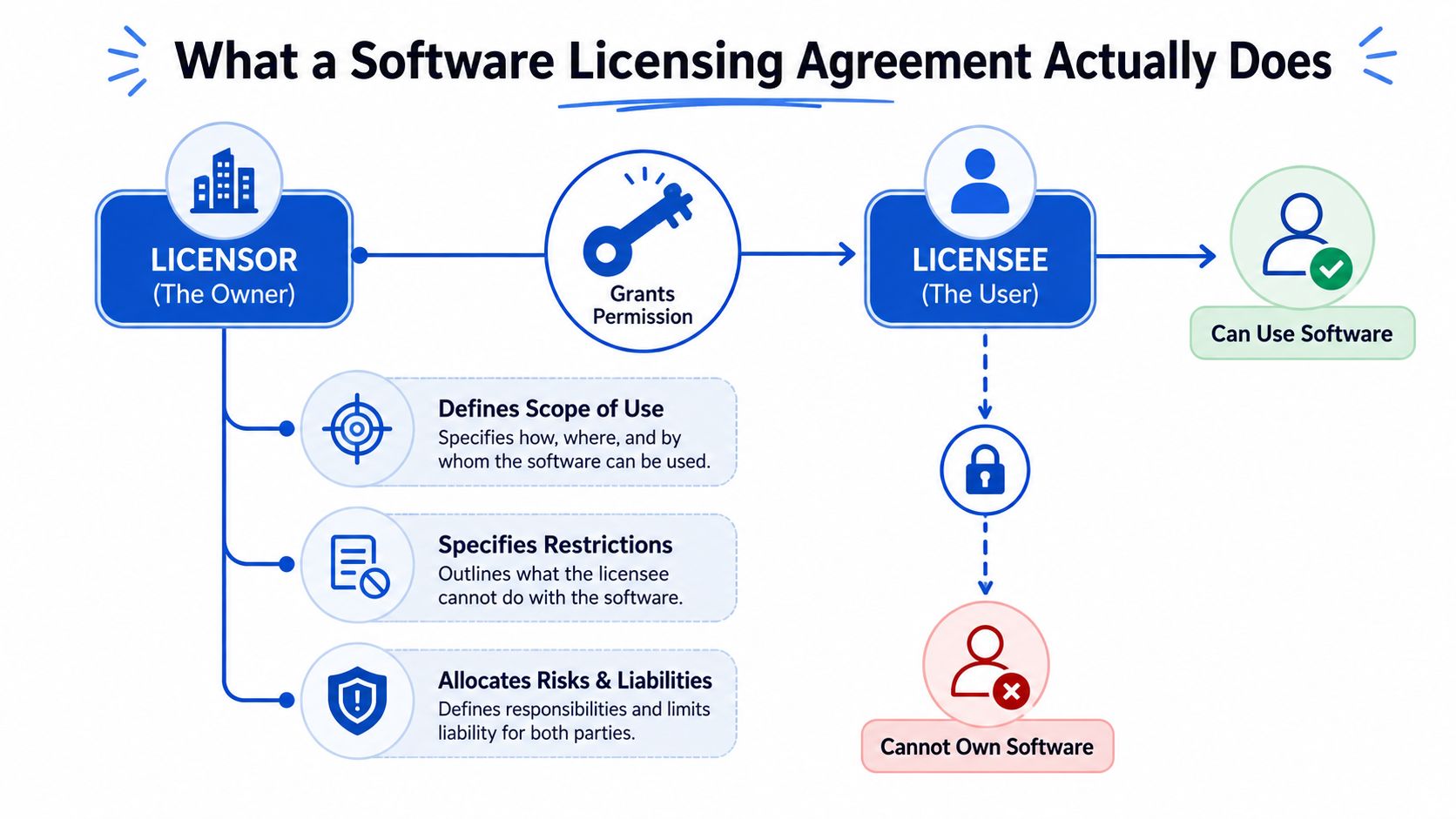
What a Software Licensing Agreement Actually Does
A founder reading a vendor PDF should stop hunting for a hidden purchase button. There usually is none. A software licensing agreement gives permission to use software under defined conditions, and the licensor keeps the underlying title while the licensee gets only what the contract expressly allows (software licensing agreement fundamentals).
Permission, not ownership
That distinction drives the rest of the deal. If the grant is narrow, the customer cannot stretch it because the business changed, the team grew, or the deployment got messy. The contract sets the operating envelope, and anything outside it is either a negotiation or a breach.
Modern agreements measure use with metrics because vendors need a way to meter value and check compliance. Named users, concurrent users, devices, CPU cores, transactions, and API calls are all common ways to do that. Disputes usually start when the metric is sloppy, undefined, or left to the vendor's interpretation.
Practical rule: If a metric can be read two ways, assume the vendor will read it the expensive way.
That is why licensing is a finance issue as much as a legal one. For Washington startups, this shows up fast in enterprise procurement. A Seattle founder I worked with nearly signed a contract that counted every contractor login as a full paid seat, even though half the team only needed read access for a few hours a week. That kind of clause does not just define permissions, it sets the shape of the budget at renewal.
The cleanest way to read the deal is simple. The contract decides who can use the software, how they can use it, and what happens when the deal ends. If those rights are vague, the company is not just buying risk, it is buying argument.
For founders who want the ownership-versus-use distinction laid out in plain English, a short guide to intellectual property rights helps frame the issue correctly (types of intellectual property rights). If perpetual licensing is part of the conversation, Creem's take on perpetual licenses is a useful companion read because it shows how buyers and sellers think about long-term use versus ongoing access (Creem's take on perpetual licenses).
Comparing the Four Common License Models
Founders hear the same four models over and over, even when vendors wrap them in prettier labels. Perpetual, SaaS or subscription, OEM, and source-code escrow answer different business needs, and each shifts the pain to a different part of the deal.
The model matters more than the brochure
Perpetual licensing fits a buyer that wants long-term use without a recurring access fee. SaaS or subscription fits a seller that wants continuing control and recurring revenue. OEM shows up when software is embedded inside another product or device. Source-code escrow is the backstop enterprise buyers and investors want when vendor failure would interrupt the business.
The subscription model now sets the tone in most negotiations. That matters because it gives vendors a stronger starting position on renewals, usage controls, and price increases, while startups buying software need to push back hard on auto-renewal, audit rights, and seat creep. For startups licensing out their own products, the same trend means buyers will expect cleaner uptime commitments, clearer exit rights, and more concrete continuity language in the event the vendor stumbles.
| Four Common Software License Models at a Glance | ||||
|---|---|---|---|---|
| Model | Duration | Payment | Control | Risk |
| Perpetual | Long-term, usually indefinite use | Often upfront, sometimes plus support | More local control after purchase | Upgrade and support burden can sit with the buyer |
| SaaS or Subscription | Term-based access | Recurring | Vendor keeps tight platform control | Renewal and price creep sit with the buyer |
| OEM | Tied to an embedded product | Often bundled into the product economics | Split control between platform maker and reseller | Misaligned use rights can hit product launches |
| Source-Code Escrow | Trigger-based access, not ordinary use | Usually tied to the main commercial deal | Limited until a release trigger happens | Safety net, but only if the trigger language is tight |
OEM and escrow deserve special attention for startups building products on top of third-party software or licensing out their own technology. OEM usually matters when the software is part of a larger offering. Escrow matters when customers need continuity if the supplier disappears or stops supporting the product. In both cases, the contract has to do real work, because the business can look fine until a launch, a shutdown, or a financing event forces the language to be tested.
Open-source terms create a separate trap. A commercial license can look clean on paper and still collide with open-source obligations if the team has not handled those rights carefully. A short guide on open source licensing legal challenges is useful here, especially for founders who want to combine proprietary code, embedded components, and downstream distribution without creating a compliance mess.
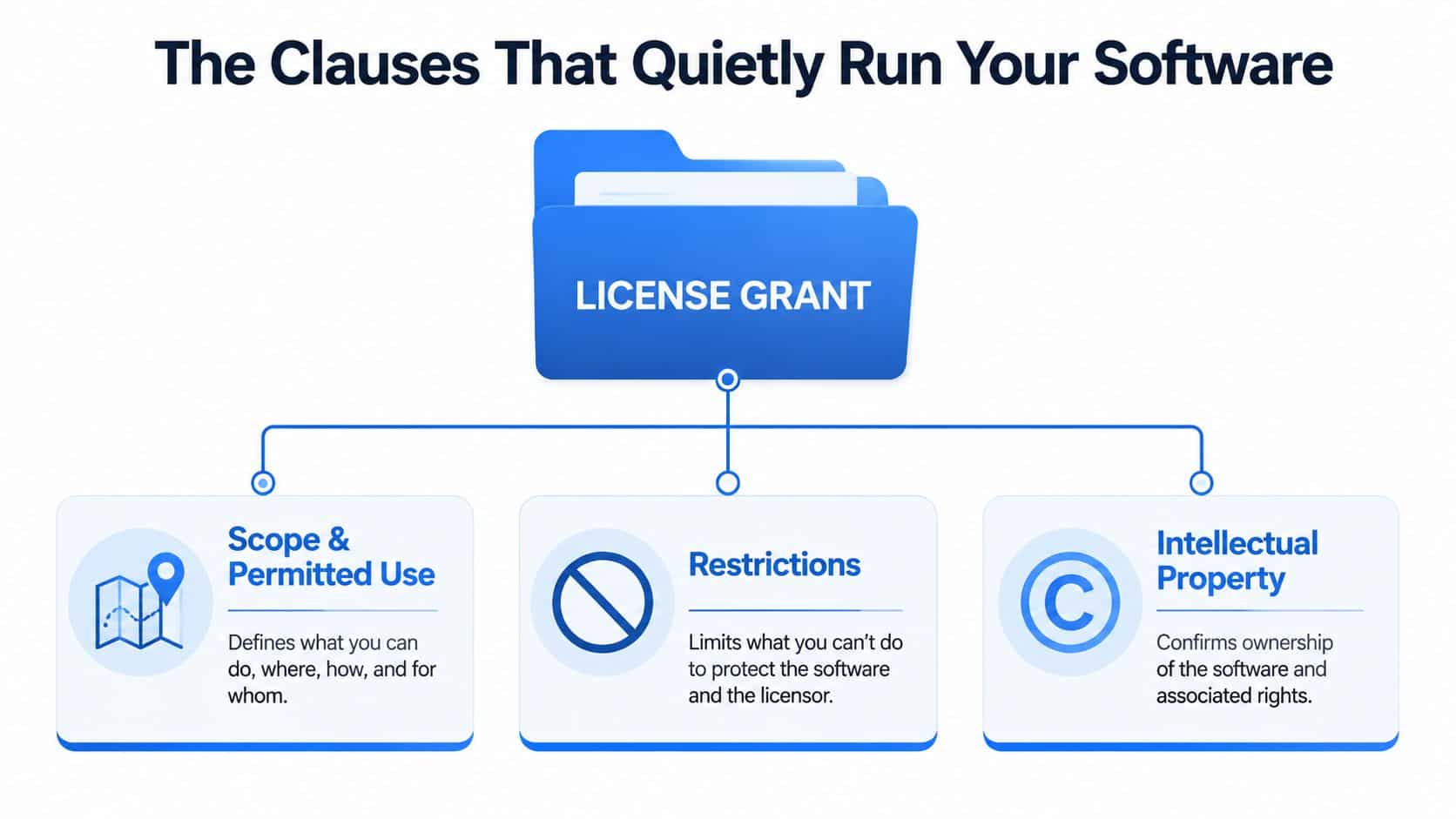
The Clauses That Quietly Run Your Software
Most founders read the price and skim the rest. That’s backward. The first ten pages usually decide whether the company can deploy the software, support it, migrate it, and survive a renewal without a budget ambush.
The license grant is the control plane
The license grant should identify the software, the deployment model, the permitted users, the purpose of use, the territory, and whether sublicensing is allowed. Thomson Reuters’ drafting guidance is right to treat this as the core control plane, because if the grant is thin, everything downstream gets fuzzy (key issues in drafting software license agreements).
Restrictions matter just as much. Reverse engineering, copying, transfer, hosting, benchmarking, and competitive use prohibitions are standard pressure points. The company should assume the vendor drafted them to protect margin, not to make operations easy.
The clauses that cause fights
The most contested terms are scope of use and termination. That tracks with the broader trend in licensing disputes, where usage-rights clauses, authorized user definitions, indirect access, and overuse are often the flashpoints (commercial licensing dispute trends). A vague “authorized user” definition can turn a normal growth spurt into an audit, then the audit turns into a true-up demand, then the true-up becomes a point of pressure at renewal.
Practical rule: If the contract doesn’t clearly define who can touch the software, someone will eventually argue that someone touched it wrong.
The rest of the clause stack still matters. IP ownership should say the vendor keeps the software and the customer keeps its own data and deliverables. Warranties and indemnity allocate who pays if the software breaks someone else’s rights. Liability caps decide how much pain the vendor absorbs. Maintenance and support decide whether the company gets fixes or just apologetic emails. Data, privacy, security, export controls, and termination decide whether the software can be used safely, exported lawfully, and unwound cleanly.
A focused review of representations and warranties helps because that section often carries more real-world risk than founders expect (representations and warranties guidance). Ignore boilerplate at your peril. Boilerplate is where vendors hide the parts that keep the deal profitable for them and painful for everyone else.
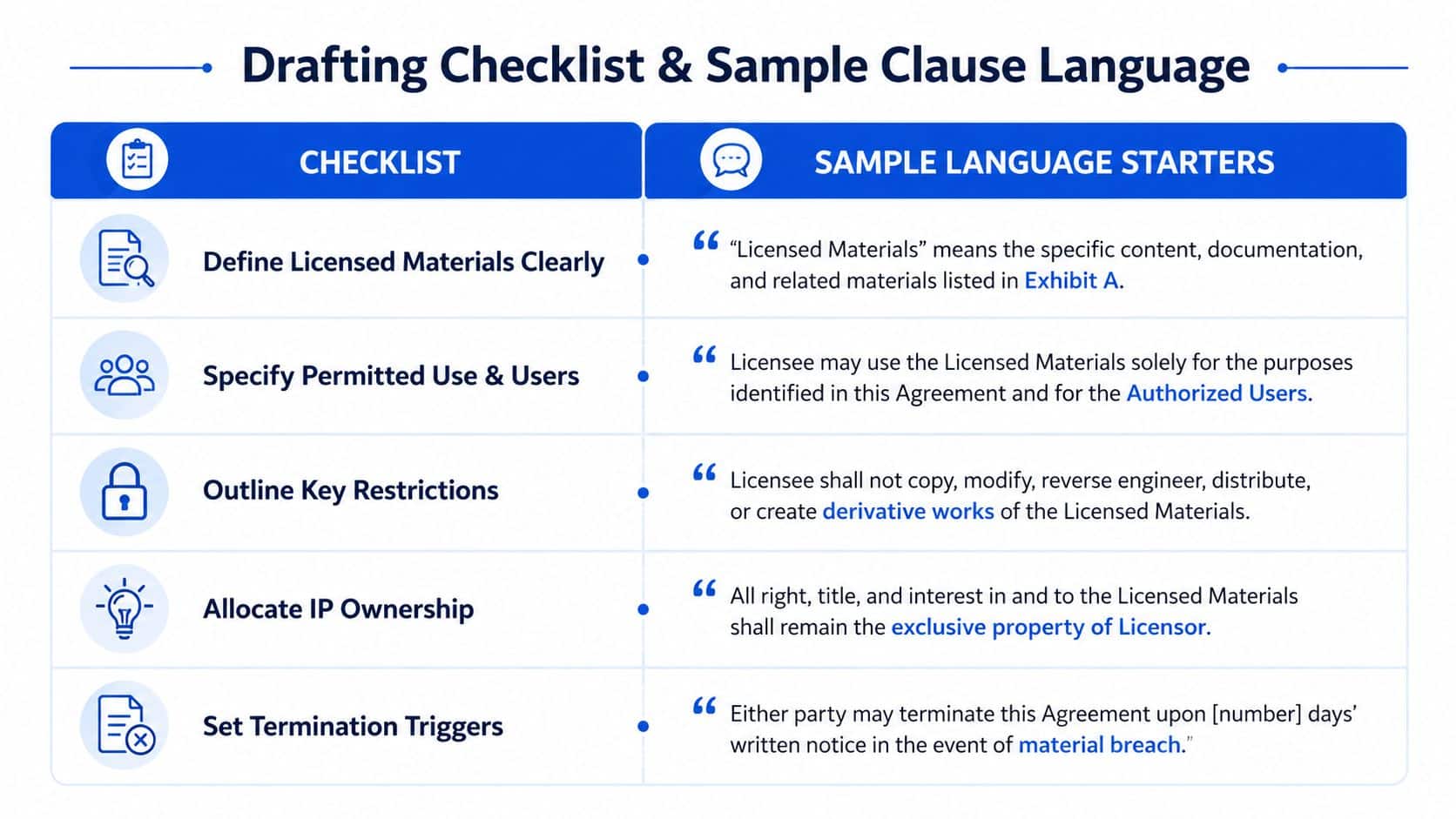
Drafting Checklist and Sample Clause Language
A founder does not need to become a contracts lawyer to spot a weak license. A disciplined checklist catches most of the mistakes before they become a support ticket, audit notice, or renewal fight.
Start with scope, not price
The license grant should name the licensed materials, the permitted users, the deployment model, the territory, and the purpose. For on-premise software, the agreement should also authorize installation, copying for execution, reasonable backup copies, and modification if the business needs customization. That matters because guidance notes that missing those permissions can block disaster recovery, patching workflows, and environment migration even when the software was lawfully acquired (on-premise software licensing guidance).
Here is the kind of language that keeps teams out of trouble:
- Define Licensed Materials Clearly: “Licensed Materials means the specific software, related documentation, and updates identified in the order form.”
- Specify Permitted Use and Users: “Customer may use the software solely for internal business use by named users located in the United States.”
- Outline Key Restrictions: “Customer may not reverse engineer, sublicense, or use the software to provide services to third parties.”
- Allocate IP Ownership: “Vendor retains all right, title, and interest in the software, and Customer retains ownership of its data and custom content.”
- Set Termination Triggers: “Either party may terminate for uncured material breach after written notice and a reasonable cure period.”
Check the operational clauses too
Fees, auto-renewal, support, data protection, security, and termination need to line up with how the software will be used. That is especially true for startups with remote teams, contractors, or customer-facing systems. If the license says nothing about who can install or copy software for resilience, the IT team may not have contractual authority to do routine work.
The clean draft is the one operations can live with without asking legal for permission every week.
The best redlines read like a systems diagram. They tell the team what is allowed, what is blocked, who pays, and what happens if the relationship ends badly. If the clause language does not do that, it’s not finished.
Data, AI, and Post-Termination Use of Your Content
Seattle SaaS deals keep tripping over the same clause pattern. The vendor gets broad rights to collect, store, analyze, and retain customer content, while the customer gets a short promise that the service will work and a vague line about privacy. That is backwards. Data rights decide who controls product feedback, model inputs, and the customer’s position when the relationship ends.
Keep training rights out unless they are explicit
Current practitioner guidance is increasingly focused on prompt handling, output handling, and vendor reuse restrictions, including limits on using customer data for model training without express permission (software license agreement issues for data and AI). That is the right place to be cautious. If the vendor wants broad reuse rights, the contract should say so in plain English, and the buyer should decide whether that is worth the price.
For startups licensing their own product to enterprise customers, the same issue runs in the other direction. The company’s template should say what happens to customer content, usage telemetry, prompts, and generated outputs during the term and after termination. If the agreement is silent, those assets can become a dispute later, especially if the business product relies on analytics or AI features.
A practical clause starter looks like this:
- Training Restriction: “Vendor will not use Customer Data, prompts, outputs, or confidential information to train or fine-tune models without Customer’s prior written consent.”
- Post-Termination Handling: “Upon termination, Vendor will delete or return Customer Data within the agreed period, except for legally required backups.”
- Reuse Limits: “Vendor may use de-identified aggregate data only to operate and improve the service, not to identify Customer or Customer’s users.”
Privacy and security language has to match the rest of the stack. If the contract promises data handling, deletion, retention, or incident response terms, it should line up with the broader compliance documents, including the data processing agreement template at this data processing agreement template. A licensing clause that looks harmless in isolation can still create a problem if it gives the vendor broader retention or reuse rights than the company’s privacy program can support.
Practical rule: If a vendor wants the data to improve the product, the contract has to say exactly what data, exactly for what purpose, and exactly for how long.
The same logic applies to export and deletion. Founders should not leave termination language vague and then discover that the vendor treats their customer content like a permanent archive. That is how modern software contracts turn into data-governance problems.
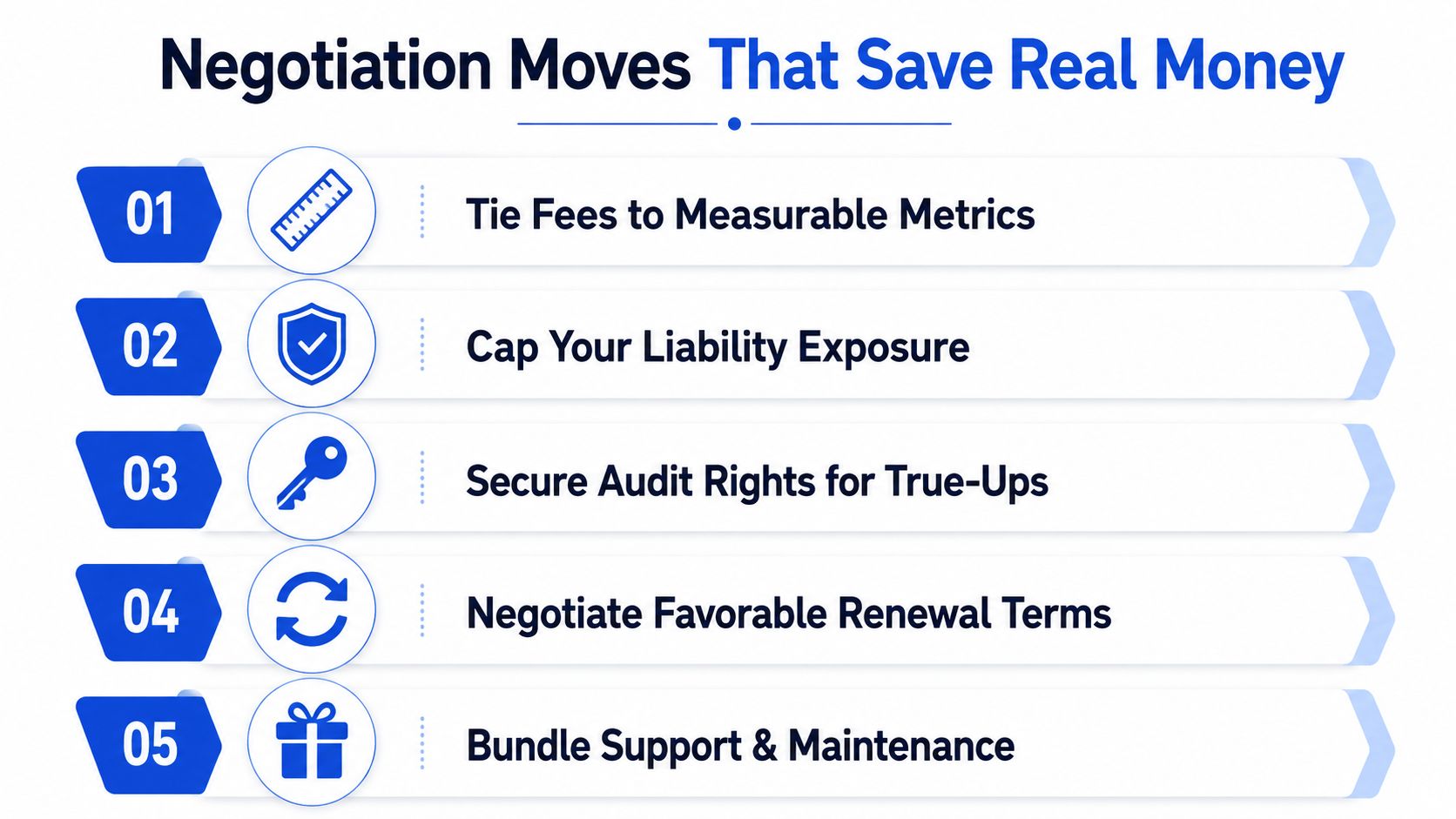
Negotiation Moves That Save Real Money
A Puget Sound startup once got to renewal and discovered the clause it had ignored months earlier. The auto-renewal window had closed, the vendor extended the term, and the company was stuck with a larger commitment than the team had budgeted for. That kind of surprise is boring, common, and expensive.
Five moves that actually matter
The first move is to tie fees to measurable usage. If the vendor bills by named users or transactions, those metrics need clean definitions and reporting rights. The second move is to cap true-up exposure so growth does not turn into open-ended retroactive billing. The third move is to negotiate audit rights and cure periods so an audit notice does not become a threat letter overnight.
The fourth move is to tighten auto-renewal windows. Renewal should require a clear notice period and a human touchpoint, not a buried calendar trap. The fifth move is to demand a named support contact, because escalation paths save more time than general help desks ever will.
For teams that need help redlining efficiently, a useful roundup of top contract redlining tools for lawyers can save hours when the draft is messy and the vendor is moving fast (LocalChat redlining tools). Good tools do not replace judgment, but they do help teams catch the same bad clause faster.
The negotiation story usually comes down to this, the company that knows its actual usage can push back with evidence. The company that doesn’t ends up paying for imagined headcount, stale seats, or vendor-defined “growth.” That difference is why procurement should never show up empty-handed.
Washington and Startup-Specific Considerations
Washington founders should not assume a software license is just a commercial issue. It can trigger privacy, data-handling, and export questions fast, especially in health tech, AI, and products that touch sensitive consumer data. Skimming the clause and signing is how a benign vendor form becomes a compliance headache.
The local rules can change the deal
Washington’s My Health My Data Act raises the stakes for agreements that involve consumer health data, and federal export control rules can affect how software, encryption, or technical data is shared across borders. A vendor clause that allows broad data retention, cross-border processing, or unrestricted subcontracting may look ordinary in a generic SaaS form, but it can create real friction for a Seattle startup trying to stay compliant. The contract should match the company’s regulatory posture, not the vendor’s default template.
The same pressure exists for founders licensing their own SaaS to enterprise customers. Their template should clearly state data ownership, acceptable use, confidentiality, security obligations, and the limits on reuse of telemetry or customer content. If the startup is in AI, it also needs language around prompts, outputs, and training rights so enterprise buyers do not read silence as a license to object later.
For teams that need a practical documentation baseline, GitDocAI for engineering docs is worth a look because clean product documentation often exposes the same ambiguity that shows up in contract drafting (GitDocAI documentation for startups). If the product team cannot explain the workflow clearly, the license probably can’t either.
Health tech and products that handle minors’ data need even tighter language. The contract should mirror the company’s privacy posture, not fight it. A license that leaves room for broad vendor reuse, vague retention, or undocumented subprocessors is the kind of clause that keeps compliance counsel awake.
When to Bring in Counsel and What to Ask First
Outside counsel should get involved when the contract is large enough to hurt, when it touches AI training rights or sensitive personal data, or when it limits the company’s ability to pivot, assign, or get acquired. Those are not edge cases. Those are the contracts that shape the company.
Give counsel a tight intake package
A good intake list is short and concrete:
- Deal context: What software is involved, who uses it, and what business process depends on it.
- Risk points: Data types, AI features, export issues, and any planned resale or embedded use.
- Commercial asks: Seat counts, renewal concerns, audit exposure, support expectations, and termination timing.
A licensing review should produce three things, not twenty. First, a marked-up draft with the risk clauses fixed. Second, a short issue list that explains what changed and why. Third, a fallback position for the business team so negotiations don’t stall on every objection.
Practical rule: Treat the software licensing agreement like a strategic document. If the company can’t live with the clause in two years, it should not sign it today.
Founders who handle the negotiation with that mindset usually get better economics and fewer surprises. The agreement stops being procurement wallpaper and becomes part of the company’s operating structure.
By Design Law Firm & Legal Consultancy, PLLC helps Seattle and Greater Puget Sound founders negotiate software licensing agreements that protect budget, data, and future flexibility. If this is the contract that controls your core tools or your product’s licensing model, visit By Design Law Firm & Legal Consultancy, PLLC to get practical counsel that turns redlines into something your business can live with. Call our law office today at (206) 593-1519.