A founder signs a new SaaS contract on Friday afternoon. Procurement is happy. The product team wants access turned on by Monday. Then the customer sends over a data processing agreement and asks for comments, or the vendor asks for one before any personal data moves.
That's usually the moment a data processing agreement template stops looking like routine paperwork and starts looking like infrastructure.
A DPA decides who gives instructions, what data may be processed, which security commitments apply, when a breach must be reported, and whether a vendor can hand work to subprocessors without meaningful oversight. For a Washington business selling into Europe, California, or health-related markets, those details aren't just legal niceties. They affect revenue, deal speed, internal operations, and whether the business can defend its practices when a customer or regulator asks hard questions.
A useful template saves time only if it matches the way the company really operates. A bad template does the opposite. It creates false confidence, slows enterprise contracting, and leaves the business with promises nobody has translated into vendor management, security review, or incident response. Companies that need broader privacy support often fold DPA work into a larger data privacy and compliance program so the contract terms line up with actual controls.
Why Your Business Needs a Rock-Solid DPA
The fastest way to create DPA trouble is to treat it like an attachment that legal signs at the end of the deal cycle.
A strong DPA is the contract that governs one of the most sensitive parts of a modern business relationship. It tells the processor what it may do with personal data, sets boundaries on reuse, and gives the controller a basis to ask questions about security, subcontracting, and deletion. Without that structure, everyone assumes the other side has the same understanding. They usually don't.
The business problem behind the template
Most startups hit the same pressure points:
- Enterprise sales pressure: A larger customer wants the vendor's privacy paper before purchase approval.
- Vendor onboarding pressure: The company wants to use a platform like HubSpot, Salesforce, AWS, Snowflake, or Zendesk and needs to document who handles personal data.
- Cross-border pressure: The business serves users in more than one region and can't rely on a single domestic contract form.
- Operational pressure: Security, legal, procurement, and product all need different things from the same document.
The DPA sits at the center of all of that. If it's drafted well, it shortens internal debates because the document answers practical questions. If it's vague, those questions come back later as disputes.
Practical rule: If a contract involves a third party receiving, storing, analyzing, or otherwise handling personal data for the company, the DPA should be reviewed as an operating document, not a legal appendix.
What a durable DPA actually does
A solid DPA helps a business do three things at once.
First, it allocates responsibility. That matters when a customer asks who responds to a deletion request, who investigates a breach, or who approves a new subprocessor.
Second, it supports trust. Buyers increasingly expect a vendor to produce a coherent DPA quickly, and they notice when the template is generic or internally inconsistent.
Third, it creates an implementation checklist. If the agreement says the processor will assist with audits, notify of breaches, and delete data at termination, the business needs staff, workflows, and records to perform those promises.
A founder doesn't need a longer template. The founder needs one that can survive contact with procurement, privacy review, and actual operations.
Deconstructing Mandatory DPA Clauses
A data processing agreement became a formal legal requirement in the EU with Article 28 of the GDPR, which took effect on 25 May 2018 and requires controllers to use only processors that provide sufficient guarantees to implement appropriate technical and organizational measures, as described in Cooley's discussion of the most important DPA considerations.
That legal rule explains why a serious DPA template follows a recognizable structure. It isn't arbitrary. Each clause answers a specific operational question.
The clauses that can't be skipped
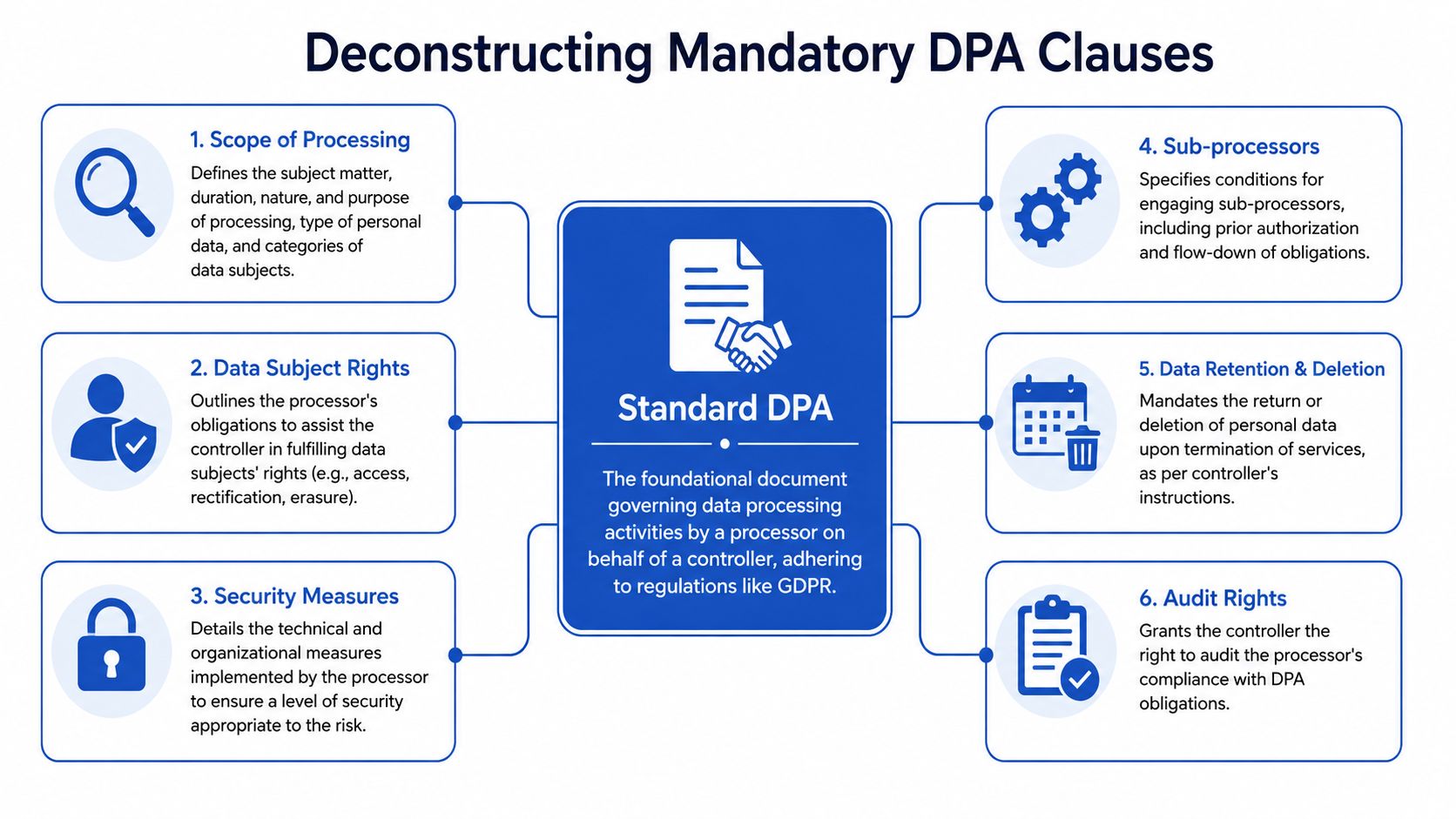
A workable template usually includes the following core components:
| Clause | What it needs to say | Why it matters |
|---|---|---|
| Parties and roles | Identify who is controller and who is processor | Role confusion breaks the whole contract |
| Purpose and duration | State what processing is for and how long it lasts | Scope creep usually starts here |
| Data and data subjects | Describe categories of personal data and categories of people | Security and response duties depend on this |
| Security obligations | Describe the processor's required measures and confidentiality duties | Vague security promises are hard to enforce |
| Subprocessing rules | Explain whether subprocessors are allowed and under what approval model | Most vendor chains fail here first |
| End-of-term handling | Return or delete data, with cooperation obligations as needed | This is where retention mistakes surface |
That structure is familiar for a reason. It matches the practical anatomy of processor oversight.
What each clause means in plain English
Each clause means a plain rule about the service, the data, or the security steps. Parties and roles should name what the vendor does in each service, and purpose and duration should limit the work.
Purpose and duration should narrow the engagement. “Providing services” is often too broad on its own. “Hosting customer account data to provide subscription software services and related support during the subscription term” is far more useful.
Types of personal data and data subjects shouldn't be drafted by copying someone else's annex. If the company only processes customer employee contact details and support logs, the template shouldn't also list biometric data, geolocation, and government identifiers without a reason. That overstatement creates extra diligence burdens.
A DPA that lists every imaginable data type usually signals that nobody matched the contract to the service.
Security obligations should connect contract language to real controls. A processor should know who has access, how confidentiality obligations apply, and what internal security documentation supports the commitment. If the business needs help translating those commitments into lifecycle rules, a related data retention policy template often helps align contract promises with deletion practice.
Clauses that deserve extra scrutiny
Two provisions often look harmless in template form but carry most of the risk.
- Subprocessor language: If the agreement allows broad subcontracting with weak notice rights, the controller loses visibility quickly.
- Audit cooperation: If audit rights exist only on paper, the clause won't help when diligence or an incident occurs.
- Deletion and return mechanics: If the template says data will be deleted “as applicable,” the parties haven't resolved anything.
Mandatory clauses are only useful when they're specific enough to run in real life.
How to Customize Your DPA Template
The fastest way to customize a data processing agreement template is to fill it out in the same order the law expects the relationship to work.
According to Lexion's guidance on structuring a GDPR-grade DPA, the agreement should start with the parties and roles, then specify the subject matter, duration, nature, and purpose of processing, identify categories of personal data and data subjects, and then allocate instructions, confidentiality, security, audit, and termination obligations. That sequence works because it forces the company to describe the service before it negotiates the legal mechanics.
Fill in the business description first
Start with the operational facts, not the legal boilerplate.
Use this checklist when completing the template:
-
Name the service clearly.
State what the processor does. Examples include hosting a customer relationship platform, providing payroll support, running marketing email infrastructure, or delivering managed IT support. -
Describe the processing activity.
Use verbs tied to the service, such as collect, host, store, organize, analyze, transmit, support, or delete. Avoid broad catchalls like “process in any manner necessary.” -
Set the duration.
Match the commercial term and any wind-down period. If support tickets remain accessible after termination for migration or compliance reasons, say that. -
Identify the people whose data is involved.
Customer employees, end users, website visitors, contractors, job applicants, patients, or business contacts all create different review issues.
Draft the annex like an operator, not a copy editor
The annex usually determines whether the template is useful.
A good annex is specific enough that security, procurement, and product teams can read it and recognize the service. A bad annex reads like a universal privacy glossary.
Consider the difference:
| Weak entry | Better entry |
|---|---|
| Personal data includes names and other information | Business contact details, account login information, support communications, and usage records submitted through the platform |
| Data subjects include any individuals | Customer personnel, authorized users, and end users whose data the customer uploads |
| Purpose is to provide services | To host and operate the software platform, authenticate users, store submitted records, and provide support |
Match instructions to product reality
A processor clause should reflect the product's architecture and support model. If engineers can access production data for troubleshooting under limited conditions, the agreement should contemplate documented instructions and confidentiality controls rather than pretending access never occurs.
That same discipline applies to security and assistance clauses.
- Confidentiality: Limit access to personnel who need it, and make sure internal agreements back that up.
- Security: Refer to technical and organizational measures in a way the business can substantiate.
- Assistance: Promise help with data subject requests, audits, or incidents only through workflows the team can perform.
Working test: If legal inserted the clause but the operations team doesn't know how to execute it, the template isn't finished.
Don't customize in isolation
Founders often try to finalize a DPA from the contract screen alone. That's where mistakes happen. The right inputs usually come from several places:
- Security or IT: access controls, incident handling, vendor stack
- Product: what data the service touches
- Customer success or support: retention periods and access patterns
- Procurement: whether vendors and subprocessors have already been approved
The template becomes much stronger when those teams validate the facts before signature.
Negotiating Key DPA Terms to Mitigate Risk
Most DPA disputes don't come from the opening definitions. They come from clauses that looked settled until something went wrong.
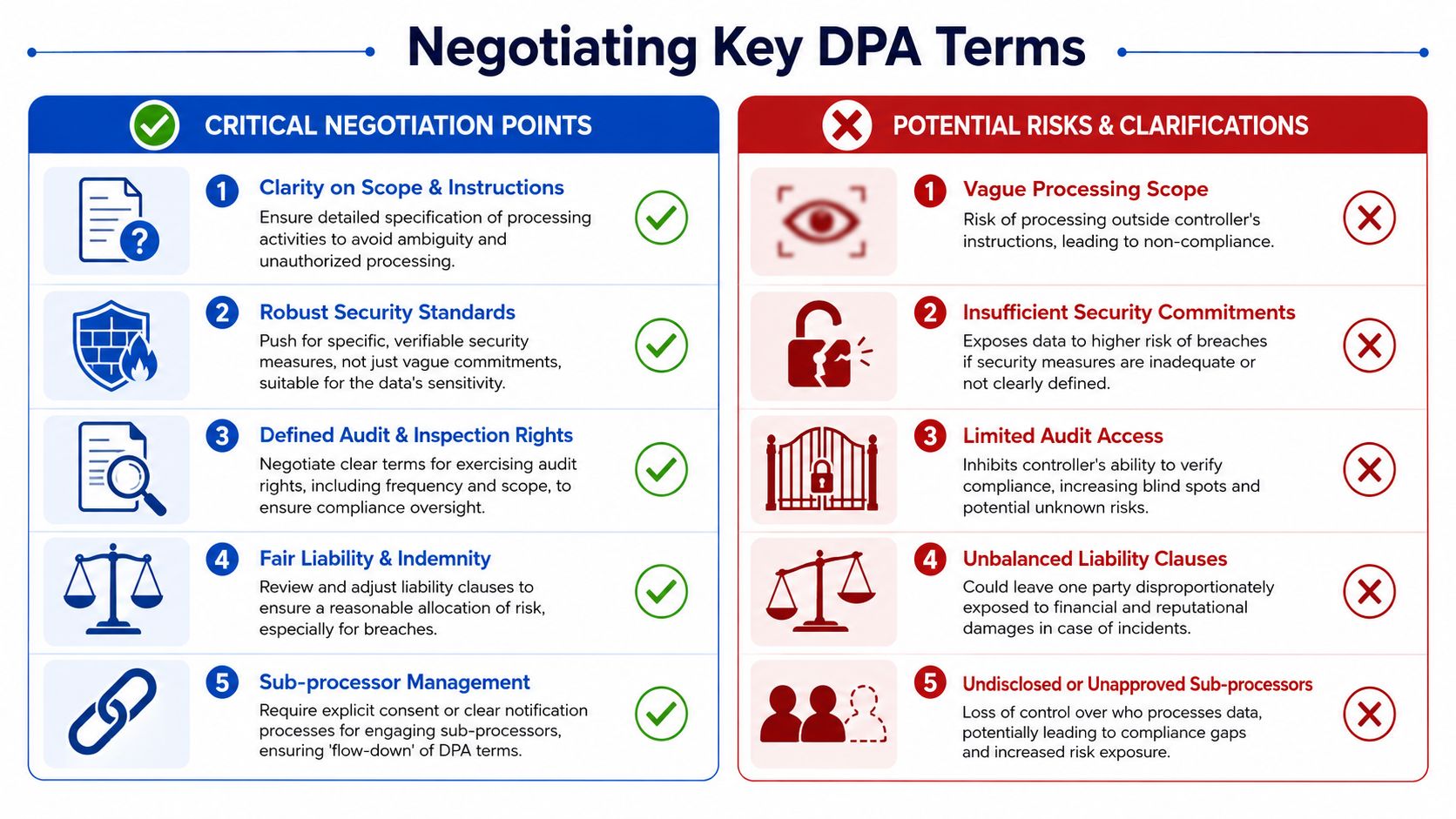
The highest-risk drafting failures tend to involve subprocessing, breach-notification timing, and audit rights, and independent DPA template guidance from Piwik PRO recommends making those points explicit rather than vague. That's where negotiation matters most.
Terms worth redlining early
A startup doesn't need to fight every clause. It does need to push on the clauses that control real exposure.
Subprocessors
Bad language says the processor may appoint subprocessors at its discretion. Better language requires prior specific authorization or at least a defined notice process, an opportunity to object on reasonable grounds, and flow-down obligations that bind the subprocessor to equivalent protections.
Breach notice
Bad language says the processor will notify the controller promptly or without unreasonable delay. Better language sets a concrete timeline tied to awareness and allows staged updates as facts develop.
Audit rights
Bad language gives the controller broad audit rights but no process. Better language allows proportionate review through documentation, certifications, or reasonable onsite review where justified, with cooperation duties, confidentiality protections, and timing rules.
What weak and strong language look like
| Issue | Weak draft | Stronger draft |
|---|---|---|
| Subprocessors | Processor may use third parties as needed | Processor may use listed subprocessors and must follow the agreed notice and objection process for changes |
| Breach notice | Notify promptly | Notify within the agreed timeframe after becoming aware, then provide updates as information develops |
| Audit | Controller may audit at any time | Controller may request information and conduct reasonable audits under defined procedures |
| Data requests | Processor will assist where feasible | Processor will assist within defined timelines and escalation paths |
A founder reviewing a vendor paper should ask one basic question: Could the company operationalize this clause on a stressful day? If the answer is no, the clause needs work.
Fairness matters, but symmetry doesn't
Not every risk should be split down the middle. The right allocation depends on who controls the systems, who selected the subprocessor, who failed to notify, and who can prevent the event.
That's why liability discussions should connect to conduct, not slogans. A vendor shouldn't accept open-ended exposure for matters the controller caused. A controller shouldn't accept a liability cap so low that the processor has little practical incentive to perform meaningful security and response duties. Teams doing diligence on these issues often pair the DPA review with a broader vendor risk assessment template so contract language aligns with the vendor's actual role and criticality.
A DPA negotiation is successful when the obligations are clear enough that neither side needs to guess what happens during a breach, audit, or vendor change.
A DPA Compliance Checklist for GDPR CCPA and WA Law
A Washington company can't assume that a GDPR-only template covers every contract need in the United States. That's the most common gap in public forms.
As Termly notes in its overview of DPA requirements, most templates focus on GDPR Article 28, but by 2023, at least five U.S. states had enacted privacy laws with specific processor contract requirements. That creates a drafting problem for companies that need one agreement to work across the EU and major U.S. markets.
Why Washington businesses need a broader view
Washington businesses often sell software, digital services, health-adjacent products, or consumer applications across state lines. That means one customer may use GDPR terms such as controller and processor, while another procurement team expects business, service provider, contractor, or other U.S.-specific terminology.
The practical answer isn't to maintain a stack of unrelated templates unless the business has the legal and operational capacity to manage them. In many cases, the better approach is a main DPA with modular addenda or drafting that maps equivalent concepts carefully and avoids internal contradiction. Teams that need to line this up with California obligations often use a broader CCPA compliance checklist alongside contract review so operational restrictions match what the agreement says.
DPA requirements GDPR vs CCPA vs WA My Health My Data
| Requirement | GDPR Art. 28 | CCPA/CPRA | WA My Health My Data Act |
|---|---|---|---|
| Core relationship model | Controller and processor | Business and service provider or contractor | Regulated entity and processor concepts may need tailored drafting depending on the role |
| Processing instructions | Must be documented and tied to controller authority | Contract should restrict use to specified business purposes and services | Agreement should tightly limit handling of regulated health-related data to permitted purposes |
| Data description | Should identify categories of personal data and data subjects | Contract should describe the services and the information involved clearly | Health data scope needs careful description because sensitivity and downstream use matter |
| Security obligations | Processor must provide appropriate technical and organizational measures | Service provider restrictions should be backed by workable security commitments | Security commitments should reflect the sensitivity of consumer health data and internal access limits |
| Subprocessors | Approval and flow-down structure should be addressed expressly | Downstream restrictions need to be carried through the chain | Processor chains should be reviewed closely because health-data disclosures create elevated risk |
| Deletion or return | End-of-term handling should be specified | Contract should define retention and permitted use boundaries | Retention and destruction rules should align with the regulated entity's notices and practices |
| Audit and cooperation | Assistance and audit cooperation are central issues | Operational cooperation still matters even where wording differs | Review rights and incident coordination should be tailored to the data and service model |
What to add for multi-jurisdiction use
A reusable template usually needs more than a single definitions section.
- Terminology bridge: Define equivalent roles where lawful and avoid assuming every customer fits the same privacy vocabulary.
- Use restrictions: U.S. privacy laws often care intensely about whether the recipient can retain, use, or disclose data outside the business purpose.
- Sensitive-data tailoring: Washington health-related data should not be buried inside a generic “personal data” list if the service touches health in any meaningful way.
- Operational proof: If the business promises notice, deletion, or access restrictions, it should maintain evidence. Tools that preserve logs and support streamlined audit trails for secrets can be useful where access governance and change history matter.
A practical drafting stance
One global DPA can work. But only if someone reconciles the legal language before signature.
That means checking the template against actual product behavior, subprocessor usage, data categories, and customer geography. A founder shouldn't rely on a GDPR annex pasted into a U.S. service-provider form and assume the result is compliant. That kind of patchwork is exactly what creates contradictions during diligence.
Operationalizing Your DPA Obligations
The contract is signed. That's the starting line, not the finish.
A DPA has no practical value if the company can't locate it, track the related vendor, update the subprocessor list, or respond when a customer invokes one of the promised rights. Many startups frequently lag in these critical areas. Legal finishes the paper. Operations never gets the memo.
UW-IT's public guidance shows how this shift has become formalized in practice. Starting in September 2022, DPA-related agreements were required to be recorded in the TrustArc Privacy Management Platform before or alongside privacy review, reflecting a broader move toward treating DPAs as part of structured vendor-risk operations rather than optional boilerplate, as described in UW-IT's DPA process guidance.
The post-signature checklist that matters
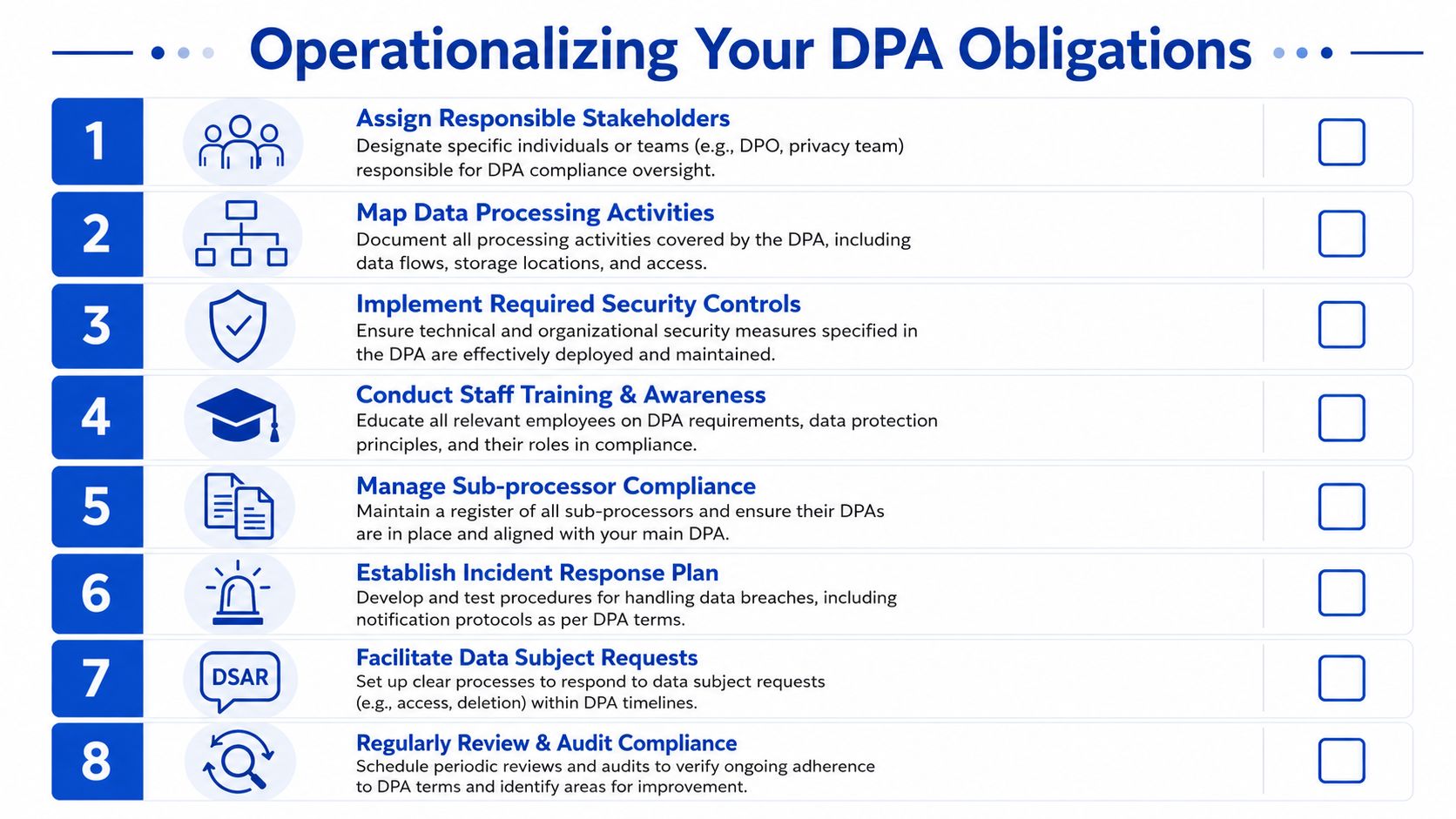
A practical implementation program should include at least these steps:
- Centralize signed DPAs: Keep the agreement, annexes, amendments, and subprocessor notices in one searchable system.
- Assign ownership: Someone in legal, privacy, procurement, security, or operations should own follow-up obligations.
- Map the covered processing: Tie the DPA to the relevant product, vendor, or workflow so teams know what it governs.
- Track subprocessor changes: A listed vendor today may not be the same vendor stack six months from now.
- Link incident response: Breach notice timing in the contract should be mirrored in the internal escalation playbook.
- Schedule periodic review: Services evolve. The DPA should be checked when functionality, data categories, or infrastructure changes.
Turn clauses into workflows
The best way to operationalize a DPA is to convert each promise into a named process.
If the agreement requires assistance with data subject requests, designate the intake route, responsible team, and response handoff. If it requires deletion or return at termination, define the trigger event and evidence of completion. If it restricts subprocessor use, require procurement or security review before engineering adopts a new tool that touches customer data.
Contracts fail operationally when nobody owns the verbs in the agreement.
Train the teams that create the risk
Founders sometimes assume DPA obligations belong only to lawyers. They don't.
Product teams define new features. Engineers add third-party tools. Marketing deploys tracking platforms. Customer success exports records. Security investigates incidents. Each of those teams can create a DPA mismatch if they don't understand the boundaries.
A short internal playbook works better than a dense policy memo. It should tell each team:
| Team | What they need to know |
|---|---|
| Product | Which data uses are in scope and which require legal review |
| Engineering | When a new integration may create a subprocessor issue |
| Support | How to escalate requests involving deletion, access, or correction |
| Security | What notice windows and cooperation duties apply |
| Procurement | When a DPA must be in place before data sharing starts |
A signed DPA becomes meaningful only when the business treats it like a living control.
Building Your Durable Legal Foundation
A good data processing agreement template does more than accelerate signature. It forces a business to define its data relationships, pressure-test vendor assumptions, and build repeatable compliance habits.
The core lessons are straightforward. Mandatory clauses need to be specific. Negotiated terms should focus on real failure points, especially subprocessors, audits, and breach notice. Multi-jurisdiction drafting matters for Washington companies that serve customers across borders or in regulated U.S. markets. Post-signature operations matter just as much as the paper itself.
Founders also need a way to keep contract obligations aligned with internal procedures. Resources like StepCapture’s guide to policy manuals can help teams think more clearly about how documented procedures support recurring compliance tasks, especially when obligations need to survive staff turnover and product growth.
At some point, every growing company outgrows the generic template phase. That usually happens when enterprise customers negotiate harder, health or consumer data enters the system, or the vendor stack becomes too complex for informal oversight. At that point, customized legal review stops being optional and starts being efficient.
By Design Law Firm & Legal Consultancy, PLLC advises Washington businesses on contracts, privacy, cyber risk, and operational compliance. Companies that need a DPA reviewed, negotiated, or adapted for GDPR, CCPA, or Washington-specific obligations can work with the firm to align the document with actual data flows, vendor practices, and internal processes. Learn more at By Design Law Firm & Legal Consultancy, PLLC. Call us today at (206) 593-1519.