A founder ships fast. Stripe handles payments, Segment routes events, HubSpot tracks leads, Google Analytics measures traffic, the support team works in Intercom or Zendesk, and marketing adds a few ad pixels along the way. Then a California user asks for deletion, and the company realizes no one can say with confidence what data was collected, where it sits, which vendors received it, or how long removal will take.
A CCPA compliance checklist becomes an operating discipline at that point, not a document that sits in a folder. For startups and SMBs, the risk usually comes from ordinary implementation choices: product telemetry sent to a warehouse, support transcripts synced into a CRM, mobile SDKs collecting more than the team expected, or ad tech that turns a simple analytics setup into a sale or sharing analysis under the CPRA.
Coverage is not limited to large enterprises. A for-profit company doing business in California may be covered based on revenue, the volume of personal information it handles, or whether a significant share of its revenue comes from selling or sharing personal information, as outlined in the CCPA threshold summary. For early-stage companies, that is a practical warning. Scope can attach through architecture and vendor choices long before the business feels “big.”
The distinction is important because privacy risk in startups rarely comes from one dramatic decision. It shows up in dozens of small ones made during rapid shipping: a form field added without review, a new SDK pushed by engineering, a RevOps sync turned on by default, or broad retention settings no one revisits after launch.
CCPA, especially after the CPRA amendments, rewards companies that can translate legal requirements into repeatable operational steps. That means clear ownership, accurate disclosures, workable request handling, disciplined vendor contracting, and a realistic plan for keeping pace with product changes and enforcement expectations.
1. Conduct a Comprehensive Data Inventory and Audit
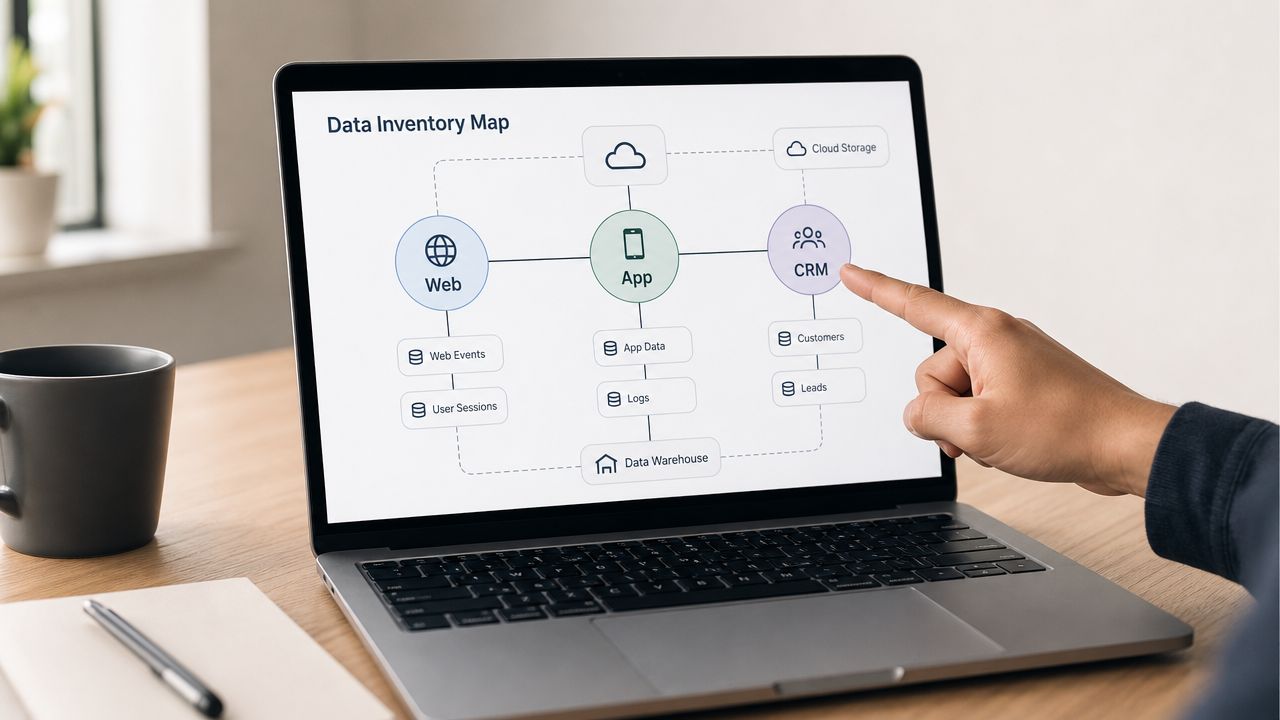
Most privacy failures start with a false assumption that the company already knows its data. It usually doesn't. A modern startup collects personal information across website forms, product events, support tickets, payment flows, sales demos, ad platforms, and internal analytics tools. The first serious move in any CCPA compliance checklist is a defensible data inventory.
For a SaaS startup, that often means tracing data across AWS or Google Cloud, a production database, Snowflake or BigQuery, a CRM like HubSpot or Salesforce, support tools like Zendesk or Intercom, and marketing tools like Meta Pixel, Google Ads, or LinkedIn Insight Tag. For an ecommerce business, it also includes returns, loyalty programs, SMS tools, reviews platforms, and warranty workflows.
What the inventory needs to show
A useful inventory isn't a vague diagram. It should identify the data category, source, business purpose, storage location, retention logic, internal owner, and every vendor that receives it. If the team can't answer those fields quickly, it won't be able to write accurate disclosures or fulfill a rights request reliably.
Start with the highest-risk systems first. Founders often get more value by mapping authentication data, payment-linked records, precise location features, customer communications, and advertising technology before trying to perfect every edge case on day one.
- List collection points: Website forms, signup flows, mobile SDKs, cookies, support inboxes, sales call recordings, and in-product telemetry.
- Map transfers: Which tools receive data from the app, from the CRM, from the support stack, and from warehouse exports.
- Assign owners: Product, engineering, marketing, customer success, and finance should each own the systems they introduced.
- Document retention: Even a simple rule beats indefinite storage by default.
Practical rule: If the company can't explain why a tool receives personal information, that transfer should be paused, narrowed, or removed.
A workable startup version can begin as a spreadsheet. Later, the team can mature into structured records, automated discovery, and system-level tagging. What doesn't work is delegating the whole exercise to legal without engineering, marketing, and operations in the room.
2. Update Privacy Policy and Create CCPA-Specific Disclosures
A privacy policy drafted from a generic template is one of the fastest ways to create risk. Startups often publish broad language that doesn't match their stack, their vendor relationships, or their actual advertising practices. Regulators and plaintiffs' lawyers both notice that gap.
A defensible policy should reflect what the company collects, how it uses the data, which categories are disclosed to service providers or third parties, and what rights California consumers can exercise. It should also align with product reality. If a site uses cookies, device identifiers, analytics tools, and retargeting pixels, the policy should say so plainly.
Plain language beats legal fog
Consumers shouldn't have to decode the document. Organize the policy around data categories and actions: what gets collected, why it's used, who receives it, how long it's retained, and what choices the consumer has. Mobile readability matters just as much as desktop readability because many startup users never see a full desktop footer.
A common failure point is “sale” or “sharing” analysis in adtech-heavy environments. A startup that relies on ad platforms, affiliate partners, or cross-context behavioral advertising should review those flows carefully instead of assuming that every vendor is just a service provider.
Useful disclosure areas include:
- Data categories: Account details, transaction records, usage data, support communications, and device-level identifiers.
- Business purposes: Product delivery, fraud prevention, analytics, customer support, billing, and marketing.
- Vendor disclosures: Payment processors, cloud hosts, CRM providers, analytics vendors, and customer support platforms.
- Consumer choices: Access, deletion, correction, and opt-out pathways.
The company's privacy documentation should also stay synchronized with operational changes. If the product team adds a new SDK or the growth team launches a new pixel, the policy should be reviewed before or immediately after release, not months later.
For teams reviewing model privacy language and disclosure structure, it can help to compare their public-facing language against examples of AI document processing privacy disclosures. The point isn't copying language. The point is testing whether the startup's own disclosures are concrete enough to reflect real processing.
3. Implement Consumer Rights Request Processes Access, Deletion, and Opt-Out
A founder usually discovers the actual state of CCPA compliance when the first deletion request lands in the support queue and nobody knows who owns the response. Engineering assumes legal will handle it. Legal assumes support can find the data. Support exports what it can see in the app and misses the warehouse, CRM, billing platform, and old logs. That is how a routine rights request turns into an avoidable compliance problem.
The fix is an operating process, not just a mailbox. California consumer requests have statutory response deadlines, and CPRA-era enforcement has also put more weight on honoring browser-based opt-out signals such as Global Privacy Control. For a startup running on SaaS tools and cloud infrastructure, the hard part is rarely the rule itself. The hard part is coordinating systems, owners, and records fast enough to respond accurately.
A workable process has five parts: intake, verification, routing, fulfillment, and audit logging. If customer data sits across Postgres, Salesforce, HubSpot, Zendesk, Stripe, and a data warehouse, each request needs a defined path through those systems. Otherwise the team improvises, and improvisation creates inconsistent responses and missing records.

Build the workflow before request volume increases
Use case management from the start. Every request should generate a record that shows when it came in, how identity was checked, which systems were searched, whether any legal exception applied, what was sent back, and when the matter closed. If the California Privacy Protection Agency asks questions later, that record will matter almost as much as the underlying response.
For smaller teams, the setup can stay lean. A webform, a monitored privacy alias, a lightweight ticketing workflow, and approved response templates are often enough. What matters is clear ownership. Product or engineering should own app and database retrieval. RevOps or go-to-market operations should own CRM and marketing systems. Finance should confirm billing records and any retention limits. Someone, usually legal or the privacy lead, needs final review.
Verification deserves more attention than many startups give it. The standard is reasonable verification, not maximum friction. For an authenticated user asking for access to account data, existing login controls may do much of the work. For a deletion request tied to a dormant email address with no active session, the company may need extra confirmation. Over-verification creates consumer complaints. Under-verification creates disclosure risk.
A good request workflow usually includes:
- Request intake channels: At minimum, a privacy email address and a webform that routes into a trackable queue.
- Request categorization: Access, deletion, correction, opt-out, and requests that need clarification before work starts.
- System-level playbooks: Clear instructions for each core tool on retrieve, delete, suppress, or retain actions.
- Internal target dates: Deadlines earlier than the legal deadline so legal and operations have time to review exceptions.
- Decision logging: Notes on identity checks, systems searched, partial denials, and reasons for any retained data.
Deletion is where startup architecture matters. Data may be removable from the production app but retained in backups, fraud systems, finance records, or security logs. The response process should distinguish between deletion from active systems, suppression from future use, and retention required for security, legal, or transactional reasons. If the company cannot delete from a tool, document that limitation now and decide whether that vendor still fits the stack.
Opt-out handling also needs engineering attention. If the site uses adtech, analytics tags, or cross-context behavioral advertising tools, GPC signals and Do Not Sell or Share choices must be honored in practice, not just referenced in policy language. That often means updating consent tooling, tag firing rules, and downstream data flows so the request changes actual processing behavior.
Test the process with mock requests every quarter. Use one access request, one deletion request, and one browser-based opt-out signal. Start the exercise from the intake point and confirm the team can complete it without Slack chaos, undocumented judgment calls, or manual searching across disconnected tools. That is the difference between a checklist item and a process that holds up under enforcement scrutiny.
4. Establish Third-Party Vendor and Service Provider Agreements
Most startups don't just process personal information. They outsource large parts of the processing environment. Infrastructure, analytics, payments, communications, customer support, session replay, fraud tooling, and customer success all involve third parties. That makes vendor governance a core part of any CCPA compliance checklist.
The contract review should start with the vendors that touch the most sensitive or broadly distributed data. For many companies, that means cloud hosting, payment processors, customer support systems, CRMs, marketing automation platforms, and data enrichment or advertising tools. The goal is to confirm what role each vendor plays and whether the contract restricts use of personal information to the agreed services.
Focus on use restrictions, not just security promises
Founders often look for a DPA checkbox and stop there. That's not enough. The agreement should address whether the vendor can use the data for its own purposes, whether it can combine the data across clients, whether it uses subprocessors, and how it supports deletion or correction requests.
A practical vendor register should track the system name, business owner, categories of personal information involved, contract status, deletion support, and risk notes. This becomes critical when a privacy request requires downstream action across multiple tools.
Questions worth asking every material vendor include:
- What data enters the service: Raw customer records, event streams, transcripts, attachments, identifiers, or derived analytics.
- How the vendor uses it: Only to provide services, or also for product improvement, benchmarking, or model training.
- How requests are handled: Deletion, export, suppression, and retention control.
- Who else gets access: Subprocessors, affiliates, implementation partners, or integrated applications.
Startups that move fast often create hidden vendor risk through self-serve purchasing. Marketing adds a tool. Product installs an SDK. Sales starts recording calls. No one updates procurement or legal. That's how the company ends up with personal information in systems no one can govern.
5. Create and Maintain Data Security and Breach Response Protocols
CCPA compliance and security operations are tightly connected. A startup doesn't get much credit for polished disclosures if credentials are shared in plaintext, production data is copied into test environments, or former employees still have access to customer systems. Security discipline supports privacy rights because it controls where personal information goes and who can act on it.
The best startup programs start with boring controls that work. Enforce multi-factor authentication, tighten role-based access, log administrative actions, review permissions after team changes, and avoid copying production records into development and demo environments without a real need.

The incident plan has to fit the company's stack
A breach plan that names no tools, no decision-makers, and no communication channels won't survive a real incident. If the startup runs on Google Workspace, Okta, GitHub, AWS, Slack, and a handful of SaaS tools, the plan should identify how to isolate accounts, preserve logs, assess affected data, involve counsel, and coordinate consumer and regulatory notifications where required.
For Washington companies handling this work, a practical companion is this guide on data breach response planning for Seattle businesses. It helps anchor privacy compliance inside an incident-response process instead of treating it as a separate silo.
A startup-ready security baseline should include:
- Access discipline: Least-privilege access and prompt offboarding.
- Environment separation: Keep test, sandbox, and production data practices distinct.
- Logging: Preserve enough system history to investigate misuse and support legal review.
- Playbooks: Define who investigates, who approves decisions, and who communicates externally.
Security controls should reduce the number of places where personal information can leak, not just help explain the leak after it happens.
What doesn't work is relying on a cloud provider's default posture as the full security strategy. Shared responsibility is still responsibility.
6. Develop Opt-Out Mechanisms and Honor Do-Not-Sell-My-Data Requests
This is one of the most misunderstood parts of compliance for tech companies because the issue isn't just a website link. It's whether the company's adtech and partner ecosystem stops processing data in the way the consumer opted out of.
For some startups, the answer is straightforward. They don't sell personal information and their vendors operate in tightly restricted service-provider roles. For others, especially businesses using retargeting, audience building, affiliate marketing, enrichment, or cross-context advertising, the analysis is harder and the operational burden is real.
Make the opt-out travel through the stack
The company should provide a clear, accessible opt-out method and then ensure that preference propagates to the systems that matter. That includes website tags, consent tools, data pipelines, CRM flags, audience syncs, and vendor instructions where relevant. If the company honors the request only in one interface while other systems keep sharing data, the mechanism is cosmetic.
One source of pressure here is modern browser signaling. Consumer rights workflows increasingly need to recognize automated signals rather than relying only on manual forms, especially in web environments with heavy cookie and pixel use.
Founders dealing with vendor ecosystems that look anything like data brokerage or downstream audience distribution should pay close attention to how states are viewing these practices. This discussion of Washington State's approach to data brokers is useful context because it shows how quickly scrutiny can move from theory to operational expectations.
A practical opt-out setup usually includes:
- Visible consumer choice: Homepage footer placement and privacy policy access.
- Low-friction submission: Simple form fields and accessible alternatives.
- Backend suppression logic: CRM and marketing systems must respect the flag.
- Partner follow-through: Notify relevant recipients where the business relationship requires it.
For teams also reviewing broader notice obligations around incidents and downstream data handling, this overview of data breach notification requirements helps frame how consumer-facing privacy promises can intersect with operational response duties.
7. Implement Internal Privacy Governance and Training Programs
A startup rarely fails because it lacked one more policy document. It fails because nobody owned privacy decisions across product, marketing, engineering, support, and leadership. Governance fixes that by giving the company a decision structure, not just a document repository.
One strong signal from current compliance guidance is that privacy rights operations should support a 10-business-day acknowledgment and a 45-calendar-day substantive response window. That timing forces teams to build workflow automation, verification logic, and audit logging into normal operations. It also underscores a bigger point from the same guidance: a governed workflow matters more than a static policy.
Assign authority and make privacy part of launch decisions
A smaller company doesn't necessarily need a large privacy department. It does need someone with enough authority to coordinate engineering, product, legal, marketing, and support. That person should know when a feature launch, new integration, or revised growth campaign needs privacy review before release.
Training should be role-based. Developers need guidance on data minimization, logs, SDKs, and test data. Marketing needs clear rules around pixels, audiences, cookies, and disclosures. Support needs scripts and escalation rules for consumer rights requests. Sales needs to know what can and can't be promised in security questionnaires and procurement calls.
Useful governance mechanics include:
- A named privacy lead: Even if privacy is one function of a broader legal or compliance role.
- A cross-functional review group: Product, engineering, security, marketing, and operations.
- Launch checkpoints: New vendors, new tracking, and new data uses should trigger review.
- Training records: Completion logs matter when proving the program exists in practice.
For companies formalizing this structure, this legal guide on crafting effective compliance programs for Seattle corporations offers a practical governance lens that fits growing businesses.
8. Monitor Regulatory Changes and Implement Ongoing Compliance Updates
Privacy compliance drifts unless someone actively maintains it. Startups change vendors, launch new features, enter new markets, and revise pricing or growth strategies quickly. A CCPA compliance checklist that was accurate last year can become misleading after a few product sprints.
The biggest mistake here is treating compliance as a one-time remediation project. The better model is a recurring review cycle tied to actual business events: product launches, adtech changes, new integrations, fundraising diligence, enterprise procurement requirements, and incidents.
Watch the law, but also watch the product roadmap
Regulatory updates matter, but internal change creates just as much risk. If the company adds a session replay tool, deploys a new mobile analytics SDK, starts using AI features on support transcripts, or syncs customer data into a new marketing platform, privacy documentation and workflows should be revisited.
This matters well beyond California. State-level privacy regulation keeps expanding, and companies that build disciplined governance once will adapt faster across jurisdictions. Washington businesses tracking adjacent health and consumer-data issues should also review Washington's My Health My Data Act, because product features can cross into sensitive territory faster than founders expect.
The strongest privacy program is the one that keeps changing on purpose.
A durable maintenance rhythm usually includes legal review, vendor review, data map updates, rights-request testing, and policy refreshes tied to material operational change. Startups don't need bureaucracy for its own sake. They need enough process to keep growth from outrunning compliance.
CCPA 8-Point Compliance Comparison
| Item | Implementation complexity | Resource requirements | Expected outcomes | Ideal use cases | Key advantages |
|---|---|---|---|---|---|
| Conduct a Comprehensive Data Inventory and Audit | Medium–High, cross-department mapping and technical discovery | Low–Medium: $5K–$50K+, 4–12 weeks; possible external consultants | Complete data map, identified governance gaps, prioritized remediation | Organizations starting compliance, complex data ecosystems, pre-CPRA readiness | Visibility into personal data, enables accurate DSARs, informs policy/vendor work |
| Update Privacy Policy and Create CCPA-Specific Disclosures | Medium, legal drafting and consumer-facing clarity required | Medium: $3K–$15K, 2–8 weeks; legal review advised | Compliant, transparent disclosures; clarified consumer rights; reduced enforcement risk | Consumer-facing websites/apps, multi-state businesses, marketing-heavy firms | Legal defensibility, builds trust, communicates rights, supports other regs |
| Implement Consumer Rights Request Processes (Access, Deletion, Opt-Out) | High, operational, verification, and system integration challenges | Medium–High: $10K–$100K+, 6–16 weeks; staffing and automation needs | Timely DSAR fulfillment, documented audit trails, reduced regulatory exposure | High-volume consumer platforms (e‑commerce, SaaS), healthcare-adjacent services | Demonstrates compliance, operational clarity, preserves consumer trust |
| Establish Third-Party Vendor and Service Provider Agreements | Medium, contract negotiation and vendor assessments | Low–Medium: $5K–$30K, 4–12 weeks; legal and vendor management effort | Contractual protections, vendor accountability, audit and breach controls | Businesses relying on cloud, payment processors, CRMs, marketing vendors | Allocates liability, enforces vendor compliance, provides remediation rights |
| Create and Maintain Data Security and Breach Response Protocols | High, technical controls plus incident response planning | High: $50K–$500K+ annually, initial 8–16 weeks; ongoing investment | Reduced breach risk, rapid incident response, compliant notification processes | High-risk data holders (health, finance), large user-base platforms, SaaS | Protects reputation, may lower insurance costs, shows reasonable security measures |
| Develop Opt-Out Mechanisms and Honor Do-Not-Sell-My-Data Requests | Medium, cross-system flagging and vendor coordination needed | Medium: $10K–$50K, 4–8 weeks; integration with marketing/analytics | Honored opt-outs, visible compliance, tracked confirmations and vendor notices | Ad-tech, publishers, data brokers, e‑commerce, marketing platforms | Meets CCPA visibility rules, reduces complaints, preserves opt-in audiences |
| Implement Internal Privacy Governance and Training Programs | Medium, organizational design, role definitions, and ongoing training | Medium: $20K–$100K+ annually, 6–12 weeks initial setup; staffing for privacy lead | Embedded privacy culture, clearer accountability, fewer employee errors | Scaling companies, regulated industries, firms launching new data products | Sustains compliance, cross-functional accountability, faster issue response |
| Monitor Regulatory Changes and Implement Ongoing Compliance Updates | Low–Medium, process setup and periodic review | Low: $0–$10K for subscriptions/counsel, ongoing 4–8 hours/month | Proactive updates, earlier compliance, reduced emergency remediation | All companies subject to CCPA/CPRA or operating in multiple jurisdictions | Early adoption of requirements, lowers long-term remediation cost, informed planning |
Building a Durable Foundation for Privacy Compliance
A solid CCPA compliance checklist gives a startup something more valuable than paper compliance. It creates visibility into how the business handles personal information, where risk sits in the stack, and which teams need to act when a consumer, regulator, investor, or enterprise customer asks hard questions.
That matters because privacy risk in startups usually doesn’t come from a dramatic single decision. It comes from accumulation. One analytics tool gets added without review. A customer success platform stores more than expected. Product logs retain identifiers longer than anyone planned. Marketing launches a new audience sync without fully understanding the downstream implications. Each decision looks manageable on its own. Together, they create a program that no one can confidently explain or defend.
The eight pillars above work because they align legal requirements with operating reality. Data mapping tells the company where obligations attach. Accurate disclosures reduce mismatch risk. Rights-request workflows make deadlines manageable. Vendor controls extend governance beyond internal systems. Security and incident planning reduce exposure when something goes wrong. Opt-out handling translates consumer choice into technical action. Governance and training turn privacy from a side task into an assigned responsibility. Ongoing review keeps the program current as the company changes.
For startups and SMBs, the practical trade-off is always the same. Perfect systems are expensive and slow. No system at all is far more expensive when enforcement, customer complaints, diligence reviews, or a security incident arrives. The right answer is usually a staged program built around the company’s actual data footprint, risk profile, and team capacity.
That’s especially true for Washington-based technology companies serving California residents. They often need a program that addresses California consumer privacy expectations while fitting a lean operating model and a cloud-heavy tech stack. In that context, outside counsel can be useful not because it replaces internal ownership, but because it helps structure priorities, tighten documentation, review vendor terms, and pressure-test workflows before they’re tested by a real event.
For companies that want customized support, By Design Law Firm & Legal Consultancy, PLLC is one relevant option. The firm states that it advises on cyber and data privacy matters, including compliance programs, policy development, and incident response. For founders, that kind of support can help translate a generic checklist into an operating framework the business can maintain.
A startup that handles California consumer data should treat privacy governance like product infrastructure, not a one-time legal task. By Design Law Firm & Legal Consultancy, PLLC works with startups and established businesses on data privacy, cybersecurity, contracts, governance, and incident response, and can help turn a CCPA compliance checklist into a practical program matched to the company’s systems and growth plans. Call us today at (206) 593-1519.