Many US founders assume the EU AI Act becomes relevant only when the business formally enters Europe. In practice, the trigger usually arrives much earlier. A company can close enterprise pilots, support multinational customers, or launch AI features that influence real-world decisions, and find that its product is already touching regulated use cases involving the EU.
That is what makes the Act commercially important. The core issue is not where the company is headquartered. It is whether the system is used in the EU, affects individuals in the EU, or is designed for workflows the law treats as higher risk. By the time a customer asks for compliance assurances, a procurement team requests documentation, or a product team has already shipped decision-shaping functionality, the compliance gap may already be expensive to unwind.
The law is already in force. It entered into force on 1 August 2024, following publication in the Official Journal on 12 July 2024, and its implementation now proceeds through phased deadlines in 2025, 2026, and 2028 (European Commission overview). For founders, the practical challenge is not memorizing statutory language. It is identifying what must change across contracts, product design, documentation, and internal governance before growth outpaces control.
Why Your US Startup Might Already Fall Under EU AI Act Jurisdiction
Your US startup can fall under the EU AI Act when its AI system is offered or used in the EU in a way that affects people. A European unit using it for hiring in Paris or Madrid is cross border use.
The critical mistake is assuming jurisdiction depends on maintaining a European office. It does not. The better test is whether the system is offered, deployed, or used in a way that affects people in the EU, particularly where outputs shape hiring, access, services, or other regulated decisions. For startups, that exposure typically appears first in documentation and workflow design, not in correspondence from Brussels.
What founders should check first
If the company sells SaaS, leadership should begin with three direct questions. Does the product have EU customers, EU users, or EU-facing downstream use? Does the model's output influence decisions that materially affect people in the EU? And does the business already make promises in marketing, onboarding, or implementation materials that could be interpreted as an intended high-risk use?
At that point, the company's operating model matters more than its product demonstration. A purely internal workflow tool may remain outside the Act, but the same tool can move into scope when a customer uses it for screening candidates, allocating services, or generating decisions that affect EU residents. Contract language matters as well. If a customer agreement is too broad, the company may need a more precise allocation of responsibility, which is why a data processing agreement template is a useful starting point for redrafting roles, instructions, and use limitations.
Practical rule: if sales, product, and legal describe the use case differently, assume the broadest description will control the risk analysis, and document the limitations before the next enterprise rollout.
Founders seeking a disciplined operating model should tighten commercial documentation early and pair it with an internal review process that flags risky use cases before customers activate them. The SupportGPT governance frameworks overview is a useful reference for how policy, review, and operational controls fit together within a functioning company. The objective is not to replicate another company's template. It is to treat EU AI Act scope as a contracting issue, a product issue, and a governance issue simultaneously.
Understanding the Risk-Based Classification System
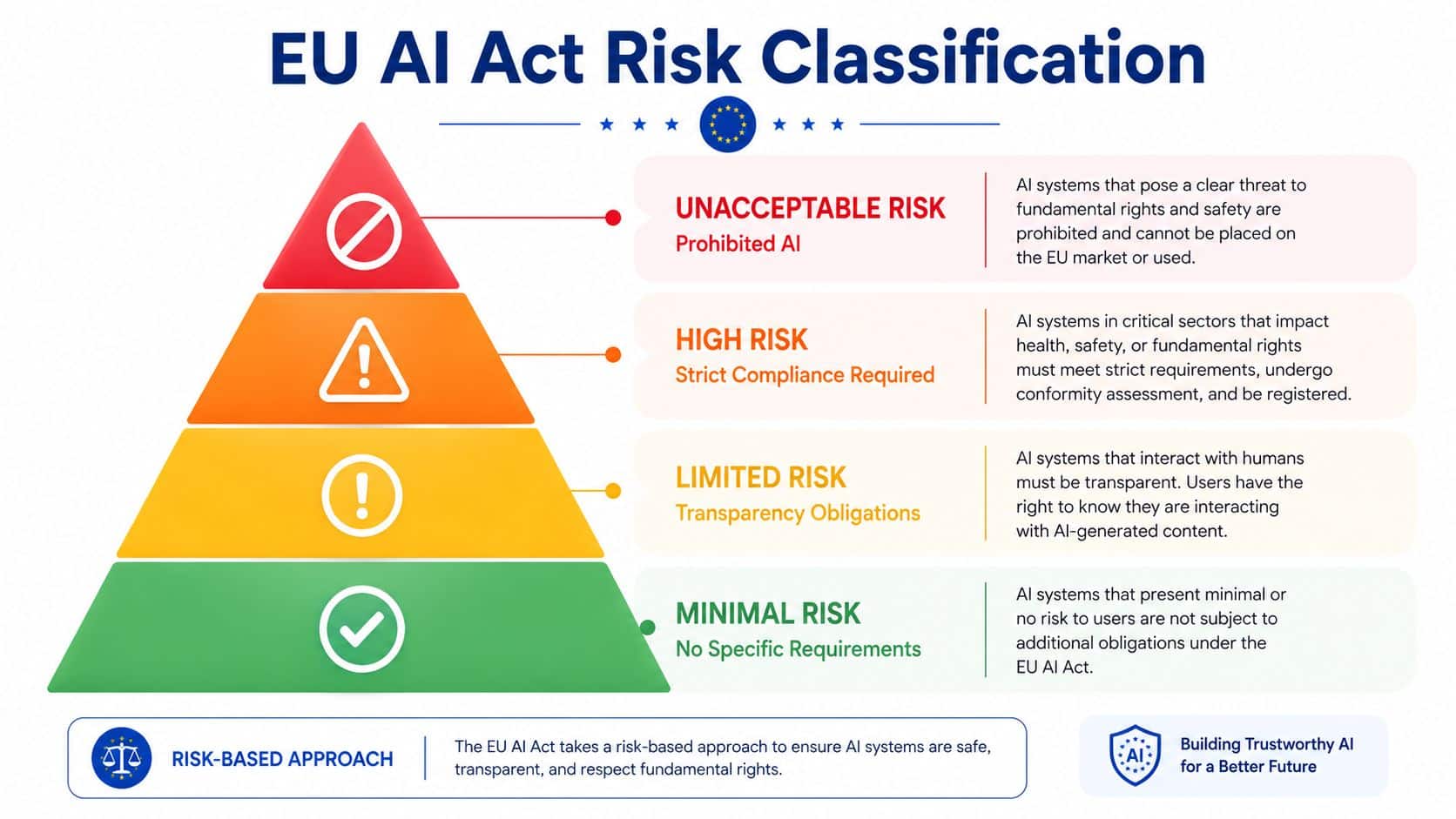
A startup can release a single model and trigger multiple compliance analyses. That is a defining feature of the EU AI Act. The Act categorizes AI into unacceptable, high, limited, and minimal risk tiers, and the relevant inquiry is not what the model can do in theory. It is what the company enables customers to do with it, and what contracts, product settings, and internal controls permit in practice.
Where common products usually land
An AI hiring tool will often fall within high-risk territory because employment is one of the listed domains that triggers the stricter regime. A customer service chatbot is usually limited risk if it interacts with individuals and requires transparency notices. A fraud detection engine can also become high-risk if it affects essential services or substantive decisions, but classification depends on the deployment context, not merely the product label. A recommendation engine is often minimal risk unless its deployment crosses into a listed use case or a transparency-triggering context.
The same model can move between categories after a product change or contract revision. A resume-ranking model sold as an internal productivity feature may remain outside the high-risk category if it simply helps recruiters organize work. It can become high-risk, however, once a customer integrates it into candidate screening, shortlist generation, or automated rejection workflows. That is the practical gap many founders miss. Risk does not reside in the code alone. It also resides in the workflow, the permissions, and the documented limits on use.
The classification framework includes a second dimension. The Act treats some AI as high-risk because it serves as a safety component of regulated products, while other systems are high-risk because they are used in listed areas. That distinction matters for product planning because a general-purpose feature can become a compliance issue once it is embedded in a regulated workflow. A team that deploys the same feature into a healthcare product, a hiring workflow, and a customer support tool needs separate risk reviews for each deployment, not a single generic approval.
Why the deployment context controls the analysis
The provider's intended purpose is important, but founders should not stop there. Sales language, onboarding flows, administrative settings, and customer-facing documentation can all indicate how the system is expected to be used, and those materials are likely to be reviewed closely by regulators. A vague disclaimer will not offset a product page that promises screening, ranking, or decision support in a listed area. If the commercial documentation and product interface point in the same direction, the company owns that risk posture.
Direct takeaway: the same model can be low-friction in one workflow and high-risk in another once deployment turns it into a tool for eligibility, ranking, access, or outcome decisions.
Founders should review features individually and tie each feature to an actual workflow, not a demonstration environment. The key question is whether the feature merely supports a human decision or materially shapes it. If it shapes eligibility, access, ranking, or rejection, legal review should be integrated into the product cycle before engineering finalizes the design. A practical AI governance best practices process should connect product, legal, and customer success so the company can identify risky deployment changes before a rollout goes live.
Key Legal Obligations for Providers and Deployers
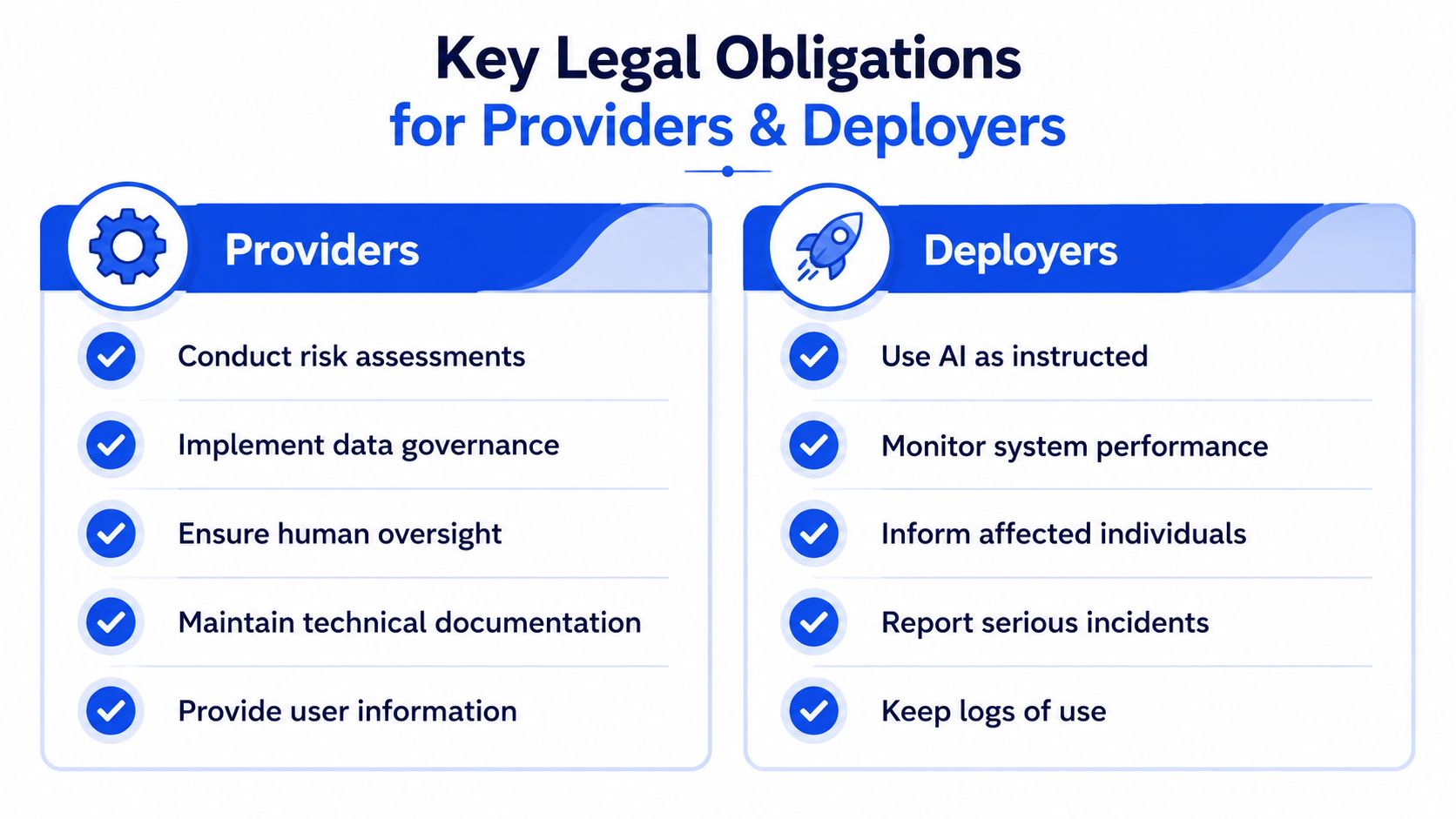
Once a system falls into a regulated category, compliance quickly becomes operational. For high-risk systems, the law requires a risk-management system, data governance, technical documentation, human oversight, and controls for accuracy, robustness, and cybersecurity. That is an implementation agenda, not a theoretical legal summary.
What providers must build
For high-risk AI systems, Article 11 requires technical documentation before the system is placed on the market or put into service, and that documentation must remain current so authorities and notified bodies can assess conformity (Article 11 explanation). Annex IV sets the minimum content requirements, and SMEs or startups may use a simplified format for those elements. In practical terms, founders need a record of design decisions, data handling, testing evidence, and risk controls that can withstand external review.
That requirement changes how product teams operate. Model cards, training data summaries, test logs, incident notes, and version control all become part of the compliance record. If the team cannot explain why a dataset was selected or how a fallback mechanism was tested, the company does not have a documentation system, it has an unresolved compliance risk. The most effective way to keep that record useful is to build it into an internal AI governance best practices process followed by product, legal, and security teams.
What deployers need to remember
Deployers also have material obligations. They must use the system in accordance with instructions, monitor performance, preserve logs where they control them, and inform affected individuals in the appropriate contexts. In workplace settings, the obligation to inform workers and worker representatives is particularly significant because many enterprise buyers will expect that compliance trail.
For companies bringing products to market, the contract stack matters as much as the technology stack. Product teams should define approved use cases, escalation paths, and the allocation of responsibility between vendor and customer across the terms, order form, and support workflow. If that documentation is imprecise, the company will spend its time disputing responsibility after an incident instead of presenting a regulator with a coherent control structure. Teams that need outside support often look for compliance guidance for enterprises because the practical question is not whether the law exists, it is who owns each obligation across the product and customer lifecycle.
What limited-risk and GPAI teams still need
Limited-risk tools, including chatbots and other transparency-triggering systems, still require clear user notices. The Act also separates general-purpose AI model obligations from application-specific system obligations. As a result, companies using foundation models in their products cannot assume a vendor's compliance posture fully resolves their own deployment responsibilities.
Operational rule: if a product team can launch a new AI use case without updating documentation, notices, and oversight measures, compliance has not yet been integrated into the workflow.
The right implementation pattern is straightforward and effective. Build controls into the product lifecycle before launch. Tie each new model release to a concise evidence packet, a use-case review, and sign-off from the person accountable for legal risk.
Extraterritorial Impact on Non-EU Companies
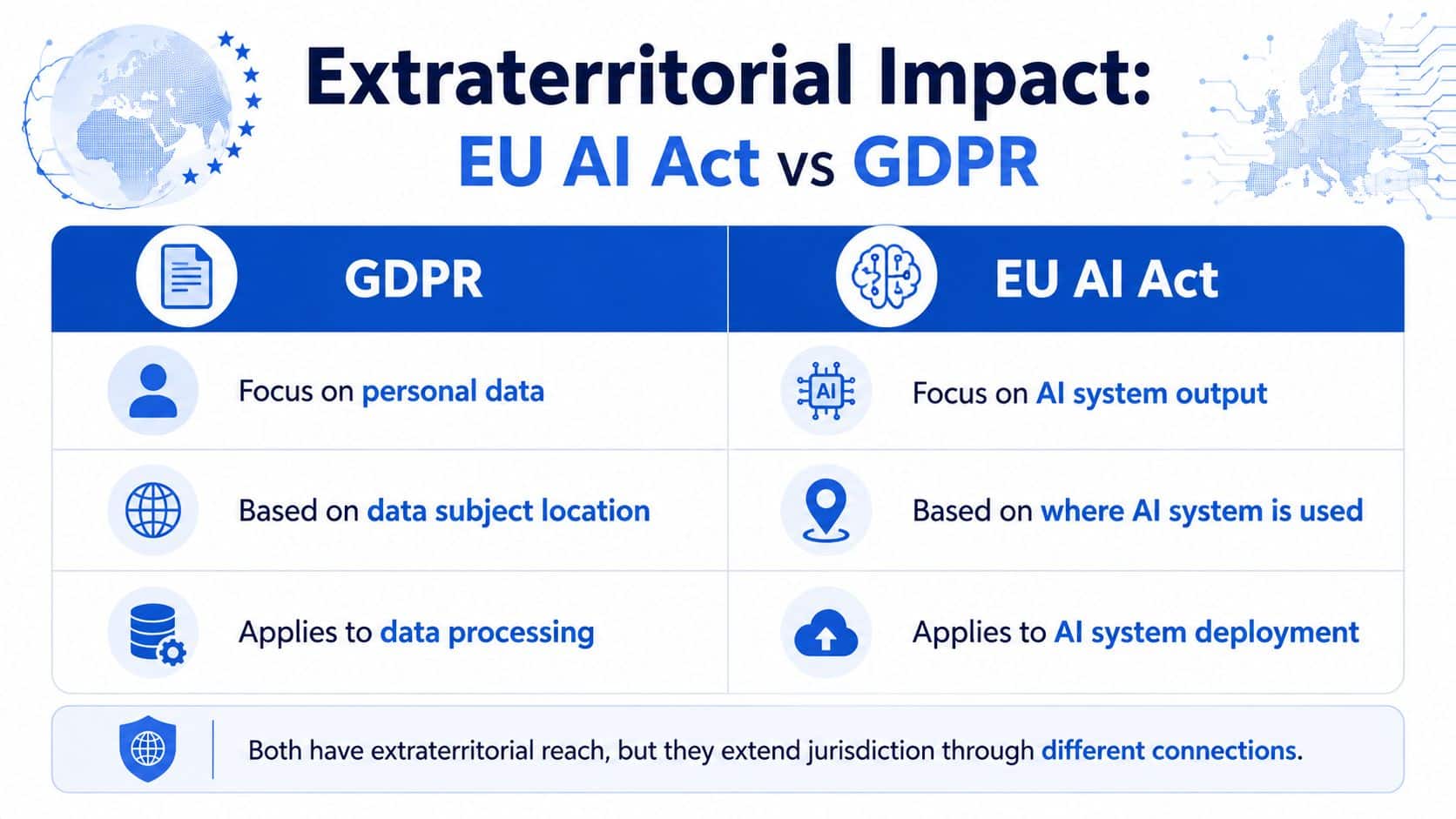
A New York SaaS company with EU enterprise customers cannot reasonably view itself as "outside Europe" simply because its payroll and servers remain in the United States. If the product is deployed for EU users or used in Europe, the company may need to address the EU AI Act as part of its commercial and compliance framework. This is similar to the lesson many companies learned under privacy regulation, although the trigger here is AI system deployment, not only personal data processing.
Comparing the business models
A B2B platform with EU enterprise customers should assume its contract stack is immediately relevant. Its terms of service, product descriptions, and support commitments can help define intended purpose, which in turn affects classification. A consumer app with EU users needs transparent disclosure if it directly interacts with people. An API provider whose model is accessed from Europe should pay close attention to downstream use because a customer's deployment can place the service inside a regulated workflow.
A company that only processes EU data without direct EU customers may still be subject to other legal regimes, but the AI Act analysis is narrower. The relevant issue is whether the AI system itself is deployed in a regulated context or marketed for a use that triggers obligations. That means the analysis is not identical to a standard data transfer review, which is why a cross-border data transfer framework is useful but not sufficient on its own.
What should go into the commercial paper
The contracts should specify who is responsible for lawful use, what the customer may and may not do with the system, and who bears responsibility if the customer changes the use case. A sound enterprise compliance process should also consider whether the company should geo-block EU users, build a single compliant global product, or maintain separate product versions for different markets.
For enterprise teams seeking external support, compliance guidance for enterprises is a relevant reference because many companies need help converting legal theory into internal controls, vendor terms, and audit-ready records. The objective is not to outsource judgment. It is to avoid deploying a product with vague legal boundaries.
How to reduce scope without pretending Europe does not exist
Some founders will decide to block EU access for the time being. That can be a rational short-term decision, but it should be deliberate rather than accidental. Others will standardize on a single global build and layer in notices, logging, and governance so the product can move across borders without repeated redesign.
Practical Compliance Steps for Technology Companies
Compliance should begin with an AI inventory. If a company does not know which products use AI, which vendors supply it, and which workflows depend on it, there is no reliable basis for assessment. A founder does not need a six-month program to begin. What is needed is a disciplined inventory of systems, owners, use cases, data sources, and customers.
A simple operating sequence
First, classify each system by use case. Second, determine whether the company is acting as a provider, deployer, or both. Third, draft the contract language so intended purpose and permitted use are explicit. Fourth, implement the product changes needed to make those commitments accurate, including transparency notices, logs, review queues, and human escalation paths.
A helpful starting point is this AI risk assessment template, because the internal review process should be repeatable rather than ad hoc. The assessment should capture whether the feature touches employment, essential services, access decisions, or user-facing interaction, and whether the team can defend its design choices if challenged.
Practical rule: if a system affects people, the company should maintain a record explaining why the output is acceptable, who reviewed it, and what happens when the system fails.
Contract and product changes that matter
Customer agreements should address permitted use, downstream responsibility, logging rights, incident notification, and the customer's obligation not to repurpose the system into a higher-risk workflow without approval. Terms of service should not function as a catch-all repository. They should align precisely with product behavior.
Product design should follow the same principle. A chatbot needs a disclosure. A human-in-the-loop workflow needs an actual human with authority, not a nominal review screen. A traceable system needs logs that are meaningful after the fact, not vanity telemetry that no one can interpret.
A stage-based action table
| Company Stage | Immediate Actions 0-3 months | Medium-Term Actions 3-12 months | Ongoing Requirements |
|---|---|---|---|
| Early-stage startup | Build the AI inventory, classify use cases, review customer promises | Update contracts, notices, and escalation paths | Reassess each new feature and customer vertical |
| Growth-stage SaaS | Map provider and deployer roles, tighten approvals for new use cases | Add logging, documentation workflows, and governance ownership | Track model changes, incidents, and vendor updates |
| Mid-sized tech company | Formalize cross-functional review and control owners | Align product, security, legal, and sales language | Keep evidence current and review high-risk deployments regularly |
For Article 50 transparency work, Humantext.pro Article 50 guide is a useful external reference if the company is trying to understand when notices, labeling, and user disclosure begin to matter in day-to-day product operations. That is often the compliance layer teams underestimate and then rush to retrofit.
Enforcement Timelines and Penalties You Cannot Ignore
A US startup can treat the EU AI Act as a future issue until a customer, reseller, or EU affiliate requests evidence of compliance. By that stage, the statutory schedule is already shaping what should be in place. The Act entered into force on 1 August 2024 after publication on 12 July 2024, with 2 February 2025 for prohibited AI practices and AI literacy duties, 2 August 2025 for governance rules and GPAI model obligations, and 2 August 2026 for the broader application of much of the law, with certain high-risk product-related rules expected to extend to 2 August 2028.
Why the dates matter for budgeting
Founders should not approach compliance as a single large legal expense. The work unfolds in phases, and the budget should reflect that structure. First, eliminate prohibited practices and train personnel who engage with AI systems. Next, address foundation model governance and model provider obligations. After that, strengthen high-risk documentation, oversight, and product controls as the wider rules take effect.
That sequencing matters because the penalties are significant. For prohibited AI practices, fines can reach €35 million or 7% of global annual turnover, whichever is higher, and other violations can trigger lower tiers such as €15 million or 3%, or incorrect-information penalties of €7.5 million or 1%–1.5% depending on the category cited in different summaries of the law (penalty summary). Companies do not need to operate in constant fear of the highest number, but they should assume the exposure is real and budget accordingly.
What enforcement will feel like
Enforcement will operate through national authorities and the European AI Office, so EU-facing products should be prepared for scrutiny regarding documentation, classification, and product controls. That shifts the practical burden to evidence rather than advocacy. If the company cannot show what it built, what it tested, and how it supervises use, the regulator is likely to draw adverse conclusions.
The least expensive compliance error is the one identified during product review, not in an enforcement inquiry.
The practical budget plan is straightforward. Spend first on training and intake controls. Then improve documentation and contracts. Then make deeper product changes as the risk profile expands. External counsel or consultants are most useful when the company is already selling into Europe, changing intended uses, or embedding AI into a regulated workflow.
Common Misconceptions That Leave Companies Exposed
The most dangerous misconception is that the EU AI Act regulates all AI equally. It does not. The law is risk-based, and many everyday tools remain outside the strictest obligations unless the deployment context changes. As a result, a startup can be compliant for one product line and exposed for another.
The exemptions are real, but narrower than founders assume
Military and defense systems sit outside the Act's core scope, and pure research uses are treated differently. Many low-risk consumer tools also face limited or no direct obligations. Even so, the fact that a tool began as an internal prototype does not make it permanently exempt, and the line depends on use, deployment, and intended purpose, not just model capability.
Internal-only tools are another common point of confusion. If an HR team uses a system to sort applicants, rank people, or shape decisions that affect employment, the company should not assume the tool is merely internal software. The deployment context matters, and the workstream can move the product into a regulated category quickly.
The Act is not a blanket safety law
Public discussion often treats the law as though it bans all harmful AI. It does not. A separate analysis of malicious-use coverage found that the Act's treatment of such risks is uneven, with direct gaps involving bioweapons, autonomous weapons, rogue AI, and concentration of power (analysis of malicious-use coverage). That is not a reason to dismiss the law. It is a reason to avoid overstating what it resolves.
Founders should also be cautious about arguments that the company is too small to matter. Small companies can still fall within scope if they deploy the wrong use case or make the wrong promise in a customer contract. The appropriate response is not denial. It is a focused internal review, a contract update, and a product check before the next release goes live.
Bottom line: if a company wants to stay out of trouble, it should classify the system by actual deployment, not by optimistic assumptions.
By Design Law Firm & Legal Consultancy, PLLC helps startups and growing tech companies translate AI obligations into practical contracts, governance structures, and product controls that stand up in practice. If this reflects your current backlog, visit By Design Law Firm & Legal Consultancy, PLLC to get direct, founder-focused guidance on AI risk, documentation, and compliance planning before the next launch creates a more difficult problem to unwind. Contact our law office today at (206) 593-1519 for a complementary consultation.