A founder in Seattle signs up for AWS, runs product analytics, uses Google Workspace for email, Slack for support, and hires one engineer in Germany. Nothing about that setup feels international in a legal sense. It feels like normal startup operations.
It also creates a cross border data transfer map almost immediately. Customer account details may be stored in one region, accessed by support in another, backed up somewhere else, and exposed to subprocessors the company has never reviewed closely. That isn't a niche problem for large enterprises. It's a standard operating model for modern software companies.
Your Business Is Already Global Whether You Know It Or Not
A typical early-stage company rarely decides to become global in one dramatic move. It happens through infrastructure choices. The product team deploys on AWS. Sales uses HubSpot or another CRM. Finance pays an overseas contractor. Support uses a ticketing platform with globally distributed teams. A European customer signs up, and the company starts collecting names, emails, billing details, usage logs, and support messages.
That is already a cross border data transfer issue.
The startup stack creates international movement by default
A transfer doesn't require someone to email a spreadsheet abroad. It can happen when data is hosted outside the country where it was collected, when a foreign employee can log into a dashboard, or when a vendor's support team can see records during troubleshooting. Founders often underestimate this because the movement is invisible. The product works, the contract gets signed, and the legal complexity sits underneath the workflow.
The stakes are bigger than many founders expect. Cross-border data flows contribute an estimated $2.8 trillion to global GDP, and everyday consumer activity drives much of that system, with video, gaming, and social sharing making up 80% of all Internet traffic in 2020 according to the UNCDF brief on cross-border data flows.
Practical rule: If a company uses cloud software, remote workers, or international vendors, it should assume cross border data transfers are happening until a data map proves otherwise.
Why this matters before the first enterprise deal
Security posture matters before the first enterprise deal because investors, enterprise buyers, and regulators ask where data goes, which safeguards apply, and how subprocessors and transfers work. If a founder cannot answer fast, diligence slows and contracts may include claims engineering cannot support.
This is where vendor discipline matters. A startup doesn't need a massive compliance team to get control. It needs a current inventory of providers, the countries involved, and the contractual and technical safeguards attached to each relationship. A simple but disciplined vendor review process often prevents expensive cleanup later. For founders building that discipline, this vendor management playbook for growing companies is a useful operational starting point.
The business risk is operational, not theoretical
Cross border data transfer compliance isn't just about avoiding a regulator's letter. It affects product architecture, sales velocity, customer trust, and market access. The company that knows where data moves can answer due diligence requests faster, design cleaner permissions, and avoid emergency contract rewrites after a big customer spots a problem.
Founders often treat this as legal overhead. The better view is simpler. It's part of how a technology company builds infrastructure that can survive growth.
What Is a Cross Border Data Transfer
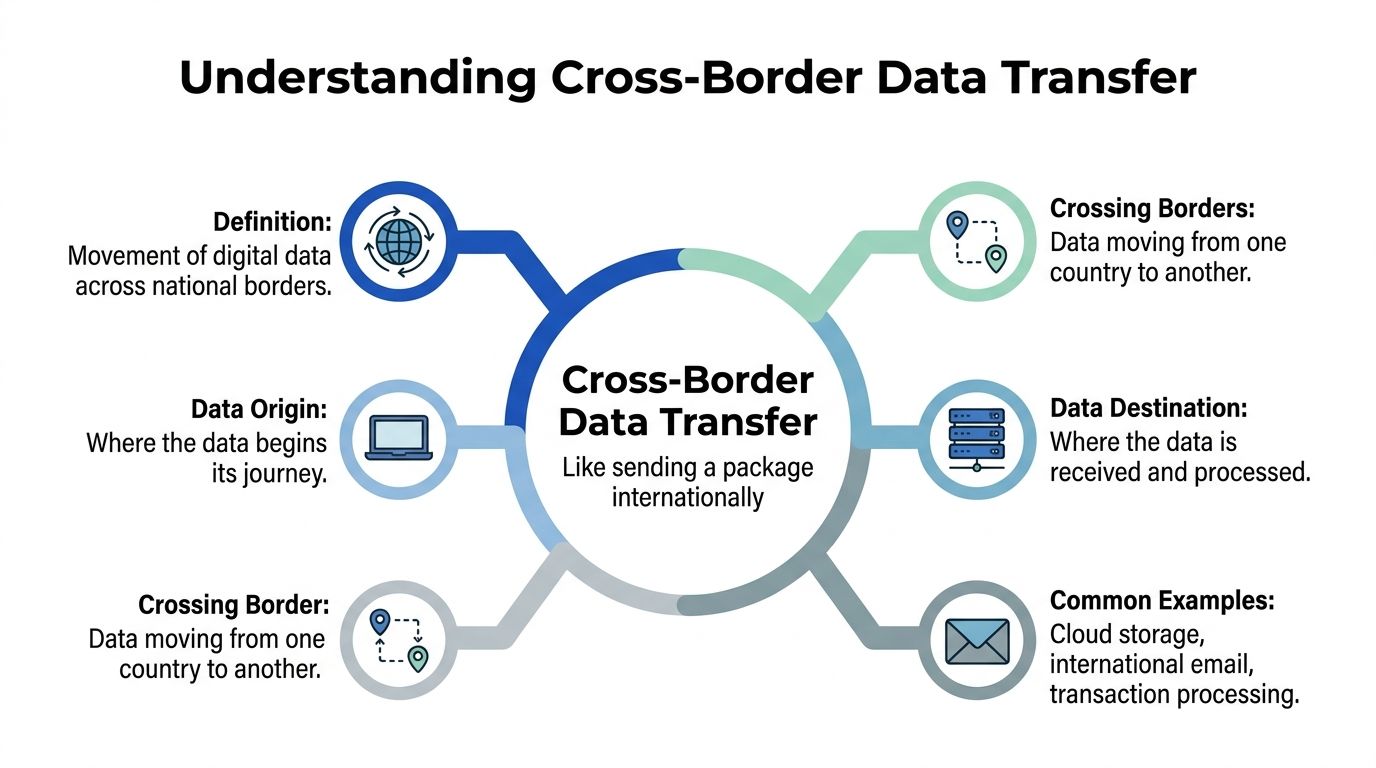
A cross border data transfer is the movement of digital data from one country to another. The easiest way to understand it is to think about mailing a package internationally. The package starts in one place, crosses a border, and arrives somewhere else under a different set of handling rules. Data works the same way, except the package may move in milliseconds and may be copied, cached, stored, or accessed in more than one jurisdiction.
What counts as a transfer
Founders often look for a dramatic export event, but most transfers are ordinary product operations. Common examples include:
- Cloud hosting abroad: Customer data collected in Washington is stored on servers in another country.
- Remote access: A developer, contractor, or support agent outside the original country can view or process the data.
- Vendor processing: Payment, analytics, CRM, email, and support tools receive data in order to provide services.
- Backups and failover: Data may replicate across regions even when the company thinks it chose a single primary location.
Why data type changes the legal analysis
Not all data creates the same risk. The first practical step is classification.
| Data type | What it usually means in practice | Why it matters |
|---|---|---|
| Personal data | Information linked to an identifiable person, such as name, email, account ID, or IP-linked records | Most privacy laws focus here first |
| Sensitive data | Higher-risk categories, such as health, financial, or other tightly regulated information | Triggers stricter controls and sharper diligence |
| Anonymized data | Data that no longer identifies a person | May reduce regulatory risk, but only if anonymization is real and durable |
A startup gets into trouble when it labels something "anonymous" that is only pseudonymized or still linkable through other datasets. Legal review should follow the actual architecture, not the label in a slide deck.
A transfer analysis starts with one question: what exact data is moving, and can a real person still be identified from it?
The founder's working definition
A useful rule for operators is this: if personal data is stored, viewed, routed, or processed outside the country where the legal framework expects protection, assume there's a cross border data transfer to assess. That framing catches the situations founders most often miss, especially access by foreign teams and silent vendor replication.
Navigating the Global Regulatory Maze
A founder signs an EU customer, keeps data in a U.S. cloud account, gives support access to an engineer in India, and uses a security tool that mirrors logs to another region. The contract closes in a week. The transfer analysis takes much longer, because each country asks a different legal question about the same technical setup.
GDPR still shapes global product decisions
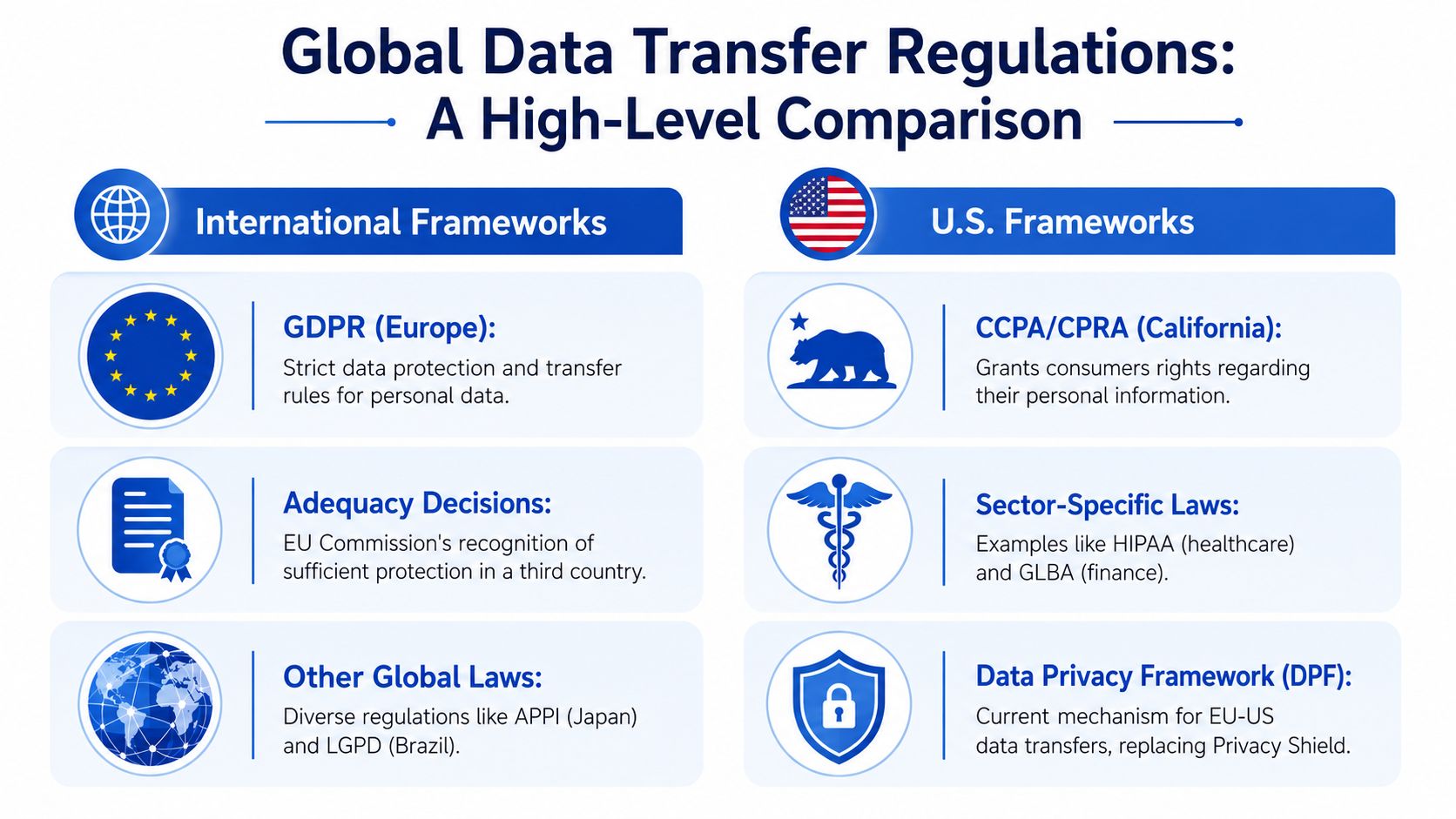
For many U.S. startups, GDPR sets the baseline because it reaches companies outside Europe that handle EU personal data. The transfer question is practical, not abstract. Can the company show that data leaving the EEA remains protected in a way regulators will accept?
The answer often depends on more than the contract stack. Analysts at the Information Technology and Innovation Foundation found that countries have added more barriers to cross-border data flows over time, which reflects a broader shift toward data localization and tighter control, as discussed in the Information Technology and Innovation Foundation analysis of global data-flow barriers. For a product team, that changes architecture decisions. Regional hosting, admin-access restrictions, key management, and logging design can become legal issues, not just infrastructure preferences.
A company building transfer controls usually needs a broader governance model around retention, vendor review, access management, and incident response. This data privacy and compliance overview is a useful reference point for how transfer questions fit into a larger privacy program.
The EU to U.S. route is available, but it has conditions
The EU permits transfers to countries outside the EEA through approved mechanisms, including Standard Contractual Clauses and Binding Corporate Rules. The EU-U.S. Data Privacy Framework also gives some companies a route for certain transfers. None of those options eliminates the need to examine how the system operates.
That is where startups get exposed. I regularly see teams complete the paperwork, then leave broad foreign admin access in place, fail to map subprocessors, or store readable data in systems they cannot meaningfully audit. SCCs help allocate legal obligations. They do not fix weak encryption practices, excessive support access, or undocumented onward transfers.
Later-stage companies entering stricter markets face another layer of rules tied to internet controls, platform regulation, and local hosting expectations. For teams assessing how those rules can affect routing, hosting, and product availability, this Throughwire compliance guide is a useful starting point.
U.S. rules also raise national security issues
Startups that treat cross-border transfers as a Europe-only privacy issue miss a separate U.S. risk. Recent U.S. restrictions focus on sensitive data, foreign access, and transactions involving countries of concern. That analysis does not map neatly onto GDPR, and a privacy-compliant vendor arrangement can still create exposure under U.S. rules.
The business point is straightforward. Vendor diligence has to cover who can access the data, where support personnel sit, whether logs or backups move offshore, and whether any subprocessor creates onward exposure that the company did not intend. If legal signs SCCs but engineering cannot verify the access path, the company is relying on paperwork to solve an infrastructure problem.
Contracts can support a lawful transfer. They do not substitute for system design that limits access, secures data in practice, and can be verified when a regulator or enterprise customer asks questions.
Lawful Mechanisms for Transferring Data
Once a company identifies where data moves, it needs a lawful mechanism that fits the transfer. Founders usually encounter three options first: adequacy decisions, Standard Contractual Clauses, and Binding Corporate Rules. There are other narrower paths under privacy law, but those three matter most in regular business operations.
The mechanism most startups actually use
For transfers from the EU to countries without an adequacy decision, GDPR requires pre-approved mechanisms such as Standard Contractual Clauses (SCCs) or Binding Corporate Rules (BCRs). The EU-U.S. Data Privacy Framework offers another route, but SCCs remain the most widely used mechanism globally, as explained in this Atlan overview of cross-border transfer mechanisms.
SCCs are regulator-approved contract templates. They aren't magic language invented by outside counsel. They are standardized legal commitments that bind the exporter and importer around how personal data will be handled.
For startups, SCCs are usually the practical choice because they work across many vendor and customer relationships. BCRs, by contrast, are internal rules approved for multinational groups. They can be powerful, but they are usually too resource-intensive for an early-stage company with a lean legal function.
What works and what doesn't
A simple comparison helps.
| Mechanism | Best fit | Main limitation |
|---|---|---|
| Adequacy decision | Transfers to a country the EU recognizes as providing sufficient protection | Limited to specific destinations |
| SCCs | Vendor, customer, and service-provider transfers across many common workflows | Must be implemented correctly and supported in practice |
| BCRs | Large multinational groups moving data within affiliated entities | Heavy lift for smaller companies |
Consent comes up often in founder conversations, but it’s rarely a stable basis for routine, repeated transfers. It can be withdrawn. It may not be freely given in all contexts. And it doesn’t solve the operational need for a durable transfer framework across vendors, employees, and enterprise customers.
The paperwork should match the vendor relationship
A company also needs the surrounding contract set to make the transfer mechanism operational. That usually includes a data processing agreement, security obligations, subprocessor terms, and clear instructions on access, retention, and deletion. Startups often sign a vendor paper stack that mentions privacy at a high level but leaves critical processing details vague.
For teams tightening that layer, a well-structured data processing agreement template resource can help identify the clauses that should align with the transfer mechanism instead of sitting beside it as disconnected paperwork.
The key point is simple. A lawful mechanism is the legal lane the data uses to cross the border. It isn’t proof that the road is safe.
Beyond Paperwork Contractual and Technical Safeguards
Many startup compliance programs fail at this point. The company signs SCCs, stores a PDF in a contract folder, and assumes the transfer issue is closed. It isn’t. The legal obligation doesn’t stop at the contract. It extends to whether the data is protected in a way that makes unauthorized access materially harder.
The Transfer Impact Assessment is where reality enters the room
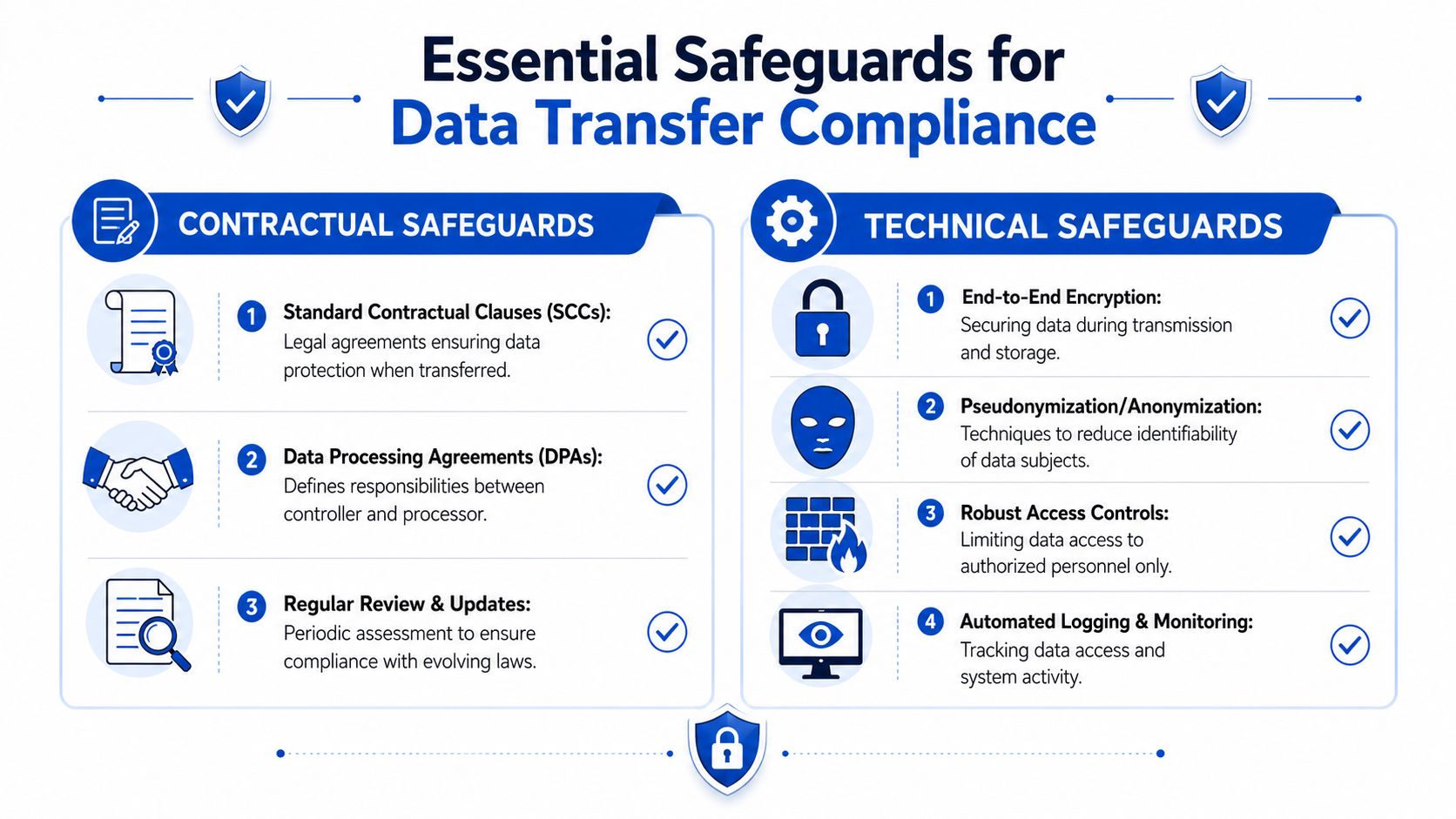
When relying on SCCs, organizations need a Transfer Impact Assessment, or TIA. That assessment should evaluate foreign surveillance laws and determine whether supplementary measures are sufficient. According to the Censinet cross-border transfer compliance checklist, mandatory technical safeguards include TLS 1.2+ for data in transit and AES-256 for data at rest, and those protections must be documented when the TIA addresses surveillance risks.
A useful TIA asks operational questions, not just legal ones:
- Who can access the data: Internal admins, vendors, support personnel, or offshore engineers.
- Where keys are controlled: If a vendor controls both the environment and the keys, the protection story may be weak.
- Whether the data is readable in usable form: Encryption matters, but implementation matters more.
- How access is restricted and logged: Broad admin rights defeat a lot of otherwise good contract language.
What contractual language can’t fix
SCCs can prohibit misuse on paper. They can’t stop someone with overbroad privileges from pulling records. They can’t cure a system where logs are incomplete, encryption is inconsistently deployed, or support access is granted ad hoc. They also can’t eliminate the practical risk of foreign government access if the architecture leaves data exposed in usable form.
That gap is why privacy teams and security teams need a shared checklist. Good cross border data transfer compliance usually includes:
- Strong encryption design: Data in transit and at rest should meet the documented baseline, and key management should be deliberate.
- Access controls tied to role: RBAC or ABAC, plus multi-factor authentication, should limit who can touch production data.
- Logging that can survive diligence: The company should be able to show who accessed what and when.
- Vendor review beyond the MSA: Hosting regions, subprocessor chains, support pathways, and government access posture all need attention.
For teams aligning transfer controls with a broader security framework, this visual ISO 27001 security requirements guide is a practical reference point.
The company that can prove technical separation, controlled access, and verifiable encryption is in a much stronger position than the company that can only produce signed clauses.
The legal and engineering work should meet in one place
A startup doesn’t need perfect architecture on day one. It does need architecture that matches its contractual promises. If a customer DPA says access is limited, engineering should be able to show how. If the TIA says encryption mitigates risk, the security team should know where keys sit and who can decrypt.
That is the difference between paperwork compliance and defensible compliance. For founders formalizing that review process, a structured vendor security assessment approach helps connect procurement, privacy, and engineering before a problematic vendor is embedded in the stack.
Common Pitfalls and Recent Enforcement Examples
A founder signs SCCs, picks an EU hosting region, and assumes the transfer issue is handled. Six months later, the company learns its support vendor can open tickets from outside the region, an analytics script sends identifiers abroad, and no one can clearly explain who had access to production data. That is how transfer problems usually surface. Not from the contract packet, but from the actual system design and vendor stack.

Two mistakes that keep showing up
The first is the cloud provider myth. AWS, Google Cloud, Microsoft, and similar providers give customers useful transfer and security options. They do not make the legal analysis disappear. The customer still chooses regions, sets access permissions, approves subprocessors, and decides how support is delivered. If engineers in multiple countries can reach live personal data, or if the vendor’s support model permits routine offshore access, the signed paperwork will not carry much weight on its own.
The second is third-party vendor blindness. Startups often review the primary host and miss the rest of the stack. Analytics tools, customer support platforms, adtech, error logging tools, session replay products, and AI features can all create onward transfers or remote access paths. European enforcement around analytics tools made the point plainly. Regulators will examine what the tool does with personal data, where access occurs, and whether the safeguards work in practice.
This is the pattern I see most often. Legal signs the DPA. Engineering installs the tool. No one checks whether the data flow described in the contract matches the product’s real behavior.
The newer U.S. trap is hidden in vendor relationships
There is also a separate U.S. risk that founders sometimes miss because they are focused on GDPR mechanics. Recent U.S. restrictions on certain sensitive data transfers and vendor arrangements mean a company can create exposure through a partner relationship, even if its public privacy materials look polished. The problem is not limited to selling datasets. It can arise through service arrangements, data access rights, infrastructure choices, or analytics relationships that touch restricted jurisdictions.
For a startup, the practical lesson is simple. Vendor due diligence has to ask more than whether SCCs are in place. It should ask where data is stored, which countries support and engineering teams can access it from, whether sensitive fields are involved, and whether any part of the service chain creates restricted-country exposure.
A company can have a privacy policy, transfer clauses, and customer-facing disclosures and still miss the core issue. Enforcement risk often sits in the gap between the contract promise and the technical reality.
When to Seek Legal Counsel A Founder’s Guide
Founders don’t need outside counsel for every routine SaaS signup. They should get legal advice when the business crosses certain thresholds or starts making commitments it can’t easily reverse.
The moments that justify immediate review
A legal review is warranted when any of these events happen:
- The company launches in Europe: That usually triggers a serious look at transfer mechanisms, privacy disclosures, and vendor contracts.
- An enterprise customer sends a security questionnaire: The answers often create contractual commitments that outlast the sales cycle.
- A new global vendor enters the stack: Especially for analytics, hosting, support, AI tooling, or anything that can access production data.
- The business handles sensitive information: Health, financial, and other regulated datasets need tighter transfer analysis.
- The company opens access to overseas staff or contractors: Access rights can be a transfer event even if the data stays on the same platform.
Counsel should be practical, not abstract
The right legal support doesn’t just recite GDPR articles or paste SCCs into a packet. It should help the company decide what data it really needs to move, which vendors need renegotiation, what engineering controls must exist before signing a customer contract, and where national-security rules change the analysis.
For startups and established technology companies in Washington, one option is By Design Law Firm & Legal Consultancy, PLLC, which advises on business, technology, and data privacy issues, including cross-border transfer planning as part of a broader compliance program.
Good counsel shortens the path between product reality and legal language. That’s what keeps diligence manageable and growth durable.
By Design Law Firm & Legal Consultancy, PLLC helps Washington startups and growth-stage companies turn cross border data transfer risk into an actionable legal and operational plan. If a company is expanding internationally, onboarding new vendors, revising customer contracts, or tightening its privacy and security posture, the firm can help align the paperwork, architecture, and governance needed to support sustainable growth.
Contact our law offices at (206) 593-1519 for a complementary consultation.