The incident began with a message from the security team and a difficult question from the chief executive: should customers be notified now, or should the company wait until the forensic investigation confirms exactly what happened? The legal deadline is already running, the facts are incomplete, and every sentence in the proposed data breach notification letter could later be read by regulators, customers, or plaintiffs' counsel.
That tension defines modern breach response. A useful notice must arrive quickly enough to satisfy applicable law, yet contain enough specific information for recipients to protect themselves. The answer isn't to guess, hide behind boilerplate, or wait for perfect certainty. It's to separate confirmed facts from unresolved questions, explain the limits of current knowledge, and build a process for supplementing the notice when the investigation produces material new information.
Why Data Breach Notification Letters Matter in 2026
Data breach notification letters matter because they start statutory duties, consumer remediation, and regulator reporting. They also create timing and wording duties, since state rules differ on deadlines and required content.
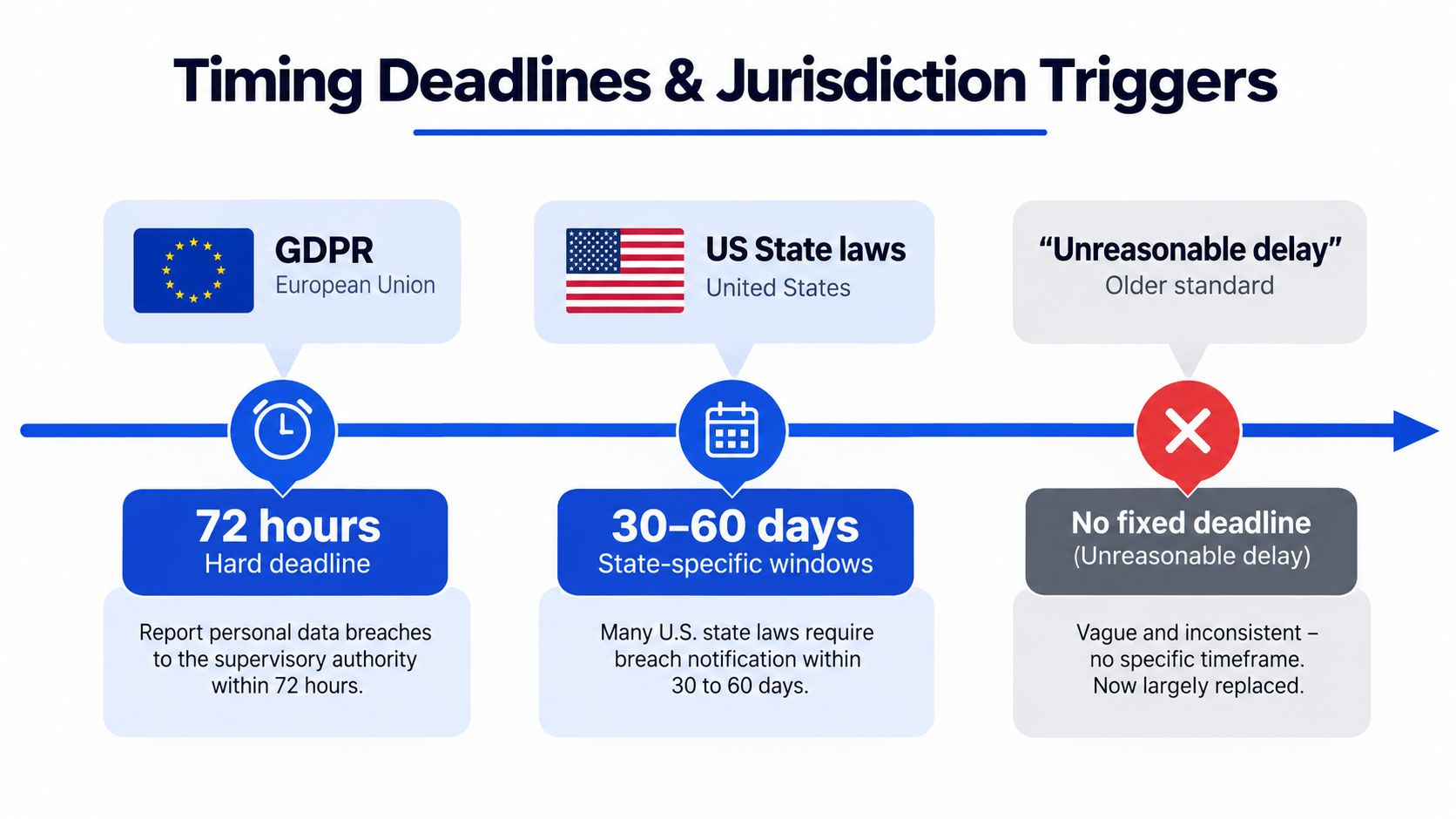
The practical problem is that those laws differ on trigger events, deadlines, required content, recipients, and regulator filings. A 2026 50-state survey found that 20 states, or 39%, specify numeric deadlines for consumer notice, commonly within 30 to 60 days. That shift away from a general “without unreasonable delay” standard makes timing a legal control, not a public-relations preference. A single incident affecting residents in several jurisdictions may require parallel timelines and customized notices.
Practical rule: Treat every proposed sentence as both customer communication and potential evidence of the company's response.
Drafting creates several forms of exposure. An unsupported statement may later appear misleading. An omission may suggest that the company withheld a material fact. An overly broad admission may frame an unresolved technical event as established negligence. A notice that separates confirmed facts from open questions, explains what remains uncertain, and gives practical protective steps presents a more defensible record while helping recipients respond.
Federal guidance reinforces that approach. The Office of Management and Budget breach-notification memorandum calls for concise plain language covering what happened, when the breach and discovery occurred, the data involved, applicable protections, mitigation steps, organizational actions, and clear contact channels. Companies handling health information must also account for sector-specific requirements. Businesses serving European users must distinguish individual notices from regulator notifications under the GDPR.
Privacy teams should review the outreach process itself, including whether recipient addresses and email lists are handled lawfully. A practical resource on GDPR and email verification can help assess how data quality and notification practices intersect with privacy obligations. For teams still determining whether an event meets the relevant definition, what constitutes a data breach offers foundational context.
Required Content Elements for Legal Compliance
The strongest breach letters answer the recipient's immediate questions in a predictable order. They don't lead with corporate history or technical jargon. They explain what happened, what information may be involved, what the organization has done, and what the recipient should do next.
The FTC's business guide to data breach response says the notice should clearly describe what is known about how the breach occurred, what information was taken, how it has been used if known, and the company's response. That guidance also connects recommended protective steps to the category of information exposed. Someone whose password was involved needs different instructions from someone whose government identifier or payment information was involved.
The core content checklist
A compliant draft should contain:
- Incident description: State whether the event involved unauthorized access, acquisition, disclosure, loss, or another form of compromise. Use “accessed” only when access is confirmed. Use “may have been accessed” when the evidence supports a possibility but not a conclusion.
- Relevant dates: Identify the breach date or date range when known, the discovery date, and the notice date. If the company cannot establish a precise date, say so rather than presenting an artificial level of accuracy.
- Information categories: Name the affected data types precisely, such as account credentials, contact information, financial information, or health information. Don't write “personal information” alone when more detail is available.
- Protection status: Explain whether the information was encrypted or otherwise protected, and whether the relevant keys or credentials were also involved.
- Response actions: Describe containment, password resets, access changes, vendor measures, investigation steps, and other completed actions. Avoid promising that no future issue can occur.
- Recipient actions: Provide concrete instructions, such as changing a reused password, watching accounts, contacting a financial institution, or enrolling in an offered monitoring service.
- Contact channels: Include a dedicated phone number, email address, postal address, and, where relevant, a data protection or privacy contact.
CMS uses a 60-day benchmark for notification involving compromised PHI, with the letter drafted by privacy leadership and submitted for approval before release, as described in its HIPAA breach notification guidance. That benchmark shouldn't be copied into every incident plan, because the governing rule depends on the data and jurisdiction.
Comparison by jurisdiction
| Content Element | Federal Baseline | California | Washington | Massachusetts |
|---|---|---|---|---|
| Incident description | Explain what happened in plain language | Adapt to California notice requirements | Adapt to Washington requirements | Avoid language that minimizes harm |
| Dates | Include breach and discovery dates when known | Include applicable dates and deadline information | Identify discovery and notice timing | Include accurate dates and relevant details |
| Data categories | Describe the information involved | Include required information and applicable remediation details | Include affected information and required contact information | Describe the information without minimizing risk |
| Protective measures | Explain company actions and recipient steps | Address any required monitoring or remediation | Include required agency and consumer information | Provide clear protective guidance |
| Contacts | Provide usable phone, email, and postal channels | Include required contact details | Include required attorney general contact information | Provide clear response channels |
Washington-specific drafting should be checked against the Washington breach-notification law guide. A multi-state letter can use shared factual language, but the final version still needs a jurisdictional review for required contacts, remedies, formatting, and recipient groups.
Timing Deadlines and Jurisdiction-Specific Triggers
Timing analysis starts with a calendar, not a template. Record when the company became aware of the incident, when it confirmed a legally relevant breach, which jurisdictions are involved, and each applicable regulator deadline. Laws may start the clock at discovery, awareness, confirmation, or another defined event, so the team should document the trigger it is applying and why.
The IAPP survey describes a national situation in which 20 states, or 39%, use numeric consumer-notice deadlines, commonly ranging from 30 to 60 days. Washington requires notice to affected individuals as soon as expedient and no later than 30 days after discovery. If more than 500 Washington residents are affected, the organization must notify the Washington attorney general within that same 30-day window, according to Washington’s breach-notification requirements.
GDPR creates a separate regulator-versus-individual analysis. Under GDPR Article 33, a controller must notify the supervisory authority without undue delay and, where feasible, within 72 hours after becoming aware of a personal data breach that requires notification. The controller must explain any delay. Individual notice follows a different threshold. EDPB guidance states that individuals should be informed without undue delay when the breach is likely to create a high risk to them.
A workable multi-state decision method
When several states apply, the response team should:
- Identify every affected resident group. Recipient geography can control duties even when the company operates from one location.
- Map each trigger. Record whether the rule starts at discovery, awareness, confirmation, or another event.
- List recipient and regulator obligations separately. The individual letter may not satisfy an attorney general, health agency, or European supervisory authority.
- Use the earliest defensible deadline as the operational target. A conservative schedule reduces the risk that a slower jurisdiction becomes the company’s excuse for missing a faster one.
- Plan supplemental notices. New facts can support a follow-up communication, but the initial notice should not wait for a perfect forensic report.
Cross-border operations add controller, processor, transfer, and regulator responsibilities. Teams assessing those issues can consult guidance on cross-border data transfers while building the incident timeline.
The practical trade-off is speed versus specificity. Early notification may leave factual gaps, while delay can create statutory exposure and weaken trust. Issue a factually supportable notice within the controlling deadline, identify the investigation’s limits, and preserve a documented rationale for each timing decision.
Drafting When the Investigation Is Incomplete
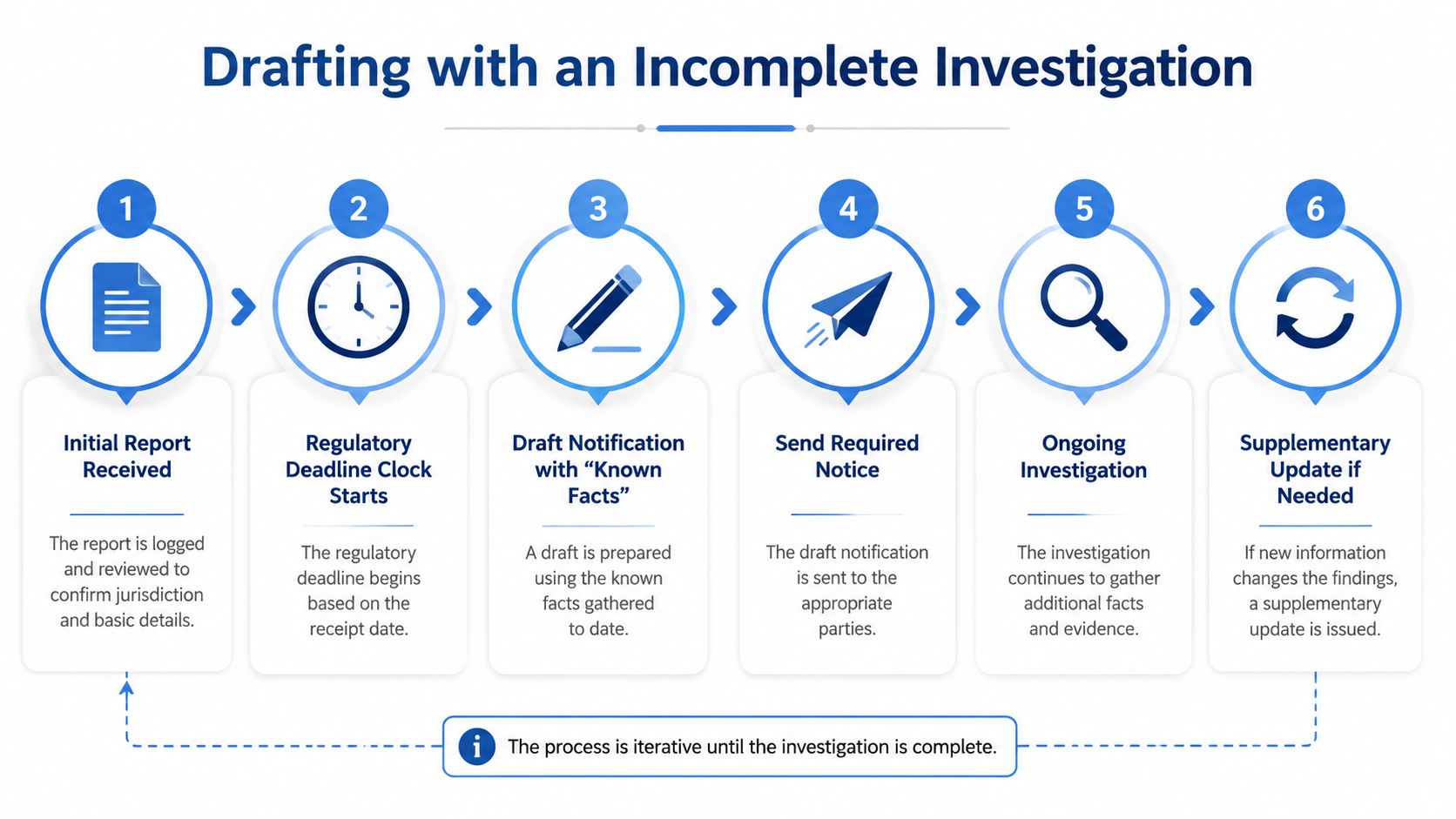
Forensic work rarely concludes before the first notice deadline. Waiting for a final root-cause report can produce the very delay regulators question. But sending speculative detail creates a second problem, especially if the company later has to retract or materially revise the letter.
The answer is disciplined uncertainty. The draft should distinguish three categories:
- Confirmed facts: The systems involved, the relevant date range, the data categories supported by evidence, and containment steps already completed.
- Reasonable possibilities: Information that may have been accessible or potentially acquired, but isn’t confirmed.
- Open questions: Matters the forensic team is still testing, such as whether an attacker viewed or used particular records.
Language such as “based on information available to date” and “the investigation remains ongoing” is useful when followed by a concrete explanation. Those phrases become evasive when they replace the facts the company already knows.
The early-notice decision tree
If access to a system is confirmed, describe the system and the affected information category. If the evidence shows only potential access, say that the information “may have been accessed” and identify the basis for that assessment in understandable terms. If the company can’t yet determine whether information was acquired, the letter can state that the investigation is evaluating that question, while still providing protective measures appropriate to the data involved.
A ransomware event illustrates the distinction. “An unauthorized party encrypted certain files” is a factual description if confirmed. “The attacker stole all customer data” is not supportable unless the investigation establishes it. An insider event requires the same discipline. The company can identify unauthorized access to records without asserting motive or misuse that investigators haven’t confirmed.
Drafting standard: Uncertainty should narrow the claim, not erase the recipient’s ability to act.
Counsel should also establish a supplemental-notice protocol before the initial letter leaves the company. The protocol should identify who decides that new facts are material, who approves revised language, how recipient lists are updated, and how the company documents the relationship between the original and supplemental notices. The record should preserve forensic updates, legal analyses, approval timestamps, and the reason the company chose to notify when it did.
Practical Drafting Tips to Reduce Liability
A notice drafted before the investigation is complete must balance speed with specificity. State confirmed facts, identify what remains uncertain, and give recipients steps they can take immediately. The letter should not recite every technical artifact, speculate about an attacker’s capabilities, or defend the company’s entire security program. Descriptions such as “a complex cyber incident” add little unless tied to facts, and can invite scrutiny if they suggest the company understood the threat but failed to prepare.
Start with the recipient’s practical concerns. Explain what happened, identify the information involved, describe completed containment, and provide protective steps. An apology can be sincere, but it should not displace instructions about passwords, account review, fraud alerts, or the designated contact channel.
Wording that withstands scrutiny
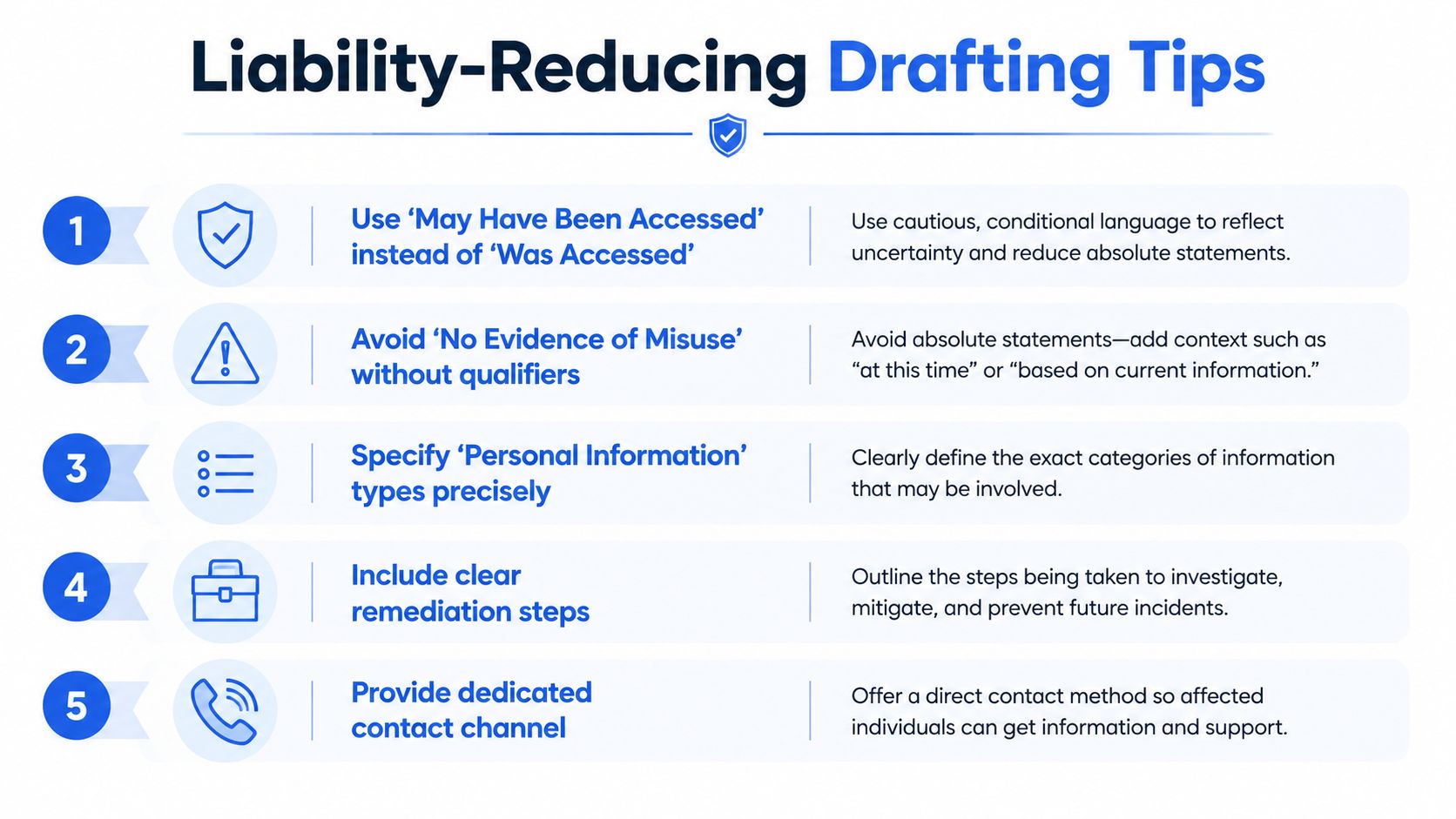
- Use calibrated verbs: “May have been accessed” is appropriate when the evidence supports possibility rather than confirmation.
- Qualify misuse statements: “The investigation has found no evidence of misuse to date” is safer and more accurate than assuring recipients that misuse has not occurred.
- Name the data: Replace “sensitive information” with the categories supported by the investigation.
- Separate action from outcome: State that passwords were reset or access was disabled. Do not promise those actions eliminate every risk.
- Create a dedicated channel: A trained call center or privacy inbox helps prevent inconsistent answers from general customer support.
A letter earns trust by stating confirmed facts clearly and providing actionable steps the recipient can take immediately. If facts change, the company should explain what was initially known and what later analysis established, rather than silently revising its account.
Credit monitoring can help, but describe the offer precisely. Identify the provider, enrollment process, eligibility conditions, available services, and any material time limitation. Do not imply that monitoring makes the recipient whole or eliminates the need to watch accounts and change compromised credentials.
Formatting affects whether recipients can act on the notice. Use short paragraphs, descriptive headings, a prominent subject line, plain-language definitions, and instructions that require no technical knowledge. Translations should preserve legal meaning rather than merely reproduce English sentence structure.
A third-party vendor breach requires careful attribution. State that the incident occurred in a vendor environment, explain the information involved, and describe the company’s oversight and response. Avoid shifting blame or making promises about an investigation the company cannot verify.
Counsel assessing litigation risk should review recent data breach litigation trends before finalizing admissions, remediation language, or descriptions of security controls.
Integrating the Letter into the Incident Response Plan
A notification letter is one workstream in a coordinated breach response. A mid-sized technology company may be handling consumer notices, state attorney general filings, sector-specific reports, law enforcement requests, employee communications, vendor coordination, media questions, and customer support at the same time.
Assign owners before the facts are complete. Privacy counsel directs the legal analysis and notice language. Forensics supplies confirmed findings and marks open questions. Security contains the event. Operations builds and validates recipient lists. Communications prepares public statements. Executives approve business decisions without rewriting technical or legal conclusions from instinct.
Parallel obligations require one shared record
The incident file should give every team the same working record:
- Evidence preservation: Logs, system images, access records, vendor reports, and investigative notes.
- Legal review: Applicable jurisdictions, notification thresholds, deadline calculations, and law enforcement considerations.
- Regulator coordination: State filings, HHS reporting where relevant, and European supervisory authority analysis.
- Recipient operations: Address validation, mailing or email logistics, translations, monitoring enrollment, and call center scripts.
- Public communications: Website notices, customer-facing FAQs, investor messaging, and a media response.
Forensic uncertainty should be visible in the record, not concealed in polished notice language. Record what is confirmed, what remains under review, who approved each statement, and when the team will reassess. That structure lets the company issue a timely notice without converting an early working theory into a final factual assertion.
Law enforcement may request a delay in some circumstances. Document the request, the delay sought, the approving decision-maker, and each reassessment with counsel. An informal conversation should not become the undocumented reason for missing a statutory deadline.
The operating plan should require approval before release, avoid multiple notices for one breach, and prevent incomplete or generic repetitive language. Communications teams can use real-world crisis plan examples to organize media escalation, spokesperson roles, and approval paths. Privacy counsel should retain control over breach-specific legal judgments, especially where the investigation is still developing.
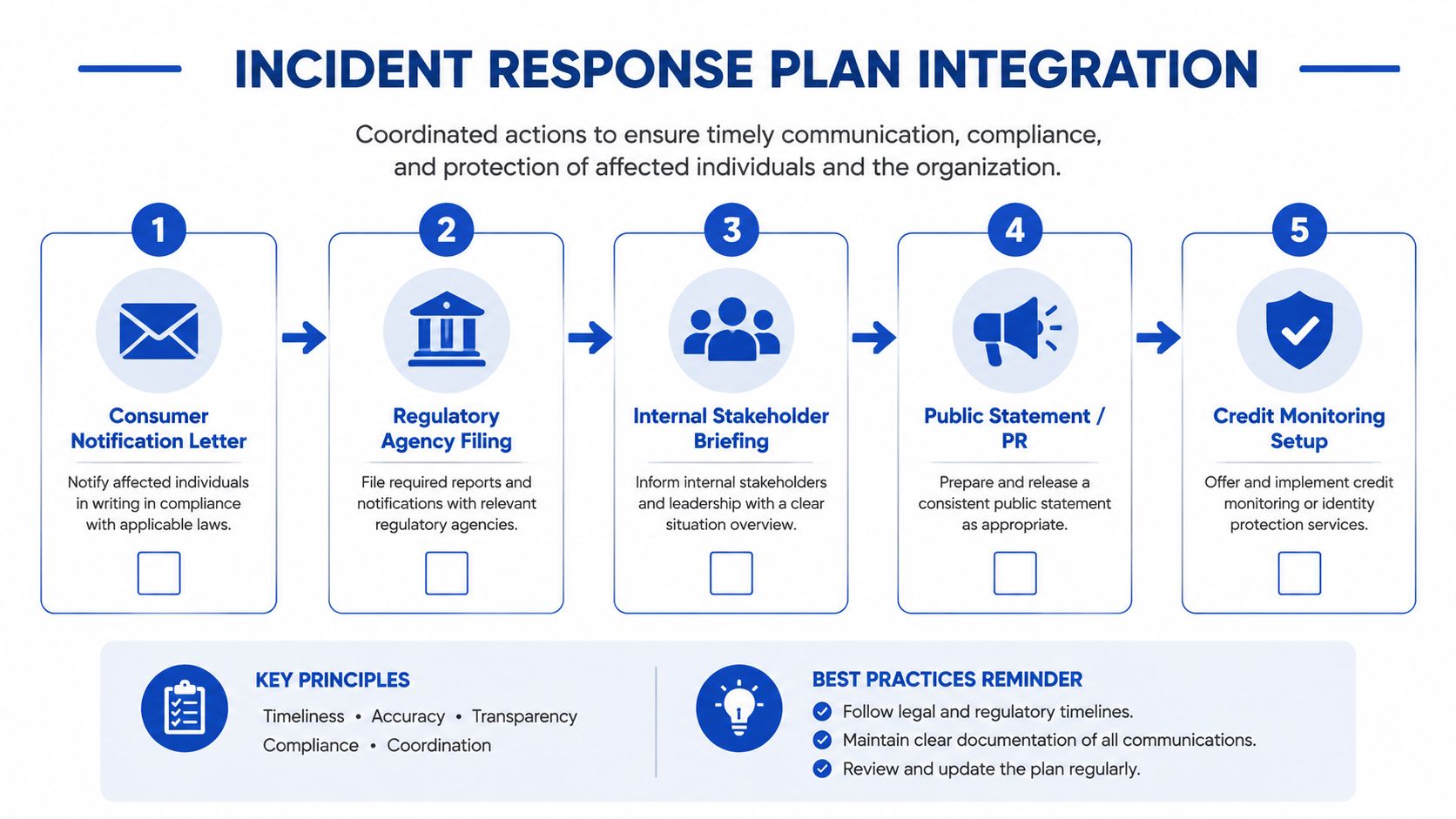
After release, monitor inbound questions, regulator correspondence, returned mail, enrollment problems, and new forensic findings. A short, accurate FAQ helps prevent customer support from contradicting the letter. Maintain timestamps for each decision, the legal basis for timing choices, and a log of communications with regulators and affected individuals.
By Design Law Firm & Legal Consultancy, PLLC advises technology companies on breach readiness, notification processes, jurisdiction-specific analysis, and incident response coordination. Visit By Design Law Firm & Legal Consultancy, PLLC to discuss a data breach notification letter, response plan, or privacy compliance program before an incident forces rushed decisions. Contact our law office in Seattle today at (206) 593-1519.