A Seattle founder often meets the same problem after incorporation. The company has bylaws, the cap table looks clean, and everyone assumes the governance paper trail is finished. Then one founder leaves, a new investor asks about transfer rights, or a director dispute surfaces, and the question appears, which document controls the issue, the shareholder agreement or the bylaws?
For Washington corporations, that answer turns on who is bound and what the clause is trying to do. Bylaws are the corporation's internal rulebook, while a shareholder agreement is a private contract among owners that can reshape default rules when Washington law allows it. In closely held companies, the difference is not academic. It decides whether a board can act unilaterally, whether owners can lock in exit rights, and whether a later dispute gets resolved by corporate procedure or by contract.
| Feature | Bylaws | Shareholder Agreement |
|---|---|---|
| Primary purpose | Internal corporate rules for the entity | Private ordering among owners |
| Statutory source in Washington | Corporation governance statute and internal corporate law | RCW 23B.07.320 |
| Who is bound | Corporation, directors, officers, and shareholders through the corporate form | Usually only signing shareholders, unless statute expands effect |
| Adoption and amendment | Adopted through corporate governance procedures | Written consent and notice formalities can matter, especially for unanimous agreements |
| Typical subject matter | Board structure, officer roles, meetings, procedures | Transfer restrictions, voting arrangements, exit terms, dispute rules |
| Enforceability against third parties | Generally stronger inside the corporation | Usually weaker against non-signers unless they join |
| Visibility | Usually internal, not a public filing in the ordinary course | Private contract, generally not public |
Why Two Governance Documents Exist for the Same Company
Two governance documents exist for the same company because bylaws govern internal corporate rules, while a shareholder agreement sets private owner promises. The corporation otherwise follows its default rules unless owners make an enforceable change.
The two-document structure reflects two different legal relationships. Bylaws establish the corporation's internal operating framework. A shareholder agreement sets private commitments among owners and, in some cases, the corporation itself. Washington practice follows that division. The drafting question is therefore where each term should live, not whether one document can replace the other. A practical guide to corporate law for startups can help founders connect formation documents to the company's actual control and ownership risks.
The historical divide still matters
Bylaws developed as the corporation's general operating framework. They address board meetings, officer roles, notice, voting procedures, and routine governance mechanics. Shareholder agreements became a way for owners, particularly in closely held companies, to alter default rules through a private contract instead of rebuilding the corporation's entire structure.
Practical rule: if a term governs the corporation as an entity, bylaws are usually the better fit. If a term protects a particular group of owners, the shareholder agreement usually does the work.
Clause placement affects enforceability. Put company-wide procedures in the bylaws, and make sure the board and officers can follow them without consulting a private contract. Put negotiated owner protections, such as transfer limits, voting commitments, or exit arrangements, in the shareholder agreement. Under Washington's RCW 23B.07.320, a properly drafted shareholder agreement may override ordinary corporate-law defaults, but its scope and signatories must be clear.
That arrangement lets the shareholder agreement carry owner-specific control and economic terms while the bylaws keep daily corporate administration workable. Treating the documents as interchangeable creates avoidable conflict, especially when a later amendment, new investor, or non-signing shareholder enters the picture.
What Each Document Actually Is and Who It Binds
Bylaws operate through the corporation
In plain English, bylaws are the corporation's rulebook. Washington corporations use bylaws to set out the internal mechanics of governance, and those rules apply through the corporate form itself rather than through individual signatures alone. That is why bylaws are usually the place for board structure, officer titles, meeting notice, voting procedure, and similar company-wide rules.
A founder should think of bylaws as a set of instructions the corporation follows every day. Once adopted properly, they can bind directors, officers, and shareholders on matters the statute and the corporate form permit. That broader reach is what makes bylaws useful for baseline governance, but also why they are not ideal for sensitive owner-specific economics.
Shareholder agreements work sideways among owners
A shareholder agreement is different. It is a private contract among shareholders, and sometimes the corporation itself, that can adjust default rules under RCW 23B.07.320. That means it can address voting arrangements, transfer restrictions, board-control mechanics, and exit rights in a way that speaks directly to the people whose money and control rights are at stake.
The binding effect is narrower unless the statute expands it. That is a feature, not a flaw. It lets founders and investors create bespoke rules for a defined set of owners without turning every private bargain into a public corporate norm.
A concise explanation of the contract side appears in this overview of what a shareholders' agreement is, which aligns with the basic drafting reality in Washington. The company can keep its bylaws as the general framework, while the owners use the shareholder agreement to handle the terms that need private protection.
A future buyer or minority investor can be swept into bylaws by joining the corporation, but that person is not automatically a party to a private shareholder agreement. If that person matters to the control or economics of the deal, the joinder language has to be deliberate.
That is the core distinction. Bylaws are corporate. Shareholder agreements are contractual. The first governs the company's internal machinery, the second governs owner-level bargains.
Side by Side Comparison of Core Features
The comparison that matters is not abstract. It is operational. Founders need to know what each document does, how hard it is to change, and whether it can bind the people who matter.
| Feature | Bylaws | Shareholder Agreement |
|---|---|---|
| Primary purpose | Internal governance framework | Private owner-level ordering |
| Washington source | Corporate governance statutes and internal corporate power | RCW 23B.07.320 |
| Who is bound | The corporation and those who operate through it | Usually only signing shareholders, unless the statute or joinder expands effect |
| Adoption | Corporate adoption process, usually through board action under the governing law | Written agreement and, in Washington, the formalities in the statute |
| Amendment | Usually by the corporate process set in the bylaws or statute | Often unanimous or otherwise contractually specified |
| Typical topics | Board seats, officer roles, meeting procedure, notices, indemnification, issuance mechanics | Transfer restrictions, drag-along, tag-along, buy-sell terms, voting pools, exit rights |
| Third-party reach | Stronger within the corporate structure | Limited unless later signers join the contract |
| Visibility | Generally internal, not public-facing in ordinary practice | Private document, usually not public |
The rows that drive real drafting decisions are who is bound and how amendment works. A board can often update bylaws more easily than a shareholder agreement, which makes bylaws good for routine administration but risky for founder protections that should not move with the board.
That is why transfer restrictions, exit mechanics, and shareholder remedies are usually better placed in the shareholder agreement. Those clauses are meant to protect the owners against later internal changes, not just to regulate company housekeeping.
A quick drafting filter
- Board and officer mechanics belong in bylaws when the rule needs to apply to the corporation as a whole.
- Owner economics and exit rights belong in the shareholder agreement when the term is meant to bind a defined group of signers.
- Anything meant to survive a board reshuffle usually needs contract treatment, not just bylaw treatment.
For broader compensation design questions, the practical framing in profit sharing insights from Duncan & Associates can help founders think about how economic terms sit next to governance terms, even though compensation itself is a different document set.
Clause by Clause Breakdown of Where Each Term Belongs
Put corporate machinery in the bylaws
Start with the clauses that shape the company's operating skeleton. Board structure, officer roles, meeting mechanics, quorum rules, indemnification, and routine stock issuance procedures usually belong in bylaws because they regulate how the corporation functions every day. Those provisions are meant to be stable, company-wide, and easy to reference when the board acts.
There is some overlap around director election mechanics, but the safe rule is simple. If the clause sets the corporation's procedural baseline, bylaws are the right home. If the clause gives a particular owner or group a special control right, the shareholder agreement usually does the better job.
Drafting rule: the more a clause looks like a command to the entity, the more it belongs in bylaws. The more it looks like a bargain among owners, the more it belongs in the shareholder agreement.
Put owner protections in the shareholder agreement
The clauses that usually belong in the shareholder agreement are the ones founders most want to protect from later unilateral change. That includes drag-along rights, tag-along rights, ROFRs, transfer restrictions, buy-sell triggers, vesting mechanics, dividend policy, preemptive rights, and dispute resolution. These are owner-level rules, and Washington's shareholder-agreement statute exists to make that kind of private ordering workable.
A shareholder agreement can also be a better home for hard issues like deadlock, forced sale rights, and exit planning, because those rules often need to bind only the parties who agreed to them. That is especially useful in closely held companies, where the wrong amendment path can let a later board wipe away the deal the founders thought they had locked in.
For companies thinking about how economics and governance fit together, the practical discussion in the section above pairs well with a broader look at profit-sharing structure. The important point is that compensation, control, and transfer rights should be written where the people affected sign.
| Governance Topic | Bylaws | Shareholder Agreement | Why |
|---|---|---|---|
| Board structure | Yes | Sometimes | Board mechanics are corporate housekeeping |
| Officer roles | Yes | Rarely | Officer authority needs entity-level clarity |
| Meeting procedure | Yes | Rarely | This is internal corporate process |
| Indemnification | Yes | Sometimes | Often set in bylaws, sometimes reinforced by contract |
| Stock issuance | Yes | Rarely | Issuance mechanics are corporate-level |
| Transfer restrictions | Sometimes | Yes | Owner-level control works better by contract |
| Drag-along | Rarely | Yes | It is a negotiated exit right |
| Tag-along | Rarely | Yes | It protects minority owners by contract |
| ROFR | Rarely | Yes | It controls private transfers among owners |
| Vesting | Sometimes | Yes | Founder economics usually need contract treatment |
| Buy-sell triggers | Rarely | Yes | These are private exit mechanics |
| Dispute resolution | Rarely | Yes | The parties need a direct contractual remedy |
Washington and Model Act Mechanics Founders Need to Know
Washington’s rule is direct. RCW 23B.07.320 allows a shareholder agreement to override otherwise inconsistent corporate-law defaults if the agreement is written, signed by all shareholders at the time of the agreement, and made known to the corporation. The statute even allows a properly drafted agreement to eliminate the board of directors or restrict board discretion, though public-policy limits and distribution restrictions still apply.
That statutory architecture matches the broader Model Business Corporation Act approach. Under the MBCA framework, the agreement can be embedded in the articles or bylaws with unanimous approval, or placed in a separate written agreement signed by all current shareholders and disclosed to the corporation. Amendment usually requires all current shareholders unless the agreement says otherwise.
The mechanics that founders miss
The drafting mistakes usually happen at the edges. A founder assumes a side letter is enough, but the statute wants a written, properly authorized agreement. Another founder assumes the corporation can treat the agreement like an ordinary contract amendment, but the statute can require much tighter consent mechanics, especially when the agreement changes board power or other core governance rules.
If the agreement is meant to survive future ownership changes, the joinder language has to be part of the design, not an afterthought.
A founder should also pay attention to any statutory duration limit, extension mechanics, and notice obligations tied to provisions that shift board authority or restrict directors. The practical point is not that Washington makes these agreements hard to use. It makes them formal enough that sloppy drafting can undercut the entire plan.
For founders mapping these rules onto a new entity, the formation process matters too. A clean organizing package, described in this guide on how to incorporate a business, gives the shareholder agreement a proper corporate home instead of leaving it stranded in email threads or unsigned drafts.
Keep the document precise
The safer approach is to write the clause as if a later investor, transferee, or board member will read it with a litigation lens. If the agreement is supposed to bind a future owner, say so. If the clause is supposed to limit director discretion, make the limitation unmistakable. Precision matters more than length.
How Current Governance Trends Affect This Choice
Recent proxy-season changes have made governance paperwork feel less static than founders expect. The SEC Staff’s 2025 approach to Rule 14a-8 exclusions shifted more weight onto notice procedures and, in some situations, made Delaware-law opinions more relevant, which shows how procedural pressure can ripple through governance documents even when the underlying entity is private.
That pressure does not turn bylaws into shareholder agreements. It does, however, make one thing clearer. If founders want transfer, exit, and protective provisions to survive changing board dynamics and outside governance scrutiny, those terms belong in the shareholder agreement more than in bylaws.
Why private-market founders care
Proxy advisers, auditors, and counterparties increasingly ask to see governance materials. They want to understand control rights, transfer limits, and whether the company’s documents are internally consistent. A shareholder agreement can be drafted so it is reviewable without broadcasting every sensitive economic term, which is useful when the company wants to preserve confidentiality while still proving there is a coherent governance structure.
That is especially important as public-company governance habits filter into private deals. Board competence, disclosure discipline, and ownership transparency are all pushing founders to think like larger companies without giving up founder control. The cleanest response is still the old one. Use bylaws for corporate operations, and use the shareholder agreement for the private rights that founders do not want a later board to rewrite.
The document that protects founders today should still work after the company grows, raises capital, and brings in owners who were not at the original table.
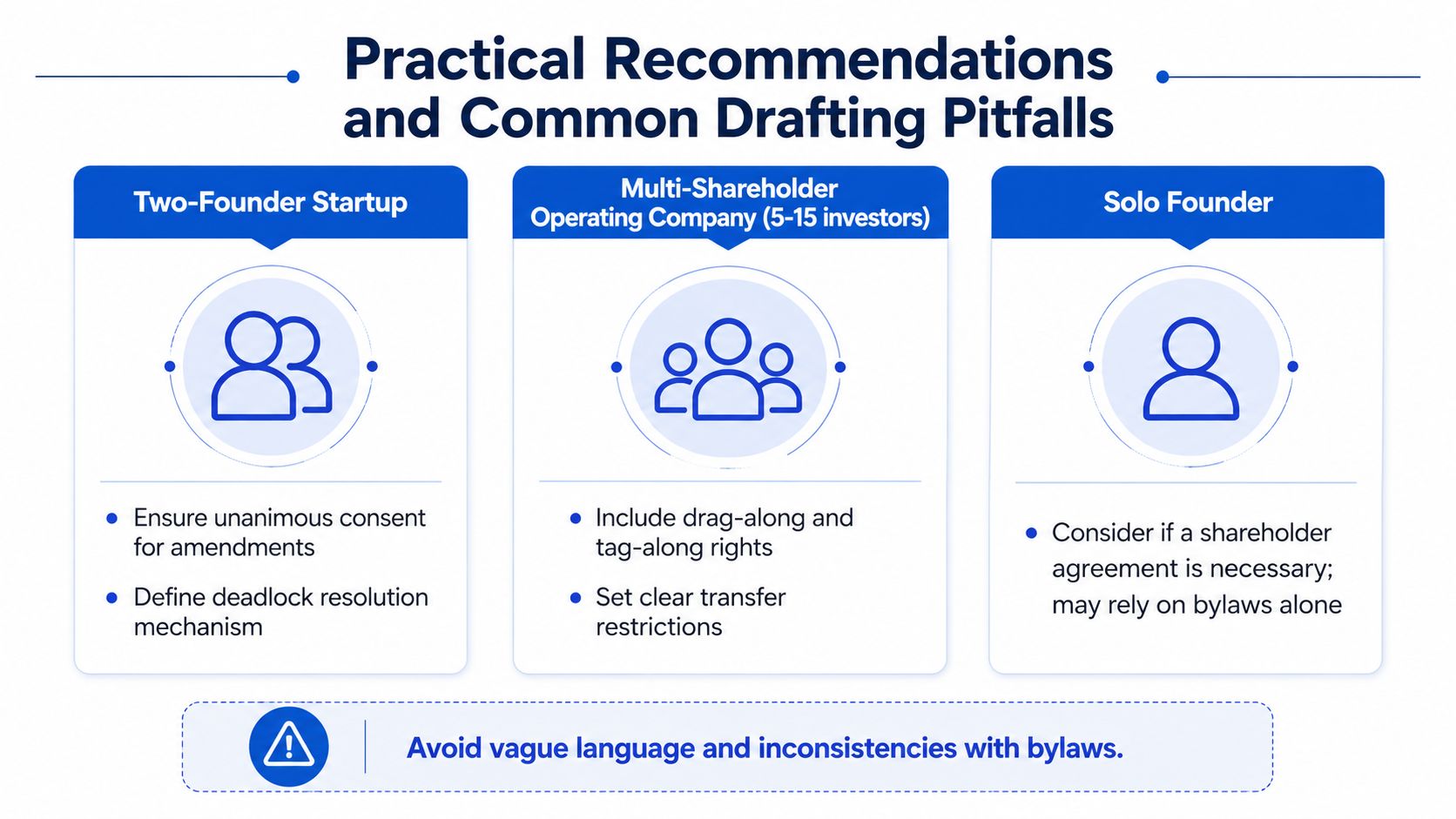
Practical Recommendations and Common Drafting Pitfalls
Match the document to the founder profile
A two-founder startup usually benefits from both documents, with different jobs. Put board and officer mechanics in the bylaws. Put vesting, deadlock procedures, transfer limits, and forced-sale or buyout triggers in the shareholder agreement. Under RCW 23B.07.320, a properly executed shareholder agreement can alter ordinary statutory and governance defaults, so founders should place negotiated control rights in the document that binds the intended owners.
A multi-shareholder operating company with five to fifteen investors needs tighter coordination. Drag-along, tag-along, ROFR, and other transfer restrictions generally belong in the shareholder agreement because they govern owner coordination, liquidity, and exit risk. Keep meeting procedures and board administration in the bylaws. Do not put economic bargains in a document that may not bind every person whose investment depends on them.
A solo founder may not need a shareholder agreement while there is one owner and no shared-control arrangement. Bylaws and formation documents may suffice until a second owner, investor, or transfer right appears. At that point, update the document set before issuing or transferring shares.
Avoid mistakes that create disputes
- Put transfer restrictions in the wrong place. If a restriction affects ownership economics, state it in the shareholder agreement and coordinate it with the bylaws, stock records, and any purchase agreement.
- Use vague supermajority language. Define the approval threshold, the shares or shareholders counted, whether abstentions count, and the matters covered. Founders seeking contract drafting and negotiation guidance should resolve those details before signing.
- Skip put and call triggers. Identify the triggering event, notice method, response period, valuation process, payment terms, and what happens if a party refuses to close.
- Rely on oral side agreements. An unwritten promise can conflict with the signed documents and may be difficult to prove.
- Forget unanimous written consent. RCW 23B.07.320 requires the formalities stated in the statute. Unsigned understandings can fail when enforcement matters most.
Use a yearly governance checkup. The board, founders, and counsel should review the bylaws, shareholder agreement, share ledger, cap table, and signature pages as one set. Confirm that new shareholders signed joinders where required, and add a clear priority rule for any unavoidable conflict between documents.
By Design Law Firm & Legal Consultancy, PLLC can draft and update shareholder agreements and bylaws so the control provisions match the company’s ownership structure.
Frequently Asked Questions for Washington Founders
Can a Washington corporation rely on bylaws alone? Yes, if the company only needs baseline corporate procedure and no special owner-level protections. Once founders want transfer limits, exit rights, or founder-specific control terms, a shareholder agreement becomes the cleaner tool.
What makes a shareholder agreement enforceable under RCW 23B.07.320? The agreement needs to be written, signed by all shareholders at the time of the agreement, and made known to the corporation. Washington also recognizes that the statute can override otherwise inconsistent defaults when the formalities are satisfied.
If bylaws and the shareholder agreement conflict, which one controls? The answer depends on the clause, the statute, and the drafting. A tie-breaker clause should say expressly which document controls for that subject and should be written so it does not create an internal contradiction.
What happens when a new investor buys stock? The new investor usually is not bound by a private shareholder agreement unless the person signs a joinder or the agreement otherwise brings the investor in. That is why transfer and joinder language matter so much.
Does a single-member LLC use bylaws and a shareholder agreement? No. An LLC usually uses an operating agreement, not bylaws or a shareholder agreement. The entity type drives the document set, and that is a question worth confirming with counsel before formation or any ownership change. Contact our law office at (206) 593-1519.
By Design Law Firm & Legal Consultancy, PLLC helps Washington founders align bylaws, shareholder agreements, and formation documents so the company’s control rules match its real ownership plan. For startups, investor deals, and closely held companies that need clear governance terms, visit By Design Law Firm & Legal Consultancy, PLLC to discuss drafting, review, or updates that fit the business.