A founder in Bellevue has just left a software job, signed the first consulting client, and promised delivery by Friday. A former colleague is already discussing a seed round and expects a Delaware C-corporation. Both choices involve more than submitting a form. The entity determines how ownership is recorded, how investors participate, how taxes are reported, and how much ongoing maintenance the business requires.
The practical question isn't just how to incorporate a business. It's which structure can support the founder's financing plans, protect personal assets, preserve intellectual property, and remain compliant in Washington after the filing is approved. A useful overview of the broader decision is starting a corporation in 2026, but Washington founders also need a state-specific operating plan.
Washington incorporation starts with a legal entity and quickly expands into federal registrations, state tax filings, local licenses, governance records, and employment obligations. The strongest formation plan produces two things: a defensible entity choice and a clean 30/90/180-day compliance runway.
The Founder's First Decision When Forming a Company
The Bellevue founder has two plausible paths. A Washington LLC could support a consulting practice with relatively simple management and pass-through taxation. A Delaware C-corporation could provide the conventional structure for venture financing, employee equity, and preferred stock later. Neither choice is automatically correct.
The decision should begin with the business model rather than a preference for a familiar filing portal. A founder expecting outside equity financing must consider investor expectations, stock authorization, founder vesting, intellectual property assignments, and future securities compliance. A profitable owner-operated business may place greater value on flexible distributions, simpler administration, and pass-through treatment.
Practical rule: The cheapest filing is rarely the cheapest structure if the company must later convert, reincorporate, clean up ownership records, or replace defective founder documents.
Washington also matters after formation. A company organized elsewhere but operating in Washington may still need Washington registration, tax filings, annual reporting, and local licensing. A Delaware corporation doesn't avoid Washington obligations merely because its certificate came from Delaware. The same principle applies to a company formed in Washington that later hires workers, sells taxable products, or conducts business across state lines.
The historical purpose of incorporation helps explain why the choice carries lasting consequences. Before the American Revolution, there were probably fewer than a dozen business corporations across the thirteen colonies. During the 1790s, about 200 businesses were incorporated, marking the transition of incorporation into a mainstream legal tool for growth and capital formation, as described by the Library of Congress business history research guide. Modern corporations remain legally distinct from their owners, can issue shares, can limit owner liability, and can continue despite changes in ownership.
Washington founders should therefore evaluate four questions before filing:
- Capital: Will the company seek venture capital, angel investment, bank financing, or no outside capital?
- Tax posture: Will owners distribute profits, reinvest them, or receive compensation?
- Ownership: Will there be one owner, several founders, passive members, or institutional investors?
- Operations: Will the company remain in Washington, or will it hire, sell, and register in multiple jurisdictions?
A filing certificate creates the entity. It doesn't finish the work.
Choosing the Right Entity Type for Your Goals
Entity selection is a business planning decision disguised as paperwork. The main options differ in ownership mechanics, tax treatment, fundraising compatibility, and governance requirements.
| Entity | Tax Treatment | Best For | Key Trade-off |
|---|---|---|---|
| C-corporation | The corporation generally pays tax on its income, while distributions may create a separate tax consequence for owners | Venture-backed startups, scalable technology companies, and businesses planning employee equity | More formal governance, equity administration, and tax complexity |
| S-corporation | Pass-through taxation, subject to federal eligibility and operational rules | Profitable closely held businesses seeking a corporation structure with pass-through treatment | Ownership and equity rules can limit flexibility |
| LLC | Usually pass-through taxation by default, with flexible management and the ability to elect other federal tax treatment | Consulting practices, closely held businesses, and owners who value operational flexibility | Institutional investors may require conversion before financing |
| LP | Pass-through structure with general and limited partner roles | Certain investment, real estate, or joint venture arrangements | The general partner carries significant management and liability concerns |
C-corporations and venture financing
Most investor-backed startups choose a Delaware C-corporation because venture investors commonly understand its stock, board, preferred equity, and financing framework. That doesn't mean Delaware is universally superior. A Washington company still needs to assess foreign registration and Washington compliance if it operates from the state.
C-corporation planning also intersects with qualified small business stock, founder vesting, restricted stock, employee equity plans, and potential 83(b) elections. The company's capitalization records must match its governing documents from the beginning. Startup founders considering that broader legal framework can review corporate law for startups before choosing a structure.
LLCs and S-corporations for profitable businesses
An LLC often works well when owners want pass-through taxation, flexible allocations, and fewer corporate formalities. An S-corporation can be useful for an eligible closely held business, but the election and compensation structure require tax advice. Neither structure eliminates Washington tax obligations. Washington's Business and Occupation tax, commonly called B&O tax, is based on business activity classifications rather than ordinary corporate income tax principles, so an owner must evaluate the company's actual activities.
A nonprofit corporation serves a different purpose. It may fit a mission-driven organization seeking nonprofit treatment, but forming a nonprofit doesn't automatically create federal tax exemption. A professional LLC or similar professional entity may be appropriate where Washington licensing rules govern the owners or services.
The decision matrix should be driven by financing plans, ownership count, and profit distribution strategy, not by the convenience of a short online application. A solo consultant distributing current profits may have a different answer from a software founder retaining earnings for growth, issuing equity to employees, and preparing for institutional financing.
Filing the Articles of Incorporation in Washington
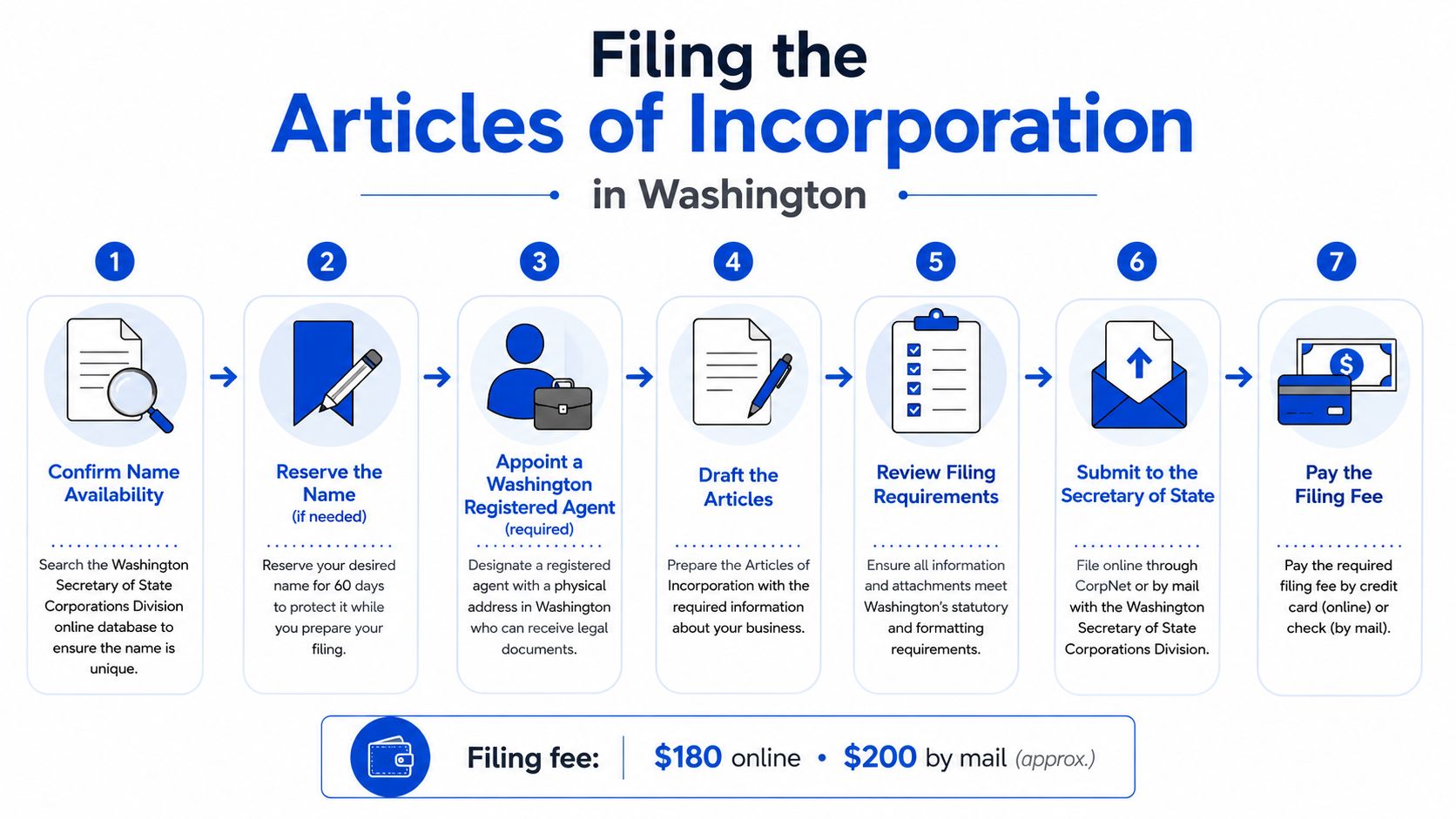
Washington's filing process should be completed in execution order. The corporation legally exists when the Secretary of State approves the Articles of Incorporation, not when the founder drafts them or opens a bank account.
Name and registered agent
First, the founder should search the Washington Secretary of State Corporations Division database for name availability. A name that appears available still requires acceptance by the state, and a reservation can be useful when the founder isn't ready to file immediately. The filing plan provided for this process lists a $50 name reservation, a standard $180 filing fee, and an optional $50 expedite fee for two-hour processing rather than the standard two-week turnaround.
The corporation must appoint a Washington registered agent. The agent needs a physical street address in Washington. A P.O. box or private mailbox isn't sufficient because the registered agent receives legal process and official correspondence during normal business hours, according to the Washington Secretary of State registered-agent guidance.
Articles and submission
Washington's Articles of Incorporation must identify the corporate name, authorized shares, initial registered agent and address, and each incorporator's name and address. The statutory requirements appear in RCW 23B.02.020. Optional provisions can address director powers, internal governance, and liability limitations.
The founder can submit through the Corporations and Charities Filing System or use a paper filing. The Secretary of State's fee schedule lists $180 for Articles of Incorporation of a profit corporation and $100 for expedited service, along with an initial report fee of $10 and an annual report fee of $70 for for-profit corporations, as shown in the Washington profit corporation filing document.
Approval generates the corporation's Washington Unified Business Identifier, or UBI. The certificate also starts the compliance clock. The corporation must address Washington reporting, tax registration, and licensing even if it has no revenue yet.
A board-resolution primer can help clarify which decisions should be documented after approval. Founders can review what a board resolution is while assembling the corporate records.
Setting Up the Governance Layer Right After Filing
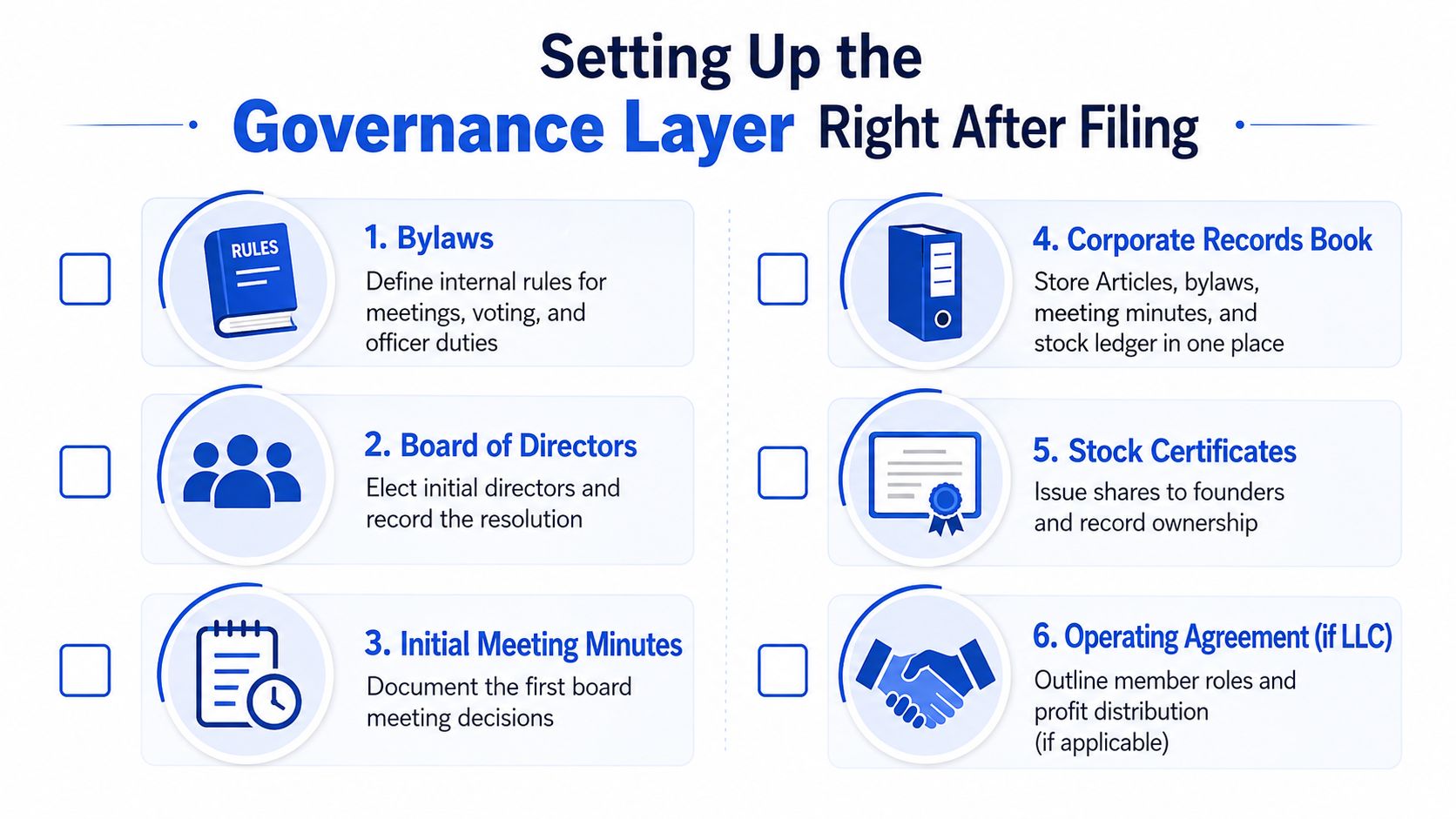
The Washington Secretary of State doesn't file a corporation's bylaws, but the corporation still needs internal rules. Bylaws establish the mechanics for meetings, voting, notices, officer authority, records, indemnification, and other governance matters. Washington corporate guidance recognizes bylaws as private governance documents that may be adopted by the incorporators or board unless the Articles or bylaws provide otherwise, as explained in this Washington corporation law guide.
The first organizational actions
The incorporator's first task is usually to appoint the initial board if the Articles didn't already do so. The board then holds an organizational meeting or adopts written consents, elects officers, approves the bylaws, authorizes the bank account, and approves the stock issuance.
A practical first-meeting record typically addresses:
- Bylaws: Approve the internal rules, including electronic notice, fiscal year, officer titles, and indemnification.
- Directors and officers: Record the initial directors and elect the officers who will act for the corporation.
- Banking: Authorize the financial institution, signatories, and basic account controls.
- Equity: Approve founder stock issuances, consideration, vesting terms, and the capitalization table.
- Intellectual property: Confirm assignments of relevant code, inventions, trademarks, and other work product.
- Records: Establish the corporate records book and minute-keeping process.
The corporation should issue stock only after documenting the authorization and consideration. A stock ledger and capitalization table should identify each holder, the number and class of shares, issuance date, vesting terms, and any transfer restrictions. A financing investor will usually expect these records to reconcile with the Articles, board approvals, and founder agreements.
LLCs use a different governance file
An LLC generally uses an operating agreement instead of corporate bylaws, member consents instead of board resolutions, and a member or manager structure instead of directors and officers. The agreement should address contributions, voting, allocations, distributions, transfers, deadlock, departures, and intellectual property ownership. A practical drafting resource is how to write an operating agreement.
The documents remain private, but private doesn't mean optional. Lenders, investors, acquirers, and major counterparties may request them during diligence. A signed governance file created on the first day is much easier to defend than documents reconstructed after a dispute.
Handling EIN, State Tax, and Local Licensing
After formation, the company needs the right federal, state, and local registrations. The sequence matters because banks, payroll providers, tax agencies, and customers may request different identifiers.
Federal identification
The corporation should obtain an Employer Identification Number from the IRS. The EIN application is free and can be completed online when the responsible person has the required taxpayer identification information. If the responsible person cannot use the online process, the IRS provides fax and paper Form SS-4 alternatives.
An EIN isn't the same as every tax identification number a business may encounter. Founders comparing those concepts can consult HireAccountants' explanation of EIN and TIN distinctions, then confirm the company's specific filing obligations with a tax professional.
Washington licensing and tax
Washington's Department of Revenue Business Licensing Service connects the state business license process with the company's UBI and relevant endorsements. Depending on the activity, the company may need retail sales, wholesale, manufacturing, or other endorsements. Cities can impose separate license requirements, so a Seattle business and a Bellevue business may need different local registrations.
Washington's B&O tax classifications generally depend on the type of business activity and gross receipts rather than net profit. A business selling taxable goods may also need to collect and remit retail sales tax. The correct excise tax reporting cadence depends on the Department of Revenue's assignment and the company's activities.
| Registration | Agency | Form / Portal | Typical Fee | Turnaround |
|---|---|---|---|---|
| EIN | Internal Revenue Service | IRS EIN application or Form SS-4 | No fee for the EIN application | Depends on the submission method |
| Washington business license | Washington Department of Revenue | Business Licensing Service | Varies by license and endorsement | Depends on the application and review |
| Washington excise registration | Washington Department of Revenue | My DOR and related registration process | Varies by obligation | Depends on account setup |
| Local business license | City or local authority | Applicable city licensing portal | Varies by locality | Depends on the city |
| Workers' compensation | Washington Department of Labor and Industries | L&I registration | Depends on payroll and classification | Begins with employment registration |
| Unemployment insurance | Washington Employment Security Department | ESD employer registration | Depends on payroll and classification | Depends on account review |
Workers’ compensation registration through Washington Labor and Industries becomes necessary when the company hires a W-2 employee, including a single employee. The Employment Security Department handles unemployment insurance registration. Working owners may also evaluate voluntary elective coverage where available, but that choice should be reviewed against the company’s ownership and payroll structure.
Your 30, 90, and 180 Day Compliance Checklist
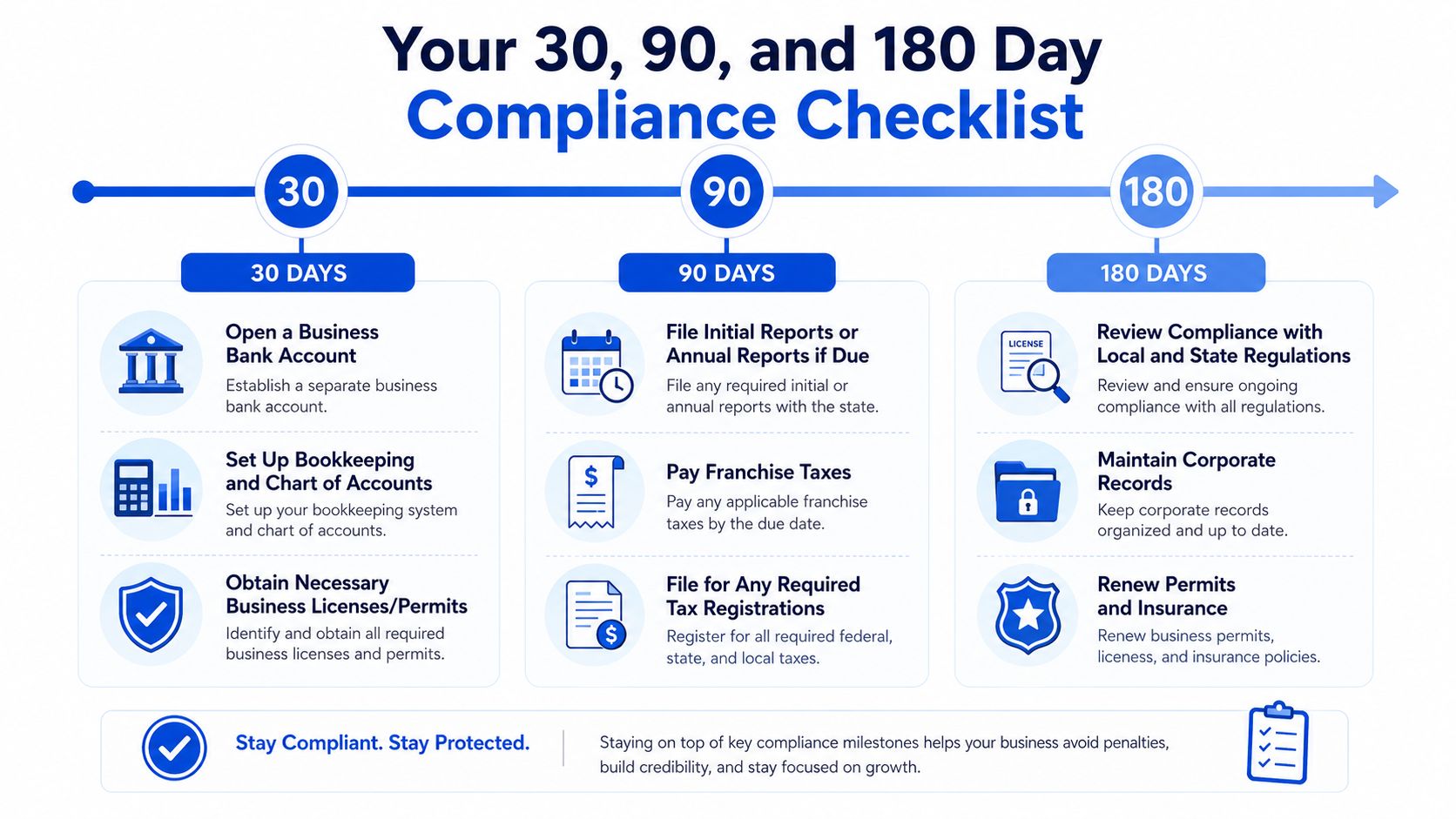
A filed corporation can be legally alive and operationally neglected at the same time. The first six months should be treated as a controlled implementation period, not as an administrative afterthought.
By the first 30 days
Open a business bank account, establish bookkeeping, and create a chart of accounts. The company should register for Washington excise tax and complete the applicable business license and local licensing work. If founders received restricted stock, counsel and tax advisors should confirm whether an 83(b) election is needed and whether the filing deadline is running.
Skipping this stage creates commingling risk, confused tax records, and defective equity documentation. A founder who pays company expenses from a personal account may later struggle to prove that the corporation operated separately.
By the first 90 days
The board should approve any equity incentive plan and document grants to founders, advisors, or employees. Industry-specific endorsements should be identified and obtained, and a company soliciting charitable contributions should assess whether charitable registration applies.
A company that grants equity informally may create ownership disputes, tax problems, or an inaccurate cap table. The governing body should approve each issuance or grant, and the records should match the signed agreements.
By the first 180 days
The company should review its annual report status, beneficial ownership information readiness, insurance coverage, and capitalization table. Insurance may include commercial general liability, directors and officers coverage, and professional liability coverage, depending on the business.
Washington requires an annual report each year by the end of the corporation’s incorporation month. The company should calendar that deadline rather than wait for a reminder. A governance and compliance resource such as corporate governance and compliance can help founders organize these recurring duties.
The deeper lesson is simple: incorporation is the entry point. Good standing depends on what the company does afterward.
Common Mistakes and When to Bring in a Lawyer
Washington founders repeatedly underestimate maintenance. The filing itself may be straightforward, but small errors can affect good standing, litigation rights, tax exposure, and personal liability.
Errors that create avoidable exposure
- Using an unsuitable registered-agent address: A P.O. box or private mailbox doesn’t satisfy Washington’s physical-address requirement. Important legal documents may also go unanswered if the chosen agent isn’t reliable.
- Missing the annual report: A corporation that fails to maintain its reports can lose good standing and face administrative dissolution. The company may also encounter difficulty accessing Washington courts or completing transactions.
- Mixing personal and corporate money: Commingling weakens the separation between owner and entity. In a dispute, that behavior can support an argument for personal liability through veil-piercing theories.
- Ignoring B&O tax: Washington tax obligations can arise from business activity even when revenue is modest or the company has little net profit. The company should register and report according to the Department of Revenue’s requirements.
- Issuing stock informally: A founder who promises shares without board approval, consideration, vesting terms, or a stock ledger may create a defective ownership record.
- Skipping organizational minutes: Without initial consents or meeting minutes, the company may lack evidence that it approved officers, banking, equity, intellectual property assignments, and bylaws.
DIY formation can be reasonable for a simple, single-owner business with low regulatory complexity and no immediate financing. A lawyer’s review earns its cost when the company has multiple members, substantial intellectual property, planned venture financing, operations in several states, or founder equity subject to 83(b) elections, 409A valuations, vesting, or founder agreements.
For Washington startups and growing companies, By Design Law Firm & Legal Consultancy, PLLC provides entity-selection, formation, governance, contract, intellectual property, and data privacy support. Founders who want the Articles, governance records, ownership structure, and post-filing calendar reviewed together can visit By Design Law Firm & Legal Consultancy, PLLC to discuss the company’s formation plan and next compliance steps. Contact our law office today at (206) 593-1519.