For 2026, Washington allows a noncompete only if the worker earns at least $126,858.83 as an employee or $317,147.09 as an independent contractor. All such covenants become void on June 30, 2027, regardless of when they were signed.
That creates an awkward moment for a Seattle startup founder preparing an offer this quarter. The company may still want protection for customer relationships, confidential information, and specialized know-how, but a standard agreement copied from 2023 could already contain restrictions Washington treats as unenforceable or recharacterizes as a noncompete. The practical answer isn't to delete every post-employment protection. It's to separate legitimate confidentiality and relationship safeguards from provisions that punish lawful competition.
Why Washington Non-Compete Rules Are Suddenly a Hot Topic
A founder reviewing a senior engineer's offer package may find a mutual-resignation template with a blanket restriction covering every software business worldwide. The document may have worked as an internal template, but the legal assumptions behind it have changed. The company now has to ask who the restriction covers, how long it lasts, what conduct it blocks, and whether another provision creates the same restraint under a different label.
Washington's framework is codified in Chapter 49.62 RCW. The original statutory structure, which took effect in 2020, used an income gate and a duration presumption rather than allowing employers to restrict every worker. The 2024 amendments tightened the treatment of restrictive language and applied to proceedings commenced on or after January 1, 2020, while also expanding scrutiny of clauses that operate like noncompetes. The current statute is available through the Washington Legislature's full RCW 49.62 text.
Three issues now converge for Washington employers:
- The 2026 income gate: A worker must clear the applicable annualized earnings threshold before a noncompete can generally qualify for enforcement.
- The June 30, 2027 effective date: Washington's new law will make noncompetes void and unenforceable regardless of their signing date.
- The October 1, 2027 notice deadline: Employers must make reasonable efforts to provide written notice that covered existing covenants are void.
Practical rule: A restriction should be reviewed as a business process, not just as a paragraph in an offer letter. Recruiting, compensation, equity administration, offboarding, and contractor management can all create exposure.
The issue also belongs in a broader conversation about key workplace rights for managers. A founder who relies on a contractor agreement should separately examine independent-contractor misclassification risks, because calling a worker an independent contractor doesn't remove Washington employment-law concerns or make a restrictive covenant automatically valid.
For founders, HR leads, and in-house counsel, the immediate task is an agreement audit. A company doesn't need to wait for the 2027 ban to identify a clause that fails the current income test, exceeds the duration presumption, or attempts to evade Washington protections through compensation forfeiture or another indirect penalty.
How RCW 49.62 Defines a Non-Compete Today
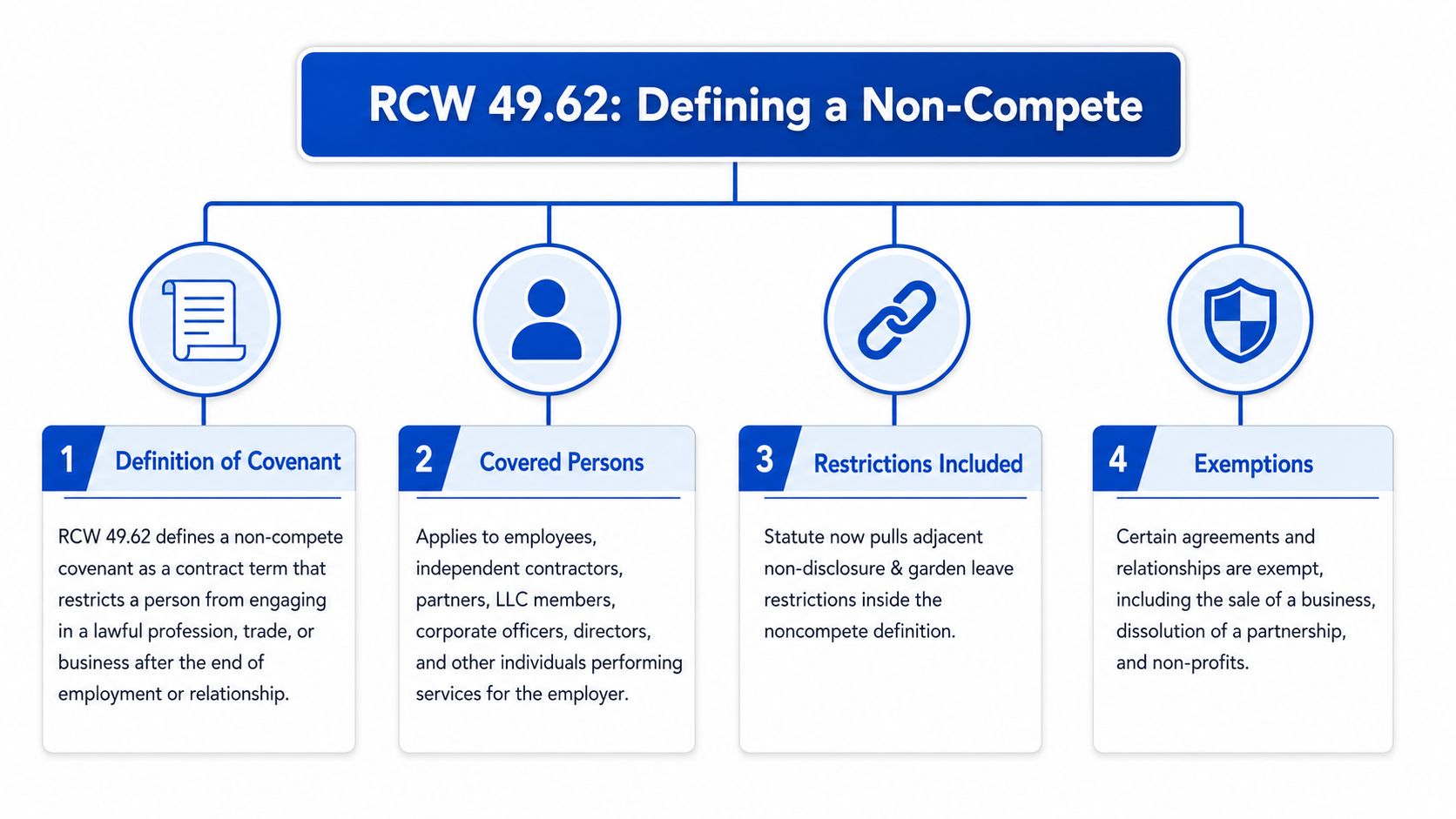
Washington starts with function, not the heading above the clause. A noncompete is generally a covenant that restrains a worker from engaging in a lawful profession, trade, or business after the employment or business relationship ends. The restriction must also be reasonable in scope, geography, and duration under the statutory framework.
That definition matters because a company can't reliably avoid the statute by replacing “noncompete” with “competitive activity restriction.” A provision that prevents a former employee from working for a competitor may receive the same treatment even if it appears in an equity agreement, separation document, bonus plan, or contractor master services agreement.
Restrictions that can be pulled inside the definition
RCW 49.62.230 identifies adjacent restrictions that may be treated as noncompetes when they functionally limit competition. Counsel reviewing a contract should look beyond the conventional non-solicitation section and test the economic consequence of each obligation.
- Client non-solicits: A customer restriction that runs beyond 18 months can be treated as a noncompete under the current framework.
- No-business-deal provisions: A clause preventing a former worker from serving or transacting with former customers can cross the line, even if it doesn't use the word “solicit.”
- Forfeiture provisions: Equity, deferred compensation, or bonus rights that disappear because the worker competes may operate as a competition restraint.
- Training repayment: Repayment triggered by voluntary departure can create risk when the obligation is designed to deter the worker from entering a competing business rather than recoup a genuine training expense.
- Out-of-state terms: A choice-of-law or forum-selection clause designed to strip Washington workers of Washington protections can trigger the statute's anti-evasion rules.
Confidentiality and invention-assignment agreements generally serve a different purpose because they protect information or ownership rather than prohibit lawful work. Garden leave and non-solicitation-of-employees provisions also sit outside the statutory definition in the circumstances recognized by the statute. A carefully drafted non-solicitation agreement should therefore identify the protected relationship and avoid blocking ordinary customer business.
The drafting question is simple: Does the clause protect a specific business interest, or does it make competition financially or practically impossible? That distinction will matter even more once traditional noncompetes disappear.
The 2026 Income Thresholds and the 18-Month Duration Rule
For an agreement signed or enforced in Washington during 2026, start with compensation. The worker's annualized earnings must exceed $126,858.83 for an employee or $317,147.09 for an independent contractor, according to the Washington Department of Labor and Industries. A covenant covering someone below the applicable threshold is void and unenforceable, even if the employer considers the restriction narrow or commercially justified.
Duration creates a separate gate. Under RCW 49.62.020, a covenant lasting longer than 18 months after termination is presumed unreasonable and unenforceable. An employer may try to rebut that presumption, but it must show why the additional time protects a legitimate business interest. A general concern that the worker could compete will not do the work.
Applying the gates to real drafting choices
Consider a 12-month restriction for a sales director earning $200,000, limited to the Pacific Northwest and named direct accounts. The provision clears the employee income threshold, remains within the duration presumption, and connects its geographic and customer limits to identifiable relationships. Those features do not guarantee enforcement, but they give the clause a more defensible structure than a worldwide ban.
A three-year global ban for a project manager earning $90,000 has two independent problems. The worker falls below the employee threshold, and the restriction exceeds the 18-month presumption. Reducing the geographic scope would not solve the compensation defect.
| Requirement | 2026 Standard | Example Outcome |
|---|---|---|
| Employee earnings | More than $126,858.83 annually | A worker earning $90,000 fails the gate |
| Independent contractor earnings | More than $317,147.09 annually | A contractor below the threshold faces an unenforceable covenant |
| Duration | 18 months or less is the practical presumption | A 12-month restriction starts from a stronger position |
| Longer duration | Employer must show why the added period is necessary | A three-year restriction carries substantial risk |
| Scope | Reasonable geography, activities, and relationships | Named accounts and a defined market are easier to evaluate than a global ban |
The income floors change with inflation each year. Compensation reviews should therefore use the threshold for the relevant year, rather than relying on an old contract checklist. That review matters even more as the 2027 prohibition approaches, because a new noncompete may offer little retention value while creating notice, enforcement, and transition work. Before relying on severance conditions, equity clawbacks, or training-repayment terms, employers should also test whether those provisions effectively impose the same competition restraint.
How Washington Got Here From 2020 to 2027
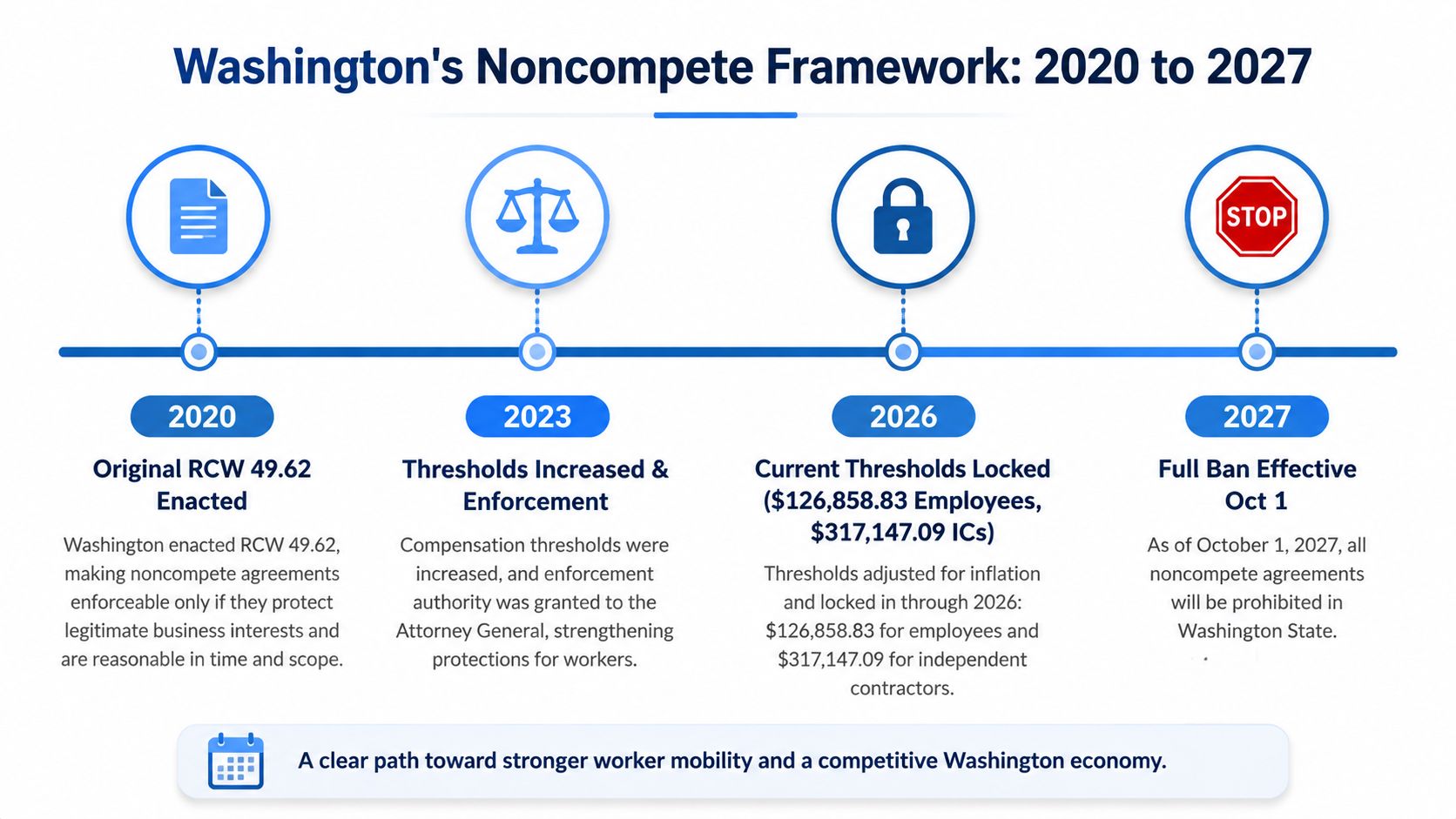
Washington's approach didn't change in a single jump. The state moved from limited enforceability toward near-total prohibition through successive statutory milestones. That history helps a company determine which rule applied when it hired a worker, signed an agreement, or started a dispute.
The statutory progression
| Phase | Legal development | Operational meaning |
|---|---|---|
| 2020 | Washington codified its noncompete framework in RCW 49.62. The original employee threshold was $100,000, with a separate $250,000 threshold for independent contractors. | Employers could use noncompetes only for qualifying higher earners and had to account for the 18-month duration presumption. |
| 2024 | Amendments took effect on June 6, 2024 and applied retroactively to proceedings commenced on or after January 1, 2020. Inflation-adjusted thresholds reached $120,559.99 for employees and $301,399.98 for independent contractors. | Older agreements could be evaluated under a tightened framework in qualifying proceedings. Restrictions that operated like noncompetes received greater scrutiny. |
| 2026 | The indexed thresholds rose to $126,858.83 for employees and $317,147.09 for independent contractors, an increase of about 2.81% from 2025. | The income gate remains relevant for agreements evaluated before the ban takes effect. |
| 2027 | ESHB 1155 eliminates noncompetition agreements in employment and independent-contractor relationships beginning June 30, 2027, including previously signed covenants. | Employers must transition away from noncompetes and provide written cancellation notices by October 1, 2027. |
The 2024 amendments matter because they changed more than the numbers. Washington also limited non-solicitation language and treated certain customer-barring provisions as noncompetes. The result is a framework that examines the substance of a restriction, including whether a compensation or repayment mechanism pressures a worker not to compete.
For a startup, the timeline changes contract strategy. A company signing a new agreement in 2026 may still need to satisfy the current income and duration rules, but it should also consider whether the restriction will have any useful life after June 30, 2027. Drafting an aggressive covenant now may produce recruiting friction and transition work without delivering durable protection.
Where the Anti-Evasion Rules Catch Founders Off Guard
The 2027 ban won't make every restrictive covenant safe. Washington's anti-evasion rules focus on whether a provision functionally prevents a worker from accepting other employment or engaging in a lawful business. A founder who deletes the heading “Noncompete” but keeps the financial penalty may have changed the label without changing the legal risk.
Four drafting patterns deserve close review.
Financial penalties tied to competition
An equity plan or bonus agreement may say that unvested compensation is forfeited, or previously paid compensation must be returned, if the worker joins a competitor. That mechanism can deter competition as effectively as a direct prohibition. It should be analyzed as a possible noncompete, not treated as an ordinary compensation condition.
Repayment and clawback structures
Training repayment can be legitimate when it recovers a genuine expense under an appropriately designed arrangement. Risk increases when the repayment amount is punitive, lasts well beyond the training relationship, or applies only if the worker joins a competitor. The same analysis applies to RSU clawbacks and deferred compensation that disappear because of competitive employment.
Garden leave and delayed payouts
A paid notice period can protect a company during transition, but an extended leave arrangement should match a legitimate business purpose. A clause that withholds all severance or PTO value unless the worker remains outside the market may function as an indirect restraint. Compensation should not become a disguised price for exercising the right to compete.
Out-of-state litigation terms
A Washington company may select California, Texas, or Delaware law in an effort to use another state's more permissive rules. A forum or choice-of-law clause cannot reliably defeat Washington protections when the work and worker are connected to Washington. The statutory anti-evasion rule is designed to prevent that result.
| Clause Type | How It Functions as a Noncompete | Compliance Risk |
|---|---|---|
| Equity or bonus forfeiture | Removes compensation if the worker joins a competitor | The financial loss may deter lawful competition |
| Training repayment | Imposes repayment because the worker enters a competing trade | A repayment demand may look punitive rather than compensatory |
| RSU clawback | Cancels or recaptures equity after competitive employment | The restriction may be embedded in the equity plan |
| Garden leave condition | Withholds pay or benefits unless the worker remains outside the market | The arrangement may exceed a legitimate transition purpose |
| Choice-of-law or forum clause | Sends the dispute to another state to avoid Washington rules | A court may disregard the evasion attempt |
Employers should still protect trade secrets and confidential information. A focused employee confidentiality agreement template can support that goal without turning every piece of company information into a reason to block future employment. Under RCW 49.62.040, a violation can also expose an employer to attorney's fees and other statutory consequences, so the cost of an indirect restraint isn't limited to losing the clause.
Drafting test: If the worker can compete only by surrendering a meaningful benefit, the provision needs the same scrutiny as an express noncompete.
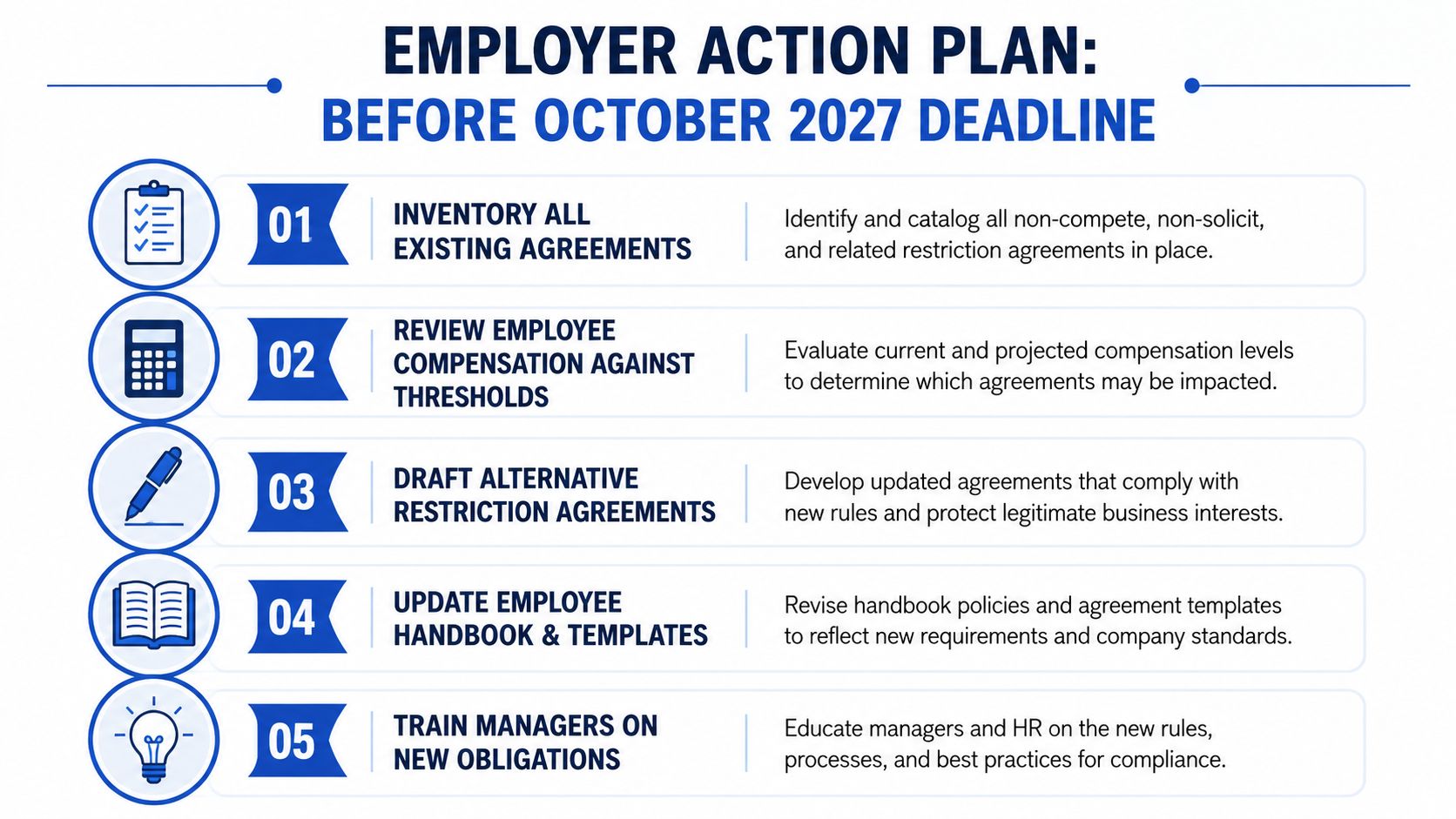
What Employers Should Do Before the October 2027 Notice Deadline
The October 1, 2027 notice obligation requires more than editing the latest offer letter. It calls for a records project covering current workers, former workers, employees, contractors, and agreements stored outside the HR system.
Build the inventory first
A company should collect offer letters, employment agreements, contractor MSAs, equity grants, bonus plans, separation agreements, severance releases, training documents, and mutual-resignation templates. Search for terms such as compete, competitive activity, forfeiture, repayment, clawback, customer restriction, garden leave, and choice of law.
The review should then classify each worker and agreement:
- Identify Washington connections: Include workers who performed Washington work or whose agreements select Washington law.
- Record compensation: Compare annualized employee and contractor earnings with the applicable 2026 thresholds where current enforceability matters.
- Measure duration: Flag provisions lasting more than 18 months after termination.
- Review function: Treat indirect financial penalties as possible noncompetes rather than assuming they are ordinary compensation terms.
- Track status: Separate current workers, former workers, active disputes, and agreements that have already expired.
Redesign the templates and retention tools
Below-threshold employees shouldn't receive a noncompete intended for senior executives. Above-threshold agreements that remain relevant before the 2027 effective date should use a carefully limited duration and scope. Confidentiality, invention assignment, trade secret, and narrowly drafted employee non-solicitation provisions should be separated from competition restraints so each provision serves a defined purpose.
Retention programs also need a redesign. A company may use deferred cash, ordinary equity vesting, or a paid transition period, but the benefit shouldn't disappear merely because a worker accepts lawful competitive employment. Every clawback, repayment term, and severance condition deserves a standalone review.
Document the notice process
By October 1, 2027, employers should make reasonable efforts to send written notices to affected current and former workers stating that covered noncompetes are void. Legal teams should preserve the agreement reviewed, the worker's contact information, the notice version, delivery method, delivery result, and any acknowledgment.
An updated employee offboarding checklist can help HR connect notice duties with return-of-property, access termination, confidentiality reminders, and final compensation review. No acknowledgment signature can guarantee enforceability, but a consistent record gives the company evidence of a serious transition process if a court or the Department of Labor and Industries later examines the file.
Operational advice: Start with the contract inventory, not the new template. A polished form doesn't solve a legacy-agreement problem that the company hasn't found.
Key Takeaways and Questions for Washington Employers
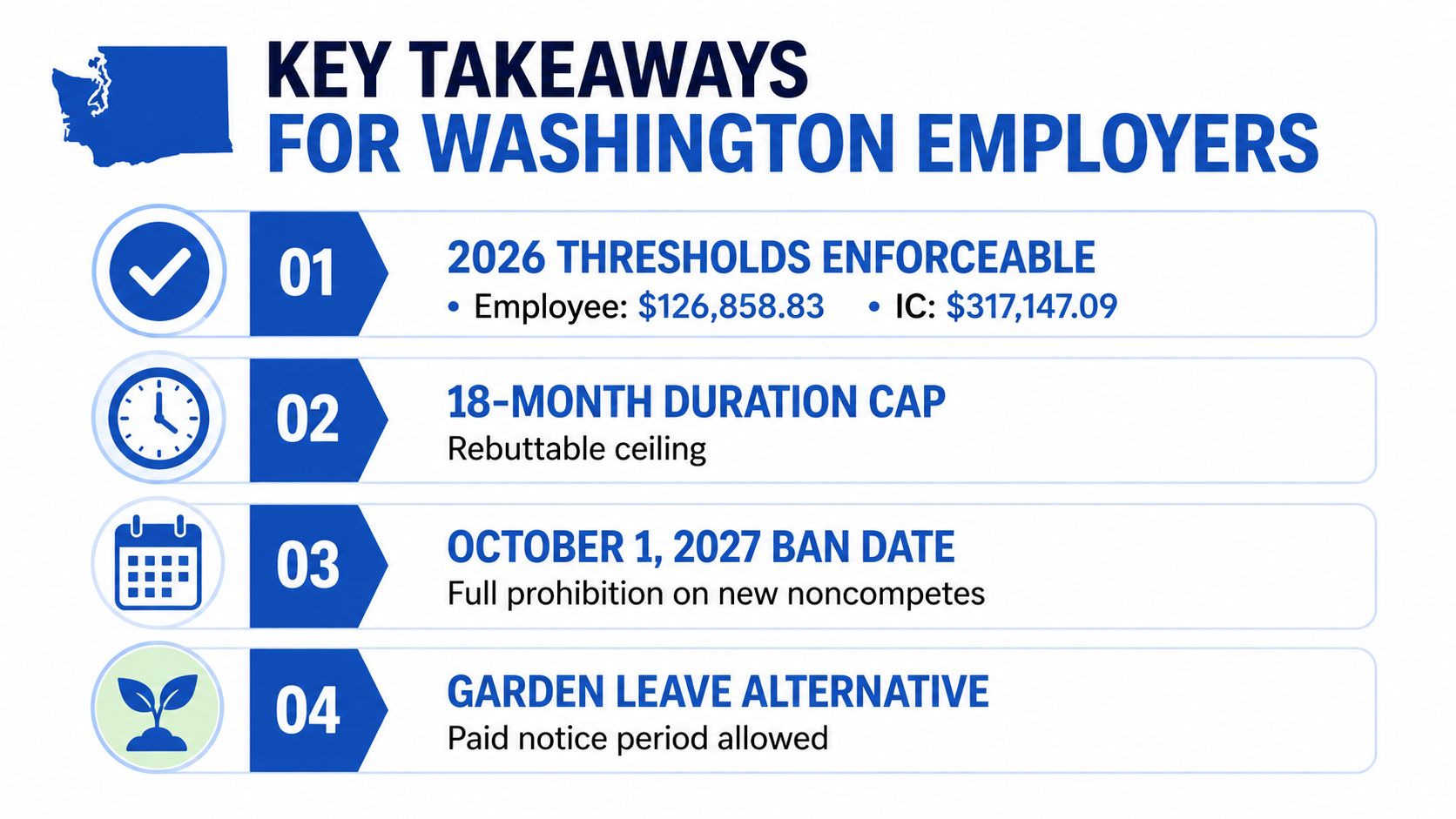
A founder signing an agreement this quarter should treat Washington's rules as a narrowing window, not a durable license to restrict competition. For 2026, the income gates remain $126,858.83 for employees and $317,147.09 for independent contractors, as described in the Washington Department of Labor and Industries' noncompete guidance. A duration beyond 18 months carries a rebuttable presumption of unreasonableness. June 30, 2027 will be the date when covered noncompetes become void regardless of execution date.
The checklist is short, but each item requires review of the actual documents:
- Audit current forms: Find noncompetes in employment, contractor, equity, bonus, severance, and resignation documents.
- Separate protection types: Retain confidentiality, invention assignment, and trade secret protections while removing language that blocks lawful work.
- Test indirect restraints: Review severance clawbacks, equity forfeitures, training repayment, and extended leave conditions.
- Question governing-law terms: Check whether an out-of-state forum or choice-of-law clause attempts to avoid Washington protections.
- Prepare the notice record: Identify affected current and former workers and establish a process for written notice by the October 1, 2027 deadline.
- Document business interests: For restrictions still assessed under the current framework, record the scope, duration, and legitimate interest supporting them.
Before renewing or issuing an agreement, ask whether an existing USNDA contains a reclassified customer restriction, whether a severance clawback penalizes competition, whether equity vesting accelerates or disappears based on competitive employment, and what supports the chosen duration. Those questions often reveal more exposure than the paragraph labeled “Noncompete.”
A review of employment, equity, contractor, and separation documents can prevent a startup from spending resources on restrictions unlikely to survive the statutory transition. It should also identify workable protections for confidential information and customer relationships without creating a new anti-evasion problem.
By Design Law Firm & Legal Consultancy, PLLC offers Washington startups and established companies review and drafting of employment, equity, contractor, confidentiality, and separation agreements affected by the transition. Visit By Design Law Firm & Legal Consultancy, PLLC to arrange a review before signing new agreements or beginning the legacy-contract notice process.