A founder in Seattle forms an LLC with a trusted colleague, deposits the initial capital, and starts signing customer contracts. Months later, one member assumes both owners must approve a loan, while the other believes either member can act alone. Neither assumption came from a signed agreement. Washington law now supplies the missing rules, and those rules may not reflect the deal the founders thought they made.
That is the practical problem behind an LLC operating agreement in Washington. The document isn't filed with the Secretary of State, but it can determine who controls the company, how profits are allocated, when money can be distributed, and what happens when an owner leaves. A template can identify familiar topics. A carefully drafted agreement addresses the Washington defaults that take over when the document stays silent.
What a Washington LLC Operating Agreement Does
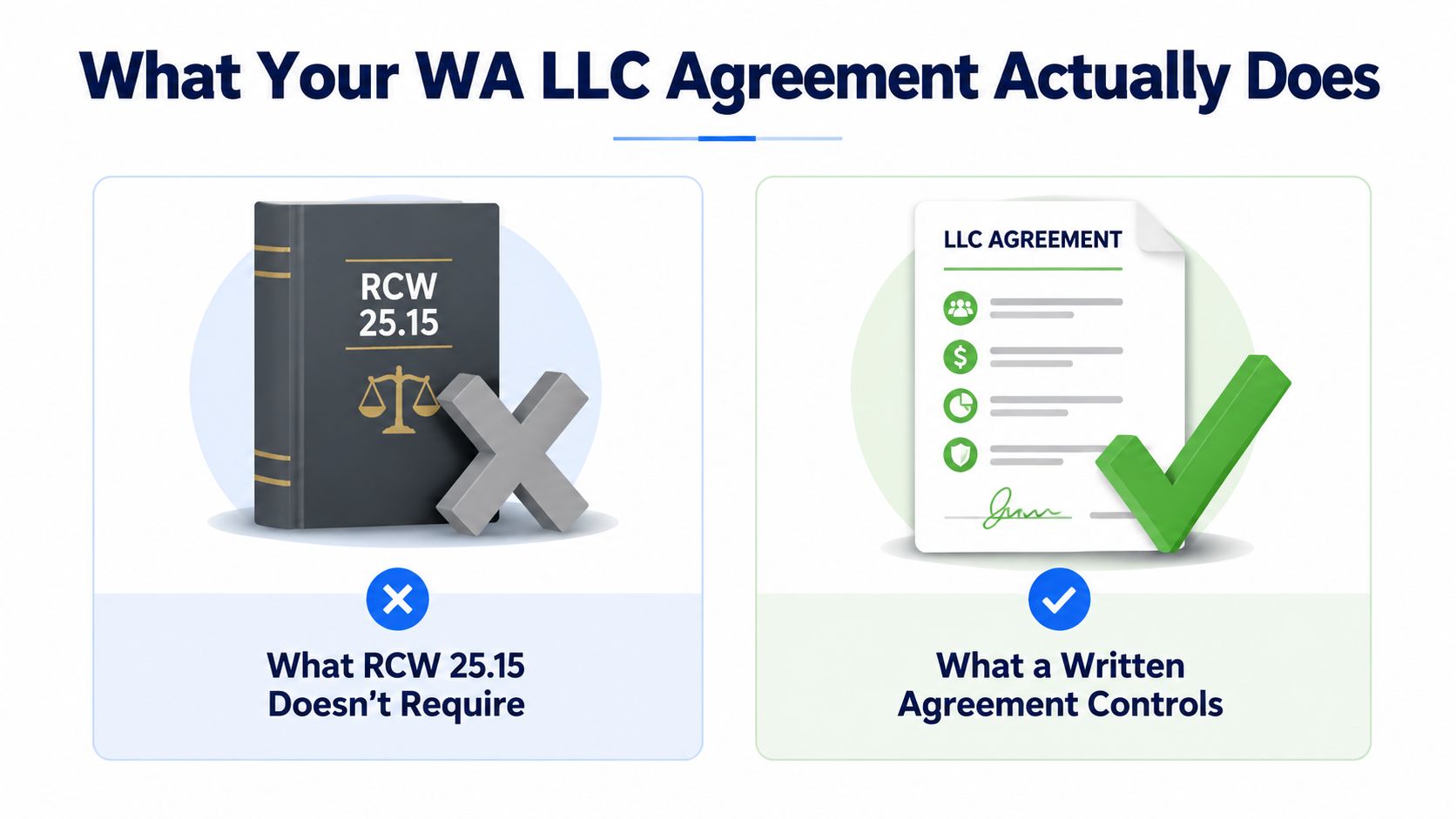
A Washington LLC can begin operating without a written agreement, but that choice leaves important questions to statutory defaults and whatever evidence exists of the members' understanding. RCW Chapter 25.15 does not require a written operating agreement. The Washington Secretary of State nevertheless says an LLC should create one and explains that it is not filed with the state. The agreement is an internal governance record. Formation filings and annual reports remain part of the public entity record, as the state's business-entity formation guidance explains.
The absence of a filing requirement is not the absence of governance risk. Under RCW 25.15.018, an LLC agreement may be oral, implied, or contained in a record. It governs relationships among members and manager duties unless it is silent or a statutory rule cannot be changed. A signed written agreement gives the company evidence of assent and a deliberate way to replace Washington defaults before a dispute over money, authority, or ownership.
The agreement's core functions
A useful agreement should state the company's choices rather than merely repeat statutory language:
- Ownership: It identifies members, ownership economics, and the effect of future contributions.
- Management: It selects a member-managed or manager-managed structure and sets authority.
- Economics: It addresses allocations, distributions, reserves, and tax-related cash needs.
- Consent: It records member approval of the company's structure and rules.
- Exit planning: It addresses transfers, death, incapacity, buyouts, dissolution, and deadlock.
A single-member LLC benefits from the same discipline. The agreement documents separation between the owner and company, supports consistent handling of company assets and obligations, and confirms that ownership alone does not make the member personally liable for company debts. It does not replace separate banking, records, contracts, or proper business conduct.
For a practical comparison of statutory defaults and written terms, review whether an LLC needs an operating agreement. The operative question is which Washington default the company should override before control, cash, or ownership becomes contested.
Choosing Member-Managed or Manager-Managed Governance
The management choice affects who can act for the LLC. Washington treats member-managed governance as the default, so a manager-managed structure should be selected clearly in the formation documents and operating agreement. Under RCW 25.15.131, a member-managed company can give each member authority to bind the company. That arrangement often fits a closely held founder team, a family business, or a professional practice where each owner participates in operations.
A manager-managed LLC serves a different purpose. Passive investors may own economic interests without having authority to sign leases, hire employees, open accounts, or commit the company to contracts. Real estate syndications, holding companies, and investor-backed startups commonly need that separation. The trade-off is control. Minority members may receive information and economic rights but have limited ability to intervene in daily decisions unless the agreement gives them consent rights or removal remedies.
| Factor | Member-Managed | Manager-Managed |
|---|---|---|
| Daily authority | Members generally participate in operating decisions and may have agency authority. | Designated managers handle the company's operational authority. |
| Best fit | Closely held founder teams, family businesses, and active professional practices. | Passive investors, real estate groups, and companies with centralized operations. |
| Control benefit | Owners retain direct influence over business activity. | The company has a clear operational chain of command. |
| Risk | One member may create exposure by acting beyond the group's expectations. | Passive or minority members may lack practical recourse. |
| Drafting priority | Signing limits, spending controls, and approval thresholds. | Manager appointment, removal, replacement, and reserved member decisions. |
Authority needs written boundaries
A member-managed agreement should state whether a member can borrow money, hire staff, sign customer agreements, buy property, or settle litigation without approval. A manager-managed agreement should identify the managers, define their compensation and authority, and state how members remove or replace them.
A useful governance document also establishes signing protocols. A bank or counterparty may ask for a certificate of authority, member consent, or manager resolution even when the state doesn't require those internal documents to be filed. Guidance on maintaining formal corporate governance and compliance can help a company coordinate the operating agreement with those approval records.
The right structure isn't the one that sounds more complex. It is the one that matches who works in the business and then states the limits clearly enough that a lender, employee, investor, and court can understand them.
Capital Contributions, Allocations, and Distributions
The economic provisions should be drafted together. Capital contributions describe what members put into the company. Allocations determine how profits and losses are assigned. Distributions determine when members receive cash. Treating those concepts as interchangeable creates disputes, especially when members contribute different amounts or different types of property.
Build a contribution schedule
The agreement should attach a schedule identifying each initial contribution and its agreed value. The schedule can cover cash, equipment, intellectual property, real estate, services, or a promissory note. It should also state due dates, documentation requirements, valuation methods, and the consequences of a missed commitment.
A contribution isn't automatically an ownership percentage. If one founder contributes cash and another contributes services, the agreement should explain how the parties value those contributions and whether additional capital changes ownership, creates a loan, or produces a preferred return. Vague language such as “members will contribute as needed” leaves the most important economic question open.
Separate allocations from distributions
Washington's default rule under RCW 25.15.200 uses per-capita treatment for distributions when the agreement doesn't provide a different arrangement. A member who contributed more capital therefore can't assume the default will produce a return matching that contribution. The agreement should state whether profits and losses follow ownership percentages, capital interests, special allocations, or another negotiated formula.
If the LLC is taxed as a partnership, tax counsel should also check whether the allocation provisions are intended to satisfy the Section 704 regulations governing substantial economic effect. An LLC taxed as an S corporation needs a different analysis, because its operating agreement must remain consistent with the tax election and the restrictions governing that classification.
Distributions need their own rules. The agreement should address:
- Timing: Quarterly, annually, after a financing event, or at manager discretion.
- Tax payments: Tax distributions can help members cover tax liabilities associated with allocated income shown on a K-1.
- Reserves: Managers may need to retain cash for payroll, taxes, claims, repairs, or planned growth.
- Debt limits: Distributions may be restricted when the company has permitted indebtedness or lacks sufficient assets.
Washington has no state franchise tax on LLCs, but the Department of Revenue administers the business and occupation tax. That gross-receipts-based obligation can affect how much cash the company must retain before paying members. Tax distributions should be coordinated with the LLC's federal tax classification, accounting method, and cash forecast.

A capitalization table should match the signed agreement, contribution records, and tax reporting. Companies that need help maintaining those records can review capitalization table management, particularly before admitting investors or issuing additional interests.
Voting Rights, Decision Rules, and Transfer Restrictions
A silent agreement can produce a governance result that feels fair in theory but becomes unworkable in practice. Washington's default rules under RCW 25.15.124 and RCW 25.15.130 affect member voting and consent. The agreement should replace those defaults with decision rules that reflect the company's ownership, financing needs, and operating pace.
A founder group may choose one vote per member, votes weighted by capital interest, or a hybrid system. Equal voting can protect smaller founders, while capital-weighted voting often tracks financial exposure. Neither approach works well if the agreement fails to distinguish ordinary business decisions from actions that change the owners' economic or control position.
Create a decision ladder
Routine decisions may be delegated to a manager or approved by a stated majority. Major decisions usually deserve a higher threshold, such as approval for:
- admitting a new member;
- borrowing above a negotiated cap;
- purchasing or selling real estate;
- guaranteeing another party's debt;
- changing tax classification;
- approving a merger or sale of substantially all assets;
- issuing new units that dilute existing members.
The agreement should define whether the threshold is calculated by all outstanding interests, members present and voting, or only disinterested members. It should also state what happens when a vote ties. A neutral tie-breaker, mediation process, buy-sell mechanism, or defined sale procedure is more useful than a general promise to act in good faith.
Restrict transfers before an investor arrives
Washington's statutory transfer framework may not give the company the protection founders expect when an owner wants to sell, dies, divorces, becomes incapacitated, or faces a creditor claim. A well-drafted agreement can separate the transfer of economic rights from admission as a voting member and can give the LLC or remaining members a right of first refusal.
Buy-sell provisions should address notice, valuation, payment terms, funding, and the effect of a disputed valuation. Drag-along provisions can help complete a company sale, while tag-along rights can protect minority members in certain transactions. These clauses should exist before a term sheet arrives, not after an investor asks why the ownership records don't explain who can approve the deal.
| Decision Area | RCW Default | Typical Drafted Override |
|---|---|---|
| Routine management | Statutory management rules apply when the agreement is silent. | Delegate authority to named members or managers with written limits. |
| Voting | Applicable statutory voting and consent rules fill gaps. | Use per-member, percentage, or hybrid voting with defined thresholds. |
| Major actions | Silence can force owners into an unsuitable approval process. | List reserved matters and require majority, supermajority, or unanimous consent. |
| Transfers | Statutory restrictions and admission rules may control. | Add notice, valuation, right of first refusal, and admission procedures. |
| Deadlock | Unresolved consent requirements can prevent action. | Add mediation, a tie-breaker, buy-sell process, or sale mechanism. |
A governance resource on corporate governance and compliance is relevant when these rules need to align with resolutions, delegation documents, and transaction approvals. The operating agreement should not merely list voting percentages. It should explain how the company keeps moving when owners disagree.
Adopting and Signing the Agreement Inside the Company
A Washington operating agreement becomes useful when the LLC and its members can prove adoption, assent, and consistent use. Filing it with the Secretary of State isn't the mechanism. Internal approval and recordkeeping are.
The organizers and initial members should review the agreement against the Certificate of Formation, ownership schedule, tax classification, and planned banking arrangements. The management structure in the agreement should match the governor information reported to the state. Any mismatch can create uncertainty when a bank or counterparty asks who has authority to sign.
Use a clear adoption process
A company can adopt the agreement through unanimous written consent or a formal organizational meeting. The chosen record should identify the LLC, approve the agreement, appoint managers if applicable, authorize banking, confirm initial contributions, and approve any immediate tax elections. A separate member consent may be appropriate for an election or filing that requires a distinct authorization.
Every member should sign the same final version. Signature blocks should identify the individual, capacity, and date. If a member is signing through an entity, the block should identify that entity and the authorized representative. Counterparts can be useful when members sign separately, provided the agreement says counterparts together form one instrument.
A board resolution isn't automatically the right document for an LLC, but the underlying principle applies. The company should create a written record showing what was approved, by whom, and under what authority.
Preserve the evidence
The signed original should be stored with the company's core records, with controlled electronic copies available to members, accountants, lenders, and counsel. The record set should also include:
- Adoption consent: The approval document or meeting minutes.
- Ownership schedule: Current members, contributions, and interests.
- Amendments: Each amendment attached or cross-referenced to the original.
- Authority records: Manager appointments, signing authorizations, and major consents.
- Tax records: Relevant elections and supporting approvals.
A bank may request the agreement even though Washington doesn't publicly record it. Keeping a clean, current copy prevents an administrative question from becoming a credibility problem during financing, litigation, or an acquisition.
Amendments, Dissolution, and Ongoing Maintenance
An operating agreement should change when the company's deal changes. New members, additional capital, a different management structure, a spouse's involvement, a departure, or a succession event can make existing language inaccurate. The agreement should continue to match the ownership ledger, tax filings, and the company's actual decision-making.
Under RCW 25.15.075, amendment approval may depend on the agreement and the kind of change involved. Draft the approval rules before a dispute arises. Identify provisions that may be amended by majority vote, those requiring a higher threshold, and those requiring unanimous consent. State the notice process, written-consent requirements, effective date, and procedure for updating schedules.
Track the events that require review
Review the agreement after events such as:
- Financing: New money, preferred economics, SAFEs converting into units, or lender conditions.
- Ownership: Admission, withdrawal, death, incapacity, divorce, or a proposed transfer.
- Operations: A move from member-managed to manager-managed governance or the appointment of a senior manager.
- Tax status: A new federal election, conversion planning, or a change in accounting treatment.
- Records: A new principal office, registered agent, member schedule, or capitalization record.
Tax treatment needs separate review. If the company is considering a corporate conversion, examine the tax implications of C corp conversion before changing the agreement or issuing interests. The agreement, tax election, books, and ownership records should describe the same transaction and ownership structure.
Document dissolution before conflict
Dissolution provisions should identify triggers, voting requirements, winding-up authority, asset-sale procedures, creditor payments, final distributions, and record retention. Washington's dissolution and winding-up rules appear in RCW 25.15.290 and RCW 25.15.300. The company should know who may wind up the business, sign final contracts, collect receivables, sell assets, and distribute remaining value.
Dissolution does not end every liability immediately. Address notices, claims, reserves, tax filings, and authority to resolve disputes after operations stop. Coordinate the agreement with Secretary of State filings and the company's tax and licensing obligations.
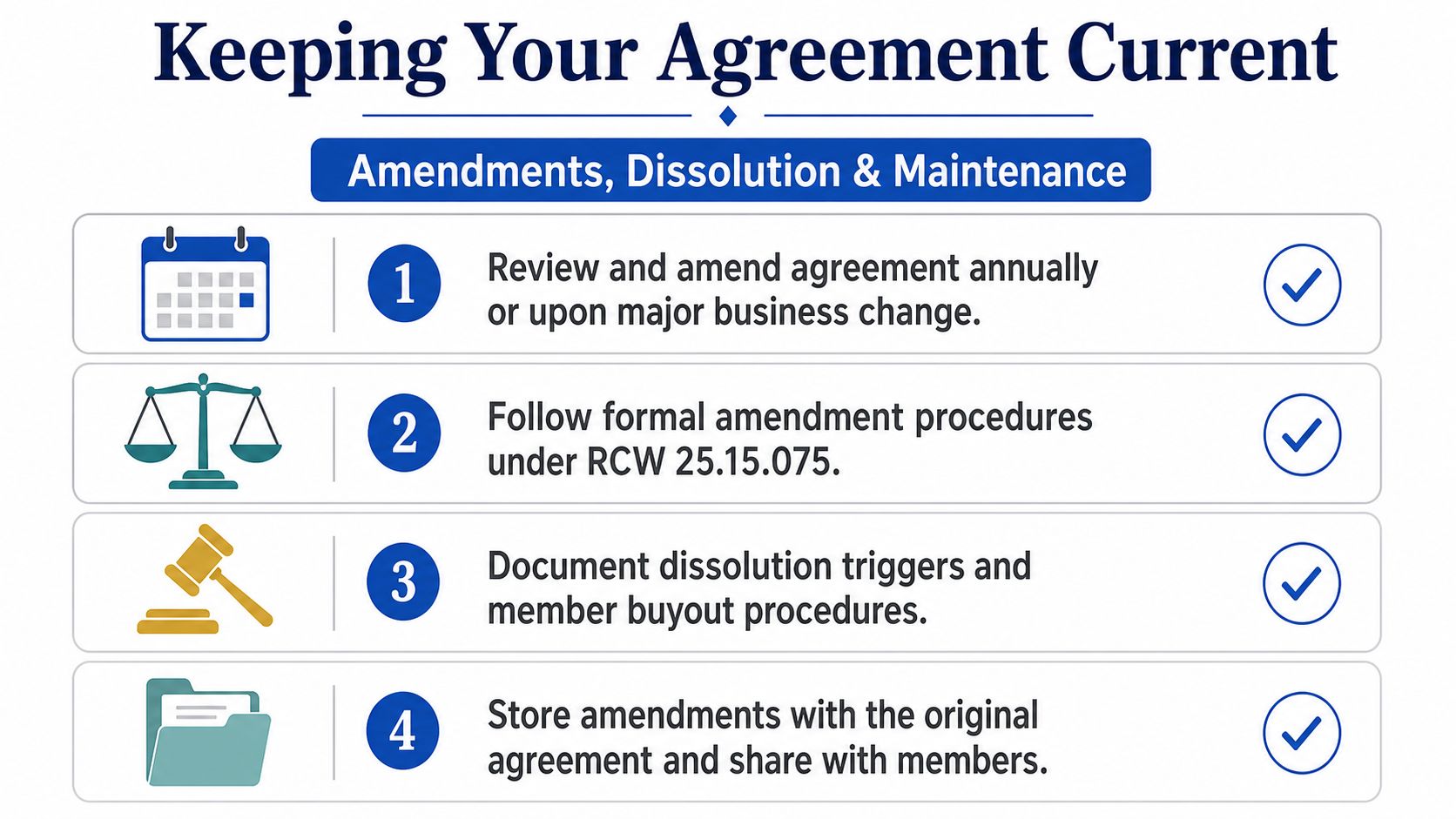
An annual review helps, but event-driven review matters more. Washington Secretary of State maintenance remains fee-based, including a $70 annual report fee, with delinquency and reinstatement fees listed separately in the state's LLC annual report fee schedule. Review the agreement when the company verifies its ownership, management, address, and compliance records.
Pitfalls, Red Flags, and When to Bring in Counsel
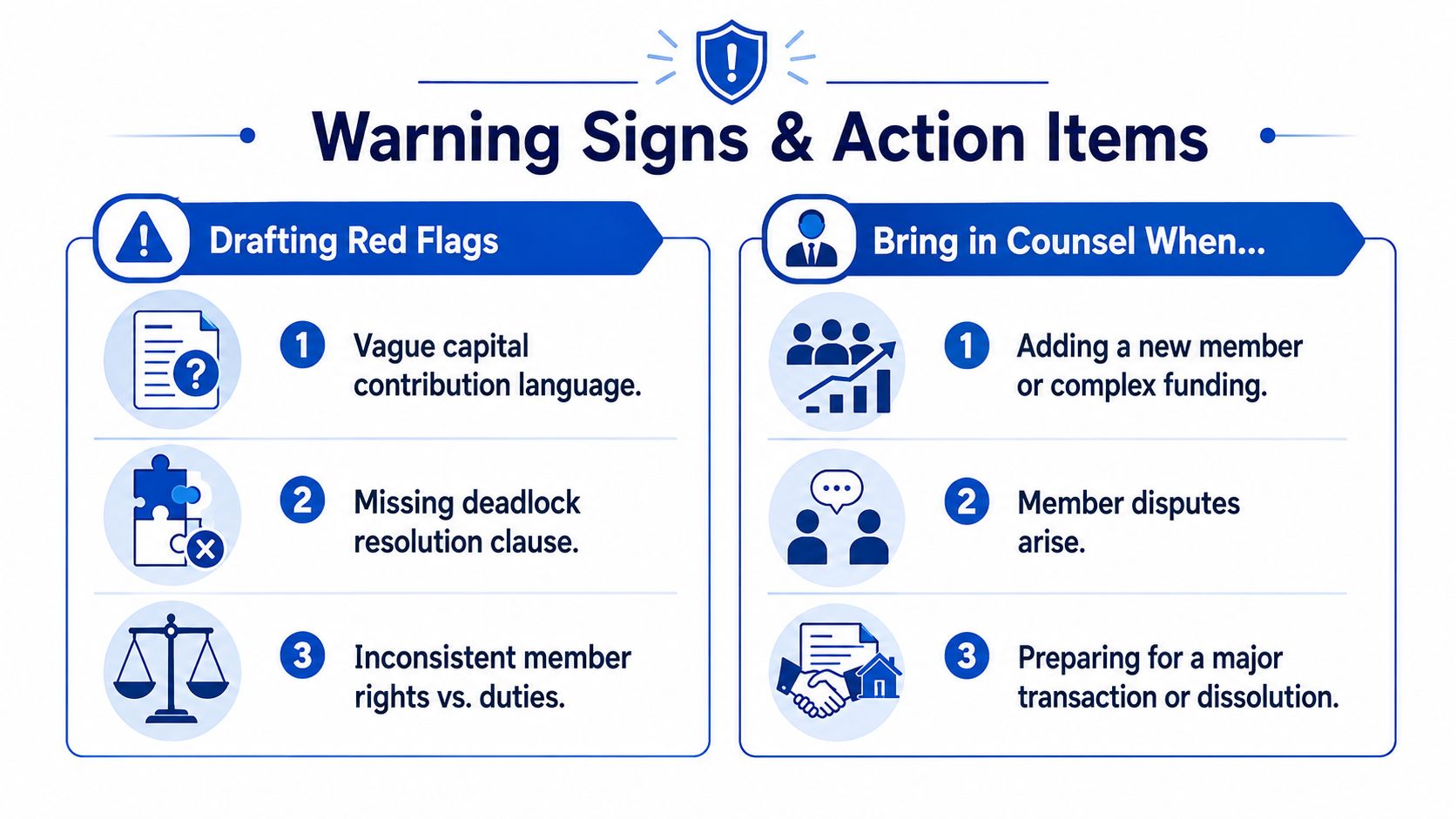
The most expensive operating agreement problems usually start as small drafting shortcuts. A template may mention contributions, voting, and transfers, yet omit the mechanics that decide a real dispute. Washington's default rules then fill the gaps, or inconsistent documents create competing versions of the deal.
Warning signs in the draft
- Vague contributions: A promise to contribute “as needed” can leave the company and members arguing about obligations under RCW 25.15.183.
- No departure trigger: Death, disability, divorce, bankruptcy, or voluntary withdrawal can create an ownership problem if the agreement has no valuation and buyout process.
- Oral side arrangements: Washington recognizes company agreements that may be oral or implied under RCW 25.15.071. A written agreement should therefore identify amendments, waivers, and consent procedures clearly enough to reduce proof disputes.
- Tax inconsistency: Allocation language may conflict with the LLC's Form 1065 or Form 1120-S treatment, producing accounting and member-level problems.
- No deadlock remedy: Equal owners need a defined path when neither side can approve a financing, sale, hire, or major expenditure.
The one-page pre-signing checklist should include the company name, member identities, ownership schedule, contribution obligations, allocation rules, distribution policy, tax distributions, management structure, authority limits, voting thresholds, reserved matters, information rights, transfer restrictions, right of first refusal, buy-sell terms, valuation method, death and incapacity provisions, dispute resolution, deadlock process, amendment rules, dissolution triggers, winding-up authority, and execution records.
Counsel becomes necessary in predictable situations
A founder should involve Washington counsel when the company has multiple members raising capital, a SAFE converting into units, real estate assets, professional licensing concerns, or a planned ownership change. A real estate holding LLC may need review of transfer restrictions and RCW 64.06 issues, including possible due-on-transfer concerns in loan documents. A professional LLC requires attention to RCW 25.15.045 and the applicable licensing rules.
A single-member LLC also needs legal review before adding investors. That transition changes governance, economics, tax analysis, records, and often the company's financing documents. It isn't a matter of inserting a new name into an existing template.
Administrative support can help organize signature packets, ownership schedules, consents, and version control. Businesses considering virtual legal assistants should keep the boundary clear: administrative help can support implementation, but Washington counsel should draft or review the legal terms that allocate control, liability, and exit rights.
The state formation filing fee for a domestic LLC is $180, and the Washington Secretary of State separately lists the same $180 fee for a foreign LLC registration in its business filing information. Those formation costs are modest compared with the cost of resolving an ownership dispute created by silence. A strong Washington agreement is not boilerplate insurance. It is the operating map for authority, economics, transfers, and the company's eventual exit.
By Design Law Firm & Legal Consultancy, PLLC offers Washington LLC operating agreement drafting and review for founders, closely held businesses, startups, and companies preparing for financing or ownership changes. Visit By Design Law Firm & Legal Consultancy, PLLC to request counsel that aligns the agreement with RCW Chapter 25.15, the company's tax structure, and its actual governance needs.