In Washington State, an LLC isn't legally required to have a written operating agreement, but operating without one exposes founders to default state rules and practical risks, including unclear liability protection. For founders in most other states, the answer also depends on local law, with California, Delaware, Maine, Missouri, and New York commonly identified as states that impose statutory requirements.
A Seattle founder may form an LLC, open a business bank account, sign a client contract, and start hiring without ever writing down who controls the company or how profits will be divided. That omission often feels harmless until a co-owner wants to leave, a lender asks for governance documents, or the members disagree about a major transaction.
The more useful question isn't only “does an LLC need an operating agreement?” It's whether the company can safely leave its ownership, management, financial, and exit rules to statutory defaults. For a Washington LLC, the answer is usually no.
Why Your Washington LLC Needs an Operating Agreement Even When the State Does Not Require One
A Seattle software startup may begin with two founders who verbally agree that one will handle engineering and the other will lead sales. They may also agree that ownership reflects each person's expected contribution. Months later, one founder contributes additional money, the other works full time, and neither agreement is documented. The company now has revenue, expenses, and competing assumptions about control.
Washington law doesn't require the LLC to adopt a written operating agreement, and the document isn't filed with the Secretary of State. It serves as an internal governance document, as explained in this Washington operating agreement overview. That means the absence of a filing requirement shouldn't be confused with the absence of legal consequences.
Legal requirement versus practical necessity
A state can make an operating agreement optional as a filing matter while still allowing its default LLC statutes to control important issues. If members haven't addressed ownership, voting, management, distributions, or dissolution, the statutory fallback rules may determine the result.
That fallback is rarely suited to the founders' actual deal. It's a general framework designed to operate when the members haven't supplied more specific terms. A document that records the parties' actual agreement gives the business a clearer operating manual and reduces the chance that a later dispute will turn on assumptions.
The U.S. Small Business Administration explains that the need for an operating agreement depends on the state where the LLC was formed, and that many states don't require one at all. Recent legal summaries also identify California, Delaware, Maine, Missouri, and New York as recurring examples of states with statutory requirements, while New York requires a written agreement within 90 days after filing the Articles of Organization, as discussed in this state-by-state operating agreement analysis.
Practical rule: Washington founders can decline to prepare an operating agreement, but they can't decline to have governing rules. If they don't write their own, statutory defaults fill the gap.
An agreement also helps prevent formation mistakes, especially when founders use an out-of-state entity without understanding the resulting governance and tax complications. Washington entrepreneurs considering that route should review the risks discussed in this guide to out-of-state LLC formation pitfalls.
What Happens When an LLC Operates Without an Agreement Under Washington Law
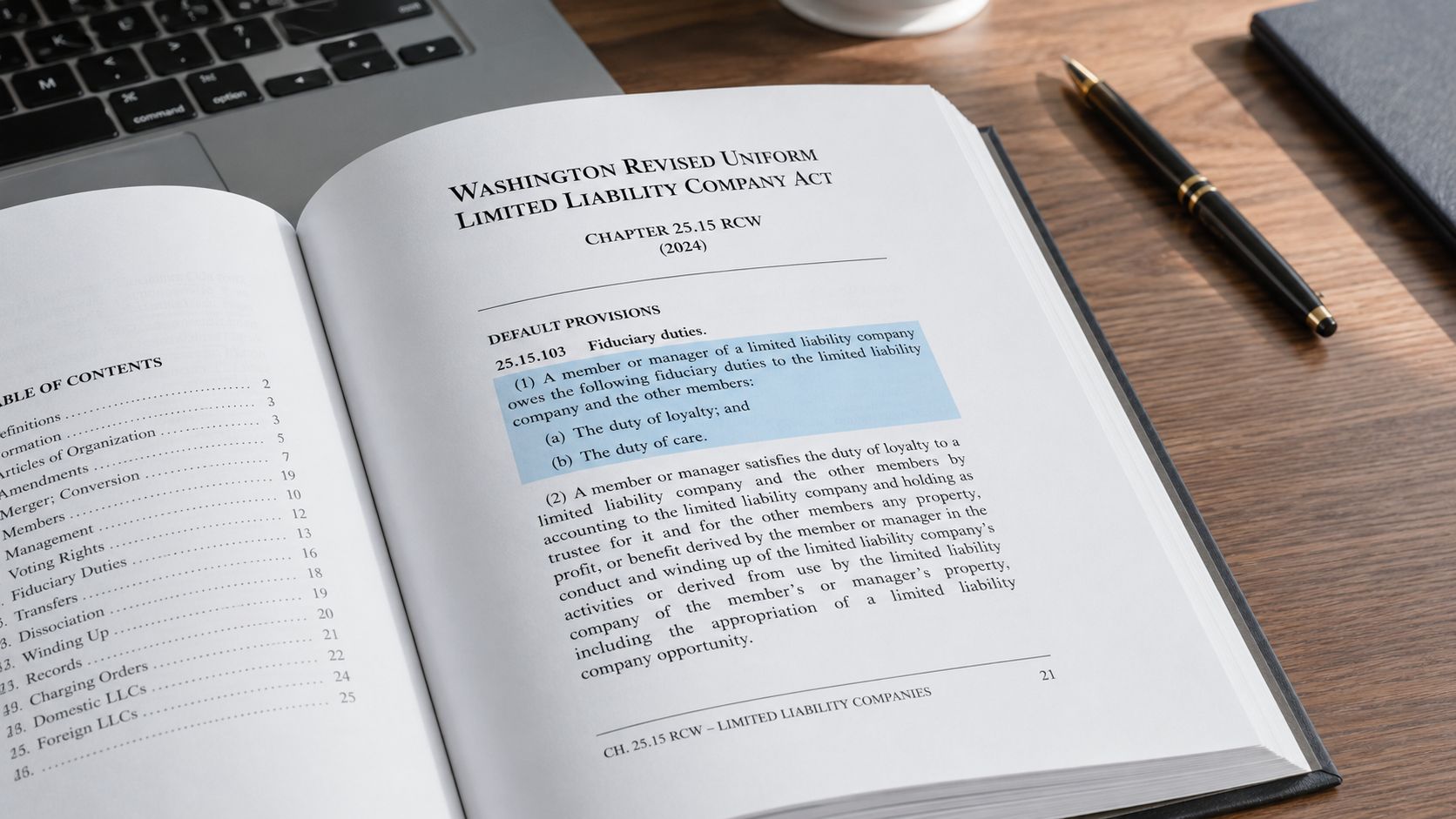
Without a written agreement, Washington's default LLC statutes don't leave the company ungoverned. They provide the rules that apply when the members haven't customized the relationship. That may keep the LLC functioning, but it can also place decisions in the hands of provisions the founders never selected.
The default rules are generic by design
The practical areas affected can include:
- Ownership records: The company may lack a clear contractual explanation of how ownership relates to contributions, membership interests, or future funding.
- Voting and authority: Members may disagree about who can bind the company, approve spending, take on debt, or authorize a major transaction.
- Management structure: The business may not clearly distinguish between a member-managed company and one operated by designated managers.
- Economic arrangements: Profit and loss allocations may not match the founders' intended deal.
- Exit and dissolution: A departing member's rights, valuation, or buyout process may be uncertain, as may the process for winding up the business.
These issues matter because statutory rules don't know that one founder supplied intellectual property, another supplied cash, or a third accepted a lower salary in exchange for a different ownership arrangement. A properly drafted agreement translates those business decisions into enforceable governance terms.
The state-driven nature of LLC law also explains why national articles can produce misleading answers. Delaware's statute treats the operating agreement as central to LLC governance, but the agreement isn't filed with the state. New York, by contrast, imposes a written-agreement deadline. The SBA's explanation of operating agreements reflects that the answer depends on formation state rather than a single federal rule.
Why disputes become harder
A disagreement without an agreement often starts as a business question and becomes a legal one. Members may argue about whether a decision required consent, whether a contribution changed ownership, or whether a member had authority to sign a contract.
Once the dispute affects operations, negotiations can become expensive and slow. Washington businesses facing that situation may need structured negotiation, mediation, arbitration, or litigation, depending on the governing documents and applicable law. Founders can review practical options through By Design Law's business dispute resolution services.
Single-Member Versus Multi-Member LLCs and the Risk of No Agreement
A single-member LLC still benefits from a written operating agreement. It records how the owner intends to treat the LLC as a separate entity, identifies who may act for the company, and gives banks, lenders, accountants, and other counterparties a clear governance record.
That record can matter during routine business tasks. An operating agreement is generally an internal document, yet a financial institution may request it before opening an account or evaluating financing. Formation filings identify the entity, but they may not explain its authority, ownership, internal procedures, or succession plan.
Two ownership structures, different pressure points
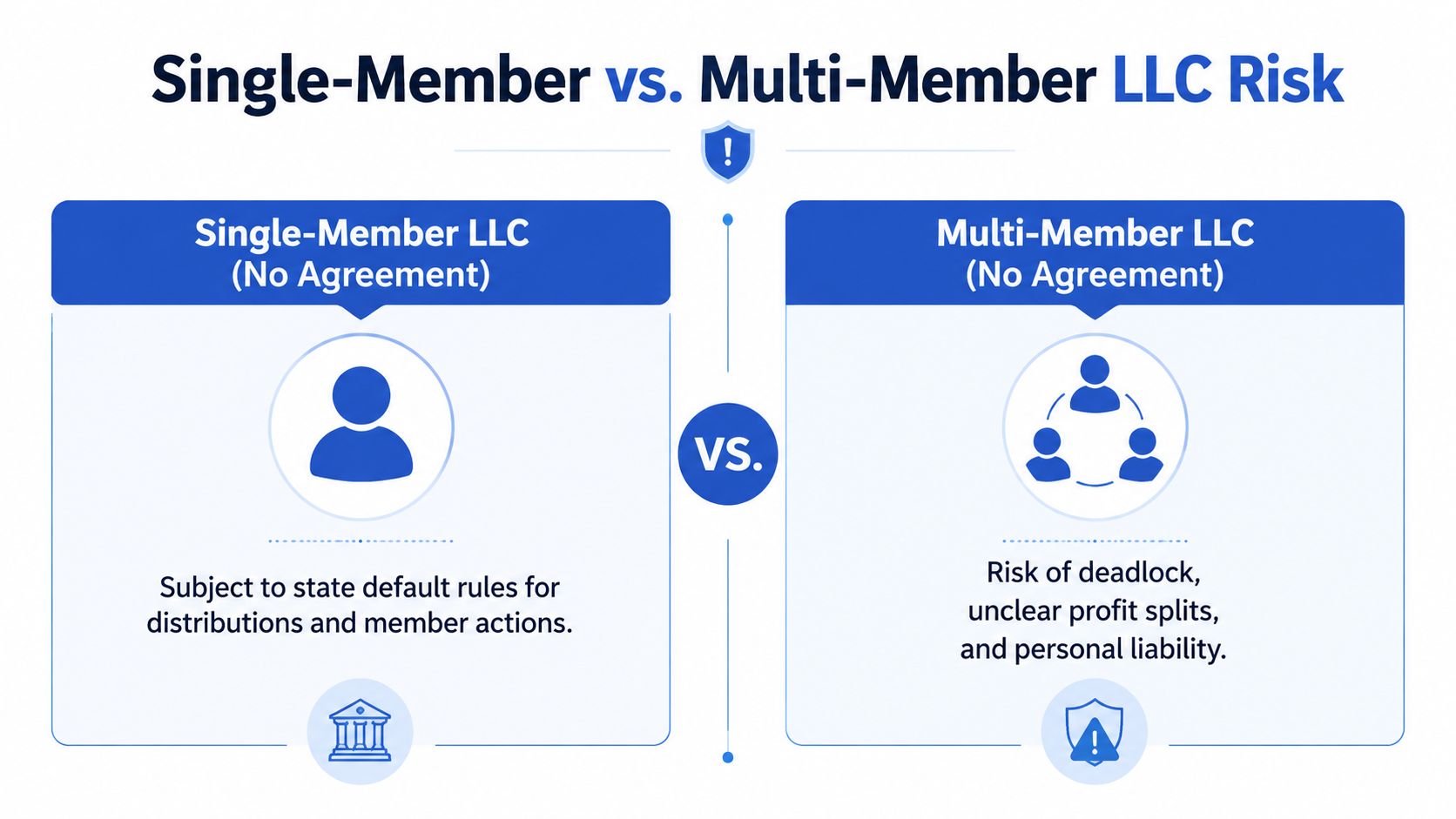
| Structure | Main risk without an agreement | What the document clarifies |
|---|---|---|
| Single-member LLC | Unclear authority, separateness, and internal procedures | Ownership, authority, records, and succession instructions |
| Multi-member LLC | Conflict over control, economics, funding, or departure | Voting, contributions, distributions, buyouts, and dispute procedures |
For a multi-member LLC, ownership percentages answer only part of the governance question. The agreement should address decisions about debt, asset sales, new members, and changes in business direction. It should also establish a process for handling disagreement and a member's departure. Without those terms, statutory default rules may control matters the founders expected to decide themselves.
State law can produce materially different outcomes. California's statutory defaults, for example, provide equal voting rights for members, majority approval for ordinary-course matters, and generally unanimous consent for extraordinary actions such as selling substantially all assets or merging, as described in this California LLC default-rule discussion. Washington founders should treat that example as a reason to avoid applying general internet guidance without checking the governing state law.
A single owner needs a record of authority. Multiple owners need rules for consent, money, and separation.
The agreement also supports the distinction between company obligations and personal exposure. LLC members are generally not personally liable for company debts beyond their contributions, unless the agreement or applicable law provides otherwise. Written governance records cannot guarantee liability protection. They do, however, document how the entity is intended to operate and help the owner maintain consistent company practices.
Essential Clauses Every Washington LLC Operating Agreement Should Include
A useful operating agreement should reflect the company's actual deal, not merely repeat a generic template. The drafting process should begin with the owners' business arrangement and then convert that arrangement into clear rules.
Ownership and money
The agreement should identify each member, state ownership interests, and record initial capital contributions. It should explain whether later funding is mandatory, optional, treated as a loan, or capable of changing ownership.
Profit and loss provisions deserve equal attention. Members may expect distributions to follow ownership, but the agreement should say how distributions are approved, when cash can be retained, and how losses are allocated. A document that lists percentages without explaining the economic mechanics may leave the most important financial questions unanswered.
The LLC operating agreement guidance from Rocket Lawyer identifies ownership, contributions, voting, management, and buyout provisions as core subjects. Those subjects should be drafted together because a change in one can affect the others.
Governance choices
| Governance model | Control implication | Common fit |
|---|---|---|
| Member-managed | Members participate directly in ordinary company decisions | Owner-operated small businesses |
| Manager-managed | Designated managers handle authority within defined limits | Companies with passive owners or delegated operations |
The agreement should define who can sign contracts, open accounts, hire employees, borrow money, and approve extraordinary actions. It should also establish voting thresholds. Without that precision, a member may claim authority that another member believed required group approval.
Transfers, disputes, and the end of the company
Transfer restrictions can prevent an ownership interest from moving to an unwanted third party. Buyout terms should address voluntary withdrawal, death, disability, termination of service, valuation, payment timing, and funding. Dissolution provisions should identify who can approve a wind-down and how remaining assets and obligations will be handled.
Dispute provisions should set a process before relationships deteriorate. A clause may require internal negotiation, mediation, arbitration, or court proceedings, but it should also address venue and the scope of available remedies. Founders can review drafting considerations in this guide to dispute resolution clauses.
Real Examples, Sample Language, and a Practical Compliance Checklist
A missing clause becomes visible when the business reaches a decision that the founders never anticipated. Suppose one member wants the LLC to accept a large loan while another objects. If the agreement doesn’t define borrowing authority or approval thresholds, the members may spend more time arguing about procedure than evaluating the financing itself.
A similar problem arises when one member wants to leave. Without a valuation method and payment terms, the departing member may demand a price the company can’t support, while the remaining members may argue that no buyout is available. The operating agreement should resolve those questions before a personal event forces the issue.
Central point: An operating agreement is both a risk-management tool and a credibility document. It tells owners how to act and tells outside parties who has authority to speak for the company.
Sample language for a starting discussion
The following examples are drafting prompts, not substitute provisions for every Washington business:
- Management authority: “The Company shall be member-managed. No Member may bind the Company to a material loan, asset sale, or extraordinary transaction without the approval required under this Agreement.”
- Additional contributions: “No Member shall be required to make an additional contribution unless the Members approve the contribution requirement in writing and this Agreement states the consequences of declining.”
- Transfer and buyout: “A Member may not transfer an interest to a non-member without the required consent. Upon an approved withdrawal, the Company shall determine value using the valuation method stated in this Agreement.”
- Dispute process: “The Members shall first attempt good-faith negotiation, followed by mediation before either party files a claim, except where emergency relief is necessary.”
A lawyer should tailor these provisions to the company’s ownership, tax treatment, financing, intellectual property, and succession needs. Founders using a template or AI drafting tool should also check for inconsistent definitions, missing cross-references, and provisions that conflict with Washington law.
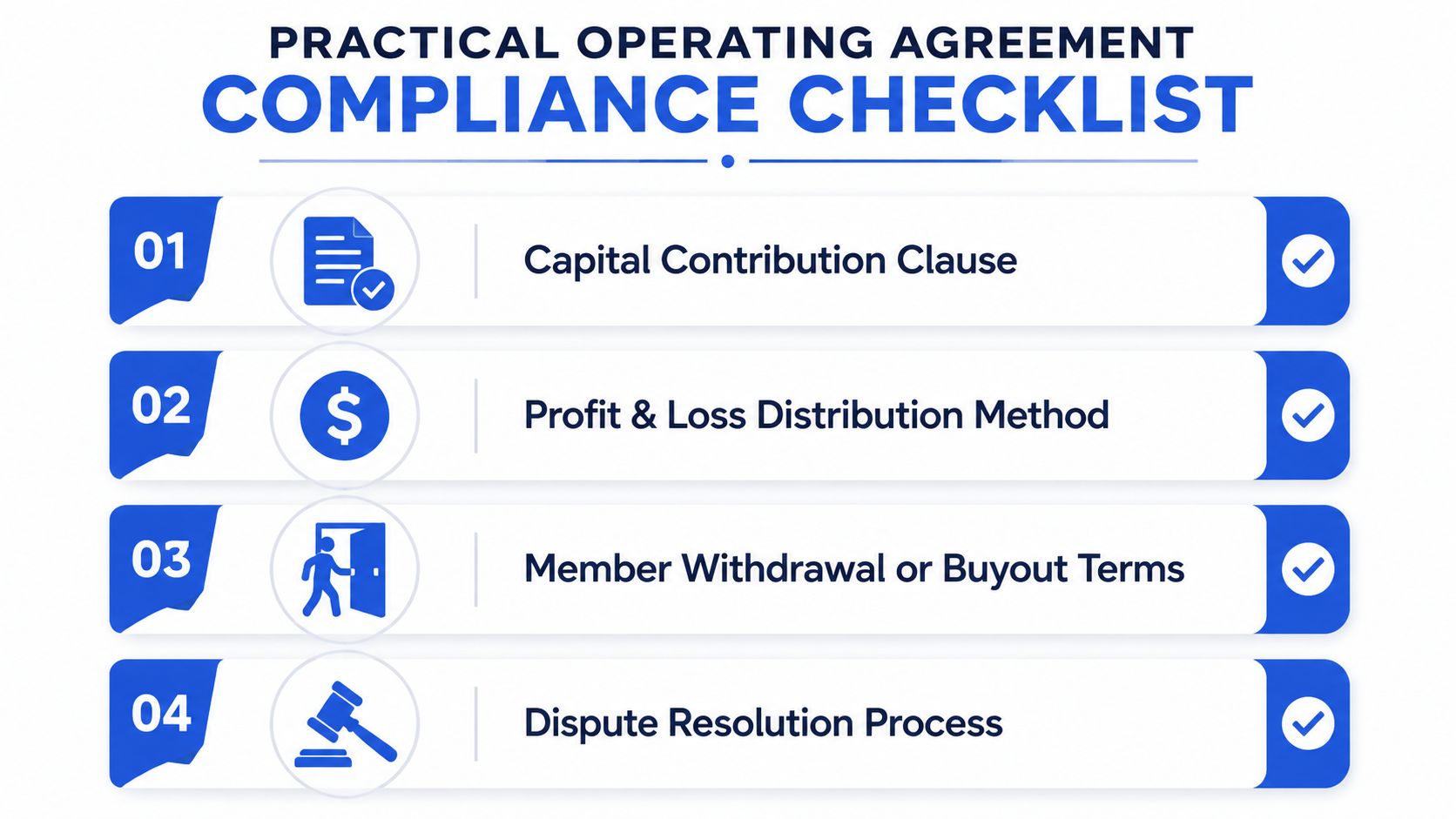
Washington review checklist
- Confirm governance: State whether the LLC is member-managed or manager-managed and identify authority limits.
- Document contributions: Record each member’s contribution and explain future funding obligations.
- Set economic rules: Define profit, loss, distribution, and retained-cash procedures.
- Plan departures: Add transfer restrictions, valuation, buyout, death, and withdrawal terms.
- Record approvals: Keep signed agreements, amendments, consents, and major resolutions with company records.
- Coordinate documents: Make the operating agreement consistent with formation records, contracts, banking instructions, and ownership records.
Founders seeking a custom drafting process can review how to write a Washington operating agreement.
Next Steps for Washington Founders and Small Businesses
A Washington LLC doesn’t have to file an operating agreement with the Secretary of State, and Washington law doesn’t require the company to adopt a written version. That legal flexibility doesn’t eliminate the need for clear governance. It gives founders the responsibility to choose their own rules instead of accepting statutory defaults by silence.
A practical path forward is straightforward:
- Identify the ownership deal. Confirm members, ownership interests, contributions, and any promised future funding.
- Choose the management model. Decide who can act for the company and which decisions need member approval.
- Write the economic terms. Address distributions, losses, retained funds, and tax-related coordination with professional advice.
- Plan for change. Include transfers, buyouts, valuation, death, withdrawal, deadlock, and dissolution.
- Sign and maintain the document. Update it when ownership, management, or the company’s business arrangement changes.
Legal review becomes especially valuable for multi-member LLCs, businesses seeking financing, companies with unequal contributions, and ventures holding significant intellectual property or entering complex contracts. A customized agreement can also help prevent the formation documents, bank records, and internal governance terms from contradicting each other.
By Design Law Firm & Legal Consultancy, PLLC advises Washington founders on LLC formation, operating agreements, governance, contracts, and business disputes. Visit By Design Law Firm & Legal Consultancy, PLLC to discuss an operating agreement that matches the company’s ownership, control, and risk profile. Contact our law office in Seattle today at (206) 593-1519.