A Seattle founder opens an email from the IRS between product calls. The company paid several engineers as contractors after its Series A closed, issued 1099 forms, and kept moving. Then the audit notice arrived. The founder screenshots it, forwards it to the CPA, and learns that the same worker-status questions could draw attention from Washington's Department of Labor and Industries and Employment Security Department.
That's the danger of independent contractor misclassification. One relationship can create separate exposure under federal tax rules, federal wage-and-hour law, and Washington law. A business can have a defensible position for one purpose and still lose under another because the IRS, the U.S. Department of Labor, and Washington agencies apply different tests.
The practical question is straightforward: how can a company reduce exposure before a notice arrives, and what should it do once one does?
The Founder Who Got the Letter in the Mail
The founder's first instinct is to search the company's records. The engineering contractors signed master services agreements. They sent invoices. The finance team issued 1099 forms. Nobody received health insurance or paid time off. On paper, the arrangement looks organized.
The CPA's response is less reassuring. The IRS may examine how the contractors worked, not just how the company described them. If the engineers worked under company direction, used company systems, joined recurring team meetings, performed core product work, or remained economically dependent on the startup, the paperwork may not carry much weight.
The notice can open several doors
Federal tax exposure is only one concern. A worker treated as an employee may claim unpaid minimum wage or overtime under the Fair Labor Standards Act. The U.S. Department of Labor explains that misclassification can deprive workers of minimum wage, overtime, and other FLSA protections through its worker misclassification guidance.
Washington adds another layer. A worker may pursue wage remedies, including claims connected to the state's minimum-wage law and RCW 49.46.130, while state agencies examine unemployment insurance, workers' compensation, and wage compliance. A finding can also create investor diligence problems, employee-relations damage, and unwanted attention from former contractors.
Practical rule: A signed contractor agreement is evidence. It isn't immunity.
The founder now needs three separate analyses. The first concerns federal tax treatment. The second concerns federal wage-and-hour status. The third concerns Washington's worker-classification rules, which can be stricter than the federal standards. No single label, form, or contract governs all three.
The right response depends on timing. Before a notice, the company can audit relationships, preserve records, and correct structures. After a notice, casual explanations and inconsistent documents can increase the problem. Every founder using contractors should know both paths.
What Independent Contractor Misclassification Actually Means
Misclassification occurs when a company treats a worker as an independent contractor even though the facts support employee status under an applicable law. It's best understood as a three-track compliance problem, involving tax treatment, wage-and-hour coverage, and state-specific worker status.
A useful analogy is a lease versus a purchase. Calling an arrangement a lease doesn't change ownership if the transaction functions like a purchase. Likewise, calling someone a contractor doesn't control the legal result if the company manages the person like an employee.
Paperwork is only one piece of the analysis
A 1099-NEC, a master services agreement, and the absence of employee benefits can support a company's position, but none automatically establishes contractor status. Agencies and courts examine the relationship in practice, including who controls the work, who bears financial risk, whether the relationship is permanent, and whether the worker operates an independent business.
The consequences differ by forum:
- Tax treatment: The company may face unpaid employment-tax obligations involving Social Security, Medicare, unemployment taxes, and related reporting.
- Federal wage law: A worker who qualifies as an employee may seek minimum wage, overtime, and other FLSA protections. The Department of Labor describes these consequences in its official misclassification materials.
- Washington law: A worker may qualify for state wage protections, paid leave rights, unemployment coverage, or workers' compensation treatment that the contractor label excluded.
Intent doesn't cure a structurally noncompliant arrangement. A founder who relied on a template, followed a previous company's practice, or accepted a contractor's preference can still face liability. The question is what the relationship looks like under the governing law.
Tax treatment can affect the worker too
A worker who believes the company improperly treated employment compensation as nonemployee compensation may need to address tax reporting through Form 8919. A practical explanation of that process appears in Omni Tax Help's Form 8919 guide, which can help a worker understand the reporting issue without confusing it with the separate wage-and-hour analysis.
The next step is identifying the test that applies. The IRS uses a common-law framework. The Department of Labor uses an economic-realities analysis under the FLSA. Washington generally starts from a stricter statutory presumption.
The Federal Tests That Decide the Outcome
Federal classification is not governed by one universal checklist. The IRS commonly organizes its common-law analysis into behavioral control, financial control, and the type of relationship, while the Department of Labor asks whether the worker is economically dependent on the business under the FLSA. The IRS and DOL test comparison summarized by The Tax Adviser illustrates why a company needs a law-specific review.
IRS common-law analysis
The IRS asks whether the business has the right to control how the worker performs the work, how the worker handles the business side of the engagement, and how the parties understand their relationship. Actual conduct matters, and the company's right to direct work can matter even if managers rarely exercise it.
Behavioral control includes instructions, training, schedules, methods, and supervision. Financial control includes unreimbursed expenses, investment in equipment, opportunity for profit or loss, and the way the worker receives payment. The relationship category includes written contracts, benefits, permanency, and whether the services are a regular part of the company's operations.
A startup's classification may look stronger when a contractor supplies specialized tools, markets services to multiple clients, sets prices, invoices by project, and controls the means of achieving a defined result. It looks weaker when the person works inside the company's ordinary team structure, receives detailed instructions, uses company equipment, and performs an ongoing role.
DOL economic realities
The Department of Labor's 2024 final rule became effective on March 11, 2024 and rescinded the 2021 independent-contractor rule. The rule uses a six-factor economic-realities analysis focused on economic dependence. The factors examine control, opportunity for profit or loss, investments, skill, permanence, and whether the work is integral to the business.
The DOL's central question differs from the IRS formulation. The question isn't just who controls the details. It's whether the worker is in business for themselves or economically dependent on the company.
| Factor Category | IRS Common-Law Test | DOL Economic-Realities Test (2024 Rule) |
|---|---|---|
| Control | Behavioral control, including instructions and supervision | Nature and degree of control over the work |
| Financial structure | Financial control, including expenses, investment, and payment | Opportunity for profit or loss and worker investment |
| Relationship | Contracts, benefits, permanency, and regular business activity | Permanence and the parties' actual relationship |
| Skill and business operation | Considered within the common-law relationship | Skill and initiative used in an independent business |
| Integration | Services and benefits can indicate employee treatment | Whether the work is integral to the business |
| Overall inquiry | Whether the company controls the means and details | Whether the worker is economically dependent |
The IRS may focus heavily on benefits, equipment ownership, and duration. The DOL may place more weight on core-business integration and whether the worker can meaningfully pursue profit or refuse work. A relationship that survives an IRS review can still fail under an FLSA claim or Washington wage law.
How Washington State Applies the ABC Test
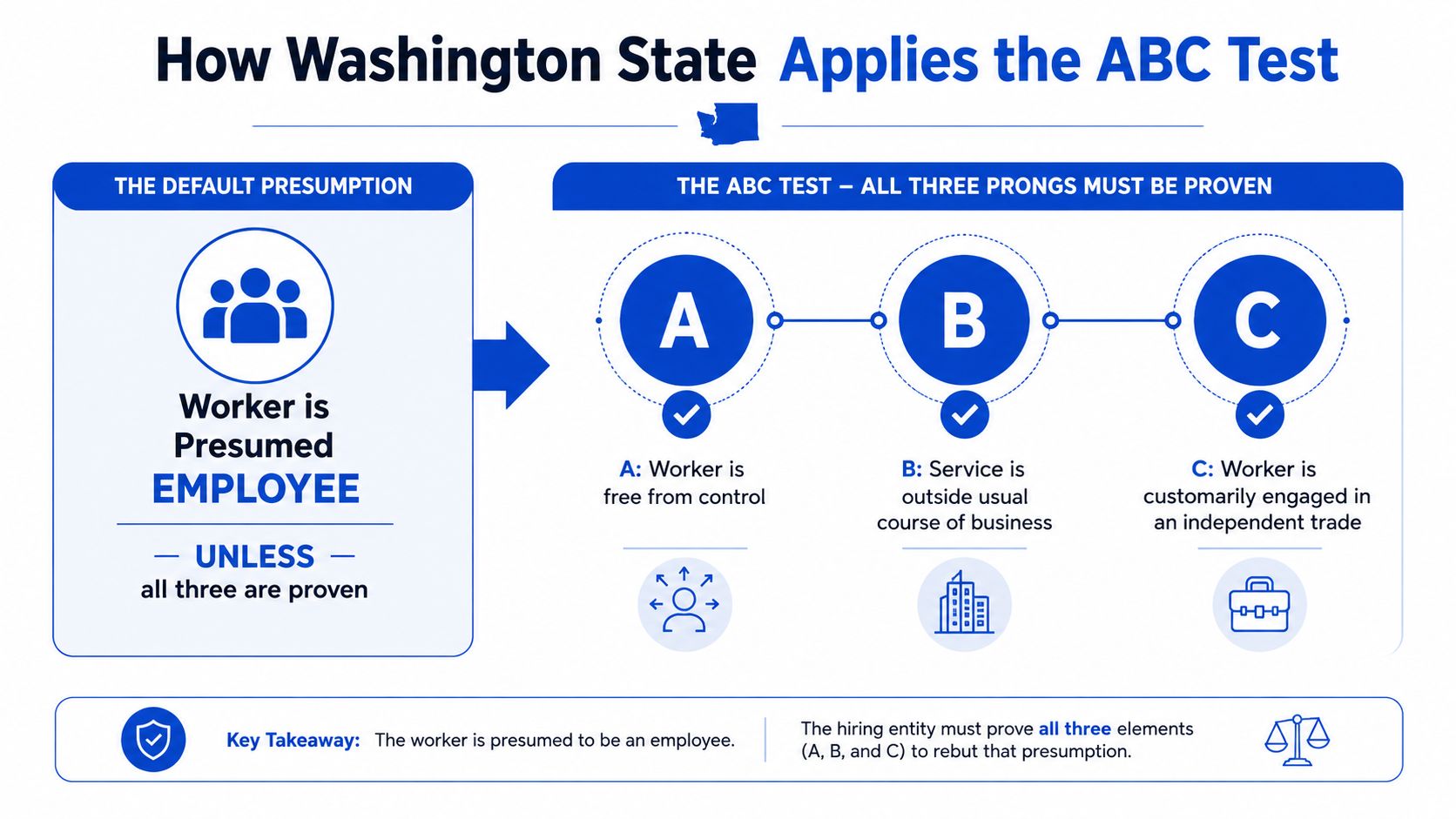
Washington generally starts from a worker-as-employee presumption under the state's ABC framework. For a worker to qualify as an independent contractor under RCW 49.46.130, the hiring entity must establish all three requirements, not merely the one that appears most favorable.
The Washington analysis is severe because failure on one prong can end the inquiry. The state's legal guidance on working with contractors in Washington provides useful context for founders building contractor relationships.
The three prongs
- A, freedom from control: The worker must be free from direction and control in performing the service.
- B, work outside the usual course: The service must fall outside the hiring entity's usual course of business.
- C, independent trade: The worker must be customarily engaged in an independently established trade, occupation, profession, or business.
Prong B is where Washington startups get into trouble. A SaaS company that hires UX designers to build its product is likely using work within its usual course of business. Calling the engagement a special project, pointing to the designer's expertise, or paying by invoice doesn't necessarily move the work outside the company's ordinary business.
Exemptions don't create a shortcut
Washington law contains limited exemptions and special rules for categories such as licensed professionals, real estate agents, investment advisors, truck owners, freelance journalists, and a narrow sales-representative carve-out added in 2024. An exemption must be analyzed carefully. It doesn't permit a company to skip the underlying statutory requirements or assume every skilled professional qualifies.
The practical burden sits with the hiring entity. In an L&I audit or worker-rights action, the company needs contemporaneous evidence for each applicable prong. Federal contractor status doesn't answer the Washington question. A worker can qualify as an independent contractor under a federal analysis and still be an employee under the state ABC test.
The 2025 Enforcement Reset and the 2026 Proposed Rule
The federal government now has a split-brain problem. The Department of Labor announced on May 1, 2025 that Wage and Hour Division investigators would stop applying the 2024 independent-contractor rule in current enforcement matters and return to the older 2008 framework while the rule is reviewed. The DOL enforcement announcement also stated that the 2024 rule remains in effect for private litigation.
That distinction changes the risk calculation. A government investigator may use one framework during an audit, while a former contractor and counsel may rely on the 2024 rule in private FLSA litigation. A founder who asks, “Which test is the actual test?” is asking the wrong operational question. The better question is which forum can evaluate the relationship and which standard that forum may apply.
Federal standards can point in different directions
The IRS continues to use its common-law approach for tax classification. The DOL's enforcement position for current agency matters has shifted back to the 2008 framework, while private litigation can still involve the 2024 rule. Washington applies its own state test, including the ABC framework described above.
| Forum / Agency | Standard Applied in 2025-2026 | Burden of Proof |
|---|---|---|
| IRS | Common-law analysis involving behavioral control, financial control, and the relationship of the parties | The company must support its tax treatment with facts and records |
| DOL enforcement | Older 2008 economic-realities framework while the 2024 rule is reviewed | The agency evaluates the relationship under its enforcement standard |
| Private FLSA litigation | The 2024 rule remains relevant to private litigation | The parties litigate status under the governing law and facts |
| Washington agencies and courts | Washington statutory tests, including the ABC framework where applicable | The hiring entity generally must establish the required elements or exemption |
The Department of Labor announced another proposed rule on February 26, 2026, signaling continued federal churn. The proposal highlights control and opportunity for profit or loss as core factors, with skill, permanence, and integration into an integrated unit of production as additional factors. It would also extend the analysis to the FMLA and MSPA because those statutes incorporate relevant FLSA definitions. The DOL’s 2026 rulemaking page describes the proposal and its framework.
Washington startups should respond with a dual-track posture. The company should test each engagement against the strictest applicable standard, preserve facts supporting independence, and avoid choosing the loosest test merely because it reduces payroll friction.
Penalties, Back Wages, and Your Audit Checklist
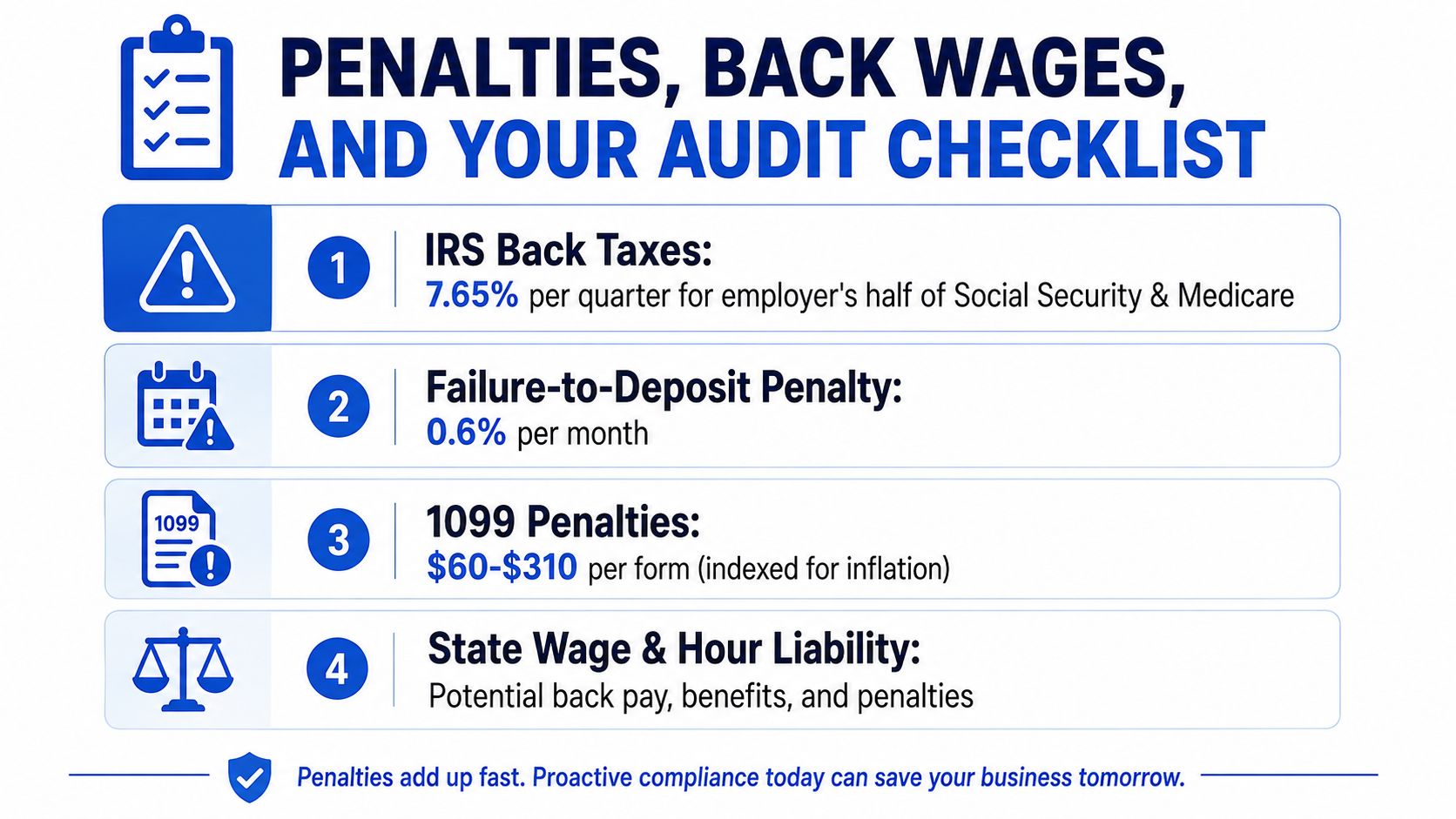
Misclassification exposure stacks. Federal tax issues can coexist with wage claims, state assessments, benefit disputes, and litigation costs. The historic scale explains why agencies continue to focus on the issue. The IRS’s last estimate, for tax year 1984, found that about 15% of employers misclassified 3.4 million workers, with an estimated $1.6 billion in lost federal revenue. The Government Accountability Office later restated that amount as roughly $2.72 billion in inflation-adjusted 2006 dollars, and noted that nearly 60% of the revenue loss came from misclassified individuals who didn’t report and pay income taxes on compensation. Those figures appear in the GAO’s review of contractor misclassification.
More recent state enforcement shows the issue remains measurable. Maryland’s Joint Enforcement Task Force reported 8,170 misclassified workers in 2025 and more than $196 million in underreported wages as of December 12, 2025, according to its 2025 annual report. The figures are Maryland-specific, but they show why founders should treat classification as a financial exposure problem, not a paperwork cleanup.
A practical pre-audit checklist
The company should build an engagement inventory before an agency builds one for it.
- Pull every 1099 engagement: Collect contractor agreements, invoices, payments, amendments, and communications from the prior three years.
- Apply both federal and state analyses: Review each relationship under the IRS factors and the applicable Washington test.
- Reconcile expenses and equipment: Identify company reimbursements, company devices, software access, and other signs of operational integration.
- Audit equity documents: Review vesting, option, and restricted-equity language because equity can make a relationship look more like employment.
- Verify separate businesses: Confirm the contractor has a distinct business identity, tax identification, insurance, and external operations where relevant.
- Document project scope: Define deliverables that sit outside the company’s usual course of business when that position is legally supportable.
- Confirm written contracts: Use a current agreement and a project-specific statement of work.
- Preserve contemporaneous records: Store invoices, correspondence, deliverable approvals, and evidence of client independence.
- Prepare a worker-status memo: Record the facts, governing tests, risks, and decision-maker approval.
- Rehearse document production: Make sure finance, HR, founders, and outside vendors know where responsive records live.
A company reviewing wage concerns can also consult a practical resource on how to file a wage claim. That information is useful for understanding how a worker may approach a dispute, which helps a business anticipate the records and allegations likely to appear.
The internal due-diligence process should sit alongside the company’s broader business diligence checklist, especially before financing, acquisition talks, or a major workforce change.
Contract Language and Documentation That Hold Up
A misclassification defense lives or dies in the paper trail and the parties’ conduct. The contract should describe a relationship that functions like a business-to-business engagement, not an employment arrangement with a contractor label attached.
Clauses should match the real relationship
A strong agreement starts with a defined statement of work. The SOW should identify a finite deliverable, acceptance criteria, and a completion date rather than describe an indefinite role inside the company’s workforce.
Useful provisions include:
- Project-based compensation: Payment by milestone, deliverable, or project is generally more consistent with independent business activity than a wage-like hourly structure.
- Control over methods: The contractor should control how the work is performed, subject to legitimate quality, safety, security, and deadline requirements.
- Independent pricing: The agreement should avoid language suggesting the company sets a wage or guarantees continued work.
- Separate business activity: The contractor should be free to serve other clients, subject to legitimate confidentiality and conflict protections.
- Limited reimbursement: The contractor should bear ordinary business expenses unless a project-specific expense is expressly approved.
- Business responsibility: The agreement can require appropriate insurance, licenses, taxes, and tools where those obligations reflect actual practice.
An open-ended termination provision can be useful, but it won’t rescue a relationship that operates like a permanent job. A clause acknowledging that the contractor may work for others also has limited value if the company expects exclusivity in practice.
Records must prove behavior
The company should keep signed SOWs, outcome-focused invoices, deliverable approvals, and communications showing the contractor operated independently. Evidence of separate business insurance, an LLC or other business entity, a tax ID, contractor-owned tools, contractor-selected software, and independent marketing can strengthen the record when those facts are genuine.
A service agreement resource for contractors can help founders distinguish a general agreement from the project-specific documents that make the relationship understandable.
Several common mistakes undermine otherwise careful drafting. A 1099-NEC filing alone doesn’t establish status. Intellectual-property assignment language should be scoped to the work rather than copied from an employee form. Equity grants deserve special review because vesting schedules, company control, and ongoing service expectations can point toward employee treatment.
The best contract is the one the company’s managers can follow without quietly converting the contractor into staff.
When to Stop Self-Auditing and Call Counsel
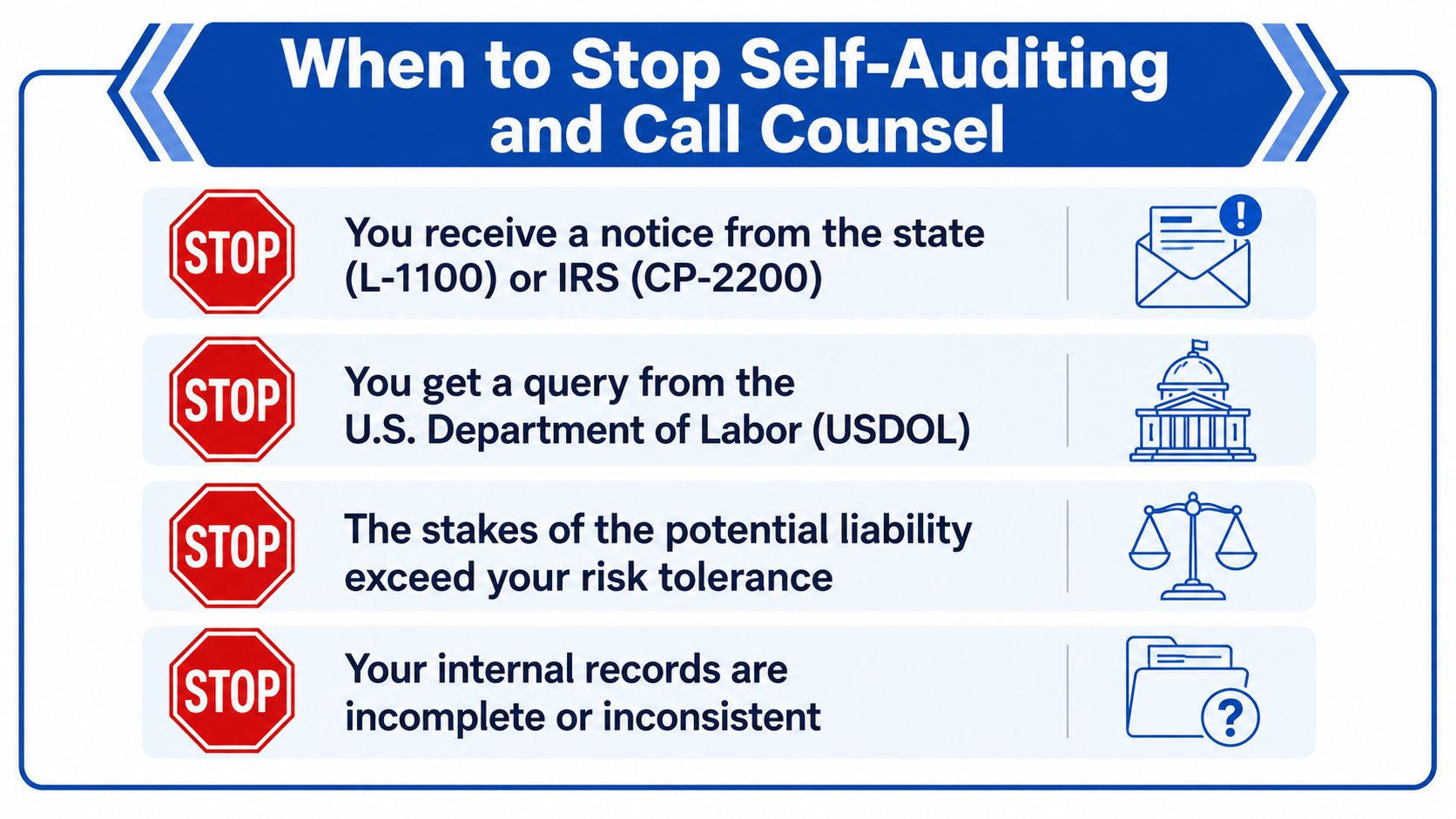
Self-auditing ends when the company loses control of timing, scope, or document preservation. Stop and call counsel if an agency notice arrives, a worker files a wage or unemployment complaint, a contractor is injured, or a buyer or investor raises classification during diligence.
Escalate sooner when records are incomplete, managers imposed employee-like schedules, or a contractor’s engagement has become a long-running operational role. One relationship can trigger overlapping tax, wage, unemployment, and benefits claims. Rushed reclassification can also create admissions or conflicting explanations.
Escalation points founders shouldn’t ignore
- An IRS notice arrives: Preserve the notice, tax filings, contracts, and payment records before responding.
- L&I, ESD, or the DOL makes contact: Use one coordinated response team and avoid informal explanations.
- A worker files a claim: Treat the complaint as potential litigation evidence, not a routine payroll question.
- A transaction is pending: Address classification gaps before diligence turns them into a pricing or closing issue.
- The records conflict: Inconsistent contracts, invoices, schedules, and manager communications require legal review.
Counsel can organize a focused 30-day sprint covering a document hold, voluntary reclassification analysis, exposure mapping, and a settlement playbook. If the company is weighing mediation versus litigation, counsel should first review the forum, records, and potential worker group.
A founder who asks, “Which test applies here?” is asking the wrong operational question. The company needs one coordinated response to the 2025-2026 federal split, where the DOL uses the 2008 framework for audits while the 2024 rule still applies in private lawsuits. Washington startups should not let that gap produce inconsistent positions.
By Design Law Firm & Legal Consultancy, PLLC helps Washington founders audit contractor relationships, draft practical agreements, and respond to IRS, DOL, and state classification risks. Visit By Design Law Firm & Legal Consultancy, PLLC to discuss a focused classification review or urgent response plan. Contact our law office today at (206) 593-1519.