An offer letter lands with a salary, a bonus target, and a line that says “stock options.” The equity sounds valuable, but the document may leave basic questions unanswered. How many options are there really? What price must be paid? When can the employee exercise them, and what happens if the company remains private?
Those questions matter because an option isn't cash, and it isn't the same as owning shares today. It's a conditional opportunity whose value depends on the company's growth, the plan's rules, tax timing, and whether a future buyer or public market ever provides liquidity. A grant can become meaningful compensation, but it can also create a tax bill before the employee has money from a sale.
This guide offers a plain-English approach to stock options for employees explained from the first grant through vesting, exercise, taxation, dilution, and negotiation. It also shows why founders should treat equity documents and cap-table records as operating tools, not paperwork afterthoughts. Companies preparing to raise capital can review related considerations in this guide to funding and seeding.
Key concept: An employee stock option is a right to buy shares later at a fixed price. The right can have substantial value, but only if the employee understands the conditions attached to it.
Introduction to Employee Stock Options Without the Confusion
Employee stock options became a significant compensation mechanism because companies can use future ownership to compete for talent without matching every offer with cash-heavy pay. Historical data from the U.S. Bureau of Labor Statistics shows that options were granted to 1.7% of private-sector workers in 1999, while the rate was about 12% for white-collar employees, 6% for blue-collar workers, and 2% for service workers. The same research found that the share reached 12.9% among higher-paid workers, demonstrating how concentrated grants were in better-paid roles. The BLS survey provides the historical context.
The broader history is even older. Researchers report that the first U.S. employee stock ownership plan was created in 1956, after the Revenue Act of 1950 introduced tax-advantaged restricted stock options for employees. The National Center for Employee Ownership reports 6,609 U.S. ESOPs, holding more than $2 trillion in assets and covering 15.1 million participants, including more than 10.9 million active participants. A separate research summary says about 18% of employees, roughly 25 million U.S. workers, have some ownership stake in their employer, while 8% have employee stock options. Rutgers' historical overview explains the development of employee ownership.
For an employee, the practical questions are straightforward even when the legal documents aren't:
- What was granted? The number and type of options matter.
- What must be paid? The strike price determines the exercise cost.
- When is the right earned? Vesting controls when options become exercisable.
- When could tax arise? The answer depends on the option type and transaction.
- Can the shares be sold? A private-company grant may remain illiquid for years.
A useful evaluation starts with the grant agreement, the equity incentive plan, the company's current valuation information, and the post-termination rules. The attractive headline number is only one part of the compensation package. Value lies in the relationship between the strike price, the company's prospects, the employee's time horizon, and the cash required to exercise and pay taxes.
What Employee Stock Options Are and How They Actually Work
An employee stock option works like a reservation for a future purchase. A company gives an employee the right to buy a stated number of shares at a fixed price, called the strike price or exercise price, during a defined period. The employee doesn't receive the shares merely because the grant appears in an offer letter.
The mechanics become clearer through five terms:
- Grant: The company awards the contractual right to purchase shares.
- Strike price: The employee's fixed purchase price per share.
- Grant date: The date the award is approved and issued under the plan.
- Vesting: The process through which the employee earns the right to exercise.
- Expiration: The final date by which the option must be exercised, subject to the plan and termination rules.
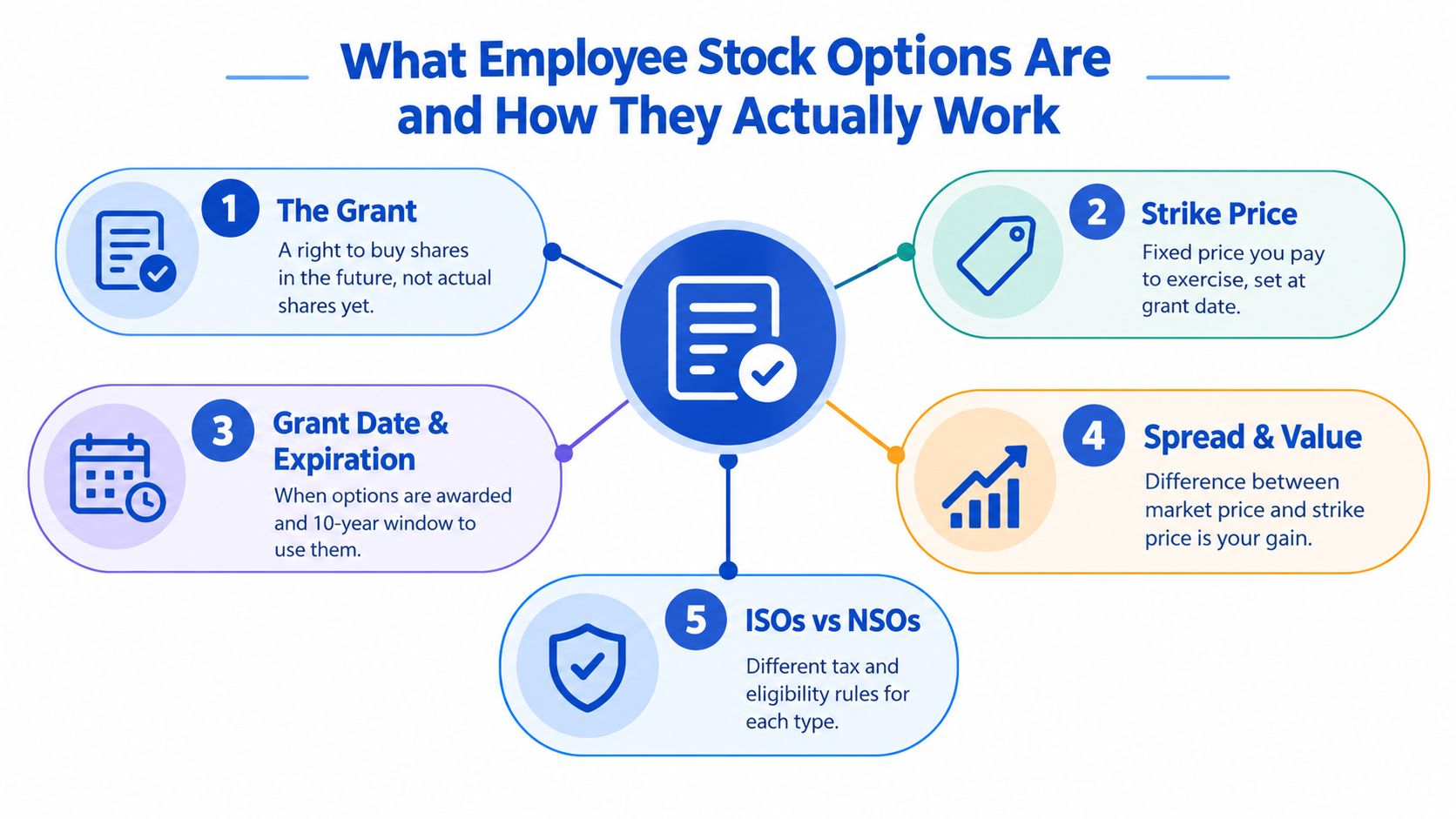
Suppose an employee receives an option to buy shares at a strike price of $5. If the company's share value later exceeds $5, the difference is commonly called the spread. The option may then be “in the money.” If the company's share value stays at or below the strike price, exercising may offer little economic benefit and may expose the employee to unnecessary cost or risk.
An option differs from outright stock. A shareholder generally owns shares and may have rights under the company's governing documents. An option holder owns a contractual right, subject to vesting, exercise, expiration, plan terms, and securities-law restrictions. The grant itself doesn't guarantee a profit, a public offering, a buyer, or a market in which the shares can be sold.
Practical rule: Employees should treat the grant agreement as a timeline and a set of conditions, not as proof that the stated option count equals current wealth.
The same discipline applies to investment options outside employment. Employees comparing workplace equity with other option arrangements can benefit from this discussion of broker options losses, especially because “option” can describe very different legal and financial products.
The company also retains a meaningful role. Its board typically approves grants, the plan defines the limits, and the cap table records the award and its status. A careful holder should obtain the plan, the individual award agreement, the vesting schedule, the exercise procedure, and the expiration provisions before assigning a value to the grant.
ISOs vs NSOs and Other Equity Choices You Will Encounter
Suppose your offer says you will receive stock options, but does not explain whether they are ISOs or NSOs. That label affects who may receive the award, how payroll withholding works, and when a tax bill may appear. The distinction can also change the cash you need before any shares can be sold.
Incentive stock options, or ISOs, are generally available only to employees. They receive special statutory treatment when the plan, grant, and holding requirements qualify. The IRS limits the stock underlying ISOs that first become exercisable in a calendar year to $100,000, measured by grant-date fair market value. IRS Publication 5992 explains the ISO limitation. ISOs may also create alternative minimum tax exposure, so an exercise decision should account for more than the stated strike price.
Nonstatutory stock options, or NSOs, can generally be granted to employees and, when permitted, other service providers. A U.S. federal tax charge generally arises at exercise on the difference between the stock's fair market value and the exercise price. The IRS tax topic on nonstatutory options describes that treatment. In a private company, this can produce taxable income without an available buyer for the shares. The holder may need cash for both the exercise and the tax before liquidity arrives.
| Feature | ISOs | NSOs | RSUs / ESPP |
|---|---|---|---|
| Typical recipient | Employees meeting statutory requirements | Employees and, when permitted, other service providers | Employees, with plan-specific rules |
| What the holder receives | A right to buy shares | A right to buy shares | RSUs generally settle in shares or cash after vesting; an ESPP permits purchases under a Section 423 plan |
| Main tax question | Whether special treatment applies and whether alternative minimum tax may arise | Tax generally arises at exercise on the spread | Under a Section 423 ESPP, tax is generally recognized when the stock is sold |
| Exercise cost | The employee pays the strike price | The employee pays the strike price | RSUs generally don't require an exercise payment |
| Key limitation | Annual exercisability limit and statutory requirements | Plan and tax rules govern | Plan terms and Section 423 requirements govern |
A Section 423 employee stock purchase plan follows a different path. The IRS generally recognizes tax when the stock is sold, rather than when the option is granted or exercised. The taxable amount reflects the difference between what the employee paid and receives on sale, with portions potentially treated as ordinary income and capital gain or loss. The IRS explains Section 423 ESPP treatment.
RSUs usually do not require the employee to buy shares. After vesting, the plan delivers shares or a cash equivalent, subject to its terms. Preferred stock is a separate ownership class with distinct rights and preferences. Employees and founders comparing equity should first understand what preferred stock is, because an employee award commonly relates to a different class of equity.
For founders, the choice should fit the hiring goal, company stage, recipient’s role, and administrative capacity. Clear planning can help a company attract top talent with compensation while presenting the grant accurately. For an employee, ask four questions before accepting or exercising: What tax may arise, when is cash required, can the shares be sold, and what happens if employment ends?
How Grants Vesting Exercise and Liquidity Fit Together
A grant becomes useful only through a sequence of events. The company issues the award, the employee satisfies vesting conditions, the employee exercises vested options, and a liquidity event may eventually permit a sale. Each stage has a separate risk.
The grant document identifies the award, price, type, and schedule. Vesting determines when the employee earns the right to exercise. A schedule may include a cliff, meaning no options vest until a specified service milestone, followed by periodic vesting. Some plans provide acceleration if the company is acquired or the employee experiences a qualifying termination, but acceleration isn’t automatic and must be written into the governing documents.
After vesting, exercise means buying the shares. The employee pays the strike price and follows the company’s exercise process. In a public company, shares may be saleable subject to securities rules, trading windows, and company policies. In a private company, the employee may own shares after exercise but lack any immediate buyer.
An employee leaving the company faces a separate deadline. One SEC-filed plan provides a U.S. participant whose service ends for reasons other than death or disability three months to exercise vested options, or until expiration if sooner. Another SEC-filed plan provides a 90-day period after involuntary termination. These examples don’t replace the employee’s own plan, but they show why an exit review must happen immediately. The filed plan terms provide one example of a three-month window.
Liquidity changes the decision
A private-company option can be economically valuable on paper while remaining impossible to monetize. The employee may need company approval for a transfer, may face a right of first refusal, or may have to wait for an acquisition, tender offer, or public listing. The company’s share value can also change before a sale becomes available.
Dilution affects the value of each share. New grants and other equity issuances increase the potential share count, while the treasury stock method considers exercise proceeds when estimating the incremental effect of in-the-money options. The SEC describes how option accounting and dilution analysis intersect, including the use of models such as Black-Scholes-Merton and binomial models for fair-value measurement. The SEC testimony discusses option valuation and the treasury stock method.
Employees evaluating a grant can use a timeline: vested options, exercise cost, estimated tax, transfer restrictions, expiration, and possible liquidity events. A separate framework for modeling option value with Total Comp can help organize the economic assumptions without treating an estimate as a promise.
Tax Timing and the Dry Income Problem Every Holder Should Understand
A private-company employee exercises vested options, pays the exercise price, and receives shares that cannot yet be sold. The exercise can also create a tax bill based on the spread, the difference between the shares’ fair market value and the exercise price. Cash has left the employee’s account, but the shares may produce no cash for years.
For a U.S. nonstatutory option, the grant itself is generally not taxable. Exercise generally creates ordinary income on the spread. If the shares remain subject to a substantial risk of forfeiture, applicable rules can affect when that income is recognized. The IRS describes the treatment of nonstatutory options.
That mismatch is called dry income. It resembles receiving a valuable house that cannot be sold while still owing tax on its value. The employee owns an asset, yet the tax authority expects payment before a sale makes cash available.
Finland’s 2026 proposal would defer taxation until shares are disposed of to address dry income. Luxembourg’s 2026 draft regime would similarly move taxation toward disposal for qualifying plans. These are proposed policy changes, not U.S. rules, but they show why policymakers are examining tax triggered before liquidity. Luxembourg’s proposal and its dry-income rationale are discussed by EY.
The tax questions that should come first
Before exercising, an employee should identify:
- Option type: Confirm whether the award is an ISO, NSO, or another equity instrument.
- Fair market value: Ask how the company determined the value used for tax and exercise purposes.
- Cash requirement: Calculate the exercise cost separately from expected tax and withholding.
- Sale restrictions: Confirm whether the shares can be sold immediately, only during a company-approved transaction, or not at all.
- Filing obligations: Ask a tax professional whether an 83(b) election, alternative minimum tax analysis, or another filing applies to the transaction.
ISOs can avoid regular income tax at exercise in some circumstances, but exercise may create alternative minimum tax exposure. The special treatment also depends on statutory requirements and holding rules. A Section 423 ESPP follows a different pattern, with tax generally recognized at sale rather than grant or exercise, as described earlier.
The decision depends on valuation, available cash, tax treatment, forfeiture risk, transfer restrictions, and the likelihood of a liquidity event. Compare the exercise cost and estimated tax with the time you may need to hold the shares. Ask whether the company offers a tender opportunity or other approved sale path. A tax adviser should model the transaction before funds are sent, especially for private-company shares.
Employer Obligations Cap Table Impact and Negotiation Tips That Work
An option grant affects the company’s books, ownership records, financing plans, and the employee’s practical ability to receive value. Under U.S. accounting rules, companies generally measure employee stock options at grant-date fair value using an option-pricing model, such as Black-Scholes-Merton or a binomial model, then recognize the expense over the vesting period. That accounting expense does not determine the employee’s tax bill. Legal, finance, payroll, and capitalization table management therefore need to work from consistent grant records.
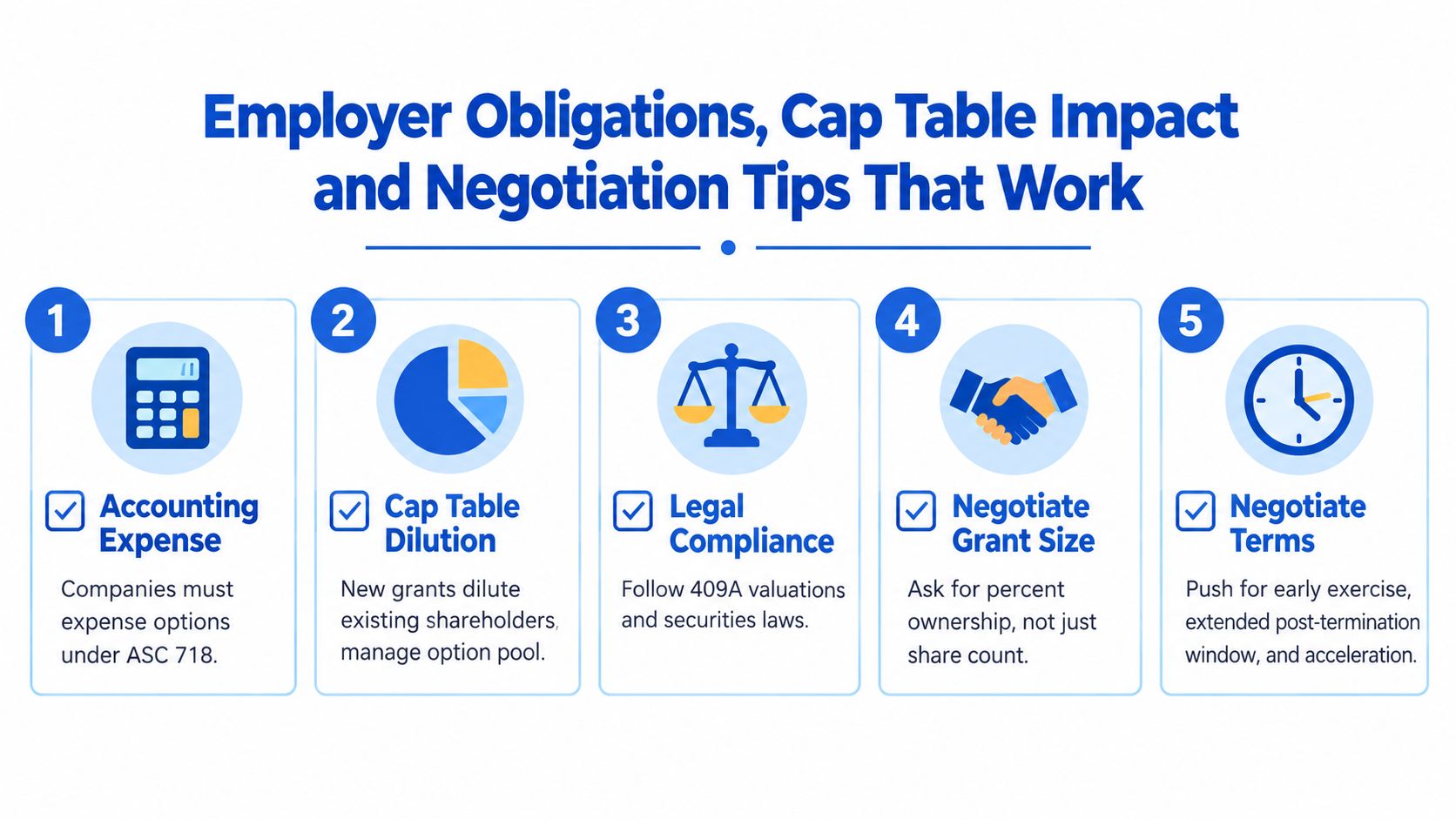
A useful cap table records the grant date, option count, exercise price, vesting schedule, cliff, current status, and any exercise or termination event. For public-company reporting, the treasury stock method assumes in-the-money options are exercised and uses the exercise proceeds to offset part of the added share count. The resulting option overhang can affect reported per-share value and discussions with investors or employees.
For founders: An option count without its ownership context can give candidates the wrong impression. A credible offer should explain the stated capitalization basis, vesting terms, exercise conditions, and restrictions that determine whether the grant can produce cash.
Employees can negotiate the conditions surrounding a grant, not only its size. Ask:
- Ownership context: What percentage does the grant represent on the company’s stated capitalization basis?
- Vesting protection: What are the cliff, ongoing vesting, and any single-trigger or double-trigger acceleration terms?
- Exit flexibility: Is early exercise available? Does the company offer a longer post-termination exercise period or a company-sponsored liquidity program?
- Information access: How will employees receive valuation updates, plan notices, exercise instructions, and transaction information?
- Tax coordination: Which withholding process applies, and will the company provide tax documents or access to a specialist?
These questions matter because private-company options can create dry income. An employee may owe tax or withholding after exercise while the shares remain restricted and unsellable. Before accepting or exercising, compare the cash required today with the realistic paths to liquidity, rather than treating the stated share value as available cash.
The company should document board approval, maintain the option pool, update valuations, follow securities requirements, and communicate changes consistently. Missing cancelled, exercised, or forfeited awards can distort financing work and negotiations. Teams responsible for these records should review the company’s process as part of broader governance.
Making Smart Decisions With Your Stock Options Going Forward
A sound option decision begins with verification, not excitement. The employee should collect the plan, grant agreement, vesting schedule, current exercise price, expiration date, termination rules, transfer restrictions, and the company’s explanation of fair market value. The employee should then separate three questions: Can the options be exercised? Can the shares be sold? Can the taxes be paid without relying on a future sale?
The practical checklist is short:
- Read the deadline: Record vesting dates, expiration, and the post-termination exercise period.
- Classify the award: Identify ISO, NSO, RSU, or ESPP treatment.
- Model the cash: Include the exercise price, estimated tax, withholding, and the possibility that shares remain illiquid.
- Assess concentration: Consider whether exercising would tie too much personal wealth to one employer.
- Get advice before acting: Consult tax and legal professionals when the grant involves a private company, a large spread, a termination, an 83(b) election, or a possible liquidity event.
Founders should apply the same discipline in reverse. A clear plan, accurate cap table, approved grants, and candid communication protect both retention goals and employee trust. For readers reviewing the ownership consequences of future grants, what equity dilution means provides useful context.
Employees should act promptly when a deadline is approaching, but waiting can be sensible when exercise creates a large unfunded tax obligation or the shares have no realistic path to liquidity. The right time to call counsel is before the irreversible step, not after a missed exercise window, unexpected tax bill, or disputed ownership record.
By Design Law Firm & Legal Consultancy, PLLC advises founders and employees on equity plans, grant documentation, cap-table governance, and the legal issues surrounding exercise and liquidity. Visit By Design Law Firm & Legal Consultancy, PLLC to discuss an option arrangement before signing, exercising, terminating employment, or negotiating revised terms. Call our law office at (206) 593-1519.