A Seattle founder sits at the kitchen table with a laptop open, a coffee going cold, and a Washington filing form one click away from submission. Last night's choice was “LLC” because that's what every startup checklist seemed to say. This morning, the question feels heavier. Is that structure right for the business, the tax plan, the co-founder relationship, and the chance that an investor shows up later?
That pause is smart.
Entity choice is the first legal decision that controls a lot of what happens next. It affects whether business income lands directly on the owner's return or gets taxed at the entity level first. It affects whether a founder's personal assets are exposed when the business signs a lease, misses payroll, or gets sued. It affects governance, ownership transfers, fundraising, and how ugly a breakup can get if the founders never wrote down the rules.
Most online guides flatten this into a quiz. That's a mistake. A founder doesn't need generic advice. A founder needs a structure that fits the actual plan.
The Decision Every New Founder Has to Make
A founder in Ballard who sells design services from home has a different legal problem than a biotech team in South Lake Union trying to build a cap table investors will accept. Both are starting businesses. They should not file the same way by default.
Why this decision matters early
The legal form picked at formation does three things immediately:
- Sets the tax starting point. Some structures push income straight to the owners. Others create a separate taxpaying entity.
- Defines liability boundaries. Some structures leave the owner personally exposed by default. Others create a liability shield, at least if the business is run properly.
- Creates governance rules. Ownership, voting, transfer rights, and decision-making all get easier or harder depending on the structure.
A lot of founders overthink the label and underthink the consequences. The label matters less than the mechanics behind it. That's why any founder trying to choose your business entity should focus on taxes, liability, capital needs, and state compliance instead of trend-following.
Practical rule: If a founder expects co-owners, outside money, meaningful contracts, or any real liability exposure, filing first and “fixing it later” is usually the expensive path.
Where Washington founders get tripped up
Washington founders also make a very specific mistake. They read national advice, form in another state because it sounds advanced, and then discover they still have to register and comply where the business operates. That issue is laid out clearly in this discussion of out-of-state LLC formation pitfalls.
The right starting question isn't “What do startups use?” It's simpler. What is this business trying to become in the next twelve to twenty-four months? A solo consultant, a cash-flowing services firm, a real estate holding company, a venture-backed startup, or a mission-driven nonprofit all need different answers.
The Core Business Formation Types at a Glance
Founders usually encounter the same set of business formation types over and over. That's because most real businesses cluster into a handful of practical structures, even though business law offers more specialized options.
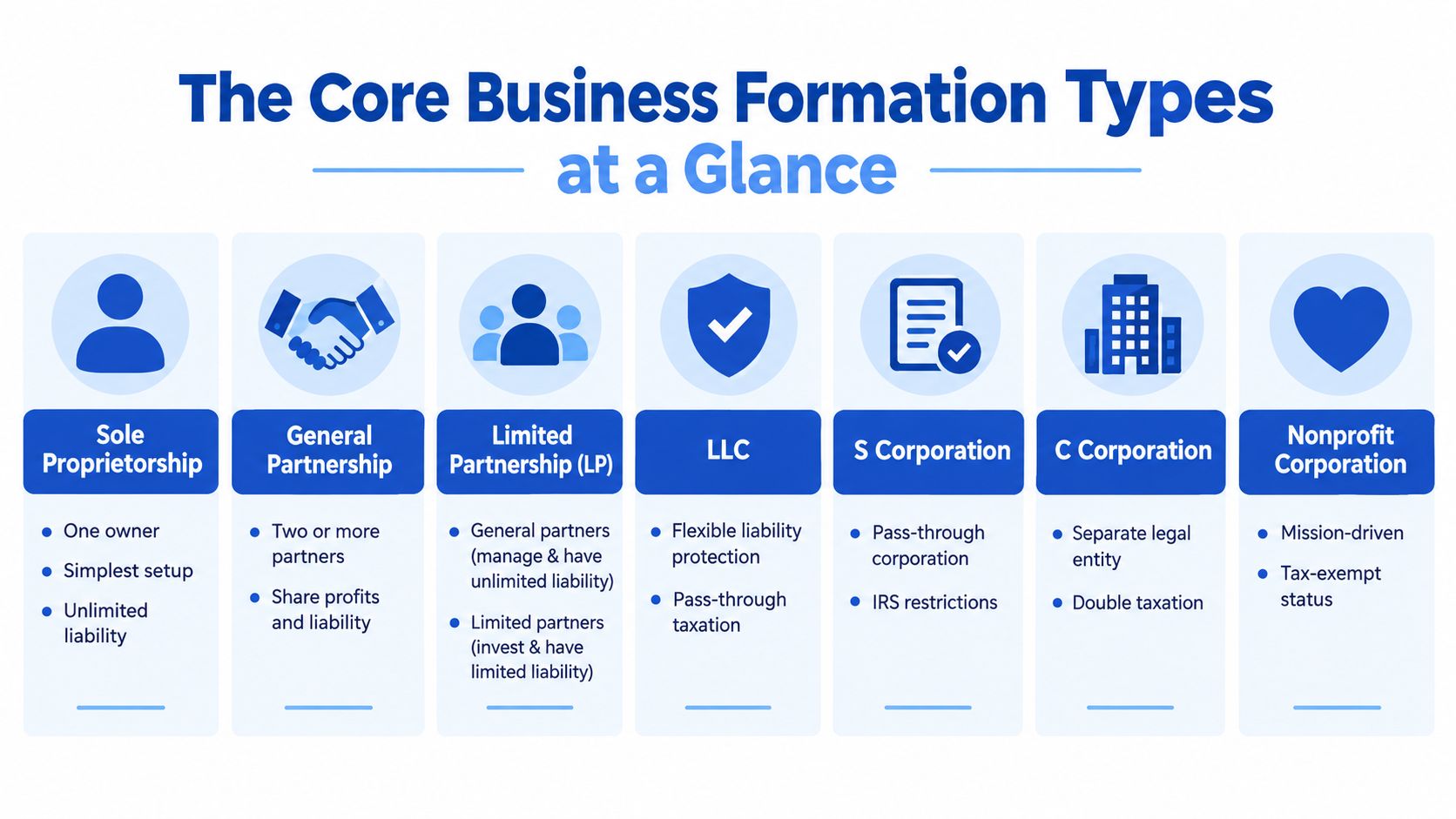
Seven forms that matter most
-
Sole proprietorship. Think freelance designer or solo bookkeeper. One owner, no separate entity by default, business income typically lands on the owner's return, and the owner is personally liable.
-
General partnership. Think two friends splitting rent on a small studio and working together without forming an entity. Two or more owners, pass-through taxation by default, and each partner can be personally liable for partnership obligations.
-
Limited partnership or LP. Think a deal with an active manager and a silent investor. At least one general partner manages and bears broad liability exposure, while limited partners usually invest without taking on the same management role.
-
Limited liability company or LLC. Think a consultant, agency owner, or rental property operator who wants liability protection with flexible tax treatment. An LLC is formed under state law, and the IRS says a domestic LLC is default-classified as a disregarded entity if it has one member, a partnership if it has two or more members, and it can elect corporate tax treatment with the proper filing (IRS LLC classification rules).
A quick visual helps separate these forms before getting into tax detail:
-
S corporation. Think a profitable owner-operated consulting business that wants corporate form with pass-through tax treatment. The IRS identifies S corporation as one of the common U.S. business structures, separate from the fact that an LLC may also elect different tax treatment (IRS business structures overview).
-
C corporation. Think venture-backed software startup. Separate legal entity, formal governance, stock-based ownership, and taxation at the entity level.
-
Nonprofit corporation. Think a community arts organization or educational initiative. Mission-driven, organized under nonprofit corporate law, and often formed to pursue tax-exempt status if the organization qualifies.
A plain-English way to sort them
A sole proprietorship is easiest to start and easiest to regret once risk shows up. A general partnership is the same problem, multiplied by another person.
LLCs are the practical middle ground for many operating businesses. Corporations are more rigid, but that rigidity is often exactly what investors, employee equity plans, and formal governance require. For a one-person operation that just needs cleaner books, a tool like sole trader expense tracking with Snyp can help organize records, but recordkeeping software doesn't solve entity choice. The legal structure still has to fit the plan.
How Each Structure Handles Taxes and Liability
Founders usually obsess over formation speed and ignore the issue. Tax treatment and liability exposure are the engine under the hood. The entity name on the filing matters because it changes how the law treats income, losses, governance, and owner risk.
The core split
The IRS and SBA describe LLCs and corporations as separate legal entities formed under state law, and both generally shield owners from personal liability for business debts. The important difference is tax and governance architecture. LLCs default to pass-through taxation unless an election is made, while corporations are typically taxed at the entity level under C-corp treatment (SBA business structure guidance).
That means a founder choosing between an LLC and a corporation is usually deciding between tax flexibility and capital-raising standardization.
An LLC can limit liability and still leave the owner personally exposed on obligations the owner signs personally, like a lease guaranty. Founders often miss that point.
Tax and Liability Outcomes by Entity Type
| Entity Type | Federal Tax Treatment | Washington Tax Treatment | Personal Liability | Key Trade-Off |
|---|---|---|---|---|
| Sole Proprietorship | Owner reports business income directly | State-level treatment depends on activity, registration, and tax obligations | Owner is personally liable | Simple, but legally exposed |
| General Partnership | Pass-through by default | State-level treatment depends on activity and registration | Partners can be personally liable | Easy to start, risky to operate |
| LLC | Default classification depends on members and elections | State-level treatment depends on activity and tax registration | Generally limited liability, subject to personal guarantees and bad formalities | Flexible tax treatment, less standardized for outside investment |
| S Corporation | Pass-through corporation under IRS rules | State-level treatment depends on activity and filings | Generally limited liability | Good fit for some owner-operated firms, but comes with corporate formalities |
| C Corporation | Entity-level taxation | State-level treatment depends on activity and registration | Generally limited liability | Best for scalable equity financing, more formal and potentially less tax-flexible |
Washington-specific tax consequences depend on what the business does, where it operates, and which registrations it needs. Entity selection doesn't replace tax analysis.
What founders underthink
A lot of founders need less Reddit and more planning. Multi-owner companies need written economics and control terms from day one. Investor-facing startups need corporate housekeeping that won't scare off diligence. A founder comparing those paths can use startup corporate law guidance to evaluate whether the business really needs a corporation now or just thinks it does.
The shortcut answer is this:
- Pick a sole proprietorship only when the business is small, low-risk, and likely to stay that way for a while.
- Pick an LLC when the founder wants liability protection and operational flexibility.
- Pick a C corporation when the business expects outside equity financing, option grants, or a formal stock structure.
- Use an S corporation carefully when pass-through treatment and corporate form make sense for a profitable closely held business.
What the Latest Formation Data Tells Founders
The data gives context, not a verdict. It shows what real founders commonly choose. It does not choose for them.
What dominates in the United States
Among U.S. nonemployer firms, sole proprietorships account for 86.7% of nonemployer businesses, while among small employer firms, sole proprietorships make up 12.3%, S corporations 55.0%, and C corporations and other entities 13.9% according to the SBA Office of Advocacy's small business facts publication (SBA data summary).
That split says something important. Very small, owner-operated businesses often stay informal or simple. Once a business hires people and grows into a true employer, owners tend to move toward structures with stronger liability protection, tax planning options, or governance rules.
Another formation trend matters even more for new founders. Independent formation research describes the LLC as the most common entity choice for new U.S. formations, with one recent industry analysis estimating that roughly 85% of new entity formations are LLCs (entity comparison analysis).
U.S. Business Entity Distribution by Type 2025-2026 Estimates
| Entity Type | Approx. Share of Entities | Typical Use Pattern |
|---|---|---|
| Sole Proprietorship | 86.7% of nonemployer businesses | One-person and very small owner-operated activity |
| Sole Proprietorship | 12.3% of small employer firms | Smaller share once the business hires employees |
| S Corporation | 55.0% of small employer firms | Common among established employer businesses |
| C Corporation and Other Entities | 13.9% of small employer firms | More formal or specialized structures |
| LLC | Roughly 85% of new entity formations | Default starting point for many new formations |
What the data can’t tell a founder
It can’t tell whether a Seattle software startup should issue stock to founders and reserve equity for hires. It can’t tell whether a two-member consulting shop needs flexible profit allocations. It can’t tell whether a founder plans to stay small on purpose.
Use the numbers to see the market. Don’t use them to outsource judgment.
That’s especially true because formation activity isn’t concentrated only in a few coastal markets anymore. A recent business trends report states that in 2025, U.S. business formations rose 6.5% to nearly 5.5 million across 47 states, with Florida, California, Texas, Delaware, and New York making up about 40% of all formations, while Texas grew 8.4% and New York 9.7% (2025 new business trends report). The practical takeaway is simple. State-specific filing, tax, and operating realities matter more than generic national startup advice admits.
Filing and Compliance Basics for Washington State
Once the entity is chosen, Washington requires actual maintenance. The filing isn’t the finish line. It’s the opening move.
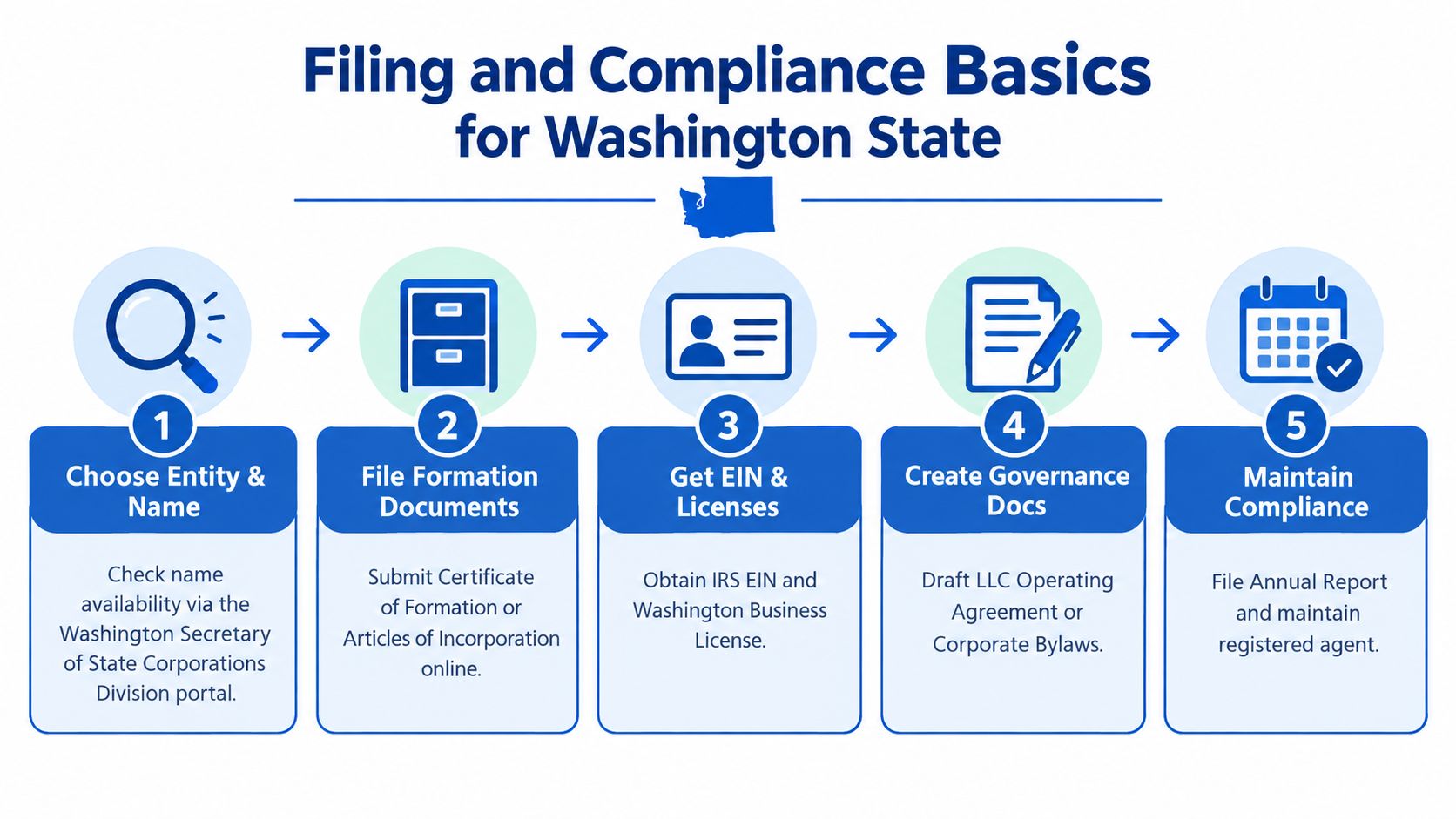
What gets filed
Washington businesses generally form through the Secretary of State’s business filing system. LLCs typically file a Certificate of Formation. Corporations and nonprofits typically file Articles of Incorporation. Founders also need a registered agent and basic governance documents, even when the state doesn’t ask to see them at filing.
A founder who wants a procedural walkthrough can review how to incorporate a business, especially when deciding between an LLC filing and a corporate filing package.
The Washington compliance items that matter
- Annual report requirement: Washington requires all domestic and foreign business entities to file an Annual Report every year to keep active status and maintain the UBI in good standing. The report is due by the last day of the month in which the entity was formed or registered, and it can be filed up to 180 days before that date (Washington annual report rules).
- Annual report fee: Washington’s annual report filing fee is $70 for profit business entity types including LLCs when filed by mail or in person, and the state adds a $25 delinquency fee if the entity is listed as delinquent (Washington filing fees information).
- UBI matters: The Unified Business Identifier is the business’s state identifier used across agencies. It ties into licensing, tax registration, and practical operations like banking and vendor setup.
What founders often miss
The UBI isn’t the same thing as an EIN. The EIN comes from the IRS for federal tax administration. The UBI is Washington’s state-level business identifier. Most operating companies need both.
The founder also needs internal documents that fit the entity:
- For an LLC: an operating agreement with ownership, management, voting, exit rights, and dispute rules.
- For a corporation: bylaws, initial resolutions, stock issuance records, and a clear founder equity paper trail.
- For a nonprofit: governance documents that line up with the organization’s charitable purpose and later exemption goals.
State filing creates the shell. Internal documents decide how the shell actually works when money, conflict, or growth appears.
Matching the Right Entity to Your Founder Goals
The standard LLC-versus-corporation debate is too shallow. The better question is what the founder wants the business to do.
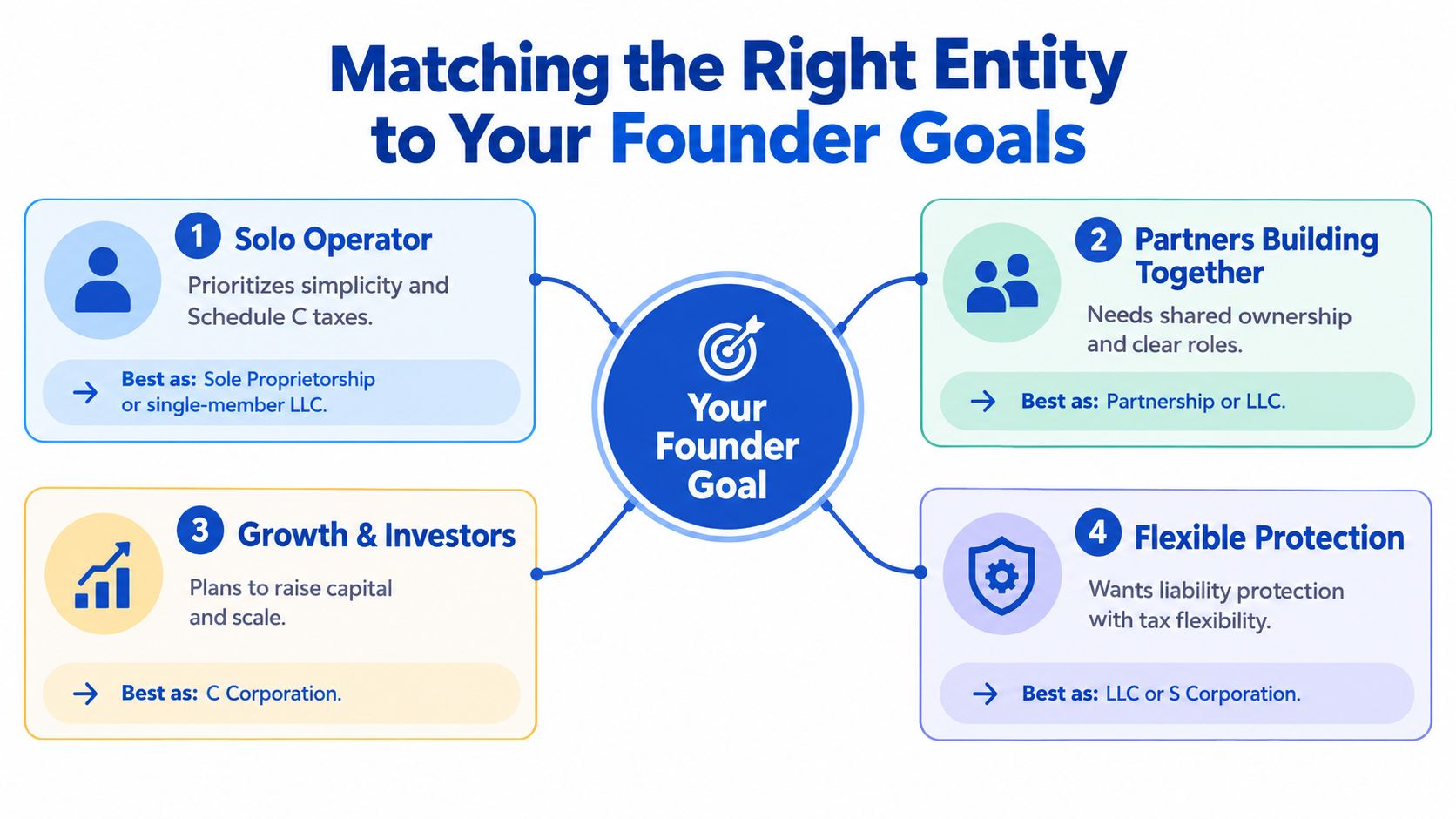
Goal one stays small and simple
A solo operator who sells services, keeps risk low, and wants the least friction may start as a sole proprietorship or a single-member LLC. The sole proprietorship is cheaper and simpler at the very beginning. The single-member LLC is usually the smarter move once contracts, clients, subcontractors, or meaningful liability enter the picture.
The trade-off is obvious. Simplicity costs less upfront. It also protects less.
Goal two builds with a partner
Two founders who want shared ownership and flexibility usually fit an LLC better than a default general partnership. The reason isn’t fashion. It’s because an LLC lets the founders define voting rules, economics, management authority, and exit rights in an operating agreement while preserving limited liability in the normal case.
That’s often the right answer for agencies, consulting firms, productized services businesses, family ventures, and closely held operating companies. A founder evaluating that path can compare options through a more industry-specific lens in this discussion of the best business entity for consulting.
Goal three raises money and scales
A startup that expects outside equity investment usually should start as a C corporation. Not because every startup is destined for venture capital, but because investors, stock plans, board governance, and cap-table mechanics are far cleaner in that structure.
A founder who says “maybe someday” but has no real investor plan shouldn’t force a corporation too early. A founder who already expects a priced round, institutional investors, or broad equity grants usually shouldn’t pretend an LLC will be easier. It won’t.
Goal four serves a mission
A team launching a charitable, educational, or community-driven venture should usually start with a nonprofit corporation if tax-exempt status is the destination. Forming as a for-profit entity first and trying to retrofit the organization later often creates avoidable cleanup.
There’s also a global signal worth noting. In India, founder behavior has shifted toward structures that prioritize control and simpler operation rather than investor-readiness. One person company incorporations reached roughly 6,281 by mid-2025, up 26% year over year, while LLP registrations increased from 61,769 to 86,476, a 40% jump in 2025-26 (analysis of India’s incorporation shift). The lesson for Washington founders is that “stay small on purpose” is a rational strategy, not a failure to be ambitious.
Choosing Your Next Step with Confidence
The right decision usually becomes clear when the founder runs three filters and answers truthfully.
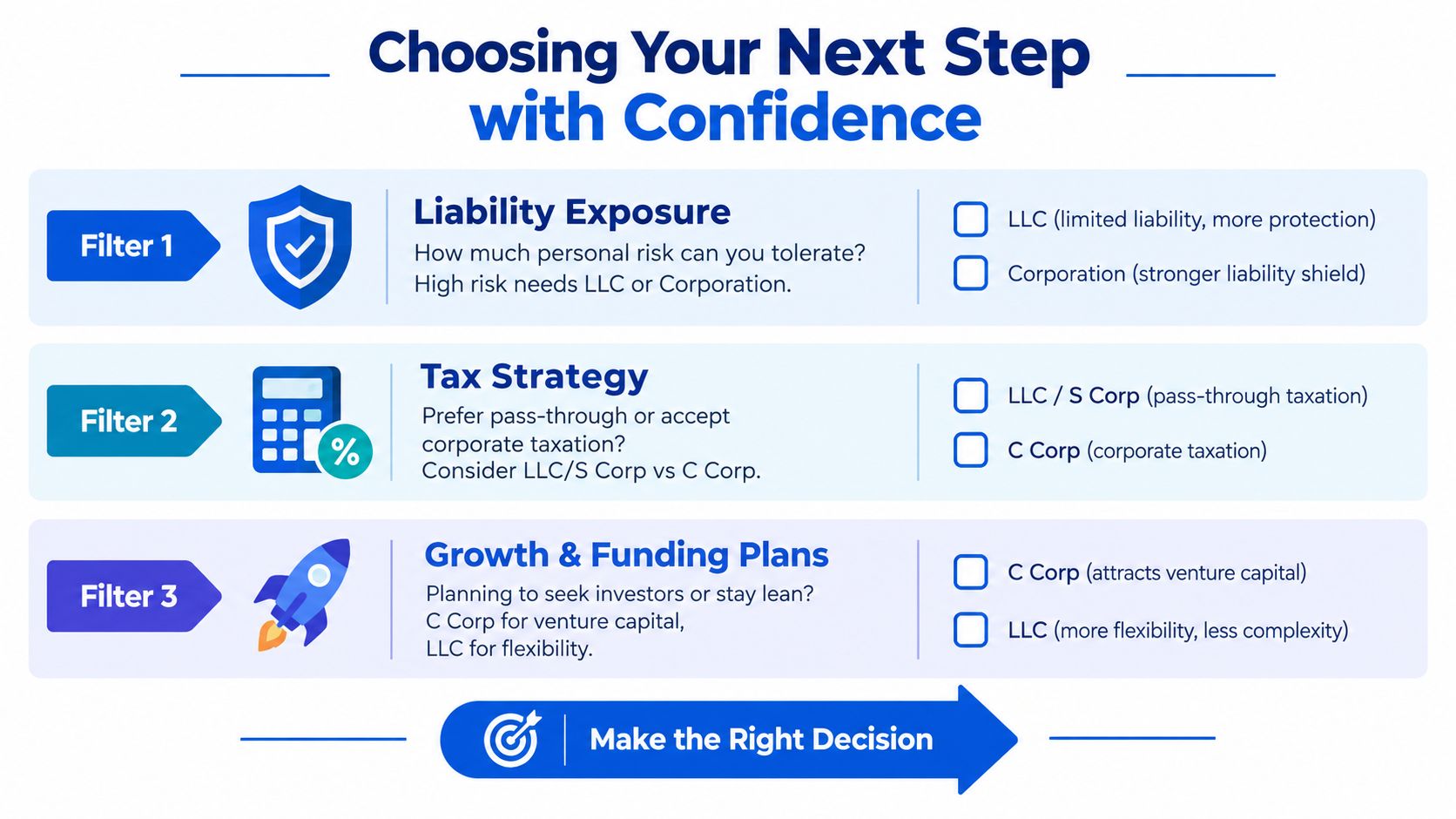
The three filters
- Liability exposure: If the business signs contracts, hires people, handles customer data, leases space, or sells anything that could create claims, a bare sole proprietorship is often too risky.
- Funding path: If outside investors, stock grants, or a sale process are realistic, corporate structure deserves serious attention early.
- Tolerance for formalities: If the founder wants fewer governance mechanics and more flexibility, an LLC usually fits better than a corporation.
The next actions that actually matter
Start with the state filing basics, but don’t stop there.
- Check name availability through Washington’s business filing system.
- Get the identifiers lined up so the business can open accounts, register, and operate properly.
- Draft the internal documents that control ownership, management, and exit rights.
- Open a separate bank account and keep business money separate from personal money.
- Calendar the Washington annual report deadline immediately after formation.
A quick legal call before filing is worth it when any of these are true:
- Multiple owners are involved
- Outside investment is likely
- Professional licensing or regulated activity applies
- One state will be used for formation and another for operations
- Founder equity or profit splits aren’t equal
One practical option for that stage is By Design Law Firm & Legal Consultancy, PLLC, which advises on entity selection, formation filings, and governance documents for Washington businesses.
By Design Law Firm & Legal Consultancy, PLLC helps Washington founders choose the right entity before a rushed filing creates tax, ownership, or compliance problems. The firm works on formation strategy, state filings, governance documents, and ongoing corporate counsel for startups and growing companies. To get help aligning the structure with the actual business plan, visit By Design Law Firm & Legal Consultancy, PLLC. Call our law office at (206) 593-1519.