A founder shares a promising product concept with a potential senior hire over coffee. No document is signed because the conversation feels informal and trust seems sufficient. A few weeks later, the candidate joins a competitor and begins developing a strikingly similar idea. The founder may feel wronged, but a confidentiality agreement could have established clearer expectations about what was shared, how it could be used, and how long the obligation would last.
That gap between casual trust and documented protection appears at nearly every stage of company growth. Confidentiality agreements arise during the first hire, the first investor pitch, the first vendor relationship, and the first serious partnership discussion. They aren't merely legal paperwork. Properly drafted, they match the level of risk to the relationship and give the business a practical way to protect non-public information without trying to control ordinary competition.
When Confidentiality Agreements Actually Matter
Your first investor meeting is tomorrow. The deck is ready, but the most valuable material may sit outside it: unreleased product plans, customer research, pricing assumptions, and technical details. Before sharing those materials, ask what the recipient may do with them, who else may see them, and what protection should continue after the meeting.
Confidentiality agreements matter whenever someone receives non-public information that could harm the business if used or disclosed improperly. That information may include a product roadmap, source code, customer list, pricing model, financial records, marketing plan, manufacturing process, or internal strategy. An NDA can protect some proprietary business information even when it does not meet the legal definition of a trade secret. Thomson Reuters explains the distinction between confidentiality agreements and trade-secret protection.
Use four questions to match the agreement to the business situation:
- What information is being shared? A product concept, customer database, and public press release carry different risks. The agreement should describe confidential material clearly enough that the recipient knows what requires care.
- Who will receive it? An employee, investor, contractor, vendor, and strategic partner may need different permissions. A vendor may need access to customer records but not the company's broader financial plans.
- Why is it being shared? The recipient should use the information for a defined business purpose, such as evaluating an investment, performing contracted work, or discussing a partnership.
- What happens after the relationship ends? Access should stop. Materials may need to be returned or destroyed, and any continuing confidentiality duty should have a clear scope and duration.
A first hire may see source code, customer data, and unreleased plans. A first investor pitch may involve projections and product details that are not public. A first vendor relationship may expose credentials, customer records, operating procedures, or system architecture. The agreement should reflect the specific exposure rather than treating every recipient alike.
Before a first hire receives sensitive information, address the definition of confidential information, permitted use, post-employment duties, and any lawful limits on solicitation. Before an investor receives review materials, decide whether the agreement should be unilateral or mutual, and whether the investor may share information with partners, counsel, financing sources, or other advisers. Before a vendor starts work, cover data handling, subcontractors, security controls, return or deletion, and use outside the engagement. Before partnership discussions begin, decide whether both sides will disclose sensitive information and deserve equivalent protection.
Confidentiality agreements are now routine across the U.S. workforce and business environment. One estimate places adoption at nearly 90% of firms, with coverage extending to more than half of workers. Another places the share of U.S. workers subject to an NDA or similar mechanism between 33% and 57%. The estimates differ, but both show that NDAs reach well beyond executive deals and mergers. The Washington University Law Review discusses the widespread use of confidentiality agreements.
A signature alone does not guarantee enforceability. Courts may reject terms that are overly broad, lack a defined period, cover information that is not confidential, or require unlawful conduct. Thomson Reuters identifies the drafting and execution issues that commonly affect NDA enforceability.
Practical rule: Draft the agreement for the information and relationship in front of the parties, rather than copying the last deal.
Mutual vs Unilateral Confidentiality Agreements
The distinction is straightforward. A unilateral NDA binds one receiving party because one side primarily discloses information. A mutual NDA imposes confidentiality duties on both sides because information may flow in both directions.
An early-stage company considering an investor pitch will often disclose more than the investor. Even so, the investor may share investment criteria, portfolio strategy, or other confidential material. A mutual agreement may fit if both parties expect meaningful information exchange. A vendor receiving a company's customer data and operating processes may usually sign a unilateral agreement, unless the vendor will also disclose proprietary technology or business information.
Contract language provides useful clues. A unilateral NDA often defines one party as the “Disclosing Party” and the other as the “Receiving Party.” A mutual agreement typically says that either party may disclose confidential information and that each party must protect information received from the other. A hybrid agreement can recognize unequal disclosure while still imposing obligations on both parties.
| Criteria | Unilateral NDA | Mutual NDA |
|---|---|---|
| Basic structure | One party discloses and the other party receives | Both parties may disclose and receive |
| Typical use case | Employer sharing company information with a worker, or a business onboarding a vendor | Partnership talks, joint ventures, strategic collaborations, or balanced diligence |
| Who is bound | Primarily the receiving party | Both parties, usually under parallel obligations |
| Common industries | Technology hiring, consulting, manufacturing, outsourced services, and customer-data work | Technology partnerships, research collaborations, acquisitions, and product development |
| Enforcement posture | Focuses on misuse or disclosure by the recipient | Creates reciprocal duties, so either party may bring a claim |
| Drafting concern | The disclosing party should avoid giving the recipient rights that exceed the business purpose | Each party should receive comparable protection while preserving necessary exceptions |
Choosing the structure
The decision can be made with three questions: Who is disclosing? Who is receiving? Is the information flow one-sided? If only one party will share meaningful confidential material, a unilateral NDA is often easier to administer. If both parties will exchange sensitive information, a mutual NDA avoids leaving one side unprotected.
A mutual agreement shouldn't become an excuse for careless symmetry. One party may disclose source code while the other shares only limited commercial information. The agreement can still be mutual, but the permitted uses, security requirements, and exclusions should reflect the actual transaction.
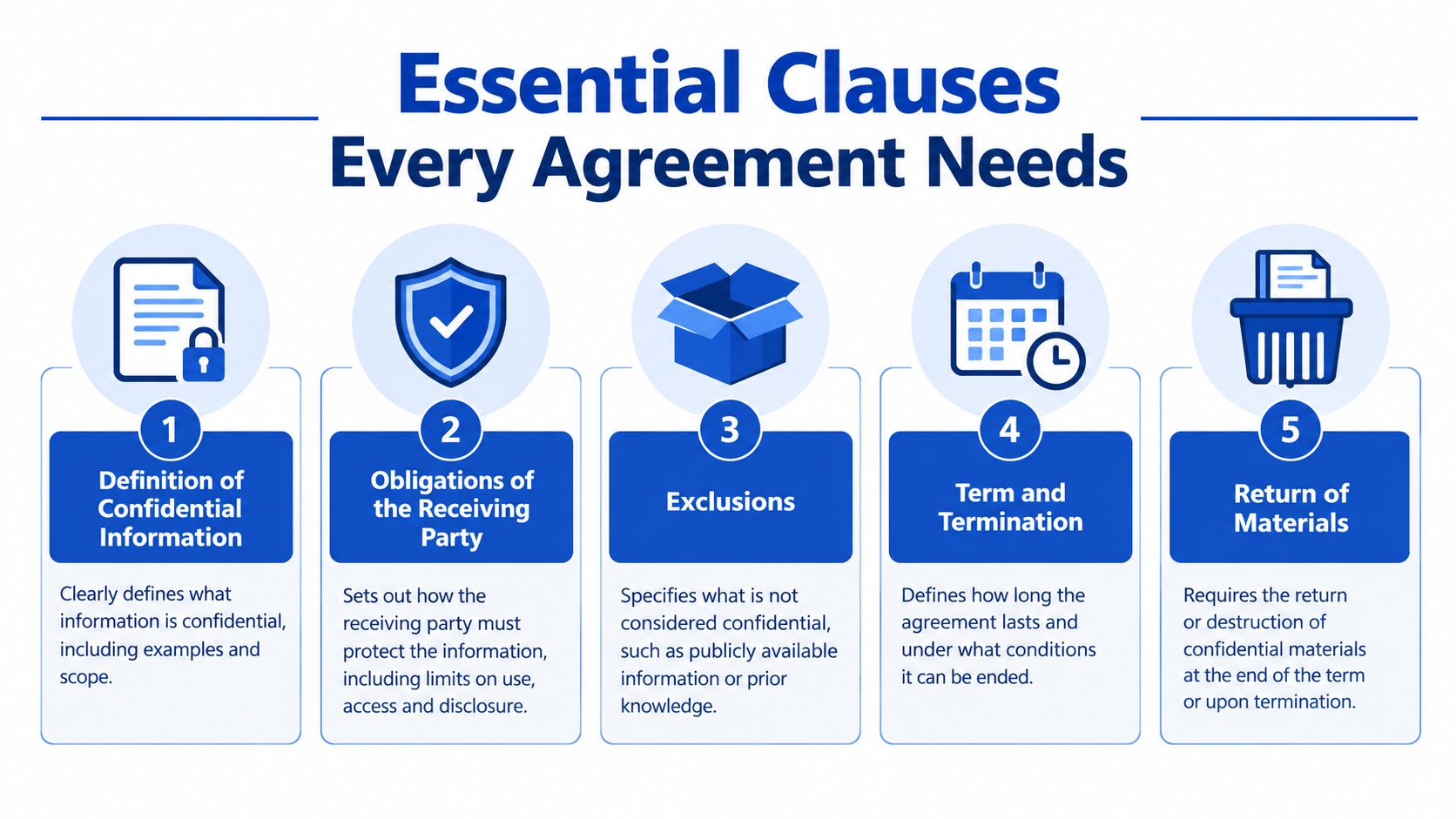
Essential Clauses Every Agreement Needs
A confidentiality agreement succeeds or fails through its details. A short document can work well if it identifies the information, limits use, includes sensible exclusions, and establishes a workable enforcement path. A longer document can still fail if it treats every conversation as secret forever.
Scope and exclusions
The definition of confidential information should be broad enough to protect legitimate business interests but specific enough to survive reasonableness review. It can cover written, electronic, oral, visual, and technical information, provided the agreement connects the information to a legitimate secrecy interest.
Exclusions prevent the agreement from claiming ownership over information that shouldn't be restricted. Common exclusions cover information that:
- Is already public: Public information isn't made confidential merely because a contract labels it that way.
- Was already known: A recipient shouldn't breach an agreement by using information documented before disclosure.
- Is independently developed: A team that creates a solution without using the discloser's information should retain the ability to use its own work.
- Comes lawfully from another source: A recipient shouldn't be responsible for information obtained without a confidentiality duty.
- Must be disclosed by law: A subpoena, court order, or regulatory obligation may require disclosure, subject to appropriate notice where legally permitted.
Use, duration, and permitted disclosure
The receiving party should use confidential information only for the stated purpose. A potential investor may evaluate an opportunity. A vendor may provide contracted services. An employee may perform assigned work. A broad “any business purpose” permission creates unnecessary uncertainty.
The term should distinguish between the agreement's duration and the period for which particular information remains protected. Many agreements use a defined nondisclosure term of one to three years, while some use an open-ended obligation tied to information that remains non-public. Bloomberg Law explains common term structures for confidentiality and nondisclosure agreements.
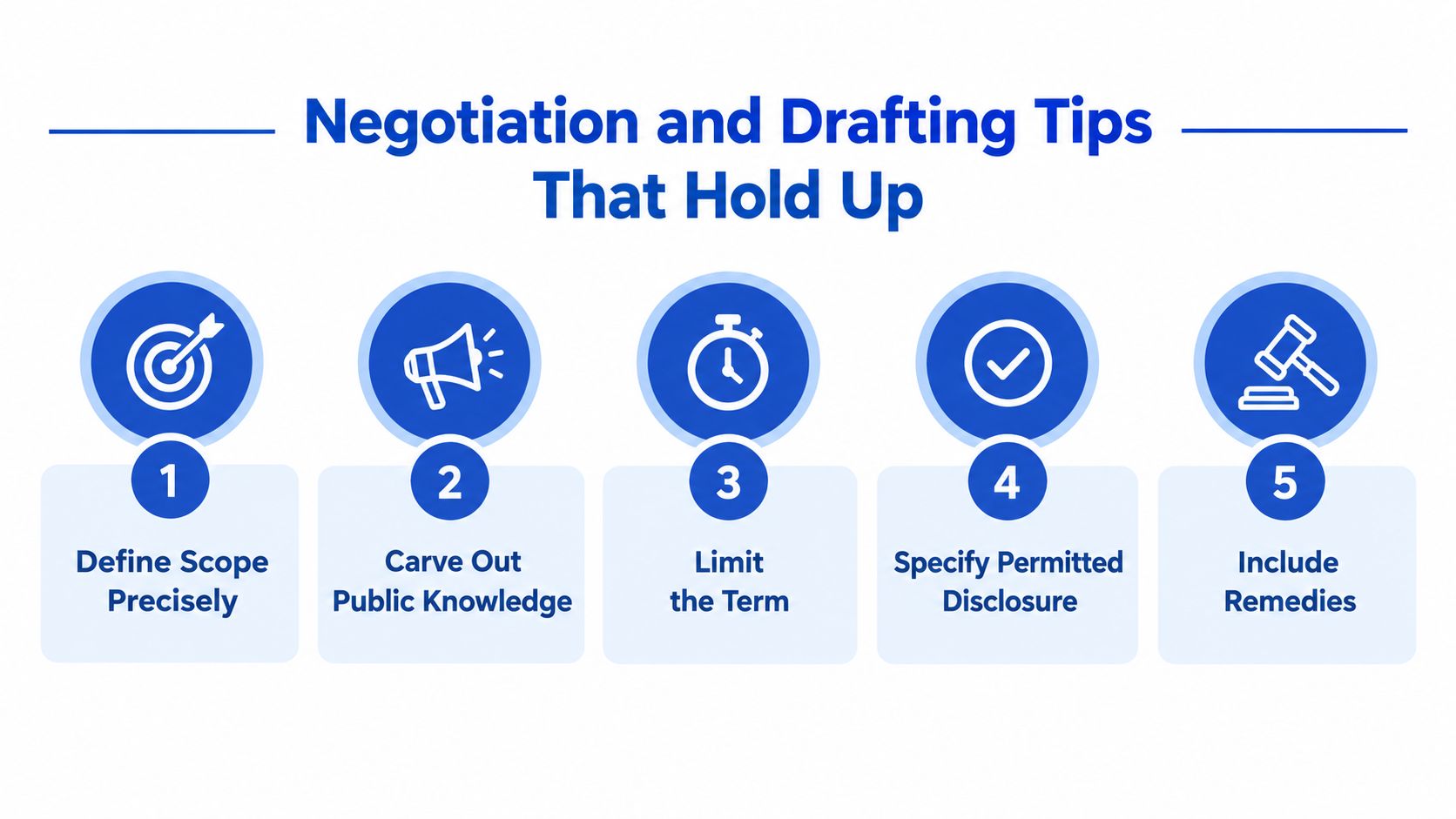
Permitted-disclosure language should identify advisers, affiliates, employees, contractors, and regulators who may need access. Each recipient should remain responsible for appropriate confidentiality controls. The agreement should also address notice before legally compelled disclosure when the law allows notice.
Return, remedies, and governing law
A return-or-destroy clause gives the disclosing party a clear off-ramp when discussions end or employment terminates. It should address copies, backups, archived email, and records that must be retained under law or routine compliance procedures.
Remedies may include injunctive relief, damages, attorneys' fees where permitted, and other contractual remedies. Non-solicitation and non-compete language deserves separate scrutiny because a confidentiality agreement can function like a non-compete if it restricts ordinary work or employee mobility rather than protecting genuine secrets. The paper “Beyond Trade Secrecy” examines confidentiality agreements that operate like non-competes.
Governing law and venue identify which jurisdiction's rules apply and where a dispute may be filed. An indemnity provision shouldn't be inserted casually. A business reviewing how responsibility is allocated can consult this explanation of indemnity clauses in Washington State contracts.
Negotiation and Drafting Tips That Hold Up
A useful negotiation starts by identifying the business purpose before anyone edits the template. The recipient should know what access is necessary, what use is permitted, and which restrictions would interfere with ordinary work. That exercise exposes vague language before it becomes a dispute.
Tighten the scope
Replace “all information disclosed in any form” with language tied to specifically identified information and the relationship's purpose. A company can protect categories such as source code, customer records, pricing, product plans, and internal financial data without claiming that every ordinary conversation is secret.
The agreement should say whether oral disclosures require written confirmation. Marking requirements help, but they shouldn't create an accidental loophole when a reasonable recipient would understand that a conversation was confidential.
Limit the obligation
“In perpetuity” is a warning sign when applied indiscriminately. A defined period or an end trigger tied to the information's continued non-public status is easier to understand and more likely to align with enforceability principles. Trade secrets may need protection for as long as they remain secret, while ordinary business information may justify a defined multi-year tail.
Replace “best efforts” with reasonable care unless the parties have a specific reason to impose a higher standard. The agreement should describe practical controls, such as access limited to personnel with a need to know, secure storage, and prompt notice of suspected misuse.
Preserve lawful disclosures
The document should expressly preserve legally protected reporting and communications. U.S. government whistleblower rules state that NDAs cannot override protections involving classified information, communications to Congress, Inspector General reporting, or other whistleblower activity. The Privacy and Civil Liberties Oversight Board describes the protections incorporated into government NDAs.
Red flags include automatic extensions, one-sided indemnification, an overbroad non-solicitation restriction, and no return-or-destroy process. An agreement also shouldn't prevent a worker from using general skills and knowledge developed through employment.
A structured drafting platform can help assemble alternative clauses, but human review remains necessary when the relationship or risk is unusual. Teams comparing AI contract generation tools should verify the tool's source material, customization controls, privacy terms, and review workflow rather than treating generated language as finished legal advice. A practical guide to how to negotiate a contract can help founders prepare the business positions before sending redlines.
Real Situations Where These Agreements Show Up
The same NDA template changes meaning when the relationship changes. A founder preparing for an investor meeting isn't managing the same risk as a founder granting a vendor access to customer records. Each situation needs its own permissions, exceptions, and enforcement mechanics.
The investor pitch
A startup may use a unilateral NDA when it shares forward-looking projections, product details, trade secrets, and technical plans with a potential investor. The investor may need to share the materials with partners, counsel, financing sources, or internal investment personnel, so permitted-disclosure language matters.
The founder should avoid demanding restrictions that make ordinary diligence impossible. The agreement should protect confidential information from misuse while allowing the investor to evaluate the opportunity and comply with internal processes.
The senior hire
A senior engineer or executive may receive source code, architecture documents, product strategy, customer information, and business plans. The employment agreement often includes confidentiality obligations that continue after employment ends, along with carefully drafted non-solicitation terms concerning colleagues or customers where lawful.
The company should distinguish company information from the employee's general knowledge, skills, and experience. A restriction that prevents a former engineer from working in the same field may look less like confidentiality protection and more like a non-compete.
The vendor relationship
A vendor may process customer data, operate a platform, access internal systems, or learn proprietary procedures. The agreement should address subcontractors through flow-down obligations, require appropriate safeguards, and give the company a practical way to verify compliance where the risk justifies audit rights.
For service providers supporting regulated or data-intensive businesses, confidentiality should sit alongside privacy, security, incident response, and deletion obligations. Resources concerning managed IT for professional services can help a business think about confidentiality as part of a broader operational control system rather than as a standalone signature page.
| Provision | Investor Pitch | Senior Hire | Vendor Onboarding |
|---|---|---|---|
| Primary protected material | Projections, product plans, trade secrets, and diligence materials | Source code, strategy, customer information, and internal records | Customer data, credentials, technical information, and operating processes |
| Agreement structure | Often unilateral, sometimes mutual | Usually company-focused, with reciprocal protection where appropriate | Usually unilateral, integrated with service terms |
| Permitted recipients | Partners, counsel, financing sources, and evaluation personnel | Personnel with a business need to know | Employees, approved subcontractors, and service personnel |
| Post-relationship issue | Destruction or return of diligence materials | Continuing confidentiality after employment | Deletion, return, certification, and access termination |
| Special negotiation point | Investor diligence and information-sharing rights | General skills, mobility, and solicitation limits | Flow-down duties, security controls, and audit rights |
A template can provide a starting point, but each relationship requires meaningful editing. The business purpose, information type, recipient group, and exit process should all appear in the final agreement.
Enforcement and Remedies When Things Go Wrong
A suspected breach calls for disciplined evidence preservation before an emotional response. The business should preserve access logs, audit trails, emails, file-transfer records, device information, meeting notes, and relevant exit-interview materials. Security and legal teams should limit further access while protecting the integrity of the investigation.
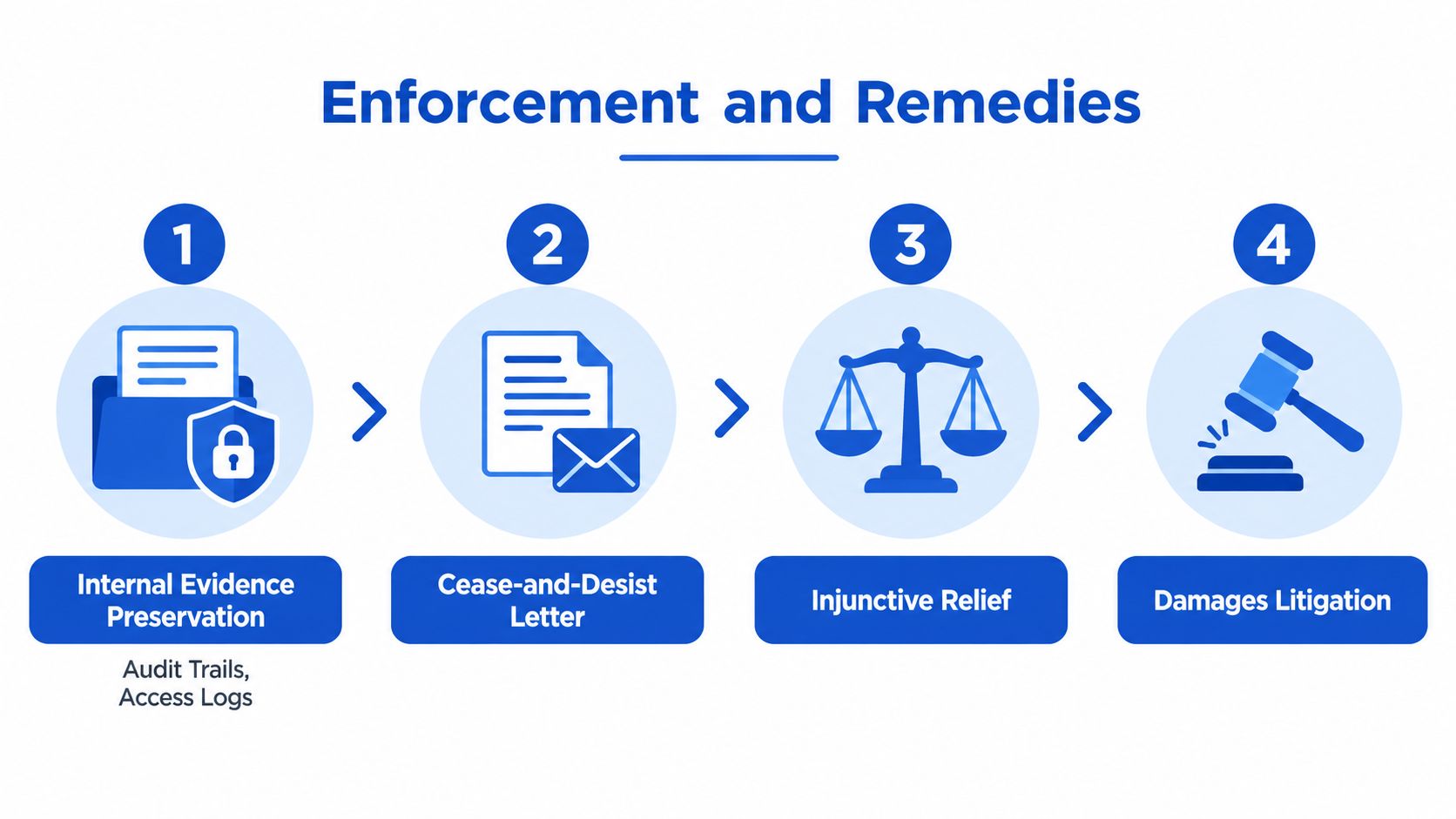
A practical response sequence
A lawyer may send a cease-and-desist letter after reviewing the evidence. The letter can identify the contractual duty, describe the suspected misuse, demand preservation and return of materials, and set a deadline for a response. Some disputes end at this stage, particularly when the recipient wants to avoid escalation and the business can demonstrate a credible record.
If the leak threatens ongoing harm, the business may seek injunctive relief. An injunction asks a court to order the recipient to stop using or disclosing the information. Monetary damages may not adequately repair a trade-secret leak because public disclosure can permanently reduce the information’s value.
The business still carries a burden of proving the relevant facts. That may include showing that the information was confidential, that the recipient received it, that the recipient breached a contractual duty, and that the business took reasonable steps to maintain secrecy. A signed agreement helps, but it doesn’t replace access controls, labeling, training, and disciplined offboarding.
Evidence matters: A confidentiality agreement is much stronger when the company can show who accessed the information, what the recipient agreed to do, and which controls protected the material.
The contract should identify governing law, venue, and dispute procedures. Mediation may resolve a business relationship without a public fight. Binding arbitration can provide a private forum if the parties selected it clearly. Liquidated damages can be useful in some transactions, but an excessive amount may invite enforceability challenges and shouldn’t substitute for a realistic remedy analysis.
The cost, speed, and strategic value of litigation vary by dispute. A company should evaluate whether the information remains secret, whether the former recipient is still using it, whether a court can exercise jurisdiction, and whether immediate relief is available. A guide to breach of contract remedies provides additional context for selecting a response.
Common Misconceptions and Emerging Risks
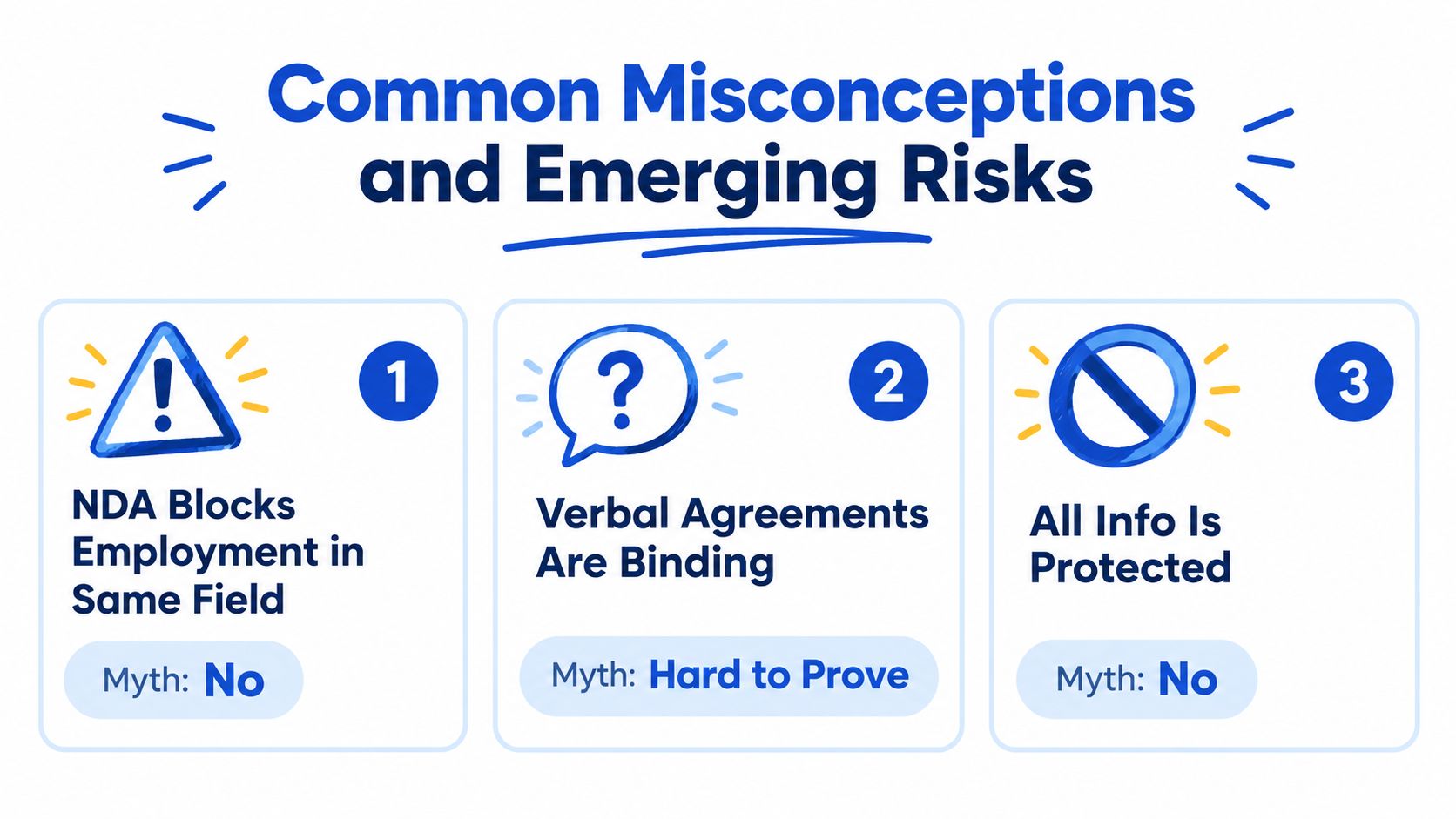
At a first hire, a founder may worry that an NDA will stop the employee from working in the same field. It will not. The agreement creates duties around protected information, while general skills, lawful competition, and ordinary employment remain separate issues. A restriction that blocks normal work may function as a non-compete instead of a confidentiality clause.
At an investor pitch, signing an agreement does not by itself create trade-secret protection. The company must handle sensitive material like valuables in a shared office: limit access, use secure storage, grant information on a need-to-know basis, supervise vendors, and remove access promptly when someone leaves. Courts may question secrecy claims when the business made little practical effort to preserve confidentiality. Thomson Reuters describes the relationship between contractual protection and ongoing secrecy controls.
The risks changing the template
AI use now requires specific drafting. A founder should decide whether a recipient may enter information into a public or private AI system, whether a provider may use it for model training, how subprocessors handle prompts and outputs, how long records remain stored, and where processing occurs. A 2026 contract benchmark found that 38% of enterprise NDAs reviewed in the first quarter of 2026 contained at least one AI-related provision, while AI disclosure obligations rose 240% year over year. It also found that 27% of technology-sector NDAs contained no model-training language, showing why older templates can leave important gaps. The Termscout 2026 Contract Signals Report provides those benchmark figures.
A first vendor relationship brings related questions about personal devices, collaboration platforms, data residency, screenshots, and access from unapproved locations. A template may not address those details when the company changes products, vendors, markets, or AI tools.
A lasting confidentiality program treats the NDA as one control in a continuing process. Revisit it when data flows change, new technology or subcontractors enter the relationship, a product launches, or a recipient receives broader access than the original deal anticipated.
By Design Law Firm & Legal Consultancy, PLLC offers NDA drafting and review for startups and growing companies, including trade-secret, AI-use, privacy, and Washington enforceability issues. Founders and business teams can visit By Design Law Firm & Legal Consultancy, PLLC to discuss an agreement suited to the relationship, information, and business risk. Contact us at (206) 593-1519.