An agreement can look complete, feel fair, and still leave a founder without a meaningful legal remedy. The label on the first page doesn't decide enforceability. The language, conduct, consideration, capacity, legality, and evidence of assent do.
That distinction became especially important as cross-border commerce moved toward formal, uniform contract rules. The United Nations Commission on International Trade Law's history of the CISG records that the convention was approved in Vienna on 11 April 1980, entered into force on 1 January 1988 after ratification by 11 initial Contracting States, and later expanded to adoption by 83 countries. Founders should take the hint: informal understandings may start a relationship, but a carefully structured contract allocates risk when the relationship breaks down.
What the Words Agreement and Contract Really Mean
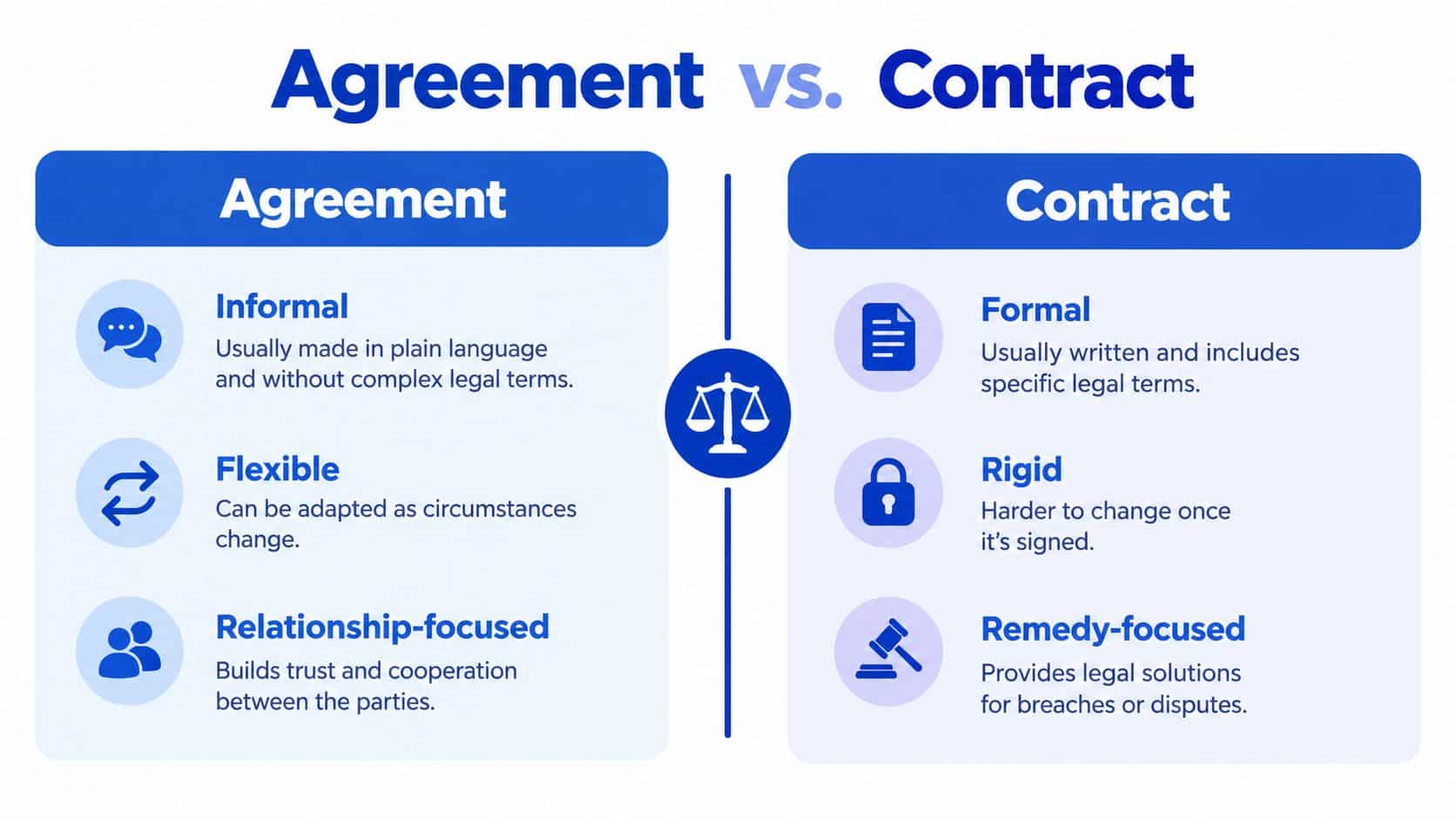
Founders often use agreement and contract as interchangeable labels for the same document. That shorthand is harmless during an early conversation. It becomes expensive when the document governs a capital raise, vendor commitment, equity transfer, intellectual property assignment, or data-sharing arrangement.
An agreement is the broader concept. It means that two or more parties have reached a mutual understanding, usually through offer and acceptance. The understanding may be written, oral, implied by conduct, or recorded across emails and messages. The Cornell Law School definition of agreement describes an agreement as a manifestation of mutual assent, while also identifying an “agreement to agree” as a category that isn't enforceable merely because the parties intend to negotiate later.
A contract is an agreement that satisfies the additional legal requirements for enforcement. Those requirements commonly include consideration, capacity, legality, and sufficient evidence that the parties intended to create legal obligations. The Cornell explanation of contracts identifies mutual assent, consideration, capacity, and legality as central components of an enforceable contract.
| Feature | Agreement | Contract |
|---|---|---|
| Basic meaning | A mutual understanding | An agreement recognized and enforced by law |
| Possible form | Written, oral, or implied by conduct | Written, oral, or implied, subject to applicable legal rules |
| Offer and acceptance | May be present | Must be sufficiently definite |
| Consideration | May be absent | Generally required |
| Legal remedy | May be uncertain or unavailable | Available when formation and enforcement requirements are met |
| Founder risk | Reliance without a clear remedy | Defined duties, remedies, and allocation of risk |
The distinction matters because a founder doesn't need a document that merely records goodwill. A founder needs to know what happens if the other party fails to perform. A practical guide to express contracts and their legal role helps clarify why explicit terms are safer than relying on shared assumptions.
Practical rule: Treat “agreement” as a description of consensus and “contract” as a conclusion about enforceability. The title never supplies the missing elements.
A signed document titled “Agreement” can be a contract. An unsigned memorandum titled “Contract” may not be one. The operative question is whether the parties created definite obligations supported by the elements required under the governing law.
How Modern Law Separated Agreements from Contracts
Contract law didn't begin with modern startup documents. English contract law traces back to the 13th and 14th centuries, when legal claims developed around formal promises, covenant, and debt. A covenant covered important agreements that were reduced to writing. The historical overview of contract law describes the 19th century as the “golden age” in which contract law developed into the structure used in modern commercial practice.
That history explains the founder misconception. Businesses inherited a vocabulary in which an agreement could describe almost any mutual understanding, while a contract identified the narrower category that courts would enforce. Modern commercial law then focused increasingly on objective formation rules, remedies, and performance obligations rather than relying on a party's private belief that a promise should count.
The international shift is especially clear in the CISG. Earlier attempts to unify international sales and formation rules failed in 1964, and UNCITRAL began work on a global sales-law project in the early 1970s. The resulting convention created a shared framework for international sale-of-goods contracts, making formation and performance more predictable across borders.
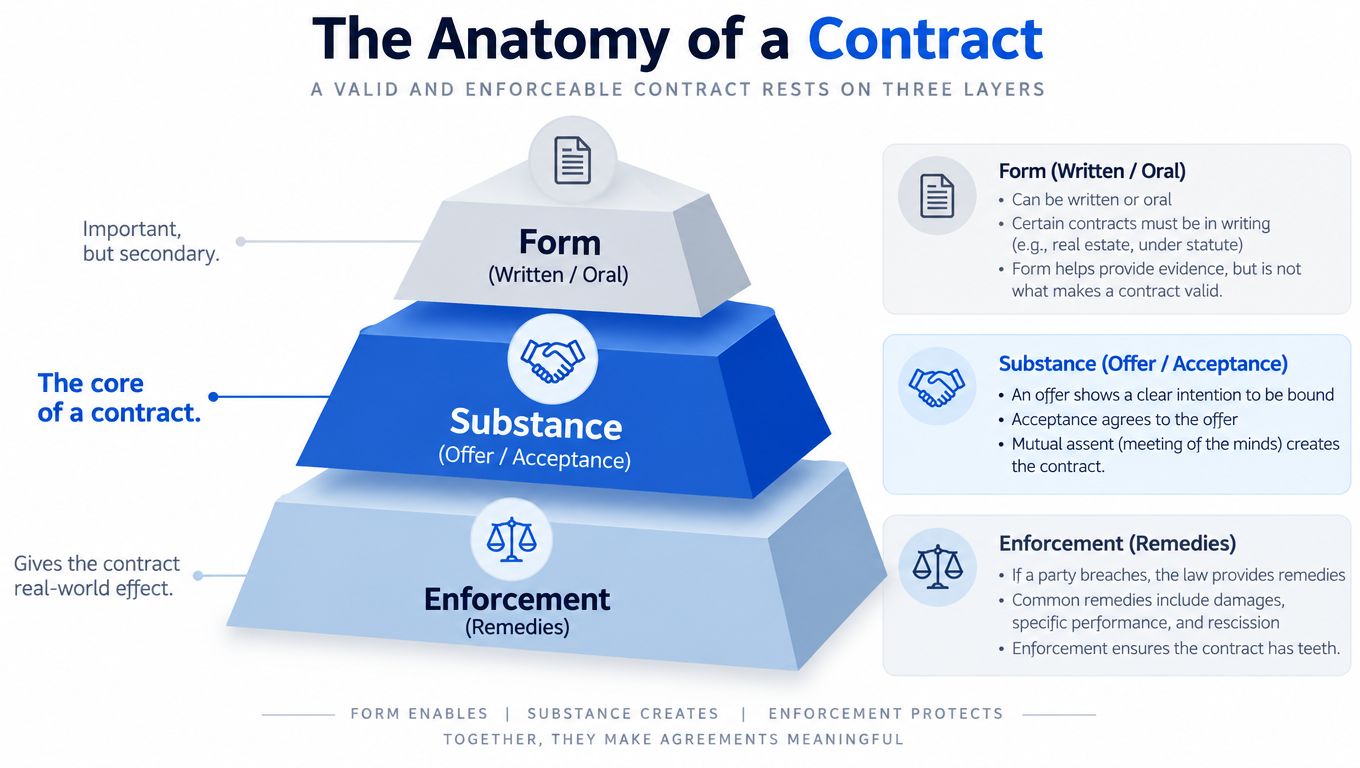
The lesson for founders is direct. A page with signatures is only the form. The parties still need substantive terms that establish what was offered, what was accepted, and what each side promised. They also need enforceable remedies, a governing law, and enough precision for a court to determine what performance means.
This is why legacy assumptions fail when founders use policy documents, data terms, platform rules, or letters of intent. A document may communicate expectations without creating reciprocal obligations. Conversely, a document that avoids the word “contract” can still impose binding duties if its language and the parties' conduct satisfy formation requirements. A clear explanation of the mirror-image rule in contract formation is useful because a response that changes material terms may be a counteroffer rather than an acceptance.
Where Agreement Ends and Contract Begins
The enforceability gap is the dividing line. Both an agreement and a contract involve some form of mutual assent, but a contract requires the additional elements that make a court willing to recognize duties and provide a remedy.
The following comparison is a working diagnostic, not a substitute for jurisdiction-specific advice.
| Element | Agreement | Contract |
|---|---|---|
| Mutual assent | The parties appear to share an understanding | The parties objectively assent to defined obligations |
| Offer | A proposal may be informal or incomplete | The offer is sufficiently definite for acceptance |
| Acceptance | Conduct or communication may show approval | Acceptance must correspond to the offer under applicable rules |
| Consideration | The parties may exchange promises without legal value | Each side generally gives or promises something of legal value |
| Capacity | A party may express assent despite legal incapacity | Each party must have the required legal ability to contract |
| Legality | The subject may be discussed or promised | The purpose and performance must be lawful |
| Intent to be bound | The parties may expect future documentation | The circumstances support present legal obligation |
| Remedy | The court may find no enforceable remedy | The court can apply contractual remedies when the claim succeeds |
Mutual assent is only the starting point
Offer and acceptance establish the basic exchange. A customer's message saying “the proposal works” may show assent, but only if the proposal is definite enough and the response doesn't change material terms. A conversation that says the parties will “work out the details later” may show enthusiasm without creating a present contract.
Consideration supplies the exchange. It can be money, services, a license, a promise to refrain from an action, or another legally recognized benefit or detriment. A promise based solely on gratitude or a hoped-for future relationship may be an agreement in ordinary language but not an enforceable bargain.
Capacity and legality protect the integrity of the transaction. A signer must have the legal ability to understand and undertake the obligation, and the subject matter must be lawful. Intent to create legal relations adds another practical question: were the parties making a present business commitment, or were they documenting a preliminary discussion?
A founder can have a genuine agreement in spirit and still have no contract remedy when a required formation element is missing or contested.
That risk is greatest when the business performs first and documents later. The relationship may create evidence of reliance, but reliance isn't automatically the same as a fully enforceable contract. The drafting task is to turn the commercial understanding into a clear obligation before the company commits money, code, data, equity, or confidential information.
The Formation Checklist That Makes It Binding
Founders should test every material deal against five core elements: offer, acceptance, consideration, capacity, and legality. OpenStax's business law formation checklist also addresses genuine agreement and explains consideration as something of value promised in exchange for something else of value.
Start with the deal mechanics
Offer. Identify the exact proposal. A vendor quote, equity grant, statement of work, or licensing proposal should state the essential commercial terms. A vague promise to “partner on a project” gives the parties little objective material to accept.
Acceptance. Confirm how acceptance occurs and whether the response changes the offer. Email, a signature, payment, performance, or an online click can provide evidence, but the legal effect depends on the terms and governing law. The Thomson Reuters contract overview explains that acceptance can occur verbally, through performance, or by deed, while capacity depends on whether the person reasonably understands the contract.
Consideration. Record what each side gives or promises. The contract should identify the price, service, license, equity, access, exclusivity, or other exchange instead of leaving value implied.
Capacity. Check that the signer is authorized to bind the company and has the legal ability to undertake the obligation. A founder should confirm board or member approval where the company's governance documents require it.
Legality. Examine the purpose and the restrictions that apply to it. Intellectual property assignments, employee restraints, regulated data, privacy obligations, and AI use rights can trigger rules that a generic template won't address.
Apply three quick tests before signature
-
The writing test. Determine whether the transaction falls within a rule requiring a written contract. Common Statute of Frauds categories include real estate, surety promises, marriage-related agreements, goods priced over $500, and agreements that cannot be performed within one year. The applicable jurisdiction and transaction details control the result.
-
The intent test. Read the entire document, not just the title. “Subject to definitive documentation,” “non-binding,” and similar language may undermine present enforceability, while a detailed exclusivity, confidentiality, or payment obligation may point in the opposite direction.
-
The remedy test. Ask what the company needs if performance fails. A document that doesn't specify delivery standards, payment triggers, ownership, termination rights, or dispute procedures leaves the most important business questions unresolved.
A drafting review should map each formation element to a document location. The offer belongs in the scope or commercial terms. Acceptance belongs in the signature and assent mechanics. Consideration belongs in pricing, equity, or exchange provisions. Capacity belongs in authority and representations. Legality belongs in compliance, use restrictions, and the purpose of the transaction. Founders seeking help with how to draft a contract should use that mapping as a practical starting point.
The embedded explanation below offers another way to visualize the distinction.
Real Startup Scenarios Where the Label Matters
A founder promises an equity split during a coffee meeting. The company later raises capital, the founder who made the promise denies the conversation, and the other party has no signed equity document. The relationship may have generated an agreement in the ordinary sense, but proving the precise equity promise, consideration, authority, vesting terms, and remedy becomes much harder without a writing.
The answer isn't that every oral promise is worthless. The answer is that oral deals create proof and formation problems that a written equity agreement can address directly. Ownership percentage, vesting, repurchase rights, dilution, tax treatment, board approvals, and treatment on departure should never depend on memory.
Four recurring startup traps
The vendor click-through. A SaaS provider may present terms through a clickwrap flow that requires affirmative assent. Browsewrap terms, by contrast, raise more fact-specific questions because the user may not have taken an action acknowledging the terms. The company should preserve the version accepted, the assent record, and the identity of the account holder.
The defective NDA. A document titled “mutual NDA” may contain one-way obligations, contradictory recitals, a weak definition of confidential information, or exclusions that swallow the protection. The title doesn't repair drafting that fails to identify what information is protected, who may receive it, and what happens after disclosure.
The non-binding letter of intent. A letter can state that the overall transaction is non-binding while imposing a binding exclusivity, confidentiality, access, or expense obligation. The operative language matters more than the label. A founder should separate binding provisions from aspirational deal points and say so expressly.
The Slack payment dispute. A message thread may show that the parties agreed on a project in principle. A signed statement of work can provide the defined deliverables, acceptance criteria, fees, deadlines, ownership, and remedies needed for enforcement. The thread is evidence. The SOW is the risk-control instrument.
The label doesn't determine the remedy. The combination of language, conduct, consideration, and evidence does.
These scenarios share a practical lesson. A relationship can support cooperation without allocating failure risk. Founders should document the obligations that matter most before the company transfers equity, grants access, discloses trade secrets, accepts regulated data, or begins work that will be difficult to unwind.
Data and AI Agreements Are Rewriting the Line
Data and AI transactions expose the limits of the old agreement-versus-contract binary. A model-use policy may establish conditions for access, but it often doesn't identify a bilateral exchange, allocate responsibility between parties, or provide a specific remedy when data leaks or an output causes harm.
A data contract treats data as an operational asset with defined expectations between producers and consumers. The research published by the World Journal of Advanced Research and Reviews on data contracts describes a category becoming more measurable, including the use of 4,000+ benchmark data points to evaluate contract-intelligence extraction accuracy. The important shift isn't the number itself. It's the move toward obligations that machines can extract, monitor, audit, and escalate.
Three hybrid instruments
A data clean room arrangement between a startup and a hospital system should define permitted fields, matching logic, access controls, retention, deletion, re-identification restrictions, audit rights, and incident response. A public policy is insufficient if the parties need a remedy for unauthorized use.
An AI vendor's training-data addendum should address provenance, permitted training purposes, customer instructions, deletion or isolation, infringement allocation, security controls, and audit evidence. The commercial contract can incorporate an operational policy, but it shouldn't outsource the core risk allocation to a policy that the vendor can change unilaterally.
A model-output indemnification side letter may sit beside a master agreement and address a narrow risk, such as third-party claims, prohibited uses, or failures in a specific deployment. Its enforceability depends on consideration, incorporation, authority, defined triggers, and consistency with the limitation-of-liability clause in the main contract.
| Dimension | Classic Contract | Data and AI Agreement |
|---|---|---|
| Primary asset | Goods, services, money, or defined rights | Data, access, models, outputs, and operational controls |
| Main risk | Nonpayment or nonperformance | Leakage, misuse, bias, inaccurate output, or provenance failure |
| Measurement | Delivery, acceptance, payment, and milestones | Quality, lineage, access events, retention, and policy compliance |
| Monitoring | Periodic reporting or inspection | Continuous logs, automated checks, and audit trails |
| Remedy design | Damages, replacement, termination, or specific performance | Containment, deletion, suspension, retraining, indemnity, and termination |
| Document architecture | Contract with schedules and exhibits | Contract plus policies, technical specifications, and machine-readable rules |
The founder's decision should follow the remedy required. If the business needs enforceable duties when a dataset leaks, an inference is biased, or a model hallucinates in a regulated workflow, the document should use contract architecture rather than relying on a portal policy. A review of AI contract review practices can help identify where technical controls and legal obligations need to match.
Choosing the Right Document and Drafting Tips
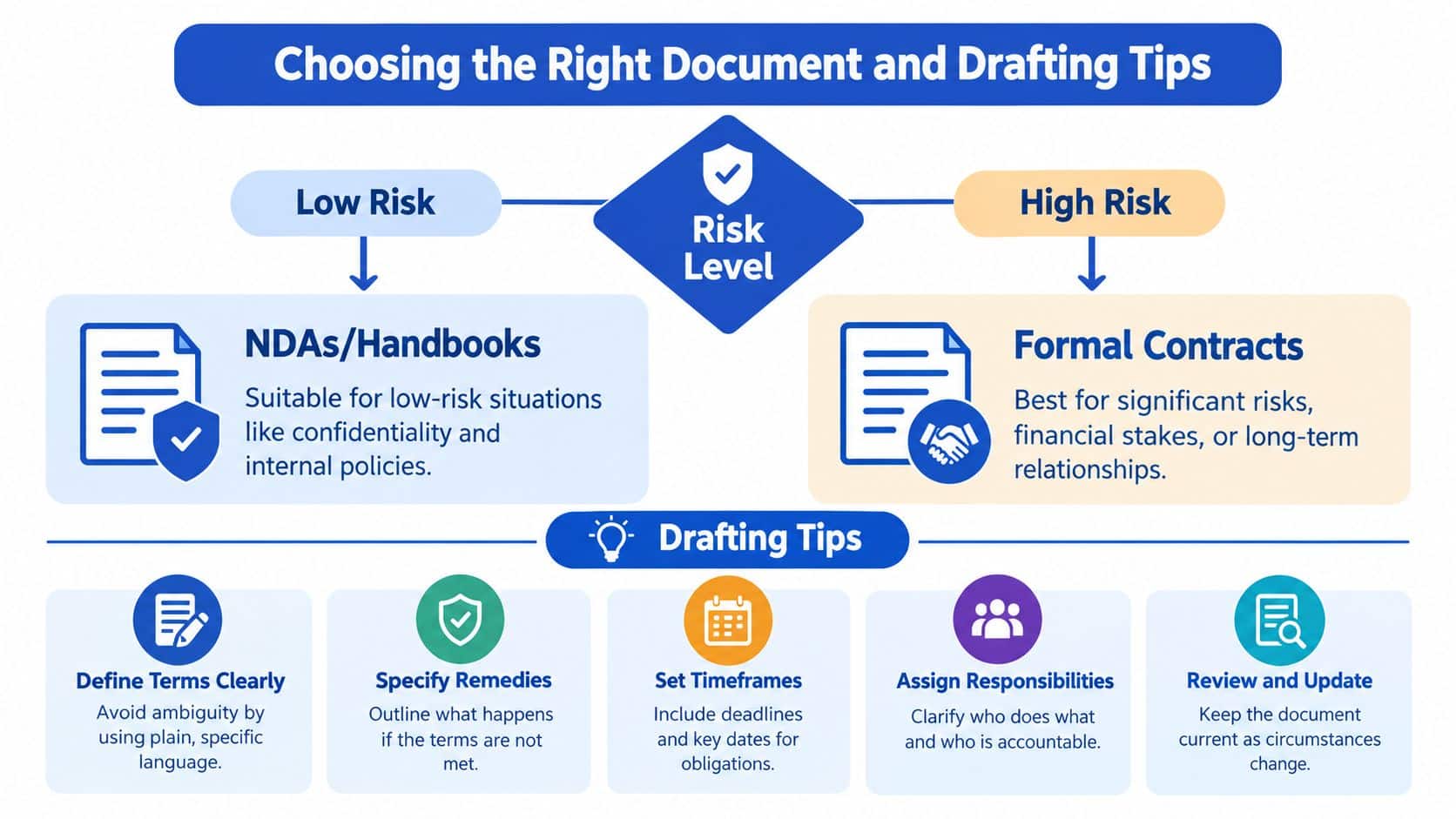
The right document depends on the risk, not the preferred title. A low-risk internal handbook can communicate operational expectations. A vendor agreement involving customer data, source code, material payments, or intellectual property needs a contract with enforceable allocation of risk.
| Risk profile | Appropriate instrument | Minimum protections |
|---|---|---|
| Low-risk internal process | Policy or handbook | Scope, ownership, update process, acknowledgment |
| Confidential business discussion | NDA | Protected information, permitted use, exclusions, return or deletion |
| Routine service with limited exposure | Short-form agreement | Scope, fees, term, termination, confidentiality |
| Critical vendor or customer relationship | MSA and SOW | Liability, IP, security, service levels, remedies, dispute terms |
| Equity, technology, data, or AI licensing | Formal contract and schedules | Ownership, consideration, compliance, audit, indemnity, termination |
Draft for the failure scenario
A founder should define key terms before negotiating price. “Data,” “confidential information,” “deliverables,” “security incident,” “acceptable use,” and “derived output” need operational meanings. Ambiguity in a definition can defeat a carefully drafted remedy later.
The contract should also spell out consideration, include severability, identify governing law, and select a dispute-resolution process. An integration clause can supersede prior discussions, but it shouldn’t be used to erase a commitment the business still expects to rely on. Audit rights, suspension rights, and termination rights matter most when the counterparty controls the systems or information involved.
Document comparison is another practical control. Before accepting revised vendor paper, a legal team can use PDFKing to compare PDFs and then confirm every material change manually. Automated comparison catches text movement and omissions, but counsel still needs to interpret whether a revised indemnity, IP clause, or liability cap changes the business outcome.
Negotiate the clauses that can injure the company
Push back on unlimited customer indemnities, broad vendor rights to use company data, automatic IP ownership transfers, unilateral policy changes, and liability caps that exclude the very risks the counterparty controls. A startup may accept standard vendor language for a low-risk tool, but material data access or core product dependencies justify redlines.
By Design Law Firm & Legal Consultancy, PLLC provides contract drafting, review, negotiation, and technology and data privacy support for startups and established businesses. The firm can help align the document with the company’s transaction, operational exposure, and required remedy.
Direct Answers to Common Agreements vs Contracts Questions
Is an oral agreement a contract?
Verdict: It can be, if the parties formed an enforceable bargain and no applicable rule requires a writing.
The practical problem is proof. Oral terms can be disputed, incomplete, or difficult to establish, so founders should put material commitments in writing even when oral formation is legally possible.
What makes a document legally binding?
Verdict: A document becomes binding when the parties objectively establish offer, acceptance, consideration, capacity, legality, and the required intent to be bound.
A signature helps prove assent, but it doesn’t cure an unlawful purpose, lack of consideration, lack of authority, or an agreement that remains subject to future negotiation.
Is a policy the same as a contract?
Verdict: Usually not. A policy generally communicates standards or conditions, while a contract creates negotiated obligations between parties.
A policy can become relevant contractual evidence when incorporated into a contract or accepted through valid assent. The document should state whether the policy is incorporated, who can change it, and what happens if it conflicts with the contract.
Can an email exchange form a contract?
Verdict: Yes, an email sequence can support contract formation when it contains definite terms, acceptance, consideration, authority, and intent to be bound.
A casual “sounds good” response may not establish acceptance if significant terms remain open. The safest practice is to identify the final offer, state acceptance clearly, and attach the complete terms.
How do implied and express terms differ?
Verdict: Express terms are stated directly. Implied terms arise from conduct, context, law, or the circumstances of the transaction.
Express drafting gives founders more control. Implied terms create uncertainty, especially when the parties disagree about delivery standards, ownership, payment timing, or permitted data use.
When does a letter of intent become binding?
Verdict: A letter of intent can impose binding obligations even when the overall transaction remains non-binding.
Confidentiality, exclusivity, access, expenses, governing law, and dispute provisions should be identified expressly as binding or non-binding. Courts examine the language and conduct, not just the heading.
Does a signed agreement without consideration hold up?
Verdict: A signature alone doesn’t replace consideration where consideration is required.
The document should identify what each party gives or promises. A gift promise, unsupported modification, or statement of future cooperation may need a different legal structure to be enforceable.
Founders facing a vendor, equity, technology, data, or AI transaction can engage By Design Law Firm & Legal Consultancy, PLLC for contract drafting, review, negotiation, and practical risk allocation. The firm helps turn informal business understandings into documents with clear duties, remedies, ownership terms, and termination rights. Contact us at (206) 593-1519.