The app is almost ready. Test users have signed up, the onboarding flow works, and the launch checklist has only one item left: the mobile app privacy policy. A founder pastes in a generic template, adds a URL to App Store Connect and Google Play, then discovers that the policy omits the analytics SDK, the store disclosure doesn't match the app's data practices, and the deletion promise has no working product path.
That failure is common because a mobile privacy policy isn't just a page of legal clauses. It's the synchronization point between what the code does, what the app stores disclose, and what users and regulators are told. A large-scale study of more than 2 million mobile apps found that 58.5% of crawled apps provided links to a privacy policy, while 39.3% provided no policy link at all. Among apps with a link, only 38.4% led users to an actual privacy policy, according to the large-scale mobile app privacy study.
The practical question isn't, “What clauses should the policy contain?” It's, “Can the legal text survive comparison with the runtime SDK inventory, Apple's Privacy Nutrition Label, Google Play's Data safety section, and the user journey?” The sections below address that question directly.
Why Your Mobile App Needs a Real Privacy Policy
The moment a test build moves from internal testing toward public distribution, the privacy policy becomes evidence. Apple and Google expect a working policy URL and accurate platform disclosures, while users need a readable explanation before they create an account, grant permissions, or provide sensitive information. A regulator may later treat the same document as a representation of the company's actual processing activities.
Three obligations converge in one document:
- Legal duties: Depending on the users and data involved, the app may need to address US state privacy laws, the GDPR, and COPPA. The policy should identify collection, purposes, sharing, retention, rights, and choices in language that matches the company's actual practices.
- Platform duties: Apple and Google use privacy disclosures as part of app review and listing compliance. Apple's Privacy Nutrition Labels appear on App Store product pages, while Google Play's Data safety requirements ask developers to disclose collection, sharing, security practices, and deletion options.
- Business duties: Investors, enterprise customers, payment partners, and prospective acquirers often read the policy during diligence. A document full of placeholders signals that the company hasn't mapped its vendors, rights process, or retention practices.
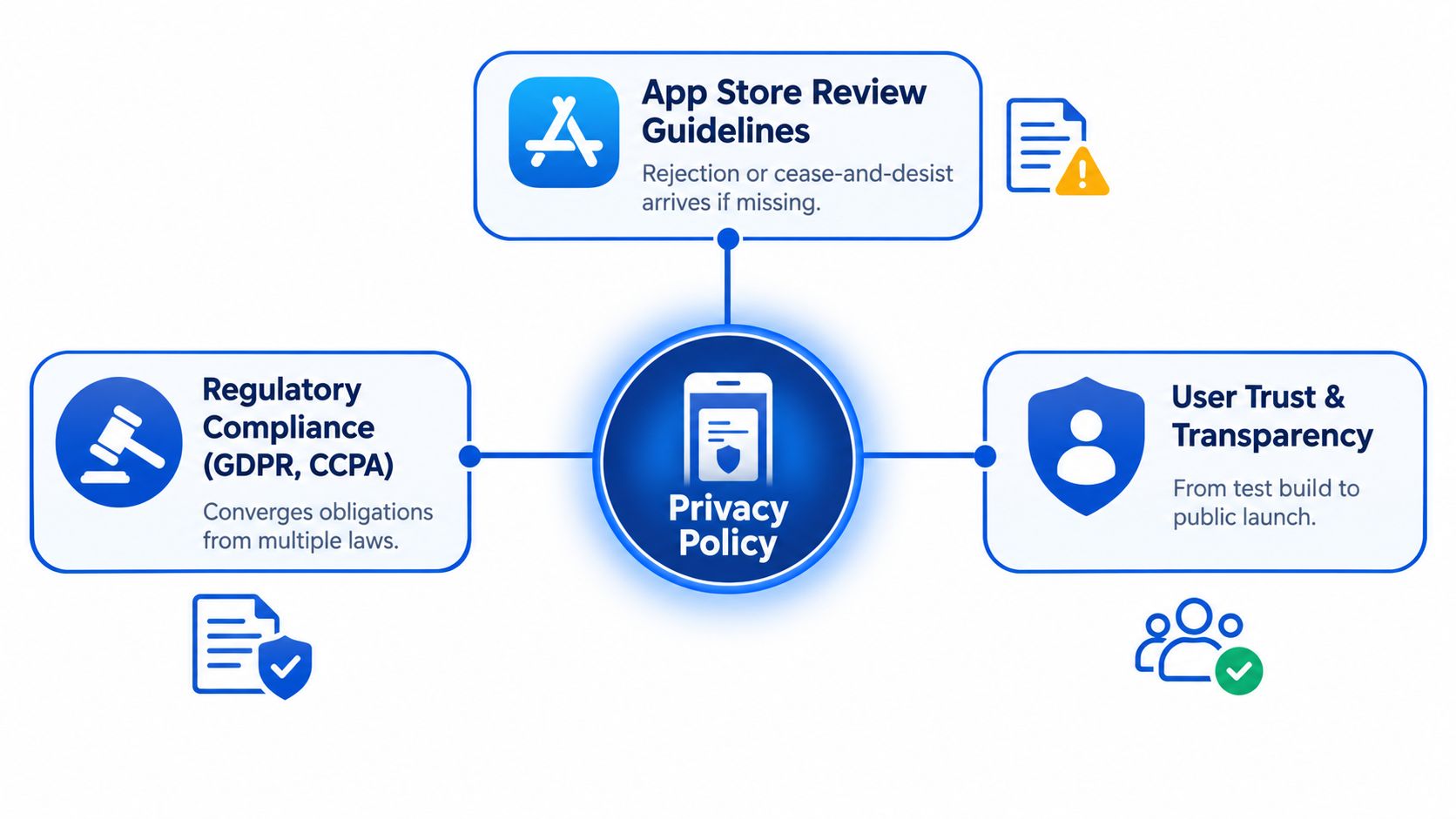
A copy-pasted policy fails all three audiences at once. It can omit the company's legal identity, describe website cookies while ignoring mobile identifiers, promise deletion without a deletion workflow, or claim that data isn't shared while an advertising SDK transmits it.
Practical rule: A short policy that accurately describes a narrow app is safer than a lengthy policy that describes a different product.
Founders can use the privacy policy and compliance guidance from By Design Law to frame the document as part of a broader privacy program. A separate example, privacy terms for NGOs, can help teams evaluate how an organization presents responsibility, contact information, purposes, and user-facing transparency.
What a Mobile App Privacy Policy Actually Is
A mobile app privacy policy serves three readers, and each reader asks a different question.
The user wants to know what happens after tapping Sign Up, enabling location, uploading a photo, or allowing notifications. The regulator reads the policy as a description of the controller's processing activities, legal bases, recipients, retention, rights, and safeguards. The app-store reviewer compares the policy with platform declarations and checks whether the listing gives users a usable route to privacy information.
That combination makes a mobile policy materially different from a generic website policy.
| Dimension | Mobile App Policy | Generic Website Policy |
|---|---|---|
| SDK ecosystem | Must account for analytics, crash reporting, attribution, advertising, authentication, payments, and other embedded SDKs. | Often focuses on first-party forms, cookies, pixels, and hosting tools. |
| Device and OS data | Addresses device identifiers, advertising identifiers, permissions, push tokens, location, camera, microphone, contacts, and background activity where applicable. | Usually centers on browser data, cookies, IP addresses, and web forms. |
| Point of access | Should be reachable in the app, during relevant collection moments, and from the store listing. | Commonly appears through a website footer or account page. |
| Offline and background flows | Must explain queued events, local storage, synchronization, background refresh, and notifications where those flows collect or transmit information. | Usually describes activity occurring during a page visit or web session. |
A website policy can cover both a website and an app, but only if it clearly separates the channels and includes the app's additional data flows. A separate app policy can also work, provided users can find complete information and the documents cross-reference one another.
The policy also sits beside the app's terms of service and consent records. Those documents serve different functions, so founders should understand the distinction explained in clickwrap versus browsewrap guidance. A privacy policy describes processing. It doesn't, by itself, prove that a user gave valid consent or accepted contractual terms.
The strongest framing is operational: the policy is a synchronization layer. When engineering adds an SDK, product changes a permission screen, or marketing changes attribution settings, the policy and store disclosures must be reconsidered.
Required Clauses Every Mobile App Privacy Policy Needs
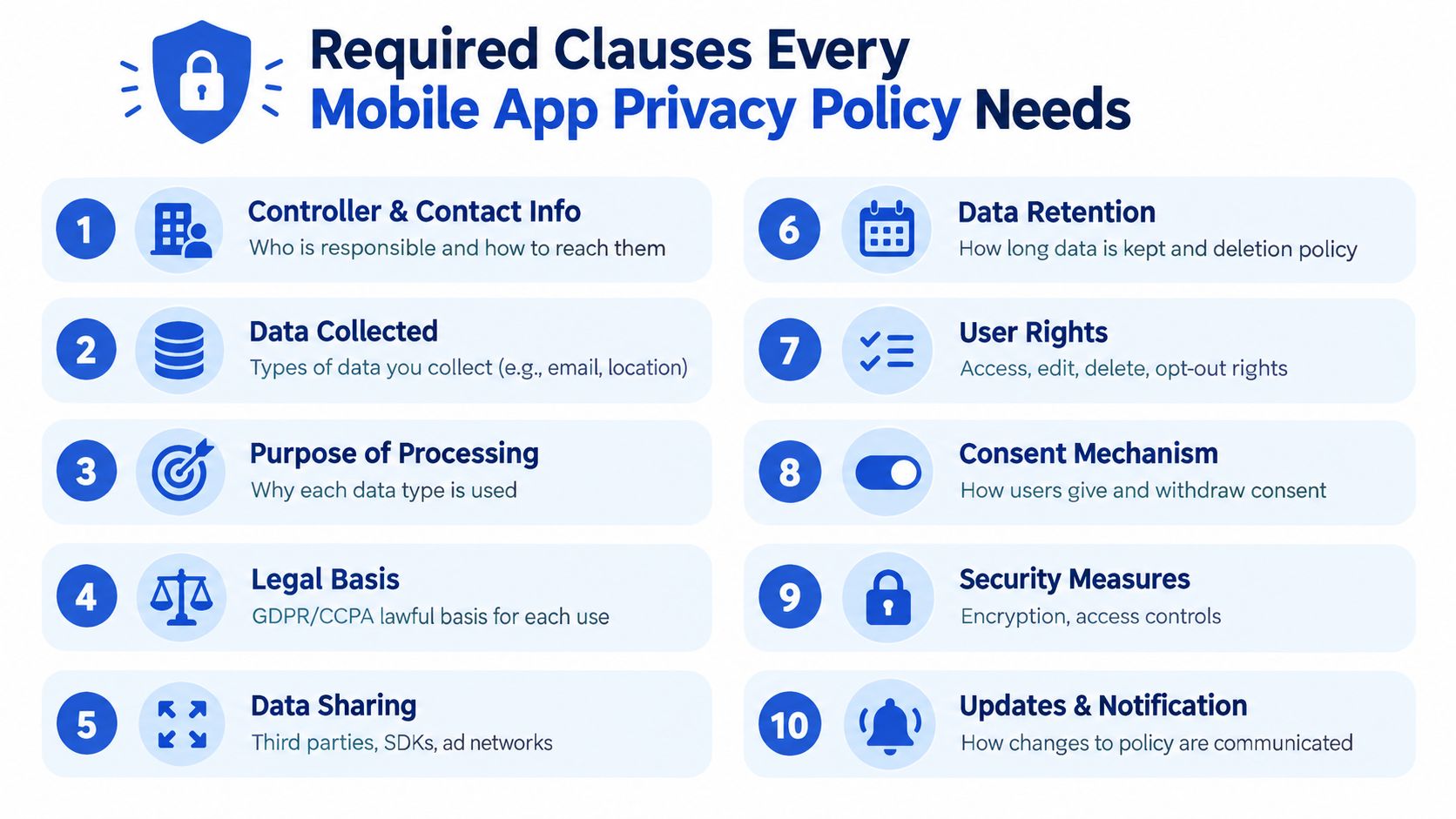
A reviewer should be able to move through the policy and answer a consistent sequence of questions. The following clauses provide that sequence, but each one must be drafted from the app's actual data map rather than filled with stock language.
Start with responsibility and collection
-
Controller and contact information: Name the legal entity responsible for processing, provide a monitored privacy email, and identify an EU representative where required. A contact form that nobody monitors isn't a meaningful rights channel.
-
Categories of personal data: Separate information the user provides, information collected automatically, and information inferred. The automatic category may include device identifiers, IP address, crash logs, diagnostic data, and usage events. If the app derives preferences, risk scores, or recommendations, explain those inferences rather than hiding them under “profile information.”
-
Purposes of use: Tie each data category to a specific purpose. “We use your data to improve services” is too vague when the actual purpose is fraud prevention, account authentication, product analytics, personalized advertising, or location-based functionality.
-
Third parties and SDKs: Name material vendors individually, describe their roles, explain what data they receive, address retention, and link to their policies. “Service providers” is a category, not a complete disclosure, when a vendor materially shapes the data flow.
-
Retention and deletion: State timeframes or trigger events where possible. Examples include deletion after account closure, removal after a support matter ends, or shorter retention for crash logs. A policy that says only “as long as necessary” leaves users unable to understand the actual lifecycle.
Add rights, choices, and safeguards
-
Security measures: Describe capabilities such as access controls, encryption in transit, authentication protections, logging, and vendor security review where accurate. Avoid absolute claims such as “your data is completely secure.”
-
User rights: Explain access, correction, deletion, portability, and applicable opt-outs, including opt-out of sale or sharing. Give users a submission method, verification steps, response expectations, and an escalation route.
-
Children's data: State the relevant age threshold and what happens if the app detects a child. COPPA covers operators directed to children under 13 and operators with actual knowledge that they collect personal information from a child under 13, as described in the FTC COPPA rule.
-
Consent and choices: Explain permission prompts, advertising or analytics choices, cookie-equivalent technologies, and granular toggles where opt-in is required. A consent clause should point to the actual control that lets a user withdraw consent.
-
International transfers: Identify the legal mechanism used for transfers, such as an adequacy decision or Standard Contractual Clauses where applicable. Generic language about data moving “to other countries” doesn't identify the safeguard.
-
Changes and notification: Include an effective date, preserve prior versions, describe material-change notice, and state how users will be informed. Version control helps the company show what users were told at a particular point in time.
The data retention policy template resource can help founders separate retention decisions from the privacy policy's user-facing explanation. The policy should describe the result, while internal schedules define the operational rule.
The most important drafting test is simple: every sentence should be traceable to a product behavior, vendor contract, legal decision, or rights workflow.
Jurisdictional Rules That Shape the Policy
Privacy regimes overlap, but they don't collapse into one universal clause. A company can reuse the core data inventory and purpose descriptions, then add jurisdiction-specific language for rights, consent, children, sensitive data, and transfers.
| Policy Section | CCPA/CPRA | GDPR | COPPA | State Privacy Laws |
|---|---|---|---|---|
| Data categories | Describe personal information and sensitive personal information categories where applicable. | Identify personal data and special categories, including the relevant processing context. | Explain children's personal information collection and use. | Map covered personal data and sensitive-data treatment under the applicable state law. |
| Purposes and legal basis | Explain business and commercial purposes, plus applicable sale or sharing practices. | Connect each processing purpose to an Article 6 lawful basis and address Article 9 where special categories arise. | Explain the purpose of collection and the limits on use and disclosure. | Tie uses to required notices, consent, and opt-out rights. |
| User rights | Address access, deletion, correction where applicable, and opt-outs of sale or sharing. | Address access, rectification, erasure, portability, objection, restriction, and withdrawal where applicable. | Provide parental access, deletion, and control mechanisms. | Address rights such as access, deletion, correction, portability, and opt-outs according to the relevant statute. |
| Transfers and sharing | Disclose relevant sharing and sale practices, including required sale disclosures over the applicable look-back period. | Explain international transfer mechanisms, such as SCCs or adequacy decisions. | Limit disclosures and use to permitted purposes and authorized recipients. | Describe third-party disclosures and any state-specific sale, targeted advertising, or profiling choices. |
The US federal baseline includes Section 5 of the FTC Act, which can apply when an app's privacy representations are deceptive or unfair. Health apps may also encounter HIPAA issues when their business model and covered-entity relationships bring the data within that framework. The policy must not imply HIPAA protection where the app isn't operating under HIPAA obligations.
California's CCPA and CPRA require careful treatment of categories, purposes, rights, sale, sharing, and sensitive information. Virginia's CDPA and other state regimes add their own definitions, thresholds, consent rules, and appeal or opt-out mechanics. The policy shouldn't claim that one generic “state privacy rights” paragraph covers every jurisdiction.
The GDPR requires lawful bases under Article 6 and additional analysis for special categories under Article 9. The ePrivacy Directive can affect access to device information and similar technologies, while the UK GDPR and related UK rules require separate review after Brexit. Transfer language must identify the mechanism used, not merely promise adequate protection.
COPPA remains distinct. The FTC states that an app's privacy policy link must appear on its home page, not only in the store listing, and children's services need direct notice, verifiable parental consent, and controls over retention and disclosure. Founders assessing international transfers can consult cross-border data transfer guidance after Schrems II, but counsel should match the transfer mechanism to the company's actual vendors and destinations.
App Store Rules and How They Layer On Top
A store review can fail after a policy update appears complete. The usual cause is a mismatch among the policy, runtime SDK behavior, and store disclosures. Apple's and Google's disclosure systems are public compliance statements, not substitutes for the privacy policy.
Apple's Privacy Nutrition Labels organize App Store disclosures around the data an app collects, whether it is used for tracking, whether it is linked to the user, and whether it remains unlinked. Developers must classify data collected by their own code and third-party SDKs. The same inventory should support the policy, consent flows, and product settings.
Google Play's Data safety section asks whether the app collects data, why it collects it, whether it shares data with third parties, whether data is encrypted in transit, and whether users can request deletion. Developers were required to complete the section by July 20, 2022. The answers must reflect actual SDK behavior, vendor contracts, and account-deletion workflows.
| Disclosure Element | Apple Nutrition Labels | Google Play Data Safety |
|---|---|---|
| Collection | Classifies data types collected by the app and its SDKs. | States whether data is collected and identifies applicable categories. |
| Tracking or sharing | Identifies tracking and whether data is linked to the user. | Addresses sharing with third parties and stated purposes. |
| Security | Uses Apple's disclosure framework alongside platform requirements. | Asks about security practices such as encryption in transit. |
| Deletion | Must remain consistent with the app's rights and deletion process. | Asks whether users can request deletion and requires accurate account-related disclosures. |
Product changes expose gaps quickly. A policy may state that the company does not sell personal information, while an advertising SDK sends an advertising identifier for attribution or targeted advertising. A retention clause may promise deletion after a defined event, while a vendor keeps event data under another schedule. Adding an analytics SDK can also change the store answers without changing a single line of policy text.
The disclosure review should therefore begin with the running app and its dependency inventory. Check SDK initialization, permissions, identifiers, event payloads, transmission destinations, retention settings, and deletion callbacks. Then reconcile those findings with the policy and each store form.
Store metadata is not a private worksheet. It’s part of the company’s public compliance story.
Apple’s tracking permissions and SDK disclosure expectations make that reconciliation particularly important. Google creates the same accountability issue through a different interface. A mismatch can lead to rejection, removal, or a user complaint, and engineering can often catch it through a focused SDK review before submission.
Where Templates and Generic Policies Fall Short
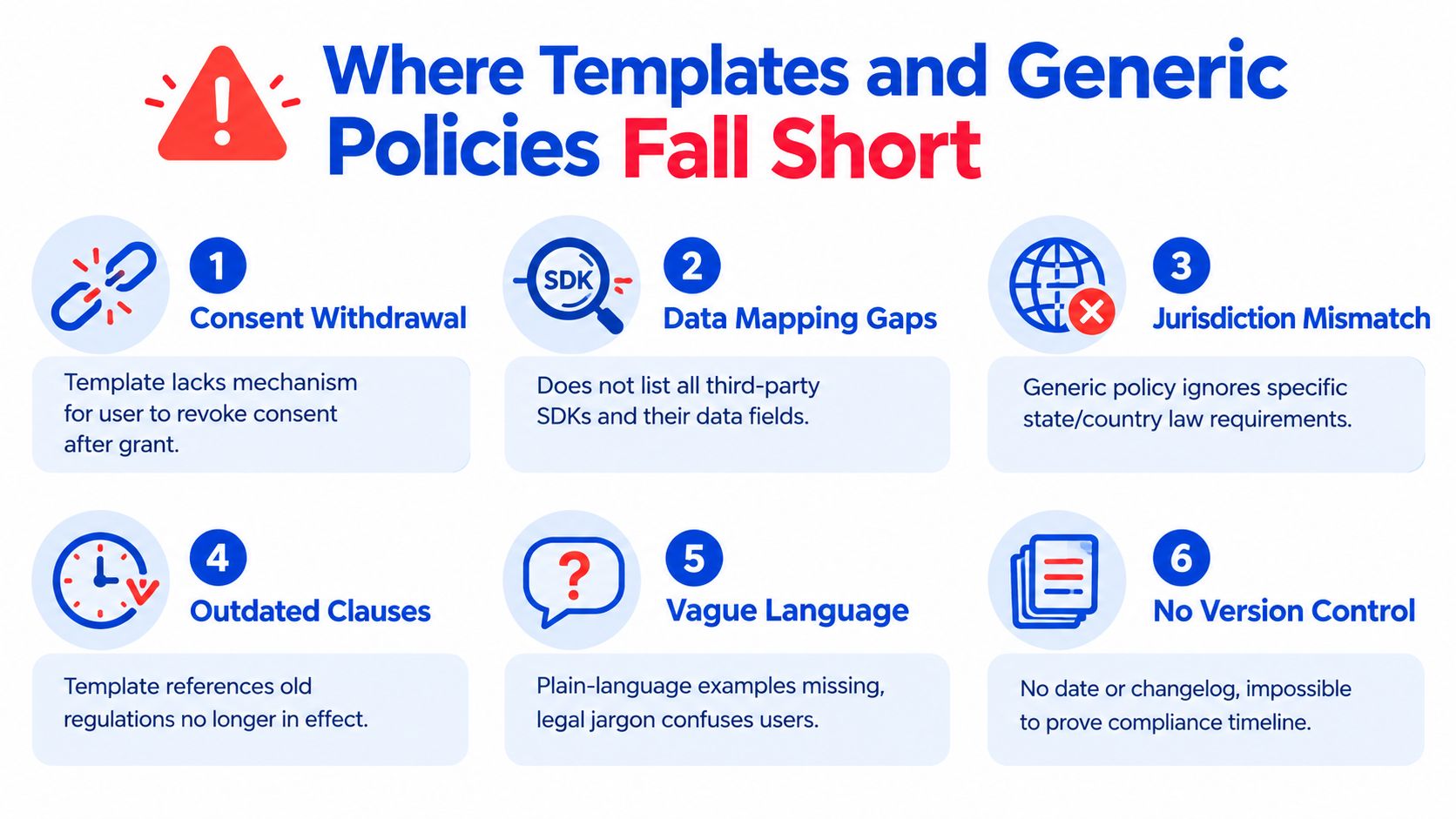
A free template can provide headings. It can’t know whether the app uses Firebase Analytics, Sentry, Stripe, OneSignal, Auth0, an advertising network, a biometric API, or a custom machine-learning service. That missing context is where generic policies break.
Boilerplate misses the operational control
Consent withdrawal is the clearest example. Boilerplate often explains how a user opts in, then says the user may withdraw consent without identifying the toggle, account setting, support channel, or backend action that makes withdrawal real. A 2024 ACM study of 77,522 mobile-app privacy policies found that 66.1% of policies claiming consent-based processing didn’t also state that users can withdraw consent, as reported in the ACM analysis of consent language.
That omission matters because valid consent requires a practical withdrawal path under the GDPR. If a user turns off a setting but the SDK continues transmitting data, the company has a product-control problem, not just a drafting problem.
SDK drift creates a second failure. Developers add crash reporting, attribution, analytics, chat, payment, or authentication tools after the original policy is published. The policy then describes the launch product while the runtime app follows a newer data map.
Cross-border language can fail just as. Generic text may mention international processing without identifying SCCs, adequacy decisions, vendor roles, or the separate UK analysis. It may also omit the ePrivacy layer for device access and consent.
Website language doesn’t cover mobile behavior
A web policy often ignores:
- Push notification tokens: The token, notification purpose, and marketing distinction need separate treatment.
- Biometric authentication: The app should explain whether biometric data leaves the device or whether the app receives only an operating-system result.
- Device identifiers: Advertising identifiers, app instance identifiers, and reset behavior can affect store and legal disclosures.
- Precise location: The policy should distinguish foreground, background, one-time, and continuous access.
- In-app purchase metadata: Receipts, transaction identifiers, and fraud signals may flow through payment or platform systems.
- Offline storage: Local drafts, cached profiles, and queued events can remain on a device before synchronization.
Recent research summarized in the mobile privacy-policy and Data Safety consistency study found that over 90% of apps had at least one inconsistency between their policies and Google Play Data Safety labels. The study reported disagreement in about 33% of collection disclosures and 31% of sharing disclosures, and recent testing found 97% of examined iOS apps missing required Privacy Manifests for third-party SDKs. Those findings support a practical conclusion: a deliberately narrow, accurate custom draft often creates less risk than an expansive template that promises controls the company hasn’t built.
Drafting, Rolling Out, and Maintaining the Policy
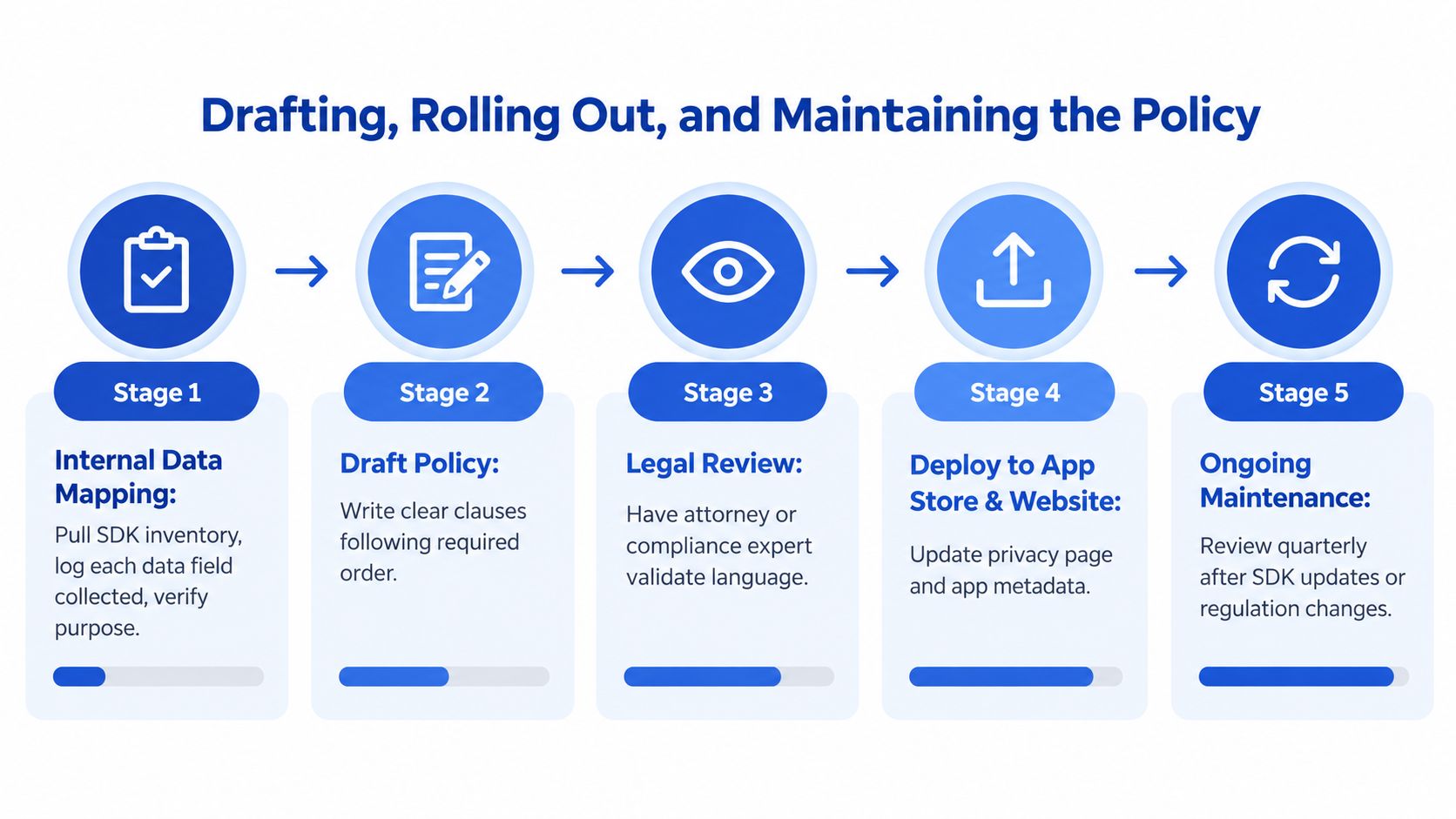
A defensible policy begins with the product, not a blank document. The rollout should move in a fixed sequence so legal text, store metadata, and runtime behavior are reviewed together.
-
Map the data internally. Pull the current SDK inventory from the mobile repositories, dependency files, build configuration, and vendor contracts. Log every field collected, including device identifiers, IP address, event names, crash data, location, push tokens, account details, payment metadata, and inferred attributes. Verify the inventory against code and network behavior, not only vendor marketing pages.
-
Draft against the inventory. Write a plain-language block for each data category, purpose, recipient, retention rule, and user choice. If the app doesn’t collect a category, say so where useful. If an SDK collects a category for the company, a vendor, or both, identify the relationship accurately.
-
Obtain legal review. Counsel should test jurisdictional scope, lawful bases, children’s obligations, sensitive-data treatment, transfer mechanisms, rights language, and the accuracy of vendor descriptions. The review should also compare the policy with permission prompts and consent records.
-
Deploy every touchpoint. Use one canonical policy URL across onboarding, account creation, settings, the app’s legal menu, App Store Connect, and Google Play Console. Children’s apps need particular care because the FTC says the privacy policy must be linked from the app’s home page.
-
Govern changes. Add a version date, archive prior versions, schedule a recurring SDK audit, and assign an owner for sign-off whenever a new vendor, permission, data field, or advertising function is added.
Before counsel review, founders should confirm:
- Scope: The policy identifies the legal entity, app, website, regions, and relevant services.
- Audience: The app’s general audience, children’s audience, business users, or mixed audience is labeled accurately.
- Retention: Each material data category has a timeframe or deletion trigger.
- Consent placement: Permission and consent copy appears before the relevant collection, not after it.
- Rights channel: The privacy email, in-app request path, and account deletion process reach an assigned owner.
- Store alignment: Apple and Google disclosures match the latest code, SDKs, policy, and deletion behavior.
A policy should be treated like a maintained product artifact. The company should reopen it after SDK updates, permission changes, new markets, acquisitions, new advertising functionality, and material changes to account or payment flows.
Common Founder Questions and When to Call Counsel
Is a free generator enough for a consumer app shipping in California and the EU? Usually not. A generated document may help organize headings, but it often lacks a tested withdrawal mechanism, precise transfer language, SDK mapping, and minor protections for the product.
How often should the policy be refreshed? At minimum, after every SDK or material product change. A quarterly review gives the team a regular checkpoint for dependency changes, store disclosures, retention rules, and regulatory developments.
Does a push-notification opt-in equal marketing consent under the GDPR? No. Permission to send notifications through the operating system doesn’t automatically establish consent for marketing processing. The app should separate necessary service notifications from promotional communications and provide the applicable choice.
What if the app has no analytics? The policy should say that clearly, including the absence of third-party analytics SDKs if that is accurate. Silence can leave users guessing and can make store disclosures harder to validate.
Outside counsel should be engaged before launch when the app targets children, processes health or financial data, depends on cross-border transfers, uses advertising or extensive profiling, or has received a regulator inquiry. A reviewed template may be defensible for a narrow, low-risk consumer utility outside those triggers, but only after the company verifies that the template matches the app.
By Design Law Firm & Legal Consultancy, PLLC offers mobile app privacy policy drafting and review, privacy program design, cross-border data guidance, and support for SDK, consent, retention, and breach-response issues. Founders can visit By Design Law Firm & Legal Consultancy, PLLC to discuss a policy that matches the app’s code, store disclosures, and launch plans. Contact our law office at (206) 593-1519.