An LLC doesn't normally adopt corporate bylaws. It runs on an operating agreement, and Washington requires that agreement even though it isn't filed with the Secretary of State. Popular advice tells founders to download a short template, call it bylaws, and move on, and that advice creates the risk. A document that misnames the governing contract, copies corporate meeting rules, and leaves ownership, voting, and exit terms vague doesn't give founders flexibility. It leaves statutory defaults to decide control when a dispute arrives. Anyone looking up bylaws LLC rules in Washington should know that the practical task isn't finding a corporate form. It's drafting a private operating agreement that matches the actual owners, money, and authority inside the company.
Whether Your LLC Needs Bylaws at All
Does a Washington LLC need bylaws? No. Washington requires an operating agreement, and the Washington Secretary of State business guidance identifies it as the document establishing the LLC's rules and operations while confirming it isn't filed publicly. Can an LLC use bylaws? Founders can keep bylaws-style procedures for meetings or officers, but those procedures can't override the operating agreement on ownership, voting, and distributions. Which document controls? The operating agreement controls because it's the private contract that sets member rights.
Many websites use the two terms as if they're interchangeable. They're not, and the comparison between a shareholder agreement and corporate bylaws shows why corporate documents solve different problems from LLC member contracts.
Bylaws versus operating agreement at a glance
| Feature | Corporate bylaws | LLC operating agreement |
|---|---|---|
| Entity that normally uses it | Corporations | Limited liability companies |
| What it governs | Board, officers, shareholder meetings and stock transfers | Members, managers, voting, contributions, distributions and transfers |
| Filed with Washington Secretary of State | No, kept as an internal record | No, kept as an internal record |
| Core question answered | How the corporation is run | How the owners share control and money |
| Typical contents | Board size, officer roles, annual meetings, share transfer rules | Management structure, approval thresholds, profit splits, deadlock path, dissolution |
| Washington requirement | Corporate governance document | Required of LLCs; SOS guidance says it must be created |
Three situations founders face
A single-member LLC still needs a written agreement. There's no co-owner to argue with, but banks, buyers, estates, and successors still need proof of who owns the company, who can sign, and what happens on incapacity or death. A short signed agreement also helps show the business is separate from the owner.
A multi-member LLC with equal founders needs more. Equal ownership without deadlock and voting terms means neither founder can resolve a disagreement over hiring, debt, or a sale. The agreement should name which decisions need unanimous consent and which need only a majority.
An LLC preparing for outside investors needs transfer restrictions, admission standards, and information rights. Investors will ask who can approve new equity, whether existing members can block a transfer, and what records they can inspect. A basic template often omits those terms.
Electing corporate tax treatment doesn't change the answer. The IRS limited liability company guidance treats classification as a federal tax election, not a change in state-law form. The verdict is simple. Washington founders should use an operating agreement and borrow from bylaws only for a specific procedural reason, never as a substitute.
Why LLCs Use Operating Agreements Instead
A corporation resembles a city with a charter and a council. Its bylaws supply the procedural rulebook for directors, officers, meetings, and shareholder votes. An LLC is closer to a private partnership, where owners write their own rules for management and money.
That hybrid design has a specific origin. The Wyoming Secretary of State business history records that Wyoming enacted the first LLC statute on March 4, 1977, after Hamilton Brothers Oil Company sought limited liability with partnership-style tax flexibility, and adoption remained slow until IRS Revenue Ruling 88-76 in 1988 recognized partnership treatment for a Wyoming LLC. The form then moved from niche to mainstream.
The signing stage is where that private contract becomes real for a new company.

The historical analysis of LLC growth notes only about 17,000 LLCs in 1993, representing less than 2% of all partnerships. By contrast, the Delaware Division of Corporations 2024 annual report recorded 211,464 LLC formations in 2024 in Delaware alone. Founders now use the form for operating companies, holding structures, and growth businesses.
What happens without a tie-breaker
Consider two founders who each own 50% and sign a template with no deadlock clause. One wants to hire a senior engineer and take on debt to fund the role. The other refuses. Neither can outvote the other, vendors wait, and the statutory default for who controls management fills the gap the founders left open.
A missing provision doesn't create freedom. It transfers the decision to default rules the founders didn't choose.
That's why the operating agreement matters more than its length suggests. It's the only place where member rights, manager authority, and exit mechanics live together. When it's vague, every major disagreement becomes an argument over intent.
Key Provisions Every Operating Agreement Needs
Founders should test each provision three ways. The agreement should state what happens, acknowledge what happens if it's silent, and identify the statutory default that would apply. Guidance on how to write an operating agreement is useful only when it's applied to those three questions, not copied as a checklist without decisions.
The checklist below summarizes the twelve provisions a Washington founder should settle before signing.
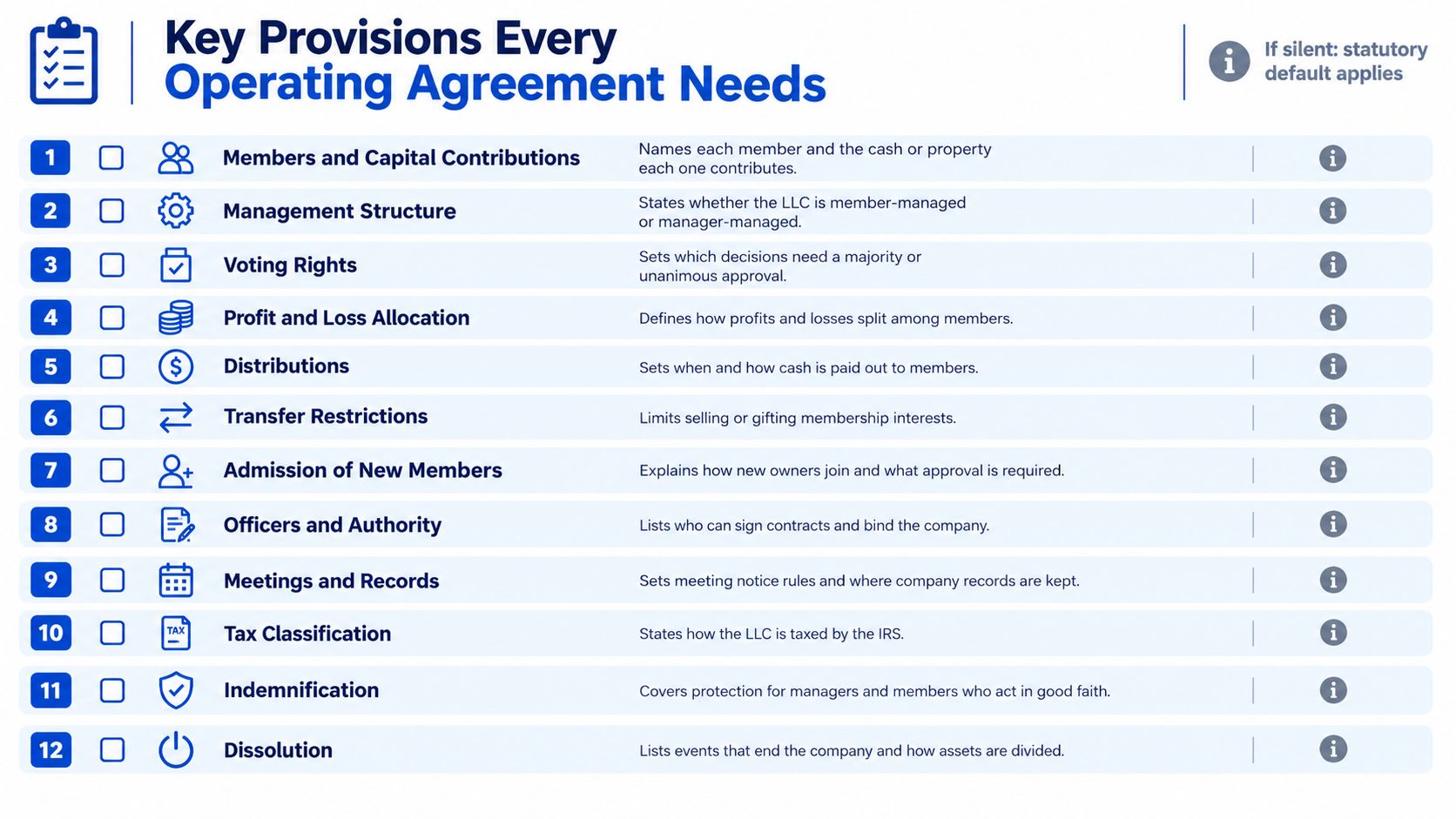
Governance provisions to specify in a Washington LLC agreement
| Provision | What to specify | Problem it prevents |
|---|---|---|
| Management structure | Member-managed or manager-managed, with named managers | Disputes over who can sign and bind the company |
| Voting and approval thresholds | Majority, supermajority or unanimous votes for listed decisions | A minority blocking routine work or a majority overriding key rights |
| Capital contributions | Amount, timing and consequences of late funding per member | Disagreement over who paid in and who owns more |
| Profit and loss allocation | Percentages, distribution timing and tax distributions | Cash flow that conflicts with ownership and tax bills |
| Transfers and right of first refusal | Permitted transfers, consent rules and first refusal period | Unwanted owners entering the company |
| Admission of new members | Approval required and how new equity is issued | Founders diluted in an investment round without consent |
| Deadlock resolution | Negotiation, mediation, buy-sell or dissolution path | Stalled votes ending in litigation by default |
| Fiduciary duty modifications | Which duties are narrowed and what statute preserves | Waivers that are unenforceable or challenged as unreasonable |
| Founder vesting and departure | Vesting schedule, repurchase rights, good-leaver and bad-leaver terms | A departed founder keeping full equity |
| Intellectual property assignment | Transfer of founder-created code, brands and inventions to the company | Core technology owned personally by a founder |
| Dissolution and incapacity | Triggering events and successor authority | No one authorized to act when an owner dies or is incapacitated |
| Records and information rights | Who keeps the ownership ledger and what members may inspect | Failed bank, investor or tax diligence |
The fiduciary duty limit
An operating agreement can act as a contractual control layer, but it can't rewrite every duty. Under the framework reflected in California's LLC operating agreement provisions, an agreement may modify or, in defined circumstances, eliminate duties such as loyalty and care. Statutory limits commonly preserve liability for bad faith, willful or intentional misconduct, knowing violations of law, and improper distributions.
Overly aggressive waivers create their own risk. They may prove unenforceable or invite disputes over whether consent was informed and whether the term is manifestly unreasonable. A thorough agreement specifies approval thresholds, conflict procedures, information rights, and standards for related-party transactions instead of relying on a blanket waiver.
Other states describe the same central role. The New York Department of State LLC guidance describes the operating agreement as the primary document establishing member rights, powers, duties, liabilities, and obligations, and confirms it is internal rather than a public filing.
Practical rule: A short agreement isn't automatically founder-friendly. Omitted provisions leave statutory defaults in charge exactly when relationships break down.
The direct answer is that an operating agreement must address the twelve provisions in the table. Any provision left silent falls to the statutory default that applies in a dispute, whether founders like that default or not.
Sample Clauses for the Provisions That Matter Most
Sample language shows the structure of a decision, not a finished draft. Each clause below needs editing for ownership, financing plans, and Washington law before use. Founders should treat the numbers and procedures as placeholders that force a conversation, not as defaults recommended for every company.
Manager authority clause
The Company is managed by the Managers named in Schedule A. Each Manager may bind the Company in ordinary-course contracts up to $25,000. Any single contract above that amount requires the written consent of Members holding a majority of the Percentage Interests.
This controls unauthorized commitments and tells vendors and members where authority ends. The dollar threshold must fit the business, since a services firm and a manufacturer face different ordinary-course spending. The edge case is a manager who signs above the limit anyway, so the agreement should also address ratification and internal consequences.
Deadlock clause
If Members holding equal voting power cannot resolve a material decision within thirty days of written notice, the Members will submit the dispute to mediation. If mediation fails, either Member may initiate a buy-sell process in which the initiating Member names a price for the membership interests and the other Member elects to buy or sell at that price within the period stated in this Agreement.
This creates an ending other than paralysis. Negotiation handles ordinary disagreement, mediation adds a neutral, and buy-sell forces an economic choice. The weakness is unequal liquidity, because the founder with more cash may use the mechanism strategically. Payment terms and valuation protections may be needed.
Fiduciary duty clause
To the extent permitted by chapter 25.15 RCW, the fiduciary duties of Members and Managers are modified as stated in this Agreement. Nothing in this section eliminates liability for bad faith, willful misconduct, or a knowing violation of law.
This preserves personal outside activities or narrowed duties where Washington law allows, while keeping core misconduct outside the waiver. The clause breaks when it's written as a total elimination of loyalty and care without stated limits. Conflict disclosure and approval procedures should sit beside it.
Transfer restriction clause
A Member may not transfer membership interests to a third party unless the Member first offers those interests to the Company and then to the other Members on the same material terms as the third-party offer. The Company and Members will have sixty days in total, as allocated in this section, to elect to purchase.
This prevents unwanted owners and gives insiders a chance to keep control. The edge case is a transfer to a family trust, estate, or affiliate, which may be permitted without an offer but still without management rights until admission. Founders should define permitted transferees, divorce and bankruptcy events, and whether an assignee receives only economic rights.
These clauses are starting points. The wording must match the company's ownership ledger, vesting terms, tax classification, and financing plans, and Washington counsel should conform each term to the current statute.
Washington Filing Rules and Tax Timing
Washington separates the public record from the private contract. The Washington LLC filing resource page states that LLCs must create an operating agreement but that it isn't recorded, and its filing instructions warn applicants not to upload operating agreements, bylaws, minutes, ownership details, or other internal governance documents because those materials are removed before filing is completed. The certificate of formation is the public record. The executed agreement belongs in company records.
The sequence below shows how formation, private storage, and annual maintenance fit together.
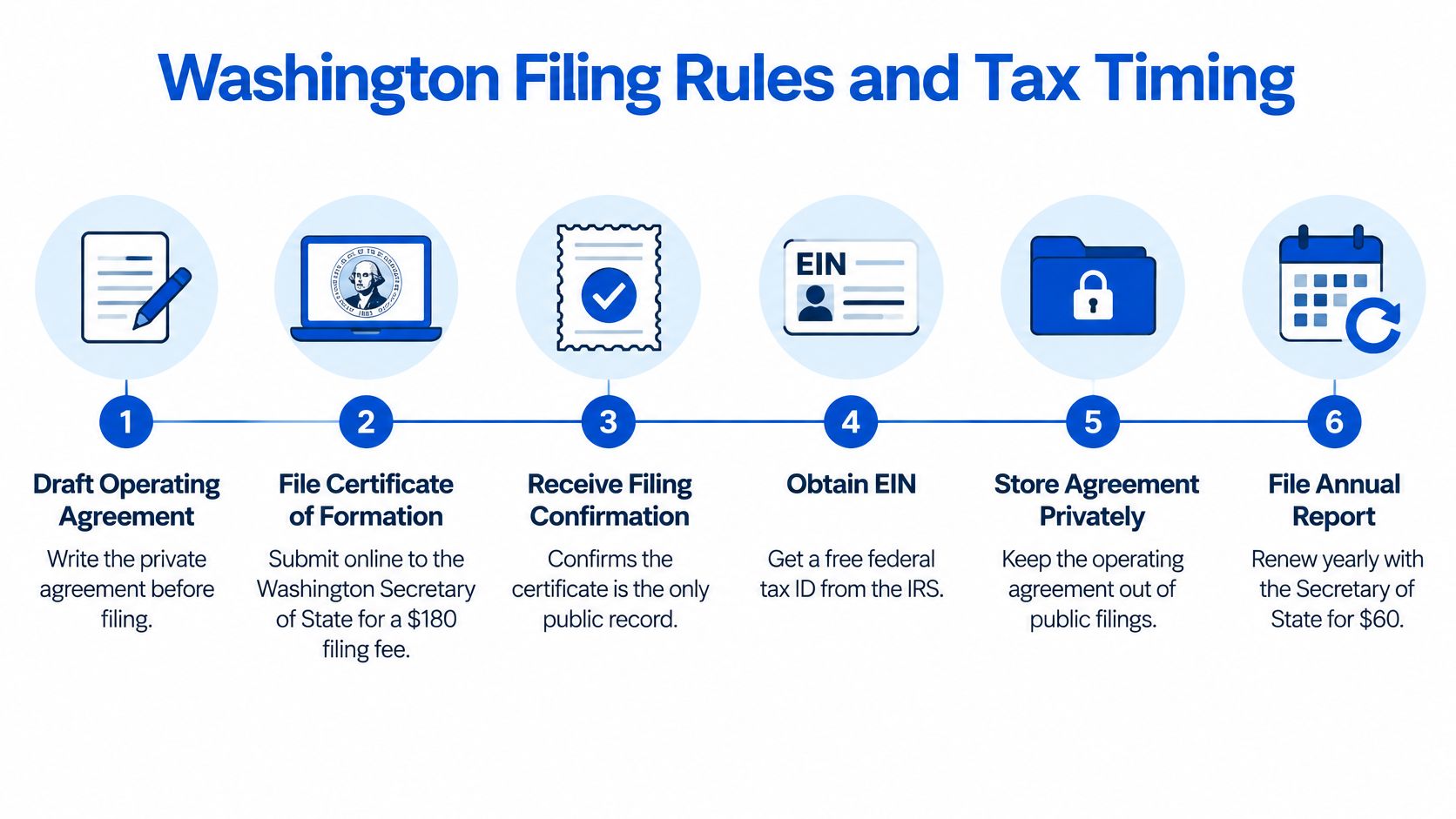
Washington LLC governance and tax rules
| Requirement | Rule | What to do |
|---|---|---|
| Governance document | Operating agreement required; not filed with the Secretary of State | Sign at formation and keep the executed copy |
| Public filing content | Certificate of formation is the public record | Do not upload the agreement, minutes or ownership details to the filing system |
| Default federal tax class | Partnership with two or more members; disregarded entity with one | State the default classification in the agreement |
| Form 8832 corporate election | Effective no more than 75 days before filing and no later than 12 months after | Match tax provisions to the actual effective date |
| S-corporation election | Form 2553 if eligible | Align salary and distribution terms before filing |
| Classification change lockout | Generally no further change for 60 months after a change | Confirm the classification before filing an election |
Federal tax timing and current reporting changes
Washington’s Small Business Guide distinguishes the documents by entity type, with corporations using bylaws, LLCs using operating agreements, and partnerships using partnership agreements. Founders following the steps for how to register a business in Washington should keep that distinction when choosing tax elections.
A two-member LLC electing corporate treatment on Form 8832 must pick an effective date no more than 75 days before filing and no later than 12 months after filing. Distribution, salary, and allocation language must match that date. After a classification change, IRS Publication 3402 explains the LLC generally can’t change again for 60 months, though a newly formed LLC whose election takes effect on formation isn’t treated as making a change.
The video below offers additional context on formation steps that sit alongside these filing and election decisions.
Current reporting guidance also needs care. FinCEN’s March 2025 interim final rule removed U.S.-created companies and U.S. persons from Corporate Transparency Act reporting, while qualifying foreign entities registered in the United States follow revised rules. That change doesn’t remove the need for accurate ownership ledgers for banks, investors, taxes, or a sale.
The drafting rule is direct. Decide tax classification before drafting distributions, authorize one named person to file the forms, and record the decision and effective date in the agreement.
Amending and Governing Your LLC Over Time
The operating agreement is a living contract, not a formation souvenir. Founders should review it after any event that changes ownership or control, including a new investor, a founder departure, a major equity transfer, a new manager, or a change in tax treatment. Waiting until diligence or a dispute exposes the gap is the expensive option.
The workflow below maps common triggers to the review and approval path.
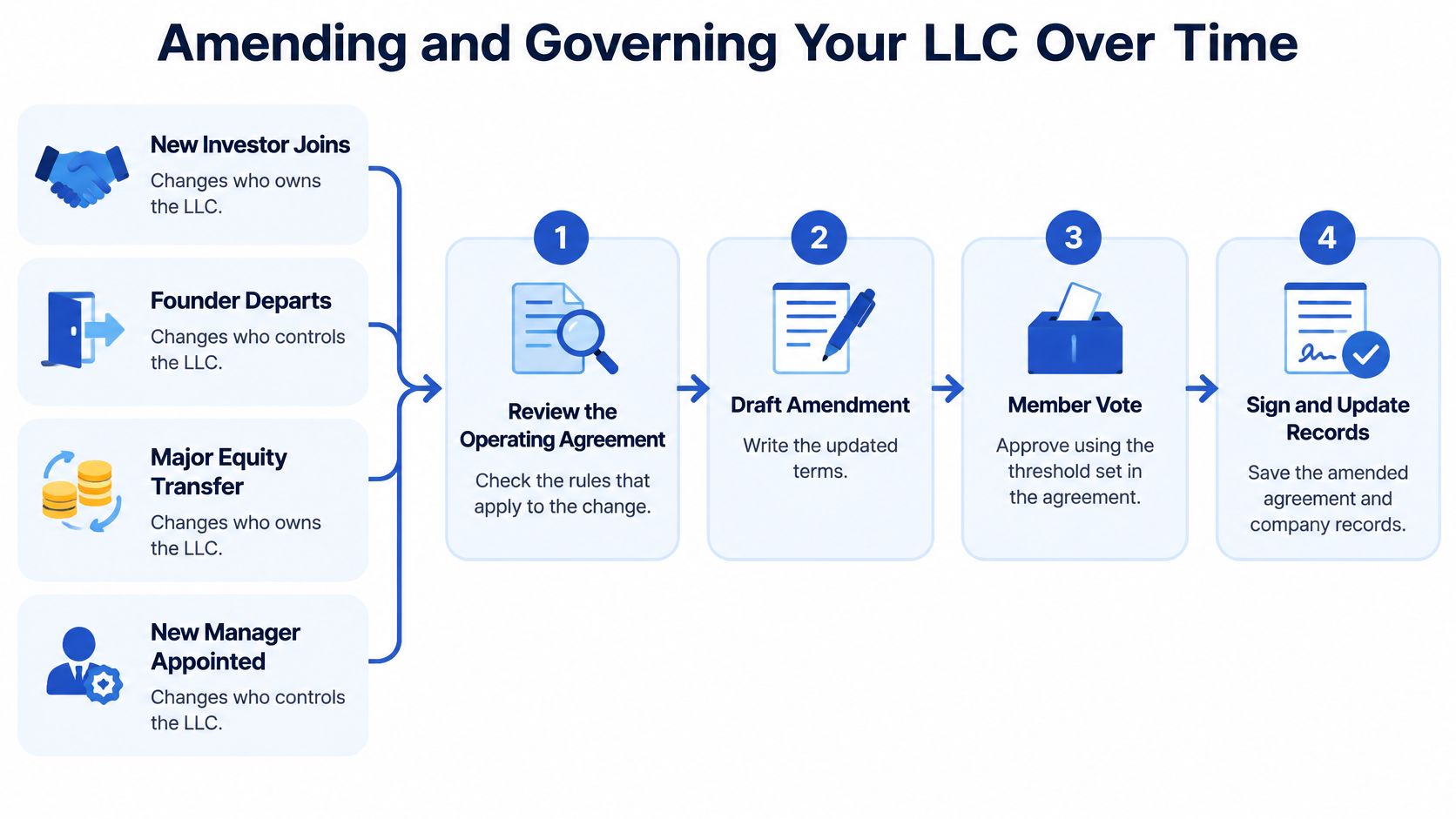
Seven amendment steps
- Identify the trigger: List every section the event affects, including voting, distributions, authority, and records.
- Check the threshold: Confirm whether the current agreement requires majority, supermajority, or unanimous consent.
- Draft the amendment: Quote each changed section in full so members can see the new operative language.
- Obtain written consents: Secure consent from the required members, including any member whose rights are reduced where consent is required.
- Sign and date: Execute the amendment and attach it to the original agreement.
- Update records: Revise the ownership ledger and capitalization records to match the amendment.
- Archive versions: Keep prior executed copies so the company can show which terms applied on any date.
A disciplined corporate governance guide approach helps founders keep those records consistent as managers and owners change. Informal practices are the recurring problem. If members routinely approve spending by text message while the agreement requires written consent, the mismatch creates arguments over whether a decision was authorized.
Record each major decision in a short signed written consent tied to the section of the agreement it implements or changes, even when no statute demands minutes.
Amendments should also revisit schedules. Member names, percentage interests, capital accounts, manager appointments, and notice addresses go stale quickly. Updating the main text without the schedules leaves the company with a polished agreement and unreliable ownership data.
Confirm the Governance Terms Before You Sign
Founders should work through six decisions before signing, using the provision table as the reference point. Skipping one rarely makes the agreement simpler. It usually makes a later amendment harder because bargaining power shifts once money, customers, and resentment enter the picture.
- Management structure: Choose member-managed or manager-managed and name who may sign contracts.
- Approval thresholds: Set votes for debt, new equity, major contracts, and sale of the company.
- Tax classification: Confirm the federal classification and any election dates, then write them into the agreement.
- Founder terms: Set vesting, repurchase, and intellectual property assignment terms for every founder.
- Deadlock path: Add a path that ends in mediation or a buy-sell rather than a court fight.
- Execution and storage: Sign, date, and store the executed agreement, then give copies to every member.
These decisions are interdependent. Manager authority affects investor diligence, tax classification affects distributions, and transfer rules affect estate planning and exit value. A change to one term requires a check of the others.
Washington counsel should review the draft against the company’s financing and exit plans before signing. By Design Law Firm & Legal Consultancy, PLLC drafts and reviews Washington operating agreements covering ownership, contributions, voting, management, distributions, transfers, departures, deadlock, and dispute procedures.
Washington founders who need an operating agreement drafted or reviewed against actual ownership, tax, and financing plans can work with By Design Law Firm & Legal Consultancy, PLLC, a Seattle-based firm advising businesses on formation, governance, and transactions. The firm helps founders replace generic bylaws LLC templates with clear terms for authority, distributions, transfers, and exit before those issues become disputes. Contact our law office at (206) 593-1519.