A founder approves a major vendor contract from a coffee shop, a co-founder promises a new investor a board seat, and nobody can later answer which decision was authorized. The company is growing, but its authority lines are still living in group chats, informal promises, and one founder’s memory. That’s the moment governance stops feeling like paperwork and starts looking like protection.

Introduction Why Governance Matters Before You Need It
Corporate governance is a company’s operating system. It determines who can make decisions, which decisions require approval, how money moves, how conflicts get handled, and what records prove that the company acted properly. For a startup or small business, that system doesn’t need to resemble a public company’s bureaucracy. It does need to work before a dispute, financing, acquisition, employee complaint, cyber incident, or leadership transition exposes its gaps.
A Washington founder may know every investor personally and still need written authority rules. A two-founder company can disagree over hiring, equity, intellectual property, or a major customer just as seriously as a larger organization. Governance gives those disagreements a process instead of allowing the loudest person, the original founder, or the person with access to the bank account to decide by default.
Investors and lenders often examine governance because the documents reveal whether the company can be trusted with outside capital. They’ll want to understand the ownership record, board authority, approval procedures, conflicts, financial controls, and decision history. Clean governance doesn’t guarantee funding, but disorganized governance can make diligence slower, more expensive, and less predictable.
Practical rule: If a decision could materially affect ownership, cash, liability, employment, or the company’s future direction, the company should identify the decision-maker and preserve a written record.
A useful corporate governance guide should answer practical questions, not just define fiduciary duties. The Loopfour tag archive offers additional governance-focused reading for owners comparing approaches and building better internal habits. The sections below translate those ideas into a Washington State lens, from board structure and bylaws to virtual meetings, AI oversight, and sustainable operating discipline.
What Corporate Governance Really Means for Startups and SMBs
Governance works like a company’s constitution and control panel. The constitution establishes the basic rules of authority and accountability. The control panel helps the people inside the company apply those rules to decisions about money, strategy, risk, ownership, and leadership.
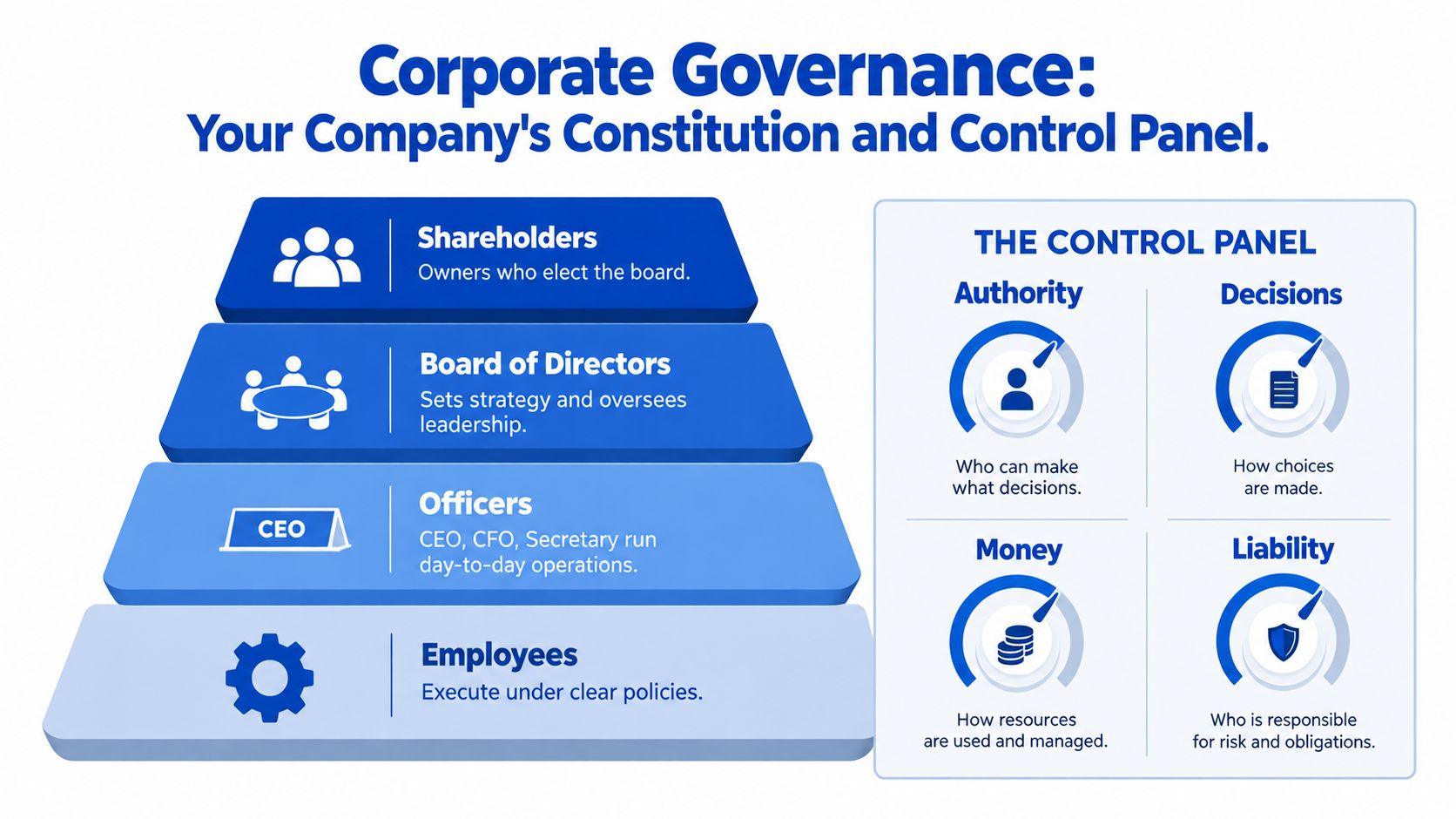
Three ideas make the framework easier to understand:
- Principles describe the destination. Accountability, transparency, fairness, responsible decision-making, and sustainable growth are governance principles. They help a company evaluate whether its systems are producing trustworthy decisions.
- Frameworks organize the route. Bylaws, board resolutions, committee charters, conflict policies, approval matrices, and meeting minutes turn principles into repeatable processes.
- Controls create evidence. A policy matters more when the company can show approvals, disclosures, reconciliations, minutes, access reviews, or follow-up actions.
The modern corporate governance guide used across major markets is anchored by the OECD Principles of Corporate Governance. OECD ministers first endorsed the principles on 26-27 May 1999. They later became the G20/OECD benchmark for listed companies, investors, disclosure, board responsibilities, and sustainability. The framework was updated in 2015. OECD materials describe the principles as non-binding, organized into six chapters, and intended to help policymakers improve legal and regulatory systems in support of economic efficiency, sustainable growth, and financial stability.
That history matters to private companies because investors, institutional partners, and employees often carry these expectations into private-company diligence. A startup doesn’t automatically become subject to every public-company rule, but its stakeholders may still ask whether ownership is clear, directors understand their duties, conflicts are disclosed, and important decisions receive appropriate oversight.
For founders seeking a deeper explanation of formation choices and governance documents, corporate law for startups provides a practical companion. The central distinction is simple: management runs the business, while governance decides who has authority to oversee management and how accountability operates.
Board Structure Roles and Independence That Actually Work
A small-company board doesn’t need ceremonial complexity. It needs defined roles, useful information, and enough judgment to challenge management when necessary.
Shareholders own the equity and elect directors or approve other matters reserved for them. Directors oversee the company, set strategic direction, appoint or evaluate senior leadership, monitor risk, and act in the company’s interests. Officers, such as a chief executive officer, chief financial officer, or secretary, handle delegated operations. Confusion begins when one person occupies all three positions but treats each role as interchangeable.
Assign the roles before assigning the titles
The chair should run effective meetings and help establish the agenda. An inside director can contribute management knowledge and operational context. An independent director should bring outside judgment without material interests or relationships that could compromise objective decision-making.
The OECD guidance on independent directors emphasizes merit-based selection and objective independence. It also identifies high-conflict assignments where independent judgment is especially valuable:
- Financial reporting integrity: Reviewing whether financial information is complete, accurate, and presented responsibly.
- Related-party transactions: Examining deals involving founders, directors, officers, family members, or affiliated businesses.
- Executive and board nominations: Evaluating candidates without allowing personal loyalty to replace qualifications.
- Remuneration oversight: Reviewing compensation decisions where management may benefit directly.
A founder should ask whether a proposed director has a material financial interest, close relationship, advisory role, employment connection, or other tie that could affect judgment. Independence isn’t a personality trait. It’s a practical assessment of relationships, incentives, and the specific decision under review.
Use committees when the work demands focused review
An early company may handle board responsibilities directly. As financial complexity or conflict risk increases, an audit committee or compensation committee can create a more disciplined review process. The committee charter should identify authority, reporting obligations, access to records, meeting frequency, and procedures for recusal.
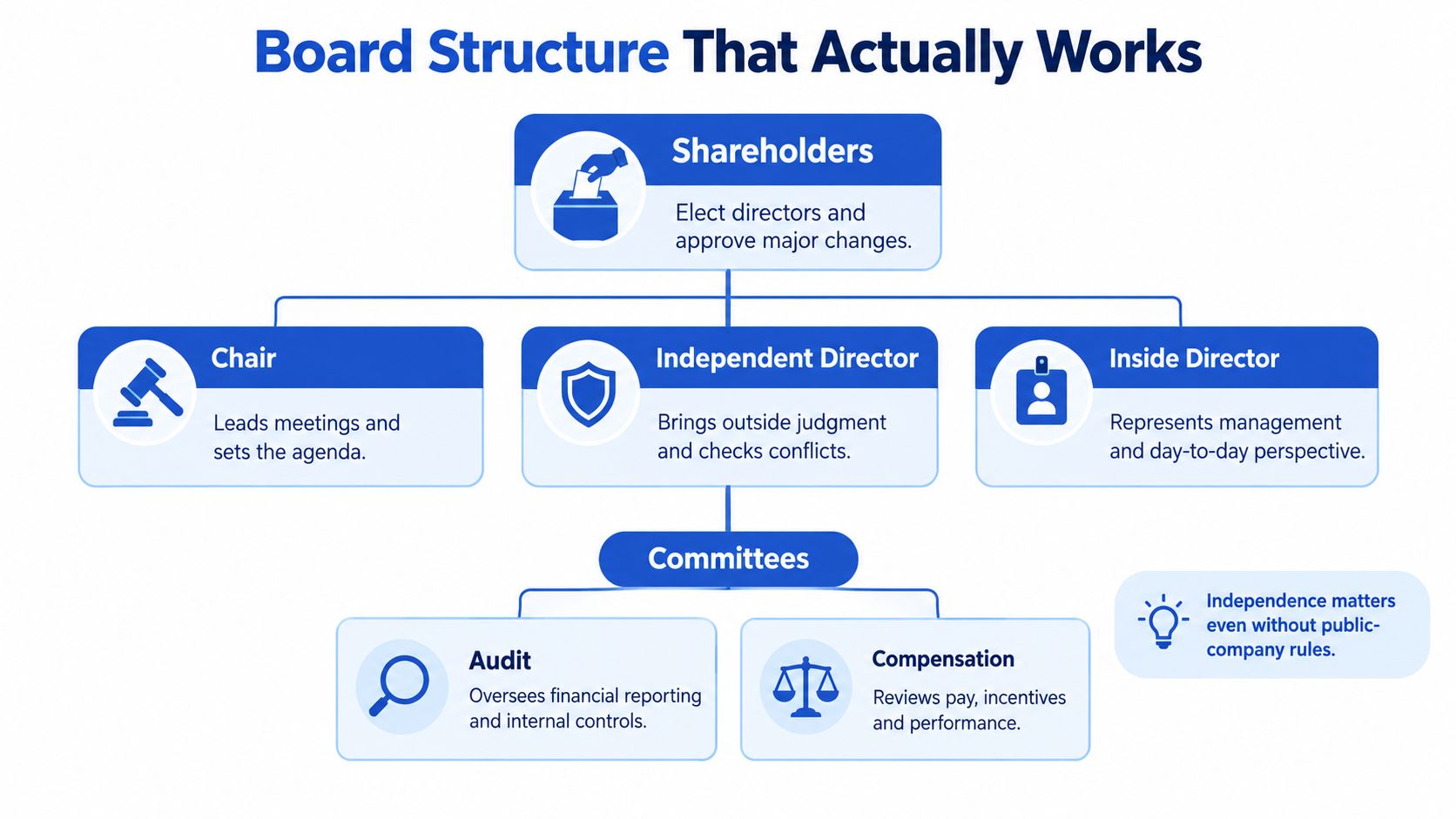
A board structure becomes credible when the company can explain who decides, who advises, who reviews, and who records the decision. Founders comparing practical structures can also consult this guide to board of directors structure.
Bylaws Policies and Compliance Foundations in Washington State
Governance becomes enforceable through documents that divide authority and create a reliable record. In Washington, the company’s formation documents and internal approvals should fit together rather than operate as disconnected files.
Build the document stack
The articles of incorporation establish the corporation’s legal foundation. Bylaws then describe internal mechanics, including shareholder meetings, director elections, board meetings, officer roles, voting procedures, notices, and recordkeeping. Initial board resolutions document the first operational approvals, such as officer appointments, banking authority, equity issuance, fiscal practices, and adoption of policies.
A shareholder agreement can address ownership-specific concerns that bylaws may not handle well, including transfer restrictions, buy-sell procedures, voting arrangements, rights of first refusal, and founder departures. The company should reconcile these documents so an approval rule in one document doesn’t conflict with a restriction in another.
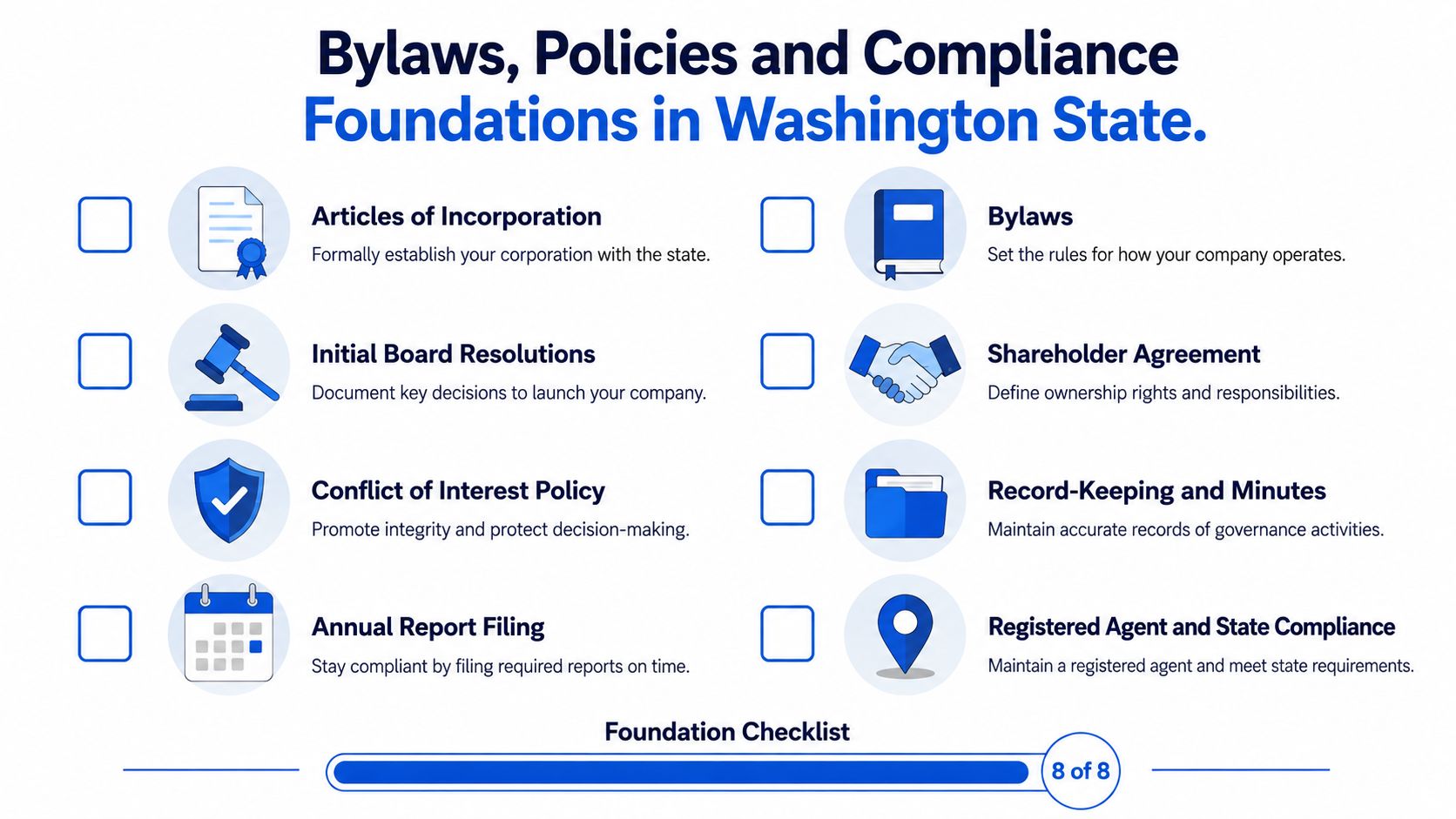
A practical foundation checklist includes:
- Articles of Incorporation: Confirm the legal entity and authorized structure.
- Bylaws: Set the operating rules for shareholders, directors, and officers.
- Initial Board Resolutions: Record formation-stage approvals and delegated authority.
- Shareholder Agreement: Address ownership rights and transfer situations.
- Conflict of Interest Policy: Require disclosures and appropriate recusal.
- Record-Keeping and Minutes: Preserve decisions, attendance, materials, and votes.
- Annual Report Filing: Track Washington filing obligations and deadlines.
- Registered Agent and State Compliance: Keep state contact and compliance information current.
Let disclosure expectations improve private-company habits
For U.S. public companies, proxy statements must disclose director names, qualifications, independence status, committee memberships and responsibilities, board leadership structure, risk oversight roles, executive and director compensation, stock ownership of executives and directors, related-party transactions, and policies concerning ethics, hedging, insider trading, clawbacks, and related-party transactions, as described in this U.S. public-company proxy disclosure reference.
A private company may not have the same proxy obligation, but the categories offer a strong design test. Can the company explain who governs, which committees do what, who owns equity, how conflicts are handled, and what controls apply to sensitive conduct?
The practical difference between a shareholder agreement and bylaws is covered in shareholder agreement versus bylaws. Washington founders should also coordinate governance documents with tax, employment, securities, privacy, and industry-specific advice instead of treating the corporate file as a one-time formation packet.
Risk Management Disclosure and Modern Oversight Challenges
Traditional governance asks whether directors oversee finances, leadership, compliance, and strategy. Modern governance asks a harder question: Can the company prove that oversight works when systems fail or information changes quickly?
That question includes accounting controls, cybersecurity, vendor access, privacy practices, AI tools, sustainability statements, and shareholder communications. A board resolution saying “management will monitor risk” is not evidence of monitoring. Evidence may include a risk register, assigned owners, review dates, escalation records, incident exercises, approval logs, and board minutes showing follow-up.
Digital shareholder meetings need a failure plan
The OECD Corporate Governance Factbook 2025, covering 52 economies, reports that 85% of jurisdictions allow virtual-only meetings and 94% allow hybrid meetings. Yet 42% lack a framework for managing digital security risks to meetings, while 48% lack explicit protections for shareholders if disruptions occur, according to the same source.
Those figures identify a practical governance gap. A company conducting a virtual or hybrid meeting should decide in advance how participants authenticate, how voting is verified, what happens during an outage, who can pause or adjourn the meeting, how questions are preserved, and whether the company, platform provider, or chair bears responsibility for different failures.
Board question: If the meeting platform stops working during a contested vote, which written rule tells the chair what happens next?
AI and succession belong on the risk agenda
AI oversight also needs an owner. The board should know which systems use sensitive data, which decisions rely on automated outputs, who reviews vendor representations, how errors are escalated, and what records demonstrate human oversight. A practical AI risk assessment framework can help translate those questions into reviewable controls.
Succession planning belongs in the same conversation because leadership continuity affects access, authority, customer relationships, and institutional knowledge. Owners managing family or closely held businesses may find the succession planning resource from The Owner’s Shortlist useful when documenting transfer expectations and preparing for an eventual change in control.
Putting Governance Into Practice Step by Step
A startup doesn’t need to build every control at once. It needs to establish the right sequence, preserve decisions, and increase formality as ownership, risk, and operational complexity develop.
Start with authority and ownership
First, confirm the entity’s formation documents, ownership ledger, equity approvals, and capitalization records. The board and founders should be able to identify who owns what, who serves as a director or officer, and which actions require shareholder or board approval.
Next, adopt bylaws and initial resolutions. Those documents should cover meeting procedures, officer authority, banking permissions, equity issuance, recordkeeping, and other formation-stage decisions. The company should avoid relying on an informal understanding that was never approved or recorded.
Create a repeatable operating rhythm
A workable governance cadence can include:
- Prepare a decision calendar. Track annual filings, board meetings, policy reviews, equity events, compensation decisions, insurance renewals, and material contract approvals.
- Send decision materials early. Directors need accurate financial, operational, legal, and risk information before a meeting.
- Record the action clearly. Minutes should capture attendance, conflicts, deliberation at an appropriate level, votes, recusals, and follow-up assignments.
- Review delegated authority. Compare spending limits and signing authority with the company’s current size and risk profile.
- Refresh the control set. Update policies when the company adds products, employees, vendors, data uses, jurisdictions, or financing arrangements.
Electronic execution can support consistent documentation when the company uses an appropriate process. Resources on eSignatures for standard operating procedures may help operations teams organize approvals and preserve evidence.
Add oversight when the facts justify it
A company should consider an independent director when founders face recurring conflicts, outside capital creates greater scrutiny, or the board needs expertise the management team lacks. An audit committee may become useful when financial reporting, related-party transactions, or external review requires concentrated attention. Compensation oversight should become more formal when executives, founders, or directors have overlapping interests.
Board.org’s 2025 enterprise data governance report states that 31% of organizations remained in the early stages of AI governance policy development, while 39% of data leaders reported difficulty demonstrating governance impact to leadership. Those findings support a measurable approach. The company should identify the responsible owner, define the control, set a review interval, and retain evidence that the board received and acted on the information.
Building a Durable Governance Culture for Long Term Growth
Governance lasts when employees and leaders use it during ordinary work, not only during fundraising or a crisis. A founder who expects contract approvals, conflict disclosures, security escalations, and board reporting to happen consistently creates an operating culture that can withstand personnel changes.
The strongest habits are practical:
- Keep authority current. Update signing limits when roles, products, or financial exposure change.
- Treat minutes as business records. Record the decision, rationale at an appropriate level, conflicts, votes, and assigned follow-up.
- Review policies on a schedule. Conflict, privacy, security, AI, compensation, and records policies should reflect actual operations.
- Evaluate the board. Directors should consider whether the board has the independence, expertise, information, and meeting discipline needed for current risks.
- Communicate with stakeholders. Clear explanations to owners, employees, lenders, and investors reduce avoidable surprises.
The historical record shows why governance standards evolve. The Sarbanes-Oxley Act was signed into law on 30 July 2002 after votes of 423-3 in the U.S. House and 99-0 in the Senate, following the Enron and WorldCom scandals. The SEC Historical Society’s account of Sarbanes-Oxley describes how the law reshaped transparency and the responsibilities of audit committees, management, and external auditors over the following decade.
For Washington startups and growing firms, governance is a competitive operating advantage because it makes authority visible, decisions defensible, and risk easier to manage. A review with counsel can align formation documents, board processes, contracts, privacy controls, AI oversight, and succession planning with the company’s actual business.
By Design Law Firm & Legal Consultancy, PLLC helps Washington businesses build governance systems that connect corporate documents, board processes, compliance programs, cybersecurity, privacy, and AI oversight to daily operations. Founders and growing companies can visit By Design Law Firm & Legal Consultancy, PLLC to discuss a governance review, document cleanup, or practical plan for the next stage of growth. Call our law office at (206) 593-1519.