One in four cybersecurity incidents disclosed by public companies after December 2023 started with a third-party vendor. An analysis of 75 disclosures from 48 companies, filed between December 18, 2023, and October 31, 2024, also found a 60% increase in disclosed cyber incidents after the SEC rules took effect, and 78% of those filings arrived within eight days of discovery, according to the SEC cyber disclosure analysis. For a Washington founder, that is not a Wall Street story. A payroll file, a SaaS admin login, or a subcontractor laptop can become your incident, your customer notice, and your board conversation.
Why Third Party Cyber Risk Matters for Washington Businesses
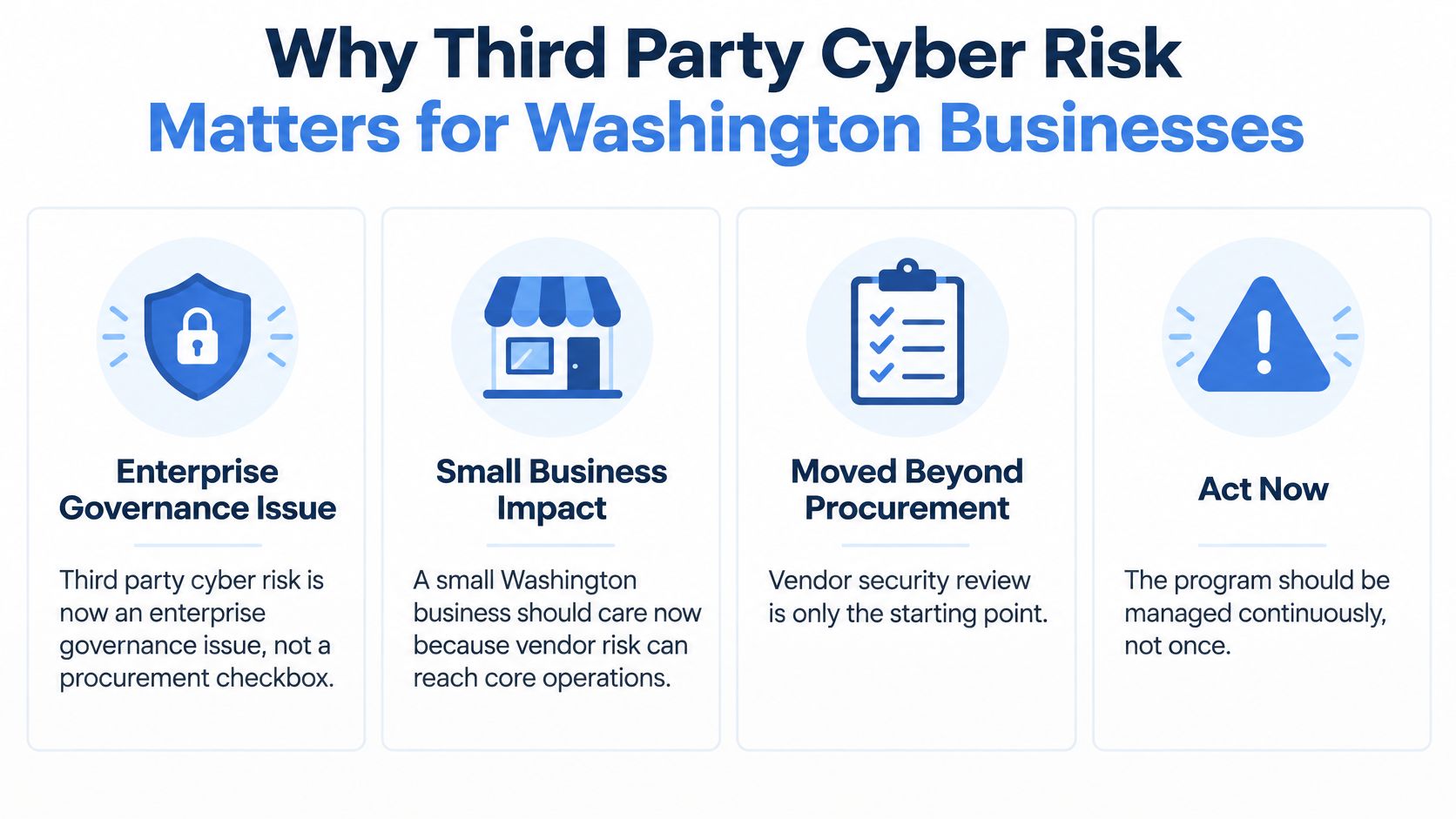
Third party cyber risk is the chance that a supplier's systems, people, or subcontractors expose your data, interrupt your operations, or start a legal clock you did not set. It stopped being a procurement checkbox once public companies had to treat cyber events as disclosure events. Vendor security is now an enterprise governance issue because the customer may have to explain, document, and escalate a supplier failure on a short timeline.
A vendor incident rarely arrives as a neat report. It looks like a payroll provider saying an employee mailbox was compromised, a cloud host flagging unusual exports, or a marketing tool revealing that an integration token was reused. The same review of public filings found that 42% of companies later updated a Form 8-K, which is a reminder that first facts are often incomplete. If you cannot see which vendor holds which data, you cannot decide whether the event touches your systems, your customers, or your own reporting duties.
What a small company should do first
Size does not shrink the dependency. A five-person startup that runs billing, email, and HR through three platforms can be stopped by one of them. The practical move is a working program, not a binder.
- Name the exposure: List who can reach customer, employee, or payment data.
- Assign an owner: Give each critical vendor a business owner who can answer after hours.
- Write the escalation path: Decide who calls counsel, who preserves logs, and who talks to customers.
- Fix the obvious doors: Guest and office networks are a common vendor entry point, and the wireless security guidance from Purple is a useful check on access that sits outside the contract.
Practical rule: If you cannot name the vendor, the data, and the person who gets the first call, you do not have third party cyber risk management. You have a contact list.
Founders who want a broader baseline can start with these cybersecurity best practices, then apply them to suppliers rather than only to internal staff. By the end of this guide you should have a ranked vendor list, a review depth for each tier, contract terms that make findings enforceable, access metrics you can show a board, and a response path that respects Washington notice clocks.
Building a Vendor Inventory and Ranking Suppliers by Risk
Programs stall when nobody can say who the vendors are. A January 2023 Ponemon Institute study with the Healthcare Sector Coordinating Council surveyed more than 400 practitioners and found that only 19% said their organizations kept a complete supplier inventory. Healthcare is the sample, but the failure mode is universal. You cannot rank, insure, or terminate a relationship you have not recorded.
What to record for each supplier
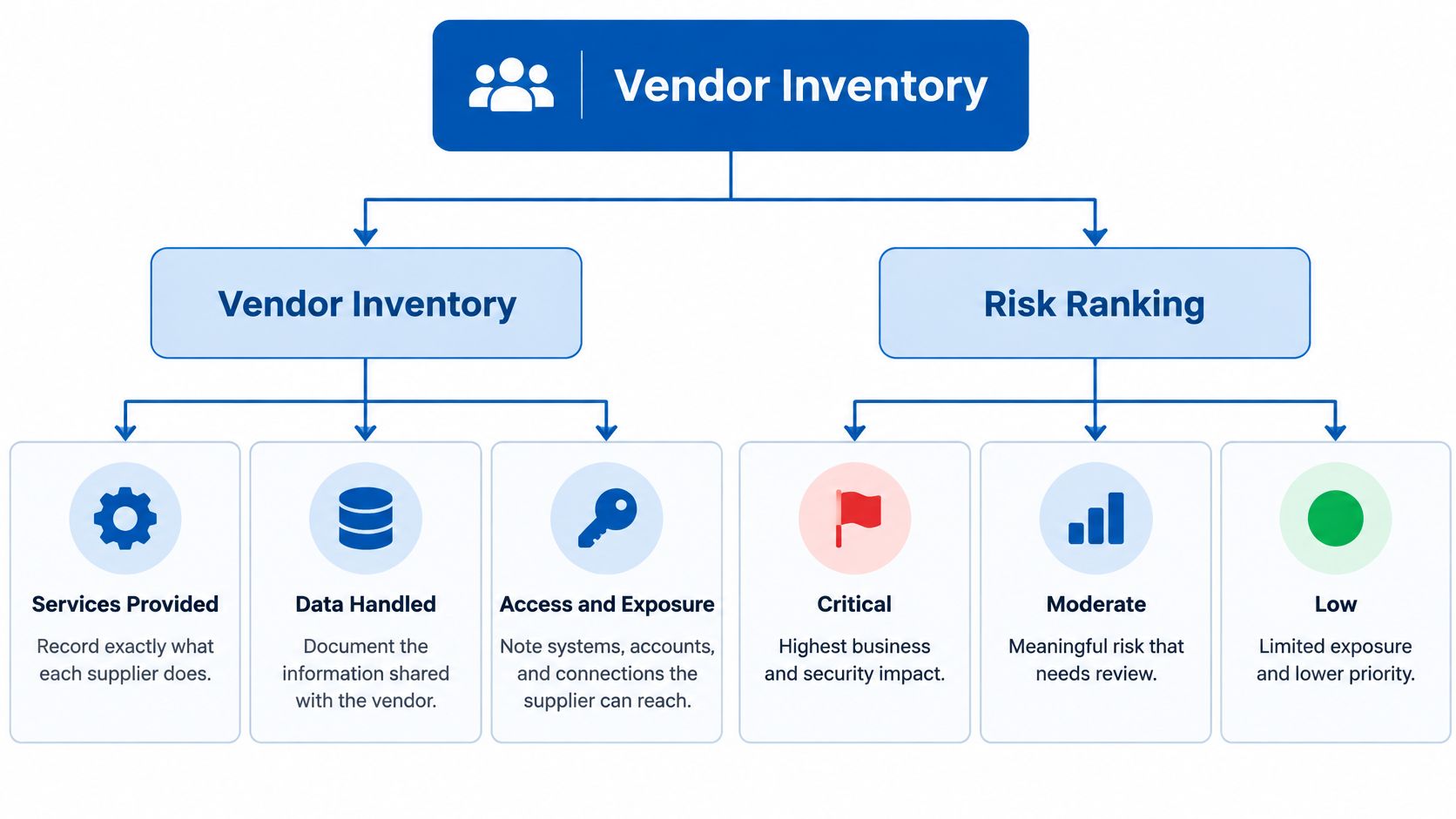
Build one row per vendor, not per invoice. Capture the service, the data categories, how the vendor connects, whether anyone has privileged access, and which fourth parties sit underneath.
Take two common tools. A SaaS customer-support platform may store names, tickets, and attachments, connect through an API, and run on a cloud host you never contracted with. A payroll provider may hold Social Security numbers, bank details, and tax forms, plus a login that an outside accountant shares. Those two rows are not equal, even if both bills are small.
Downstream visibility is worse than the direct list. Survey reporting summarized by Manufacturing.net found that only 3% of CISOs reported full visibility into fourth- and nth-party relationships, 98% left at least some third-party vulnerabilities unresolved because of limited resources, and a 2025 survey found 79% of organizations cover less than half of their nth-party chain. Exhaustive maps are unrealistic for a startup. Risk-based maps are not.
How to score inherent risk
Score before you send a questionnaire. Use data sensitivity, internet exposure, operational criticality, geographic reach, regulatory duties, and the ability to stop the business. NIST's Cybersecurity Supply Chain Risk Management guidance in SP 800-161 Rev. 1, finalized on November 1, 2024, treats supplier risk as an organization-wide process. Classify by access and impact, then document security requirements before you buy.
A workable ranking has three bands.
- Critical: Payroll, identity, payments, or the single cloud platform you cannot replace this quarter. Ask for material subcontractors in the contract, not in a follow-up email.
- Moderate: Tools that see customer data but can be swapped, such as a help desk with exports you control.
- Low: A design plugin with no production access and no personal information.
Questionnaires still have a place after the ranking, not before it. Teams that want a sharper alternative to generic forms can review this approach to moving beyond vendor security questionnaires. Revisit the score when the vendor changes systems, adds a subprocessor, or receives a new data category. A one-time onboarding sheet goes stale the week the integration is expanded.
Choosing How Deep Each Vendor Review Should Go
A vendor review should match the service's impact and the evidence you can act on. Frequent monitoring suits a supplier that could stop operations. A limited questionnaire may be enough for a tool with no sensitive data or privileged access. The practical test is whether a finding changes your decision, your contract, or the deadline for a vendor to respond.
Three depths, three jobs
| Review depth | Best suited for | Evidence to request |
|---|---|---|
| Continuous or frequent monitoring | Critical vendors whose outage or breach stops operations | Independent assurance, vulnerability metrics, identity controls, incident history, and tested recovery |
| Annual reassessment | High-risk vendors with sensitive data but a workable backup | Updated reports, penetration-test summaries, privileged-access changes, and open remediation items |
| Questionnaire validation | Lower-risk suppliers with limited data and no privileged access | Scoped answers, a current certification only if it covers the service, and a named security contact |
A certificate is one piece of evidence, not proof of resilience. SOC 2 and ISO 27001 reports help when they are current, cover the service you buy, and include a bridge letter for the period since the audit. They do not establish that a vendor can preserve relevant logs, revoke a contractor’s access, or notify you within a contract deadline. Ask what evidence supports each answer, who owns remediation, and when an open issue will be resolved.
Request evidence that fits the risk. A penetration-test summary is usually more useful than a full exploit write-up. Confirm whether recovery has been tested, who holds administrator rights, and how subcontractors are reviewed. These answers should shape contract terms: specify security duties, identify the incident notice clock, and require prompt notice when a material finding remains unresolved. Under Washington law, clear written duties and timelines give your team a firmer basis to act when an incident affects customers or operations.
Hardware disposal needs its own review. If a vendor handles retired equipment, arrange a data risk assessment for ITAD so the review covers how data-bearing devices are handled, not only the active service.
A clean questionnaire from last March does not answer what happens after the vendor fails.
Use a vendor security assessment to connect the evidence to the actual service, data, integrations, contract terms, and internal owner. Reassess when those facts change. A plugin that starts receiving customer exports needs a different review and enforceable notice duties, even if the vendor itself has not changed.
Contract Clauses That Turn Findings Into Obligations
A strong review with a weak contract is a memo. The vendor can ignore the finding, delay the notice, or point at a subcontractor you never approved. Enforcement terms are what make third party cyber risk management something you can rely on in a dispute, an insurance conversation, or a regulator’s questions.
NIST’s supply-chain guidance supports writing security requirements before procurement and planning a transition if a supplier becomes unacceptable. Updated software-supply-chain guidance issued on October 31, 2024, in response to Sections 4(c) and 4(d) of Executive Order 14028, pushes the same idea into the software lifecycle, as described in NIST’s software security supply chain appendix. Contracts should cover secure development expectations, vulnerability handling, maintenance, updates, and dependency risk, not only a general promise to use “industry standards.”
Clauses that actually bind
Put duties in measurable language. “Reasonable security” is a fight. A deadline is a fact.
- Least privilege and MFA: Limit vendor accounts to the approved purpose, and require multi-factor authentication on any remote or admin path.
- Audit and evidence rights: Reserve the right to review relevant logs, assurance reports, and remediation proof, with a short response window.
- Subcontractor disclosure: Require notice before a material subcontractor touches your data, and flow security and notification duties down to that party.
- Notice and repair clocks: Set an incident-notice deadline in hours, a remediation deadline by severity, and a right to suspend or terminate if the gap stays open.
- Washington facts: Require the vendor to share, as soon as reasonably possible, the approximate number of affected Washington residents, the categories of information, and preserved logs.
Flow-down is where many templates fail. If your SaaS vendor uses a cloud host and a support subcontractor, your notice right is useless unless those parties must tell the vendor fast enough for the vendor to tell you. Say that in the contract. Pair it with a data processing agreement when personal information moves, so security duties and privacy duties are not split across unsigned email threads.
If you cannot suspend access or exit the vendor, the security schedule is a suggestion.
Negotiate harder on critical vendors and accept narrower terms on low-risk ones. Demanding audit rights from a commodity tool you can replace in a day often costs more than it protects. Demanding them from payroll is not optional.
Monitoring Vendor Access and Tracking the Right Metrics
The contract is the promise. Access is the exposure. Excessive privilege is the failure that shows up most often once a third party is inside.
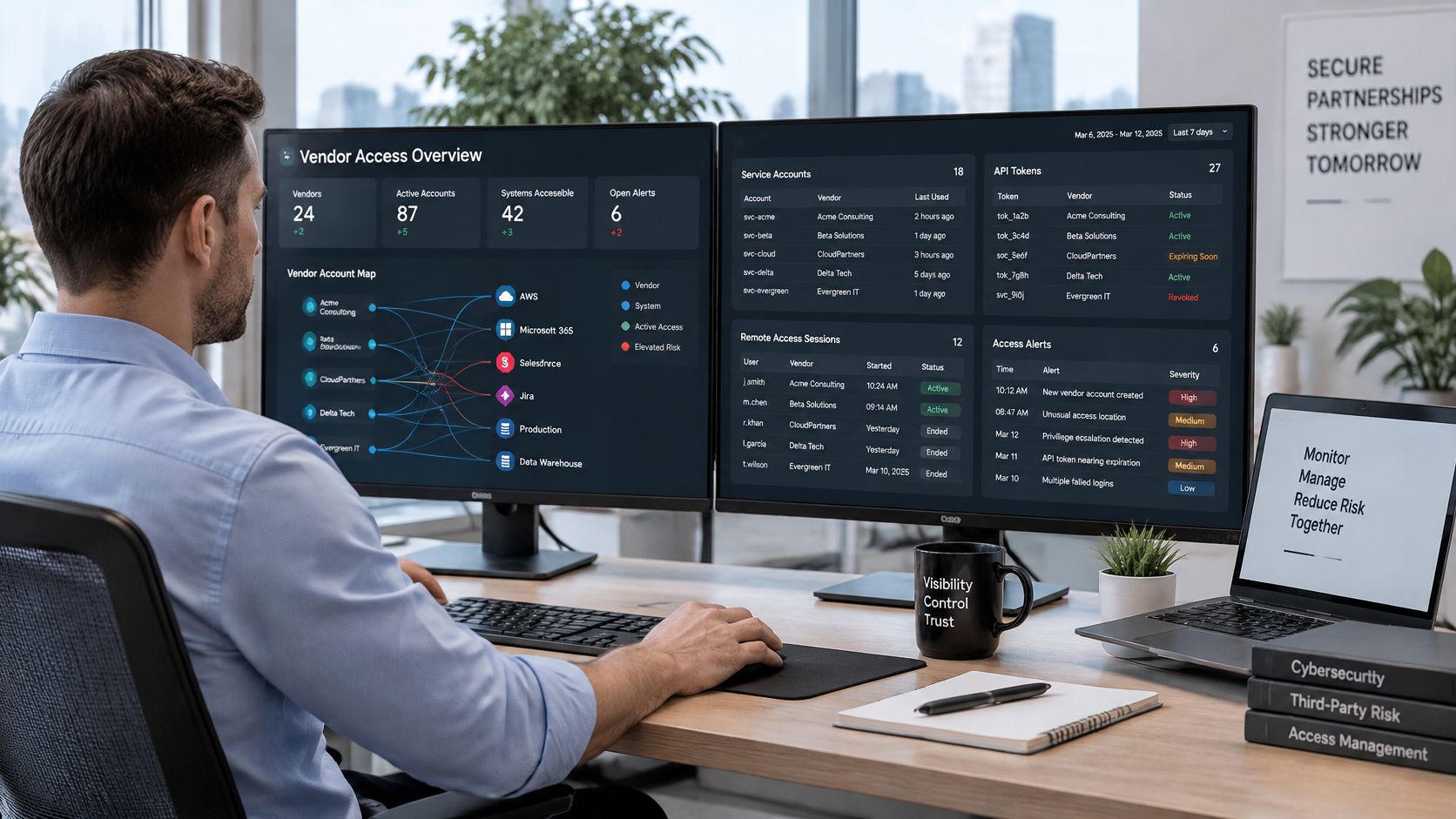
Map every vendor account, service account, API token, and remote-access path to a business owner and an approved purpose. If nobody owns the token, nobody revokes it when the project ends. Enforce unique identities, phishing-resistant MFA where the platform allows it, time-limited elevation, network segmentation, and default-deny access. Shared “vendoradmin” logins make every later investigation guesswork.
What to log and when to cut access
Log authentication, privilege changes, admin actions, data exports, and odd behavior. Send high-value events to one monitoring place with alert thresholds and a tested escalation path. Revalidate access when people, scope, or contract terms change. Disable dormant accounts automatically instead of waiting for a quarterly cleanup that slips.
A Ponemon Institute review of third-party breaches found that 49% of surveyed organizations reported a third-party-caused data breach directly or indirectly, and 70% of those respondents blamed excessive privileged access. Fewer than half of third parties in that research were aware of the breach-reporting rules that applied to them. That is why notice workflows and tabletop exercises belong next to the access list, not in a separate policy nobody opens.
The video below walks through why supplier access and resilience belong in the same operating rhythm as the contract review.
Track a short set of numbers. Each one answers a question a founder or board can ask without a security degree.
- Time to revoke access: Hours from a departure or incident to a disabled account.
- MFA coverage: The share of vendor accounts that use it.
- Dormant accounts: Count of vendor logins with no recent use.
- Privileged sessions reviewed: Whether admin activity is looked at, not only stored.
- Overdue critical findings: Open items past their due date, with an owner and a business acceptance decision if you keep the risk.
- Notice-to-escalation time: Hours from the vendor’s alert to legal and technical review.
Those metrics are the evidence. They show whether controls run, and they support insurance, contract enforcement, and regulatory response. A dashboard no one reviews is another dormant account.
Responding to Vendor Incidents and Your Next Step
Picture a Tuesday alert from the payroll provider. An employee account was phished, exports may include unencrypted personal information, and the vendor “is still investigating.” Your team has to decide, the same day, who owns the technical facts and who owns the legal notices. Waiting for a perfect narrative is how deadlines get missed.
Washington clocks that do not wait for a perfect report
Washington businesses that own or license personal information must notify affected residents when unencrypted personal information was, or is reasonably believed to have been, acquired by an unauthorized person and the breach is reasonably likely to create a risk of harm. Under RCW 19.255.010, notice must go out as expediently as possible and no later than 30 calendar days after discovery, unless law enforcement requests a delay or the business needs more time to determine scope and restore system integrity. A service provider that only maintains data it does not own must notify the owner or licensee immediately after discovering a qualifying breach.
There is a second clock. When more than 500 Washington residents are affected, the business must also notify the Washington Attorney General within 30 days after discovery, as the Attorney General’s data breach guidance explains alongside the resident-notice duty. Vendor agreements should force an early count of affected Washington residents, preserved logs, and the categories of exposed information so that parallel notices are possible.
Name the roles before the alert. One person runs the technical investigation with the vendor. One person decides customer and regulator communications. Counsel checks whether the event meets the statute. The vendor’s cooperation duty should already require evidence preservation and access to relevant logs. A tabletop that uses a payroll or cloud scenario will show, in an hour, which of those roles is staffed.
Build that path into a written cyber incident response plan that includes suppliers, not only internal outages. By Design Law Firm & Legal Consultancy, PLLC, a Seattle business and technology firm, is one option for founders who want vendor contracts, incident response, and breach management handled together rather than as three disconnected projects.
This month, pull the vendor list and the contracts for anything that touches personal information or can stop operations. Mark missing notice deadlines, missing subcontractor terms, and accounts nobody has reviewed since onboarding. Then call (206) 593-1519 or start at https://www.bydesignlaw.com before the next vendor email arrives with incomplete facts and a clock already running.
By Design Law Firm & Legal Consultancy, PLLC helps Washington startups and growing companies turn vendor security into contracts, notice duties, and incident plans they can use. If a supplier touches your data or can stop your operations, the firm can review the terms and the response path before a breach sets the deadline. Visit By Design Law Firm & Legal Consultancy, PLLC to start that review. Contact our law office at (206) 593-1519.