Yes, a sole-member LLC should have a written operating agreement, even where state law doesn't require one. But if the owner treats every company dollar as personal money, what does that signed document prove?
The useful agreement isn't a template tucked away after formation. It records who can act, how money moves, and what happens when the founder can't run the business. For Washington founders, those rules should match the bank account, accounting records, contracts, and decisions made every day.
Does a Sole-Member LLC Really Need an Operating Agreement?
What would your records show if a bank asked who can sign for your LLC? A sole owner still needs written rules for how the company operates. The U.S. Small Business Administration recommends an operating agreement even where state law does not require one. The agreement can define business decisions, member duties, powers, and responsibilities.
An agreement is evidence of separation, not proof by itself. Its value depends on whether your actions match it. If the agreement says company money stays separate, pay business expenses from the company account and record owner withdrawals.
What belongs on paper
Set out who owns and manages the LLC, who can sign contracts, and how the company handles distributions, banking, records, tax elections, contributed property, and succession or transfers. The explanation of setting rules for LLC management provides context for turning those topics into operating rules.
A freelance designer opening a business account may need written authority to act for the LLC, then use the LLC's name on client contracts. If the owner becomes incapacitated, the agreement should identify a valid way for an authorized person to keep company obligations moving.
Washington's Secretary of State provides LLC filing information, but an operating agreement is an internal company record, not a public state filing. Keep the signed agreement consistent with how you handle company money, property, and decisions.
Check these gaps before relying on the agreement:
- Banking: Can you show written authority to sign for the LLC?
- Property: Do company records identify assets contributed to the LLC separately from your personal property?
- Continuity: Is there a valid mechanism for an authorized person to act if you become incapacitated?
The Eleven Core Clauses Every Sole-Member Agreement Should Contain
| Clause | What the agreement should state | Why it matters for one owner |
|---|---|---|
| Management and authority | Member-managed or manager-managed; who signs contracts, opens accounts, and approves transactions | Prevents confusion between personal and business acts |
| Capital contributions | Amount, date, and form of each contribution; loans recorded separately | Identifies funding as company capital rather than an unexplained transfer |
| Distributions | Approval authority, timing, and a cash reserve test before payment | Prevents withdrawals that leave obligations unpaid |
| Tax classification | Default federal status and who may make or sign elections | Keeps tax filings consistent with intended treatment |
| Transfer restrictions | Required consent or an applicable right of first refusal before sale or pledge | Controls transfers and separates economic ownership from admission as a member |
| Admission of new members | Written consent and an amended agreement before admission | Establishes the transition to shared ownership |
| Banking and records | Dedicated accounts, required books, and record locations | Creates a traceable company history |
| Indemnification | Conditions for covering company-related losses, subject to applicable law | Clarifies which claims the company may pay |
| Incapacity and succession | A designated agent or successor and a valid authorization mechanism | Supports continuity during an emergency |
| Dissolution and winding up | Closing triggers, debt-payment priorities, and final distributions | Documents an orderly shutdown |
| Amendments | Written, signed, dated changes and version history | Keeps operative terms identifiable |
Start with authority and money
The first column identifies the clause, the second describes drafting content, and the third identifies the problem being prevented. This is a checklist, not a ready-to-sign agreement.
Management authority comes first because a lender or counterparty needs to know who can bind the company. A manager title without defined powers leaves the central question unanswered.
Capital contributions and distributions follow because they explain transfers between the owner and company. A deposit should have an accounting classification; a withdrawal should have an approval and business justification.
Tax language should identify who can change the company's reporting treatment. It shouldn't give a bookkeeper unrestricted authority to make an election just because that person prepares records.
Plan for changes before they happen
Transfer restrictions should address sales, gifts, pledges, and estate-planning transfers. A right of first refusal needs an identified holder and a workable process; copying a multi-owner provision into a sole-owner agreement can produce nonsense.
Admission language should require affirmative written action before someone becomes a member. Promising an employee equity isn't a substitute for documenting ownership rights, contributions, and revised governance.
Banking and recordkeeping clauses should specify where signed agreements, consents, and financial records live. Indemnification should explain when the company covers an authorized person's expenses, while preserving legal limits.
Incapacity provisions must coordinate with estate documents and actual account-access requirements. Naming a successor alone doesn't guarantee that a bank will accept that person's instructions.
Dissolution provisions should assign responsibility for collecting receivables, resolving obligations, and distributing remaining property. Amendment provisions should prevent an old template from remaining the apparent governing document after the business changes.
Drafting check: Mark every row as drafted, borrowed from a template, or missing. Borrowed language deserves review just as much as an empty section.
Writing Management and Signing Authority Clauses
Member-managed means the owner runs the LLC directly. Manager-managed means a designated manager runs it, and that manager can be the owner acting in a separately defined role.
The distinction should be explicit in the agreement and consistent with the company's other records.

Separate routine powers from major approvals
Member management is usually the simplest choice for a founder handling daily operations. A sample starting provision, subject to state-law review, is:
The Member manages the Company and may sign contracts, open bank accounts, and approve transactions in the Company's name. Each such act shall be recorded in the Company's books.
That provision shouldn't stand alone. The agreement should identify decisions requiring separate written member consent, even when the member and manager are the same person.
For a hypothetical startup, the approval schedule might include:
- Borrowing: Written consent for debt above $10,000.
- Long commitments: Written consent for leases longer than 12 months.
- Asset transactions: Specific approval before selling substantial assets or granting a security interest.
- Staffing: Recorded approval before hiring employees or creating equity compensation commitments.
These are illustrative internal controls, not legal thresholds. The owner should choose limits that match revenue, available cash, and contractual risk.
Define delegated powers narrowly
A one-person company still needs an organizational chart. It shows whether the founder signs as owner, manager, guarantor, or an individual customer.
A bookkeeper might receive authority to prepare payments without authority to release them. A project manager might approve ordinary vendor work without power to borrow, transfer intellectual property, or change bank signers.
A corporate governance guide can help organize approval procedures beyond the agreement itself. Delegations should name the role, spending limit, prohibited actions, expiration, and revocation method.
The following video provides additional operating-agreement context.
Use a separate sentence for each material authority. That makes later review practical: the company can compare an actual signature or payment against an identifiable permission.
Money Terms for Contributions, Distributions and Cash Reserves
When money or property moves into the LLC, record what it is. Document the date, amount or property, and whether the transfer is an equity contribution or a loan. That record helps show the company handles its finances separately from the owner's.
Put an owner loan in a separate promissory note with repayment terms. List contributed equipment, software, domains, and intellectual property in a contribution schedule. Use an assignment when needed to transfer ownership to the company.
Revenue isn't available cash
Require member approval for distributions, subject to applicable legal restrictions. Don't promise automatic monthly draws just because the company has received revenue.
Washington B&O tax is generally measured by gross receipts rather than net profit. A reserve policy should account for that tax even when the business has little profit or none. It should also account for:
- Business taxes: Washington B&O tax and sales tax where applicable.
- Worker obligations: Payroll, withholding, and related amounts due.
- Owner tax planning: Estimated federal income tax associated with business income, coordinated with the tax adviser.
- Committed expenses: Insurance premiums, debt payments, rent, subscriptions, and other fixed costs.
Keep company liabilities distinct from money retained for the owner's anticipated tax distributions. They serve different purposes and shouldn't be treated as interchangeable accounting categories.
Adopt a forward-looking payout test
Set a rule that distributions can be made only after available cash covers listed obligations for the next 90 days. This is an internal planning horizon, not a statutory safe harbor.
A consultant receives $60,000 in a strong month and expects $20,000 in taxes and insurance obligations next quarter. The expected bills stay reserved. The account balance alone does not make the full amount available for withdrawal.
Use a provision such as:
Before any distribution, the Member shall confirm that the Company retains sufficient funds to pay the obligations listed in this Section for the following ninety days. Distributions are never guaranteed and remain subject to applicable law.
Keep the cash forecast with the distribution approval. A written reserve rule supports separation only when the owner follows it in practice.
For a legitimate business expense paid personally, keep the receipt, business purpose, approval, and accounting entry. Reimburse it through the company's process rather than recording an unexplained draw.
Tax Classification Language That Prevents Filing Mistakes
| Status | How it is set | Federal treatment | What the agreement should say |
|---|---|---|---|
| Disregarded entity (default) | No election needed | Income reported on the owner's return; separate for employment and certain excise taxes | State the default and authorize the member to elect otherwise |
| Corporate taxation | File Form 8832 | Taxed as a corporation | Identify the election signer and responsibility for reviewing governance effects |
| S corporation | Elect through Form 2553, subject to eligibility requirements | Pass-through treatment with shareholder-employee rules | Require appropriate compensation, payroll, and distribution records; obtain tax advice first |
A one-member LLC is generally disregarded for federal income-tax purposes unless it elects corporate treatment using Form 8832, according to the IRS single-member LLC guidance; an eligible LLC seeking S corporation status generally makes that election using Form 2553. A qualifying S election can also establish corporate classification, so filing both forms isn’t automatically necessary.
State the intended treatment precisely
Under default treatment, the owner generally reports the company’s income, deductions, gains, losses, and credits on the owner’s return. A disregarded LLC conducting a trade or business is generally subject to self-employment-tax rules comparable to a sole proprietorship.
The employment-tax and certain excise-tax exceptions matter operationally. Disregarded status doesn’t mean that payroll records, employer obligations, or company accounting disappear.
For a plain-language comparison, Allied Tax Advisors explains LLC taxation in terms founders can discuss with their accountant. The drafting task is to convert the selected treatment into clear authority and recordkeeping obligations.
The agreement should identify:
- Election authority: The member or designated representative permitted to approve and sign elections.
- Record ownership: The person responsible for maintaining returns, confirmations, payroll reports, and accounting records.
- Implementation: The review required before changing compensation, distributions, or reporting practices.
Don’t let an election outrun operations
An S election requires more than replacing a tax paragraph. A working owner needs advice about reasonable compensation, payroll administration, and the distinction between wages and distributions.
An operating agreement addressing S corporation treatment should be checked alongside the company’s actual payment practices. The agreement shouldn’t authorize conduct inconsistent with the intended election.
Tax-sensitive property deserves attention too. If the business depends on software or other intellectual property, the records should identify who owns it and how it entered the company.
The agreement doesn’t make a tax election by itself. An election changes reporting and compliance duties, not the underlying state-law governance framework.
Why the Agreement Alone Does Not Protect Personal Assets
Many owners assume signing an operating agreement creates liability protection. It doesn’t: the agreement is evidence of separateness, not a substitute for separateness, a distinction emphasized in this Washington operating-agreement guide.
The agreement is like a survey marking a property line. The owner still has to maintain the fence through consistent financial and contractual behavior.
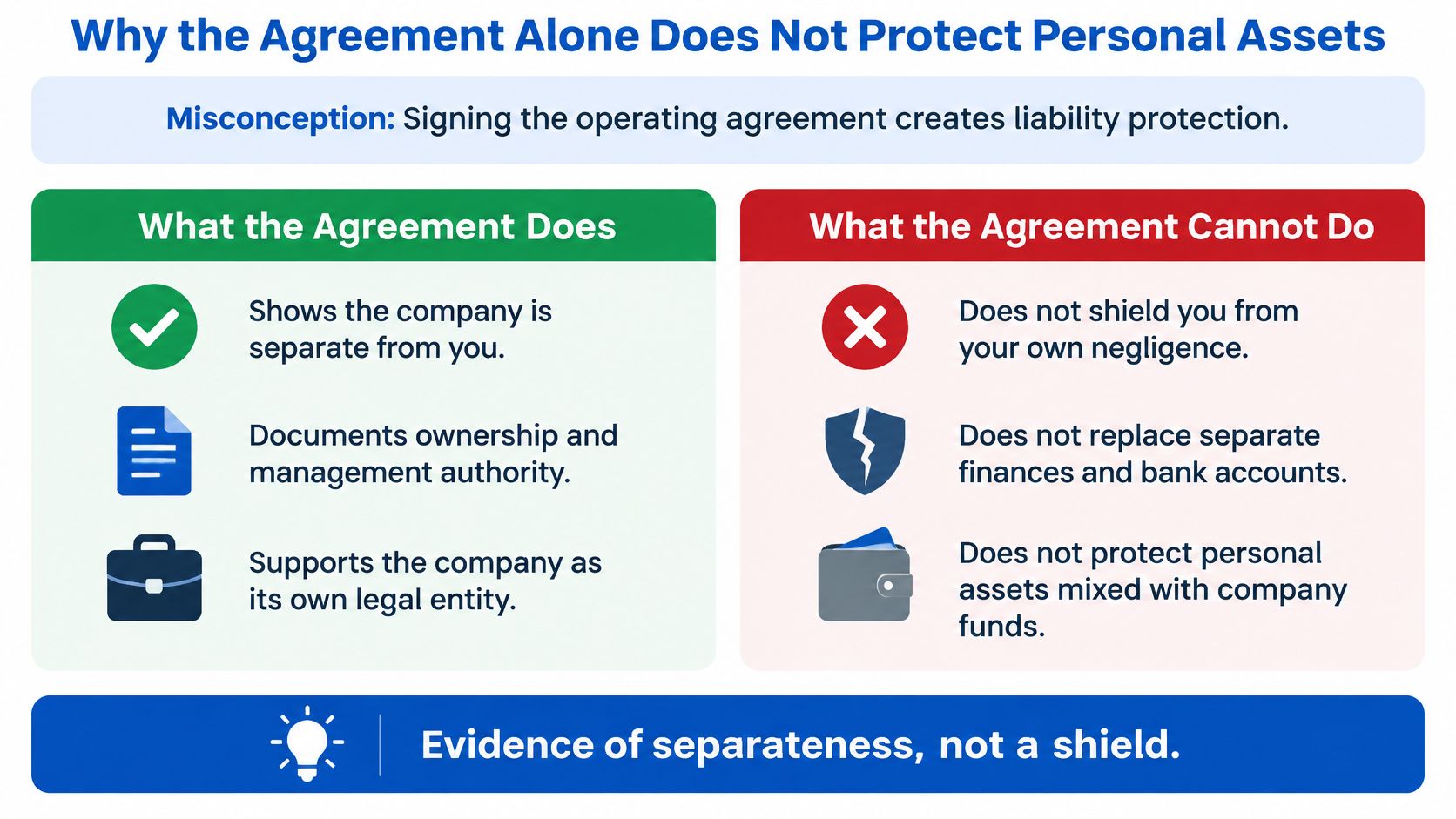
What the document can and can’t establish
The useful evidence includes dedicated banking, company-name contracts, accurate books, documented funding and withdrawals, adequate capitalization, and recorded company decisions. A court reviewing a dispute or a lender reviewing financing can compare that evidence with the agreement.
- What it does: Establishes authority, documents ownership intent, and supplies a written governance record.
- What it cannot do: Cure commingled funds, override mandatory law, erase a personal guarantee, or eliminate responsibility for the owner’s own wrongful conduct.
- What needs separate analysis: Tax treatment, insurance coverage, contractual indemnities, and exposure arising from particular business activities.
Tax Attorney Stephen A Weisberg’s discussion of understanding LLC liability limits offers useful context for evaluating the boundaries of the entity structure. Formation and governance are related, but understanding entity formation shouldn’t be confused with purchasing immunity from claims.
Build evidence during ordinary transactions
The strongest practical test is whether an unfamiliar reviewer could reconstruct a transaction without relying on the owner’s memory. Account statements, invoices, approvals, and ledger entries should tell a consistent story.
- Separate accounts: Customer receipts and business payments move through company accounts.
- Company signatures: Contracts identify the LLC and the signer’s representative capacity.
- Clean card use: Personal purchases stay off company cards.
- Written reimbursements: Owner-paid business expenses receive receipts and accounting treatment.
- Appropriate insurance: Coverage matches the services, products, workers, and data risks involved.
A technology company should also document software assignments, access authority, and responsibility for incident-response decisions. An operating agreement can assign responsibility, but it can’t replace the actual assignment or security procedure.
Suppose an owner pays a client refund using a personal card and never records it. That isolated mistake doesn’t automatically destroy limited liability, but opposing counsel may use it to challenge the claimed separation, especially if other transactions show the same pattern.
Washington Rules and How State Law Changes Your Drafting
Washington’s LLC Act makes the operating agreement central to relations among the LLC, its members, and its managers. RCW 25.15.018 also supplies default rules when an agreement is silent. Under RCW 25.15.006, an agreement can be oral, implied, written, or a combination. For a sole owner, a signed document is the clearest way to show the terms the business intends to follow, especially when opening a bank account or applying for a loan.
Customize within statutory boundaries
Set out who can manage the company, which decisions require approval, how ownership may be transferred, and what happens if the owner can no longer run the business. The statute limits which duties and liabilities an agreement can waive, so don’t rely on template language that claims to eliminate them all.
Before adapting an out-of-state form, check:
- Management defaults: Who has authority when the document is silent?
- Required form: What must be in the agreement, and which actions need written records?
- Transfers and closure: What happens if the agreement lacks customized admission or dissolution terms?
- Member consents: What makes an approval effective, and how will the company document it?
A Washington business formation attorney can review these provisions against your financing and ownership plans. Employee equity, future investors, or a sale may call for terms a basic sole-owner form does not address.
Keep ownership records regardless of federal reporting
Federal beneficial ownership reporting rules for U.S.-formed entities have changed. Check FinCEN’s current beneficial ownership information guidance before deciding whether a filing is required.
Federal reporting rules do not replace the company’s own ownership records. Keep the agreement, contribution schedule, transfer documents, and company books consistent about who owns the LLC.
Tie the agreement to recurring tasks. Set a process for reserving cash for Washington B&O tax payments, keep governance records with company documents, and spell out how an ownership change must be approved and recorded before offering equity. A signed agreement is useful evidence only when the company’s records and decisions follow its terms.
Draft, Sign and Maintain Your Operating Agreement
- Inventory the business. List assets, contributions, and recurring obligations, including intellectual property requiring a separate assignment.
- Choose member-managed or manager-managed governance and confirm the intended tax treatment with a qualified adviser. Check applicable defaults rather than assuming the template reflects Washington law.
- Draft from the clause checklist. Give each material authority a clear sentence and each approval process an identifiable record.
- Have a business attorney review statutory limits, planned borrowing, investor arrangements, and employee equity before execution.
The maintenance process should be as deliberate as the initial drafting.
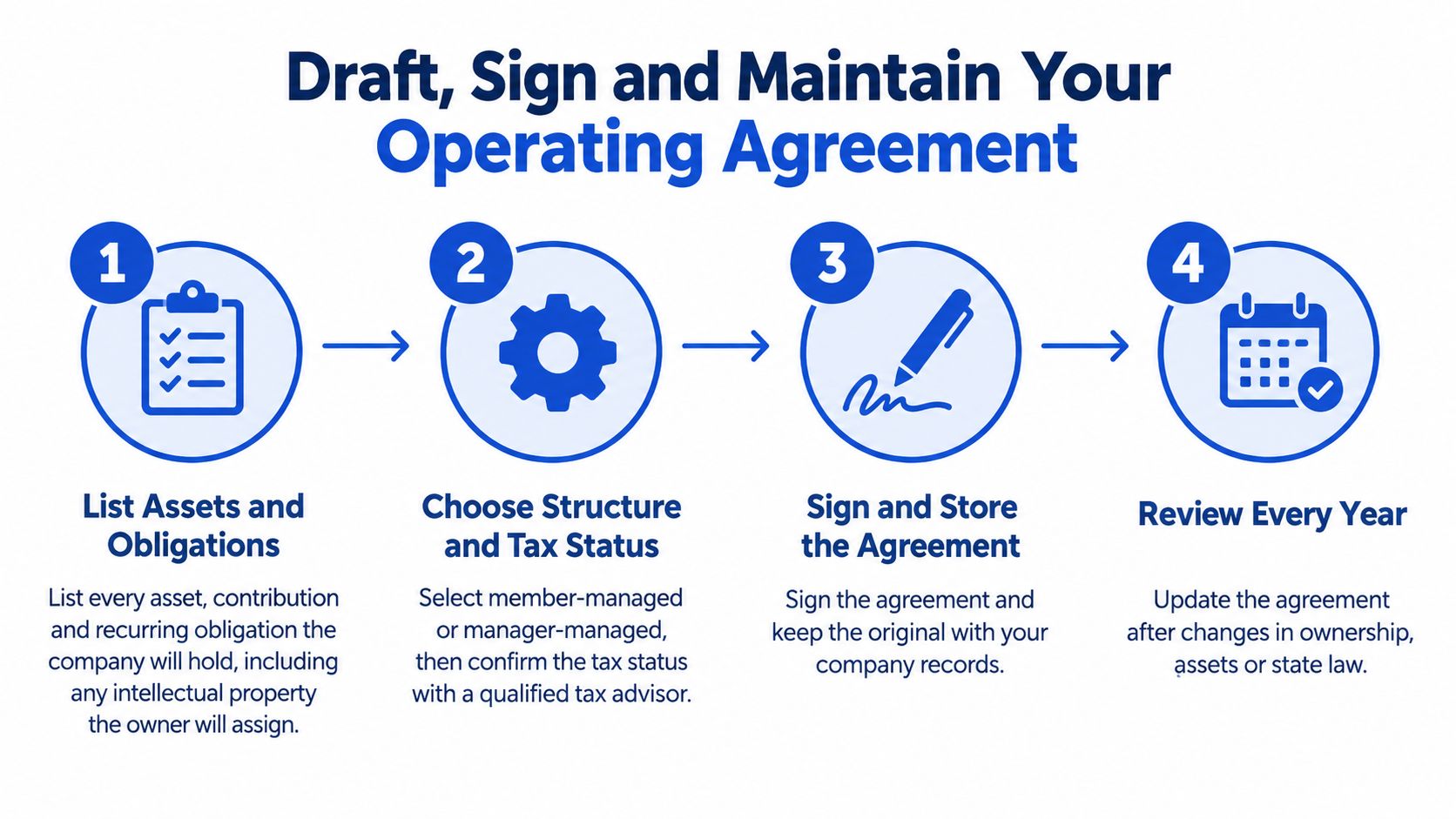
- Sign, date, and store. State the effective date and retain the original with formation documents, consents, and financial records. The Washington Secretary of State says an LLC must create an operating agreement but doesn’t record it publicly.
- Review annually and after a new member, tax election, substantial loan, new business line, or address change.
- Update the operative document. Record ownership and management changes promptly, preserve prior versions, and make actual conduct match the signed terms.
For Washington review, one option is By Design Law Firm & Legal Consultancy, PLLC, a Seattle-based business and technology law firm, at (206) 593-1519.
By Design Law Firm & Legal Consultancy, PLLC offers Washington LLC operating-agreement drafting and review, including single-member governance, contribution, distribution, and authority provisions. Founders can arrange a review of an existing draft alongside their banking, contracts, and ownership plans so the company’s paperwork supports how the business runs day to day. Contact our law office at (206) 593-1519.