A Seattle founder files IRS Form 2553, starts running payroll, and tells the company's bookkeeper that the business is now an S corporation. The operating agreement, however, still contains the same partnership-style distribution waterfall used when the LLC was formed. Nothing changes in the company's daily operations, but the document may now conflict with the tax election.
That situation is common because an LLC and an S corporation describe different things. An LLC is a state-law business entity. S corporation status is a federal tax classification. An LLC can elect S corporation taxation, but its internal governance document must support the federal rules rather than preserve every form provision designed for partnership taxation.
The Governance Document Confusion
A founder searching for an “operating agreement S corp” often finds three different documents treated as if they were interchangeable. They aren't.
A traditional corporation generally uses bylaws to establish internal governance and may use a shareholder agreement to address ownership, voting, transfers, and buy-sell rights. An LLC uses an operating agreement to define management structure, member duties, economic rights, and decision-making procedures. A practical comparison of these corporate documents is available in this guide to shareholder agreements versus bylaws.
The confusion becomes more serious when an LLC elects S corporation tax treatment. The entity remains an LLC under state law, so its operating agreement remains the central governance document. At the federal level, however, the company must satisfy S corporation requirements, including the one-class-of-stock rule and restrictions on eligible owners. SCORE describes an operating agreement as a best practice that defines management, duties, and rights, even though states don't universally require one under every circumstance.
What the filing changes
The filing of Form 2553 doesn't automatically transform an LLC into a corporation under state law. It changes the federal tax treatment, subject to IRS eligibility requirements. Founders reviewing the election process can use this explanation of IRS Form 2553 for S Corp election as background, but the tax filing should be coordinated with the governance documents.
A corporation taxed as an S corporation usually operates through bylaws and shareholder agreements. An LLC taxed as an S corporation operates through an operating agreement, but the economic provisions must be adapted for S corporation compliance. Calling the document an “S corp operating agreement” can be useful for search purposes, but it shouldn't obscure the legal structure.
Practical rule: The entity type determines the state-law document. The tax election determines which provisions that document must avoid.
A founder who files the election without reviewing the operating agreement may leave behind provisions for preferred returns, capital-account allocations, or discretionary distributions. Those provisions may work for an LLC taxed as a partnership, but they can create a federal eligibility problem for an S-taxed LLC. The document review belongs in the election process, not months or years afterward.
Federal Constraints That Override State Flexibility
Washington LLC law gives members broad contractual freedom over management, ownership, and economic arrangements. That flexibility can serve founders, investors, and family businesses well. It narrows sharply after an LLC elects S corporation tax treatment because federal eligibility rules control the tax result, regardless of what Washington law permits.
Under IRC §1361 and the IRS's discussion of S corporation eligibility, an S corporation can't have more than 100 shareholders, can't have nonresident aliens as shareholders, and generally can't have partnerships or corporations as shareholders. It also may have only one class of stock. The election requires Form 2553, signed by all shareholders. These requirements should shape the operating agreement before the election is filed, not after a transfer or distribution creates a problem.
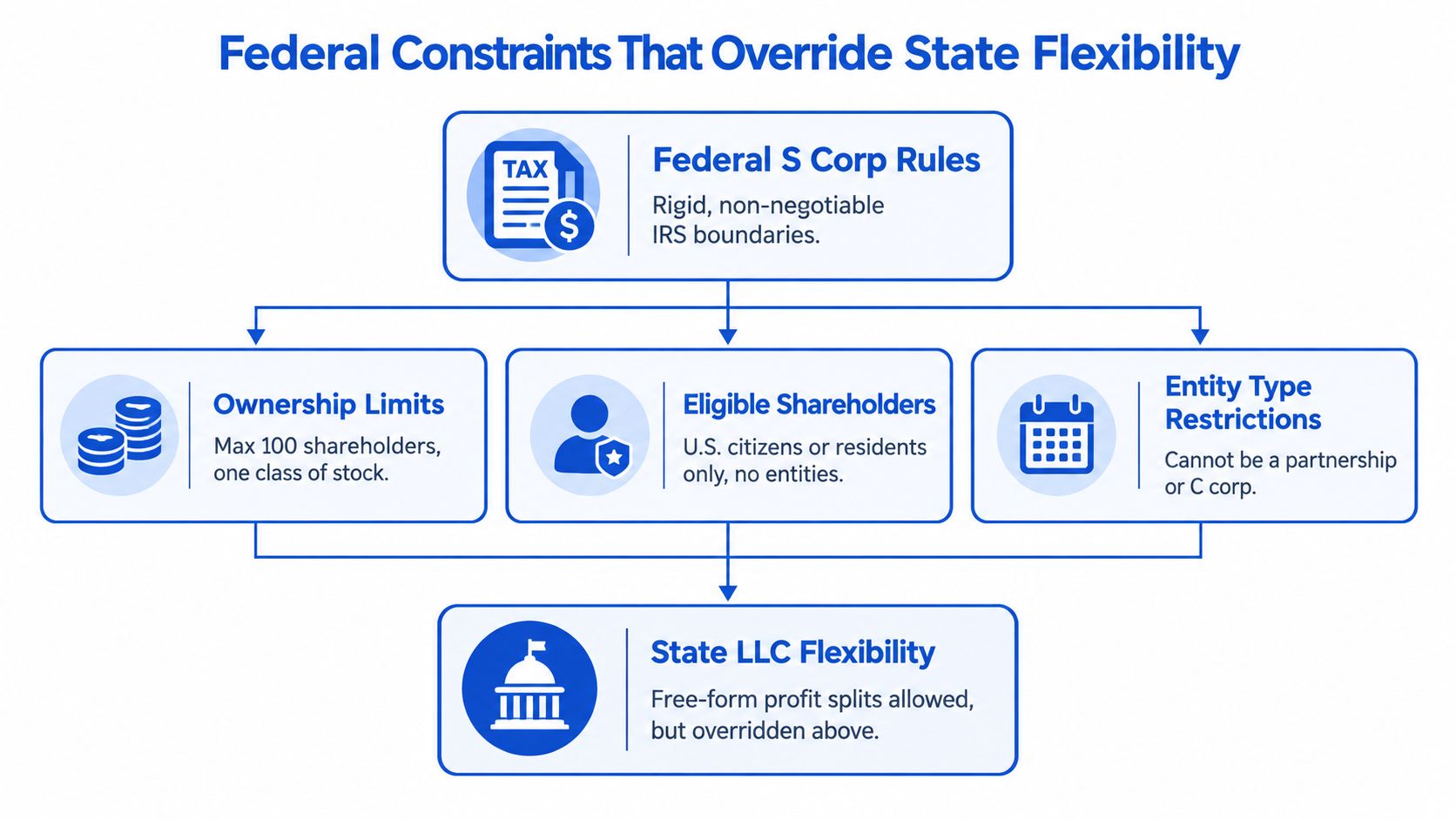
The ownership ceiling is only the starting point
The shareholder limit is a hard ceiling for most businesses. Certain family members may sometimes count as one shareholder under the statute, but that exception does not eliminate the need to track ownership carefully. The company should identify each owner, confirm eligibility, and review every proposed transfer before it occurs.
A sale, gift, trust arrangement, or restructuring that places equity with a corporation, partnership, or nonresident alien can jeopardize the election. The operating agreement should therefore require eligibility checks and restrict transfers that could introduce an ineligible owner. A transfer clause that addresses only valuation and consent is incomplete.
One class means uniform economics
The one-class-of-stock rule concerns the rights to distributions and liquidation proceeds created by the operating agreement and other binding agreements. Voting and non-voting rights may be permitted, but different economic rights can indicate a second class of stock.
Standard LLC language often creates that risk. Capital-account provisions, preferred returns, special allocations, and distribution waterfalls may be valid for a partnership-taxed LLC while conflicting with S corporation requirements. Washington founders comparing business formation types should separate state-law entity choices from federal tax constraints. The operating agreement must preserve consistent economic rights, even where Washington law would allow a more customized arrangement.
Rewriting Economic Rights and Distribution Rules
The most dangerous language in an S-taxed LLC is often not a dramatic provision. It may be a familiar paragraph copied from a standard multi-member LLC form. Terms such as “maintain capital accounts,” “distribute according to the waterfall,” or “allocate profits based on economic arrangement” can create rights that don't match ownership percentages.
The drafting objective is direct: distributions, liquidation proceeds, and ownership economics must remain pro rata. If two owners hold different percentages, each owner should receive the corresponding percentage of permitted economic distributions. The agreement shouldn't give one owner a preferred return, a special allocation, or a priority based on a capital account.
Clauses that need a close review
A lawyer reviewing an operating agreement s corp document should mark every provision that addresses:
- Current distributions: Replace discretionary or waterfall-based payments with language requiring distributions in proportion to ownership percentages, subject to lawful reserves and applicable tax rules.
- Tax distributions: Confirm that any tax distribution mechanism doesn't give one owner a different economic right from another owner with the same ownership percentage.
- Liquidation rights: Tie liquidation proceeds to pro rata ownership rather than capital contributions, account balances, or negotiated priorities.
- Loss and income allocations: Remove partnership-style allocations that separate tax items from the owners' uniform economic interests.
- Capital accounts: Avoid language that makes a capital account the source of a member's priority claim to company assets.
- Voting rights: Distinguish governance rights from economic rights. Voting and non-voting interests may be possible, but the economic rights must remain uniform on a per-share or percentage basis.
The following comparison shows the drafting difference:
| Clause Type | Dangerous LLC Boilerplate | Compliant S Corp Language |
|---|---|---|
| Operating distributions | “Distributions shall be made under the manager's discretion and in accordance with the members' capital accounts.” | “Distributions shall be made to the owners strictly in proportion to their ownership percentages.” |
| Preferred return | “A member receives a preferred return before distributions to other members.” | “No owner has a preferred return or priority economic right.” |
| Distribution waterfall | “Available cash shall be distributed through the tiers described in the waterfall.” | “Available cash shall be distributed pro rata, subject to documented working-capital reserves.” |
| Liquidation proceeds | “Liquidating assets shall be applied first to positive capital accounts.” | “Liquidation proceeds shall be distributed in proportion to ownership percentages after permitted company obligations.” |
| Special allocation | “Profits and losses may be allocated differently to reflect member contributions.” | “Profits, losses, and related economic items shall be allocated consistently with the owners' pro rata interests.” |
A business can still create meaningful performance incentives through wages, bonuses, or carefully structured compensation, but those arrangements should be analyzed separately from equity economics. Founders considering employee incentives can review how advisers compare profit sharing benefits for HR, while tax and corporate counsel assess whether the proposed arrangement affects equity rights.
Why old language creates a current problem
An agreement doesn’t become safe merely because the company has always distributed cash informally in proportion to ownership. The written rights matter. A provision that authorizes disproportionate economics can create an eligibility defect even when the owners have never used it.
Drafting standard: If the agreement gives an owner a better economic outcome than the ownership percentage provides, the provision deserves S corporation counsel’s attention before the next distribution or amendment.
Transfer Restrictions and Buy-Sell Triggers
Ownership restrictions serve two purposes in an S corporation. They manage business continuity, and they protect the federal tax election. A transfer provision that addresses only valuation and consent may be incomplete if it doesn’t screen the proposed recipient for S corporation eligibility.
The choice of governing document depends on the entity. A traditional corporation usually places transfer controls in its bylaws, articles, shareholder agreement, or buy-sell agreement. An LLC taxed as an S corporation places those controls primarily in its operating agreement and related member agreements. The labels differ, but the compliance function is the same.
Two drafting paths
For an LLC taxed as an S corporation, the operating agreement should:
- prohibit transfers that would create an ineligible owner;
- require advance written notice of a proposed transfer;
- give existing members a right of first refusal or similar purchase opportunity;
- require the proposed recipient to satisfy the federal eligibility rules;
- make any transfer conditional on tax and legal review;
- address death, disability, divorce, bankruptcy, and attempted involuntary transfers.
For a corporation taxed as an S corporation, the shareholder agreement or buy-sell agreement should perform the same screening function, while the bylaws and corporate records should remain consistent with the agreement. A resource explaining the role of a shareholders agreement can help founders distinguish that document from corporate bylaws.
A right of first refusal can keep an outside buyer from entering the ownership group. A mandatory offer mechanism can require an owner who wants to transfer shares to offer them to the company or existing owners first. Neither device replaces eligibility language. The agreement should also state that a prohibited transfer is ineffective to the fullest extent permitted by law and triggers a buyout or other specified remedy.
The tax-without-cash problem
S corporation owners are taxed on their allocated profits whether or not the company distributes enough cash to cover the owners’ tax obligations. The agreement should therefore address working-capital reserves, minimum distribution policy, and payment timing without creating non-pro rata economic rights.
A workable provision can authorize the company to retain reasonable reserves for payroll, taxes, debt, operations, and planned expenditures. It can then establish a uniform distribution policy tied to ownership percentages. The policy shouldn’t promise one owner a special payment or permit management to favor one owner economically.
The buy-sell section should also coordinate valuation, payment terms, insurance proceeds where appropriate, and the treatment of an owner whose transfer would threaten the election. Tax counsel should review the payment mechanics because a well-intended buyout can still create economic distinctions if the agreement gives different owners different rights to proceeds.
Washington State Compliance and Governance Mechanics
Washington founders face a two-layer governance problem. The Washington entity documents must work under state law, while the federal tax election imposes a separate set of economic and ownership restrictions. A document can be valid as an LLC contract and still create an S corporation tax issue.
For a Seattle technology company, the operating agreement should identify who manages the business, what duties apply, how members approve major actions, and how amendments become effective. A family-owned company may need carefully drafted succession, buy-sell, and dispute provisions. Those provisions can remain practical and detailed, but they shouldn’t create unequal liquidation rights, special distributions, or transfer rights that undermine the federal election.

State procedures need federal discipline
Washington governance mechanics include more than the economic provisions. The agreement should establish a reliable process for approving amendments, recording consents, handling conflicts, and resolving disputes. If an amendment changes ownership economics, the company needs a tax review before approval, not after the revised document has been signed.
Member duties and fiduciary obligations also need clear treatment. The agreement should distinguish a manager’s authority to operate the company from a member’s economic rights. Manager discretion over business expenses and reserves shouldn’t become discretion to distribute cash unequally.
A state-law provision can authorize an arrangement that the IRS won’t accept for S corporation purposes. That doesn’t mean every flexible provision must be removed. It means the document should use flexibility for governance while keeping equity economics identical and pro rata.
The practical compliance process should include:
- Version control: Keep the signed operating agreement, amendments, ownership ledger, consents, and tax election records together.
- Approval discipline: Require documented approval before any transfer, admission, amendment, or restructuring.
- Professional coordination: Have corporate counsel and the tax adviser review changes affecting ownership, distributions, or liquidation.
- Washington filings: Track state maintenance obligations separately from federal tax compliance, since satisfying one doesn’t establish compliance with the other.
A short visual explanation can help teams understand why state-law organization and federal tax treatment must be analyzed together:
The local lesson is straightforward. A Puget Sound business shouldn’t treat the operating agreement as a document that is finished at formation. It should function as a living governance control, updated through a process that protects both Washington-law operations and federal S corporation eligibility.
The Hidden Dangers of Online Templates
Generic online templates are often built to serve the broadest range of LLCs. That can make them useful as issue-spotting tools, but it also makes them risky as final documents for an S-taxed entity. Many standard agreements assume partnership taxation and include economic provisions that are perfectly ordinary for an LLC with flexible profit sharing.
The problem is usually buried in the boilerplate. A template may authorize special allocations, preferred returns, capital-account liquidations, or distribution waterfalls without explaining that those provisions can conflict with S corporation requirements. A founder may sign the agreement before filing the election, or file the election years after formation without reopening the document.
Common poison pills
The following language deserves special scrutiny:
- Capital-account priority: A clause pays members according to account balances rather than ownership percentages.
- Targeted allocations: A clause assigns income, loss, gain, or deductions to a particular member based on a negotiated result.
- Preferred economics: A clause guarantees one member a return before other owners participate.
- Discretionary distributions: A manager can choose different amounts for different members.
- Unequal liquidation rights: A member receives a different share of sale or liquidation proceeds from the member’s ownership percentage.
- Hybrid capital structures: The document combines LLC-style preferred economics with an S corporation election.
The tax danger doesn’t depend on whether the company has used the provision. A written right can be enough to create a compliance concern because the federal rule examines whether owners have identical economic rights. A standard template also may fail to restrict transfers to nonresident aliens, corporations, partnerships, or other ineligible owners.
Why the cheap document can become expensive
A defective agreement can create more than a drafting inconvenience. If the S election was invalid from the beginning, the company may have filed returns under the wrong tax treatment. If the election was later terminated, the company may face amended filings, corporate-level tax consequences, and an IRS remediation process.
The appropriate response isn’t to delete every tax provision without replacement. The agreement needs affirmative language that preserves pro rata distributions, defines reserves, controls transfers, and identifies the approval process for amendments. Founders can use this practical guide to write an operating agreement, but an S-taxed entity needs a document review specific to its ownership and election.
A template can provide a starting point. It can’t determine whether its economic provisions fit a particular S corporation.
Auditing and Remediating Your Governing Documents
A founder may discover the problem just before a financing, distribution, or ownership transfer: the signed operating agreement contains partnership-style tax provisions, while the company has been filing as an S corporation. Treat that conflict as a document audit, not an informal cleanup. Compare the signed governance documents with the ownership ledger, tax election, transfer history, and filed returns. For an LLC, the operating agreement performs much of the work that bylaws perform for a corporation, but neither document can override federal S corporation requirements.
Start with the complete record
Gather every operative document, not only the newest agreement:
- Gather documents: Collect the operating agreement or bylaws, shareholder or buy-sell agreements, amendments, written consents, ownership ledger, stock or membership records, Form 2553, IRS correspondence, and relevant tax returns.
- Map ownership: Confirm current owners, ownership percentages, transfer dates, and whether any owner is a corporation, partnership, nonresident alien, or another potentially ineligible holder.
- Read economic provisions: Search for capital accounts, preferred returns, special allocations, waterfalls, targeted allocations, unequal liquidation rights, and discretionary distributions.
- Check transfer controls: Determine whether the agreement requires advance notice, approval, a right of first refusal, or a mandatory offer before a transfer.
- Compare practice with paperwork: Check whether distributions, admissions, transfers, and amendments followed the written agreement and S corporation requirements.
Confirm that the company remains within the 100-shareholder limit and that each owner fits an eligible category. The IRS materials address eligible ownership restrictions and the need for a properly signed Form 2553 in the S election framework. Review the election file directly rather than assuming the original filing resolved every eligibility issue.
Correct the document before the next transaction
If the audit identifies problematic language, prepare an amendment or restatement. Remove partnership-style economic rights and state expressly that distributions and liquidation proceeds follow pro rata ownership interests. Add transfer restrictions, reserve authority, a uniform distribution policy, and a clear amendment procedure.
Approve and sign the amendment under the governing document and applicable law. For a closely held company, unanimous shareholder or member consent is often the cleanest practical approach when the change affects ownership economics or tax rights. The required approval still depends on the entity documents and governing law.
A possible election defect requires more than revised paperwork. Tax counsel and the CPA should determine whether the issue is inadvertent and correctable, whether IRS relief may be available, and whether amended returns or other filings are needed. Preserve the analysis, approvals, signed documents, and tax correspondence in the remediation file.
A Washington founder needs documents that prevent problems before they reach a sale, audit, or ownership dispute. By Design Law Firm & Legal Consultancy, PLLC offers operating agreement drafting and review for Washington founders and closely held businesses. Owners can visit By Design Law Firm & Legal Consultancy, PLLC to discuss a governance audit or amendment before the next distribution or transfer. Contact our law office at (206) 593-1519.