Most founders ask the wrong question. They ask what a partnership agreement is, as if it were a neat little startup form. It's not. It's the document that decides who can bind the business, who owns what, who gets paid, and what happens when one partner stops playing nice.
That matters because a partnership can exist without a signed paper. Conduct can create it, oral promises can create it, and then the default rules kick in whether the founders like them or not. In a market where the IRS reported more than 4.5 million partnership returns for tax year 2023 and more than 30.2 million partners, this isn't a niche issue, it's a common business risk with real money attached. IRS partnership statistics
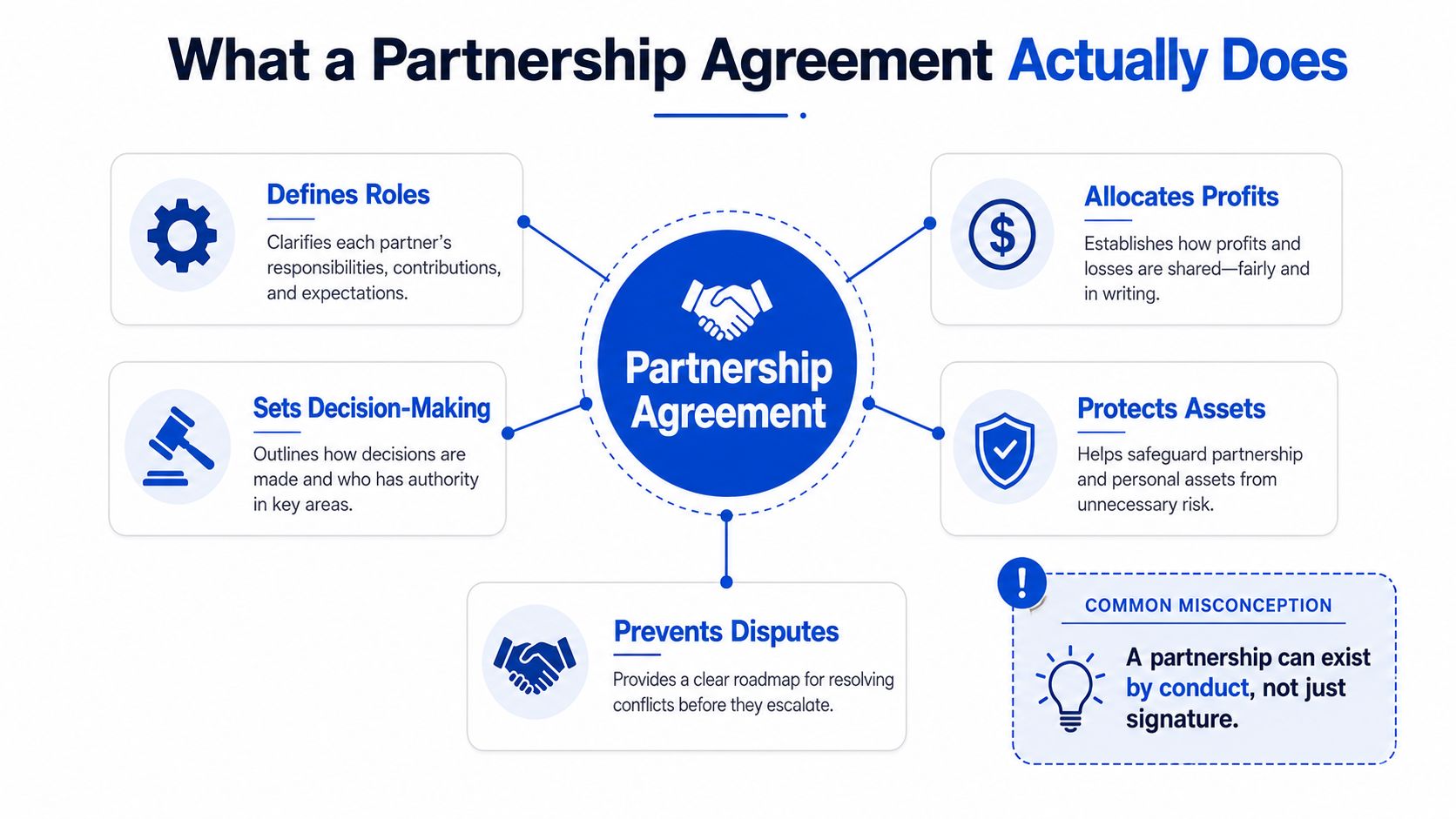
What a Partnership Agreement Actually Does
A partnership agreement is not a relationship memo. It is a risk-allocation contract that decides who owns what, who can act for the firm, how profits get split, and what happens when the relationship breaks down. Without it, founders leave those decisions to default law, and default law is usually a poor fit for the deal they thought they made.
A common misconception is that a partnership only exists after paperwork is signed. A partnership can form through conduct, and a founder can end up in a real business relationship without meaning to create one. The agreement's job is to replace vague baseline rules with terms that match the actual deal on the table.
Practical rule: If the founders would argue about authority, money, or exit, they need a written agreement before the argument starts.
The issue is control. One partner may assume they can sign contracts, hire vendors, or spend company money. Another may think every major decision needs consent. If the agreement does not answer that cleanly, the fight starts there, and the law fills the gap with rules that were never custom-made for the business.
For founders comparing entity documents, a partnership agreement does a different job than a corporate governance document. A useful comparison is this overview of a shareholders agreement, because the function is similar even if the entity type is different. The point in both settings is simple, put the rules in writing before a dispute turns them into evidence.
Types of Partnerships Founders Can Choose
The entity choice has to match the deal on the ground. A founder who picks the wrong form and then drops in a generic agreement is creating avoidable risk. The differences that matter are liability, management, and who is supposed to do the work.
| Structure | Liability | Management | Best Fit |
|---|---|---|---|
| General partnership | Broad personal exposure unless the agreement and local law say otherwise | Shared control among partners | Small founder teams that want direct control and understand the risk |
| Limited partnership | General partners manage, limited partners usually stay passive | Split between active and passive roles | Investor-backed ventures where one side supplies capital and the other side runs the business |
| LLP | Liability protection is stronger for partner-level errors, depending on state law | Often shared among professionals | Professional firms that want co-ownership without the same personal exposure |
| LLC taxed as a partnership | Flexible, agreement-driven economics | Defined by operating document and ownership rights | Most modern startups that want flexibility with fewer default traps |
Use the structure that fits the actual business, not the one that sounds simplest on a form. The IRS partnership filings show how often founders end up inside LLC-style setups, which is one reason the agreement cannot be sloppy. A limited partnership can also produce economics that do not line up neatly with a casual 50/50 split, so the paper has to match the actual bargain. IRS partnership statistics
A general partnership is easy to form and easy to misunderstand. It works when the founders want simplicity and are comfortable sharing management, but it also leaves more room for personal exposure if the agreement is thin. A limited partnership makes more sense when there is a real investor-passive role split. An LLP is usually the practical fit for professional services, not a product startup.
Entity choice changes what the agreement should focus on. A lawyer drafting for a tech startup does not write the same agreement as one drafting for a clinic, an architecture firm, or a real estate investment group. A useful template comparison sits in this guide to how to write an operating agreement, because the drafting discipline is similar even though the document title changes.
A passive investor belongs in the passive seat. If the agreement hands that person management power by accident, the founders have already weakened the structure.
The Clauses That Allocate Ownership and Profit
Capital contributions are where a lot of founders fool themselves. More money does not automatically mean more control, and more work does not automatically mean more equity. The agreement has to say what each partner contributed, how that contribution was valued, and what ownership percentage it supports.
Start with capital accounts, not vibes
A solid agreement treats cash, property, intellectual property, equipment, services, or professional expertise as possible contributions, then ties each one to a capital account entry. That keeps the paper trail clean. It also prevents the classic fight where one partner thinks a bigger check buys control while the other thinks sweat equity should count just as much.
For founders who need a clean ledger from day one, bookkeeping matters as much as legal drafting. A solid accounting setup from a provider like bookkeeping services helps keep contribution records, capital balances, and later distributions from becoming a mess the moment the business starts moving money.
The checklist language is straightforward. Document the contribution, assign a value, credit the capital account, then state the ownership percentage that follows from it. A partner can contribute more cash and still own less, if the agreement says so. That flexibility is useful, but only when it's written down.
The same logic applies to profits and losses. Ownership and profit sharing can be the same, but they don't have to be. That distinction matters in founder-heavy deals where one person brings cash, another brings product development, and a third brings market access. If the paper says nothing, the default rules do the talking.
Put voting rules in the document
Governance is where good deals usually get wrecked by vagueness. The agreement should say which decisions are routine, which ones need a vote, and which ones need unanimous consent. Major actions, such as debt, new partners, or strategic changes, should not be left to guesswork.
A concise drafting rule helps here:
- Routine decisions: one managing partner or a majority of partners can approve ordinary operating items.
- Major decisions: unanimous consent for debt, partner admissions, and structural changes.
- Special authority: banking, signing authority, and operational limits should be named explicitly.
Drafting tip: If a clause does not tell a third party who can sign, it is not finished.
A clean capitalization schedule also helps later when someone leaves. The same ledger that supports ownership percentages supports buyouts, distributions, and any future dispute about who put what into the business. That is why this is not just an accounting exercise. It's a legal one. For a deeper drafting framework, see capitalization table management.
The Clauses That Protect IP, Secrets, and Relationships
Technology deals need sharper language than a generic partnership form. If the business depends on code, data, design, formulas, or technical know-how, the agreement has to treat those assets as the prize. That means the document should define scope, technical contributions, quality standards, confidentiality, IP ownership, and security protocols, not just who gets paid and when.
Separate old work from new work
The first thing to lock down is ownership of pre-existing IP versus newly developed IP. If a partner brings in code, a brand asset, a process, or a dataset before the partnership starts, that asset needs to stay identified as separate unless the deal says otherwise. Without that line, people argue later over whether the partnership owns everything or only the jointly created material.
The second thing is survival. Confidentiality language should not die when a partner walks out. It needs to survive exit, termination, and any dispute over who left first. A partner who had access to source code, customer lists, pricing, or product roadmaps should still be bound after departure.
For founders who need a practical drafting reference on secrecy terms, how to draft a non-disclosure agreement is the right companion document to review. A partnership agreement should work with that NDA, not collide with it.
Make the dispute path fast and controlled
IP-heavy ventures also need a way to handle conflict without blowing up the business. Mediation, arbitration, and venue selection matter because they control speed and confidentiality. If the founders are building something valuable, public litigation is usually the worst first move.
A good clause set should answer three questions:
- Who owns improvements: the partnership, the contributing partner, or the specific project team.
- Who can use the material after exit: nobody, both sides, or only under a limited license.
- Who handles security and access: named partners, an administrator, or a technical lead.
This is also where a founder should think hard about protecting proprietary material before the deal becomes heated. The practical reference for that problem is protect your startup's intellectual property, especially when the venture depends on intangible assets rather than cash.
By design, this is not boilerplate. It's the operating system for a business where value can disappear with a laptop, a credential, or a copied repository. If the agreement doesn't say who controls the asset and who keeps using it later, the founders are just trusting each other's mood.
Common Risks and How Strong Agreements Prevent Them
The lawsuits that matter usually start with a vague sentence. One partner signs a deal the other partner never approved, someone claims profits were supposed to be split differently, or a departing founder insists the business can't continue without them. Those are drafting failures, not personality quirks.
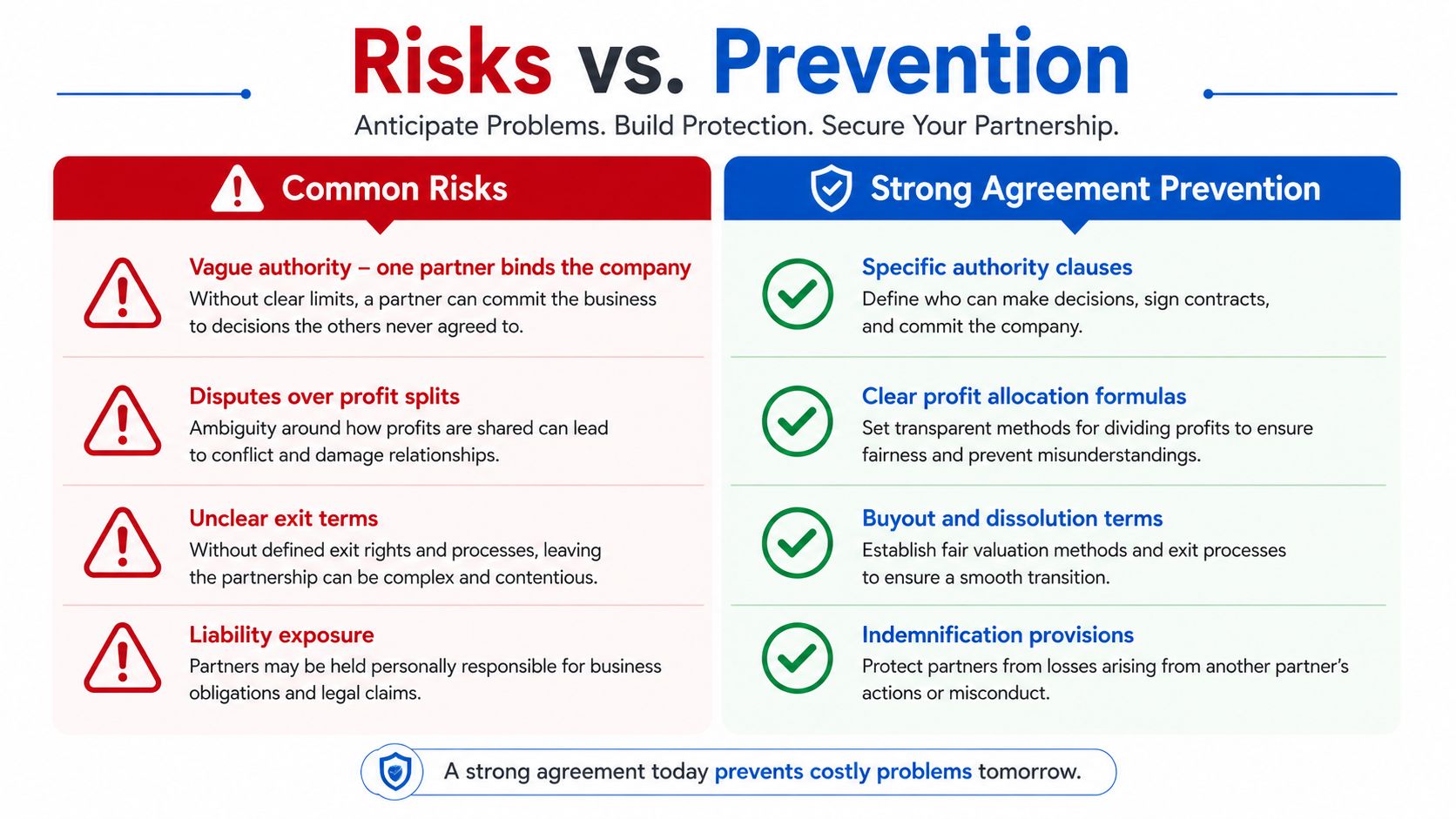
Risk to clause map
| Common risk | What goes wrong | Clause that fixes it |
|---|---|---|
| Vague authority | One partner binds the business to a bad deal | Authority limits and signing rules |
| Profit split dispute | Partners fight at tax time or distribution time | Clear allocation formula |
| Exit conflict | A departure forces a breakup or hostage situation | Buyout and dissolution terms |
| Liability spillover | Personal exposure expands because the agreement is thin | Indemnification and liability clauses |
The decision-making framework matters most because it controls who can act and when. Major actions may require unanimous consent while ordinary matters can be approved by majority vote, and that difference is a frequent source of disputes. If the agreement skips that distinction, the founders have not settled governance, they’ve postponed the fight. Partnership agreement decision-making framework
A strong agreement also cuts off a second problem, the surprise exit. The business should know what happens if someone withdraws, dies, retires, or gets removed. If the document doesn’t say how the interest gets valued and bought out, the remaining partners may end up trapped with a deadlock or forced dissolution.
A clean buyout clause is cheaper than a courtroom fight over who gets to stay.
Founders who want to screen for hidden partner issues can use insider risk in partner deals as a practical lens. The point is not paranoia. The point is to catch the clause gaps before someone uses them.
Washington State Specifics Founders Must Know
Washington founders don’t get to rely on generic startup advice. State default rules fill the gaps when the agreement is silent, and those defaults can be fine for an accident, but terrible for a serious business deal. The agreement has to override them on purpose.
Match the document to the state defaults
ACCA’s technical factsheet says a well-drafted agreement should specify the commencement date, duration, capital provisions, share of profits and losses, authority limits, and notice required to end the relationship. That is the practical checklist for replacing default rules with customized ones, and it fits Washington businesses that need clarity from day one. ACCA partnership factsheet
Washington founders also need to remember that an oral partnership can still create real obligations. If two people start operating together, sharing control, and acting like co-owners, they may already be in partnership territory even without polished paper. That is why the agreement should be signed before the business behaves like one.
A Washington deal should also be built for the business the founders run, not the one a template writer imagined. Remote operations, mixed contribution types, and fast-changing roles all make static boilerplate weaker. A plain-language agreement that names decision rights, capital, and exit mechanics will usually do more work than a fancy form stuffed with filler.
Keep the state-level practicalities in view
A founder should also think about the business registration footprint alongside the agreement. If the partnership uses a trade name or operates through another formal structure, the filings need to line up with the document, not contradict it. A mismatch between what the partners signed and what the public record suggests creates avoidable confusion later.
For local founders, the issue is not whether Washington is friendly to startups. It is whether the agreement clearly says who owns the enterprise, who can sign for it, and how the business survives a departure. That’s where the legal risk lives.
Sample Clauses and a Founder Drafting Checklist
A founder doesn’t need poetic drafting. The agreement needs hard-edged sentences that a banker, investor, or judge can read without guessing. The most useful clauses are the ones that settle ownership, profits, votes, and exit.
Sample clause language that actually helps
Ownership allocation. “Partner A owns 60 percent and Partner B owns 40 percent, as reflected in the capital accounts and subject to the terms of this agreement.”
Profit and loss. “Profits and losses will be allocated in the same proportions unless amended in writing by all partners.”
Voting. “Ordinary business matters require a majority vote. Debt, new partner admission, asset sales, and dissolution require unanimous consent.”
Exit mechanics. “A withdrawing partner must give written notice, and the remaining partners will have the first right to purchase the departing interest before any sale to an outside buyer.”
Those clauses are useful because they answer the fight before it starts. The right of first refusal is especially important, because it keeps an outsider from walking in through the departing partner’s door. The agreement should also say how the interest gets valued, what payment timing looks like, and whether death or retirement changes the process. Exit mechanics and right of first refusal
A short drafting checklist
- List contributions clearly: cash, property, services, or IP.
- State ownership percentages: don’t leave them implied.
- Name voting thresholds: ordinary versus major decisions.
- Add buyout terms: valuation, timing, and buyer priority.
- Confirm dispute forum: mediation first if that’s the plan.
- Review with counsel: especially if the deal includes IP, outside investors, or multiple entities.
For founders in a hurry, the right move is not to overbuild. It’s to draft the core clauses first, then let counsel tighten the language before money, code, or customers are on the line. By Design Law Firm & Legal Consultancy, PLLC handles contract and transactional work for business owners who need agreements reviewed before they become disputes.
Questions Founders Ask Before They Sign
An oral agreement can count as a partnership if the conduct shows the parties are carrying on a business together. That’s the problem, not the feature. A written agreement removes the guesswork and gives the founders a clean rulebook.
Partnership taxation is generally passed through to the partners, which is one reason these structures are so common for closely held businesses. The drafting question is not whether tax exists, it’s whether the agreement matches the ownership and allocation the founders intended. If the deal is heading toward a different tax treatment or entity structure, counsel should review it before the paperwork hardens.
A founder can sometimes leave without blowing up the whole business, but only if the agreement says how withdrawal works. If it doesn’t, the default rules become dangerous. That is why exit mechanics belong in the first draft, not a later cleanup memo.
The agreement should be reviewed whenever the business changes shape. New capital, new roles, remote operations, a new product line, or a partner’s exit all justify a fresh look. A static agreement is fine for a static business. Most startups are not static.
By Design Law Firm & Legal Consultancy, PLLC helps Washington founders put real rules around ownership, authority, and exit before those issues turn into disputes. If a partnership is being formed, reviewed, or untangled, visit By Design Law Firm & Legal Consultancy, PLLC to get contract and governance support for the deal on the table. Contact our law office today at (206) 593-1519.