A stock option agreement is the signed contract that gives the holder the right, but not the obligation, to buy a set number of company shares at a fixed exercise price for a limited time. Incentive stock options that first become exercisable in one calendar year can't cover more than $100,000 of stock value, and any amount past that line is taxed as a nonstatutory option.
You just got the grant email. The offer letter names a share count, a strike price that looks tiny, and a vesting schedule that stretches four years. The attachment is a stock option agreement, and it reads like the company is handing you ownership. It isn't. Nothing is yours until you pay the exercise price, and often a tax bill, for shares you may not be able to sell.
That gap is the cash-flow trap. The option can be legally valid and economically valuable, and still be impossible to afford. Tax and cash come due before any buyer exists.
What a Stock Option Agreement Gives You
Say a Seattle software company offers Maya 40,000 options at $0.80 a share. The stock option agreement is a price lock, the way a homebuyer locks a purchase price before closing. Maya pays nothing merely to hold the right. She must pay the full exercise price, and possibly tax, if she wants the shares. Until she exercises, she owns no stock.
The company is the grantor. The holder is the employee, advisor, or director named in the grant. The agreement sits under an equity incentive plan. The plan sets the share reserve and the approval rules, so the agreement can't promise more shares than the plan still has available.

Five terms show up in nearly every grant, and each one changes the money.
- Number of shares: the fixed count the holder may buy.
- Exercise price: the locked cost per share.
- Grant date: the day the price and the tax clock start.
- Vesting schedule: when the right to buy is earned.
- Expiration date: the last day the right exists.
Those terms are judged under Internal Revenue Code sections 422 and 409A, Securities Act Rule 701, and the IRS instructions for Form 3921. Section 422 is the incentive-stock-option statute. Section 409A polices discounted nonstatutory options. Rule 701 is the private-company securities exemption most startups rely on. Form 3921 is the form the company sends after an incentive option is exercised.
Before reading further, check the first page. Does the stock option agreement label the grant an incentive stock option (ISO) or a nonstatutory option (NSO)? That label decides the tax.
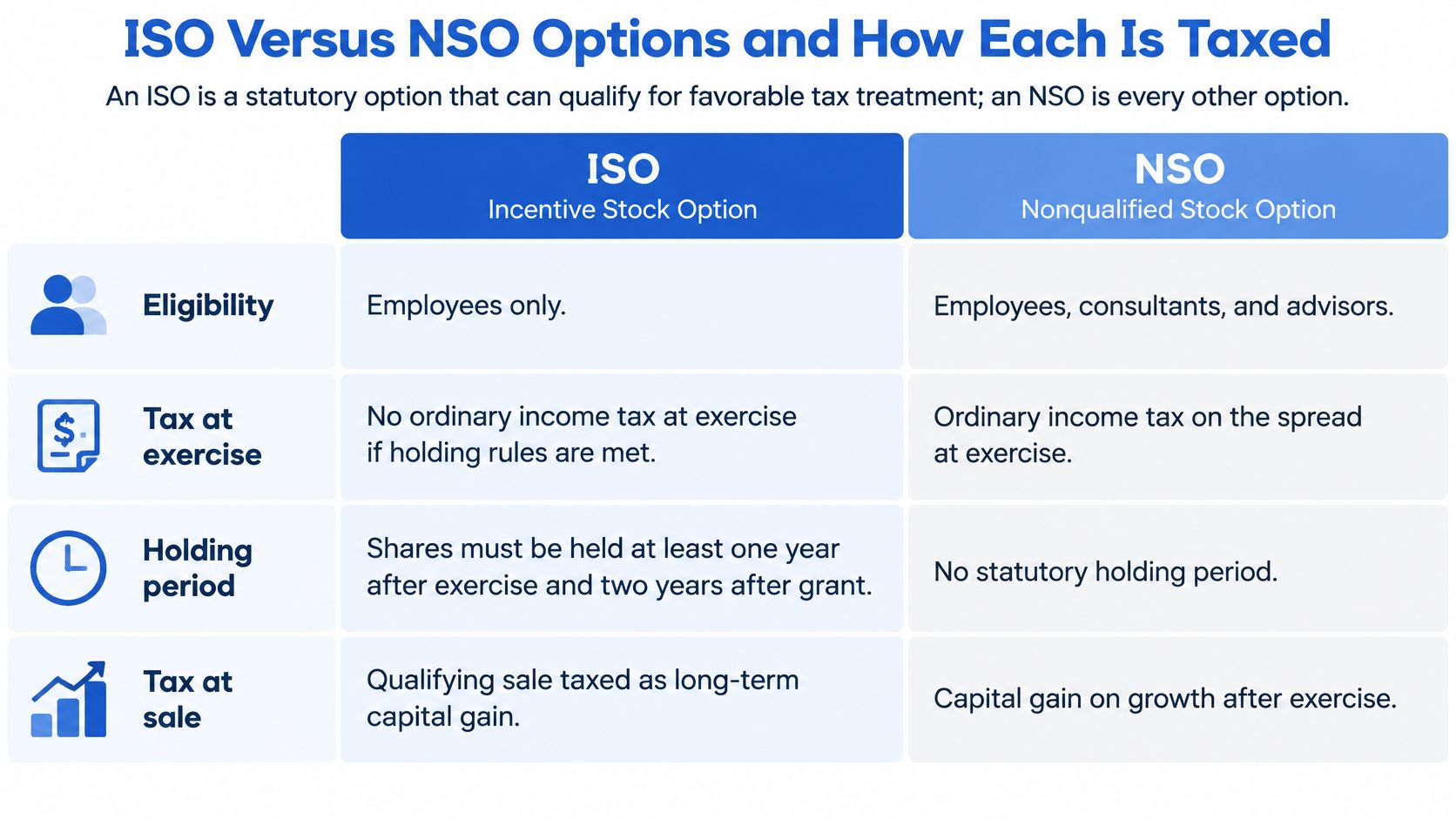
ISO Versus NSO Options and How Each Is Taxed
An ISO is a statutory option that can qualify for favorable tax treatment. An NSO is every other option. The IRS regulations on incentive stock options trace the modern ISO rules to the Economic Recovery Tax Act of 1981.
| Feature | Incentive stock option (ISO) | Nonstatutory option (NSO) |
|---|---|---|
| Who can receive it | Employees only | Employees, contractors, advisors and directors |
| Regular income tax at exercise | None on the spread | Spread taxed as ordinary wage income |
| Alternative minimum tax at exercise | Spread counts as AMT income | Not applicable |
| Tax on sale after holding periods | Long-term capital gain on gain above exercise price | Gain after exercise taxed as capital gain |
| Tax on sale before holding periods | Spread taxed as ordinary income (disqualifying disposition) | Spread already taxed at exercise |
| Holding periods for favorable treatment | At least 2 years after grant and 1 year after exercise | Not required for the exercise-date tax |
| Annual value limit | $100,000 of shares first exercisable per year; excess becomes NSO | No annual limit |
| Reporting after exercise | Form 3921 issued to the holder | Wages reported with withholding on the spread |
Who can hold the option
Only employees can receive ISOs. Contractors, advisors, and directors get NSOs. A founder who is also an employee can hold ISOs. A founder who is only a consultant cannot.
What happens at exercise
On a qualifying ISO exercise, regular federal income tax doesn't hit the spread. The spread still counts as alternative minimum tax income, so a tax bill can arrive with no sale. On an NSO, the spread is wage income at exercise, and the company generally withholds.
A plain comparison of ISOs vs NSOs explained is worth reading beside the grant notice, because the label on page one changes both the tax and who may hold the award.
What happens at sale
Hold ISO shares at least two years after grant and one year after exercise, and gain above the exercise price is long-term capital gain. Sell sooner and the sale is a disqualifying disposition. Some or all of the spread is ordinary income. An NSO has no matching holding period for the exercise-date tax, because that tax already happened. Later growth is capital gain.
The dollar cap and the 10 percent shareholder
The aggregate fair market value of shares for which ISOs first become exercisable can't exceed $100,000 in any calendar year. Value is measured at grant, not at exercise. Anything over that line is an NSO. The exercise price must be at least fair market value on the grant date. Holders of 10% or more of the voting power face stricter price rules, and their maximum exercise period is generally five years, not ten. An ISO must be granted under a shareholder-approved plan within 10 years after the plan is adopted or approved, whichever comes first, and it normally expires no later than 10 years after grant.
Find the type in two places. The stock option agreement should say ISO and name the plan. After exercise, the company issues Form 3921 for an ISO. An NSO shows up as wages instead.
Key Provisions That Decide What You Actually Get
The clause that surprises people is the post-termination exercise window. Leave the company, and vested options often die in about 90 days. ISOs generally must be exercised within three months of leaving to keep ISO status. Miss the window and the vested value is gone, even if you worked years to earn it.
The clauses in document order
| Provision | What It Controls | Typical Startup Term |
|---|---|---|
| Vesting | When you earn the right to exercise | Four years with a one-year cliff, then monthly |
| Exercise price | Cost per share to buy | Not less than fair market value on the grant date |
| Term | Last day to exercise | Ten years from grant for ISOs; five years for 10% holders |
| Post-termination exercise window | How long to exercise after leaving | Often 90 days; ISO status generally needs exercise within three months |
| Acceleration | Whether vesting speeds up | Single trigger (on sale) or double trigger (sale plus termination) |
| Repurchase right | Company's right to buy back shares | Unvested shares at lower of cost or fair market value |
| Transfer restrictions | Who you can sell or give shares to | Right of first refusal, lock-up and market standoff |
| Early exercise | Buying unvested shares early | Possible with an 83(b) election filed within 30 days |
Vesting is the earn-out. A common schedule is four years, a one-year cliff, then monthly. Quit before the cliff and the exercise right is zero.
Exercise price is the per-share cost. It should not sit below fair market value on the grant date. A current 409A valuation is the usual support for a private company.
Term is the outside date. For a standard ISO that is ten years from grant. For a 10% holder it is generally five.
Acceleration decides whether a sale helps you. Single-trigger vesting speeds up when the company is sold. Double-trigger needs a sale plus a termination. Compare your clause to this double-trigger sample: "If within 12 months after a Change of Control the Company terminates the Participant without Cause, the unvested portion of this Option shall vest in full as of the termination date." If your paper is weaker, the unvested slice can disappear in the deal.
Repurchase lets the company buy back shares you don't yet own free and clear, often unvested shares at the lower of what you paid or current value. Transfer limits add a right of first refusal, a lock-up, and a market standoff, so you can't hand shares to a friend or sell into the first trading window. New shares from options also change everyone's percentage, which is why holders should read how equity dilution works before treating a grant as a fixed ownership stake.
Early exercise lets you buy unvested shares. Pair it with an 83(b) election filed within 30 days of the purchase, or the tax timing can shift against you. Thirty days means thirty days. Late filings aren't repaired by a polite email.
Practical rule: Open the stock option agreement and mark six spots before you sign: vesting start date, exercise price, expiration, post-termination window, acceleration, and repurchase. If any date disagrees with the offer letter, the agreement usually controls.
Exercise Price, 409A Valuation and Cash Needed to Exercise
Two formulas decide whether a grant is usable. Exercise cost equals shares times exercise price. Spread equals shares times the gap between fair market value at exercise and that exercise price. The spread can dwarf the check you write, and the spread is what the tax system looks at.
The figures below are illustrations for 25,000 shares, not a valuation and not tax advice.
| Scenario | Spread at exercise |
|---|---|
| Early stage | $0 |
| Growth stage | $50,000 |
| Later stage | $150,000 |
| Late stage, high 409A value | $400,000 |
Four questions the rows force
Early stage, spread of $0. Fair market value still equals the strike. Ask whether you can write the exercise check now, while the taxable gap is nothing. That is the cheap year, and it may not last.
Growth stage, spread of $50,000. The strike check might still be a few thousand dollars. Ask what tax is due on a $50,000 spread if the shares can’t be sold. For an NSO, that spread is generally compensation income at exercise. For an ISO, it can land in alternative minimum taxable income before any sale proceeds exist.
Later stage, spread of $150,000. Ask who funds the tax. A same-day sale works in a public company. A private company often has no buyer, a repurchase right, and a transfer ban. The option is valuable on a spreadsheet and unusable in a checking account.
Late stage with a high 409A value, spread of $400,000. Ask what happens if value falls after you exercise. You have paid cash and possibly tax for shares worth less than the bill. A down round doesn’t refund either one.
Why the grant-date price has to be real
A nonstatutory option generally stays outside Internal Revenue Code Section 409A only when the exercise price is never less than fair market value on the grant date, the share count is fixed, and the option has no feature that defers compensation. The IRS discussion of stock rights and Section 409A treats a discounted grant as nonqualified deferred compensation, with tax-compliance consequences for the holder. In some cases fair market value may be an average selling price over a period inside 30 days before or 30 days after the valuation date, but only if the program locks that method in before the period starts.
A legally clean stock option agreement can still be a grant you cannot afford to use. Price the cash, the tax, and the downside before you exercise.
A Four-Year Grant From Offer to Exercise
Maya joins a Seattle software startup and receives 40,000 ISOs at an $0.80 exercise price. Vesting is four years with a one-year cliff. The story is a hypothetical. It is not tax advice.
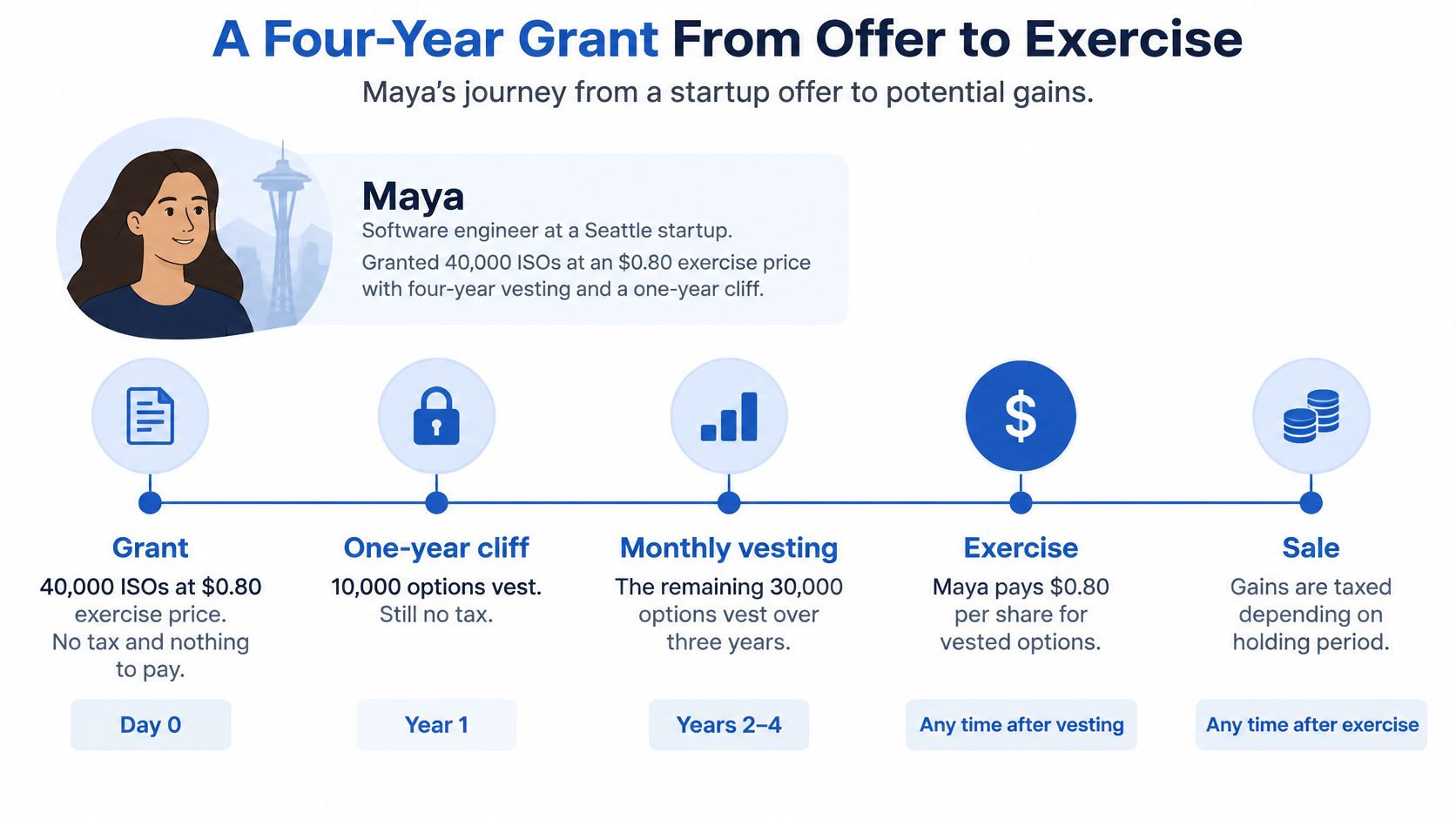
At grant, she owes no tax and pays nothing. The right just sits there.
At the one-year cliff, 10,000 options vest. Still no tax, because vesting isn’t exercise.
Through month 24, monthly vesting continues. Half the grant is earned, so 20,000 options are vested. She leaves. The post-termination window is 90 days. After that, the vested options expire.
She exercises all 20,000. Cost is 20,000 times $0.80, or $16,000. Fair market value that day is $3.00, so the spread is 20,000 times $2.20, or $44,000. That spread counts toward the alternative minimum tax even though she has not sold a share. The IRS guidance on statutory stock options is clear that ISO treatment doesn’t erase that AMT result, and the company must issue Form 3921 after the exercise. The agreement should name the option type and the statutory plan so payroll and the cap table tell the same story. A messy grant is also a messy line on the capitalization table.
The sale choice
She can sell immediately. That is a disqualifying disposition, and the spread is taxed as ordinary income. Or she can hold until both clocks finish, one year after exercise and two years after grant, and seek long-term capital gain treatment. Washington’s capital gains excise tax can apply to long-term gains above an annual standard deduction. The threshold is indexed, so the current figure under RCW 82.87 has to be checked for the year of sale, not copied from an old article.
The calendar, not the headline share count, sets the tax. Vest, exercise, and sell on three different dates and you can get three different results from the same stock option agreement.
A short walkthrough of how these grant clocks work in practice:
Securities Rules and Board Approval Before Issuance
The stock option agreement is one piece of a compliance chain. A missed step can spoil the securities exemption the company is relying on, and that defect can complicate a later exercise or sale. Walk the chain before you sign.
- Plan reserve and approval. Confirm the equity plan still has unissued shares, and that shareholders approved the plan within 12 months before or after adoption, which ISO treatment requires.
- Board grant. The board should approve the person, the share count, and the exercise price. Ask for the board resolution that did it.
- Valuation. The price should rest on a current fair market value report.
- Cap table. The grant should already be recorded.
- Rule 701 tally. The company tracks securities sold under the rule across any consecutive 12-month period.
- The $5 million disclosure trigger. When sales in that window pass $5 million, the SEC’s Rule 701 release requires enhanced disclosures, including plan terms, risk factors, and specified financial statements, within a reasonable time before the sale. For options, that moment is exercise, not grant.
- Proof and legends. Delivery should be documented, and the share legends should match the restrictions.
Before signing, request four records: the plan, the board consent, the valuation report, and the Rule 701 disclosure file.
Confirm the Agreement Before You Sign It
Don’t accept the grant on the offer-letter summary. The stock option agreement is the document that spends your cash later.
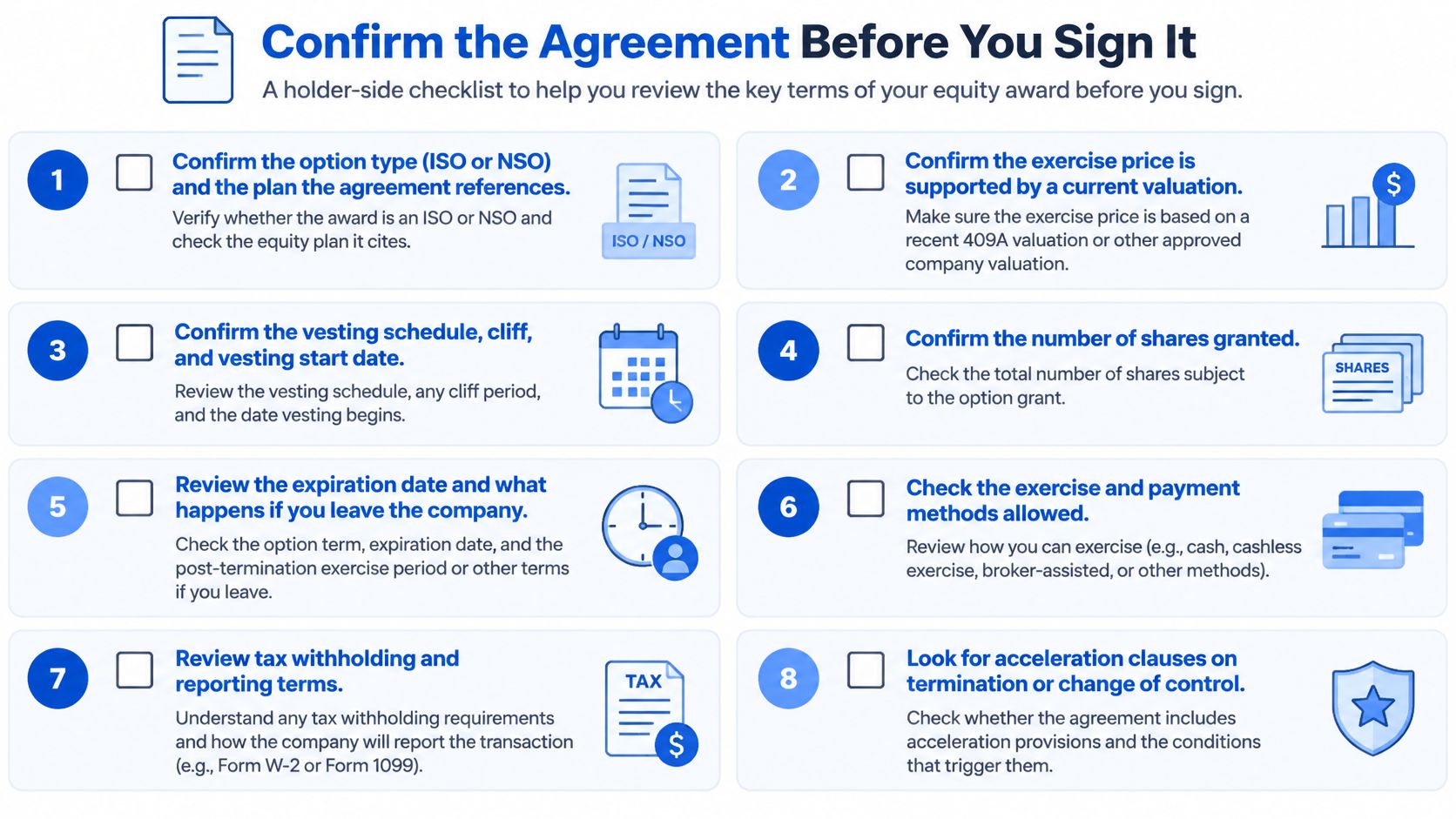
- Option type: Confirm ISO or NSO, and the plan the agreement names.
- Price support: Confirm a current 409A valuation backs the exercise price.
- Match the offer: Confirm term, cliff, vesting start, and share count match the offer letter.
- Authority: Confirm board approval and reserved shares, using the sequence above.
- Rule 701 file: If sales in a 12-month period have passed $5 million, ask for the disclosures before you rely on any exercise right.
Three asks matter most for Washington startup hires, and each one has a trade-off the company will name.
A window longer than 90 days. You want time to raise the exercise cash after a job ends. The company will say a long window complicates ISO status and leaves overhang on the cap table.
Double-trigger acceleration, not single-trigger. You want unvested options to vest if a buyer terminates you. Investors often resist single-trigger because it dilutes them at the closing.
A limit on repurchase of vested shares. You want vested stock to stay yours. The company will want a buyback so a departing holder doesn’t sit on the cap table through the next round. That tension shows up in almost every venture financing.
Next step: request the plan and the valuation report before you accept. If a clause is unclear, By Design Law Firm & Legal Consultancy, PLLC reviews commercial contracts before they are finalized, and its contract lawyers draft and review agreements for Washington State compliance. The firm offers a free consultation.
By Design Law Firm & Legal Consultancy, PLLC helps founders and employees read a stock option agreement against the plan, the board approvals, and the tax label before anyone signs or exercises. The Seattle firm drafts and reviews equity and commercial contracts, flags the cash and tax traps in a grant, and aligns the paperwork with Washington requirements. Visit By Design Law Firm & Legal Consultancy, PLLC to set up a consultation before the grant goes stale. Call our office at (206) 593-1519.