Venture capital legal work is the framework that protects a Washington startup's equity and ensures fundraising compliance, acting as both a shield against investor disputes and a roadmap for corporate governance. The NVCA model-document format grew from fewer than 3% adoption in 2004 to 85% by 2022, showing how strongly standardized documents now shape venture financings.
A founder can still feel unprepared when an investor sends a familiar-looking term sheet. The documents may follow a market pattern, but the economics, voting rights, transfer restrictions, securities exemption, and data disclosures can produce very different outcomes for the company. Washington founders need counsel who can read the standard form, identify where it departs from the company's interests, and coordinate federal requirements with state procedures.
Understanding the Role of Venture Capital Legal in Startups
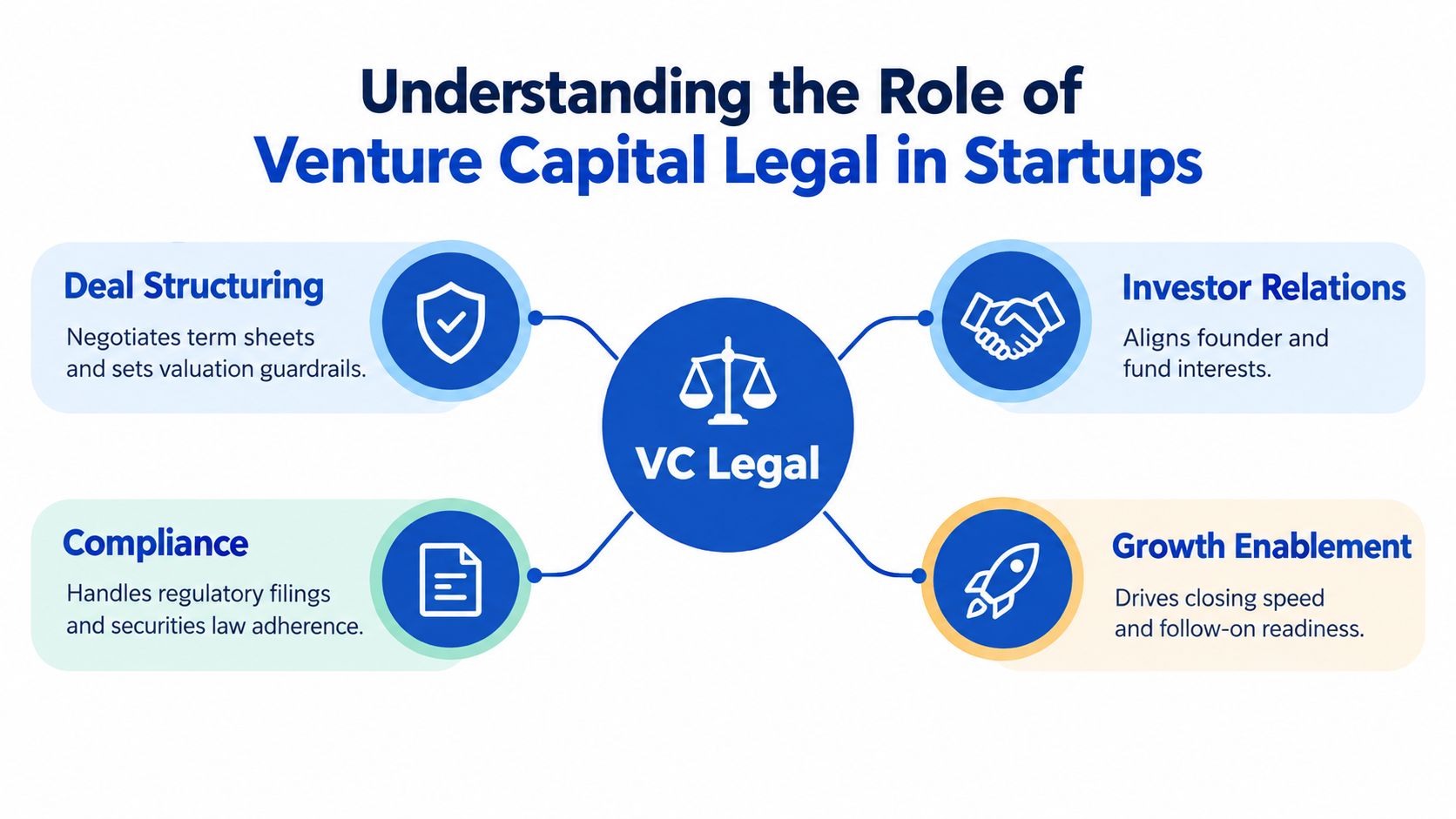
A financing round is not just an exchange of cash for stock. It changes the company's ownership records, governance rights, disclosure obligations, board relationships, and future financing options. Venture capital legal work connects those moving parts before they become conflicting promises.
Counsel typically helps the company move through four practical tasks:
- Structure the deal: Determine whether the financing is a priced preferred-stock round, convertible instrument, or another structure, then identify the approvals and documents required.
- Protect the cap table: Reconcile issued shares, option grants, founder ownership, reserved pools, conversion rights, and new investor securities before anyone signs.
- Coordinate compliance: Select the securities exemption, prepare required notices, preserve investor eligibility records, and align state and federal filings.
- Prepare for governance: Translate investor rights into board procedures, consent mechanics, information delivery, and future financing controls.
Why standardized documents help
The National Venture Capital Association created its model legal documents in 2003, when approximately two dozen attorneys organized an effort to reduce variation and negotiation costs in startup financings. The initial package included a term sheet and agreements addressing the charter, stock purchase, investor rights, voting arrangements, and rights of first refusal or co-sale. The NVCA describes the documents as a foundational standard for U.S. venture financings. NVCA model legal documents
A Stanford study of nearly 5,000 startup and venture capital funding agreements found that fewer than 3% used the standardized format in 2004, compared with 85% by 2022. The same study found that fewer than 60% of sampled company charters were filed in Delaware in 2004, compared with 100% by 2022. Those figures show that standard forms can influence transaction practice and corporate jurisdiction, not merely drafting style.
Standardization works when it gives both sides a known starting point. It doesn't work when founders assume the form is neutral. Liquidation preferences, protective provisions, anti-dilution adjustments, option-pool treatment, and consent thresholds still require careful review.
Practical rule: Treat every model document as a negotiation map, not as a recommendation about what the company should accept.
Washington founders preparing outreach can also use a curated early stage VC list to organize investor research. Legal readiness matters before that outreach begins because the company's ownership records, formation documents, and financing narrative should withstand the questions that serious investors will ask.
Navigating Core Venture Capital Legal Documents
The term sheet is the negotiation summary. The stock purchase agreement records the investment. The investor rights agreement governs the continuing relationship. None of those documents should be reviewed in isolation because the certificate of incorporation often controls the economic result more directly than the term sheet.
The term sheet sets the pressure points
A term sheet usually identifies the proposed valuation, security type, investment amount, liquidation preference, board structure, protective provisions, pro rata rights, and other major business terms. It can be partly nonbinding, but provisions concerning confidentiality, exclusivity, expenses, or access to information may still carry legal effect.
The practical question isn't whether the term sheet looks familiar. It is whether the proposed economics work across multiple outcomes. Founders should model an acquisition with a modest return, a strong return, a down round, a later preferred round, and an option-pool increase. Valuation alone won't reveal how much common-stock holders receive after preferences and dilution.
The charter controls the waterfall
The NVCA model term sheet describes a common non-participating liquidation preference. On a liquidation, dissolution, or deemed liquidation event, preferred holders receive the greater of a specified preference, often 1x the original purchase price, potentially plus accrued or declared unpaid dividends, or their as-converted share of proceeds. The NVCA model term sheet illustrates why the certificate of incorporation deserves close attention.
Under that structure, investors generally choose between taking the preference and converting into common stock. Participating preferred stock can produce a different result because the investor may receive the preference and then participate in the remaining proceeds. Anti-dilution provisions can adjust conversion economics after a down round, while pro rata rights can preserve an investor's percentage in later financings but require additional capital.
| Document | What it controls in practice | Review focus |
|---|---|---|
| Term sheet | The commercial outline for the proposed round | Economics, control, exclusivity, and conditions to closing |
| Stock purchase agreement | The issuance and sale of the securities | Representations, closing conditions, approvals, and consideration |
| Investor rights agreement | The investor's continuing information and participation rights | Reports, inspection rights, registration rights, and future-round access |
| Certificate of incorporation | The legal rights attached to preferred stock | Preferences, conversion, voting, protective provisions, and seniority |
The agreements must tell one story
The voting agreement may give investors board-designation or voting commitments. The right-of-first-refusal and co-sale agreement may restrict founder transfers and provide investors with participation rights in certain sales. The investor rights agreement may require recurring financial or operational reporting. The charter may give preferred holders consent rights over issuing senior securities, changing the charter, approving a sale, or taking other specified actions.
A founder reviewing only the term sheet may miss a conflict between a board provision and a protective provision. A founder reviewing only the stock purchase agreement may miss a cap-table assumption embedded in the charter. A pre-seed funding guide 2026 can help founders understand early financing paths, but transaction counsel still needs to reconcile the actual documents and the company's facts.
For a document-by-document reference point, founders can review NVCA model forms, then ask counsel which provisions should change for the company's size, financing history, investor group, and expected governance needs.
Comparing Securities Exemptions for Fundraising
A Washington startup should select its securities-law pathway before it announces a round or accepts commitments. The choice between Rule 506(b) and Rule 506(c) changes who can be approached, how the company communicates, what investor records it must preserve, and what closing process counsel must administer.
Rule 506(b) limits publicity
Rule 506(b) permits an unlimited amount of capital from accredited investors and up to 35 non-accredited investors, but it prohibits general solicitation. Non-accredited purchasers create enhanced disclosure requirements comparable to those used in Regulation A offerings. The company therefore needs disciplined investor communications and a defensible basis for its relationship with prospective investors.
A public announcement, open social-media campaign, or broadly accessible pitch can create problems if the company is relying on 506(b). Founders should control who receives the deck, avoid public offering language, and maintain a record of how the relationship began.
Rule 506(c) permits outreach but requires verification
Rule 506(c) permits general solicitation and unlimited capital, but every purchaser must be accredited and the issuer must take reasonable steps to verify that status. A signed investor questionnaire alone may not be enough. Depending on the circumstances, verification can include tax returns, W-2s, brokerage or bank statements, credit reports, or other reliable documentation. SEC materials on accredited-investor verification explain the distinction between investor qualification and reasonable verification.
| Decision point | Rule 506(b) | Rule 506(c) |
|---|---|---|
| Public solicitation | Not permitted | Permitted |
| Accredited investors | Unlimited | All purchasers must qualify |
| Non-accredited investors | Up to 35, with enhanced disclosure | Not permitted |
| Verification | Eligibility records still matter | Reasonable verification steps are required |
| Operational risk | Improper publicity can undermine the exemption | Weak verification can create exposure |
The Washington workflow starts before outreach
A practical sequence is straightforward:
- Choose the exemption: Match the fundraising strategy to the communications plan and investor base.
- Build the diligence file: Preserve questionnaires, verification materials where required, subscription documents, approvals, and communications.
- Track state obligations: Coordinate federal filings with Washington notice requirements and the laws of other states where investors reside.
- Control closing: Confirm that funds, signatures, board approvals, securities issuance, and capitalization records all match.
The worst workflow is to market first and decide the exemption later. That approach can force the company to reconstruct communications, revise investor materials, or explain inconsistent eligibility records under time pressure.
Meeting Washington State Compliance and Filing Requirements
Federal exemption planning doesn’t end when the wire arrives. A Washington company must preserve evidence that the issuance was authorized, accurately recorded, and reported where required. The board should approve the financing under the company’s governing documents, and the company should update its capitalization records immediately after closing.
Separate company obligations from fund obligations
The SEC venture-capital adviser exemption generally allows an adviser to avoid SEC registration if it advises qualifying venture-capital funds and has less than $150 million in private-fund assets under management in the United States. The SEC’s venture-capital adviser exemption isn’t based only on a fund’s label. The qualifying-fund definition limits investments primarily to equity securities of private operating companies, short-term U.S. Treasury securities, and cash, generally prohibits fund debt, and requires the fund to represent itself as a venture-capital fund.
That exemption usually concerns the adviser, not the startup receiving the investment. The startup still needs to document its securities issuance, maintain approvals, handle investor reporting commitments, and monitor continuing contractual obligations.
Build a Washington closing file
The closing file should contain the signed financing agreements, board and shareholder approvals where required, updated charter documents, stock ledger, capitalization table, investor questionnaires, wire confirmation, and copies of applicable federal and state filings. Counsel should also calendar recurring information rights, board procedures, option approvals, annual reports, tax matters, and any notice obligations.
Washington’s crowdfunding exemption offers a separate route for an eligible Washington corporation or centrally managed LLC or limited partnership to raise up to $1 million during any rolling 12-month period through equity or convertible-debt securities. The issuer must be resident and doing business in Washington at the time of the offer or sale, specify a minimum offering target and deadline in its Washington Crowdfunding Form, and show that the target plus other financing is sufficient to implement the business plan. Washington’s crowdfunding requirements make clear that the exemption is a defined pathway, not a general waiver of securities compliance.
Formation choices also affect future financing. Founders comparing Washington and Delaware structures can review how to incorporate a business while coordinating the decision with counsel, tax advisers, and prospective investors. Regulatory developments outside Washington may also affect an AI company’s risk profile, so an AI policy competition analysis can provide useful policy context without replacing company-specific legal advice.
Addressing Emerging AI Startup Legal Needs
AI diligence increasingly asks a harder question than whether the company owns its code. Investors want to know whether the company can prove where its training data came from, what rights it obtained, how vendors handled it, and which party owns the resulting model assets.

Turn data lineage into evidence
Recent coverage reports that investors increasingly ask for documented training-data provenance, model-weight and fine-tuning ownership, AI-output contract terms, and internal controls for employee use of public AI tools. Coverage of AI startup diligence and hidden legal risk identifies a practical gap between broad policy statements and diligence-ready evidence.
An AI startup should maintain a living evidence system containing:
- A data-source register: Identify company-owned, licensed, open-source, customer-provided, and unverified inputs.
- A rights matrix: Record license scope, permitted uses, geographic limits, consent basis, retention terms, and restrictions.
- Vendor flow-down terms: Confirm that suppliers address data rights, confidentiality, security, indemnity, and downstream use.
- Model documentation: Track model versions, fine-tuning sources, weight ownership, evaluation records, and material changes.
- Response procedures: Assign responsibility for takedown requests, infringement allegations, privacy complaints, and customer inquiries.
Public availability doesn’t establish a commercial license, eliminate privacy obligations, or resolve copyright and trade-secret questions.
The company should connect this evidence to customer contracts and financing disclosures. It may need to allocate indemnity and limitation-of-liability risk, disclose uncertain provenance, restrict internal use of public AI tools, and identify regulatory milestones that investors will monitor.
A structured AI risk assessment framework can help organize those questions, but technical teams and legal counsel must validate the underlying facts. The aim isn’t to promise that a model is risk-free. It is to show that the company knows what it uses, why it can use it, and how it will respond when a rights issue arises.
The following visual offers additional context for organizing the relationship between technical controls and legal evidence.
Understanding Secondary Transaction Legalities
A secondary sale can give a founder or employee liquidity without creating a new primary financing. It can also introduce a holder the company never evaluated, change voting dynamics, expose confidential information, and create a cap-table problem that surfaces during the next institutional round.
The market is material. A 2025 industry report citing NVCA estimated U.S. venture secondary activity across direct and GP-led stakes at $94.9 billion annualized as of Q3 2025, with persistent liquidity constraints and maturing portfolios identified as drivers. The 2025 global venture capital report provides that market context.
A founder liquidity example
Suppose a founder wants to sell shares to address personal liquidity needs. The first question isn’t the discount. Counsel should inspect the charter, investor rights agreement, voting agreement, equity plan, and stock purchase documents for transfer restrictions, company repurchase rights, investor rights of first refusal, co-sale rights, and board or company consent requirements.
The proposed buyer also matters. The company may need to block or condition a transfer to a competitor, sanctioned entity, unknown special-purpose vehicle, or buyer unwilling to sign confidentiality and information-rights provisions. A sale may also affect drag-along obligations, tax reporting, voting records, and future notices.
Choose the transaction method deliberately
A direct bilateral sale may be efficient but requires careful consent and notice management. A tender offer can provide a more consistent process for eligible holders, while a company buyback raises its own corporate, solvency, tax, and securities-law questions. A GP-led transaction operates at the fund level and may require a different diligence and conflict analysis.
The practical checklist is short:
- Identify every transfer restriction.
- Confirm required notices and consents.
- Verify the buyer and securities-law pathway.
- Update the ledger and capitalization table immediately.
- Preserve confidentiality and continuing governance obligations.
- Model the effect on future financings and perceived valuation.
A discount may solve liquidity pressure while creating governance or signaling risk. The company should treat the secondary as a controlled transaction, not an informal share handoff.
Final Checklist for Washington Startup Legal Readiness
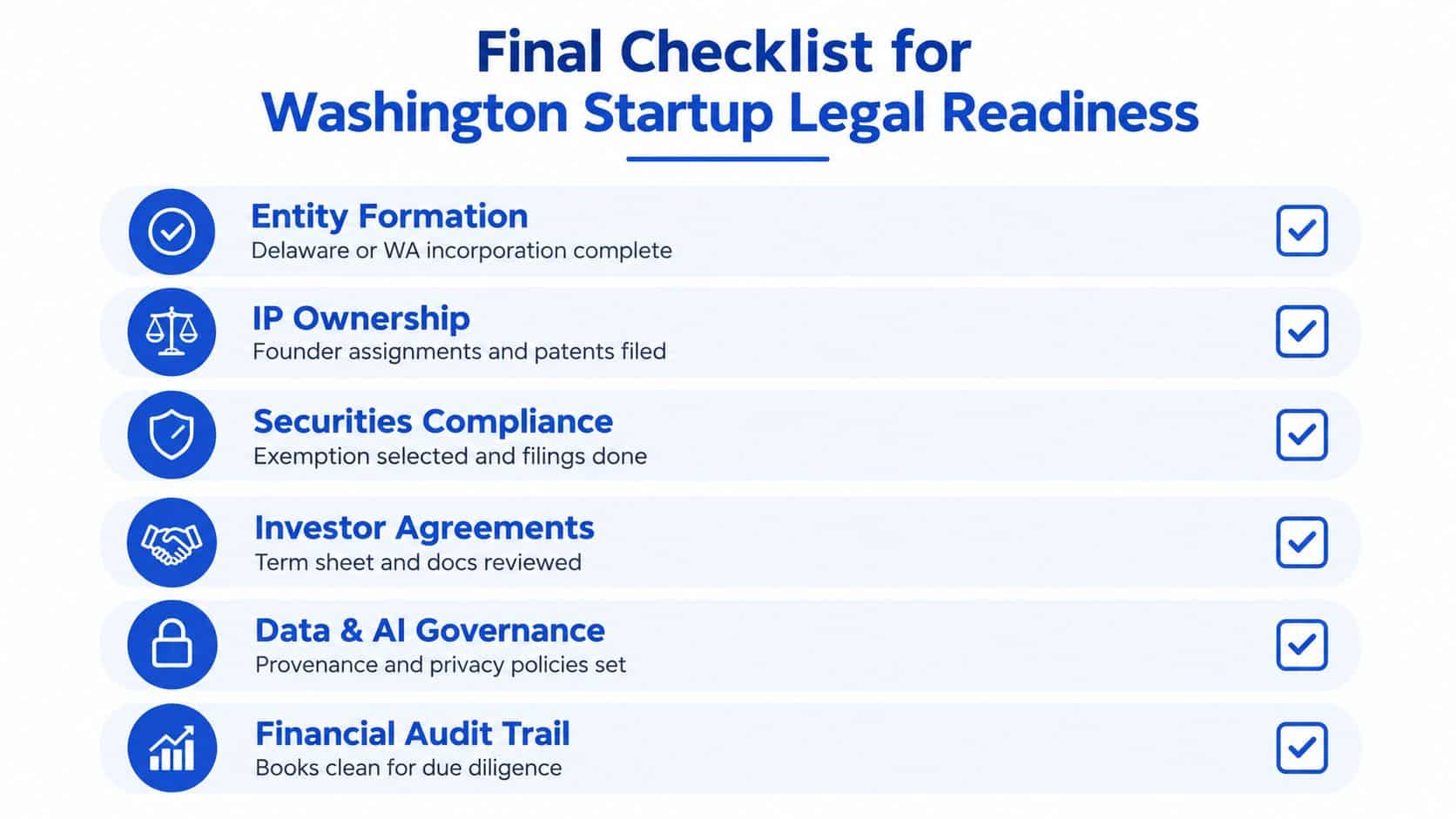
Before approaching investors, a Washington founder should confirm that the entity, charter, founder assignments, employee equity, capitalization table, financing approvals, securities exemption, federal and state notices, investor agreements, insurance, and AI data records are internally consistent. A final capitalization table management review should reconcile issued shares, options, preferences, conversion rights, and transfer activity. Legal readiness means the diligence folder tells one coherent story.
By Design Law Firm & Legal Consultancy, PLLC advises Washington startups on formation, governance, venture financing documents, capitalization tables, securities compliance, AI risk, and data privacy controls. Founders preparing a round or reviewing a secondary transaction can visit By Design Law Firm & Legal Consultancy, PLLC to discuss a practical legal-readiness plan before investor diligence begins. Contact our law office at (206) 593-1519.