An NDA agreement template is a contract that creates a legal obligation to keep exchanged private information confidential, not a universal shield for every business secret. Its protection depends on accurate definitions, lawful carve-outs, and the company's ability to show that it had treated sensitive information as secret.
A founder in Seattle may be preparing to send source code to a contractor, product plans to a potential partner, or financial projections during fundraising. The downloadable form may look complete, but the difficult questions begin after signature. Who may access the files? What can the recipient do with them? Which disclosures are legally protected? What evidence shows that the company used reasonable secrecy measures?
Washington companies need an NDA that answers those questions and fits the actual information flow. A document helps allocate risk. A working confidentiality program helps preserve trade-secret protection.
Understanding What an NDA Actually Protects
A founder about to disclose a product roadmap often reaches for a standard NDA. That instinct is sound, but the document's function needs to be defined precisely. The U.S. Small Business Administration's explanation of NDAs describes the agreement as creating a legal obligation for signatories to keep exchanged private information confidential and secure. The obligation can cover trade secrets, customer information, marketing plans, and financial data.
That doesn't mean every piece of company information becomes a protected trade secret just because an NDA labels it confidential. Trade-secret protection generally requires economic value from secrecy and reasonable efforts to maintain that secrecy. A contract supports those efforts, but it doesn't replace them.
Start with the information flow
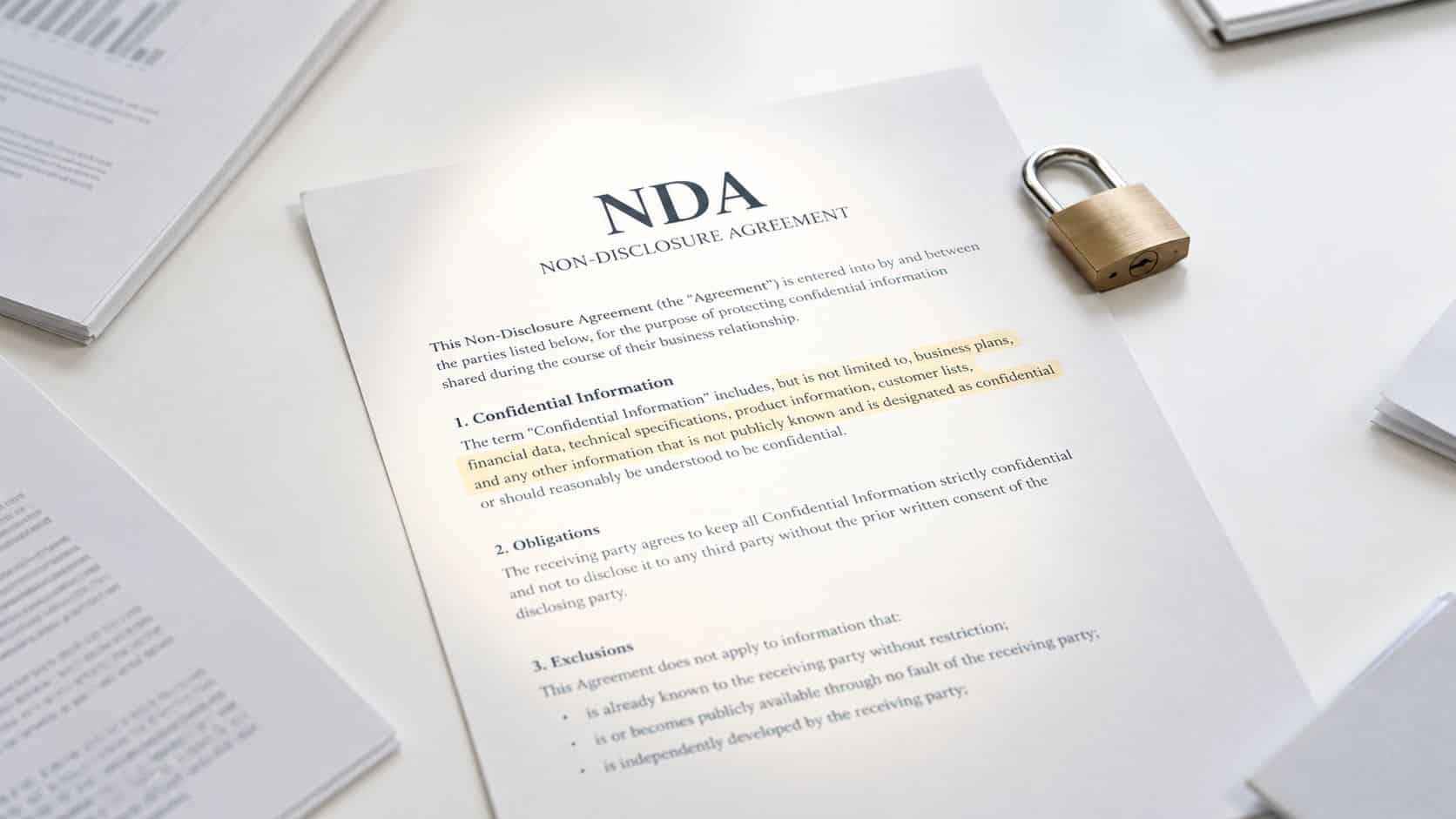
A useful template identifies the disclosing party, the receiving party, and the transaction purpose. It then defines confidential information in categories that match the disclosure, such as:
- Technical material: Source code, architecture documents, algorithms, specifications, and test results.
- Commercial material: Customer information, pricing, marketing plans, financial data, and business strategies.
- Product material: Roadmaps, prototypes, designs, demonstrations, and unreleased features.
The agreement should also state permitted uses. A contractor reviewing source code for a defined development project shouldn't be free to use that code for a separate client. A prospective partner reviewing a product roadmap should receive access only for evaluating the proposed relationship.
A practical explanation of what an NDA agreement does helps distinguish the document's contractual role from the operational work that preserves secrecy. That distinction matters because a broad promise to protect “all information” may be less useful than a focused definition paired with clear handling rules.
Why exclusions improve the document
A credible NDA excludes information that was already known to the recipient, independently developed, publicly available, or lawfully obtained from another source. Those exclusions prevent the agreement from claiming control over information the recipient could use without the contract.
A foundational template should also address security duties, permitted recipients, disclosure procedures, confidentiality duration, and return or destruction of materials. Its value comes from accuracy and fit, not page count.
Practical rule: The document should describe what the recipient may do with the information, not merely promise that the recipient won't disclose it.
Choosing Between Mutual and Unilateral Templates
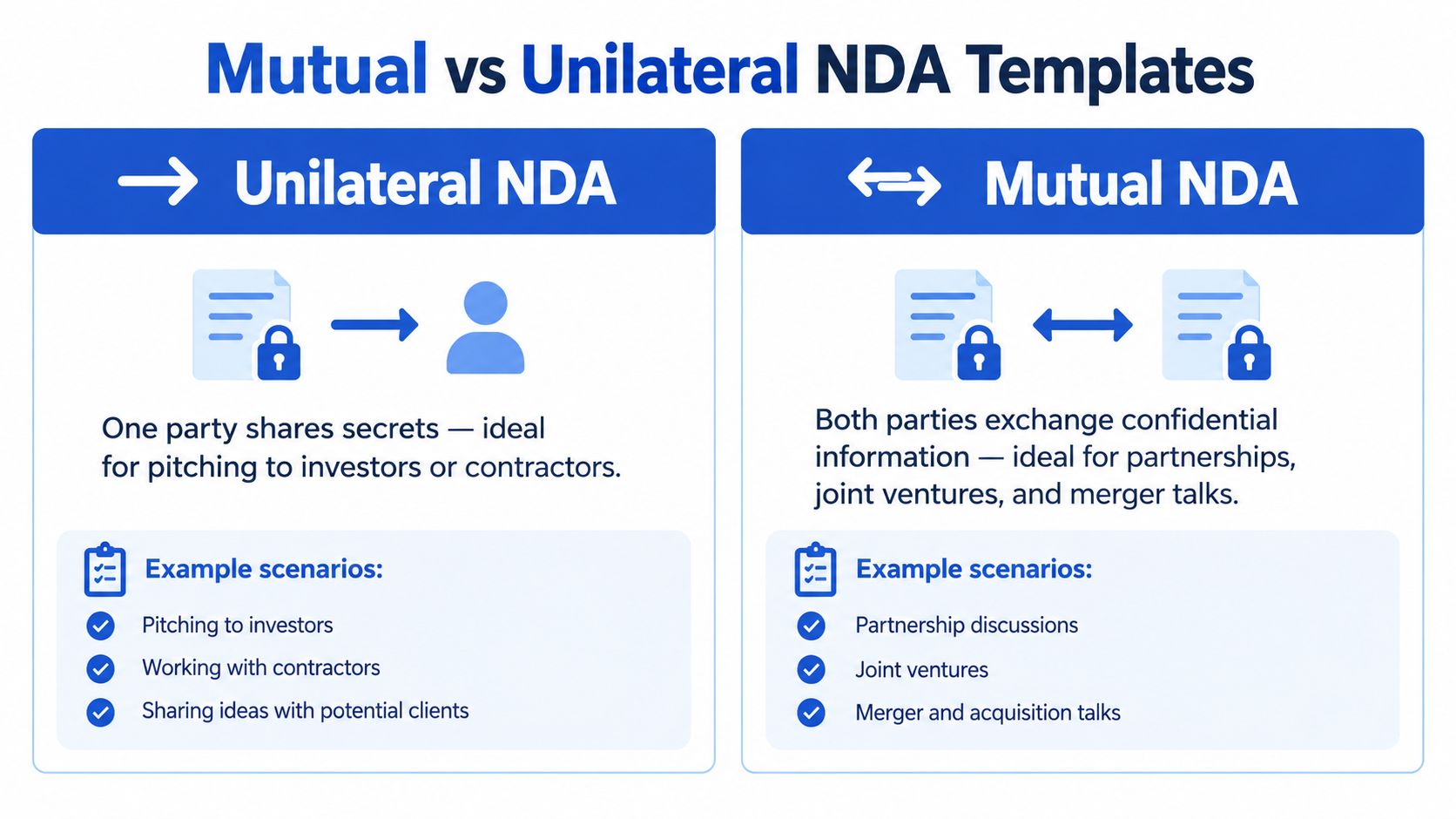
The right NDA structure follows the direction of the information exchange. A unilateral NDA imposes confidentiality duties primarily on the party receiving information. A mutual NDA imposes corresponding duties on both parties because both sides expect to disclose protected material.
A startup hiring a software contractor will usually disclose product requirements, source code, credentials, or technical plans. The contractor may not disclose comparable information to the startup. A one-way NDA keeps the obligations focused and avoids adding unnecessary promises about information the startup may never receive.
By contrast, two companies evaluating a partnership may exchange source code, customer data, financial projections, and product roadmaps. Each side needs protection. A mutual template reflects that reciprocal flow and gives both parties defined rights and duties.
A practical selection matrix
| Business situation | Usually appropriate | Reason |
|---|---|---|
| Startup shares product plans with a contractor | Unilateral NDA | The startup is the primary disclosing party |
| Company shares confidential material with a consultant | Unilateral NDA | The consultant's use and disclosure require control |
| Two companies explore a partnership | Mutual NDA | Both businesses may disclose sensitive information |
| Parties exchange technical and financial diligence material | Mutual NDA | Each party needs comparable protection |
| Company evaluates a potential acquisition | Often mutual NDA | Buyers and sellers may exchange confidential information |
The structure also affects drafting. A unilateral template should identify the company’s disclosures and the recipient’s permitted use, access limits, security obligations, and return duties. A mutual template must define each party as a potential discloser and recipient, while ensuring that the obligations work in both directions.
The label alone isn’t decisive. Some agreements called “mutual” create uneven obligations, while some unilateral agreements include unnecessary restrictions on the disclosing party. The operative clauses matter more than the title.
A founder shouldn’t use a mutual form merely because it appears more balanced. Unnecessary reciprocal language can create obligations the business didn’t intend to accept. Conversely, a one-way form is a poor fit when both sides will share confidential material because it leaves an avoidable gap in protection.
Essential Clauses for an Enforceable Agreement
A strong NDA agreement template begins with the transaction, not a copied definition. The agreement should explain why the parties are exchanging information and limit use to that purpose. That limitation gives the confidentiality duty a practical boundary.
The trade-secret protection guidance for businesses reflects the central drafting problem. The company must connect contractual restrictions to actual secrecy practices. A clause that identifies source code as confidential but permits uncontrolled copying doesn’t match the company’s conduct.
Clauses that deserve close review
Parties and purpose. Identify legal names, business entities, and the project or evaluation that justifies disclosure. A vague purpose makes it harder to determine whether a later use was authorized.
Definition of confidential information. Use categories that reflect the company’s real assets. The definition can cover written, electronic, visual, and oral disclosures, but oral information may require a written confirmation process.
Permitted recipients. State whether employees, officers, lawyers, accountants, contractors, affiliates, or investors may receive the information. Recipients should have a legitimate need to know and should be bound by confidentiality duties.
Handling and security. Specify reasonable safeguards, including password protection, controlled copying, secure storage, limited physical access, and obligations to report suspected incidents.
Exclusions. Exclude information already known, independently developed, publicly available, or lawfully received from another source. The recipient should generally bear the burden of proving an exclusion when that allocation is appropriate.
Duration. Separate the agreement’s term from the duration of confidentiality obligations. Information that remains a trade secret may justify continuing protection, while ordinary business information may call for a defined period suited to the transaction.
Return or destruction. Address copies, backups, extracts, notes, and electronically stored materials. Include a process for confirming destruction where appropriate, while accounting for lawful archival obligations.
Remedies and governing law. The agreement can address injunctive relief, damages, and other remedies, but it shouldn’t promise a result a court is unlikely to grant. Washington law and the chosen forum should fit the parties and transaction.
A clause-by-clause review should ask whether the recipient can understand the rules and whether the company can prove it followed corresponding practices. An overlong template with vague controls often performs worse than a shorter agreement that accurately describes the disclosure.
Navigating Federal and State Compliance Rules
An NDA cannot lawfully block protected government reporting or protected workplace disclosures. That limitation must appear in the drafting, not remain an assumption.
The federal Defend Trade Secrets Act of 2016 created a federal civil cause of action for trade-secret misappropriation involving products or services used in, or intended for use in, interstate or foreign commerce. Available remedies can include injunctions, damages for actual loss or unjust enrichment, a reasonable royalty, exemplary damages, and attorney’s fees in some circumstances. Contract language supports that protection, but contractual language alone doesn’t establish every element of a trade-secret claim.
Federal reporting protections
SEC Rule 21F-17 prohibits actions that impede a person from communicating directly with SEC staff about a possible securities-law violation. The SEC applied that rule in its 2015 KBR enforcement action, including where the agency didn’t need to prove that an employee had been prevented from contacting the Commission.
For companies that may become SEC-reporting entities, the template should expressly preserve direct communications with regulators. It shouldn’t require advance notice, company approval, or payment of damages before a person communicates with the SEC. The SEC reported civil penalties from $19,500 to $1,386,000 in charges against seven public companies announced in September 2024, as described in its whistleblower protections materials.
Washington employers must also account for the Silenced No More Act and related statutory protections. Certain employment-related nondisclosure provisions are void when they restrict discussion of conduct an employee reasonably believes involves illegal discrimination, harassment, retaliation, wage-and-hour violations, sexual assault, or conduct contrary to a clear public-policy mandate. Legitimate trade secrets and unrelated confidential information remain protectable.
A five-step drafting workflow
- Define the transaction purpose. Identify the project, evaluation, relationship, or diligence process and state the permitted use.
- Classify the information. Separate trade secrets, technical data, customer information, source code, business plans, and ordinary confidential material.
- Specify disclosure mechanics. Address marking, oral-disclosure confirmations, permitted recipients, security controls, and incident reporting.
- Add exclusions and protected-disclosure carve-outs. Cover prior knowledge, independent development, public information, lawful receipt, subpoenas, court orders, regulators, whistleblowing, legal advice, and protected workplace discussions.
- Finalize enforcement terms. Set duration, return or destruction, remedies, governing law, compelled-disclosure procedures, and a final review against employee reporting and regulator-cooperation scenarios.
Companies handling personal information should coordinate the NDA with their broader Washington data-breach notification obligations. An NDA shouldn’t be drafted as though confidentiality rules eliminate separate privacy, employment, or regulatory duties.
Common Pitfalls That Weaken Protection
A longer NDA isn’t automatically safer. A definition covering every fact, conversation, file, and observation may look aggressive, but it can become difficult to administer and harder to reconcile with the company’s actual practices.
Washington’s trade-secret framework focuses on economic value from secrecy and reasonable efforts to maintain secrecy. If employees share the same files broadly, contractors receive access without documented obligations, and the company never labels or inventories sensitive material, a sweeping definition won’t cure those gaps.

Where generic forms fail
“All information” language. This phrase doesn’t tell the recipient which material needs special handling. It also creates tension when the company treats routine information exactly like sensitive technical assets.
No operational evidence. A template rarely identifies who received a document, when access ended, whether copies were returned, or whether a contractor acknowledged the restrictions. Those records often matter as much as the signed agreement.
Blanket employee restrictions. An employment NDA that says workers can’t discuss anything learned at work may conflict with Washington protections for reporting unlawful conduct and discussing legally protected workplace matters.
Missing AI-use rules. Employees may paste source code, customer information, or business plans into external AI tools. A generic NDA doesn’t establish approved platforms, prohibited inputs, monitoring authority, incident reporting, or deletion expectations.
Overreaching competition language. Washington’s noncompetition statute distinguishes confidentiality agreements from noncompetition covenants. A narrowly written obligation protecting confidential information, trade secrets, or inventions is different from a restriction that prevents someone from competing or working in a field.
A confidentiality agreement should protect information, not quietly become a noncompetition agreement or a gag order.
The practical test is consistency. If the business promises narrow access but gives everyone unrestricted folders, the paperwork and conduct point in different directions. Courts and regulators may view that mismatch skeptically.
Integrating the Template into Your Data Governance
A signed NDA becomes useful when the company can show what it protected, who received it, and how access was controlled. That evidence starts with an information inventory, not a signature page.
Trade-secret protection under Washington law depends on reasonable secrecy measures. The company should classify sensitive information, limit access, control copying, use secure systems, and document recipient obligations. Those controls should apply to employees, contractors, vendors, and other external recipients.
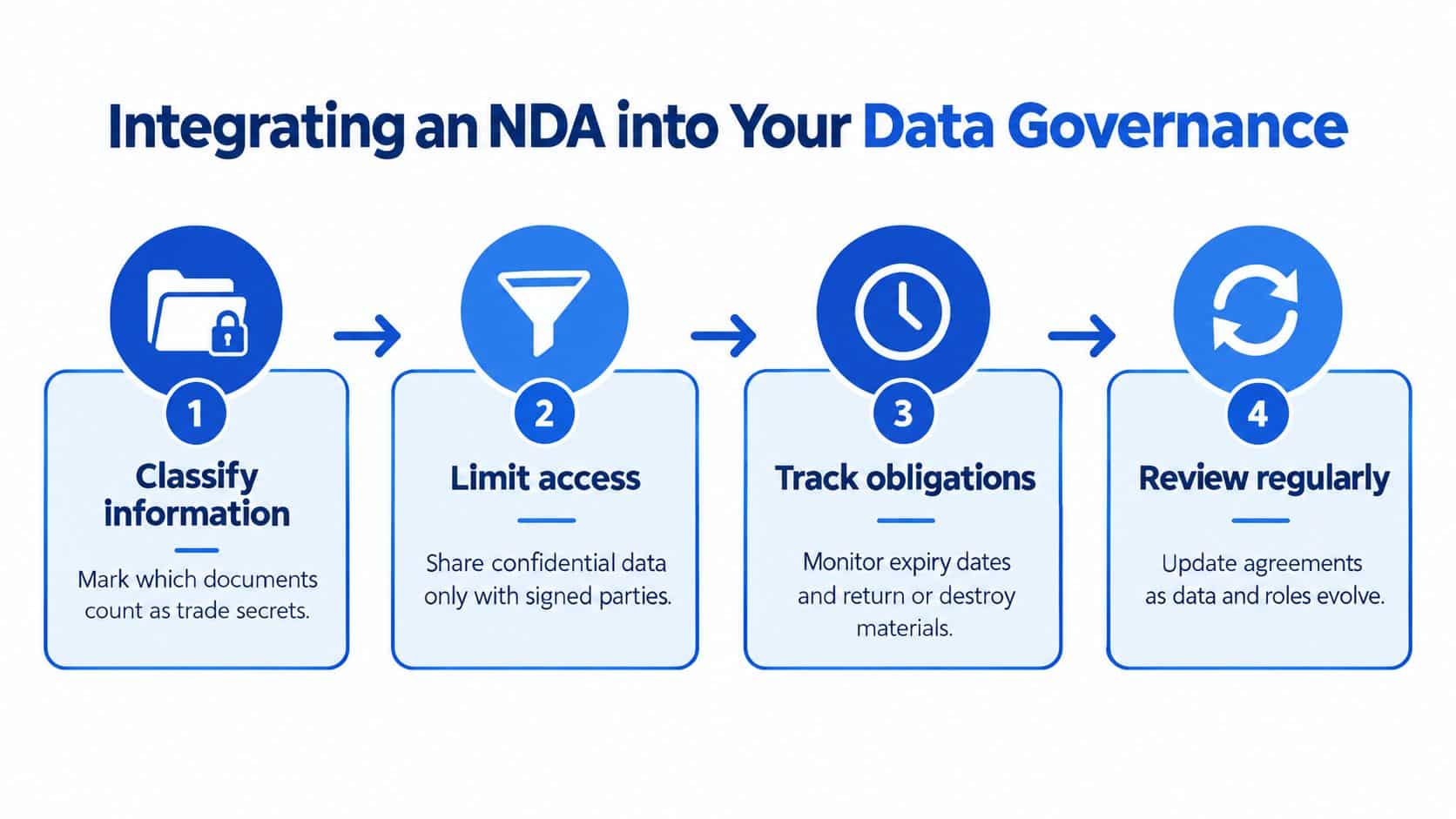
Build a repeatable control process
- Classify information: Mark which files contain trade secrets, source code, customer information, financial material, or ordinary business data.
- Limit access: Give recipients only the information needed for the approved purpose, and remove access when the purpose ends.
- Track obligations: Maintain signed agreements, recipient lists, access records, disclosure dates, expiration dates, and return or destruction confirmations.
- Review regularly: Update the NDA and related policies when roles, systems, vendors, or information categories change.
A visual data comparison can help teams distinguish governance controls from privacy obligations. The distinction is practical. Governance manages how the organization creates, classifies, accesses, and retains information. Privacy compliance addresses duties arising from personal information and its use.
A company can use a focused employee confidentiality agreement template as one layer of its workforce controls, but the agreement should align with onboarding, access provisioning, training, acceptable-use rules, and offboarding.
Connect the document to daily behavior
Before disclosure, a responsible employee should confirm that the recipient has signed the appropriate unilateral or mutual form. The business should record what was shared and why. During the relationship, least-privilege access, password protection, controlled copying, and limited physical access should reflect the obligations in the contract.
When the relationship ends, the company should revoke access, request return or deletion, preserve required records, and document the result. If the company uses external AI platforms or vendors, its policies should identify which information may be submitted and how the provider must handle retention and deletion.
The NDA is therefore a legal control inside a larger system. It works best when the company’s contracts, technology settings, employee training, and records all tell the same story.
When to Seek Legal Counsel for Your NDA
A downloadable template can work as a starting point for a routine disclosure with a clear purpose and limited risk. It becomes inadequate when the transaction involves layered ownership, sensitive technical assets, several recipients, or conflicting regulatory duties.
A Washington startup preparing a fundraising round may need to disclose source code, product plans, customer information, and financial projections to different audiences. The company may use a one-way NDA for a contractor, a mutual NDA for a strategic partner, and diligence-specific provisions for an investor or potential acquirer. A single generic form may not fit those relationships.
Legal review becomes especially important for:
- Complex fundraising: The agreement should address permitted recipients, advisers, diligence teams, and information used to evaluate the investment.
- Mergers and acquisitions: The parties need clear rules for diligence, representatives, compelled disclosure, return or destruction, and post-termination obligations.
- Significant trade secrets: The company should distinguish trade secrets from ordinary confidential information and coordinate the contract with access controls and evidence practices.
- Employee and contractor arrangements: The agreement must preserve protected reporting, workplace disclosures, legal advice, and rights under applicable Washington law.
- Regulated or data-intensive businesses: Confidentiality terms should coordinate with privacy, cybersecurity, incident-response, and records-retention duties.
A founder preparing for counsel should bring the proposed template, a description of the transaction, a list of information to be disclosed, the intended recipients, existing security policies, and any concerns about employee reporting or regulator contact. That preparation lets counsel focus on the provisions that create real exposure instead of spending time reconstructing the business context.
The right question isn’t whether the template looks complete. It’s whether the agreement accurately governs the disclosure and whether the company can prove that its people and systems followed the rules. For Washington startups and technology companies, the NDA should remain one layer of a broader trade-secret and data-governance program.
By Design Law Firm & Legal Consultancy, PLLC offers Washington businesses NDA drafting, review, and negotiation alongside broader contract, trade-secret, cybersecurity, and data-privacy counsel. Visit By Design Law Firm & Legal Consultancy, PLLC to discuss a template that fits the company’s disclosures, workforce, and regulatory obligations. Contact our law office at (206) 593-1519.