Y Combinator reports that SAFE documents have been used to raise more than $15 billion for its portfolio companies, a scale detailed by the Angel Capital Association history of SAFEs. That reach reframes SAFE vs Convertible Note from a paperwork preference into a financing decision that sets conversion price, repayment exposure, and cap-table clarity. The right answer depends less on which document is simpler and more on what happens when timing slips.
Why the Instrument Choice Shapes Your Next Round
Carta data covered more than 4,611 U.S. pre-seed rounds and reported that 88% used SAFEs, compared with 12% using convertible notes, according to Osler's 2025 convertible securities analysis. At seed, SAFEs accounted for 64% of rounds, rising to 86% for deals below $500,000. Deal size is the first filter, because SAFE use drops sharply as checks get larger.
What is a SAFE? It's an agreement to receive equity at a future priced round, with no interest and no maturity date. What is a convertible note? It's a loan that converts into equity, with a stated interest rate and a due date. On a spreadsheet both look like deferred equity. In practice, only one creates a deadline that can force repayment, extension, or default negotiations.
Deal Size Is the First Filter
When deal sizes exceeded $5 million, SAFE usage fell to approximately 20% in the same Osler-cited data. Larger investors more often want accrued interest, a defined conversion deadline, or priced equity instead. Founders planning investor outreach for pre-seed funding should therefore sort prospects by likely check size before settling on a form, since a $250,000 angel round and a $6 million seed round rarely produce the same instrument.
Washington founders also shouldn't treat a downloadable form as local advice. Caps, discounts, pro rata rights, and maturity remedies still require negotiation, and venture capital legal review can test whether standard terms match the company's fundraising timeline before signatures lock them in.
SAFE vs Convertible Note Side by Side
One question settles most of the SAFE vs convertible note comparison before any negotiation starts: does the document create a repayment deadline. The grid below lays out the terms that answer it.
| Term | SAFE | Convertible note |
|---|---|---|
| Legal nature | Agreement to receive equity at a future priced round | Debt that converts into equity |
| Interest | None | Stated annual rate that accrues until conversion or repayment |
| Maturity date | None | A fixed calendar date written into the agreement |
| Outcome at a deadline | No repayment obligation at a set date | Extension, conversion or repayment, as negotiated |
| Valuation cap and discount | Negotiated terms that commonly appear together on the same instrument | Same negotiated pairing, with accrued interest added to the converting amount |
| Discount rate | A negotiated percentage off the priced-round share price | Same mechanism, applied alongside the interest that has built up |
| Accrued interest adds to conversion amount | Not applicable | Yes, which can produce more shares |
| Typical deal size | Smaller, fast pre-seed and seed rounds | Larger rounds or investors who want debt protections |
Where the SAFE Came From
Y Combinator created the SAFE to simplify early fundraising, then released a post-money version so founders and investors could calculate approximate ownership more transparently when several SAFEs stack up before a priced round. That second version matters because stacked SAFEs each claim a slice of the cap table, and the math only stays readable when every holder prices off the same reference point.
The SAFE removes the repayment clock, while the note buys investor protection in exchange for a deadline the company must plan around.
The maturity row deserves the most attention in the whole grid. If a priced round never materializes, the note holder can force a conversation about extension, conversion or repayment, while the SAFE holder continues waiting. Founders who want a fuller plain-English walkthrough of the legal risks of early fundraising instruments can compare those risks against the rows above, particularly maturity remedies and whether interest converts. A term that looks minor in a table, such as accrued interest adding to principal, can move share counts materially once a priced round finally prices the company.
Direct answer: If there's no maturity date in the document, it's functioning like a SAFE. If the investor can demand a negotiated outcome at a set date, it's functioning like debt, regardless of how equity-like the pitch sounded.
How Valuation Caps and Discounts Set Your Price
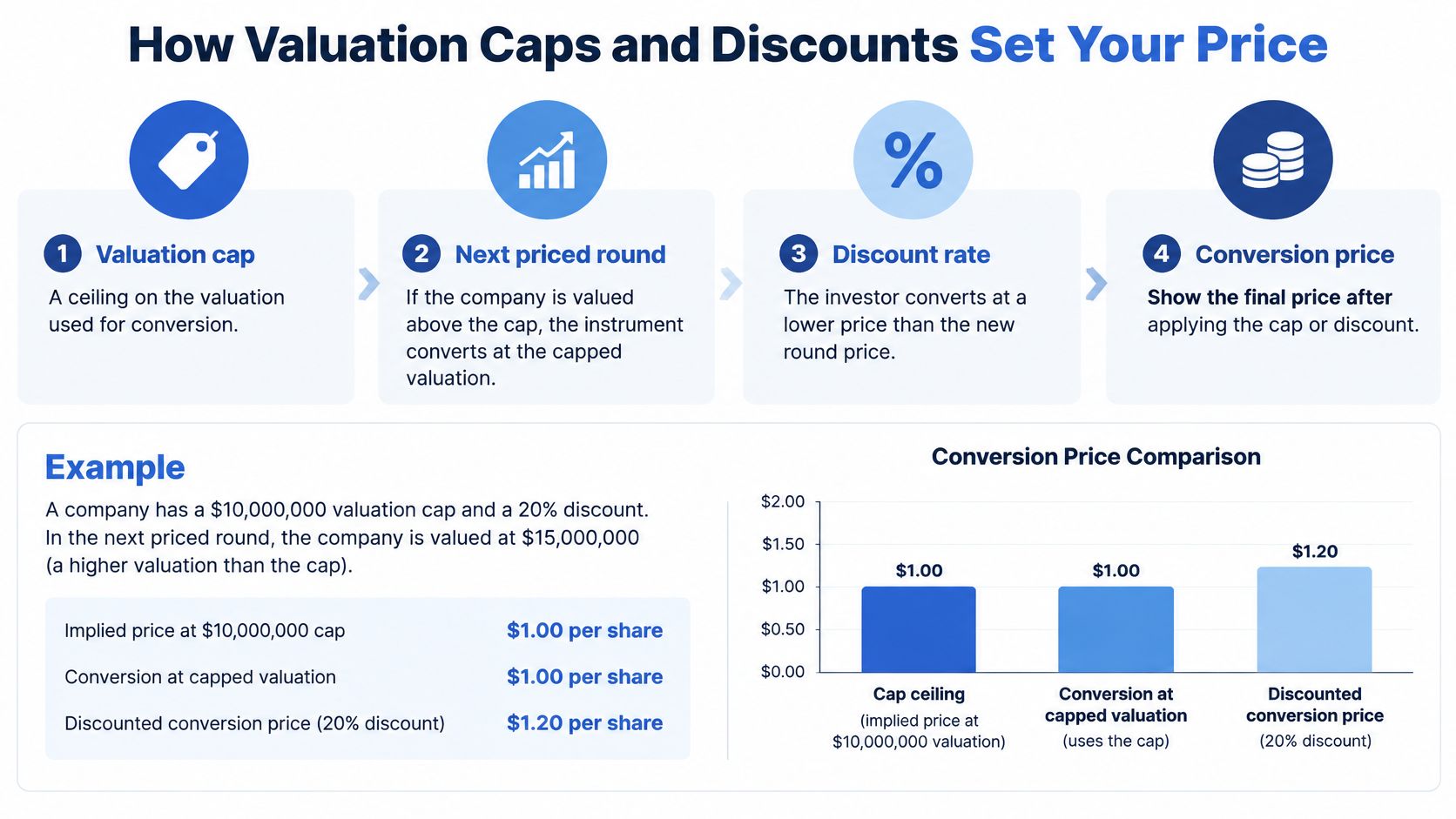
A valuation cap sets the highest company valuation used to calculate the investor's conversion price, as Y Combinator's SAFE page explains. If the next priced round values the company above the cap, the SAFE or note converts using the cap-based price rather than the higher round valuation. That gives the early investor more shares per dollar than new investors receive.
A discount works differently. It cuts the priced-round share price by a percentage for the early holder. The formula matters because an instrument with both a cap and a discount typically converts at whichever method produces the lower price, so founders must run both calculations rather than assume the cap always controls.
Worked Examples Before Later Dilution
| Instrument | Amount | Cap or terms | Result before later dilution |
|---|---|---|---|
| SAFE with valuation cap | $100,000 | $5 million valuation cap | About 2% before later dilution |
| Post-money SAFE | $500,000 | $10 million post-money cap | About 5% before the priced round's new money |
| Convertible note | $500,000 at 10% annual interest for 18 months | Cap or discount applied after interest | $575,000 principal before cap or discount, ignoring compounding |
Start with the division. $100,000 divided by $5 million equals 2%, so that SAFE implies approximately 2% ownership before later dilution and before the agreement's precise capitalization definitions apply. The cap doesn't guarantee 2% permanently. It establishes a conversion-price ceiling, and the final percentage depends on financing structure, capitalization, and whether the instrument is pre-money or post-money.
The second row uses the same logic. $500,000 divided by a $10 million post-money cap equals about 5% before the priced round's new money is issued. New shares sold in that round, an option pool creation or increase, and other converting securities then dilute that percentage.
Pre-Money and Post-Money Change the Denominator
A pre-money cap calculates conversion using capitalization before the converting instruments are counted in the way the post-money form counts them, so founders can't read ownership directly from amount divided by cap. A post-money cap includes converting securities in its capitalization definition, which makes the amount-divided-by-cap estimate usable before new-money dilution. Identical cap numbers can therefore produce different share counts, and comparing labels without running the denominators is a common pricing error.
The note example adds one step before price is set. A $500,000 note at 10% for 18 months accrues $75,000 ignoring compounding, so $575,000 may convert before the cap or discount applies. That extra principal is the assumption founders most often omit when they copy a SAFE model into a note model.
To check the math, use identical capitalization assumptions for every instrument. Run a capped case, a discount case, and a case where the priced round values the company below the cap. If those three outputs don't reconcile to one fully diluted share count, the model isn't ready for a term sheet.
Interest, Maturity and What a Note Demands
A $500,000 note at 10% annual interest, outstanding for 18 months and ignoring compounding, accrues $75,000 of interest, so $575,000 may convert before any cap or discount applies. Interest is not a footnote. Each month the note stays outstanding adds to the conversion principal and to the share count the holder will claim, which is why a principal-only model understates what a note demands.
Rates and maturities vary widely because a convertible note is a negotiated contract, not a standardized form. Filed documents put those negotiated terms on the record: an SEC-filed note example fixes its own rate, maturity and conversion mechanics in writing. Founders shouldn't assume a market rate exists independent of the signed document.
What the Document Must Answer
A note typically specifies five linked items. Each one changes either price or terms.
- Interest treatment: State the rate, whether it compounds, and whether accrued interest converts, gets paid in cash, or is forgiven on conversion.
- Maturity outcome: State whether maturity requires repayment, allows a demand, permits optional conversion, or triggers automatic conversion.
- Conversion trigger: Define the qualified financing amount and security type that force conversion.
- Cap and discount: State which pricing method applies and whether interest converts at the same price as principal.
- Default remedies: Name notice, cure, enforcement, and amendment approval rights if no qualified financing occurs.
When maturity arrives without a priced round, the company faces a refinancing, amendment, repayment, or default decision. Investors hold stronger downside and timing protections than under a SAFE, while founders assume greater administrative and payment risk. A company with no cash to repay cannot assume noteholders will extend because conversion was everyone's original intent.
Founders should stress-test cash through maturity, document whether accrued interest converts, and compare default remedies against a realistic fundraising timeline. By Design Law Firm & Legal Consultancy, PLLC identifies available funding opportunities, negotiates the terms of loan agreements and other financial documents, and assists with cash and asset protection, which is directly relevant when a note's deadline is closer than the next financing.
Tax treatment needs separate confirmation as well. Accrued interest can create income or original issue discount questions for a noteholder before cash arrives, and classification depends on the signed terms and the holder's accounting method. Confirm that treatment with counsel rather than inferring it from the label convertible note.
What Each Instrument Does to Your Cap Table
A post-money SAFE gives a predictable starting benchmark. The investor's approximate ownership immediately before the next priced financing equals purchase amount divided by the post-money valuation cap, so a $500,000 SAFE with a $10 million post-money cap represents approximately 5% before new money, according to Y Combinator's SAFE resources. That clarity is useful, but it's not a final ownership guarantee.
The priced round dilutes that 5%. So do option pool creation or increases and other converting securities. In 2024, 49% of financings in Osler's venture-capital deal dataset included conversion of convertible securities such as SAFEs or notes, as reported in Osler's 2024 financing structure analysis. A priced round therefore often has to clear a stack of instruments at once, not one isolated promise.
Stacking Hides the Real Dilution
Reviewing each SAFE separately obscures aggregate dilution. Say a startup signs three $300,000 SAFEs at different caps over nine months. Each check can look manageable in its own email thread, yet the combined claim can cut founder ownership far more than any single document suggests once all three convert into the same priced round. The error isn't arithmetic on one SAFE. It's failing to maintain one fully diluted model that updates after every closing.
Pro rata rights add another layer founders miss. Participation rights aren't necessarily embedded in the SAFE itself. They're commonly handled through a separate side letter that lets an investor purchase additional securities in a future round to preserve percentage ownership. A cap table that lists SAFEs but omits side letters understates future allocation demands.
Model in this order:
- List every instrument: Record amount, cap, discount, interest, maturity, and pre-money or post-money type.
- Add the option pool: Include issued options and the unissued pool the next round expects.
- Convert each claim: Apply the planned round price instrument by instrument, using the same capitalization assumptions.
- Run capped and uncapped cases: Calculate dilution under both scenarios, plus a priced round below the caps.
- Rerun after every check: Update the full stack before signing the next SAFE or note.
Investors conducting diligence will rebuild this stack anyway. Founders who use disciplined capitalization table management and present the full picture early avoid the credibility damage that follows when a lead investor discovers an unmodeled side letter or an old pre-money SAFE late in closing.
When No Priced Round Ever Closes
Direct answer: If no priced round closes, a convertible note reaches maturity and requires a decision, while a SAFE generally remains outstanding with no repayment deadline. That's the downside most SAFE vs Convertible Note comparisons bury, yet it determines who holds influence when a raise stalls.
Carta reported that in 2025, U.S.-based startups on Carta raised $10.4 billion across 50,316 SAFEs and convertible notes, according to Carta's State of Pre-Seed 2025 data. Tens of thousands of instruments therefore depend on a future event that some companies won't reach on schedule, and some won't reach at all.
The Note Path at Maturity
A note is debt. Interest accrues, the balance grows, and maturity commonly arrives 18 to 24 months after issuance in typical early-stage structures. Using the earlier economics, a $500,000 balance at 10% for 18 months is already $575,000 before an extension adds more interest. At that point the parties must renegotiate, amend, repay, convert on fallback terms the document allows, or confront default remedies.
An extension isn't automatic. It requires whatever approvals the note specifies, and investors can demand a lower cap, higher interest, governance rights, or other concessions in exchange for more time. The deadline that protects investors can also push a cash-poor company into a distressed negotiation at exactly the moment it's weakest.
The SAFE Path With No Trigger
A SAFE removes that deadline, but it doesn't remove the claim. With no maturity, interest, or repayment duty, the investor's right can stay open indefinitely if no conversion, liquidity, or dissolution event occurs. That helps founders who miss a timeline, yet it can block a clean ownership picture in an acquisition, complicate a shutdown distribution, and leave investors with no contractual moment that forces resolution.
Founders should test three outcomes before signing. First, the next round closes and both instrument types convert into equity, often preferred stock issued in that financing. Second, the round slips and a note needs an extension while a SAFE waits. Third, no round closes, and the company compares note repayment or default against a SAFE that never converts. If the third outcome has no workable answer in the document, the instrument choice hasn't been finished.
Founder and Investor Views on the Same Terms
A founder and an investor can read identical language and reach opposite conclusions about fairness, as this negotiation image illustrates.

Investors favor a note when they want a deadline that forces a response. Extension, conversion, repayment, or default gives them a decision point instead of an indefinite wait. They also benefit from a low cap, a deep discount, and accrued interest that can enlarge the share count, and Cooley GO's SAFE guidance notes that interest can increase the principal used for conversion, resulting in more shares than the original investment alone would produce.
A SAFE investor has no maturity lever. The investor provides capital now and receives equity upon a defined triggering event, usually the startup's first priced financing. If that financing stalls, the claim can sit open through a bridge, a sale process, or a shutdown, subject to the document's liquidity and dissolution provisions.
Founders favor the SAFE for the mirror-image reasons. There's no interest accrual, no repayment merely because a deadline passes, and standard forms often close with less negotiation. The conflict is direct. Investors push for low caps, discounts, pro rata side letters, and maturity remedies. Founders push for high caps, no debt, and fewer future allocation promises.
The video below gives additional context for how those opposing incentives surface during term discussions.
Before signing, founders should ask about cap level, whether interest converts, pro rata side letters, and acquisition payout rights. Investors, including angel business investors, should ask about maturity remedies, pre-money versus post-money math, and how many open instruments already claim ownership. By Design Law Firm & Legal Consultancy, PLLC's attorneys advise clients proactively, establishing standard business agreements and other legal documents designed to protect the business's interests and help avoid expensive disputes or litigation.
Choose the Instrument That Fits Your Round
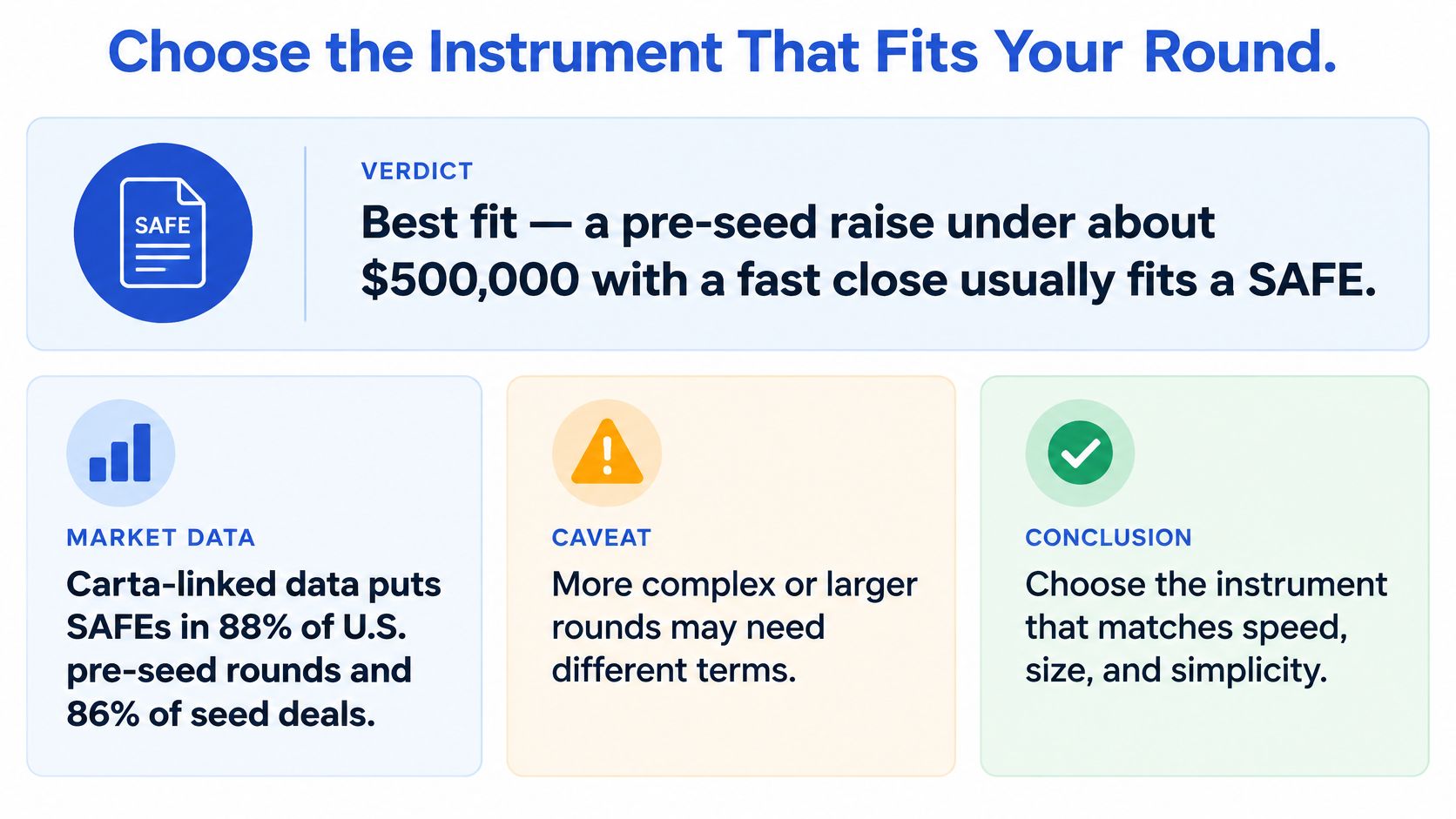
Verdict: A fast pre-seed raise under about $500,000 usually fits a SAFE. A raise above $5 million, or an investor who requires interest and a hard deadline, usually fits a convertible note or a priced round. A useful framework models a successful next round, a delayed next round, and no next round, showing maturity extensions, accrued interest, conversion ownership, and dissolution outcomes, as outlined in Promise Legal's SAFE versus note decision guide.
| Situation | Usually better fit | Why it fits |
|---|---|---|
| Pre-seed raise under about $500,000 with a fast close | SAFE | Simple documents and no maturity clock |
| Raise above $5 million or a debt-oriented investor | Convertible note or priced round | Interest and maturity protections match larger deals |
| Founder wants no repayment clock | SAFE | No interest accrual and no maturity-date repayment |
| Investor wants interest and a defined deadline | Convertible note | Accrued interest and a deadline give downside protection |
| Round timeline uncertain beyond 12 months | Model a missed close before choosing | A note's maturity forces a decision; a SAFE's claim can stay open-ended |
The last row is the one founders skip. A note’s maturity helps discipline a timeline only if the company can plausibly extend, convert, or repay it. A SAFE’s open timeline helps only if founders and investors accept that the claim may remain unresolved until a financing, sale, or dissolution triggers the document. Choose based on the realistic path to revenue, a priced round, acquisition, or shutdown, not on which form has fewer pages.
Six Checks Before the First Term Sheet
- Instrument type: Confirm SAFE, note, or priced equity, and confirm pre-money or post-money treatment for a SAFE.
- Valuation cap: Record the cap and the exact capitalization denominator behind it.
- Discount: State the percentage and whether it combines with the cap through a lower-price calculation.
- Note economics: For a note, confirm interest, compounding, maturity, and default remedies.
- Pro rata rights: Identify every side letter and the scope of each participation promise.
- Exit language: Read acquisition, liquidity, and dissolution provisions before money arrives.
Washington founders shouldn’t treat a template as local advice. By Design Law Firm & Legal Consultancy, PLLC reviews and gives guidance on all commercial transactions, contracts, and warranties before they are finalized, and the firm offers a free consultation. That review should cover bridge rounds and sale provisions too, because the costly SAFE vs Convertible Note mistakes usually appear at conversion or maturity, long after the signing felt routine.
By Design Law Firm & Legal Consultancy, PLLC in Seattle can model how a SAFE or convertible note converts, matures, or remains outstanding against the specific round a Washington startup is raising, including cap-table stacking, side letters, and acquisition language. Founders who want those scenarios tested before signing can visit By Design Law Firm & Legal Consultancy, PLLC to arrange a review of the proposed financing documents. Call our office at (206) 593-1519.