The advice most founders hear is simple. Download a founders agreement template, split the company evenly, drop in a four-year vesting schedule, and sign it before anyone gets busy. That advice treats the document as text to fill in. It is not. A downloaded form only becomes useful once the team has decided who owns what, who decides what, and what happens when someone stops showing up. Signing a blank-friendly form without those decisions is how companies walk into seed diligence with a cap table nobody can explain.
Founders Agreement Clauses at a Glance
A founders agreement is the contract that records each co-founder's role, ownership, contributions, decision authority, and exit terms, and a founders agreement template is only a starting point until those blanks hold real decisions.
| Clause | Decision to make | Gap templates often leave |
|---|---|---|
| Roles and time commitment | Title, duties, and minimum hours per week | Vague duties and no minimum time commitment |
| Ownership split | Percentage for each founder and the reason for it | Equal split with no documented rationale |
| Vesting | Schedule, cliff, and what happens on early exit | Unvested equity left untreated |
| Decision authority | Approval thresholds for hiring, fundraising, and salaries | No threshold for major decisions |
| Deadlock and disputes | Escalation path from talks to mediation to arbitration | No deadlock tie-breaker |
| IP assignment | Inventory of pre-formation code, designs, and trademarks | Broad assignment with no asset schedule |
| Departures | Leaver categories and buyout or repurchase formula | No mechanism for returning company IP |
A clear agreement identifies each founder's cash, intellectual property, role, time, responsibilities, and authority. It also says how dilution, new issuances, and transfers change ownership later. Generic forms skip that second half. They list a percentage and stop, which leaves the next financing round to guess whether a new hire's option pool comes out of everyone or only the inactive founder.
Practical rule: Mark every row decided, open, or not applicable before anyone drafts language around it.
An open row is a conversation still owed, not a clause to copy. Not applicable belongs only where the fact is true, such as a solo technical founder with no pre-formation code from a prior job. If a row stays open, the template is not ready to sign.
How to Customize the Template Step by Step
Order matters because founder equity is both money and votes. When common shares carry one vote per share, the cap table sets economic ownership and formal control at the same time. Drafting roles, buyouts, or IP language before the share counts are settled produces a contract that fights the stock ledger.
Harvard Business School research treats the founder-equity split as an early negotiation over timing, effort, and equal versus unequal allocation. Documenting the rationale, covering cash, IP, time, risk, and continuing responsibilities, is what stops a later claim that the split was arbitrary. The main slip is treating equal ownership as automatically fair without a rule for unequal future work.
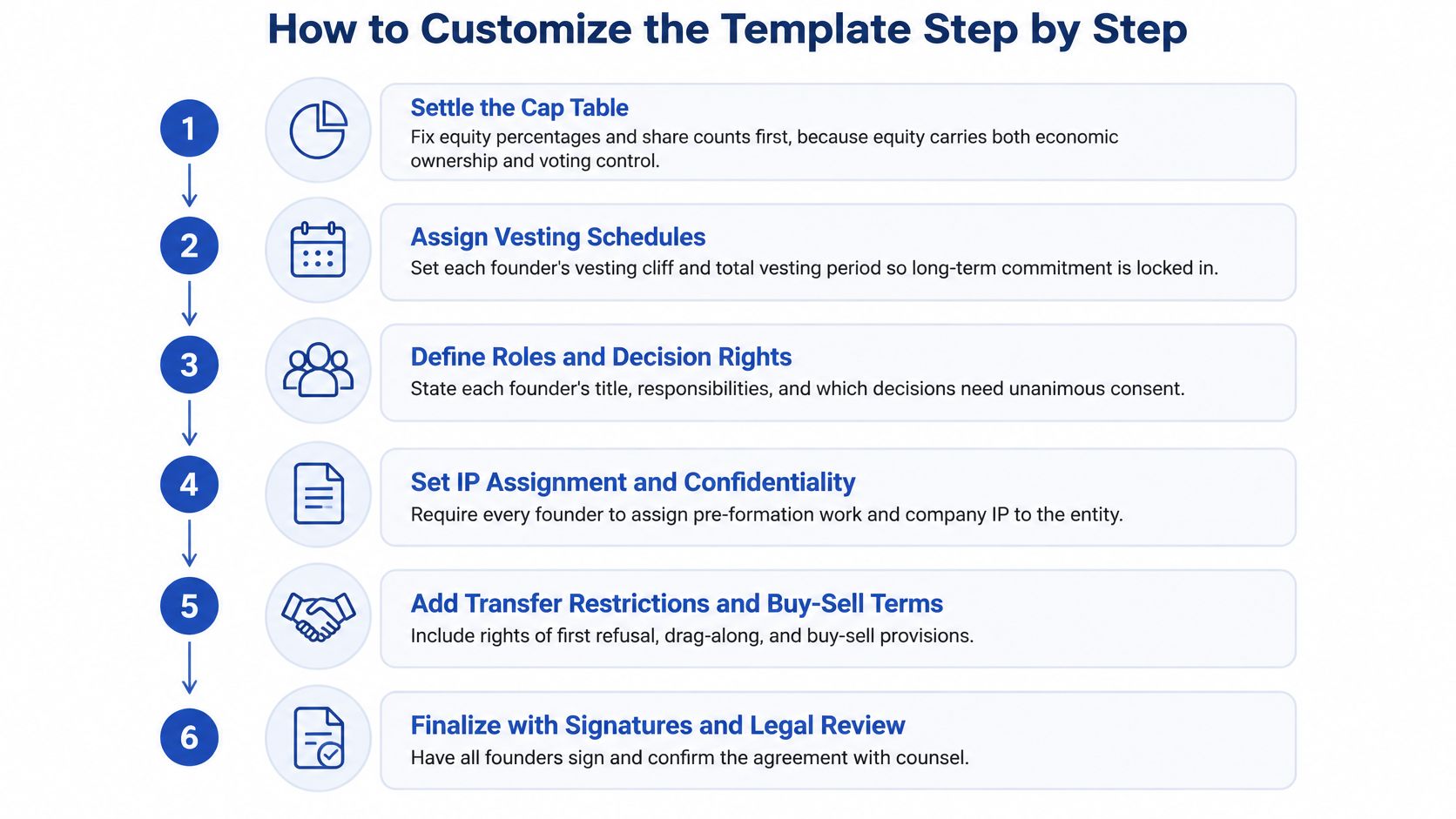
- Hold a written founder workshop. Cover vision, authority, hiring, fundraising, salaries, workload, and what happens if someone underperforms or leaves, because unwritten answers become the fight. The slip is a verbal huddle with no notes.
- Record identity and contributions. Write each founder's name, role, expected hours, compensation, and what they put in at the start, so later "I built this" claims have a baseline. Skipping compensation is how salary fights get relabeled as equity fights.
- Build the capitalization schedule. Show shares, percentage ownership, vesting, and voting power on one page before any other clause is polished. Guessing percentages in the narrative and fixing the ledger later is the usual mismatch.
- Write the split rationale. Name cash, IP, time, risk, and ongoing duties next to each percentage, which is the point of the HBS framing above. "We are equal partners" is not a rationale.
- Add the operating terms. Cover IP assignment, confidentiality, competing activity, company opportunities, financing, departures, disability or death, deadlock, and buyout rights. Leaving buyout math for "when it happens" means it gets written during a breakup.
- Sign before equity is issued. Each founder signs the agreement and the IP assignments before the company issues or records shares. Signing after the ledger already shows the grant is the slip that creates cleanup work.
- Reconcile to fully diluted ownership. The cap table should reflect options and promised grants, not just issued common. A financing round, a material role change, or a new founder joining is the trigger to reopen the file.
By Design Law Firm & Legal Consultancy, PLLC helps new companies pick an entity and write founding documents that state mission, goals, principles, and how the company operates. Its attorneys set those agreements up early so a dispute does not become the first time the terms get tested.
Equity Split and Vesting Terms to Set
An equal split is a choice, not a default that fits every founding team.
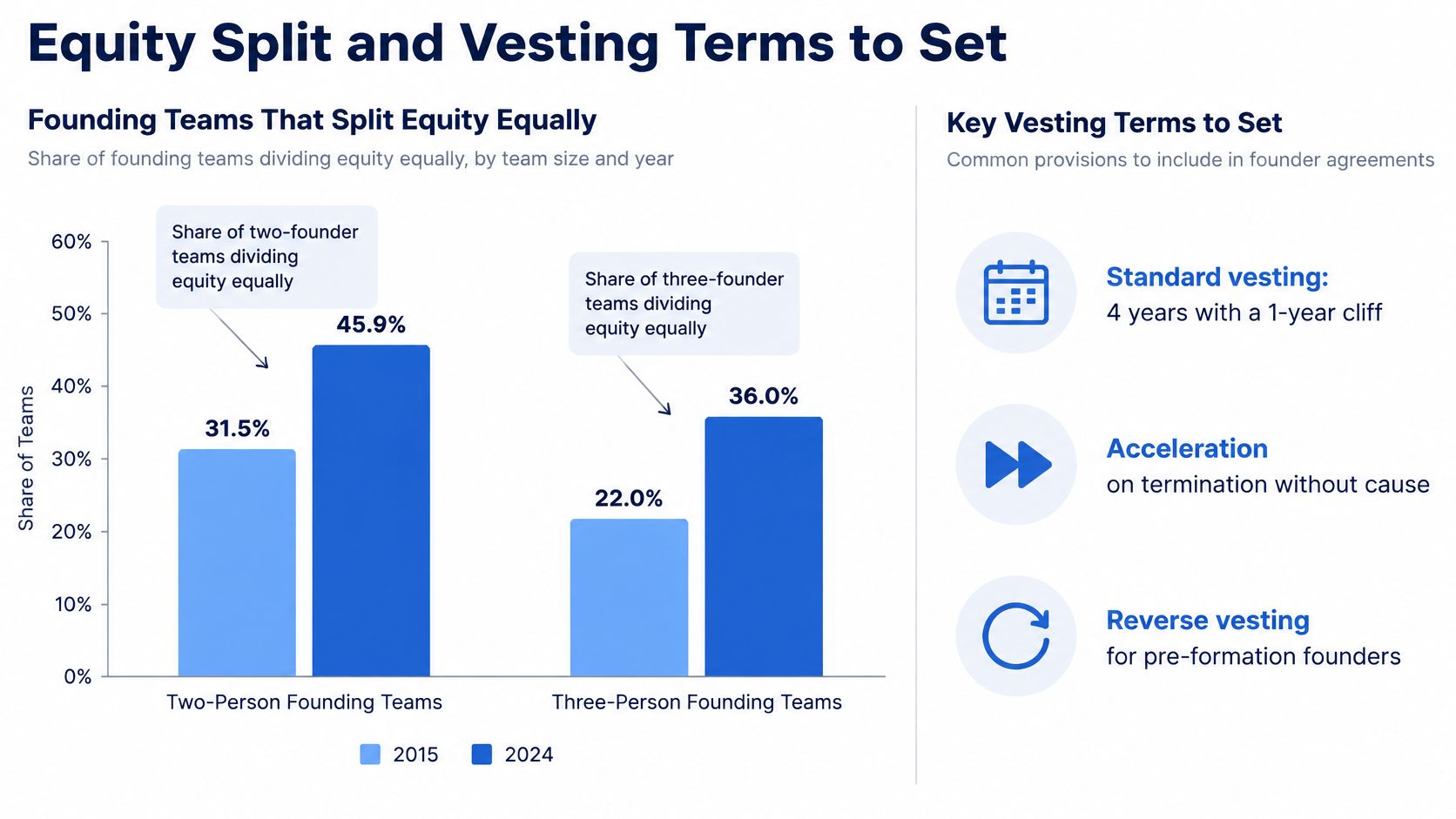
Carta analyzed more than 45,000 startups incorporated between 2015 and 2024 across the U.S. venture ecosystem. Among two-founder teams, 45.9% split equity equally in 2024, up from 31.5% in 2015, a rise of 14.4 percentage points. Equal splits among three-founder teams increased from 12.1% in 2015 to 26.9% in 2024. The median split for two-founder companies was 60–40 in 2019 and 51–49 in 2024. These figures are market reference points, not a formula for your company. Carta
| Measure | 2015 | 2019 | 2024 |
|---|---|---|---|
| Two-founder teams splitting equity equally | 31.5% | 45.9% | |
| Three-founder teams splitting equity equally | 12.1% | 26.9% | |
| Median two-founder split | 60-40 | 51-49 |
A near-equal split can still be wrong when one founder built the product and another remains employed elsewhere. Record the reason for each percentage: cash invested, existing IP, expected time, ongoing responsibilities, role, and decision authority. Then specify how dilution, new share issuances, and transfers affect ownership. Founders still working through the allocation can use this guide to splitting equity with a co-founder. Keep the agreed figures consistent in the contract and a maintained capitalization table.
What the vesting line has to say
A template may propose four years with a one-year cliff, but that phrase leaves key terms open. An IRS private letter ruling example describes a grant with 25% of shares vesting on the purchase date, followed by annual vesting on specified dates. State the percentage vested at signing, each subsequent vesting date, and what happens to unvested shares if a founder leaves. Repurchase or forfeiture terms should match the vesting schedule recorded in the capitalization table.
When founders contribute different amounts of time or take on unequal fundraising duties, equal ownership with a standard schedule may not reflect the deal. Consider milestone-based vesting, or a scheduled review that can adjust unvested shares, when a founder is part time. Set the split, the portion vested at signing, and the cliff date before signing. Adapt the template to those decisions rather than signing its default language.
Intellectual Property Schedule for Pre-Formation Work
A sentence that says "founders assign all company-related IP" does not tell anyone who owns the code.

Diligence reviewers flag missing founder and contributor assignments as a transaction risk, and startup due diligence guidance from Westaway is blunt about why. Reviewers ask whether the company owns the core technology and brand. A broad assignment clause, with no list behind it, gives them nothing to check.
What belongs on the schedule
Build an inventory, not a recital.
- Each asset: Code repositories, inventions, designs, datasets, trademarks, domain names, and confidential know-how, each on its own line.
- Owner and status: Who holds title today, and whether the asset is assigned, licensed, or still personal.
- Timing: Created before incorporation or after.
- Third-party limits: Open-source licenses and contractor terms that restrict what the company can do with the work.
- Moral rights: A waiver where the law allows one.
- Fallback: A written license if assignment is not legally available, so the company can still use the asset.
Say a founder wrote the first version while employed at a prior company, inside a university lab, at an accelerator, or as a contractor. The agreement should require a representation about those prior obligations and clearance before the company ships that work. A generic assignment signed on formation day does not unwind an employer's claim.
By Design Law Firm & Legal Consultancy, PLLC drafts licensing agreements and other IP contracts and works with the U.S. Patent and Trademark Office, which is the practical path when a founder keeps an asset and the company needs a license instead of an assignment. The test before a round is simple. Can each core asset be traced to a signed, dated assignment, or to a written license if the founder keeps it? If the answer is no, the intellectual property assignment is still unfinished, whatever the equity percentages say.
Any founder who built the product before incorporation should sign a dated IP assignment that lists each asset. Anything that founder keeps must be licensed to the company in writing.
Decision Rights and Deadlock Rules
A decision threshold is useful only when founders know which decisions it covers. Write the rules around the company's actual spending, hiring, and financing needs, then revisit them if the business changes.
| Decision | Approval needed |
|---|---|
| Routine operating spend | One founder, within an agreed dollar cap |
| Hiring a new employee | Majority of founders, within agreed hiring bands |
| Founder salaries | All founders |
| Raising new financing | All founders |
| Payroll, security, and regulatory emergencies | Any one founder |
Define “routine” with a dollar cap and clarify whether contractor costs count as operating spend or hiring. Without those details, “majority approval” can leave founders arguing over the same decision the rule was meant to resolve.
A ladder that still lets the company run
Set a sequence for disputes: a direct meeting after written notice, followed by neutral mediation if the founders cannot agree. Specify what happens if mediation fails, including whether the dispute proceeds to arbitration or court. During the process, let any founder take defined steps to make payroll, respond to a security incident, or meet a regulator. Otherwise, a disagreement over approvals can stop urgent business operations.
For a two-founder company, choose a tie-breaker for specific issues. The CEO might have a casting vote on operating matters, or the agreement might require timed mediation before either founder can trigger a buyout. Escalation procedures used by civil and commercial disputes lawyers in Singapore may be relevant when a contract selects a forum outside Washington. Washington companies should align their decision rules with their corporate governance documents, so the agreement and bylaws identify the same decision makers.
Record minutes quarterly to check whether the written roles, ownership, compensation, and decision rights still reflect how the company operates. Review them before a financing or pivot, while there is still time to resolve differences calmly.
Departure Rules for Leaving Founders
Say one founder steps back after the company changes direction. That person still holds unvested shares and argues the role change was not a departure. A four-year schedule with a one-year cliff does not answer that argument. Techstars flags the same hole. Standard schedules do not say how part-time or milestone work is documented, who decides a milestone was met, whether unvested shares can be repurchased, or how disability, death, termination, inactivity, and sale-related acceleration interact.
| Departure type | What the agreement must define | Who decides |
|---|---|---|
| Voluntary resignation | Notice period, vested shares kept, repurchase of unvested shares | Founder gives notice; board records it |
| Termination for cause | Written cause standard, cure period, repurchase price | Board, on written evidence |
| Termination without cause | Good-leaver treatment and buyout formula | Board, with a defined appeal step |
| Disability | Definition and the point at which vesting pauses | Board, on medical evidence |
| Death | Transfer of vested shares and repurchase option for unvested shares | Estate and company records |
| Constructive termination | Role change that counts as a departure | Neutral mediator if disputed |
Cause needs a written list and a cure period, or every performance dispute gets labeled cause so the company can repurchase cheaply. Without-cause and constructive termination need the opposite protection, a good-leaver price, so a founder pushed out after a pivot is not treated like someone who quit to compete. Death and disability need a definition and a path for the estate, or the shares sit in limbo while the company tries to hire a replacement.
Vesting protects the company only when the stock ledger, board approvals, repurchase rights, tax paperwork, and governing documents all describe the same outcome.
Equal equity plus a standard schedule is not durable when replacement cost or weekly hours differ. Put a periodic founder review and a mediation step in the template so the original split is not treated as a permanent score of contribution. A leaving founder keeps vested shares. The company may repurchase unvested shares under the formula set in advance. How that formula sits next to bylaws is a separate drafting choice, which is why founders compare a shareholder agreement and bylaws before they file one and ignore the other.
Sign and File Before the Equity Issues
Sign the founders agreement and intellectual property assignments before issuing equity. Then handle any required tax election by its deadline. The document should record decisions clearly, not merely collect signatures.
When substantially nonvested property is transferred for services, the recipient may elect to be taxed at transfer instead of as the shares vest. The Internal Revenue Service provides Form 15620 for a Section 83(b) election. File it no later than 30 days after the property is transferred. If the deadline falls on a weekend or legal holiday, it moves to the next business day; there is no routine extension.
- Name the transfer date in the agreement. It starts the 30-day filing period. An unclear phrase such as “on or about closing” can leave founders uncertain about when the clock began.
- Name who files. Each recipient files for their own shares. The company should keep the equity records, share counts, and price needed for the form.
- Match the contract and company records. The vested percentage, cliff, and repurchase right should align in the agreement and stock ledger. A mismatch can make the intended equity terms difficult to administer.
Set Washington governing-law and venue terms to match the company’s needs, and have the agreement drafted for Washington law. By Design Law Firm & Legal Consultancy, PLLC drafts and reviews agreements, advises on disputes, and helps clients address compliance with Washington State laws. Washington-specific tax and community-property questions can affect how founders structure an equity grant, so get advice on the terms before signing. Consider whether a spouse’s consent is needed for the grant or transfer restrictions. Do not copy competing-activity restrictions from a national template without checking whether they fit the agreement and applicable law. A clause that does not work in Washington may undermine the protection founders intended.
Formation paperwork has a separate federal step. The person applying for an EIN should meet the IRS responsible party requirements explained, and the name should match the person the agreement authorizes to sign for the company.
The filing rule is specific: submit the Section 83(b) election within 30 days of the transfer. Before signing, resolve open terms, coordinate the agreement with the company’s equity records, and use the firm’s free consultation to review the draft. Treat a downloaded template as a starting point, not a finished agreement. By Design Law Firm & Legal Consultancy, PLLC helps Washington founders develop founding documents and agreements suited to their company’s structure and operation. Call our office at (206) 593-1519.