Under the EU Late Payment Directive, business purchase-order terms generally cannot set a payment period longer than 60 calendar days unless the parties expressly agree and the arrangement is not grossly unfair, and public authorities generally must pay within 30 days. Purchase order terms and conditions are the standardized rules attached to an order, yet an unsigned purchase order can still bind through conduct while only the terms that survive UCC § 2-207 and a written order of precedence control.
A founder in Seattle hits send on a Friday email, the goods show up Monday, and nobody put a wet signature on anything. That is ordinary buying for a startup: laptops, a contractor, a cloud seat. The inbox then fills with an acknowledgment, a portal click, and an invoice that rewrite the warranty, the liability cap, and sometimes who owns the work.
Whether a contract exists and which words control it are different questions. Shipment, delivery, or payment can show agreement. Supplier clickwrap, an automated invoice, or a missing precedence clause can still move the risk onto the buyer, especially on SaaS, personal data, and AI tools. The pages below separate formation from controlling terms, then cover the clauses people fight over, document rank, technology purchases, Washington invoices, and a send-or-revise check.
What Turns a Purchase Order into a Contract
Say a Seattle founder emails a purchase order on Friday for server hardware. The supplier replies with an acknowledgment that shortens the warranty and caps liability at the invoice price. Monday the cartons arrive, receiving signs the packing slip, and accounts payable queues the invoice. Nobody thinks a contract fight has already started.
It has. The Friday email looked like the deal. The acknowledgment tried to change two of the most expensive sentences in it. Delivery then looked like performance. Those three events answer two questions that founders often mash together: did a contract form, and which paper won.
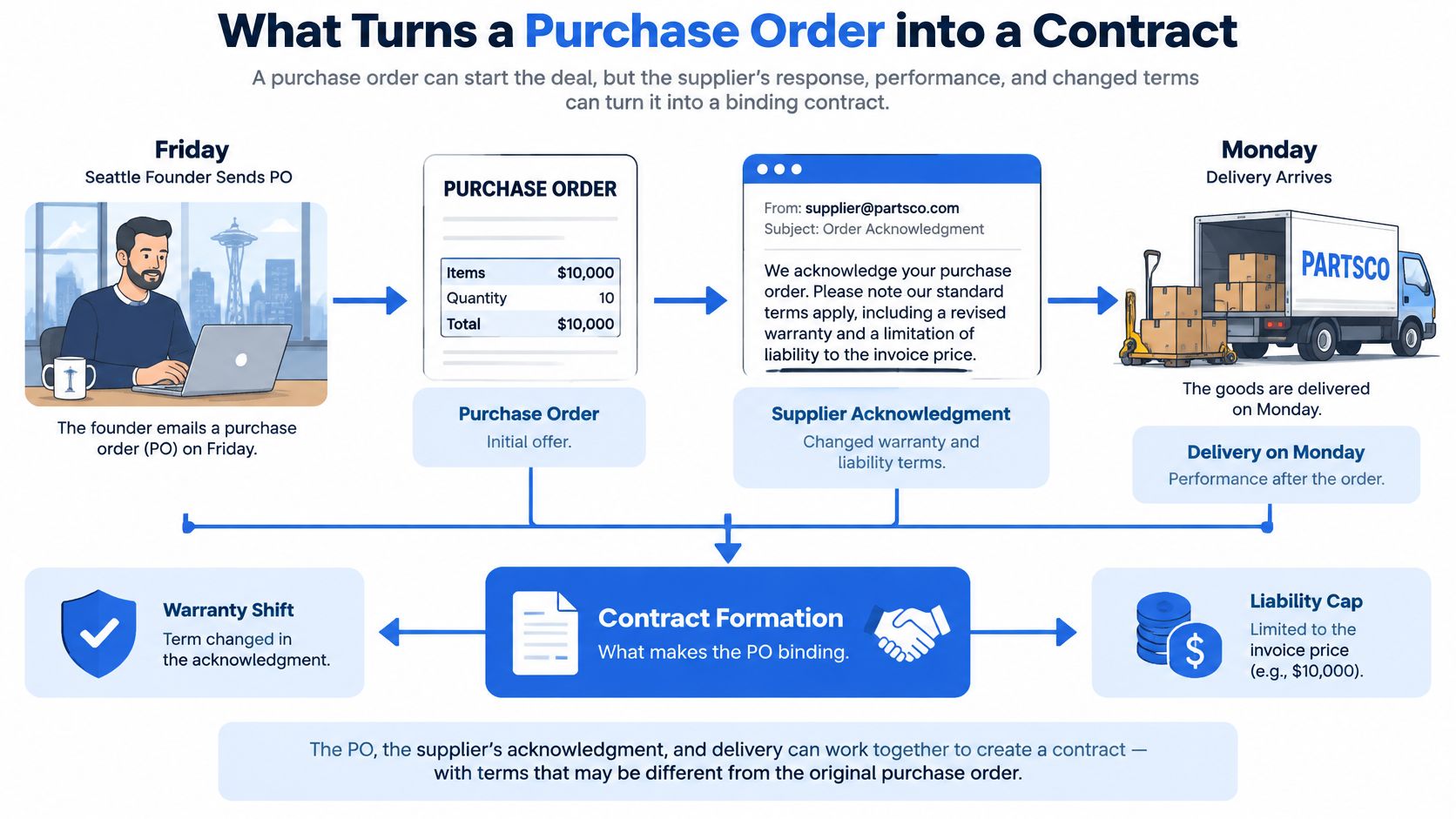
Purchase order terms and conditions are the standard rules that ride with an order: price, quantity, delivery, acceptance, warranties, risk allocation, and dispute mechanics.
Think of them as house rules posted at the door. Walking in, taking delivery, or paying can show that the parties entered. Conflicting fine print does not all stick just because it was printed on the back of a form.
How the UCC treats the unsigned order
Under Uniform Commercial Code § 2-204, as explained by Holland & Hart, a sale-of-goods contract may be formed "in any manner sufficient to show agreement," including conduct such as shipment, delivery, or acceptance of goods. An unsigned purchase order can still have contractual effect when the parties' conduct demonstrates agreement. That is the direct answer to the Monday delivery: the hardware deal can bind even though the founder never signed.
UCC § 2-207 is the battle of the forms. A definite acceptance generally can create a contract even when it includes additional terms, unless acceptance is expressly conditioned on the buyer's assent to those terms. Between merchants, additional terms may become part of the agreement unless the offer limits acceptance to its own terms, the new terms materially alter the bargain, or the offeror timely objects. Courts differ on how they treat purely different terms, so a warranty swap and a liability cap are not a puzzle to leave for later.
The practical sequence is short. Identify which document is the offer. State that acceptance is limited to the purchase order. Reject seller boilerplate. Require written approval for deviations. The purchase order should name the governing terms, say whether acceptance is conditional, and address conflicts with quotations, acknowledgments, invoices, websites, and supplier terms.
A contract can exist because goods moved, while the warranty and the cap still drop out or sneak in depending on those limits. Formation is not the same question as control. Founders who want the difference in plain terms can start with how agreements differ from contracts before they treat every emailed order as a finished deal.
Clauses Buyers and Sellers Actually Fight Over
A purchase order can bind the parties while leaving a key risk unclear. For example, a buyer may receive custom software after sending an unsigned digital PO, yet the supplier's terms may still limit warranties or claim ownership of the code. Contract formation and control of the terms are separate questions. The clauses below identify the decisions the documents need to make.
| Clause | What it must decide | If it is vague or missing |
|---|---|---|
| Payment | Due date, clock-start event, and tax treatment | Open-ended approval delays and late-pay fights |
| Delivery | Place, date, and when risk of loss passes | Loss in transit with no responsible party |
| Acceptance | Inspection window and effect of silence | Deemed acceptance or endless rejection |
| Warranties | Conformance standard and duration | Only thin implied warranties remain |
| Liability | Cap amount and carve-outs | Unlimited exposure or a cap that erases real claims |
| Indemnity | Who covers which third-party claims | The buyer funds the supplier's infringement or injury claim |
| Intellectual property | Ownership of custom work versus license scope | Vendor keeps work product the buyer paid for |
| Confidentiality | What is protected and how long | Trade secrets treated as ordinary email |
| Data and privacy | Which security addendum and data duties apply | A comply-with-law sentence with no controls |
| Termination | Convenience, cause, cure, and payment for work done | Locked-in vendor or unpaid accepted work |
| Force majeure | Covered events, notice, and long-delay exit | Every delay excused, including ordinary shortage |
| Governing law | Law, venue, and CISG treatment | Forum surprise and international-sale defaults |
Mark gaps before revising a template. Each row is a decision to make, not a heading to copy from an old vendor form.
Money, movement, and acceptance
Payment should set the due date and the event that starts the clock. “Net 30 from receipt of a correct invoice” avoids making payment depend on an internal approval queue. State whether the price includes tax. For deals involving the EU, the Late Payment Directive summary says business payment periods generally cannot exceed 60 calendar days unless expressly agreed and not grossly unfair. Public authorities generally must pay within 30 days, with extensions to 60 days only in exceptional circumstances. Acceptance or verification is generally limited to 30 calendar days from receipt unless a longer period is expressly agreed and not grossly unfair. Under the directive text, creditors can claim automatic late-payment interest without a prior reminder, plus at least €40 for recovery costs. An open-ended finance review may therefore create a problem rather than clarify when payment is due.
Delivery needs a place, a date, and a point when the risk of loss passes. If a crate is damaged in transit, the order should make clear which party carries that risk. Otherwise, both sides may point to the carrier while the goods remain damaged.
Acceptance needs a fixed inspection window, such as 10 business days, and a clear consequence if the buyer says nothing. Silence should count as acceptance only if the order expressly says so. That gives the buyer a real chance to inspect while preventing the supplier from facing an indefinite rejection period.
Risk, ownership, and the exit
Warranties should require the goods to conform to the PO and specifications, state how long the goods warranty lasts, and set a professional-standard warranty for services. Liability should identify the cap, whether that is fees paid or a multiple of those fees, and which claims fall outside it. Common carve-outs in this clause include intellectual-property infringement, confidentiality, data incidents, and willful misconduct. Without clear carve-outs, the cap may erase the very claims a buyer needs to preserve. Without a cap, the invoice price does not limit exposure from a data incident.
Indemnity should name the third-party claims each party covers and say whether the obligation is mutual. Intellectual property should assign custom work to the buyer, or use work-made-for-hire language where it fits, while granting only a license for off-the-shelf products. If that allocation is missing, the vendor may keep the code the buyer funded. Teams handling building projects can also avoid common home building contract pitfalls, where unclear scope can leave payment and work responsibilities unsettled.
Confidentiality should define protected information and how long the duty lasts. A period of three to five years may suit ordinary confidential information, with longer protection for trade secrets if the parties intend it. Data and privacy terms should identify a dated security addendum rather than try to put an entire security program into the PO. That reference gives the parties a specific set of duties to follow.
Termination should distinguish convenience from cause, allow a 15-to-30-day cure period for curable breaches, and require payment for accepted work. Force majeure should list covered events, require notice, and allow an exit if the delay continues. Ordinary shortages should not automatically excuse performance.
Governing law should name Washington law and a real venue for a Washington company, and opt out of the CISG for international sales of goods. If the parties want a charge for late delivery, they should negotiate a liquidated damages clause that states the agreed consequence clearly, rather than rely on a vague penalty sentence that a court may ignore.
Which Document Wins When Forms Conflict
| Rank | Document | Washington public pattern | Private startup practice |
|---|---|---|---|
| 1 | Underlying or master contract | Controls first | Put the MSA or subscription agreement first |
| 2 | PO commercial text | Second | Price, quantity, and dates outrank boilerplate |
| 3 | Buyer attachments and specifications | Third | SOW and specs before standard terms |
| 4 | Standard PO terms | After the documents above | House terms fill only true gaps |
| Excluded | Supplier quotation, acknowledgment, invoice, or portal terms | Not part of the PO unless accepted | No effect unless a signed written change |
Write that order down, or the last form, the portal click, or the invoice may supply the terms. Rank is the control. Without it, every PDF in the thread is a candidate.
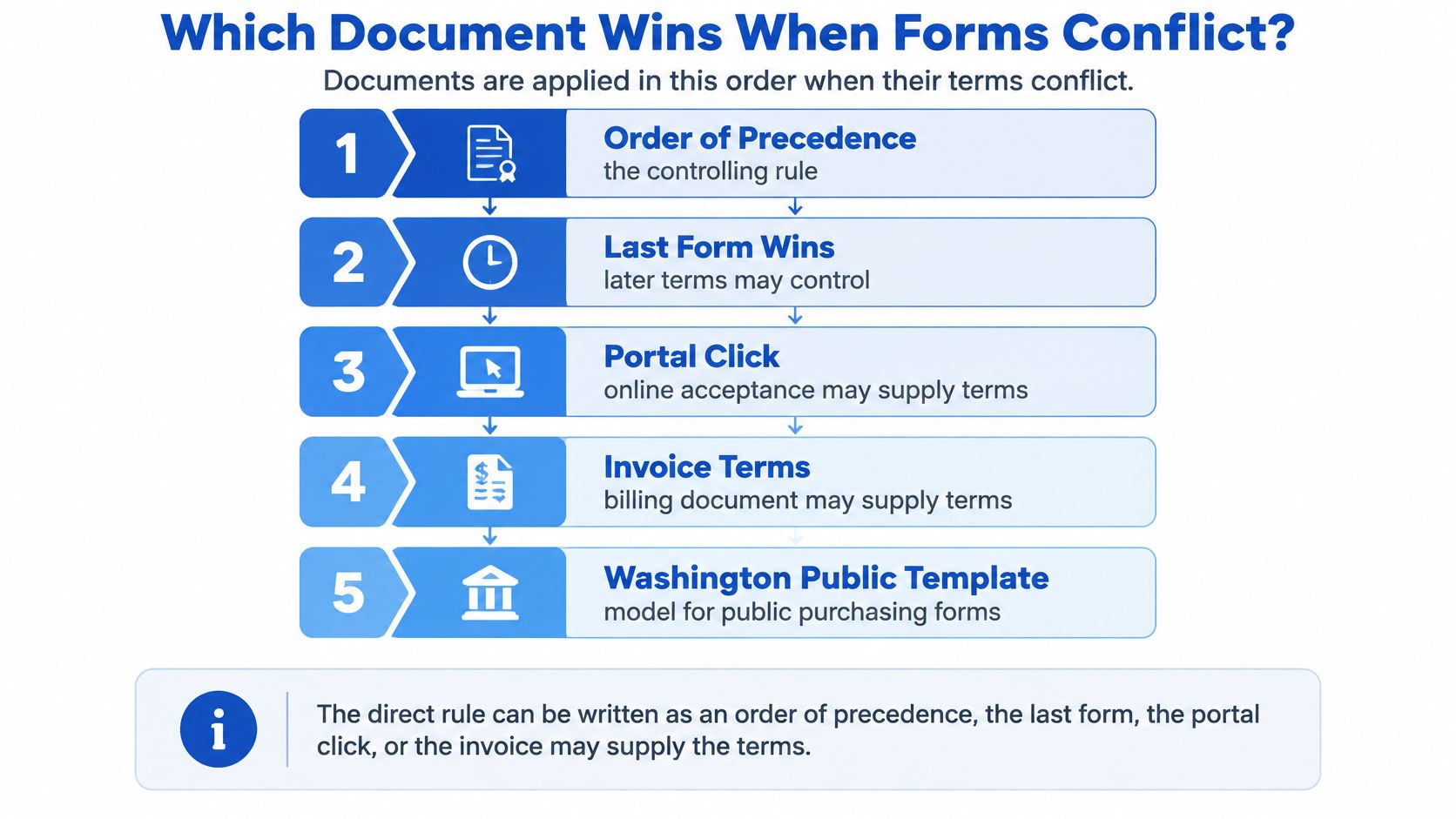
Copy the public stack, then exclude supplier paper
Washington's standard purchase-order terms place the underlying contract first, the purchase-order text second, attachments third, and standard purchase-order terms afterward. Contradictory purchase-order language is void when a controlling contract already governs. The purchase order, buyer-generated attachments, and incorporated documents are part of the order. The supplier's standard sales terms are excluded.
A private startup should copy that stack even when no public template applies. Name every incorporated document by title, version or date, and attachment number. Say supplier terms have no effect unless accepted in a signed writing. Say later acknowledgments, website terms, and automated invoices do not amend the deal without approval by a named role, such as the CFO or a designated buyer.
If the parties perform and no precedence clause exists, the practical result is often the terms they agreed, plus gap-fillers, while conflicting boilerplate drops out. Courts still differ on different terms. That is why an order of precedence beats hoping the first email wins. The older idea that an acceptance must match the offer exactly is the mirror image rule, and goods deals no longer work that cleanly once forms collide.
Keep the package that was actually sent
The sentence fails if the file room fails. Procurement should keep the exact package transmitted, the supplier's acceptance, and the timestamp. A missing attachment makes specifications and risk clauses hard to prove. Version ambiguity does the same job as a bad clause.
A short clause a company can adapt reads like this. The master agreement controls, then this purchase order's commercial lines, then buyer attachments, then these standard terms. Supplier quotations, acknowledgments, invoices, and portal terms are excluded unless a named approver accepts them in a signed writing.
Electronic buying is already the expected record, not a pilot. The National Association of State Procurement Officials reports that 87.5% of U.S. states were using an eProcurement system in the cited survey, and the OECD reports that by 2014 all OECD countries had adopted e-procurement platforms. Auditable packages and approval records are the standard a supplier portal will assume.
A short walk-through of how competing forms get read in practice sits here, after the stack is clear.
When Goods Terms Fail Technology Purchases
| Purchase type | PO alone enough | Add-on to attach | Escalate when |
|---|---|---|---|
| Ordinary goods | Often, if specs are attached | Delivery and warranty terms on the PO | Custom manufacturing or safety-critical goods |
| Professional services | Rarely | Statement of work and IP assignment | Deliverables or confidential methods |
| SaaS or cloud | No | Subscription or master terms plus security addendum | Uptime, data location, or subprocessors |
| Data-intensive or AI vendor | No | DPA, security schedule, and AI-use ban | Personal data or model training on customer data |
Ordinary goods can often live on a purchase order with specifications attached. SaaS, custom development, and any vendor touching personal data cannot. That is the split. A hardware order that names the model, the ship-to, and a one-year warranty is a different instrument from a tool that stores customer records.
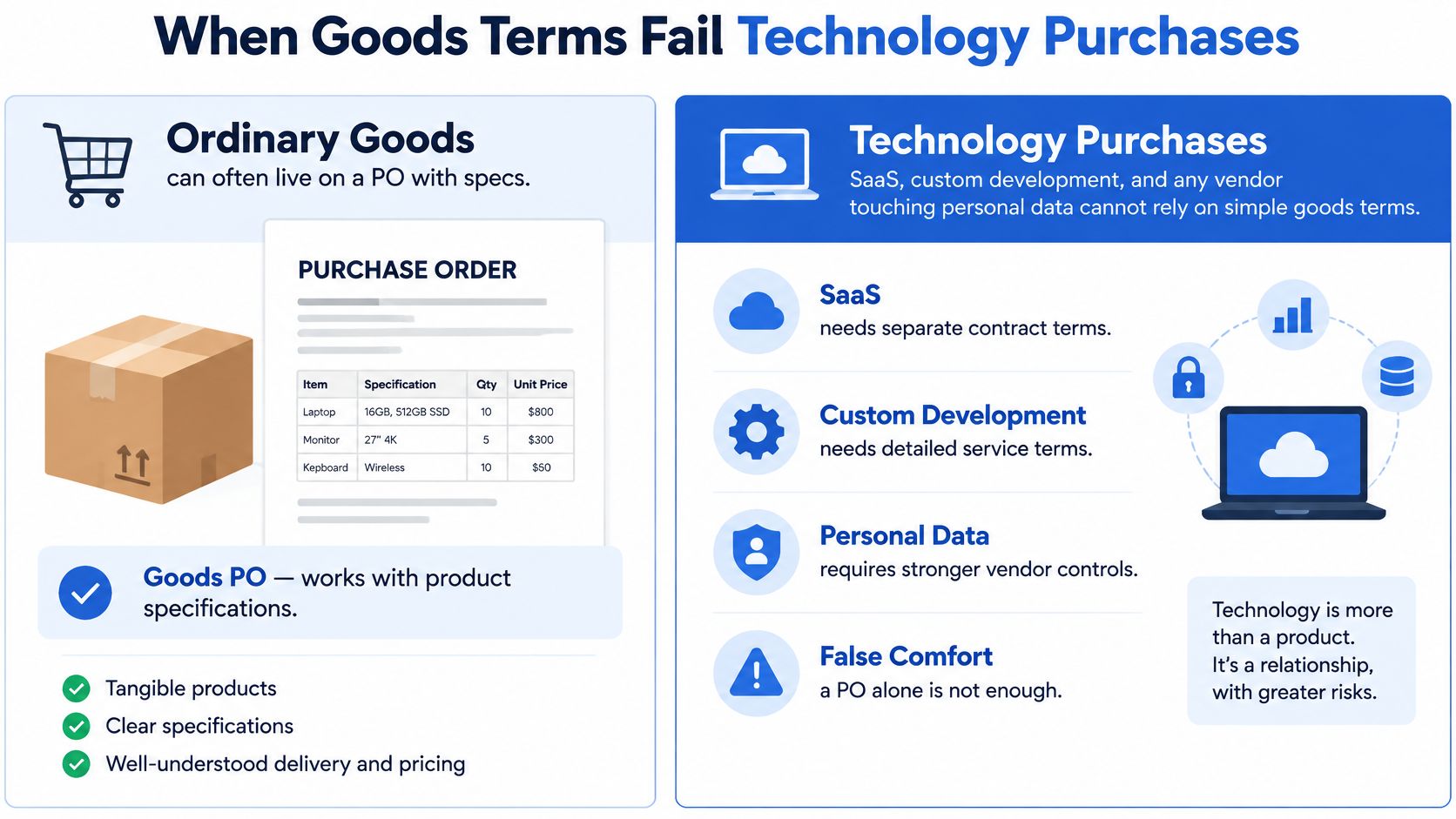
The sentence that feels safe and isn’t
“Supplier shall comply with applicable law” and “vendor security policy applies” are false comfort. Those lines do not set an incident-notice deadline, name subprocessors, grant audit rights, require deletion or return, assign custom intellectual property, disclose open-source duties, or stop the vendor from training models on customer data. Recent public procurement forms keep stressing explicit governing law, venue, dispute procedures, invoice-dispute timing, and priority among documents for the same reason. More boilerplate is not more protection. If the incorporated policy has no edition date and loses the precedence fight, the security sentence is ornamental.
What to attach instead
For a data or AI vendor, incorporate a dated data-processing agreement and security schedule by title and date. Set a short incident notice, such as 72 hours after discovery. Restrict subprocessors. Require a business-continuity commitment. Ban use of customer data or prompts to train or improve generalized AI.
For professional services, pair the purchase order with a statement of work and an assignment of deliverables. For SaaS, use subscription or master terms that cover uptime, data location, and exit assistance, then let the purchase order state only quantity, term, and price. The negotiation points that usually move those deals are the same ones covered in a practical SaaS contract negotiation review: uptime, data location, and what happens at exit.
Escalate when the vendor will hold personal data or regulated data, will write custom code, must accept government flow-downs, or pushes its own terms at portal checkout.
Federal buyers add a mandatory layer. The Federal Acquisition Regulation requires each purchase order and each purchase-order modification to incorporate all clauses prescribed for the particular acquisition. A startup selling to a federal agency cannot rely on a generic commercial sheet. Check the solicitation for inspection, intellectual property, labor, cybersecurity, or other clauses the procurement type and value trigger, and check each modification on its own.
Taxes Invoices and Disputes in Washington
A purchase order may bind the parties even without a handwritten signature, but that does not settle which invoice rules or other terms control. For Washington public purchasing, the Secretary of State purchase-order terms address both tax compliance and how charges appear on an invoice. They require suppliers to follow applicable federal, state, and local tax laws and to show taxable charges, nontaxable charges, and sales or use tax separately by jurisdiction. Unless the order says otherwise, the price includes the cost of compliance, applicable taxes such as sales, use, excise, and value-added taxes, and fees or duties on the sale. Washington Courts’ purchase-order terms and the Secretary of State form
What the invoice must show
For a private purchase order, state whether prices include tax, identify who remits each tax, and require invoices to separate those amounts. Clear line items make review easier: accounts payable can see whether a charge is taxable and what amount is being requested. If tax, freight, and other charges are blended together, the buyer may have to ask for a corrected invoice before paying.
Set a defined period for invoice disputes, such as 15 days after receipt. Also say that an objection to one line does not delay payment of undisputed amounts under the original payment schedule. If a freight charge appears wrong, the buyer can challenge that line while paying the rest, rather than holding the entire invoice.
Proof, goods versus services, and the forum
Keep the email, portal acceptance, and shipment record together. Those records can help show what the parties agreed to, even when no one signed a paper copy. For goods, the sales statute and product specifications often frame the dispute. For services, the written scope and ordinary contract rules matter; without a statement of work, it can be harder to determine what work was promised after the hours have been billed.
Choose Washington law and a venue the company can use, such as King County Superior Court or the federal court in Seattle, or require mediation before suit. For cross-border goods, address whether the CISG applies in the same clause, so the parties do not leave an international default to displace their chosen terms.
The forum should fit the dispute. An unpaid invoice may call for a collections process; an indemnity fight or data incident that exceeds a liability cap may require different evidence and a different approach. Review amendments as carefully as the original order. Confirm that they preserve the intended tax language and dispute window, rather than assuming every special term carries forward.
Draft Negotiate and Check the Order
Draft in an order that matches how the fight will be read later. Do the formation sentence first, the rank second, and the outside documents third. Payment days are not the opening trade.
- Name the offer. State that acceptance is expressly limited to this purchase order and its listed attachments. A definite acceptance that is conditioned on the buyer’s assent to extra terms does not become the contract.
- Insert precedence and name the approvers. Use master agreement, then purchase-order commercial lines, then buyer attachments, then standard terms, with supplier paper excluded. Name who may approve a deviation.
- Incorporate by identifying the text. Oak Ridge National Laboratory’s commercial purchase-order terms illustrate the public pattern: referenced clauses apply as though written in full, and some programs require the text to be available on request. Specify source, clause number, edition date, and whether the clause applies in full or only to defined products, services, data, or contract values. Say who flows those duties to subcontractors.
- Break the tie in advance. If an incorporated clause conflicts with the master agreement, say which one wins. Do not leave two “this document controls” lines in the package.
- Trade the expensive clauses before the calendar. Negotiate the liability cap, indemnity, intellectual-property assignment, and data schedule before trading days of payment. A faster pay cycle does not repair a missing assignment.
- Archive the issued file. Save the PDF or portal record that went out, not a later export that no longer matches the click. Teams that want the operational side of that archive can use purchase management insights from SIX ERP to see how order, receipt, and invoice stay tied together.
Three sentences worth pasting
Acceptance of this purchase order is expressly limited to these terms and the attachments listed by title and date. Any different or additional term is rejected unless a named approver accepts it in a signed writing.
If documents conflict, the master agreement controls, then the commercial lines of this purchase order, then buyer attachments, then these standard terms. Supplier quotations, acknowledgments, invoices, website terms, and portal terms are excluded.
Supplier will not use customer data, prompts, or outputs to train or improve generalized artificial intelligence models, except as a dated addendum expressly allows for a named product.
Generic language such as “vendor security policy applies” is weaker than a dated security addendum with measurable controls, incident-notification deadlines, audit rights, and deletion or return requirements. Treat version and access as contract controls. If the contractor cannot retrieve the clause, the incorporation is a citation, not a duty.
Pass or revise before anyone ships
Confirm each item before the vendor ships or clicks accept.
- Limited acceptance: the offer says extra terms need written approval.
- Precedence: the four-level stack is in the file, and supplier paper is excluded.
- Attachments: required clauses and any dated data-processing agreement are attached.
- Money lines: tax treatment and the invoice-dispute window are stated.
- Authority: the signer is an authorized approver, and the timestamped file is archived.
Any miss means revise before performance. Get counsel before the first enterprise or government order, before a vendor holds personal data or builds custom intellectual property, and when a portal’s terms conflict with the company’s. Founders comparing versions of an order can ask By Design Law Firm and Legal Consultancy, PLLC to review price, quantity, delivery, warranties, liability, and incorporated terms as one option alongside in-house review.
By Design Law Firm & Legal Consultancy, PLLC drafts and negotiates vendor and purchase-order terms for Washington startups and growing companies, including the precedence, data, and intellectual-property clauses that decide who bears the risk after the goods ship or the portal is clicked. The firm also reviews conflicting acknowledgments and supplier clickwrap before a founder treats an emailed order as the whole deal. Visit By Design Law Firm & Legal Consultancy, PLLC to talk through the next order before it goes out. Contact our law office at (206) 593-1519.