A lower opening price can feel like a win, but it's rarely the only number that decides whether a vendor deal works. Vendor contract negotiation succeeds when the agreement controls cost, performance, and risk after signature, not just when the vendor accepts a discount.
For a startup, the practical test is whether the contract delivers what the business negotiated for across its full term. That means setting clear commercial and security protections, documenting every change, and assigning someone to track the obligations once the deal is signed.
Why Vendor Deals Lose Money After the Signature
A vendor deal can lose value after signature even when the buyer negotiated a strong discount. World Commerce & Contracting reports that organizations lose an average of 11% of contract value through value erosion and leakage. The discount is visible on day one. The losses often arrive later, through terms that were overlooked or never tracked.
Some erosion occurs before signing, when a buyer misses a negotiation opportunity. Other losses happen after award: unrecorded scope changes, unmanaged obligations, poorly timed renewals, and missed price adjustments. In a startup, those small leaks can add up across a portfolio of software and service contracts.
Consider a vendor that offers a 10% discount but requires an automatic three-year renewal and allows uncapped annual increases. The headline saving may be offset by the time the renewal comes around, while the company is locked into a longer term and has less ability to challenge the price. A few thousand dollars a year slipping out of a dozen tools can matter when runway is limited.
The useful measure isn't the discount at signature. It's whether the contract performs as negotiated over its full term.
That measure shapes the rest of the playbook: prepare before the first call, set commercial terms, negotiate risk protections, trade concessions deliberately, identify red flags, and verify that the final contract is ready to sign.
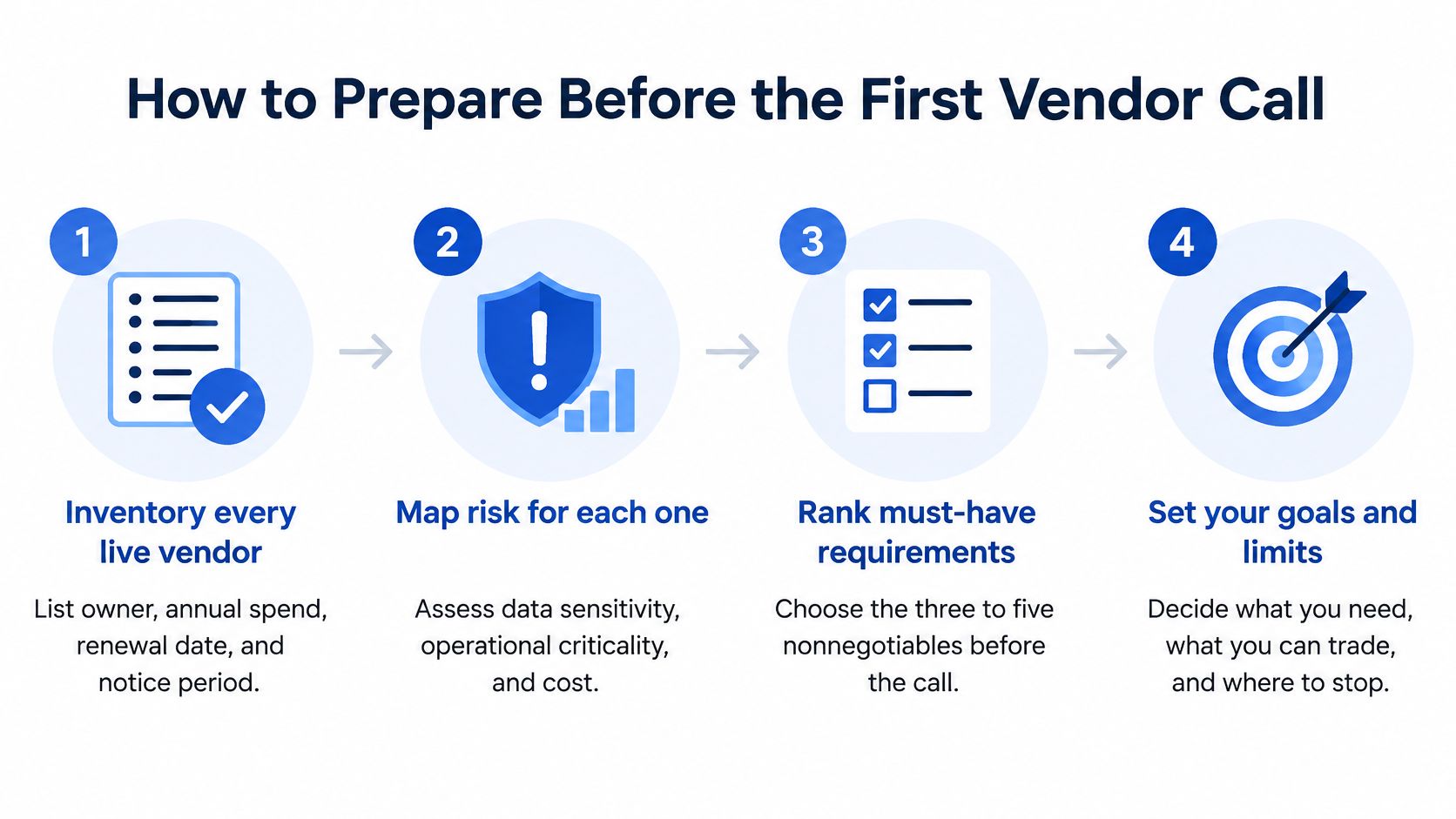
How to Prepare Before the First Vendor Call
Preparation makes a negotiation less reactive. Before discussing price, the startup should know what the vendor does, what the business needs, and what it can offer or walk away from.
- Inventory every live vendor. Record the internal owner, annual spend, renewal date, and notice period so that no contract renews unnoticed.
- Map risk for each vendor. Assess data sensitivity, operational criticality, and cost; a tool holding customer information deserves more scrutiny than a replaceable, low-impact service.
- Rank three to five must-have terms. Separate nonnegotiables, such as data export or a renewal cap, from items that can be traded.
- List useful concessions. A longer commitment, added volume, a reference case, or a fast signature may have value to the vendor, but each should be exchanged for a specific improvement.
- Build a real alternative. Obtain a written competing quote and identify the cost and effort of switching, so the walk-away point reflects a workable option rather than a bluff.
- Set approvals and limits. Agree internally on the maximum acceptable price and term, and determine who can approve exceptions before the vendor asks for a decision.
Renewal timing can affect a buyer's negotiating position. Tropic's analysis of more than $23 billion in tracked spend and over 100,000 negotiations reported savings of up to 39% when companies prepared six months before renewal, compared with 22% at 60 days and 14% at 30 days. Those are reported outcomes, not a guarantee for any individual contract. Starting early gives the buyer time to benchmark alternatives, review actual usage, reclaim unused licenses, secure budget approval, and protect the opt-out right. The Tropic analysis of renewal timing and software savings provides the context for treating renewal preparation as a strategic task rather than an end-of-term scramble.
| Renewal Lead Time and Savings Potential | ||
|---|---|---|
| Start Negotiating | Reported Savings | What You Can Still Do |
| Six months before renewal | Up to 39% | Benchmark alternatives, audit usage, and reclaim unused licenses |
| 60 days before renewal | Up to 22% | Run one competing bid and secure budget approval |
| 30 days before renewal | Up to 14% | Mostly accept the terms or negotiate a short extension |
A company with forty software subscriptions may find that twelve renew in the same quarter. An early calendar lets its team compare bids, identify unused seats, and preserve the ability to opt out rather than accept a renewal by default. For a broader view of the operating practices that support that work, CloudOrbis Inc.’s guide to best practices for managing IT vendors offers useful context. A structured review of vendor exposure can also start with this vendor risk assessment.
Action: Put every notice deadline in a shared calendar and set a reminder six months ahead.
Commercial Terms That Decide Your Real Cost
A $60,000 annual contract with a 5% escalator costs $63,000 in year two and $66,150 in year three. An uncapped increase could cost more. The price on the first order form is only one part of the financial commitment; renewal mechanics, payment timing, service failures, and changes to scope can alter the total cost.
| Commercial Clauses and Startup Positions | ||
|---|---|---|
| Clause | Ask For | Fallback |
| Payment terms | Net 45, with no prepayment | Net 30 with an early-payment discount |
| Automatic renewal | Renewal only on written notice 60 days before term end | 30-day opt-out notice with a reminder email |
| Price escalation | Increases capped at CPI or 3% a year | Cap at 5% with a documented cost review |
| Termination for convenience | Exit on 30 to 60 days' notice | Exit after the first year with a fixed fee |
| Service credits | Credits for missed service levels against a stated baseline | Credits capped at 10% of the monthly fee |
| Scope changes | Written change orders signed by an authorized person | Email approval from a named owner |
Payment terms affect cash flow. A startup should avoid paying far in advance unless the discount justifies the risk and the agreement offers a remedy if the vendor fails to perform. For renewals, an automatic extension should require an explicit written decision when possible; if the vendor resists, a clear opt-out deadline and reminder process are a practical fallback.
Service credits need a defined service-level baseline and a way to claim the credit. A promise of “high availability” without a measurement method or remedy won't help when the service is unavailable. This service-level agreement template can help teams identify the performance terms that need to be made concrete.
Scope changes deserve the same discipline as price changes. The Federal Acquisition Regulation's changes provisions offer a useful model: define who can authorize a change, require written approval, identify the impact on fees and deadlines, and set a notice deadline for disputed or constructive changes. The FAR's government-contract process is not automatically a rule for private commercial agreements, but its documentation approach helps prevent disputes over whether extra work was included in the original bargain. If the parties can't price a change in advance, the contract should state how they will document and calculate the adjustment.
Washington's Uniform Commercial Code provisions in RCW Title 62A govern sales of goods, while many startup software and service agreements are treated under general contract law. That distinction makes precise drafting especially important: parties should put scope, pricing triggers, and remedies in the agreement instead of relying on assumptions about how a court might classify the deal. For businesses planning a physical workspace alongside vendor arrangements, leasing an office with Tandem Space offers a separate guide to the commercial terms that can affect occupancy costs.
Practical rule: Rewrite any term that changes cost without a clear written trigger before signing.
Data, Security and Liability Terms for Tech Vendors
When a vendor handles customer data, the security and liability clauses may matter more than the fee. A low-cost SaaS service can still create a serious business exposure if the contract allows the vendor to retain data after termination, gives little notice of a security incident, or caps the vendor's responsibility too tightly.
| Tech Vendor Risk Clauses and Minimum Positions | ||
|---|---|---|
| Clause | Minimum Position | Stronger Ask for Sensitive Data |
| Data ownership and return | You own your data and can export it in a standard format | Export within 30 days of termination with certified deletion |
| Subprocessors | Named list with notice before changes | Approval right for material substitutions |
| Security standards | Independent audit report on request | Annual attestation, vulnerability disclosure, and a software component inventory for critical products |
| Breach notification | Notice without undue delay | Notice within 48 hours of discovery |
| Indemnity | Vendor indemnifies against IP infringement claims | Data breach response costs carved out of the liability cap |
| Liability cap | Twelve months of fees | Higher cap for data breaches, negotiated as a multiple of annual fees |
Security language should say what the vendor must do and how the customer can verify it. The NIST Cybersecurity Framework 2.0 recommends setting supplier requirements according to service criticality and potential impact, putting them in contract language, and defining verification methods. Its examples include vulnerability disclosure during the service term, a current component inventory such as a software bill of materials for critical products, employee vetting, and evidence through self-attestation, recognized standards, certifications, or inspection.
For a SaaS service, the security schedule should also set rules for incident cooperation, information sharing, and security requirements that flow down to subcontractors. A general promise to use reasonable security is hard to test and gives the parties little direction when a problem arises. The agreement should define what evidence the vendor supplies, how often it is reviewed, and what remedy applies when the vendor misses a requirement. A data processing agreement can help structure the obligations around personal information and processing.
Liability limits need to match the type of data and the likely consequence of a failure. Suppose a service costs $2,000 per month and the vendor caps liability at twelve months of fees. That puts the cap at $24,000, which may not cover even a portion of incident response, customer notices, investigation, or restoration. A buyer can seek a higher cap for data incidents or carve out defined breach-response costs, while recognizing that vendors may resist uncapped exposure. The sensible fallback is a negotiated, clearly drafted cap that distinguishes ordinary claims from serious data and confidentiality risks.
For products that touch consumer health data, contract review should also account for Washington’s My Health My Data Act. The contract can’t make the vendor’s practices irrelevant: data handling, security evidence, access controls, incident cooperation, and deletion obligations should align with the product’s actual data use.
Negotiation Tactics and Fallback Language That Work
The fastest way to improve a vendor contract is to trade each concession for a specific term and confirm every call in writing within two business days. That approach protects the commercial relationship without giving away terms for free.

Open with the shared goal of a workable long-term relationship, then focus the discussion on the business problem behind each request. Ask for the vendor’s paper before sending redlines, so the team can see the supplier’s default positions and avoid negotiating against a document that may not govern the deal. Plan a three-step concession ladder in advance: make the preferred request, offer a defined trade, then accept only with a protective condition. After each call, send a written summary of decisions and open points.
Three lines that can work in a live negotiation:
- “We can accept the 5% escalator if it applies only after the first renewal and is capped at the prior twelve months of CPI-U.”
- “Please add a 30-day written notice period before automatic renewal, with a reminder sent 45 days before the opt-out date.”
- “We can accept your standard security schedule if it adds a named subprocessor list and breach notice within 48 hours.”
The first line exchanges flexibility on an increase for limits on when it begins and how it is calculated. The second makes the opt-out process usable, rather than leaving a contractual right hidden in a notice clause. The third preserves the vendor’s standard schedule while adding specific protections for downstream providers and incident communication.
The fallback sequence is straightforward: ask, trade, accept with protection, then walk away if the remaining risk exceeds the business’s limit. A longer commitment may be worth offering for better pricing, but only if the company has tested its usage, exit options, and performance requirements. Contract & Transactional Law services at By Design Law Firm & Legal Consultancy, PLLC include drafting and review to negotiate and structure business deals; the same kind of support can help identify which concessions are safe to make. For more on a risk allocation clause that often gets negotiated alongside these terms, see this guide to indemnity clauses in Washington State contracts.
A recorded call or friendly sales conversation is not a substitute for a signed amendment. Confirm any verbal promise in writing within two business days, and make sure the final contract incorporates it.
Red Flags That Should Stop the Deal
A vendor’s willingness to negotiate is not proof that the deal is safe. A startup should pause and fix the following conditions before signing:
- The vendor won’t name its subprocessors or critical suppliers.
- The contract excludes or leaves unclear the vendor’s liability for data loss.
- The vendor can change contract terms unilaterally.
- The vendor can suspend service without notice or a chance to cure.
- Security obligations amount only to a promise to use reasonable security.
- Important commitments exist only in sales calls or email.
- The agreement gives no practical way to export data after termination.
Fourth-party risk deserves special attention. In EY’s 2025 Global Third-Party Risk Management Survey of 500 executives at organizations with at least $250 million in revenue, 57% identified operational disruption as the leading third-party risk exposure, while 64% said their organizations assess vendors’ vendors. The EY survey on third-party risk management shows why a direct vendor’s dependence on cloud providers, subprocessors, or logistics partners belongs in the contract conversation. A vendor that can’t describe its critical suppliers is itself a warning. A practical discussion of cloud migration and data portability can help teams think through exit options before a disruption makes them urgent.
Some transactions call for escalation to counsel before the final draft: a multi-year commitment, regulated or health data, intellectual-property assignment, exclusivity, or a deal above the company’s internal approval limit. By Design Law Firm & Legal Consultancy, PLLC reviews commercial transactions, contracts, and warranties before they’re finalized, and provides advice on complex agreements to help identify risk. Pause and fix a clause the business can clarify; escalate when the consequence or commitment exceeds the team’s authority.
Confirm the Contract Is Ready Before You Sign
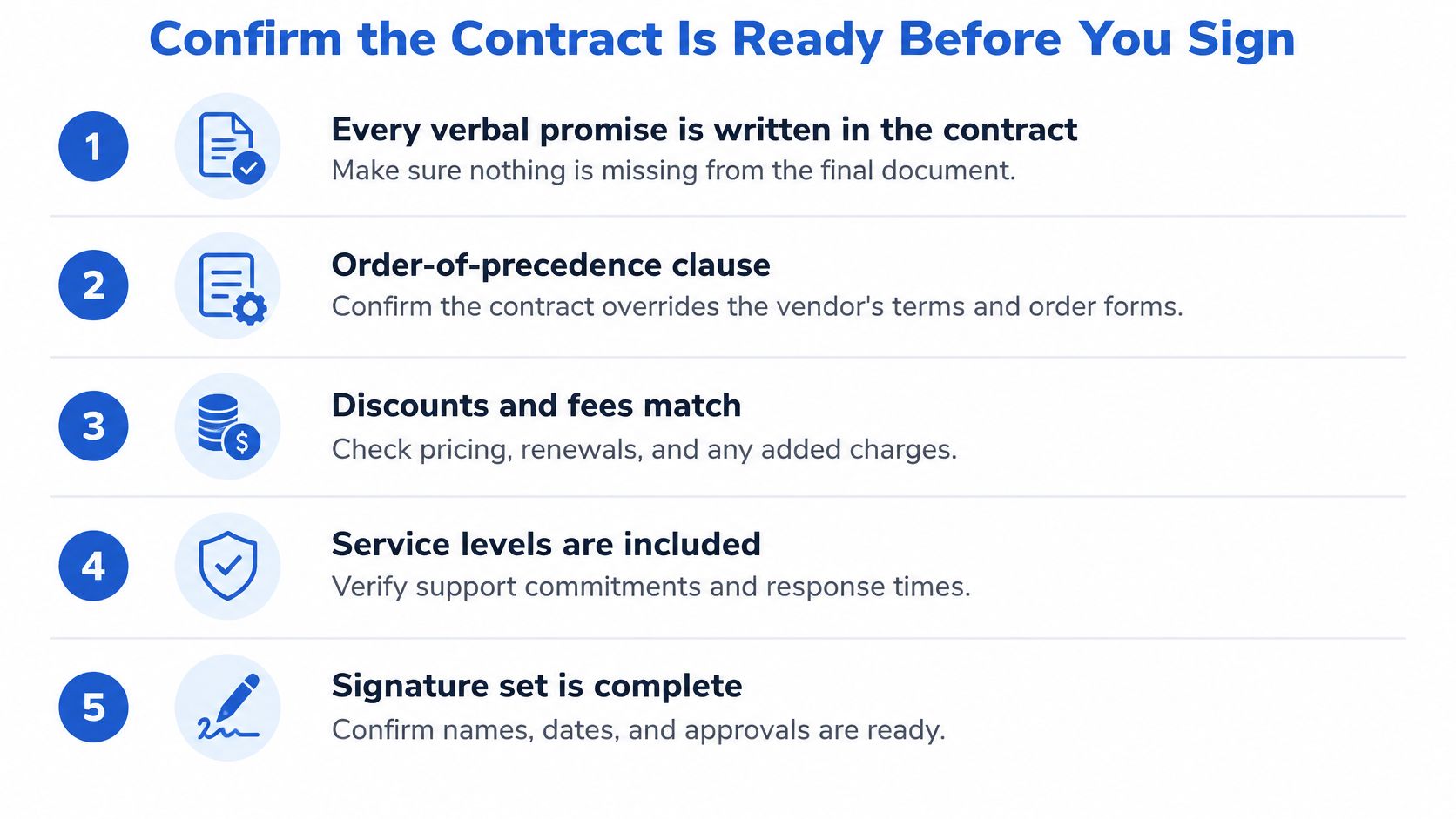
A final review catches mismatches between the deal the team discussed and the document the vendor expects the company to sign. Before execution, verify:
- Every verbal promise appears in the contract.
- The order-of-precedence clause makes clear whether the negotiated agreement controls over vendor terms and order forms.
- The renewal date and notice deadline are on the calendar.
- A named internal owner is responsible for the relationship.
- Approved scope changes are in writing.
- Every red flag is resolved or escalated.
Signature should trigger operational controls, not close out the procurement file. Create a contract register that records obligations, owners, due dates, renewal and termination notices, volume tiers, rebates, service credits, insurance, security requirements, and price-adjustment formulas. Reconcile invoices against the executed agreement so that the company pays the agreed amount and catches charges that don’t match the contract.
Deloitte and Docusign report that procurement teams miss more than $1 million on average from contractual incentives. Their contract lifecycle management survey findings support assigning each material concession a metric, evidence source, review cadence, and remedy. A quarterly supplier review can track effective unit cost, credits recovered, service performance, and renewal outcomes.
By Design Law Firm & Legal Consultancy, PLLC manages contracts from initiation through execution, including deliverables, deadlines, and terms and conditions. Before signing any deal that hits an escalation trigger, request a contract review so the final terms reflect the business’s commercial priorities and risk limits.
By Design Law Firm & Legal Consultancy, PLLC provides contract drafting, review, and negotiation, including support for vendor agreements involving liability, intellectual property, security, service levels, and remedies. Founders and business leaders in Washington can discuss a specific agreement and request counsel before signing through By Design Law Firm & Legal Consultancy, PLLC. Contact our law office at (206) 593-1519.