Only 7.2% of sampled patents were worth more than EUR 10 million each, while 68% were worth less than EUR 1 million, in the PatVal-EU study of more than 9,000 patents described in the USPTO petition record summarizing PatVal-EU. That split explains how to value intellectual property without fooling anyone. A founder doesn't need a prettier average. A founder needs to find the few rights that carry cash flow, name the evidence behind them, and present a range that survives questions.
What an IP Valuation Actually Measures
Say a Seattle software startup owns one issued patent, two pending applications, a trademark, and a customer data set. The investor question isn't how much the filings cost. It's whether any of those rights lets the company charge more, license something, keep a competitor out, or avoid paying someone else.
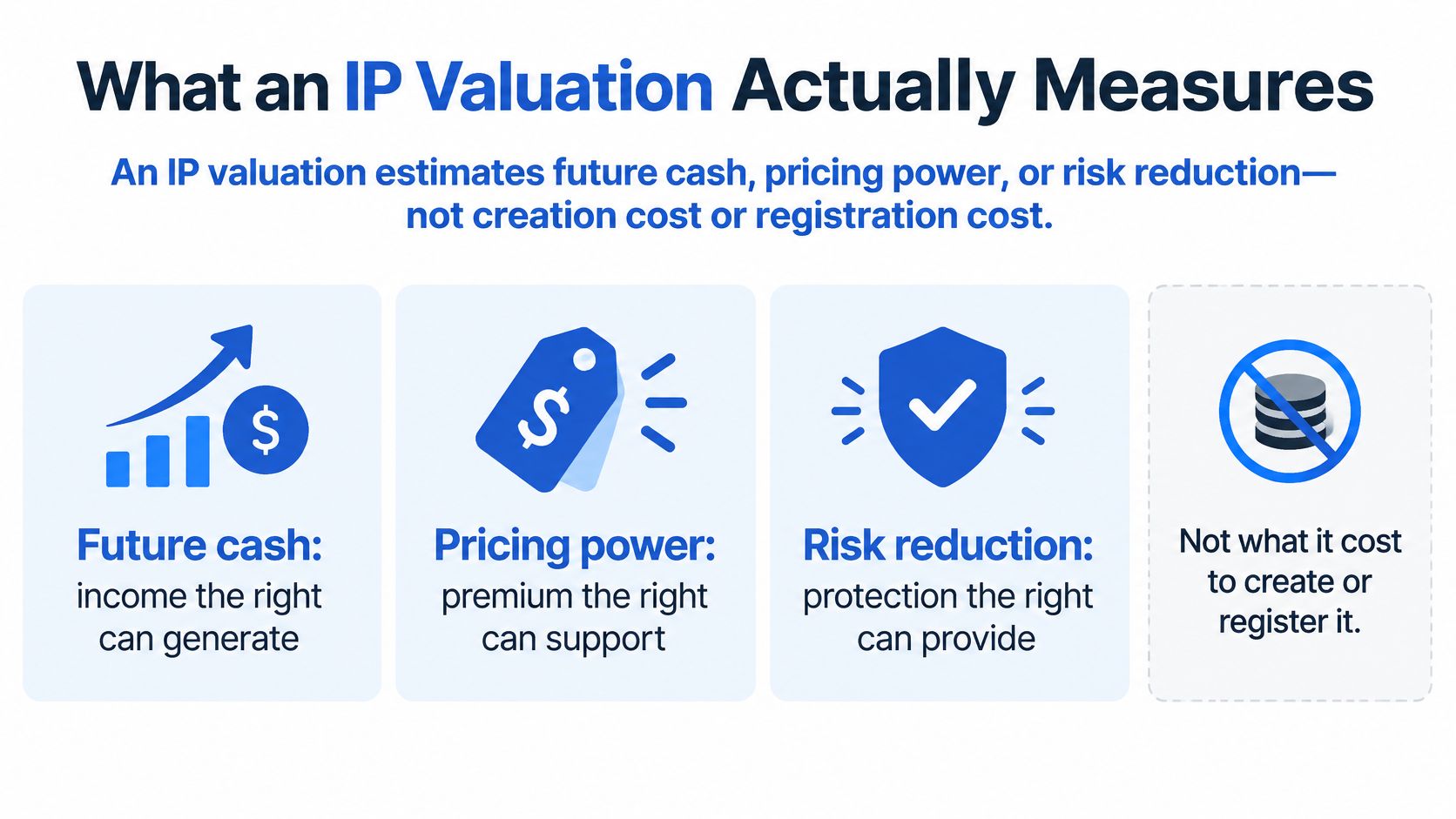
The one-sentence answer: An IP valuation estimates the future cash, pricing power, or risk reduction an enforceable right can produce, not what it cost to create or register it.
A patent can earn in three plain ways. It can lift profit on the owner's own products, it can bring in licensing income, or it can create the gap between what an invention earns with exclusivity and what it would earn without protection. If none of those paths exists, the certificate on the wall doesn't create value by itself.
Why counts mislead
Research summarized in a U.S. Patent and Trademark Office presentation found that Hall and colleagues linked adding one patent per USD 1 million of research-and-development spending, measured in 1992 dollars, with an approximately 3% increase in firm market value. That's useful evidence that markets notice patents. It isn't a price tag for the next filing in a portfolio.
Patents differ in scope, enforceability, remaining life, and ability to block a rival. One narrow patent on a feature customers don't want may be worth little. One broad patent covering the step every competitor needs may carry the company. Portfolio averages hide that difference, so each right gets valued on its own commercial job.
The first sorting task
Before any formula, a founder should list each asset and answer three questions in writing.
- Product link: Which product, service, or license offer does this right touch?
- Market effect: Does it support a price, protect margin, block entry, or only sit unused?
- Enforceability: Could the company stop a copyist, or would the claim be too narrow, expired, or undocumented?
Trade secrets belong on that same list, even though no registration exists. Founders reviewing trade secret protection often discover the valuable asset is a process, supplier method, or pricing model that stays valuable only while access stays controlled.
The sentence worth repeating to an investor is simple. Value is the enforceable right's future economic contribution, separated from enterprise value before any formula is applied. Everything after that is evidence gathering.
Choose a Valuation Method That Fits the Asset
Start with the comparison, not the calculator. The selection rule is to screen market, cost, and income approaches, promote one to primary status, and keep the others as cross-checks.
Which IP valuation method to use
| Method | Use it when | Core inputs | Main weakness |
|---|---|---|---|
| Market | Arm's-length sales or licenses exist | Comparable prices or royalty rates, adjusted for deal terms | IP deals are private and assets are rarely alike |
| Cost | Early stage, or benefits cannot be forecast | Creation, replacement, or reproduction cost less obsolescence | Spend is not future earning power |
| Income (discounted cash flow) | Cash flows can be tied to the right | Attributable cash flow, economic life, risk-adjusted discount rate | Forecast and life assumptions drive the result |
| Relief-from-royalty | A royalty rate can be supported for the technology or brand | Rate times revenue or units, after tax, then discounted | A borrowed rate that ignores exclusivity and maturity |
| Excess earnings | Brand or customer intangibles sit on top of other assets | Cash flow above required returns on contributory assets | Easy to double-count brand and technology |
| Real options or Monte Carlo | Milestones make one forecast misleading | Paths to defer, expand, or abandon, with probabilities | Heavier model than most SMB deals need |
The IRS internal revenue manual on intangible valuation frames the same three-approach screen and warns that income methods depend on forecasts, income-stream duration, and realization risk, cost methods can fail when future income or obsolescence is difficult to quantify, and market methods require comparable transactions. That warning belongs on the first page of any model. It tells a reader which assumption could break the answer.
What each method is really asking
Market asks what a real buyer paid for something similar. A license for exclusive worldwide rights in medical devices doesn't prove the rate for a non-exclusive U.S. software feature. Founders studying intellectual property licensing should compare field of use, territory, term, and exclusivity before borrowing any number.
Cost asks what recreation would cost today, using creation cost, replacement cost for comparable utility, or reproduction cost for the same features, then subtracting functional and economic obsolescence. It suits very early assets with no commercial evidence. It doesn't forecast what a buyer will pay, because expensive development can still produce something nobody wants.
Income asks what future money the right itself generates. The WIPO guide to IP valuation describes the income approach as generally the most widely used method, built on projected cash flows or earnings attributable to the IP, the asset's economic life, and a discount rate reflecting the risk that projected income won't be realized. Three inputs only, but each one needs proof.
For patents and technology, relief-from-royalty applies a supportable royalty rate to a revenue or unit base, takes the after-tax royalty savings, and discounts them. For trademarks and customer intangibles, excess earnings captures what remains after required returns on contributory assets such as people, equipment, distribution, and brand. Skipping those contributory charges inflates the IP by crediting it with everyone else's work.
When milestones dominate, one discounted path can mislead. The WIPO income approach chapter describes real-options analysis for situations where management can defer, expand, abandon, or otherwise change commercialization decisions as uncertainty resolves, with Monte Carlo simulation as another way to model multiple outcomes. That's the right upgrade for a regulated product still awaiting approval.
Three reader cases, matched
A pre-revenue internal tool with no license interest fits cost as a floor, nothing more. A licensed patent with signed royalty history fits relief-from-royalty or direct income, because cash already traces to the right. A trademark with years of product sales fits excess earnings, provided the model charges for the sales team, inventory, and distribution that also produced those sales.
How to Build the Valuation Step by Step
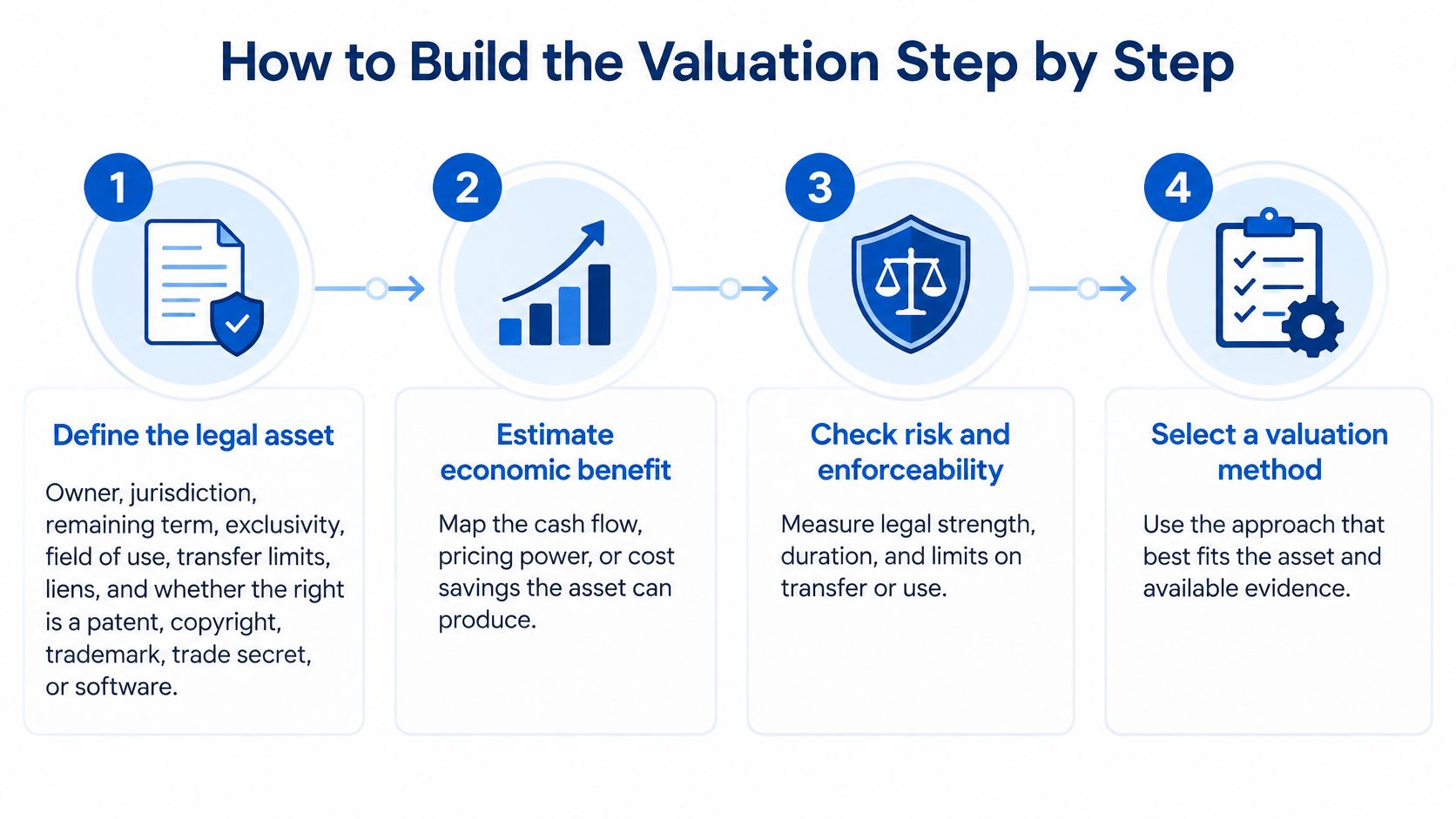
The discounting formula is rarely where valuations fail. They fail where legal protection gets connected to commercial cash flow with a hopeful sentence instead of evidence. The steps below keep that connection visible.
Steps one and two define the asset and isolate its money
Step 1. Define the legal asset. Write down the owner, jurisdiction, remaining term, exclusivity, field of use, transfer limits, and liens. State plainly whether the right is a patent, copyright, trademark, trade secret, software, data set, or domain, because each one expires, transfers, and gets enforced differently.
Step 2. Split the cash flows. Revenue from a product also pays for workforce, machinery, distribution, and brand reputation. Crediting all of it to one patent double-counts those contributors. The model should name what the right adds, such as a price premium, avoided royalty, cost saving, or protected sales volume.
Steps three and four build an honest forecast
Step 3. Forecast by product and geography over remaining legal and economic life. A patent expiring in four years can't support a ten-year exclusive revenue stream. Probability-weight the forecast for development, regulatory, infringement, adoption, and renewal risk, so a launch delay shows up as lower expected cash rather than a footnote.
Step 4. Deduct the costs of owning the right. Incremental operating costs, taxes, maintenance fees, enforcement spending, and contributory-asset charges all come out before discounting. A trademark that needs monitoring and occasional enforcement isn't free to hold. Leaving those costs out overstates net benefit in every year.
The mechanics of discounting and royalty selection reward a slow walk-through before anyone trusts the output.
Steps five and six set the rate and discount it
Step 5. Set any royalty from comparable licenses plus a profitability check. Normalize exclusivity, territory, term, minimum guarantees, sublicensing, litigation risk, and technology maturity before using a benchmark. A WIPO valuation presentation identifies the historical 25% rule as a method used in some South African tax valuations, and current practice requires market evidence and profitability analysis instead of that default shortcut.
Step 6. Discount residual cash flows at a rate matching their risk. The company's ordinary borrowing rate reflects collateral and lender protections that a single patent may not have. Riskier, less proven income gets a higher rate. The same WIPO material describes the income approach as most useful where positive cash flows are reasonably forecastable and risk can be represented by a defensible discount rate.
A worked relief-from-royalty example
Say a patent drives USD 2 million of annual product revenue, purely as an illustration. A supported royalty rate of 5% produces USD 100,000 of pre-tax royalty savings per year. At an assumed 25% tax rate, after-tax savings equal USD 75,000 per year before discounting.
With five years of remaining life, the undiscounted total is USD 375,000, and discounting each year at a risk-appropriate rate brings the present value below that figure. The example's real lesson is sensitivity. Move the royalty rate, revenue base, or life by a small amount and the answer moves a lot, which is exactly why each input needs a source note beside it.
Step seven reports a range, not false precision
Run sensitivity analysis on royalty rate, growth, useful life, margin, and discount rate. Report low, base, and high cases with the assumption that changed in each one. Common pitfalls include valuing obsolete or unenforceable rights, double-counting brand and technology benefits, ignoring tax amortization or transfer restrictions, and using a revenue base unrelated to the IP's actual contribution.
Hand off three things, not one number: the assumption sheet, the low-base-high range, and the single input that moves the result most.
Value IP When Comparables and AI Rights Are Unclear
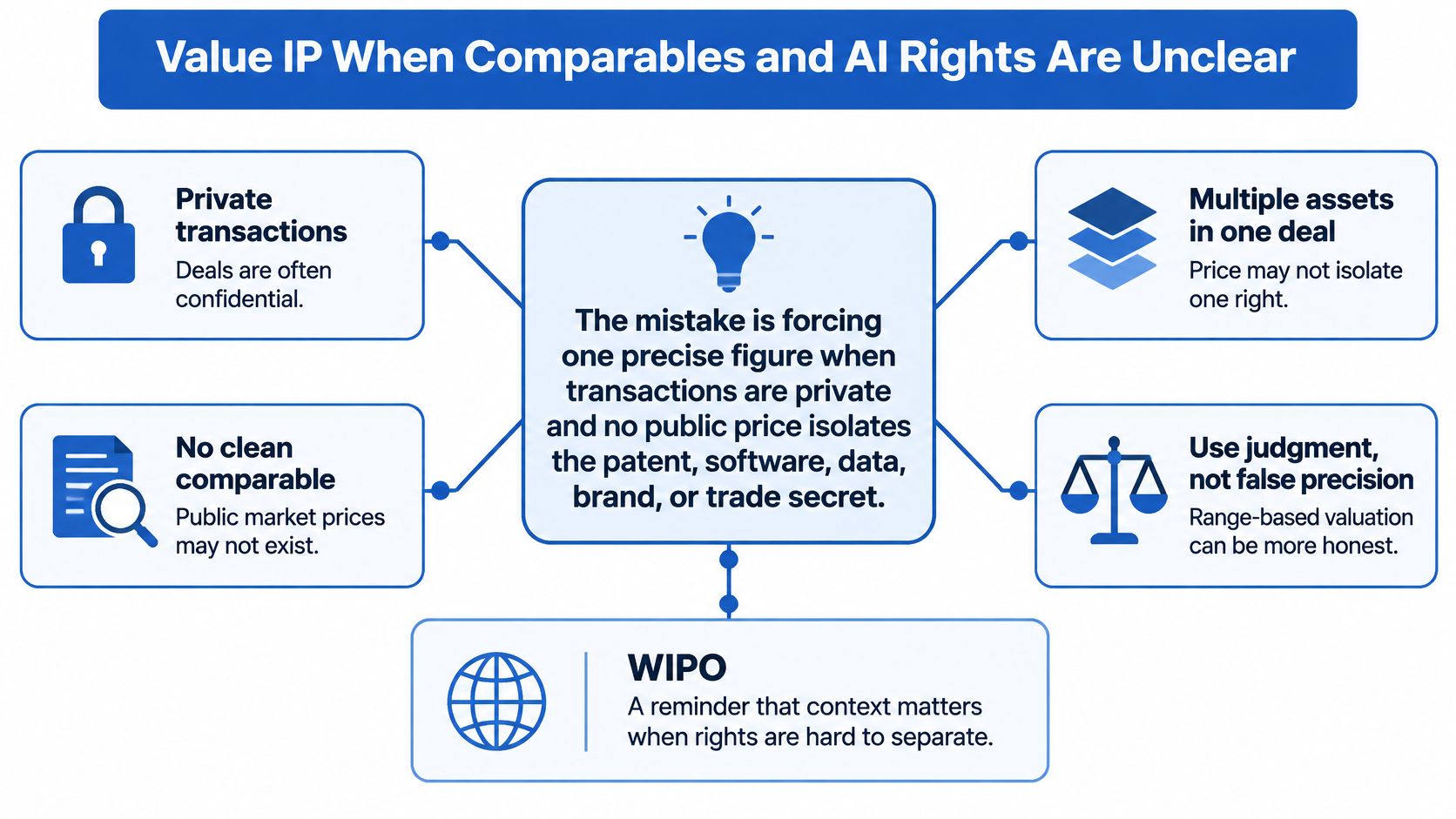
Forcing one precise figure is the mistake when transactions stay private and no public price isolates the patent, software, data, brand, or trade secret inside a deal. Precision without evidence doesn't persuade a careful buyer. It gives that buyer a reason to discount everything else in the data room.
Triangulate instead of hunting a phantom comparable
A WIPO report on moving IP finance to the mainstream identifies limited disclosure, the absence of a common valuation framework, and the scarcity of comparable transactions as major barriers to reliable benchmarking, and notes that IP assets rarely function independently. That last point matters in practice. A patent, a data set, know-how, a brand, and software often earn only as a bundle, so asset value isn't a habitual slice of enterprise value.
Triangulation gives a defensible structure when no clean comparable exists.
- Cost floor: Reproduction or replacement cost sets the minimum a rational buyer weighs against building from scratch.
- Income case: Discounted cash flow or relief-from-royalty models the expected economic benefit if commercialization works.
- Scenario range: Probability-weighted cases reflect legal, technical, regulatory, and market uncertainty instead of hiding it.
A documented range with explicit assumptions is more decision-useful than a point estimate with six significant figures. Investors can argue with an assumption. They can't argue productively with a number that arrives without one.
AI changes the ownership question before the math question
A WIPO press release with Luiss Business School reported that investment in intangible assets, including software, data, brands, and other IP-backed assets, grew three times faster in 2024 than investment in physical assets, with software and databases benefiting from the AI boom. That growth doesn't make every model, prompt library, or wrapper valuable. It raises the cost of sloppy ownership records.
An AI-related valuation has to separate protectable rights from operational advantages. A clever workflow that any competitor can copy next month isn't an asset with durable cash flow. Documented code ownership, a clean license chain, and defensible data rights are what convert capability into something transferable.
Founders sorting out who holds rights in machine-generated output will find the background on AI content ownership from LegesGPT a useful companion read. The valuation consequence is direct. Output the company can't prove it owns, or can't sublicense, can't support projected licensing revenue.
Training-data provenance deserves the same scrutiny. Data collected under terms that forbid commercial model training creates infringement exposure and may block a sale. Dependence on a third-party foundation model adds another discount, because pricing, access, or terms can change outside the company's control. Guidance on IP challenges in the age of AI covers the related contract and risk questions founders face before those issues reach a term sheet.
What makes an AI valuation financeable
Projected revenue isn't enough, and that's the direct answer founders asking about loans or venture debt need to hear. WIPO analysis points to a persistent gap between accounting values and market values, limited disclosure, weak lender familiarity with IP, high transaction costs, and difficulty liquidating intangible assets. A company can hold real economic value and still borrow poorly against it.
The financeable package answers the lender's downside questions in advance.
- Documented rights: Registrations, assignments, and license chains that prove who owns what.
- Contract strength: Enforceable customer and license agreements, with renewal and maintenance status current.
- Freedom to operate: A written analysis showing the product doesn't depend on infringing someone else's rights.
- Dependency map: Third-party models, data sources, and key contractors listed with replacement options.
- Downside case: A credible liquidation or reduced-operations scenario showing what the assets fetch if growth stalls.
Customer concentration belongs in that package too. Revenue tied to the IP means less when one customer can end it. Presented together, the cost floor, income case, and downside scenario make an AI-related valuation financeable even when no comparable sale exists.
Deal Facts and Adjustments That Move the Number
After a base model exists, deal terms do the damage or the good. This pass isn't a second valuation. It's the adjustment layer where contract language caps, shortens, or occasionally rescues the cash flow a model is allowed to count.
License scope caps countable cash
Field of use, territory, exclusivity, sublicensing rights, and audit rights all limit what a licensee can earn and what a licensor can collect. Say a trademark license carries an attractive royalty rate but no exclusivity, a single state territory, and no sublicensing. The rate looks rich until the revenue base shrinks to what that narrow grant can produce. Valuing the rate without the scope overstates the asset.
Ownership facts cut the same way in funding rounds and asset sales. Buyers discount rights that can't be assigned, sit in a founder's personal name, or depend on contractor work that was never assigned to the company. A clean intellectual property assignment record removes that discount before diligence starts, while a missing signature turns a valuation question into a closing condition.
The cost floor and the maintenance trap
The WIPO manual on IP valuation basics identifies three cost concepts, creation cost, replacement cost for comparable utility, and reproduction cost for the same features, functionality, and attributes, and treats the approach as particularly useful for very early-stage assets with little or no commercial evidence. Used properly, that figure is a floor for a prototype or young trade secret. Used as commercial value, it confuses spend with earning power.
Maintenance failures can zero an elegant model. Unpaid patent fees can lapse the right being forecast. An unmonitored trademark can weaken until enforcement gets expensive and uncertain. Those aren't administrative details, they're cash costs and survival conditions that belong inside the model.
Three scenarios that change the answer
Say a patent sale model forecasts eight years of protected revenue, but only three years of term remain. Years four through eight need a different justification, such as trade secret know-how or brand strength, or they come out. The number falls, and it should.
Say a data set looks ideal as loan collateral until provenance records can't show where records came from or what consent covers them. A lender can't pledge what a borrower may not have the right to use. The asset may still help operations, but its financeable value drops toward zero.
For machine-created output and training data in current deals, the upstream license is an economic limit, not a legal footnote. If the terms forbid a use the forecast depends on, that revenue isn't available to count. Stating who owns the output and what the license forbids protects both sides from pricing a right that doesn't exist.
Final check before the number leaves the building: Confirm ownership and assignments, remaining life, license scope, maintenance status, and the one input that moves the range most.
When to Bring In Valuation Counsel
The decision rule is about audience and consequence, not company size. A number used for internal planning tolerates rougher edges. A number shown to an investor, buyer, lender, or tax authority becomes a representation, and representations get tested.
In-house or bring counsel
| Situation | Keep in-house | Bring specialist and counsel |
|---|---|---|
| Asset | Simple, documented, and owned outright | Tied to AI training data, contractor code, or a dispute |
| Audience | Internal planning range | Investor, buyer, licensor, lender, or tax authority |
| Assumptions | Company's own revenue and documented life | Royalty rate, exclusivity, or license terms still open |
Keeping work in-house makes sense when ownership is documented, the forecast uses the company's own revenue history, and the output stays an internal range for planning. A founder can run the cost floor and a simple income case on a single trademark without outside help. The model should still carry its assumption sheet, because internal numbers have a habit of escaping into pitch decks.
Triggers that change the answer
Certain facts should move the work to a valuation specialist and counsel together, promptly.
- Missing assignments: Contractor or founder work product that the company can't prove it owns.
- Royalty disputes: A rate, audit, or scope fight where the valuation supports a legal position.
- Collateral or sale: IP pledged for a loan, or a buyer requesting an ownership warranty.
- Mismatched life: Patent term or license duration that doesn't match the forecast period.
Counsel adds what a spreadsheet can't. Confirming chain of title establishes that the seller owns the thing being priced. Narrowing license and sale terms aligns modeled cash flows with what the contract permits, and spotting infringement or AI contract risk early prevents the valuation from becoming an expensive representation later.
By Design Law Firm & Legal Consultancy, PLLC, a Seattle business and technology firm, manages intellectual property agreements and can draft licensing agreements or other contracts and work with the U.S. Patent and Trademark Office. Its intellectual property services help secure trademarks, copyrights, patents, trade secrets, and franchise rights. That combination matters because valuation support without contract cleanup leaves the weakest link untouched.
The practical next step takes one afternoon. Freeze the assumption sheet, write the low-base-high range in one paragraph, and have counsel review ownership plus the agreement that will carry that range. The firm can be reached at (206) 593-1519 or through bydesignlaw.com by choosing Intellectual Property on the contact form.
Founders and Washington businesses preparing an IP valuation for investors, buyers, licensors, or lenders can get ownership records, license terms, and the supporting contracts reviewed before the number becomes a representation. By Design Law Firm & Legal Consultancy, PLLC helps clients document, protect, and transact around trademarks, copyrights, patents, trade secrets, and AI-related rights, and the firm can be contacted at (206) 593-1519 to start that review.