Intellectual property infringement occurs when someone uses protected intellectual property without the rights holder's authorization or beyond the scope of a license. That simple definition answers what is intellectual property infringement, but it doesn't tell a founder whether a copied photo, a similar logo, or an AI generated image crosses the line.
That's the situation many Washington startups face at launch. A team pulls a font, a stock image, a snippet of code, and a catchy name into a live site in one afternoon, then wonders months later who owned any of it. Intent rarely decides the answer. The act, the type of right involved, and whether permission existed decide it, and registration timing often decides what a rights holder can recover.
What Intellectual Property Infringement Means and the Four Types
A useful analogy is a house. Owning a house gives the owner control over who enters, stays, or rents a room, and a neighbor can't move in just because a door was left open. Intellectual property works the same way, except the asset is intangible, such as code, a brand name, an invention, or a customer list.
Using that asset without permission, or using it in a way a license doesn't allow, is infringement. Identical copying isn't required. A near copy can still infringe if it takes what the right protects, whether that's expressive content, a confusingly similar brand, or every element of a patent claim.
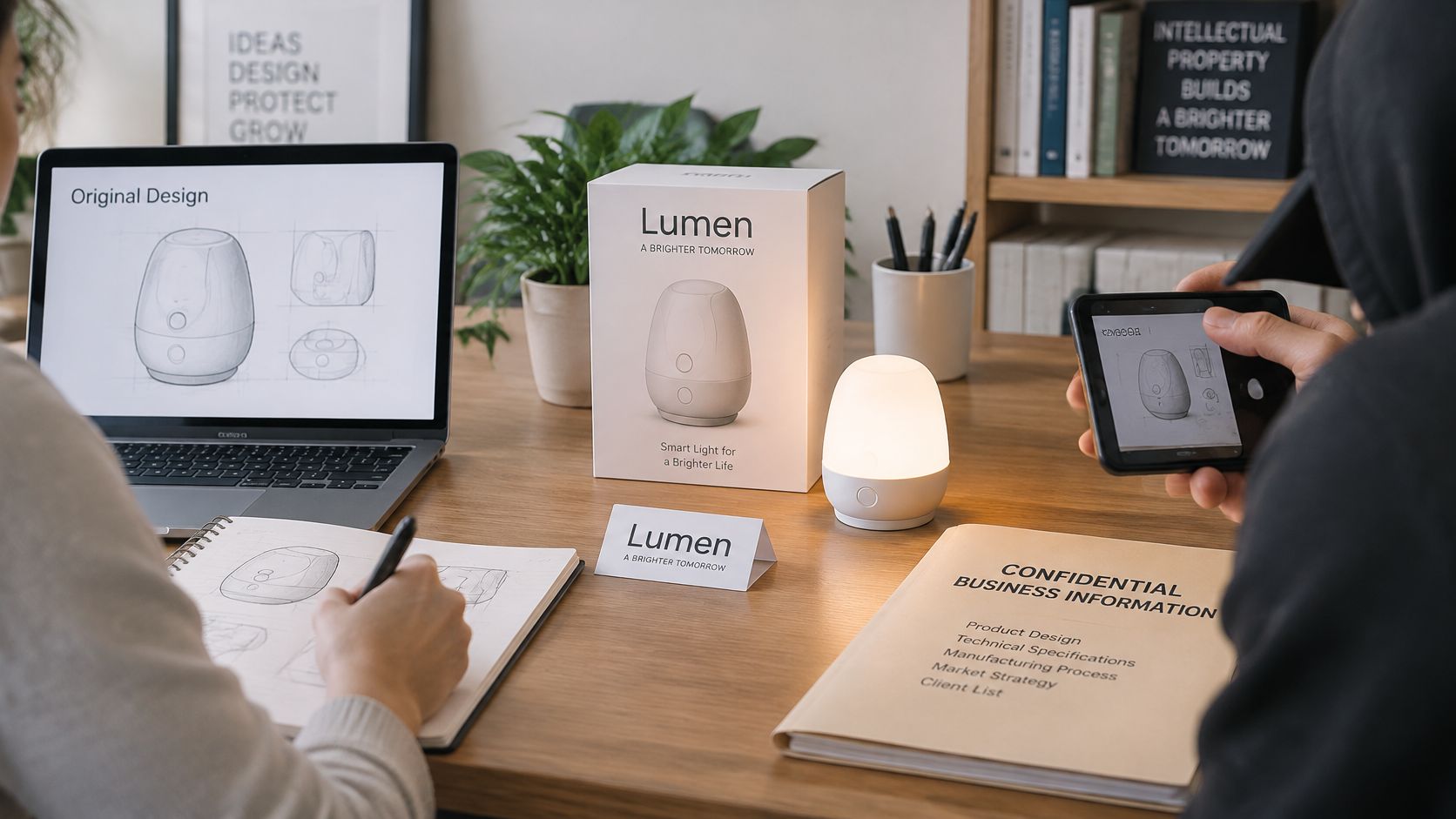
The Four Types at a Glance
The four types of IP infringement at a glance
| Type | What It Protects | Infringing Act | How the Right Arises |
|---|---|---|---|
| Copyright | Original works such as software code, text, photographs and video | Copying or distributing the work without permission | Automatically on creation; registration unlocks remedies |
| Trademark | Brand names, logos and slogans | Using a confusingly similar mark or counterfeiting | From use in commerce; registration strengthens it |
| Patent | Inventions as defined by their claims | Making, using, selling, offering for sale or importing the claimed invention | Only once a patent is granted, and only in the territory where granted |
| Trade secret | Confidential business information such as customer lists, formulas and pricing | Improper acquisition, use or disclosure | Lasts as long as the information stays secret |
Copyright is infringed by copying or distributing an original work without permission. Trademark is infringed by using a confusingly similar mark or by counterfeiting. Patent is infringed by making, using, selling, offering, or importing a claimed invention. Trade secret protection is broken by improper acquisition, use, or disclosure.
One act can touch several types at once. Copying a competitor's product photos and logo for a new storefront can raise copyright questions about the photos and trademark questions about the logo, even though the founder made a single design decision. Fonts raise a similar overlap, which is why understanding typeface copyright law helps before a team locks a visual identity into packaging and software.
How Large Is the Problem
Infringement isn't a rare dispute between two companies. It diverts sales, dilutes brand identity, reduces the value of innovation, and creates safety risks when counterfeit products are defective.
The World Intellectual Property Organization enforcement overview reports that counterfeit and pirated goods represented approximately 2.5% of global trade in 2019. WIPO also reports more than 130,000 customs seizures of counterfeit and pirated goods worldwide each year during 2017 to 2019.
Those figures need a caveat. They cover intercepted physical goods, not online piracy, domestic production and sales, unreported transactions, or infringements customs authorities don't detect. A Seattle software company can face serious infringement online without a single shipment ever reaching a border.
Practical rule: For any asset, ask three questions. Does the business hold the rights, does it have authorization, and does the planned use fit inside the license?
If any answer is unclear, the asset isn't cleared for launch. That check takes minutes before publication and can take months to reconstruct after a demand arrives. The same three questions also work in reverse when a competitor copies a founder's work, because the founder needs to show ownership, unauthorized use, and a use that falls within the protected right.
A common confusion is ownership of a copy versus ownership of the right. Buying a photograph, downloading software, or hiring a contractor doesn't automatically transfer the underlying rights. The purchase or contract controls what the buyer can do, and anything outside that scope needs separate permission.
How Courts Decide Whether Infringement Occurred
Courts don't start with whether a defendant meant to copy. They work through a structured test, and each step should be tied to a record a business can keep from day one.
The process below shows the sequence courts follow.
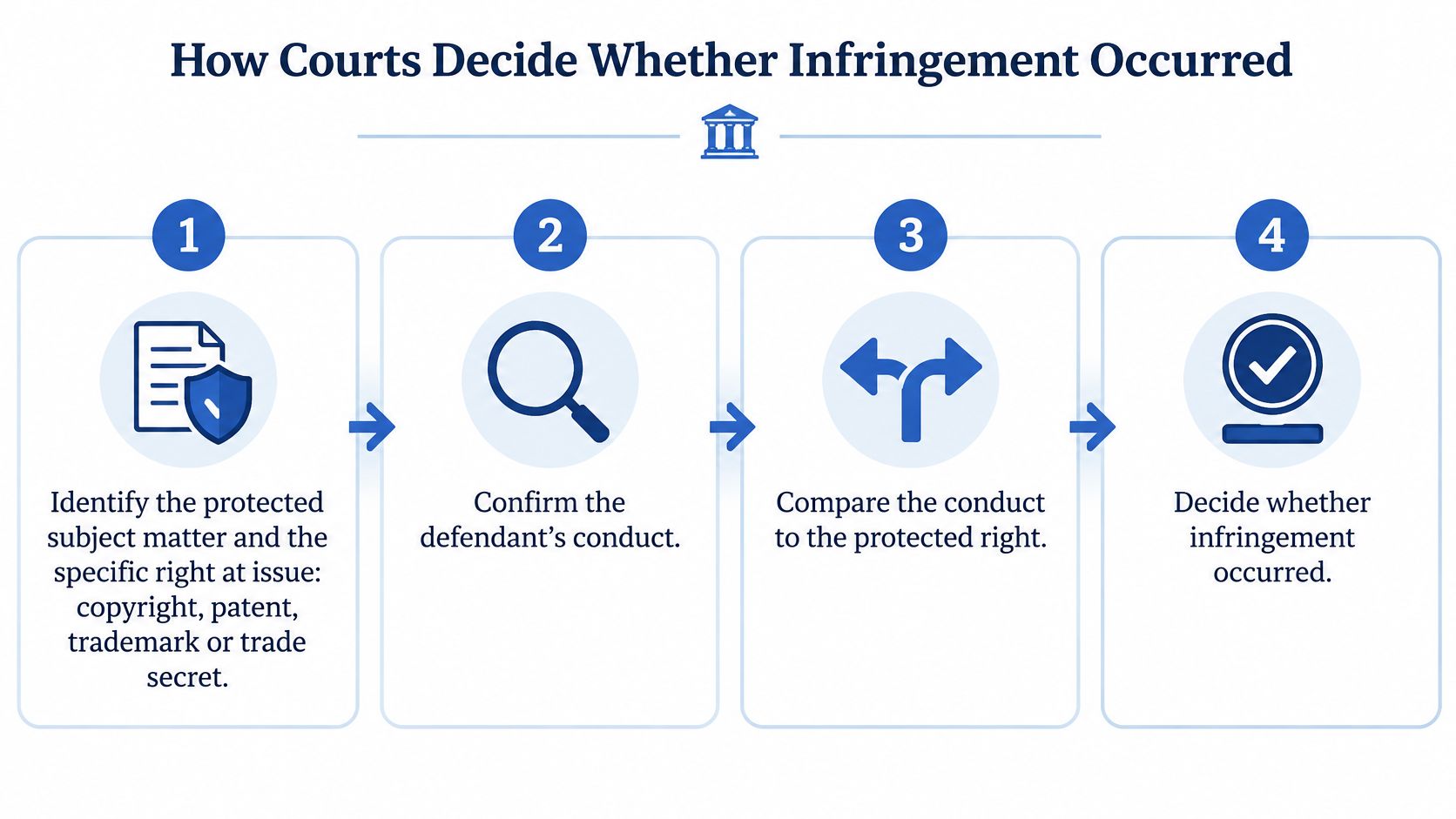
The Steps in Order
- Identify the protected subject matter: Name the specific right at issue, such as copyright, patent, trademark, or trade secret, and the exact work, mark, claim, or secret involved.
- Confirm the conduct falls within the exclusive rights: For patents, that means making, using, selling, offering for sale, or importing within the territory and period where the patent is enforceable.
- Compare the conduct to the right: For patents, compare the accused product to the asserted claim element by element. Infringement generally requires every element, although the doctrine of equivalents can catch a nonidentical component.
- Check copying and similarity for copyright: Prove copying through direct evidence or access, then show substantial similarity.
- Confirm no authorization covers the use: Review licenses, permissions, and contract scope.
On the patent point, the U.S. Patent and Trademark Office guidance on the doctrine of equivalents explains that a nonidentical component may still infringe when it performs substantially the same function, in substantially the same way, to achieve substantially the same result as a claimed element. The analysis runs element by element, not by comparing products at a high level.
For copyright, the Congressional Research Service summary on copyright infringement describes two linked requirements, unauthorized copying and legally meaningful similarity. Courts weigh the qualitative and quantitative importance of the copied material, so a short portion can matter if it captures the work's expressive core, while extensive copying of unprotectable ideas, facts, systems, or common elements may not establish infringement.
The video below walks through how that comparison works in practice.
Records usually decide the outcome. Version histories, architecture diagrams, design notebooks, source code commits, supplier records, and release dates help map functionality to claim limitations and show independent development. Original files and metadata, access logs, repository permissions, creation timelines, and licenses serve the same role in copyright disputes.
Patent infringement is also territorial. A design lawful in one country can be actionable where a corresponding patent exists and the prohibited conduct occurs. A freedom to operate review should therefore analyze issued claims and prosecution history, not product names or marketing features.
Everyday Examples From Software, Brands and AI
Abstract definitions become clearer in ordinary business scenes. Each scenario below names the right it touches and the act that triggers the problem.
Five Common Scenarios
- Copied website content: A startup copies a competitor's product photos and help center text for its own site. That's a copyright problem, because the photos and text are original works used without permission.
- Lookalike branding: A café chain adopts a logo and name with a similar look to an established brand. That's trademark confusion, and founders reviewing that risk can compare it with what counts as trademark infringement before printing signage.
- Unlicensed mechanism: A manufacturer sells a device using a patented mechanism without a license. That's patent infringement if the device contains every element of a claim.
- Client list carried to a new job: An employee brings a former employer's client list to a new firm. That's trade secret misuse if the list was confidential and taken through improper means.
- AI image that resembles existing art: A marketing team publishes an AI generated image that closely resembles an existing artwork. That's copyright risk even without intentional copying.
The AI scenario deserves closer attention because the user may never know the source of an output. Training data can include books, images, videos, and voices, and an output can closely resemble an existing work without any deliberate copying by the team that publishes it.
The OECD report on AI incidents reported by the media reports that intellectual property issues have represented about 5% of media reported AI incidents since 2022, with peaks of 7.7% in both July 2024 and June 2025. Reported issues commonly involved alleged unauthorized use of written works, images, videos, likenesses, and voices for AI training.
Ownership and infringement are separate questions here. The U.S. Copyright Office concluded in January 2025 that AI outputs may receive copyright protection when a human determines sufficient expressive elements, but providing prompts alone is not enough. A company can therefore face a claim over an output while lacking exclusive rights to protect that same output, a difficult position for marketing assets and product designs.
By Design Law Firm & Legal Consultancy, PLLC advises clients on emerging intellectual property areas, including domain name rights, digital assets, and machine created content. For any generated asset, the safer habit is simple. Keep prompts, output histories, source licenses, and human review records, and don't upload confidential third party content into a tool.
Defenses That Can Defeat or Reduce a Claim
A demand letter isn't a final judgment. Each defense below works as a question a founder can check against the facts before responding.
Was the use authorized? A license, written permission, or an open source license whose conditions were met can defeat the claim outright. Video creators face this question with background music, and music rights guidance for video creators shows how permission scope changes with platform and use.
Was the work created independently? Independent creation defeats a copying claim because copying was never shown. Dated drafts and commit histories carry more weight than a later explanation.
Does fair use apply? Fair use is flexible and case specific, weighing purpose, nature, amount used, and effect on the market, rather than applying a fixed percentage rule. Seattle creators can test those factors against fair use in digital content creation before assuming a use is safe.
Limits Founders Often Miss
Has the right expired, lapsed, or never been valid? A patent past its term or a trademark no longer in use may not support a claim. Is an asserted element absent? In patent disputes, a missing claim element is the core non infringement argument. Is the material unprotectable? Facts, ideas, systems, and common elements aren't protected expression.
Possessing or lawfully buying a copy doesn't authorize reproduction, public display, modification, or commercial deployment. Good faith conduct can also matter when damages are calculated, even when it doesn't erase liability.
Before answering any demand letter, preserve dated records of how the material was obtained, how it was used, and who approved it.
Damages and Remedies a Rights Holder Can Seek
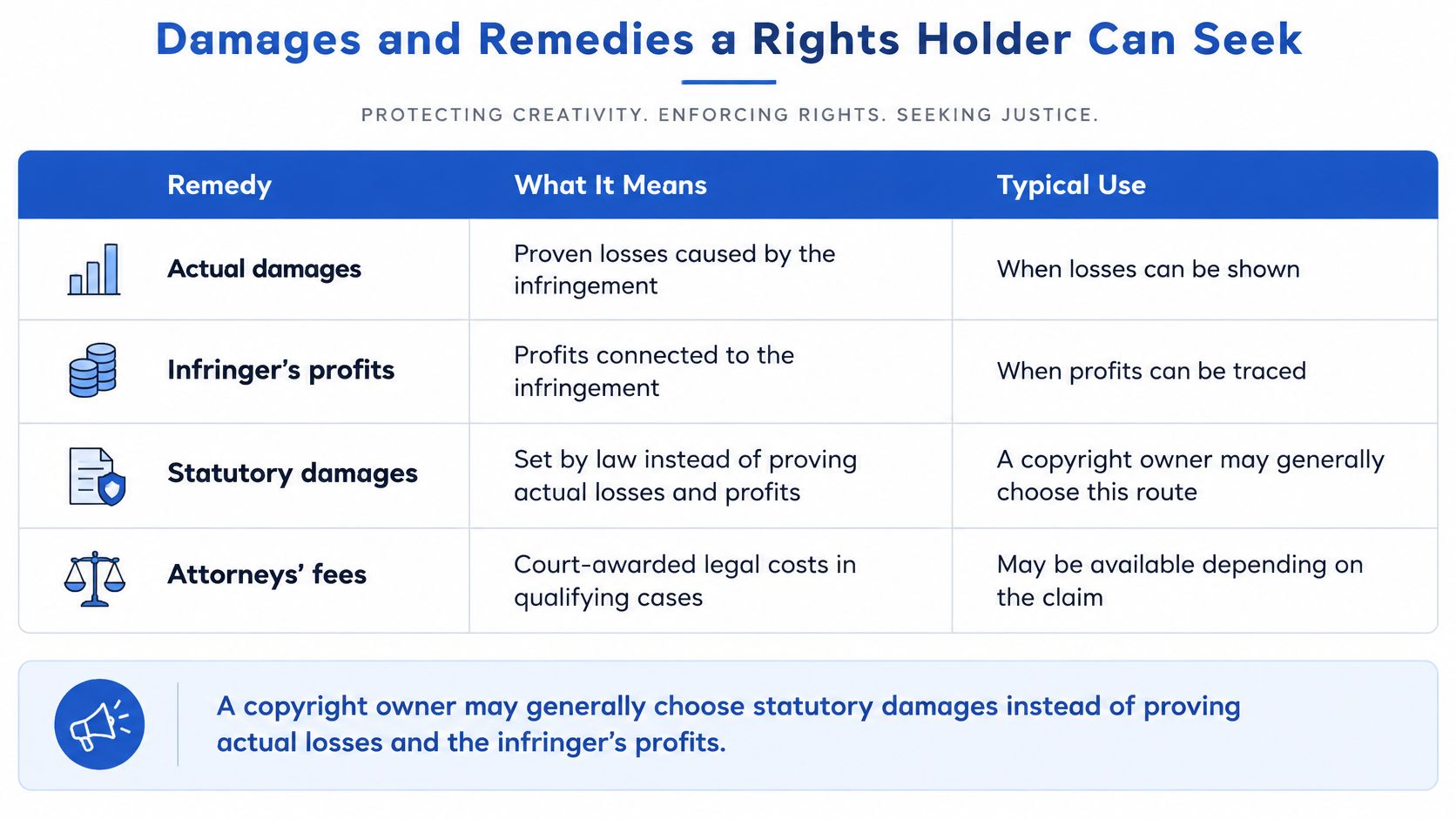
Money is where registration timing stops being paperwork and starts deciding outcomes. The chart below frames the remedy categories before the numbers.
Copyright damages and forum limits by situation
| Situation | Award Range | Condition |
|---|---|---|
| Standard statutory award | $750 to $30,000 per work | Court sets the amount within the range |
| Willful infringement | Up to $150,000 per work | Owner proves the infringement was willful |
| Innocent infringer | As low as $200 per work | Infringer proves no reason to know the conduct infringed |
| Copyright Claims Board, timely registered work | Up to $15,000 per work | Total damages capped at $30,000, excluding fees and costs |
| Copyright Claims Board, not timely registered | Up to $7,500 per work or $15,000 total per proceeding | Eligible claims only |
The U.S. Copyright Office fair use FAQ explains that a copyright owner may generally choose statutory damages instead of proving actual financial losses and the infringer's profits. The range is $750 to $30,000 for each infringed work, rising to as much as $150,000 per work for willful infringement and falling to as little as $200 per work when the infringer proves they were unaware and had no reason to know. Figures apply per work, not necessarily per copy.
Why Registration Timing Controls the Table
Statutory damages and attorney's fees are normally available only when the work was registered before infringement began or within three months after first publication, as the Copyright Office statement on registration and statutory damages sets out. Late registration leaves actual damages and provable profits. A copyright owner generally must also register, or obtain a refusal, before filing in federal court.
The Copyright Claims Board offers a limited alternative, and Chapter 15 of the Copyright Act caps total damages at $30,000, excluding attorney's fees and costs. Trademark and patent remedies follow different rules, typically centering on injunctions, damages, and profits rather than per work amounts.
The decision rule is direct. If a work is unregistered and infringement has begun, register now to protect future acts, and expect actual damages only for the current one.
Enforcement Routes From Takedown Notices to Court
Effective enforcement usually escalates in order, from cheapest to most formal. Skipping early steps often wastes money, while staying too long at a weak step lets copies spread.
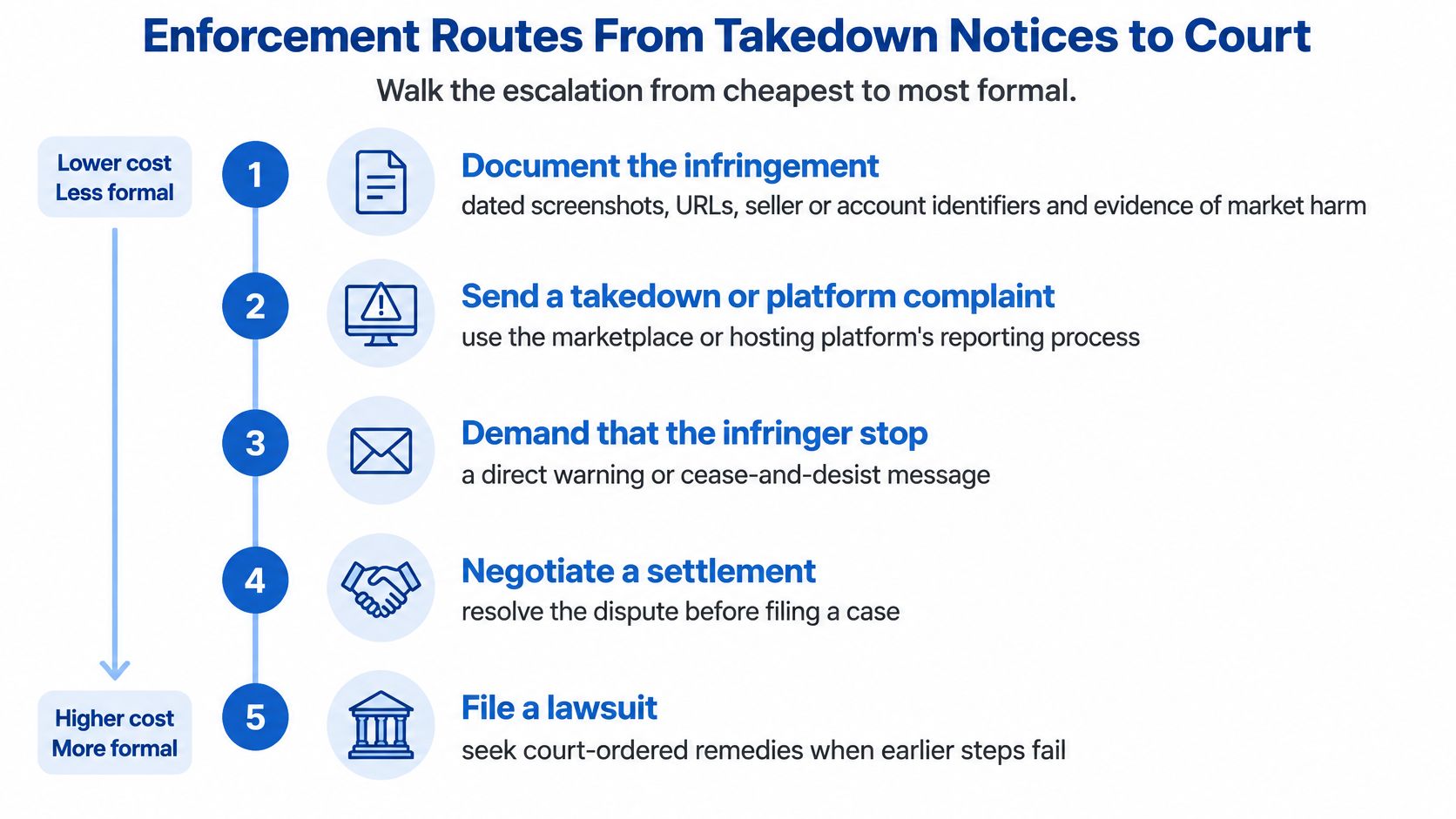
- Document the infringement: Save dated screenshots, URLs, seller or account identifiers, and evidence of market harm.
- Send a takedown or platform complaint: Use copyright notices to hosts and trademark complaints through marketplace procedures.
- Send a demand letter: Set out the rights, the evidence, and a response deadline, following the structure of a cease and desist letter.
- Use a limited forum: Eligible, modest copyright claims can go to the Copyright Claims Board.
- File federal litigation: Claims above board limits, or those needing an injunction, belong in court.
- Consider customs or criminal routes: Counterfeit physical goods may justify seizure or referral.
Speed is the hard part. The CSC State of Online IP Risk 2026 survey found that 73% of surveyed executives identified slow enforcement processes as a leading operational challenge, while 90% believed AI enabled systems were increasing the frequency of online infringements and 52% expected a significant increase over the next three years.
Stronger rights don't automatically produce stronger practical protection. Automated counterfeit listings, impersonation, domain abuse, scraped content, and synthetic media spread faster than a small team can document them. Match each step to the claim's value, urgency, and evidence, and remember that copyright takedowns, trademark platform complaints, patent litigation, trade secret containment, and contract claims aren't interchangeable.
When Infringement Becomes a Crime and How Goods Are Seized
Most infringement disputes stay civil, but deliberate counterfeiting and commercial piracy can become criminal. The distinction matters because civil liability can apply without criminal intent, while criminal routes target wilful, commercial scale conduct and the infrastructure behind it.
WIPO 2023 survey on IP crime and site enforcement
| Measure | Result |
|---|---|
| Trademark offenses, average share of reported IP crimes | 51.54% |
| Copyright offenses, average share of reported IP crimes | 27.83% |
| Member states with a process to shut down or seize infringing websites | 16 (67% of those reporting) |
| Member states with no such process | 11 (33% of those reporting) |
The WIPO Advisory Committee on Enforcement survey document estimated that trademark offenses represented 51.54% of reported IP crimes on average, compared with 27.83% involving copyright offenses. It also reported that 16 participating member states, 67% of those reporting, had a process to shut down or seize infringing websites, while 11 states, or 33%, reported no such process.
That split means site level enforcement depends on where the seller operates. One member state initiative had issued almost 4,500 cease and desist notices since April 2020, showing that administrative tools can run alongside criminal referral. More than 131,000 domains selling counterfeit goods had been shut down under reported efforts, so responses can target distribution infrastructure, not only individual sellers.
The Three Seizure Routes
- Customs seizure: Border authorities intercept physical counterfeit goods before they reach buyers.
- Administrative shutdown: Authorities or courts order infringing websites shut down or seized where a process exists.
- Criminal referral: Deliberate, commercial counterfeiting or piracy goes to prosecutors.
Is the infringing activity sold, shipped, or hosted in a jurisdiction where these tools exist?
If the answer is no, a rights holder may need platform complaints and civil claims in a different forum instead. Founders selling physical products should record trademark registrations with customs where available, because unrecorded rights are harder for border officers to act on.
Protect Your Business Before a Claim Arrives
Four moves this week prevent most of the disputes described above. None requires a large legal budget, and each one links directly to a remedy that disappears when the step is skipped.
1. Build an IP inventory. List every creative work, brand name, invention, and confidential asset with its owner, registration status, and creation date. A spreadsheet works if it’s updated at every launch.
2. Add clearance checks before launch. Search existing marks, review third party code and image licenses, and confirm source terms for stock and open source material. Teams publishing visual work can also review protecting creations with AI Image Detector for ways to monitor misuse of images online.
3. Put contracts in place. Use license agreements with clear scope, employee and contractor assignment clauses, and confidentiality terms that protect trade secrets. Founders who haven’t formalized ownership should review intellectual property assignment before a contractor’s work becomes the core product.
4. Register what matters. File copyright registration for valuable works, ideally before publication, and trademark filings for core brand names. By Design Law Firm & Legal Consultancy, PLLC’s intellectual property services help secure trademarks, copyrights, patents, trade secrets, and franchise rights, and the firm can draft licensing agreements or other contracts and work with the U.S. Patent and Trademark Office.
One question sorts the priorities. Which asset would cost the most if a competitor copied it tomorrow? Register, document, and contract around that asset first.
By Design Law Firm & Legal Consultancy, PLLC helps Washington founders register and defend trademarks, copyrights, and other intellectual property, draft the contracts that keep ownership clear, and respond when a competitor or platform crosses the line. A founder who has found copied content, received a demand letter, or wants an inventory reviewed before launch can visit By Design Law Firm & Legal Consultancy, PLLC to discuss the next step. Contact our law office at (206) 593-1519.