A founder signs a vendor agreement on a Friday afternoon and adds a $50,000 termination fee. The number feels protective. The vendor's failure could disrupt a launch, force emergency work, and create customer-support problems, so a fixed recovery seems sensible.
Months later, the vendor terminates. The founder demands $50,000. The vendor challenges the provision, arguing that the amount was selected as punishment rather than calculated as a forecast of loss. The dispute now turns on the work nobody documented when the agreement was signed.
A liquidated damages clause can make recovery more predictable, but only when the contract connects the payment to a defined breach, a defensible loss model, and a coherent remedy structure. For Washington startups, SaaS companies, and small businesses, the important question isn't whether a clause uses the words “liquidated damages.” The question is whether the signing record shows compensation instead of coercion.
A Founder's First Look at Liquidated Damages
A Seattle software founder recently negotiated a services agreement for a customer migration. The vendor wanted a termination fee. The founder agreed to a fixed amount, assuming the clause would cover replacement personnel, emergency remediation, and the internal cost of moving the project to another provider.
The problem wasn't the idea of a fixed recovery. The problem was the number. The draft contained a round sum with no breach definition, no calculation, no distinction between a missed milestone and a total abandonment, and no explanation of whether the fee was the vendor's exclusive remedy. It looked less like a forecast and more like a threat.
That distinction matters because courts examine substance, not labels. A provision called “liquidated damages” can still be treated as an unenforceable penalty if it imposes an amount disconnected from anticipated harm. If the clause fails, the non-breaching party may have to prove ordinary damages instead of relying on the agreed payment.
Practical rule: A liquidated damages clause should answer three questions before signature: what breach triggers payment, how was the amount calculated, and what other remedies remain available?
Founders often focus on whether a document is an agreement or a contract, but the same practical discipline applies to both. A useful explanation of that distinction appears in this guide to agreements versus contracts. Whatever the document's label, the commercial team should preserve the business assumptions supporting the payment.
A sound clause can prevent a messy damages fight. A careless clause can leave both sides with uncertainty, expensive proof problems, and no predetermined recovery. The strongest drafting happens before the breach, when the parties can still identify cost drivers, test assumptions, and choose a remedy architecture that matches the deal.
What a Liquidated Damages Clause Actually Is
A liquidated damages clause sets the payment due when a defined breach occurs. It may state a fixed sum or use a calculation formula. The agreed recovery avoids proving every dollar of actual loss after the breach, but the amount still needs a rational connection to the harm the parties could anticipate at signing.
Draft the trigger with precision. “Any breach” is usually too broad for a technology agreement. A missed implementation milestone, unauthorized disclosure, service outage, failure to meet a transition obligation, and early termination can produce different costs. Each event may require its own amount, formula, or breach tier instead of one charge for every failure.
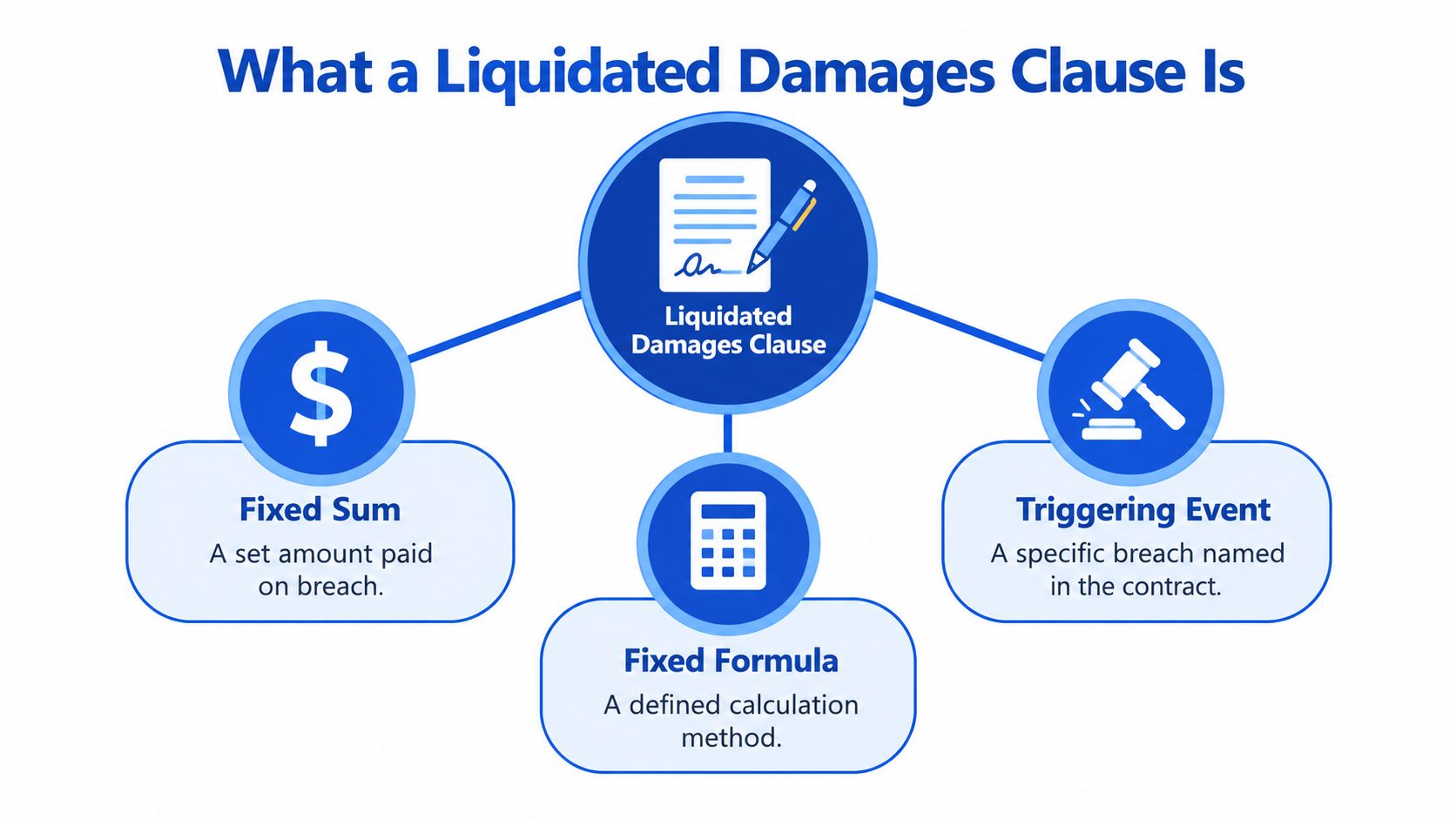
The three questions that control enforceability
Use three questions when building the clause:
- Does the amount reflect anticipated or actual harm? Tie the figure to foreseeable costs, such as replacement labor, remediation, delay-related operational disruption, or lost commercial opportunities.
- Is the harm difficult to measure accurately? Liquidated damages fit best when ordinary proof would be unusually uncertain, costly, or speculative.
- Is the amount punitive? An unreasonably large sum, or one designed mainly to compel performance, risks treatment as an unenforceable penalty.
Uniform Commercial Code § 2-718 applies this framework to sales contracts. It permits predetermined damages when the amount is reasonable in light of anticipated or actual harm, the difficulty of proving the loss, and the inconvenience of obtaining another adequate remedy. An unreasonably large amount is void as a penalty. The full rule appears in UCC § 2-718.
For a SaaS implementation, the provider's defined failure might create emergency contractor costs, customer-support escalation, and a delayed launch. A documented formula tied to those cost categories gives the payment a stronger rationale than a round termination charge chosen to pressure performance. The calculation need not predict the exact eventual loss. It should show why the recovery was reasonable when the parties signed.
Liquidated damages must also fit with the rest of the contract. A damages cap limits exposure. Indemnification assigns responsibility for specified third-party or other losses. A termination fee may address the cost of ending the relationship, but its enforceability depends on its economic function. The surrounding provisions in what a service agreement includes should coordinate these remedies rather than treat them as interchangeable.
A valid clause estimates difficult-to-prove compensation. It does not impose a punishment for refusing to perform.
The Enforceability Test Under U.S. and Washington Law
A startup can lose a customer, miss a launch, or expose confidential information, then discover that its carefully labeled “liquidated damages” clause functions as a penalty. Courts examine the commercial logic behind the number, not the label on the provision.
The modern framework began with Dunlop Pneumatic Tyre Co. Ltd. v. New Garage and Motor Co. Ltd., the 1915 House of Lords decision reported at AC 79. The dispute concerned a tire distribution restriction and a payment required for selling below the manufacturer's listed price. The court treated the payment as enforceable because it represented a genuine pre-estimate of probable loss, including commercial harm that would be difficult to calculate after breach.
Washington technology contracts apply the same practical distinction. A clause should compensate for anticipated harm, not threaten an arbitrary payment designed to force performance. Courts examine the relationship among the breach, the expected loss, and the stipulated amount.
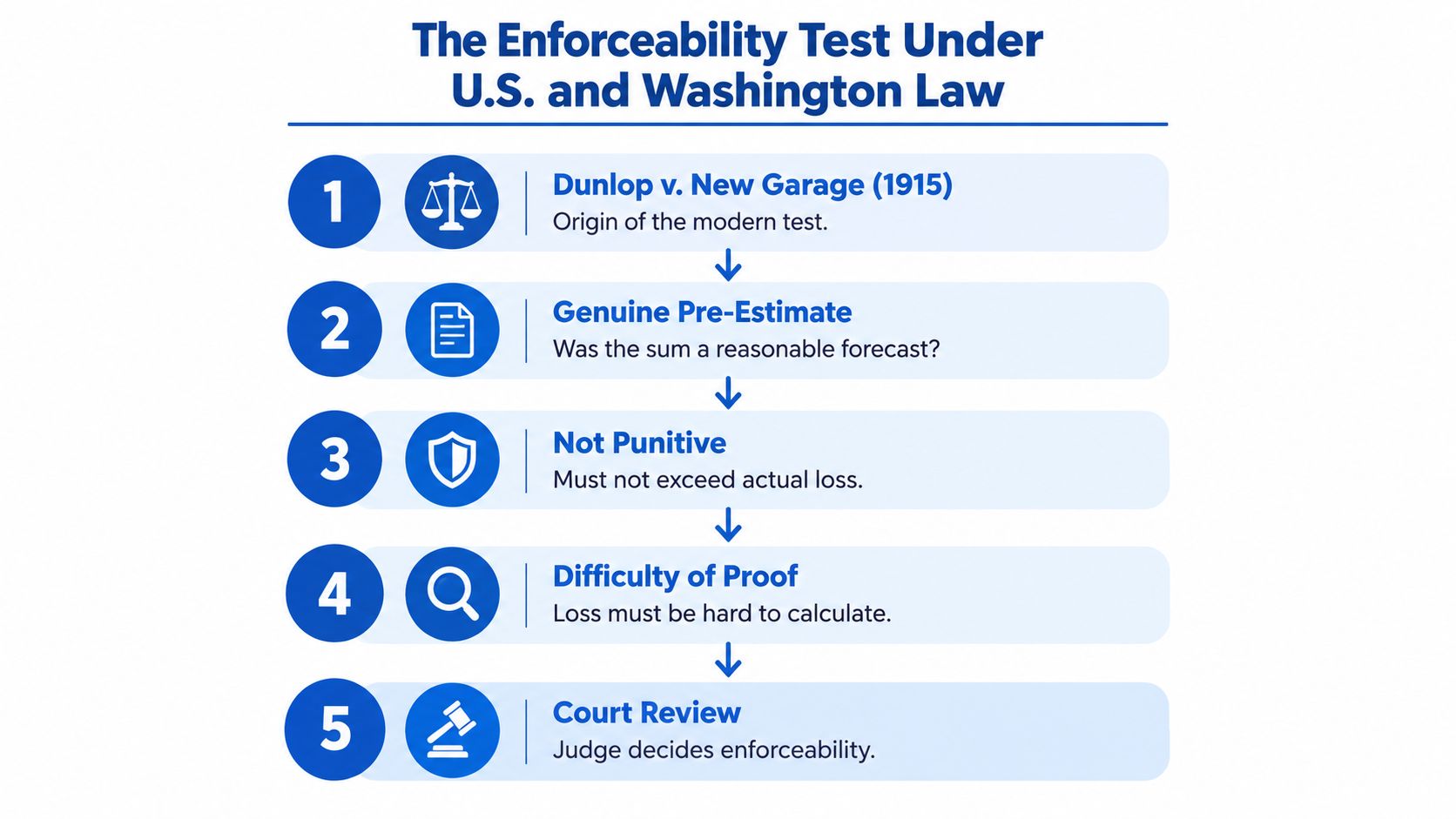
Washington applies a forward-looking inquiry
Washington courts ask whether the amount was a reasonable forecast of likely compensation when the parties formed the contract and whether the anticipated harm was difficult or impractical to measure. Later evidence that actual losses were smaller does not automatically defeat the clause. A claimant generally need not prove actual loss to recover the agreed amount when the provision satisfies that forward-looking test. The Washington Supreme Court's analysis appears in this decision on stipulated damages.
Drafting must therefore happen before the breach. Record the expected cost categories, the assumptions behind the calculation, the limits on mitigation, and the reason ordinary proof would be difficult. For a SaaS company, those categories might include emergency staffing, customer remediation, migration work, or a delayed implementation.
Use a calculation method that changes with the breach. A tier for a short delay may differ from a tier for a missed milestone, data-handling failure, or prolonged service interruption. The amount should reflect the expected harm for each tier rather than repeat one round figure across unrelated defaults.
The Restatement-based approach asks whether the amount is reasonable in light of anticipated or actual loss and whether the loss involves genuine difficulty of proof. A mismatch between the agreed amount and eventual damages does not alone invalidate the clause, but an arbitrary figure remains vulnerable.
Goods contracts have a statutory fallback
For a buyer who breaches a sales contract governed by Article 2, UCC § 2-718 provides a default restitution framework when no valid liquidated-damages term exists. Subject to the statute's conditions, the seller may generally retain the smaller of 20% of the buyer's total performance obligation or $500, as explained in the UCC provision. The rule matters for deposits, purchase orders, equipment agreements, and other goods contracts.
Washington real estate follows a separate statutory rule. A written purchase agreement can make an identified earnest-money or liquidated-damages provision the seller's sole and exclusive remedy, generally up to 5% of the purchase price, if the statutory requirements are satisfied. On a $600,000 purchase, the ceiling is $30,000, as stated in RCW 64.04.005.
The signing file should show why the formula made commercial sense at that moment.
Liquidated Damages Compared to Other Remedies
A liquidated damages clause occupies one position in a broader remedy architecture. It may provide predictability, but it doesn't automatically replace termination rights, actual damages, specific performance, indemnities, service credits, or a liability cap.
The contract should state whether the agreed payment is exclusive, cumulative, or available only after the claimant elects among specified remedies. Washington authority shows why this matters. In an earnest-money agreement, a seller who elects specific performance after a buyer's breach may not automatically recover additional unliquidated damages unless the agreement authorizes that remedy. The relevant Washington decision is discussed in this case on specific performance and damages.
| Remedy | Purpose | Enforceability Signal | Best Fit |
|---|---|---|---|
| Liquidated damages | Predetermine compensation | Reasonable forecast tied to difficult-to-measure harm | Delay, transition disruption, confidentiality loss, or other uncertain commercial harm |
| Actual damages | Recover proven loss | Ordinary evidence establishes the amount | Losses that can be measured reliably |
| Specific performance | Require the promised act | Legal and practical requirements support compelled performance | Unique assets, contractual transfers, or obligations money can't replace |
| Termination fee | Price a defined early exit or ending event | Amount reflects the consequences of termination | Agreements where transition and replacement costs can be estimated |
| Penalty | Pressure performance through excessive payment | Amount is punitive or disconnected from harm | No legitimate drafting objective |
Businesses comparing ordinary damages for breach of contract should separate two questions. First, what loss might the breach cause? Second, what relief should remain available if the agreed payment doesn’t address every consequence?
A SaaS agreement might make liquidated damages the exclusive remedy for a narrowly defined implementation delay while preserving indemnity rights for third-party claims. Another agreement might make a payment cumulative with termination rights but subject all recovery to a negotiated cap. Neither structure is automatically correct. The drafting must make the intended allocation unmistakable.
Founders reviewing a broader remedies package can also consult this resource on breach of contract remedies. The central warning is simple: don’t add a fixed payment to a contract without explaining how it interacts with everything else.
Drafting Best Practices and a Pre-Signing Checklist
The strongest clause usually begins in the deal memo, not the contract markup. Counsel should identify the breach-specific harm, test the proposed amount against realistic assumptions, and preserve the work showing why ordinary proof would be difficult.
Six moves that reduce penalty risk
-
Name the triggering breach. Identify the event precisely. “Failure to complete the migration by the agreed milestone” is more defensible than “any breach of this agreement.”
-
Use breach-specific tiers. Separate a missed milestone, a material abandonment, an unauthorized disclosure, and a prolonged service failure. A single amount for minor and major misconduct signals that the payment may be punitive.
-
State the calculation method. Identify the cost drivers and formula. The record might include replacement personnel, emergency remediation, customer-support escalation, delayed-launch revenue, and third-party response costs. A formula can use categories and assumptions without pretending that every future loss is certain.
-
Choose exclusive or cumulative treatment. State whether payment is the exclusive remedy for the triggering breach, cumulative with specified remedies, or subject to an election. Silence creates avoidable disputes.
-
Coordinate the liability cap. Say whether liquidated damages count toward the cap, sit outside it, or receive a separate cap. A clause that defeats the negotiated limitation of liability is likely to draw resistance.
-
Exclude claimant-caused events. The payment shouldn’t apply when the delay or failure resulted from the claimant’s acts, omissions, lack of cooperation, or approved change.
The American Bar Association recommends separating foreseeable damage categories, stating assumptions, identifying excluded recoveries, and specifying whether the payment is exclusive or cumulative. It also cautions against mechanical escalation when marginal harm doesn’t increase in the same way and against using the same charge for materially different breaches, as explained in its analysis of liquidated damages clauses.
Preserve the signing record
A founder should keep the forecast, calculation spreadsheet, internal approval notes, mitigation assumptions, and explanation of proof difficulty with the executed agreement. The file should identify excluded losses and explain why a fixed recovery is more practical than reconstructing every cost after a breach.
Transaction teams can apply the same discipline to broader deal preparation through a practical buying or selling guide. For contract drafting fundamentals, the next markup should also be tested against this guide on how to draft a contract. A clause that cannot be explained to a finance lead in plain language probably isn’t ready for signature.
A Sample Clause You Can Adapt
A SaaS or services clause should identify the breach, show how the amount was calculated, and define the remedy’s boundaries. Use the following as a drafting starting point, then test it against the governing law, deal economics, and related remedies.

Sample SaaS provision: If Provider fails to [complete the implementation milestone identified in Section [X] by the milestone date] for reasons not caused by Customer, Provider shall pay Customer liquidated damages calculated as [the documented, reasonable forecast of emergency remediation costs, replacement personnel, customer-support escalation, and delayed-launch disruption], subject to a maximum aggregate amount of $[amount]. The parties acknowledge that these losses would be difficult or impractical to determine precisely after the breach and that the stated amount is intended as compensation, not a penalty.
Complete the remedy architecture in the next sentence: “For the triggering breach, this payment is [Customer’s exclusive remedy / cumulative with the remedies identified in Sections [X] and [Y]], and it [is / is not] included within the liability cap in Section [Z].” Exclude claimant-caused delays, approved changes, applicable force majeure events, and amounts already paid as service credits.
For Washington real estate, a separate provision might state: “If Buyer fails without legal excuse to complete the purchase, the earnest-money deposit identified in this agreement shall be Seller’s sole and exclusive remedy, subject to the requirements and limit in RCW 64.04.005.” Washington’s real-estate statute generally permits an amount up to 5% of the purchase price, including a $30,000 ceiling on a $600,000 transaction, as discussed above.
Teams preparing independent-contractor paperwork can compare structure and issue-spotting points in RedactAI’s freelance contract roundup. Use any template as a checklist, not as a substitute for transaction-specific drafting.
Negotiation Tactics and Red Flags to Watch For
A provider should resist a customer’s demand for a single, unexplained payment. The better counterproposal identifies the triggering breach, separates tiers, explains the calculation, and clarifies whether the payment is exclusive. That approach gives the customer predictability without asking the provider to accept an arbitrary exposure.
A customer should resist vague formulas that make recovery impossible to calculate. The customer can request a documented schedule, a meaningful cap, exclusions for claimant-caused events, and a clear statement that the agreed sum doesn’t waive rights that the business still needs.
What each side should ask for
Service providers and vendors should ask:
- Defined triggers: Which breach activates payment, and what cure process applies?
- Tiered exposure: Why should a missed administrative deadline produce the same result as abandonment?
- Remedy clarity: Does the customer receive the payment instead of actual damages, or in addition to them?
- Causation limits: What happens when the customer delays access, approvals, data, or cooperation?
Customers and buyers should ask:
- A usable formula: Which expected costs support the amount?
- A practical cap: Does the payment fit within the broader exposure negotiated for the agreement?
- Mutual standards: Does the same reasonableness discipline apply to both parties’ fixed payments?
- Mitigation treatment: Are avoidable costs excluded, and are credits or offsets addressed?
Red flags that should stop the markup
A single round number with no rationale is a problem. So is a daily charge that increases automatically even though the underlying harm doesn’t increase at the same rate. A provision that applies regardless of fault, cooperation, or causation also deserves immediate revision.
The most dangerous language treats every breach alike. A clause imposing the same amount for a minor reporting error and a complete failure to deliver may look efficient, but it gives a court a reason to view the payment as punishment. The negotiation should focus on the business loss, not on maximizing advantage.
Key Takeaways and Frequently Asked Questions
A defensible liquidated damages clause is built at signing, not reconstructed after a dispute. Three drafting decisions matter:
- Document the forecast at signing. Keep the assumptions, cost categories, and calculation method that support the stated amount.
- Set the remedy architecture. Say whether payment is exclusive or cumulative, and coordinate it with termination, specific performance, indemnities, service credits, and liability caps.
- Tie the amount to measurement difficulty. Explain why ordinary damages would be uncertain, impractical, or unusually expensive to prove.
Can a clause survive when actual damages turn out to be small? Yes. Washington uses a forward-looking inquiry. Smaller losses in hindsight do not automatically defeat a payment that was a reasonable forecast when the parties signed and addressed harm that was difficult to measure. The Washington Supreme Court decision on the forward-looking test discussed above explains that approach.
Can liquidated damages stack with termination or specific performance? Only when the contract supports that result. Washington authority examines the remedy structure as a whole, and a party may not automatically recover additional unliquidated damages after electing specific performance. State the intended election, exclusivity, and cumulative rights expressly.
Is mutuality required? Identical remedies are not mandatory in every agreement. Mutual treatment can strengthen negotiations by showing that both parties applied the same commercial standard. The controlling question remains whether the particular clause and transaction are reasonable.
How do AI and privacy breaches fit? The same framework applies. Identify the triggering event, separate foreseeable investigation, response, and remediation costs, and record why the total loss would be difficult to measure. A large payment for every technical incident, regardless of impact, creates penalty risk.
Washington’s real-estate safe harbor is a distinct statutory example. Deposits up to 5% of the purchase price can be enforceable as the seller’s sole and exclusive remedy without proof of actual damages when statutory requirements are met, as explained in the Washington Supreme Court’s earnest-money decision.
By Design Law Firm & Legal Consultancy, PLLC advises startups, SaaS companies, and growing businesses on liquidated damages clauses, remedy architecture, contract drafting, and Washington-specific enforceability issues. Visit By Design Law Firm & Legal Consultancy, PLLC for clause review before signature and help building a calculation record for the deal. Contact our law office at (206) 593-1519.