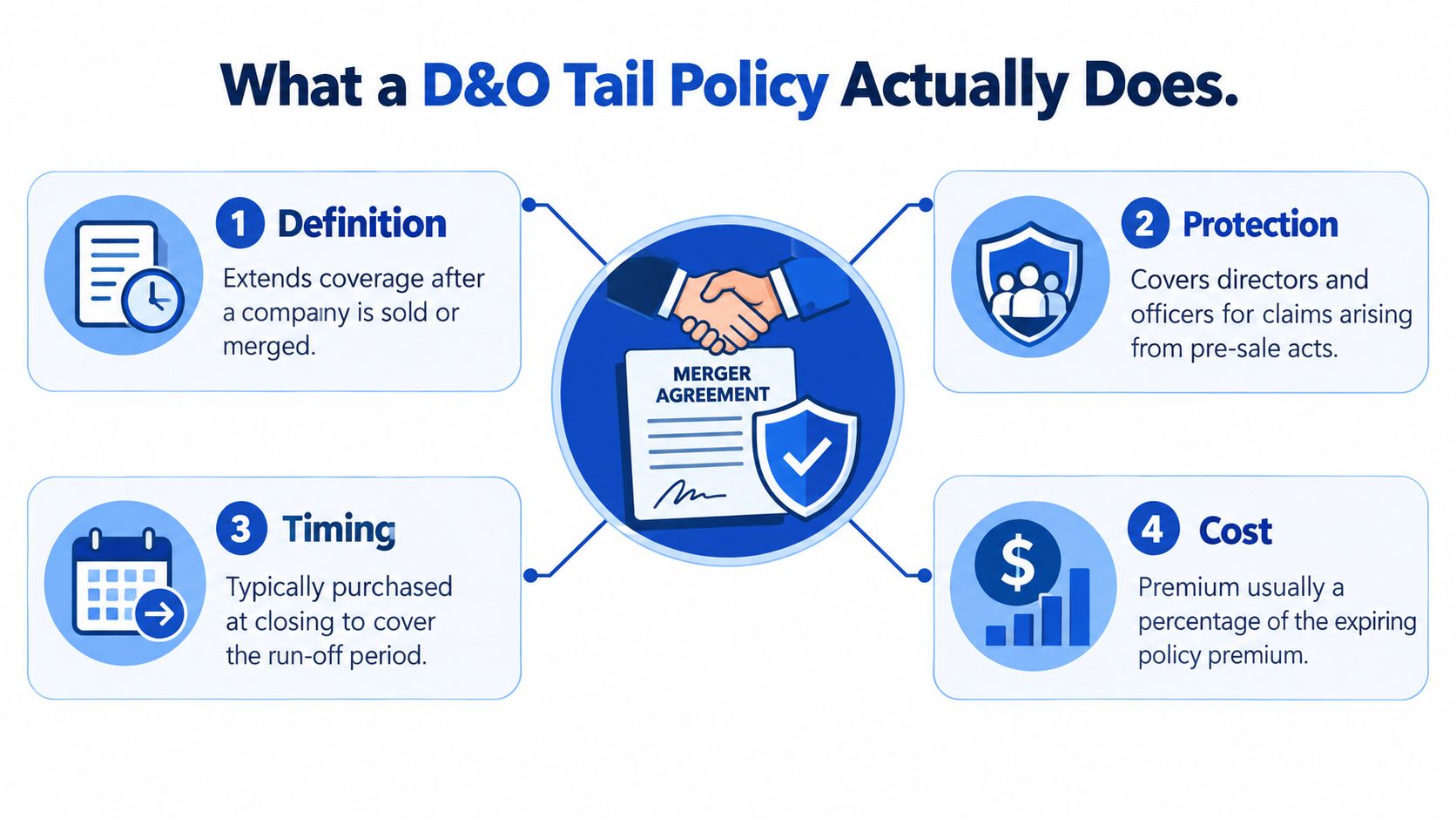
A D&O tail policy is an extended reporting period attached to a claims-made policy that lets former directors and officers report claims after expiration for pre-closing wrongful acts. In U.S. mergers and acquisitions, six years is the common standard for private-company runoff coverage.
A Seattle founder may encounter the issue while negotiating a term sheet, not at the insurance renewal date. Buyer's counsel adds a clause requiring the company to purchase a prepaid runoff policy, the broker presents one-, three-, and six-year options, and everyone treats the premium as a closing cost. That approach misses the harder question: who will be protected if a claim arrives after the company has been sold, dissolved, or become insolvent?
A tail doesn't insure new conduct after closing. It preserves reporting access for older conduct, subject to the original policy's definitions, exclusions, limits, retentions, notice rules, and consent provisions. For a Washington startup, the right tail is therefore a transaction term and an insolvency-readiness decision, not a renewal formality.
What a D&O Tail Policy Actually Does
At the term-sheet stage, a founder should read “tail coverage” as a promise about future reporting rights. The company's existing D&O policy may enter runoff when the acquisition closes, while the buyer's new policy covers the buyer's future operations. That new policy may not protect the selling company's former directors and officers for decisions made before closing.
A D&O tail policy, formally an extended reporting period, attaches to the claims-made policy that was in force before expiration or the change in control. It allows the original insureds to report a later claim when the alleged wrongful act occurred during the original coverage period. “Tail” and “run-off” are market shorthand for the same basic mechanism. The tail extends time to report. It doesn't create a new policy year, insure new post-closing conduct, or add a new policy limit. Simple Closure describes the six-year runoff as widely used for private-company D&O programs in U.S. mergers, acquisitions, and formal wind-downs.
Why six years appears in deal documents
Six years is the common runoff period in U.S. M&A practice for private-company D&O programs. That period reflects the delay between a transaction and the discovery or assertion of alleged governance failures. It also gives former directors and officers a defined reporting window after they lose control of the company, its records, and its insurance program.
One-, three-, and six-year options can appear in the market, but the menu doesn't decide the answer. The transaction, claim profile, indemnification obligations, policy wording, and solvency outlook do. A six-year term can be excessive for a low-risk wind-down with limited surviving obligations, yet too narrow where securities, regulatory, contractual, or insolvency-related exposure may mature later.
What the tail does not change
The original policy still matters. Counsel should review the definition of claim, retroactive date, exclusions, limits, notice requirements, consent-to-settle language, defense-cost treatment, and change-in-control provisions. Those terms determine whether a later demand, lawsuit, subpoena, investigation, or regulatory matter fits within the preserved reporting right.
Practical rule: A six-year label is only the outside clock. The policy wording determines whether the clock protects the claim that matters.
A founder should ask for the actual endorsement before accepting the term-sheet language. “Purchase customary tail coverage” is weaker than a clause specifying the period, insured parties, limits, scope, premium responsibility, control rights, and protection after insolvency.
How Claims-Made Coverage Creates the Need for a Tail
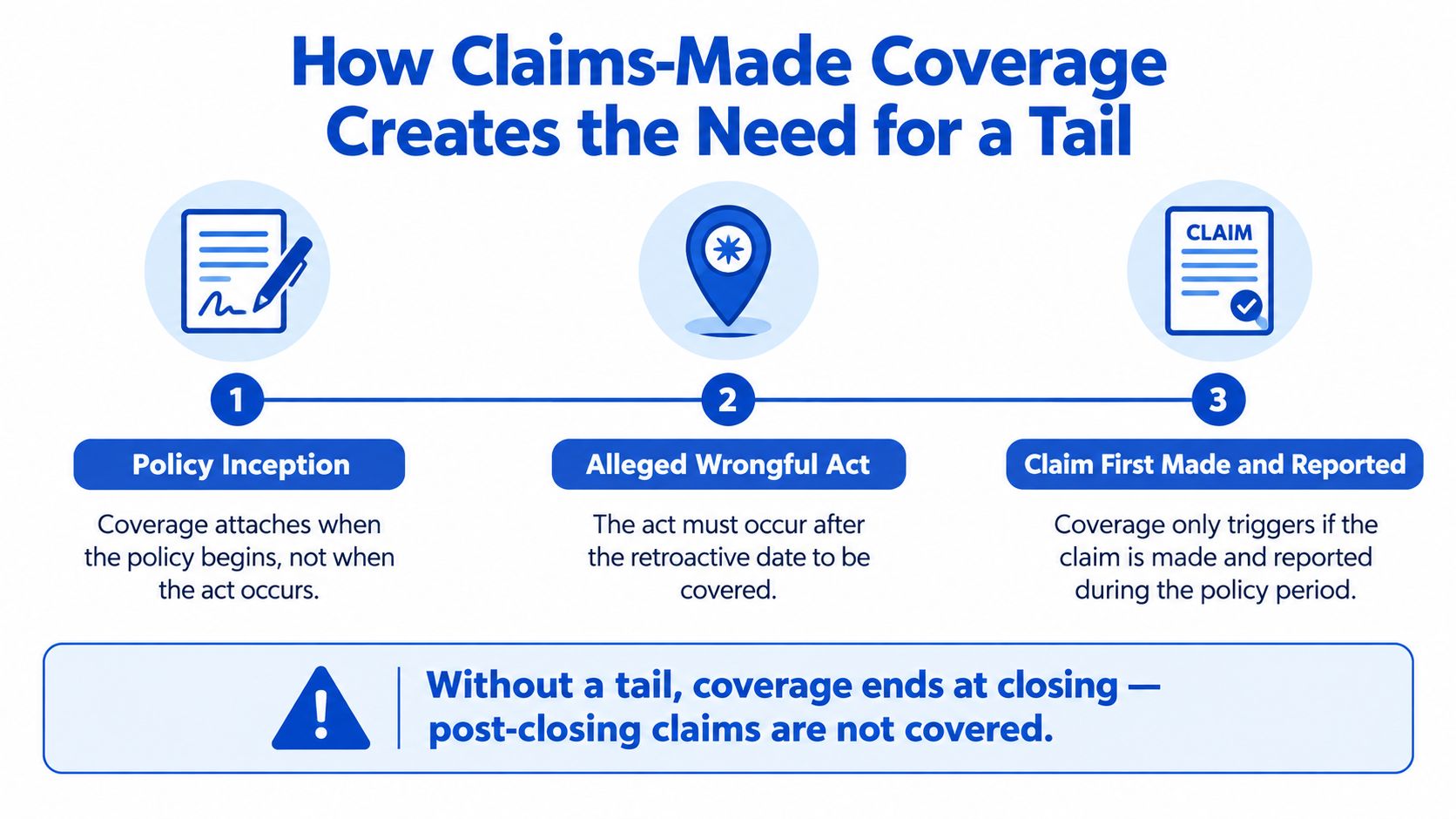
Claims-made D&O coverage works like a reporting window. The policy generally responds when a claim is first made and reported during the policy period, subject to the policy's retroactive date and other conditions. The date of the alleged conduct matters, but it doesn't replace the reporting requirement.
That structure differs from occurrence-based insurance. Occurrence coverage generally focuses on when the underlying event happens. Claims-made coverage focuses primarily on when the claim is asserted and reported. A wrongful act committed early in the policy period can therefore become a coverage problem after the policy expires if the claim is not reported within the available period.
The reporting clock
The tail props open the reporting window, but it doesn't convert the policy into occurrence coverage. A post-expiration demand can be covered only when it relates to pre-expiration wrongful acts and satisfies the applicable definition of claim, notice condition, retention, exclusion, and limit.
The difference matters at closing. A buyer may take over the business and issue a new D&O policy, but the buyer's policy may exclude the seller's pre-closing conduct or be unavailable to former leaders altogether. Without a properly purchased tail, those former leaders may face a claim after the old policy ends with no practical reporting route.
Notice is not paperwork
Notice can decide coverage. The D&O Diary discusses the claims-made-and-reported structure and notes that one professional-liability form provides a 30-day automatic reporting window. A purchased extended reporting period may last several years, but the original policy can still impose strict requirements for reporting claims or circumstances that may lead to claims.
Before closing, the board and management team should:
- Preserve the policy record: Keep the complete expiring policy, endorsements, applications, notices, and amendments.
- Identify known circumstances: Review threatened demands, regulator contact, shareholder complaints, internal investigations, and disputes that could become claims.
- Report carefully: Give notice of claims and reportable circumstances before expiration when the policy requires it.
- Track defense costs: Confirm whether defense expenses erode the shared aggregate limit.
- Confirm the election date: Verify when the insurer requires the ERP election and payment.
A useful resource for founders assessing adjacent management exposure is understanding employment practices liability, because employment allegations may require separate EPLI analysis rather than reliance on D&O coverage.
The central distinction is simple: a tail extends reporting time, not the underlying insurance promise. It can't fix a restrictive retroactive date, a prior-knowledge problem, an exclusion, an exhausted limit, or a failure to provide timely notice.
Who the Tail Actually Protects
The most important tail question isn't “How many years?” It is “Which insureds and which coverage sides remain available?” Generic explanations often treat D&O insurance as protection for former executives, but post-transaction disputes can involve shareholders, creditors, vendors, regulators, and the company itself. McDermott identifies the importance of distinguishing insured parties, Side A, Side B, Side C, and insolvency effects.
A private-company policy may include entity coverage for direct claims against the company. Public-company Side C coverage is generally narrower and focused on securities claims. The same tail duration can therefore produce very different practical protection depending on the insured parties and coverage sides included in the endorsement.
Side A, Side B, and Side C coverage at a glance
| Coverage Side | Who Is Insured | What It Typically Covers | Tail Interaction |
|---|---|---|---|
| Side A | Individual directors and officers | Non-indemnifiable loss, including defense and covered liability when the company can't indemnify | Preserves individual reporting rights for pre-expiration acts. It becomes especially important when insolvency prevents indemnification. |
| Side B | The company, as reimbursement insured | Reimbursement to the company after it indemnifies directors and officers | The tail can preserve reimbursement for older claims, but the company must still have the ability and obligation to indemnify. |
| Side C | The entity, within the policy's defined scope | Entity claims, commonly securities claims in public-company programs | The tail protects the entity only if the endorsement includes the relevant entity coverage and claim type. |
The buyer’s policy is not a substitute
A buyer’s go-forward D&O policy may protect the acquired business for future conduct, but it may not cover the seller’s former directors and officers for pre-closing acts. A change-in-control exclusion in the old policy can make the runoff endorsement essential. The endorsement must preserve the correct insured parties, not merely continue an abstract policy period.
This is why board members and founders should understand the company’s board of directors structure before negotiating the tail. The policy should be compared against the actual directors, officers, indemnification rights, committee structure, and entity exposure that exist at closing.
Insolvency changes the priority
If the company shuts down or becomes insolvent, Side B protection may lose practical value because the company may be unable to fund defense or indemnify an individual. Side A protection can become more important, particularly where management faces personal exposure and the company cannot honor its indemnification obligations.
The company itself may also remain a claimant or target. Shareholder, creditor, vendor, regulatory, and direct entity disputes don’t disappear because the business stops operating. A founder should therefore reject a tail quote that says only “former directors and officers” are protected without identifying whether entity, investigation-related, and individual coverage continue.
Why a Tail Shows Up in Every M&A Deal
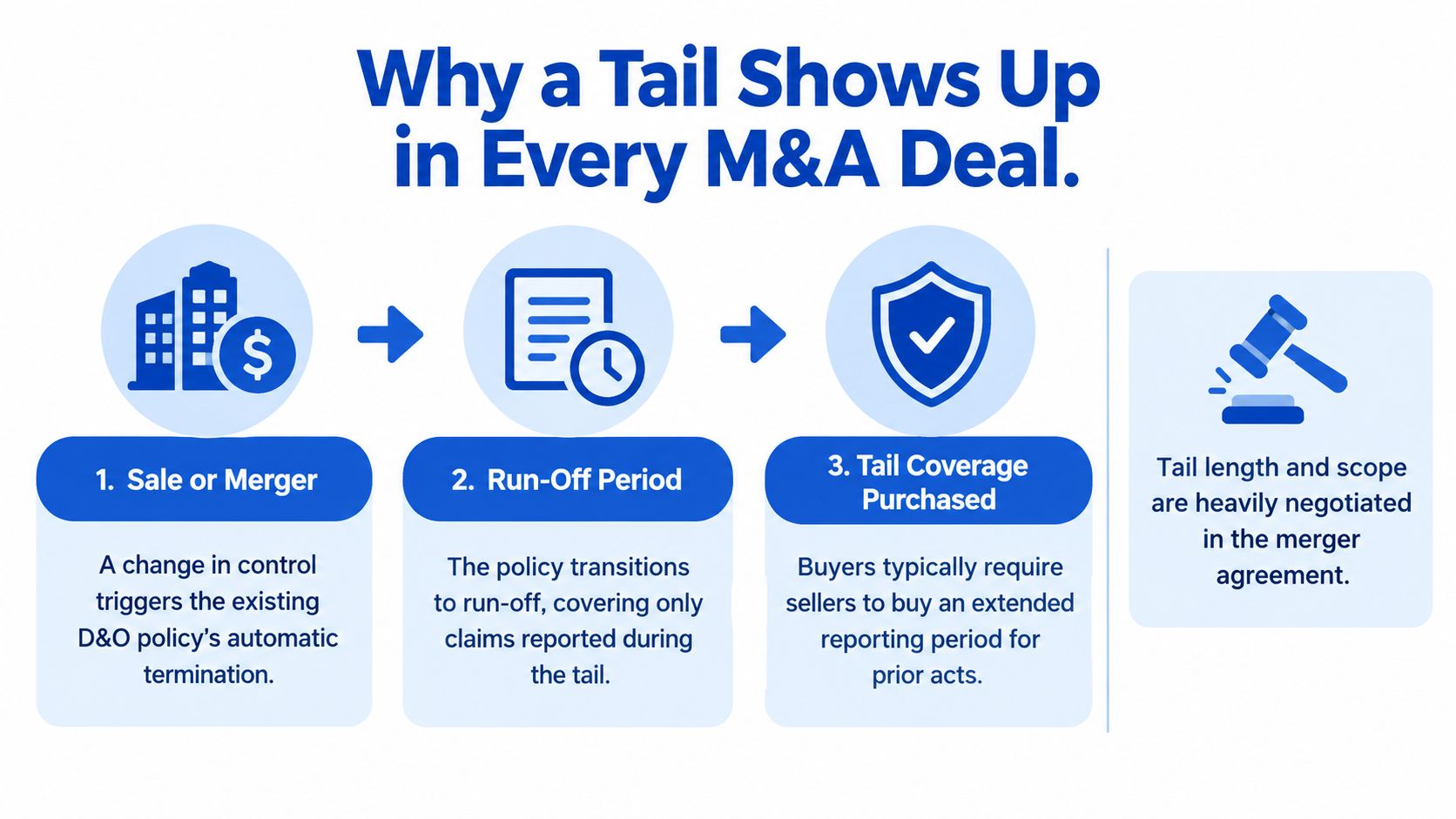
A sale, merger, or takeover can automatically put the existing D&O policy into runoff. The pre-transaction policy generally responds to claims involving pre-transaction conduct, while the buyer’s policy governs the buyer’s post-closing program. The runoff endorsement must attach to the policy that was in force when the change in control occurred. Willkie explains how a change in corporate control can place an existing D&O policy into run-off.
Reading the merger clause
A strong merger agreement usually treats the tail as a seller-side transaction obligation. The clause may require the target to purchase and fully pay for a prepaid, noncancellable runoff policy with specified limits and terms. It can also restrict the buyer and surviving entity from cancelling, terminating, eliminating, or materially modifying the tail.
An SEC-filed merger agreement illustrates the structure. It required at least six years of post-closing coverage, with limits and terms not materially less favorable in the aggregate than the existing D&O program. The filed agreement provides a concrete example of how runoff becomes a negotiated closing obligation.
The founder should compare that clause against the broader legal risks when buying a business, especially where the deal preserves indemnification obligations or leaves the seller exposed to post-closing disputes.
Aligning survival periods
The tail period should be compared with the survival period for indemnification claims, securities matters, tax disputes, regulatory investigations, and other obligations that may remain after closing. A mismatch creates a familiar problem: the contract still requires protection after the insurance reporting period has ended.
The merger and acquisition process should therefore include an insurance workstream before signing. Counsel should confirm who selects the insurer, who pays the premium, who receives notices, who controls settlement, and whether the buyer can interfere with the runoff program.
The tail belongs in the term sheet because the parties have more bargaining power before the deal terms harden. Waiting until the closing checklist gives the buyer control over the practical details and leaves the seller negotiating under time pressure.
Why a Longer Tail Is Not Automatically Better
A six-year tail is common. It isn’t automatically adequate. The duration can look reassuring while the policy leaves the founder exposed through a restrictive retroactive date, a prior-knowledge exclusion, an inadequate aggregate limit, or a broad change-in-control exclusion.
One insurance-market guide reports that most D&O claims surface approximately 12 to 36 months after the triggering event, while other market materials describe common extended-reporting options of three or six years. The timing discussion appears in market commentary on D&O insurance. Those figures help frame the decision, but they don’t replace analysis of the company’s specific claim profile.

The limit problem
A tail generally preserves the original policy limit rather than creating a fresh limit. Pre-closing claims, defense costs, settlements, or investigations may already consume part of that limit before the tail begins. If the aggregate is shared across coverage sides and insureds, a later claim may encounter less available capacity than the headline policy limit suggests.
That issue is particularly serious for a startup with concentrated exposure. Shareholder allegations, creditor disputes, regulatory matters, employment-related claims, and cyber-related governance allegations can compete for the same remaining capacity. The tail’s years don’t matter if the limit is exhausted earlier.
Better questions than “Can the company buy six years?”
A founder should ask:
- What conduct is inside the retroactive period? Confirm that the policy reaches the decisions and acts that could generate a claim.
- What was known before closing? Report circumstances that may become claims instead of assuming the tail will accept them later.
- Which exclusions apply after the transaction? Review prior knowledge, insured-versus-insured, change-in-control, allocation, and conduct exclusions.
- Are limits shared or dedicated? Determine whether entity, individual, investigation, and Side A exposures draw from one aggregate.
- Does defense erode the limit? A policy can pay defense costs while reducing the amount available for settlement or judgment.
- Would Side A DIC help? Where indemnification may fail, a separate Side A difference-in-conditions layer may provide more resilient individual protection, subject to its own wording.
The right answer may be a shorter but broader tail, a longer tail with stronger limits, or a tail paired with dedicated individual protection. Duration is one variable. Coverage architecture is the decision.
What to Negotiate Before You Sign
The founder should treat the tail clause as an insurance specification, not a sentence to accept from a form merger agreement. The negotiation should happen before the insurer’s election deadline and before the company’s bargaining power disappears.
Put the commercial terms in writing
The agreement should identify the reporting period, limits, coverage sides, insured persons, entity protection, premium responsibility, and election mechanics. It should also state whether the tail must be prepaid and noncancellable and whether its limits and terms must be no less favorable in the aggregate than the expiring program.
The market doesn’t offer one universal period. Diligent notes that some policies offer only a one-year ERP, while longer periods potentially reaching six years must be negotiated and paid for, particularly in sales and insolvency scenarios. Insurers commonly require election before or at expiration, and some markets allow only a 30-to-60-day post-expiration window.
Use this negotiation checklist
- Duration: Match the reporting period to the deal’s survival obligations and likely claim latency.
- Limits: Check remaining capacity, shared aggregates, defense-cost erosion, and whether the tail adds or merely preserves limits.
- Scope: Confirm Side A, Side B, Side C, entity, investigation, and individual coverage.
- Control: Decide who can give notice, select counsel, consent to settlement, and communicate with the insurer.
- Payment: State whether the seller, target, buyer, or another party pays the premium.
- Insolvency: Verify whether the tail remains available if the company shuts down, enters bankruptcy, or cannot indemnify management.
- Known circumstances: Identify and report circumstances that may lead to claims before expiration.
- Policy documents: Preserve the full expiring policy, endorsements, applications, notices, and underwriting materials.
- Settlement and allocation: Review consent-to-settle and allocation provisions so a dispute between the entity and individuals doesn’t strand defense coverage.
The tail also needs to fit with the broader transaction package. A founder reviewing representations and warranties should keep the insurance analysis separate from the representations package while coordinating both. Representations insurance doesn’t automatically replace D&O runoff protection for former directors and officers.
A term sheet that says “customary tail” leaves the most important terms for later. The term sheet should identify the protection the founder expects before the buyer starts drafting the closing mechanics.
A Decision Framework for Founders and Deal Teams
At the closing table, the right question isn’t whether a six-year tail sounds customary. The right question is whether the purchased endorsement maps the company’s post-closing exposure to the people, entities, limits, and reporting rules that can respond.
Start with the claims that could mature after closing. A founder should inventory shareholder demands, creditor disputes, vendor allegations, regulatory inquiries, employment issues, cyber-governance concerns, tax matters, and any known circumstance that could become a claim. The inventory should identify the likely claimant, the insured party, the relevant conduct date, and the policy section expected to respond.
Four decisions that control the result
First, decide what must be reported before expiration. A circumstance may need notice while the original policy remains active. Waiting for a formal lawsuit can surrender the reporting route.
Second, test the limit against the exposure. Review remaining aggregate capacity, defense-cost erosion, prior claims, and the number of people and entities sharing the limit. A long reporting period doesn’t restore capacity already consumed.
Third, verify individual protection. If the company may be unable to indemnify directors and officers, confirm that Side A protection and any Side A DIC structure work after insolvency. Don’t assume the company’s entity coverage protects individuals.
Fourth, lock down control and payment. The documents should identify who elects the tail, who pays for it, who controls notice and settlement, and whether the buyer can modify or cancel it. A useful due diligence checklist should include the policy, endorsements, claim history, known circumstances, indemnification agreements, and change-in-control language.
A change in control can automatically put the existing policy into run-off, and the endorsement must attach to the policy in force when that change occurred. The practical gap isn’t defining “tail.” It is mapping the tail to the deal, the claim types, the policy architecture, and the company’s ability to fund defense and indemnity after closing.
For a Washington startup, the recommendation is direct: push for six years when the deal, survival obligations, or exposure justify it, but don’t accept six years as a substitute for reviewing limits, insured parties, insolvency treatment, and exclusions. A shorter, properly structured tail can be safer than a longer endorsement that protects the wrong insureds or shares an exhausted limit.
By Design Law Firm & Legal Consultancy, PLLC helps Washington founders and executives negotiate M&A terms, review D&O tail requirements, and coordinate corporate governance, indemnification, and transaction documents. Visit By Design Law Firm & Legal Consultancy, PLLC before signing a term sheet so the tail protects the people and entities that may still face claims after closing. Contact our law office at (206) 593-1519.